20 Books of Summer, 1: Company by Shannon Sanders
I started the summer’s reading right with Company. Shannon Sanders’s energetic debut novel-in-stories traces several generations of the Collins clan, whose experiences at once exemplify African American gentrification and evoke timeless patterns of parental legacy and sibling jealousy. Sisters Cassandra, Fay, Lee and Suzette grew up at their parents’ Atlantic City jazz club before going their separate ways: Cassandra to a PhD and provost position at a college, Fay to painting and the role of family spirit-keeper, Lee to her own brood of four and a no-good jazz musician husband, and Suzette to music and a too-early death. With roots in Mississippi, they have dispersed to Atlanta, New York City and Washington, DC.
We revisit relatives at different points in their lives, mostly between the 1990s and the present day. There are 13 linked stories here, 10 in the third person and three with a first-person narrator. Each focuses on a different individual or set of characters. Celebration scenes make for memorable moments. “Bird of Paradise” is set at the party to commemorate Cassandra’s new position. There’s a Black president at the time and people can’t stop comparing her dress to Michelle Obama’s inaugural ball attire, while she can’t stop fretting that she and her nieces will live up to stereotypes of Black women’s bodies. Later, “La Belle Hottentote” revisits this evening from the nieces’ perspective as they ponder where the family’s money came from. In “Rioja,” Cassandra’s daughter Cecilia, visiting her boyfriend Cole’s family for Thanksgiving, tries not to embarrass him with any pretentious or avant-garde behavior.
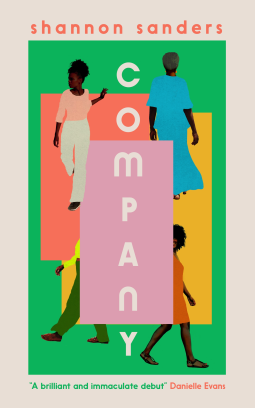
The title story, which is among the stand-outs, is the only one to feature the grandparent generation – though Opal and Centennial are but ghosts commenting on the begrudging welcome Fay offers when her niece Aubrey turns up on her doorstep in New Jersey. Fay is the sole sister without partner or children, but she got the family home as a sort of consolation prize and fills its walls with symbolism-heavy portraits of four sisters. My other favorite, alongside this and “Bird of Paradise,” was “The Opal Cleft,” in which Lee’s son Theo hosts his cousin Cyrus (Cassandra’s son) while the latter performs his drag queen act in the area.
I was reminded by turns of Danielle Evans, Kim Coleman Foote and Deesha Philyaw, while final story “The Everest Society,” about Lee’s daughter Mariolive’s desperation to impress the social worker who has to okay her and Dante adopting, recalls Sidik Fofana with its composite picture of their apartment building’s residents. In a few cases I felt that Sanders might have extended the sphere too wide by moving outside the family: “The Gatekeepers” I assume is about a co-worker or neighbor of Cassandra’s; “Mote” is about Cole’s cousin and his partner (and makes the one white woman in the book evil…); and “Dragonflies” features that cousin’s colleague. It’s not to say that these aren’t good stories, but I wondered why they couldn’t have starred extended family members instead.
Trying to get pregnant and the early days of motherhood are recurring concerns, as is the distribution of talent and wealth around the family and beyond. As these characters reach toward the upper middle class, they keep in mind the struggles they came from. Although the family legends morph over the years, shared habits and heirlooms make connections across the generations. Sanders is strong on characterization, scene-setting and social observation; I would happily have spent even longer with the Collins family. I’ll be keen to follow her career in the years to come. 
With thanks to Pushkin Press for the free copy for review.
Recommended March Releases by Jane Aldous, Danielle Evans, Katherine May & Genanne Walsh
Sonnets, short stories, nature-fuelled wonder, and an autobiographical essay about a father’s death … from postwar Edinburgh to modern-day San Francisco and from fiction about young African American women to pilgrimages along the English coast, I have a real variety to recommend this month. (And coming up in a separate post: Womb by Leah Hazard.)
More Patina than Gleam by Jane Aldous
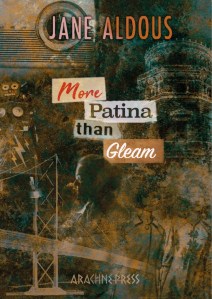 This was my second Arachne Press collection after Routes by Rhiya Pau. Intriguingly, it’s a story composed of 70 sonnets, untraditional in that they do not follow a particular rhyme scheme apart from the odd couplet. There is scant punctuation, with within-line spaces separating the phrases. Aldous, who has recently been featured in a Guardian article on debut authors over 60, imagines a sort of alternative future for her mother had she run away with her when she was a baby. Here, Linda escapes her abusive common-law husband, Vernon, and travels from England to Edinburgh with her 11-year-old daughter, Angie. They settle with an eccentric older woman named Elsie Datlow, who hires Linda as a lady’s companion and keeps her on as a housekeeper when financial struggles force her to accept paying guests. It’s impressive how much Aldous fits into comparatively little text, including Angie’s coming of age, the ups and downs of the Datlows’ picture restoring business, and transgressive romance as both Elsie and Linda fall in love across accepted gender or racial boundaries. This was a pleasant surprise that called to mind works by Muriel Spark and Sarah Waters.
With thanks to Arachne Press for the free copy for review.
Before You Suffocate Your Own Fool Self by Danielle Evans (2010)
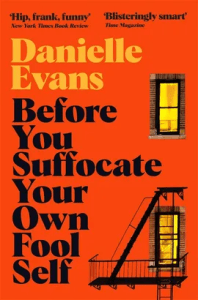 A couple of years ago I reviewed Evans’s second short story collection, The Office of Historical Corrections. This was her first book but has only just been published in the UK. Six of the eight stories are in the first person, the other two in third person. The protagonists tend to be young African American women in moments of transition or clinging to unhealthy relationships. In “Virgins,” 15-year-old Erica and Jasmine want to shed their innocence but can’t necessarily control how it happens. “Snakes” has Tara, a transracial adoptee, spending her ninth summer with her white cousin, Allison, down at their grandmother’s home in Florida. The response to a series of accidents makes it clear to her who is valued in this family. The college girls in “Harvest” consider a variety of reproductive experiences, from selling their eggs to abortion. In “The King of a Vast Empire,” a brother and sister decide to track down a survivor of a car accident their family had when they were children. “Jellyfish” sees a father and daughter meeting for lunch in Harlem and pondering their separate futures.
Many settings were familiar to me from the Delmarva area where I grew up. Here on the cusp of the South, Confederate sympathy still exists, as high schoolers Crystal and Geena discover in “Robert E. Lee Is Dead.” The best friends collaborate on pranks, but Crystal’s grades point to a promising future whereas everyone has given up on Geena, including herself. Along with that one, my two favourites were “Someone Ought to Tell Her There’s Nowhere to Go” and “Wherever You Go, There You Are.” In the former, military veteran Georgie tries to ingratiate himself with his ex-girlfriend by treating her daughter to a princess experience; in the latter, Carla takes her would-be-sexpot 14-year-old niece, Chrissie, on a road trip to North Carolina to meet her ex’s fiancée. Both are exemplary of the assets of the whole collection: strong characters, natural dialogue, and subtle treatment of themes of class and race. I’d proffer this for fans of Sidik Fofana, and as a better option than Dantiel Moniz’s stories.
With thanks to Picador for the proof copy for review.
Enchantment: Reawakening wonder in an exhausted age by Katherine May
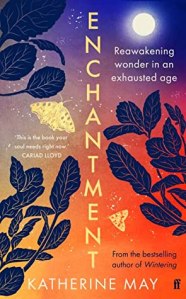 I was a big fan of Katherine May’s Wintering, which published just before the pandemic and, as if presciently, offers strategies for coping with seasons of depression. Coming after a few years of upheaval and disconnection, this follow-up voices May’s longing for rituals of the transcendent that will allow her to live in harmony and close attention to the world around her. Her usual way of communing with nature and other people was group swims in the sea, but that temporarily stopped with lockdown. She sought alternatives, such as visiting a sacred well with a friend, beekeeping, cultivating a wild garden, and chasing a meteor shower. The Earth – Water – Fire – Air structure is sometimes forced, and the content sparse; like Raynor Winn, May, I feel, was pressured to capitalize on the success of her previous work and quickly publish unfinished and rather nebulous material. It’s all surprisingly woo-woo from an English author. Yet May’s writing is unfailingly lovely and this went down easy a chapter at a time. It’s a comparable read to Wanderland by Jini Reddy.
With thanks to Faber for the proof copy for review.
Eggs in Purgatory by Genanne Walsh
I reviewed Genanne Walsh’s novel Twister as part of my summer reading in 2018. This autobiographical essay, recently published by WTAW Press and a finalist in their Alcove Chapbook Series Open, tells the story of the last few months of her father’s life. Aged 89, he lived downstairs from Walsh and her wife in San Francisco. He was quite the character: idealist, stubborn, outspoken; a former Catholic priest influenced by A Course in Miracles and convinced of the oneness of everything. Although he had no terminal conditions, he was sick of old age and its indignities and ready to exit. (“He wanted to be put on an ice floe and pushed offshore. The problem was, I lived above him on the iceberg and would be tasked with shoving him off.”) However, there was confusion about California state laws and whether doctors could help him with this, and at one point the police showed up at the door.
 The title refers to a Middle Eastern dish (see this Nigella Lawson recipe) I’ve known as shakshuka. It was the last proper meal her father ate, Christmas morning 2017 with her and her wife, before he went on his final hunger strike. Later Walsh writes, “Mourning is a kind of purgatory. You exist between worlds. For a long time I walked through, not fully feeling the world of the living or the world of the dead but aware of both.”
The task of a memoir is to fully mine the personal details of a situation but make of it something universal, and that’s just what she does here. Her father’s past with her mother (who died decades before, following a stroke) renders the family dynamic a backdrop to a final pyrrhic battle. Aware that she doesn’t come out of this a saint, Walsh admits to contradictory feelings, including “my life will be so much easier when he dies.” The prediction, no less than its reality, makes her feel guilty. Though she has no faith as such, she senses her father’s influence in her very desire to keep communing with him after his death.
This stunning little book met me at a deep place and I can highly recommend it, especially if you were a fan of In Love by Amy Bloom and All Things Consoled by Elizabeth Hay. (See also The Inevitable – one of its case studies reminded me of this.)
With thanks to the author for the free e-copy for review.
And one dud:
 Birnam Wood by Eleanor Catton – This year’s Klara and the Sun for me: I have trouble remembering why I was so excited about Catton’s third novel that I put it on my Most Anticipated list for 2023, especially given my decidedly mixed feelings about The Luminaries. I’d read a lot about Birnam Wood so its plot held no surprises for me. An American tech billionaire is up to no good on a New Zealand nature reserve; though the members of a guerrilla gardening group summon courage to fight back, his drones see all.
From early on I had little interest in the cast and their doings, especially the buzzword-filled dialogues, and skimmed the rest. Literary fiction usually distinguishes itself from commercial genre fiction by its focus on character depth (and prose quality), but in Catton’s case that was achieved through endless backstory. Her attempt at edginess entails adding at least one F-word to each spoken sentence. (The Bookshop Band, usually so mild-mannered, reflected this by dropping an F-bomb in their song based on the book – see the music video, which cleverly employs a derelict greenhouse and drones.) I’d heard that the ending was a knockout, so I skipped ahead and did find the last 40 pages gripping and the gruesome final tableau worthy of the Shakespearean allusions, but there’s a lot of blah to wade through before that.
With thanks to Granta for the free copy for review.
Would you be interested in reading one or more of these?
Best Books from 2022
I’m keeping it simple this year with one post covering a baker’s dozen from all genres: the 13 current-year releases that stood out to me the most. (No rankings this time; anything from my Best of First Half post that didn’t make it through to here can be considered a runner-up.)
Fiction
 Groundskeeping by Lee Cole: In Cole’s debut novel, two aspiring writers meet on a Kentucky college campus and form a romantic connection despite very different backgrounds. There are stereotypes to be overcome as Owen introduces Alma to Kentucky culture and slang. Trump’s election divides families and colleagues. The gentle satire on the pretensions of writing programs is another enjoyable element. Three-dimensional characters, vivid scenes ripe for the Netflix treatment, timely themes and touching relationships.
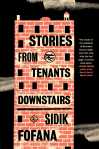
 Stories from the Tenants Downstairs by Sidik Fofana: Fofana’s novel-in-stories orbits a Harlem apartment complex and spins bittersweet tales of ambition and disappointment in a range of vibrant voices. Endearing scoundrels are the focus in a number of stories. Minor characters from some go on to have starring roles in others. Though these tenants’ lives are filled with difficulties, their optimism and sheer joy shine through in their picaresque antics. A stellar debut from a very talented writer; Fofana should win all the prizes.
 Sea of Tranquility by Emily St. John Mandel: This dazzlingly intricate novel blends historical fiction, up-to-the-minute commentary and science-fiction predictions. In 2401, the Time Institute hires Gaspery-Jacques Roberts to investigate a recurring blip in time. Fans of The Glass Hotel will recognize some characters, and those familiar with Station Eleven will find similarities in a pandemic plot that resonates with the Covid-19 experience. How does Mandel do it? One compulsively readable hit after another.
 Very Cold People by Sarah Manguso: The aphoristic style of some of Manguso’s previous books continues here as discrete paragraphs and brief vignettes build to a gloomy portrait of Ruthie’s archetypical affection-starved childhood in the fictional Massachusetts town of Waitsfield in the 1980s and 90s. The depiction of Ruthie’s narcissistic mother is especially acute. So much resonated with me. This is the stuff of girlhood – if not universally, then certainly for the (largely pre-tech) American 1990s as I experienced them.
 Body Kintsugi by Senka Marić: This intense work of autofiction is all the more powerful due to the second-person narration that displaces the pain of breast cancer from the protagonist and onto the reader. Coming of age in a female body was traumatic in itself; now that same body threatens to kill her. Even as she loses the physical signs of femininity, she remains resilient: Her body will document what she’s been through. As forthright as it is about the brutality of cancer treatment, the novella is also creative, playful and darkly comic.
 The Hero of This Book by Elizabeth McCracken: Is it autofiction or bereavement memoir? Both and neither. In 2019, an American writer wanders London, seeing the sights but mostly reminiscing about her mother, whom she describes through bare facts and apt anecdotes. London had been a favourite destination, their final trip together falling just three years before. As well as a tribute to a beloved mother and a matter-of-fact record of dealing with ageing parents and the aftermath of loss, this is a playful cross-examination of literary genres.
 The Swimmers by Julie Otsuka: Otsuka’s third novel of the Japanese American experience again employs the first-person plural, as well as the second person – rarer perspectives that provide stylistic novelty. The first two chapters are set at a pool that, for the title swimmers, serves as a locus of escape and safety. On the first page we’re introduced to Alice, whose struggle with dementia becomes central. I admired Otsuka’s techniques for moving readers through the minds of the characters, alternating range with profundity and irony with sadness.
 Which Side Are You On by Ryan Lee Wong: Wong’s dynamite debut novel weaves timely issues of racism and protest into a pacy, funny story of idealism versus cynicism. Reed, an Asian American college student committed to social justice, rethinks how best to live out his values in the real world when he goes home for a few days. Wong probes the generational gap between him and his parents through snappy dialogue and enjoyable scenes that constitute an incidental tour of multi-ethnic Los Angeles.
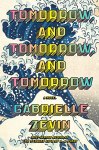
 Tomorrow, and Tomorrow, and Tomorrow by Gabrielle Zevin: Sam and Sadie’s friendship, which over the years becomes a business partnership that also incorporates Sam’s college roommate, Marx Watanabe, is a joy. Their creative energy and banter are enviable. Marx is the uncomplicated, optimistic go-between when Sam and Sadie butt heads and take offense at betrayals. Underneath their conflicts is a love different from, and maybe superior to, romantic love. An immersive story of friendship and obsession; nostalgic, even cathartic.
Nonfiction
 In Love by Amy Bloom: Bloom’s husband, Brian Ameche, was diagnosed with early-onset Alzheimer’s in his mid-60s, having exhibited mild cognitive impairment for several years. Brian quickly resolved to make a dignified exit while he still, mostly, had his faculties. This achieves the perfect tone, mixing black humour with teeth-gritted practicality as Bloom chronicles their relationship, the final preparations, his assisted suicide at Dignitas in Switzerland, and the aftermath. An essential, compelling read.
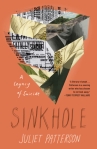
 Sinkhole: A Natural History of a Suicide by Juliet Patterson: This gorgeously written family memoir approaches its subject matter with brave tenderness. In December 2008, poet Patterson’s father died by suicide near his Minnesota home. He wasn’t an obvious risk. Yet there was family history: both of Patterson’s parents lost their fathers to suicide. She returns to Kansas on research trips to unearth her grandfathers’ lives. Throughout, sinkholes, common in Kansas, are both reality and metaphor for the chasm a suicide leaves.
 Blurb Your Enthusiasm: An A-Z of Literary Persuasion by Louise Willder: A delightful bibliophile’s miscellany about ways of pithily spreading excitement about books. Over the last 25 years, Willder has written jacket copy for thousands of Penguin releases, so she has it down to a science as well as an art. (Reviewing is an adjacent skill.) The art of the first line, serialization and self-promotion, guidelines for good writing, differences between British and American jacket copy, the use of punctuation, and so much more. Very funny to boot.
Poetry
 Inside the Storm I Want to Touch the Tremble by Carolyn Oliver: Carolyn used to blog at Rosemary and Reading Glasses and won the Agha Shahid Ali Prize for this debut collection. Every line feels tirelessly honed to elicit maximal meaning and a memorable sound. Traditional forms are adapted to great effect. Chronic illness, gardening, and everyday sexual danger are themes, but the poems that pierced me most were about her son: quirky things he says, but also the reality of modern parenting, where active shooter drills are de rigueur.

This year’s best-of selections (the ones I own in print, anyway; the rest were read on Kindle or have already gone back to the library).
Have you read any of my 2022 favourites?
What releases do I need to catch up on right away?
Book Serendipity, Mid-August to Mid-October 2022
It’s my birthday today and we’re off to Kelmscott Manor, where William Morris once lived, so I’ll start with a Morris-related anecdote even if it’s not a proper book coincidence. One of his most famous designs, the Strawberry Thief, is mentioned in Tomorrow, and Tomorrow, and Tomorrow by Gabrielle Zevin, and I happen to be using a William Morris wall calendar this year. I will plan to report back tomorrow on our visit plus any book hauls that occur.
I call it “Book Serendipity” when two or more books that I read at the same time or in quick succession have something in common – the more bizarre, the better. This is a regular feature of mine every few months. Because I usually have 20–30 books on the go at once, I suppose I’m more prone to such incidents. The following are in roughly chronological order.
 There’s a character named Verena in What Concerns Us by Laura Vogt and Summer by Edith Wharton. Add on another called Verona from Stories from the Tenants Downstairs by Sidik Fofana.
- Two novels with a female protagonist who’s given up a singing career: Brief Lives by Anita Brookner and What Concerns Us by Laura Vogt.
- Two books featuring Black characters, written in African American Vernacular English, and with elements of drug use and jail time plus rent rises driving people out of their apartments and/or to crime (I’ve basically never felt so white): Stories from the Tenants Downstairs by Sidik Fofana and Nightcrawling by Leila Mottley.

- Two books on my stack with the protagonist an African American woman from Oakland, California: Red Island House by Andrea Lee and Nightcrawling by Leila Mottley
- A middle-aged woman’s hair is described as colourless and an officious hotel staff member won’t give the protagonist a cup of coffee/glass of wine in Brief Lives by Anita Brookner and Oh William! by Elizabeth Strout.
- There’s a central Switzerland setting in Mountain Song by Lucy Fuggle and What Concerns Us by Laura Vogt.
- On the same day, I encountered two references to Mary Oliver’s famous poem “The Summer Day” (“what is it you plan to do / with your one wild and precious life?”): in Mountain Song by Lucy Fuggle and This Beauty by Nick Riggle. (Fuggle and Riggle – that makes me laugh!)
- In the same evening I found mentions of copperhead snakes in Demon Copperhead by Barbara Kingsolver (no surprise there), but also on the very first page of Birds of a Lesser Paradise by Megan Mayhew-Bergman.

- Crop circles are important to What Remains? by Rupert Callender and The Perfect Golden Circle by Benjamin Myers.
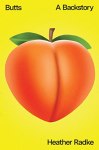
- I was reading two books with provocative peaches on the cover at the same time: The Secret Lives of Church Ladies by Deesha Philyaw and Butts: A Backstory by Heather Radke.
- A main character is pregnant but refuses medical attention in The Language of Flowers by Vanessa Diffenbaugh and What Concerns Us by Laura Vogt.
- An Australian setting and the slang “Carn” or “C’arn” for “come on” in Cloudstreet by Tim Winton and one story (“Halflead Bay”) from The Boat by Nam Le.
- Grape nuts cereal is mentioned in Leap Year by Helen Russell and This Time Tomorrow by Emma Straub.
- A character wagers their hair in a short story from Bratwurst Haven by Rachel King and one from Anthropology by Dan Rhodes.
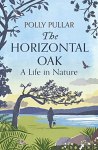
- Just after I started reading a Jackie Kay poetry collection (Other Lovers), I turned to The Horizontal Oak by Polly Pullar and found a puff from Kay on the front cover. And then one from Jim Crumley, whose The Nature of Spring I was also reading, on the back cover! (All Scottish authors, you see.)
- Reading two memoirs that include a father’s suicide – Sinkhole by Juliet Patterson and The Horizontal Oak by Polly Pullar – at the same time.
- Middle school students reading Of Mice and Men in Ms. Hempel Chronicles by Sarah Shun-lien Bynum and Stories from the Tenants Downstairs by Sidik Fofana.
- A second novel in two months in which Los Angeles’s K-Town (Korean neighbourhood) is an important location: after Which Side Are You On by Ryan Lee Wong, Tomorrow, and Tomorrow, and Tomorrow by Gabrielle Zevin.
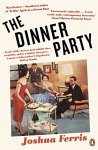
- The main character inherits his roommate’s coat in one story of The Dinner Party by Joshua Ferris, and Tomorrow, and Tomorrow, and Tomorrow by Gabrielle Zevin.
- The Groucho Marx quote “Whatever it is, I’m against it” turns up in What Remains? by Rupert Callender and Blurb Your Enthusiasm by Louise Willder (where it’s adapted to “we’re” as the motto of 3:AM Magazine).
 In Remainders of the Day by Shaun Bythell, Polly Pullar is mentioned as one of the writers at that year’s Wigtown Book Festival; I was reading her The Horizontal Oak at the same time.
- Marilyn Monroe’s death is mentioned in Sinkhole by Juliet Patterson and Tomorrow, and Tomorrow, and Tomorrow by Gabrielle Zevin.
- The types of standard plots that there are, and the fact that children’s books get the parents out of the way as soon as possible, are mentioned in And Finally by Henry Marsh and Blurb Your Enthusiasm by Louise Willder.
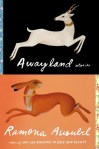
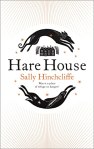
- Two books in quick succession with a leaping hare (and another leaping mammal, deer vs. dog) on the cover: Awayland by Ramona Ausubel, followed by Hare House by Sally Hinchcliffe.
- Three fingers held up to test someone’s mental state after a head injury in The House Is on Fire by Rachel Beanland and The Fear Index by Robert Harris.
- A scene where a teenage girl has to help with a breech livestock delivery (goat vs. sheep) in Belzhar by Meg Wolitzer and The Truants by Kate Weinberg.
- Two memoirs by a doctor/comedian that open with a scene commenting on the genitals of a cadaver being studied in medical school: Catch Your Breath by Ed Patrick wasn’t funny in the least, so I ditched it within the first 10 pages or so, whereas Undoctored by Adam Kay has been great so far.
What’s the weirdest reading coincidence you’ve had lately?
September’s Focus: Short Stories
This is the seventh year in a row in which I’m making a special effort to read short stories in September; otherwise, story collections tend to languish on my shelves (and Kindle) unread. In September 2020 I read 8 collections, and in September 2021 it was 12. How many can I get through this time?! Here are my options, including, at far right, some I’m partway through, a thematic trio (“Birds” titles) I fancy reviewing together, and a few from the library.


To my surprise, if I count linked short stories, I’ve already read 13 collections this year. Highlights: Dance Move by Wendy Erskine, The Summer Book by Tove Jansson, Antipodes by Holly Goddard Jones, and How High We Go in the Dark by Sequoia Nagamatsu.
The best of the lot, though, has been Stories from the Tenants Downstairs by Sidik Fofana, which I’ll be reviewing for BookBrowse over the weekend. It’s a character- and voice-driven set of eight stories about the residents of a Harlem apartment complex, many of them lovable rogues who have to hustle to try to make rent in this gentrifying area. 
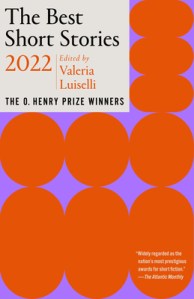 A September release I’ll quickly plug: The Best Short Stories 2022: The O. Henry Prize Winners, selected by Valeria Luiselli. I read this for Shelf Awareness and my review will be appearing in a couple of weeks. Half of the 20 stories are in translation – Luiselli insists this was coincidental – so it’s a nice taster of international short fiction. Contributing authors you will have heard of: Chimamanda Ngozi Adichie, Lorrie Moore, Samanta Schweblin and Olga Tokarczuk. The style runs the gamut from metafiction to sci-fi/horror. Covid-19, loss and parenting are frequent elements. My two favourites: Joseph O’Neill’s “Rainbows,” about sexual misconduct allegations, then and now; and the absolutely bonkers novella-length “Horse Soup” by Vladimir Sorokin, about a woman and a released prisoner who meet on a train and bond over food. (13 September, Anchor Books)
 Here’s a short story collection I received for review but, alas, couldn’t finish: Milk Blood Heat by Dantiel W. Moniz. This was longlisted for the Dylan Thomas Prize and won the NB Magazine Blogger’s Book Prize. The link, I have gathered, is adolescent girls in Florida. I enjoyed the title story, which opens the collection and takes peer pressure and imitation to an extreme, but couldn’t get through more than another 1.5 after that; they left zero impression.
Currently reading: The Boat by Nam Le (it won the Dylan Thomas Prize; I’ve read the first story so far and it was knockout!), Birds of a Lesser Paradise by Megan Mayhew Bergman.
 Resuming soon: The Predatory Animal Ball by Jennifer Fliss (e-book), Hearts & Bones by Niamh Mulvey, The Secret Lives of Church Ladies by Deesha Philyaw – all were review copies.
Are you a short story fan? Read any good ones recently?
Join me in this low-key challenge if you wish!
 Bookish Beck = Rebecca Foster. American transplant to England. Freelance proofreader and book reviewer.
 Bookish Beck