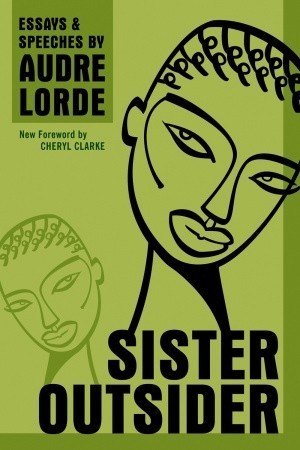
Sister Outsider by Audre Lorde (#NovNov25 Buddy Read, #NonfictionNovember)
This year we set two buddy reads for Novellas in November: one contemporary work of fiction (Seascraper) and one classic work of short nonfiction. Do let us know if you’ve been reading them and what you think!

Sister Outsider is a 1984 collection of Audre Lorde’s essays and speeches. Many of these short pieces appeared in Black or radical feminist magazines or scholarly journals, while a few give the text of her conference presentations. Lorde must have been one of the first writers to spotlight intersectionality: she ponders the combined effect of her Black lesbian identity on how she is perceived and what power she has in society.
The title’s paradox draws attention to the push and pull of solidarity and ostracism. She calls white feminists out for not considering what women of colour endure (or for making her a token Black speaker); she decries misogyny in the Black community; and she and her white lover, Frances, seem to attract homophobia from all quarters. Especially while trying to raise her Black teenage son to avoid toxic masculinity, the author comes to realise the importance of “learning to address each other’s difference with respect.”
This is a point she returns to again and again, and it’s as important now as it was when she was writing in the 1970s. So many forms of hatred and discrimination come down to difference being seen as a threat – “I disagree with you, so I must destroy you” is how she caricatures that perspective.
 Even if you’ve never read a word that Lorde wrote, you probably know the phrase “The Master’s Tools Will Never Dismantle the Master’s House” – this talk title refers to having to circumvent the racist patriarchy to truly fight oppression. “Revolution is not a one-time event,” she writes in another essay. “It is becoming always vigilant for the smallest opportunity to make a genuine change in established, outgrown responses”.
My two favourite pieces here also feel like they have entered into the zeitgeist. “Poetry Is Not a Luxury” deems poetry a “necessity for our existence … the way we help give name to the nameless so it can be thought.” And “Uses of the Erotic: The Erotic as Power” is a thrilling redefinition of a holistic sensuality that means living at full tilt and tapping into creativity. “The sharing of joy, whether physical, emotional, psychic, or intellectual, forms a bridge between the sharers which can be the basis for understanding much of what is not shared”.
In some ways this is not an ideal way to be introduced to Lorde’s work, because many of the essays repeat the same themes and reasoning. I made my way through the book very slowly, one piece every day or few days. The speeches would almost certainly be more effective if heard aloud, as intended – and more provocative, too, as they must have undermined other speakers’ assumptions. I was also a bit taken aback by the opening and closing pieces being travelogues: “Notes from a Trip to Russia” is based on journal entries from 1976, while “Grenada Revisited: An Interim Report” about a 1983 trip to her mother’s birthplace. I saw more point to the latter, while the former felt somewhat out of place.
Nonetheless, Lorde’s thinking is essential and ahead of its time. I’d only previously read her short work The Cancer Journals. For years my book club has been toying with reading Zami, her memoir starting with growing up in 1930s Harlem, so I’ll hope to move that up the agenda for next year. Have you read any of her other books that you can recommend?(University library) [190 pages]
Other reviews of Sister Outsider:
Cathy (746 Books)
Marcie (Buried in Print) is making her way through the book one essay at a time. Here’s her latest post.
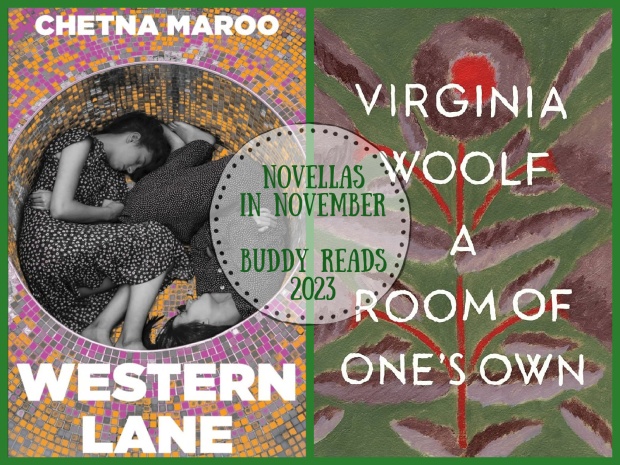
#NovNov23 Buddy Reads Reviewed: Western Lane & A Room of One’s Own
This year we set two buddy reads for Novellas in November: one contemporary work of fiction and one classic work of short nonfiction. Do let us know if you’ve been reading them and what you think!
 A version of the below review, submitted via their Facebook book club group, won me a pair of tickets to this year’s Booker Prize ceremony!
You may also wish to have a look at the excellent reading guide on the Booker website.
Western Lane by Chetna Maroo (2023)
In the same way that you don’t have to love baseball or video games to enjoy The Art of Fielding or Tomorrow, and Tomorrow, and Tomorrow, it’s easy to warm to Western Lane even if you’ve never played squash. Debut author Chetna Maroo assumes reader unfamiliarity with her first line: “I don’t know if you have ever stood in the middle of a squash court – on the T – and listened to what is going on next door.” As Gopi looks back to the year that she was eleven – the year after she lost her mother – what she remembers is the echo of a ball hitting a wall. That first year of mourning, which was filled with compulsive squash training, reverberates just as strongly in her memory.
To make it through, Pa tells his three daughters, “You have to address yourself to something.” That something will be their squash hobby, he decides, but ramped up to the level of an obsession. Having lost my own mother just over a year ago, I could recognize in these characters the strategies people adopt to deflect grief. Keep busy. Go numb. Ignore your feelings. Get angry for no particular reason. Even within this small family, there’s a range of responses. Pa lets his electrician business slip; fifteen-year-old Mona develops a mild shopping addiction; thirteen-year-old Khush believes she still sees their mother.
Preparing for an upcoming squash tournament gives Gopi a goal to work towards, and a crush on thirteen-year-old Ged brightens long practice days. Maroo emphasizes the solitude and concentration required, alternating with the fleeting elation of performance. Squash players hover near the central T, from which most shots can be reached. Maroo, too, sticks close to the heart. Like all the best novellas, hers maintains a laser focus on character and situation. A child point-of-view can sound precocious or condescending. That is by no means the case here. Gopi’s perspective is convincing for her age at the time, yet hindsight is the prism that reveals the spectrum of intense emotions she experienced: sadness, estrangement from her immediate family, and rejection on the one hand; first love and anticipation on the other.

This offbeat, delicate coming-of-age story eschews the literary fireworks of other Booker Prize nominees. In place of stylistic flair is the sense that each word and detail has been carefully placed. Less is more. Rather than the dark horse in the race, I’d call it the reader favourite: accessible but with hidden depths. There are cinematic scenes where little happens outwardly yet what is unspoken between the characters – the gazes and tension – is freighted with meaning. (I could see this becoming a successful indie film.)
she and my uncle stood outside under the balcony of my bedroom until much later, and I knelt above them with my blanket around me. The three of us looked out at the black shapes of the rose arbour, the trees, the railway track. Stars appeared and disappeared. My knees began to ache. Below me, Aunt Ranjan wanted badly to ask Uncle Pavan how things stood now and Uncle Pavan wanted to tell her, but she wasn’t sure how to ask and he wasn’t sure how to begin. Soon, I thought, it would be morning, and night, and morning again, and it wouldn’t matter, except to someone watching from so far off that they couldn’t know yet.
The novella is illuminating on what is expected of young Gujarati women in England; on sisterhood and a bereaved family’s dynamic; but especially on what it is like to feel sealed off from life by grief. “I think there’s a glass court inside me,” Gopi says, but over the course of one quietly momentous year, the walls start to crack. (Public library) [161 pages] 
A Room of One’s Own by Virginia Woolf (1929)
Here’s the thing about Virginia Woolf. I know she’s one of the world greats. I fully acknowledge that her books are incredibly important in the literary canon. But I find her unreadable. The last time I had any success was when I was in college. Orlando and To the Lighthouse both blew me away half a lifetime ago, but I’ve not been able to reread them or force my way through anything else (and I have tried: Mrs Dalloway, The Voyage Out and The Waves). In the meantime, I’ve read several novels about Woolf and multiple Woolf-adjacent reads (ones by Vita Sackville-West, or referencing the Bloomsbury Group). So I thought a book-length essay based on lectures she gave at Cambridge’s women’s colleges in 1928 would be the perfect point of attack.
Hmm. Still unreadable. Oh well!
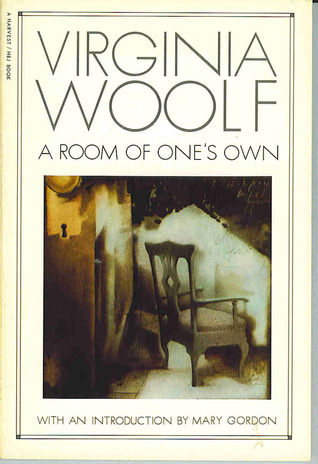 In the end I skimmed A Room of One’s Own for its main ideas – already familiar to me, as was some of the language – but its argumentation, reliant as much on her own made-up examples as on literary history, failed to move me. Woolf alternately imagines herself as Mary Carmichael, a lady novelist trawling an Oxbridge library and the British Museum for her forebears; and as a reader of Carmichael’s disappointingly pedestrian Life’s Adventure. If only Carmichael had had the benefit of time and money, Woolf muses, she might have been good. As it is, it would take her another century to develop her craft. She also posits a sister for Shakespeare and probes the social conditions that made her authorship impossible.
This is important to encounter as an early feminist document, but I would have been okay with reading just the excerpts I’d already come across.
Some favourite lines:
“I thought how unpleasant it is to be locked out; and I thought how it is worse perhaps to be locked in”
“A very queer, composite being thus emerges. Imaginatively she [the woman in literature] is of the highest importance; practically she is completely insignificant. She pervades poetry from cover to cover; she is all but absent from history.”
“Poetry depends upon intellectual freedom. And women have always been poor, not for two hundred years merely, but from the beginning of time. Women have had less intellectual freedom than the sons of Athenian slaves. Women, then, have not had a dog’s chance of writing poetry. That is why I have laid so much stress on money and a room of one’s own.”
(Secondhand purchase many years ago) [114 pages]

Four More Short Nonfiction Books for Novellas for November
Short nonfiction turns up in every genre. Today I have a feminist manifesto, some miniature travel essays, a memoir of the writing life, and a book of environmentalist speeches.
Dear Ijeawele, or A Feminist Manifesto in Fifteen Suggestions by Chimamanda Ngozi Adichie (2017)
[63 pages]
 My fourth book this year by Adichie, who is also making a repeat appearance on one of my nonfiction novellas lists; I reviewed “We Should All Be Feminists” in 2017. While this builds on the TED talk that fueled that essay, it is more successful for me because of the frame: a long letter to a childhood friend who had just had a baby girl and wanted advice about how to raise her as a feminist. Adichie’s premises are that women matter equally and that if you can’t reverse the genders in a scenario and get acceptable results (e.g. ‘women should leave men who cheat,’ but we don’t necessarily demand the opposite), an argument is sexist.
Even when her points seem obvious – gender roles are nonsense, don’t hold up marriage as the pinnacle of achievement, downplay appearance – they are beautifully expressed, and there are lots of tactics that wouldn’t have occurred to me in the context of feminism: Normalize differences between people. Teach a girl to love reading – “Books will help her understand and question the world, help her express herself”. And beware of how language is used: if people deride a woman for ambition where they wouldn’t criticize a man, their problem is not with ambition but with women. Hillary Clinton and Kamala Harris come to mind…
Go ahead and buy a stack of this book to have on hand the next time a friend has a baby (boy or girl). Adichie wasn’t a mother when she wrote it, but in her Introduction she says that, looking back after the birth of her daughter, it still rang true and gave her plenty to live up to.
[By the way, did you hear that Adichie is the Women’s Prize’s Winner of Winners for Half of a Yellow Sun? Her novel came out at #2 in my ranking of all 25 winners, so I’m pleased!]
A Time to Keep Silence by Patrick Leigh Fermor (1957)
[95 pages]
 Three brief essays about visits to monasteries: The Abbey of St. Wandrille de Fontanelle (Benedictine) and La Grande Trappe (Cistercian) in France, and the rock monasteries of Cappadocia in Turkey. I’ve read a fair bit about the monastic life, so I found little that was new in Fermor’s accounts of austere daily routines and religious history. I had more interest in the rock monasteries where some Church Fathers were based, simply because Turkey is a relatively unfamiliar setting for me, but despite Fermor’s rich descriptive gifts, this piece was, at nine pages, little more than a sketch. Alas, this was a disappointment.
The Cost of a Best Seller by Frances Parkinson Keyes (1953)
[118 pages]
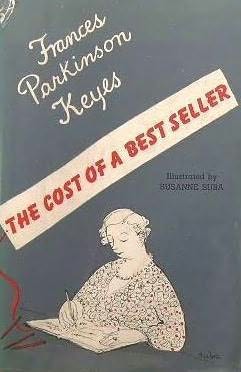 I picked up a £1 dustjacketless copy on a whim from the outdoor clearance area at the Hay Cinema Bookshop in September and started reading it immediately, off and on as a bedside book. Keyes is a twentieth-century author whose dozens of potboilers sold in their millions, but she has been largely forgotten since. Imagine my surprise, then, when her best-known novel, Dinner at Antoine’s (1948), turned up on a recent Book Riot list of New Orleans-themed literature – though mostly for the reference to the still-popular title restaurant.
When Keyes began writing, a mother of three young children in an attic room, it was to supplement her husband’s income, but the work soon became an obsession and allowed her to maintain her independence after her husband, a U.S. senator, died. Not until 17 years after the publication of her first novel did she have her first bestseller. She depicts fame as a double-edged sword: It allowed her to travel in Europe and to Louisiana, where she later made her home, but also made heavy demands on her time, requiring responses to annoying letters, hours spent signing books, and attendance at literary lunches. For someone with back problems, these commitments could be literally as well as figuratively painful.
Keyes has the popular fiction writer’s bitterness about never getting critical recognition. This memoir was pleasant enough, but hasn’t induced me to read any more by her. Readers fond of her work might get something more out of it. For the most part, it doesn’t feel dated, but one detail really got to me: Whenever she needed to ensure that she wouldn’t be disturbed, she would go work in the old slave quarters of her New Orleans mansion. Yipes! 
No One Is Too Small to Make a Difference by Greta Thunberg (2019)
[68 pages]
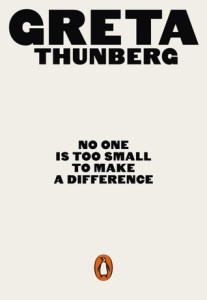 “Our house is on fire. … I want you to panic.” Starting with a speech she gave on a climate march in Stockholm in September 2018 and ending with her address to the UK parliament in April 2019, this punchy pamphlet of rhetoric makes it clear why the teenage Thunberg has rapidly become such an important public figure. She attributes her bluntness to her Asperger’s: the way her mind works, she sees climate breakdown as a simple, black and white issue – either we care or we don’t; either we stop emitting carbon or we don’t; either we find new ways of doing things now, or we stand by and watch it all go to ruin. She calls governments and international bodies to account for their inaction and lack of commitment, and for subsidizing fossil fuels and encouraging consumerism as usual.
Peppering in key statistics and accepted scientific guidelines but staying at a lay level, she calls on the world’s decision-makers to create hope for young people and others who will be most affected by global warming but don’t have a seat at the table. I admire Thunberg’s bravery as well as her words. The only issue with a wee book like this one is that the same points and language recur in multiple speeches, so there is inevitable repetition. 
It’s been Nonfiction week here on Novellas in November. #NovNov meets #NonficNov!

Starting Monday: Literature in Translation week, which Cathy is hosting.
 Bookish Beck = Rebecca Foster. American transplant to England. Freelance proofreader and book reviewer.
 Bookish Beck