Short, Soul-Soothing Reads for #NovNov24 & #NonfictionNovember: Barnes, Cognetti, Lende, Mann, Nouwen and Winner
After the catastrophic U.S. election results (which we’ve all managed to ignore or normalize so as to keep going with our lives) and a medical crisis with our dear old cat, I’ve been craving literary soul food. These six short nonfiction books have been good companions, promising love, meaning and transcendence in the midst of bereavement and daily routines.
Levels of Life by Julian Barnes (2013)
 Barnes was a favourite author in my twenties and thirties, though I’ve had less success with his recent work. He wrote a few grief-soaked books in the wake of the death of his wife, celebrated literary agent Pat Kavanagh*. I had this mistaken for a different one (Through the Window, I think?) that I had enjoyed more. No matter; it was still interesting to reread this triptych of auto/biographical essays. The final, personal piece, “The Loss of Depth,” is a classic of bereavement literature on par with C.S. Lewis’s A Grief Observed; I would happily take it as a standalone pamphlet. Its every word rings true, especially the sense of duty as the lost one’s “principal rememberer.” But the overarching ballooning metaphor, and links with early French aerial photographer Nadar and Colonel Fred Burnaby, aeronaut and suitor of Sarah Bernhardt, don’t convince. The strategy feels like a rehearsal for Richard Flanagan’s Baillie Gifford Prize-winning Question 7, a similar hybrid work that pulls it off better. (Little Free Library) [118 pages]
*In spring 2008, I attended a talk by John Irving at King’s College, London, where I worked in library services for five years. Barnes and Kavanagh were in the front row and embraced Irving before the start. I was floored to hear of Kavanagh’s death later that year because she’d looked so well. It was a fast-acting brain tumour that felled her just 37 days after diagnosis.
Without Ever Reaching the Summit by Paolo Cognetti (2018; 2020)
[Translated from the Italian by Stash Luczkiw]
 Part pilgrimage and part 40th birthday treat, Cognetti’s October 2017 Himalayan trek through Dolpo (a Nepalese plateau at the Tibetan border) would also somewhat recreate Peter Matthiessen’s The Snow Leopard. Cognetti struggles with altitude sickness and the fare: “I tried salted yak butter tea for the first time—nauseating if you thought you were drinking tea, good and refreshing if you thought you were drinking broth.” He and his companions fancifully decide that Kanjiroba, the lovable stray dog who joins their party, is a reincarnation of Matthiessen. I have limited tolerance for travel books’ episodic combinations of nature descriptions, anthropological observations, and the rigours of the nomadic lifestyle. The same was true here, but the slight spiritual aspect and references to The Snow Leopard lifted it. (Public library) [135 pages]
Find the Good: Unexpected Life Lessons from a Small-Town Obituary Writer by Heather Lende (2015)
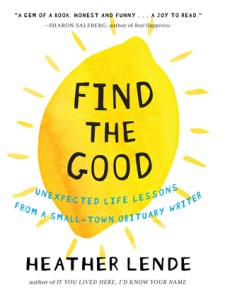 Lende is a journalist in isolated Haines, Alaska (population: 2,000). There’s a plucky motivational bent to these mini-essays about small-town life and death. In writing obituaries for normal, flawed people, she is reminded of what matters most: family (she’s a mother of five, one adopted, and a grandmother; she includes beloved pets in this category) and vocation. The title phrase is the motto she lives by. “I believe gratitude comes from a place in your soul that knows the story could have ended differently, and often does, and I also know that gratitude is at the heart of finding the good in this world—especially in our relationships with the ones we love.” The anecdotes and morals are sweet if not groundbreaking. The pocket-sized hardback might appeal to readers of Anne Lamott and Elizabeth Strout. (Birthday gift from my wish list, secondhand) [162 pages]
Do Not Be Afraid: The joy of waiting in a time of fear by Rachel Mann (2024)
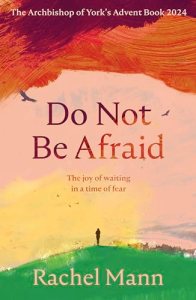 This is the Archbishop of York’s Advent Book 2024; I read it early because, pre-election, I yearned for its message of courage and patience. We need it all the more now. The bite-sized essays are designed to be read one per day from the first Sunday of Advent through to Christmas Day. Often they include a passage of scripture or poetry (including some of Mann’s own) for meditation, and each entry closes with a short prayer and a few questions for discussion or private contemplation. The topics are a real variety but mostly draw on the author’s own experiences of waiting and suffering: medical appointments and Covid isolation as well as the everyday loneliness of being single and the pain of coping with chronic illness. She writes about sitting with parishioners as they face death and bereavement. But there are also pieces inspired by popular culture – everything from Strictly to Quentin Tarantino.
Mann has written several previous Lent course books based on films. I’ve read her work in multiple genres (poetry: A Kingdom of Love and Eleanor Among the Saints; literary criticism: In the Bleak Midwinter; memoir: Dazzling Darkness; fiction: The Gospel of Eve); she is such a versatile writer, and with a fascinating story as a trans priest. Sombre yet hopeful, this is recommended seasonal reading. [114 pages]
With thanks to SPCK for the free copy for review.
The Inner Voice of Love: A Journey through Anguish to Freedom by Henri J. M. Nouwen (1997)
 Anguish is a strong word; I haven’t done any biographical digging to figure out what was going on in Nouwen’s life to prompt it, but apparently this secret journal came out of a lost relationship. (I wonder if it could have been a homosexual attachment. Nouwen was a Dutch Roman Catholic priest who became the pastor of a community for disabled adults in Canada.) He didn’t publish for another eight years but friends encouraged him to let his experience aid others. The one- or two-page reflections are written in the second person, so they feel like a self-help pep talk. The recurring themes are overcoming abandonment and rejection, relinquishing control, and trusting in God’s love and faithfulness. “You must stop being a pleaser and reclaim your identity as a free self.” The point about needing to integrate rather than sideline psychological pain is one I’m sure any therapist would affirm. Nouwen writes that a new spirituality of the body is necessary. This was a comforting bedside book with lots of passages that resonated. (Free – withdrawn from church theological library) [98 pages]
Mudhouse Sabbath: An Invitation to a Life of Spiritual Discipline by Lauren F. Winner (2003)
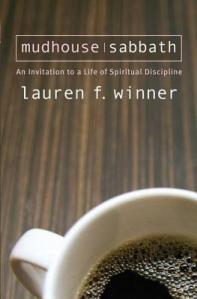 After Winner converted from Orthodox Judaism to Christianity, she found that she missed how Jewish rituals make routine events sacred. There are Christian sacraments, of course, but this book is about how the wisdom of another tradition might be applied in a new context. “Judaism offers opportunities for people to inhabit and sanctify bodies and bodily practices,” Winner writes. There are chapters on the concept of the Sabbath, wedding ceremonies, prayer and hospitality. Fasting is a particular sticking point for Winner, but her priest encourages her to see it as a way of demonstrating dependence on, and hunger for, God. I most appreciated the sections on mourning and ageing. “Perhaps the most essential insight of the Jewish approach to caring for one’s elderly is that this care is, indeed, an obligation. What Judaism understands is that obligations are good things. They are the very bedrock of the Jew’s relationship to God, and they govern some of the most fundamental human relationships”. By the way, Mudhouse is Winner’s local coffeehouse, so she believes these disciplines can be undertaken anywhere. (Secondhand – Awesomebooks.com) [142 pages]

 Bookish Beck = Rebecca Foster. American transplant to England. Freelance proofreader and book reviewer.
 Bookish Beck