The 2019 Wellcome Book Prize: Shadow Panel and Wish List
On Tuesday the longlist for the 2019 Wellcome Book Prize will be announced. For the third year in a row I’m running a shadow panel, and it’s composed of the same four wonderful book bloggers who joined me last year: Paul Cheney of Halfman, Halfbook, Annabel Gaskell of Annabookbel, Clare Rowland of A Little Blog of Books, and Dr. Laura Tisdall.
This year we’re going to do things slightly differently: we plan to split up the longlist, taking two to three titles each, so that between us we will have read them all and can announce our own preferred shortlist before the official shortlist is announced in March. At that point we’ll catch up by (re)reading the six shortlisted books, each reviewing the ones we haven’t already. Essentially, I’m adding an extra stage of shadow panel judging, simply because I can. I hope it will be fun – and also less onerous, in that we should get a leg-up on the shortlist and not have to read all six books in March‒April, which has proved to be a challenge in the past.
My Wellcome Prize hopefuls are all the fiction or nonfiction titles I’ve read on a medical theme that were published in the UK in calendar year 2018. I have put asterisks beside the 12 books in this post that I predict for the longlist. (The combination of wishful thinking and likelihood means that these are not exclusively my personal favorites.)

Below is a list of the books I’ve already featured on the blog in some way, with links to my coverage and a few-word summary of their relevance.
Nonfiction
Gross Anatomy by Mara Altman: Female body woes
*Beneath the Skin: Great Writers on the Body: Essays on organs
*All that Remains by Sue Black: Forensic anthropology
Everything Happens for a Reason by Kate Bowler: Living with advanced cancer
Heal Me by Julia Buckley: Tackling chronic pain
*The Unmapped Mind by Christian Donlan: Adjusting to life with MS
From Here to Eternity by Caitlin Doughty: Funerary rites around the world
This Really Isn’t About You by Jean Hannah Edelstein: A genetic disease in the family
Natural Causes by Barbara Ehrenreich: Questioning the wellness culture
On Smaller Dogs and Larger Life Questions by Kate Figes: Pondering breast cancer
Shapeshifters by Gavin Francis: Instances of bodily change
The Reading Cure by Laura Freeman: Healing from an eating disorder
Nine Pints by Rose George: The story of blood
Waiting for the Last Bus by Richard Holloway: Ageing and death
*Heart: A History by Sandeep Jauhar: Heart disease and treatments
Sick by Porochista Khakpour: Chronic Lyme disease
Human Errors by Nathan Lents: Flawed bodies; evolutionary adaptations
Skybound by Rebecca Loncraine: Breast cancer; flying lessons
Amateur by Thomas Page McBee: Memoir of F2M transformation
*Face to Face by Jim McCaul: Tales of facial surgery
*Somebody I Used to Know by Wendy Mitchell: A firsthand account of early Alzheimer’s
*That Was When People Started to Worry by Nancy Tucker: Mental illness from the inside
*The Language of Kindness by Christie Watson: Nursing as a vocation
Fiction
Little by Edward Carey: Anatomical models in wax (thanks to Clare for the reminder!)
Orchid & the Wasp by Caoilinn Hughes: Non-epileptic seizures
*The Winter Soldier by Daniel Mason: Neurology, surgery during WWI
The Way of All Flesh by Ambrose Parry: Medicine in 1840s Edinburgh
Other eligible books that I have read but not happened to mention on the blog:
 In Shock by Rana Awdish: The doctor became the patient when Awdish, seven months pregnant, was rushed into emergency surgery with excruciating pain due to severe hemorrhaging into the space around her liver, later explained by a ruptured tumor. Having experienced brusque, cursory treatment, even from colleagues at her Detroit-area hospital, she was convinced that doctors needed to do better. This memoir is a gripping story of her own medical journey and a fervent plea for compassion from medical professionals.
 Doctor by Andrew Bomback: Part of the Bloomsbury Object Lessons series, this is a wide-ranging look at what it’s like to be a doctor. Bomback is a kidney specialist; his wife is also a doctor, and his father, fast approaching retirement, is the kind of old-fashioned, reassuring pediatrician who knows everything. Even the author’s young daughter likes playing with a stethoscope and deciding what’s wrong with her dolls. In a sense, then, Bomback uses fragments of family memoir to compare the past, present and likely future of medicine.
 A Moment of Grace by Patrick Dillon [skimmed]: A touching short memoir of the last year of his wife Nicola Thorold’s life, in which she battled acute myeloid leukemia. Dillon doesn’t shy away from the pain and difficulties, but is also able to summon up some gratitude.
 Get Well Soon: Adventures in Alternative Healthcare by Nick Duerden: British journalist Nick Duerden had severe post-viral fatigue after a run-in with possible avian flu in 2009 and was falsely diagnosed with ME / CFS. He spent a year wholeheartedly investigating alternative therapies, including yoga, massage, mindfulness and meditation, visualization, talk therapy and more. He never comes across as bitter or sorry for himself. Instead, he considered fatigue a fact of his new life and asked what he could do about it. So this ends up being quite a pleasant amble through the options, some of them more bizarre than others.
 *Sight by Jessie Greengrass [skimmed]: I wanted to enjoy this, but ended up frustrated. As a set of themes (losing a parent, choosing motherhood, the ways in which medical science has learned to look into human bodies and minds), it’s appealing; as a novel, it’s off-putting. Had this been presented as a set of autobiographical essays, perhaps I would have loved it. But instead it’s in the coy autofiction mold where you know the author has pulled some observations straight from life, gussied up others, and then, in this case, thrown in a bunch of irrelevant medical material dredged up during research at the Wellcome Library.
 *Brainstorm: Detective Stories From the World of Neurology by Suzanne O’Sullivan: Epilepsy affects 600,000 people in the UK and 50 million worldwide, so it’s an important condition to know about. It is fascinating to see the range of behaviors seizures can be associated with. The guesswork is in determining precisely what is going wrong in the brain, and where, as well as how medicines or surgery could address the fault. “There are still far more unknowns than knowns where the brain is concerned,” O’Sullivan writes; “The brain has a mind of its own,” she wryly adds later on. (O’Sullivan won the Prize in 2016 for It’s All in Your Head.)
 I’m also currently reading and enjoying two witty medical books, The Mystery of the Exploding Teeth and Other Curiosities from the History of Medicine by Thomas Morris, and Chicken Unga Fever by Phil Whitaker, his collected New Statesman columns on being a GP.
Four additional books I have not read but think might have a chance of making the longlist:
Primate Change: How the World We Made Is Remaking Us by Vybarr Cregan-Reid
 The Beautiful Cure: Harnessing Your Body’s Natural Defences by Daniel M. Davis
Because I Come from a Crazy Family: The Making of a Psychiatrist by Edward M. Hallowell
*She Has Her Mother’s Laugh: The Powers, Perversions, and Potential of Heredity by Carl Zimmer
Look out for the announcement of the longlist on Tuesday afternoon! I’ll report back, perhaps on Wednesday, with some reactions and the shadow panel’s reviewing strategy.
Have you read, or are you interested in, any of these books?
Can you think of other 2018 releases that might be eligible for the Wellcome Book Prize?
Recent Nonfiction Reads, in 200 Words Each: Black, Fee, Gaw
I’ve let months pass between receiving these books from the kindly publishers and following through with a review, so in an attempt to clear the decks I’m putting up just a short response to each, along with some favorite quotes.
All that Remains: A Life in Death by Sue Black
 Black, a world-leading forensic anthropologist, was part of the war crimes investigation in Kosovo and the recovery effort in Thailand after the 2004 tsunami. She is frequently called into trials to give evidence, has advised the U.K. government on disaster preparedness, and is a co-author of the textbook Developmental Juvenile Osteology (2000). Whether working in a butcher’s shop as a teenager or exploring a cadaver for an anatomy class at the University of Aberdeen, she’s always been comfortable with death. “I never had any desire to work with the living,” she confesses; “The dead are much more predictable and co-operative.”
The book considers death in its clinical and personal aspects: the seven stages of postmortem alteration and the challenges of identifying the sex and age of remains; versus her own experiences with losing her grandmother, uncle and parents. Black wants her skeleton to go to Dundee University’s teaching collection. It doesn’t creep her out to think of that, no more than it did to meet her future cadaver, a matter-of-fact, curious elderly gentleman named Arthur. My favorite chapter was on Kosovo; elsewhere I found the mixture of science and memoir slightly off, and the voice never fully drew me in.
Favorite line: “Perhaps forensic anthropologists are the sin-eaters of our day, addressing the unpleasant and unimaginable so that others don’t have to.”
My rating:
All that Remains was published by Doubleday on April 19th. My thanks to the publisher for the free copy for review.
Places I Stopped on the Way Home: A Memoir of Chaos and Grace by Meg Fee
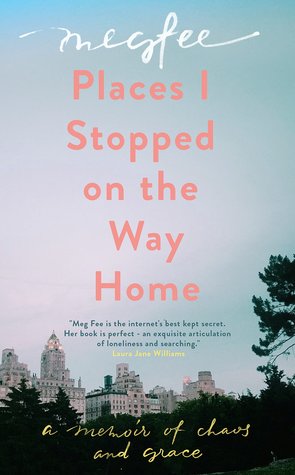 Fee came to New York City to study drama at Julliard. Her short essays, most of them titled after New York locations (plus a few set further afield), are about the uncertainty of her twenties: falling in and out of love, having an eating disorder, and searching for her purpose. She calls herself “a mess of disparate wants, a small universe in bloom.” New York is where she has an awful job she hates, can’t get the man she’s in love with to really notice her, and hops between terrible apartments – including one with bedbugs, the subject of my favorite essay – and yet the City continues to lure her with its endless opportunities.
I think this book could mean a lot to women who are younger than me or have had experiences similar to the author’s. I found the essays slightly repetitive, and rather unkindly wondered what this privileged young woman had to whine about. It’s got the same American, generically spiritual self-help vibe that you get from authors like Brené Brown and Elizabeth Gilbert. Despite her loneliness, Fee retains a romantic view of things, and the way she writes about her crushes and boyfriends never truly connected with me.
Some favorite lines:
“Writing felt like wrangling storm clouds, which is to say, impossible. But so did life. Writing became a way to make peace with that which was flawed.”
“I have let go of the idea of permanency and roots and What Comes Next.”
My rating:
Places I Stopped on the Way Home was published by Icon Books on May 3rd. My thanks to the publisher for the free copy for review.
The Pull of the River: A journey into the wild and watery heart of Britain by Matt Gaw
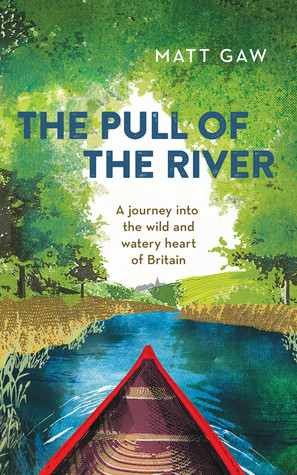 A watery travelogue in the same vein as works by Roger Deakin and Alys Fowler, this jolly yet reflective book traces Gaw’s canoe trips down Britain’s rivers. His vessel was “the Pipe,” a red canoe built by his friend James Treadaway, who also served as his companion for many of the jaunts. Starting with his local river, the Waveney in East Anglia, and finishing with Scotland’s Great Glen Way, the quest was a way of (re)discovering his country by sensing the currents of history and escaping to the edge of danger.
Access issues, outdoor toileting, getting stuck on mudflats, and going under in the winter – it wasn’t always a comfortable method of travel. But Gaw’s expressive writing renders even rubbish- and sewage-strewn landscapes beautiful in their own way: “grim bunting made from discarded bags of dog poo,” “a savannah of quivering, moussey mud” and “cormorants hunched together like sinister penguins, some holding ragged wings to the wind in taxidermic poses.”
My favorite chapters were about pollution and invasive species, as seen at the Lark, and about the beaver reintroduction project in Devon (we have friends who live near it). I’m rooting for this to make next year’s Wainwright Prize longlist.
A favorite passage:
“I feel like I’ve shed the rust gathered from being landlocked and lazy. The habits and responsibilities of modern life can be hard to shake off, the white noise difficult to muffle. But the water has returned me to my senses. I’ve been reborn in a baptism of the Waveney [et al.]”
My rating:
The Pull of the River was published by Elliott & Thompson on April 5th. My thanks to the publisher for the free copy for review.
 Bookish Beck = Rebecca Foster. American transplant to England. Freelance proofreader and book reviewer.
 Bookish Beck