East Anglian Horror for #RIPXXI: Sara Bayat and Natasha Pulley
My first Readers Imbibing Peril post featured three short story collections. I have more spooky reads to catch up on tomorrow, but today I’m featuring two 2026 works of East Anglian horror with fetching purple and black covers that I read during October. (This might seem like a niche subgenre, but I can actually think of several other books I’ve read that fit into the same tradition; if not all set in Norfolk/Suffolk, they still evoke fenland settings: The Woman in Black by Susan Hill, The Hotel by Daisy Johnson, and Wakenhyrst by Michelle Paver.) Both: 
Hesket: A Norfolk Haunting by Sara Bayat
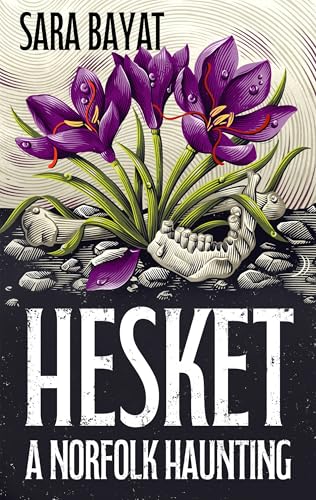 I bought this after I saw Bayat speak at Marlborough Literature Festival last month. Eight linked chapters, bookended by a prologue and epilogue, colour in a picture of a Norfolk village plagued by strange events when a housing development disturbs the ground. Each character has a source of isolation: Isla and her husband have drifted apart since their daughter died; Nell lives in a retirement home and has lost her dearest friend; Emir doesn’t fit in with the other allotment gardeners due to his ethnic background – even though he was raised in England; and Arthur has extreme social anxiety and an unhealthy attachment to a woman old enough to be his mother.
Bayat is careful to share out the sympathy, including to a tree surgeon involved in cutting down the woods for the construction project and the well-meaning vicar who sometimes oversteps her duties and at the same time fails her family. Loss links her characters, from the participants at the séance local journalist Rio reports on to Finn and his single dad. The discovery of bones and the appearance of a ghost are reminders of medieval atrocities. Nine women were executed as witches here, and the injustice lingers. Alice Spry was drowned in the River Wensum, her body never recovered. She lives on in the name of Spry Woods – and perhaps another form.
My shipping notice featured what must be a previous title, “In Old Hesket Woods,” which feels more appropriate to the subdued folktale vibe. This novel shows promise and I’ll certainly follow Bayat’s career, but something about it was a little too … quiet? provincial? to stick with me. Certain chapters, particularly the first, are strong stand-alones, but some of the rest are thin. Those with ties to Norwich may be keenest to read this. (New purchase – Awesomebooks.com with voucher)
The Salt King by Natasha Pulley
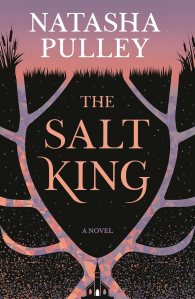 Jesuit priest Avelyn Brocken is recalled from the Vatican to Hreodwater in East Anglia to investigate miracles said to have taken place at the salt mine. His hometown is like its own country, with an ancient language and customs. Legends of the Salt King and the “salt light” emanating from the mine characterise it as a benevolent place, as several recent healings would seem to support. Miracles have been reported at other salt mines from Jordan to Russia, too. But then a Hreodwater visitor is turned into a pillar of salt. As researchers at the Dead Sea have also found, proximity to the salt destroys all electronic devices and potentially threatens human health in a way similar to radiation.
Pulley’s eighth novel blurs the lines between good and evil when it comes to ‘gods,’ ‘witches’ and ‘angels’. Supernatural events might be the physical incarnation of belief or the punishments of a capricious deity. There is quite complicated world-building around Hreodwater, which I’m not used to because I don’t read, for example, hard SF. The inclusion of other salt mine locations, even when they’re not developed into full side plots, might serve as further evidence of what’s going on but also dilutes the central story. Overall, then, the novel felt much longer than it needed to be at over 450 pages.
This was my first experience with Pulley, and I found her style to be similar to T. Kingfisher’s – hip, shrewd fantasy-meets-horror in which sarcasm and queerness (a flirtation between Avelyn and the abbey caretaker, Jericho) reign – but Pulley is less grating. There’s a jokey faux-academic tone to the footnotes, and I loved the sense of humour:
“Avelyn broke. ‘Ssh yourself. What kind of sociopath eats a peach during Mass anyway?’”
“Fabian, I mean this in the most brotherly possible way, but f*ck off before I shove you in the f*cking fen.”
“Where do I find new jeans in Hreodwater? … what would you put on the delivery instructions? Proceed past imaginary castle, mind the angry knights, try not to turn to salt for no reason”
While Pulley doesn’t always gets it right about belief – she admits in the Acknowledgements that she isn’t religious at all so had to interview a lot of people to try to understand faith – it’s heartening that she makes the attempt, and the clash of organised religion and folk religion here, as realised in the troubled character of Avelyn, is intriguing. I’d try another of this author’s (shorter) works; any recommendations for me? (Public library)
 My most striking bit of Halloween-relevant reading this year came from an unexpected place: the chapter “Spirits and Demons” in the memoir Ordinary Light by Tracy K. Smith. Her very religious mother was wary about her children celebrating Halloween, though she was happy to provide autumnal snacks and games for her daughter’s kindergarten classroom. When it came to trick-or-treating, though, she subverted the holiday’s tropes by dressing Tracy in a ghost costume disconcertingly reminiscent of a KKK outfit – a reminder that the true horrors are out there in the real world.
Are you doing anything for Halloween? Read anything spooky lately?
Nonfiction Week of #NovNov: Short Memoirs by Lucille Clifton, Alice Thomas Ellis and Deborah Levy
It’s nonfiction week of Novellas in November, which for me usually means short memoirs (today) and nature books (coming up on Wednesday). However, as my list of 10 nonfiction favorites from last year indicates, there’s no shortage of subjects covered in nonfiction works of under 200 pages; whether you’re interested in bereavement, food, hospitality, illness, mountaineering, nature, politics, poverty or social justice, you’ll find something that suits. This week is a great excuse to combine challenges with Nonfiction November, too.

We hope some of you will join in with our buddy read for the week, The Story of My Life by Helen Keller (free to download here from Project Gutenberg if you don’t already have access). At a mere 85 pages, it’s a quick read. I’ve been enjoying learning about her family history and how meeting her teacher was the solution to her desperate need to communicate.
My first three short nonfiction reads of the month are all in my wheelhouse of women’s life writing, with each one taking on a slightly different fragmentary form.
Generations: A Memoir by Lucille Clifton (1976)
[87 pages]
 After her father’s death, Clifton, an award-winning poet, felt compelled to delve into her African American family’s history. Echoing biblical genealogies, she recites her lineage in a rhythmic way and delivers family anecdotes that had passed into legend. First came Caroline, “Mammy Ca’line”: born in Africa in 1822 and brought to America as a child slave, she walked north from New Orleans to Virginia at age eight, became a midwife, and died free. Mammy Ca’line’s sayings lived on through Clifton’s father, her grandson: she “would tell us that we was Sayle people and we didn’t have to obey nobody. You a Sayle, she would say. You from Dahomey women.” Then came Caroline’s daughter, Lucy Sale, famously the first Black woman hanged in Virginia – for shooting her white lover. And so on until we get to Clifton herself, who grew up near Buffalo, New York and attended Howard University.
The chapter epigraphs from Walt Whitman’s “Song of Myself” call into question how much of an individual’s identity is determined by their family circumstances. While I enjoyed the sideways look at slavery and appreciated the poetic take on oral history, I thought more detail and less repetition would have produced greater intimacy. 
Reissued by NYRB Classics tomorrow, November 9th, with a new introduction by Tracy K. Smith. My thanks to the publisher for the proof copy for review.
Home Life, Book Four by Alice Thomas Ellis (1989)
[169 pages]
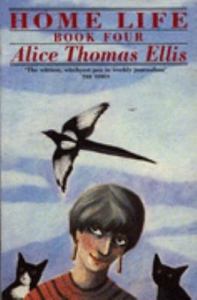 For four years, Ellis wrote a weekly “Home Life” column for the Spectator. Her informal pieces remind me of Caitlin Moran’s 2000s writing for the Times – what today might form the kernel of a mums’ blog. In short, we have a harried mother of five trying to get writing done while maintaining a household – but given she has homes in London and Wales AND a housekeeper, and that her biggest problems include buying new carpet and being stuck in traffic, it’s hard to work up much sympathy. These days we’d say, Check your privilege.
The sardonic complaining rubbed me the wrong way, especially when the subject was not finding anything she wanted to read even though she’d just shipped four boxes of extraneous books off to her country house, or using noxious sprays to get rid of one harmless fly, or a buildup of rubbish bags because they’d been “tidying.” These essays feel of their time for the glib attitude and complacent consumerism. It’s rather a shame they served as my introduction to Ellis, but I think I’d still give her fiction a try. (Secondhand purchase, Barter Books) 
The Cost of Living by Deborah Levy (2018)
[187 pages]
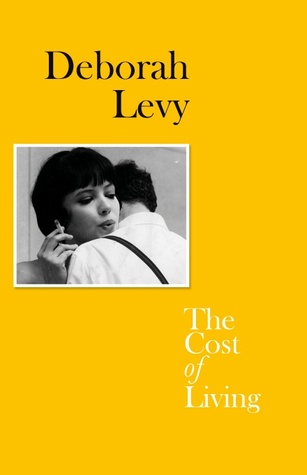 In the space of a year, Levy separated from her husband and her mother fell ill with the cancer that would kill her. Living with her daughters in a less-than-desirable London flat, she longed for a room of her own. Her octogenarian neighbor, Celia, proffered her garden shed as a writing studio, and that plus an electric bike conferred the intellectual and physical freedom she needed to reinvent her life. That is the bare bones of this sparse volume, the middle one in an autobiographical trilogy, onto which Levy grafts the tissue of experience: conversations and memories; travels and quotations that have stuck with her.
It’s hard to convey just what makes this brilliant. The scenes are everyday – set at her apartment complex, during her teaching work or on a train; the dialogue might be overheard. Yet each moment feels perfectly chosen to reveal her self, or the emotional truth of a situation, or the latent sexism of modern life. “All writing is about looking and listening and paying attention to the world,” she writes, and it’s that quality of attention that sets this apart. I’ve had mixed success with Levy’s fiction (though I loved Hot Milk), but this was flawless from first line to last. I can only hope the rest of the memoir lives up to it. (New purchase) 
Keep in touch via Twitter (@bookishbeck / @cathy746books) and Instagram (@bookishbeck / @cathy_746books). We’ll add any of your review links in to our master posts. Feel free to use the terrific feature image Cathy made and don’t forget the hashtag #NovNov.
Any short nonfiction on your reading pile?
 Bookish Beck = Rebecca Foster. American transplant to England. Freelance proofreader and book reviewer.

