Review: Service by Sarah Gilmartin
The comparison with Sweetbitter, one of my favourite debuts of the past decade, drew me to Service, and it’s an apt one. Irish writer Sarah Gilmartin’s second novel is a before-and-after set partly in the stressful atmosphere of a fine dining restaurant in Dublin. Head chef Daniel Costello worked his way up from an inner-city childhood and teenage carvery-pub job to a two-Michelin-starred establishment known as T. But then came a fall: accusations of sexual assault from several female former employees led to the restaurant’s temporary closure and a high-profile court trial. Daniel maintains his innocence. His lawyer plans to cast shade on the lead waitress’ reputation, and question her failure to come forward until one year after the alleged rape.

Three alternating first-person narrators fill in the background of the macho restaurant world and the Costellos’ marriage. First is Hannah Blake, a former waitress who is not involved in the current lawsuit but has her own stories to tell about Daniel, who treated her as a protégée during the brief time she worked at T while she was a university student. “I’ve never felt as alive as I did that summer,” she writes; it was thrilling for a girl from Tipperary to be at the heart of Dublin’s culinary life and to have a world-leading chef believe her palate was worth training. We also hear from Daniel himself, and then his wife Julie, who begrudgingly supports Daniel but is furious with him for the negative attention the trial has brought her and their two sons. Some family members and neighbours have started avoiding them.
Gilmartin invites the reader to have sympathy for all the protagonists, even when it gets complicated. There was a point about three-quarters of the way through when I had to rethink who I felt sorry for and why. I would have liked a few more restaurant scenes to balance out the aftermath, but that is a minor quibble. This is a solid #MeToo novel with pacey, engaging writing and well-rounded characters. It’s made me eager to go back and catch up on the author’s debut, Dinner Party: A Tragedy.
My rating: 
Service was published on 4 May. With thanks to Pushkin Press for the proof copy for review.
Update: Sarah Gilmartin kindly answered a question another blogger and I put to her, about how she decided on, and brought to life, these three narrators.
As a writer I’m drawn to ambivalence, ambiguity, grey areas. I’m curious about how people work, how they behave under pressure, when they think no one is watching, our public and private selves, all of that is the bones of literature. I wanted to tell a story about the abuse of power from different perspectives as I felt it was a subject that could potentially have multiple interpretations. I was interested in nuance and in leaving enough space for the reader to make up their own mind.
With Julie, I was struck that when you hear or read about MeToo stories in the media, one person you never or rarely hear from is the partner of the abuser. Certainly they’re not the most important voice in the scenario – the victim is – but you do think, or at least I do, what must it feel like for the partner of the predator? A woman whose life is being ripped apart in a different way by the same man. I wanted to know more about women in this position. In their own words. With Hannah, we have a different, younger, in some ways closer-to-the-action female perspective. Although she’s in her 30s now, in many ways Hannah is stuck in the past, her summer at the restaurant, as survivors of trauma often are, trying to get on with things but being continually brought back to the point where their lives were derailed. She’s also our guide to the restaurant world, which can often be very colourful and entertaining. Finally, with Daniel, for me the story didn’t feel cohesive without his perspective. He was a compelling character to write, a talented man, celebrated in his field, who has clearly defined private and public personas, and an aura of false humility; he’s a self-fashioned art monster. Then on another level, he’s a predator, with a huge amount of ego and vanity.
All three characters were interesting to me in their own right, which is key, and then they also had important things to contribute with regards to the subject matter of the book. I didn’t do a huge amount of research – read a lot about MeToo in the media, watched some Masterchef – but I worked as a waitress myself in my 20s so had a good idea of the world, the highs and lows, stresses and perks. Characters, once I have an idea of who they are, how they operate and what they want, tend to grow organically on the page. That’s the beauty of fiction!
Snow and Winter Reads, Part II
Since I wrote about my first batch of wintry reads in early February, it’s turned much more spring-like here in southern England, with blue skies and the daffodils blooming. Still, temperatures continue chilly and some nights I’ve had trouble falling asleep because of the wind tearing down the street and flapping the bin lids. With meteorological spring due to start tomorrow, I’m bidding farewell to winter with a few more snow-covered reads: a children’s classic, a modern classic from the 1990s, and an implausible but enjoyably rollicking thriller.
The Wolves of Willoughby Chase by Joan Aiken (1962)
 Aiken’s books were not part of my childhood, but I was vaguely aware of this first book in a long series when I plucked it from a neighbor’s giveaway pile. The snowy scene on the cover and described in the first two paragraphs drew me in and the story, a Victorian-set fantasy with notes of Oliver Twist and Jane Eyre, soon did, too. In this alternative version of the 1830s, Britain already had an extensive railway network and wolves regularly used the Channel Tunnel (which did not actually open until 1994) to escape the Continent’s brutal winters for somewhat milder climes.
One winter, the orphaned Sylvia travels by train from London to the north of England to live with her cousin Bonnie and her parents, Sir Willoughby and Lady Green. But dodgy things are afoot at Willoughby Chase: Miss Slighcarp, a distant cousin, has been hired as the girls’ governess but, just as soon as Bonnie’s parents leave on a long trip, she sets about taking over the house. Bonnie and Sylvia, exiled to a workhouse, rely on a secret network of friends and servants to keep them safe and get them home via an intrepid journey.
Miss Slighcarp is just one of the novel’s Dickensian villains – balanced out by some equally Dickensian urchins and helpful adults, all of them with hearts of gold. There’s something perversely cozy about the plight of an orphan in children’s books: the characters call to the lonely child in all of us, and we rejoice to see how ingenuity and luck come together to defeat wickedness. There are charming passages here in which familiar smells and favorite foods offer comfort. I especially loved their friend Simon’s cave and his little rituals. This would make a perfect stepping stone from Roald Dahl to one of the actual Victorian classics.
My only quibble with the book overall would be that the wolves seem unnecessary: they only truly appear once, for a climactic scene during the train ride, and the rest of the time are just a background menace. From fairy tales onwards, wolves have gotten a bad rap, and we don’t need to perpetuate myths about how dangerous they are to humans.
Snow Falling on Cedars by David Guterson (1994)
 My first 5-star read of the year! It certainly took a while, but I’m now on a roll with a bunch of 4.5- and 5-star ratings bunching together. I remember the buzz surrounding this novel, mostly because of the Ethan Hawke film version that came out when I was a teenager. Even though I didn’t see it, I was aware of it, as I was of other literary fiction that got turned into Oscar-worthy films at about that time, like The Shipping News and House of Sand and Fog.
The novel is set in 1954 on San Piedro, an island of 5,000 off the coast of Washington state. A decade on from the war, the community’s chickens come home to roost when a Japanese American man, Kabuo Miyamoto, is charged with murdering a fellow fisherman, Carl Heine. The men had been engaged in a dispute over some land – seven acres of strawberry fields that were seized from the Miyamoto family when, like the rest of the country’s Japanese population, they were rounded up in internment camps. Meanwhile, Ishmael Chambers, who runs the local newspaper and lost an arm in the war, stumbles on a piece of evidence that might turn the case around. Still in love with Hatsue, now Kabuo’s wife but once his teenage obsession, he is torn between winning her back and wanting to do what’s right.
Guterson alternates between trial scenes and flashbacks to war service or stolen afternoons Ishmael and Hatsue spent kissing in the shelter of massive cedar trees. The mystery element held me completely gripped – readers are just as in the dark as the jurors until very close to the end – but this is mostly a powerful picture of the lasting effects of racism. All the characters are well drawn, even minor ones like elderly defense attorney Nels Gudmundsson. Even though I only read 10 or 15 pages at a sitting over the course of a month, every time I picked up the book I was instantly immersed in the atmosphere, whether it was a warm courtroom with a snowstorm swirling outside or a troop ship entering the Pacific Theater. This has the epic feel of a doorstopper, though it’s only 400 pages. I can’t recommend it highly enough. 
The Quality of Silence by Rosamund Lupton (2015)
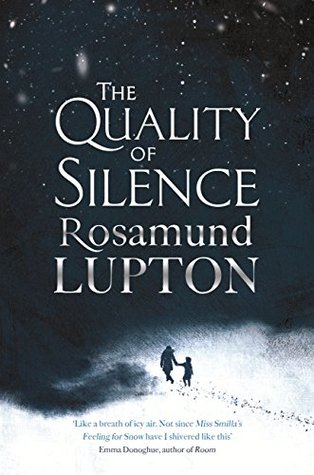 Ten-year-old Ruby and her mother Yasmin have arrived in Alaska to visit Ruby’s dad, Matt, who makes nature documentaries. When they arrive, police inform them that the town where he was living has been destroyed by fire and he is presumed dead. But Yasmin won’t believe it and they set out on a 500-mile journey north to find her husband, first hitching a ride with a trucker and then going it alone in a stolen vehicle. All the time, with the weather increasingly brutal, they’re aware of someone following them – someone with malicious intent.
The narration is in short segments, alternating between Ruby’s first person and a third-person account from Yasmin’s point-of-view. There are many interesting elements here: Ruby is deaf so communicates via a combination of sign language, voice recognition software, blogs and social media, and describes things synesthetically; Yasmin is a physicist drawing metaphors to scientific concepts, but can’t explain her own mystical certainty that Matt is still alive; and there is an environmentalist message behind the fracking cover-up plot.
But starting with the first page, there are so many improbabilities in play, from a 10-year-old having a Twitter account to Yasmin managing to drive a big rig on ice roads in a foreign country. I knew from reviewing Three Hours last year that Lupton writes addictive thrillers. This one was perfectly readable, but not as good. It’s our book club read for early March, and I expect I won’t be the only one to find it hardly believable. 
Plus a skim:
Arctic Dreams by Barry Lopez (1986)
 This was my first time trying the late Lopez. It was supposed to be a buddy read with my husband because we ended up with two free copies, but he raced ahead while I limped along just a few pages at a time before admitting defeat and skimming to the end (it was the 20 pages on musk oxen that really did me in). For me, the reading experience was most akin to The Snow Leopard by Peter Matthiessen in that both are about a literal journey in an extreme environment, yet what stands out are the philosophical musings. Where Matthiessen was animated by Buddhist ideas about selfhood and loss, Lopez takes the secular long view of human life and responsibility in light of potential extinction. The epilogue, in particular, is endlessly quotable. It’s depressing to encounter books like this now, though: 30+ years ago, literary nature writers were issuing clarion calls about climate disaster, and we didn’t listen.
Some favorite passages:
“Whenever I met a collared lemming on a summer day and took its stare I would think: Here is a tough animal. Here is a valuable life. … If it could tell me of its will to survive, would I think of biochemistry, or would I think of the analogous human desire? If it could speak of the time since the retreat of the ice, would I have the patience to listen?”
“The cold view to take of our future is that we are therefore headed for extinction in a universe of impersonal chemical, physical, and biological laws. A more productive, certainly more engaging view, is that we have the intelligence to grasp what is happening, the composure not to be intimidated by its complexity, and the courage to take steps that may bear no fruit in our lifetimes.”
“One of the oldest dreams of mankind is to find a dignity that might include all living things. And one of the greatest of human longings must be to bring such dignity to one’s own dreams, for each to find his or her own life exemplary in some way. The struggle to do this is a struggle because an adult sensibility must find some way to include all the dark threads of life. A way to do this is to pay attention to what occurs in a land not touched by human schemes, where an original order prevails.”
Did you read anything particularly wintry this year, or are you and your book stack moving on to spring already?
Six Degrees of Separation: From a Redhead to a Blue Dress

This month we begin with Redhead by the Side of the Road (2020). (See Kate’s opening post.) Anne Tyler’s lackluster latest somehow got longlisted for the Booker Prize. Still, I’m a solid Tyler fan and I’m taking advantage of Liz’s readalong to get to the books of hers that I own but haven’t read yet. Currently reading: The Clock Winder (1972).
#1 Sorry to break it to you if you haven’t read the book yet, but the title refers not to a person with red hair but to a fire hydrant: Micah, a typically useless Tyler antihero, makes this visual mistake commonly when he’s out running without his glasses on.
 The Unlikely Redemption of John Alexander MacNeil by Lesley Choyce (2017) is beloved of a couple of Canadian book blogger friends, including Naomi (here’s her review). I came across it on my Goodreads TBR the other day and the blurb caught my eye. An old man starts doing peculiar things, like picking up a hitchhiker … except that it’s actually a neighbour’s mailbox. This reminded me of Micah’s folly, not least because of the glasses on the cover.
 #2 One of the key images in The Great Gatsby (1925) is of the eyes of optician Dr. T. J. Eckleburg peering out from an old billboard. They’re explicitly equated to the eyes of God looking down on the immoral lifestyle of characters blinded by the pursuit of money and happiness. Gatsby was our neighbourhood book club choice this month. Whether we’d read it multiple times before (it was my third read) or not at all, we found a lot to talk about – and two members took the opportunity to dress up in vintage 1920s fashions for the Zoom meeting!
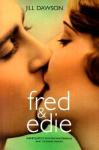 #3 Although those bespectacled eyes appeared on the copy I read in high school, the book group set cover featured a couple of 1920s figures: a woman on the front cover and a man on the back. They look rather like a young Scott and Zelda Fitzgerald, but I can’t find evidence that it’s an original photograph. In any case, I thought the image looked awfully familiar, and finally located it as the cover of Fred & Edie by Jill Dawson (2000), which is set in 1922 and was inspired by a true crime. In a sensational trial, Edith Thompson and her lover, Freddy Bywaters, were found guilty of murdering Edith’s husband and the pair were executed the following year. Cathy’s review whetted my appetite to read it.
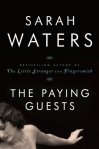 #4 Also featuring a murder committed in 1922 is The Paying Guests by Sarah Waters (2014). I will say no more – not least because I don’t fully remember what happens, though I have a vague sense that it is quite similar in plot to the Dawson – except that this was a stand-out from Waters. (My review for BookBrowse.)
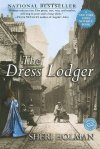 #5 “Paying guests” was an old-fashioned euphemism used by people who didn’t like to admit they had lodgers. Another random recent find on my virtual TBR was The Dress Lodger by Sheri Holman (2000), which is about a 15-year-old prostitute trying to provide for herself and her disabled baby boy during a cholera epidemic in Sunderland, England in 1831. Victorian pastiches can go either way for me, but when they’re good I adore them. There are enough positive friend reviews of this on Goodreads for me to keep it on the list: it sounds reminiscent of The Crimson Petal and the White, and the epidemic theme sure is relevant.
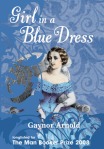 #6 The blue dress on the cover led me to Girl in a Blue Dress by Gaynor Arnold (2008), a novel about Charles Dickens’s longsuffering wife, Catherine. (Though the central pair are given different names, it’s very clear who they’re based on.) I’m a sucker for any book about Dickens. Like Redhead, this was longlisted for the Booker Prize.
This month I’ve gone round to a different primary colour, by way of a classic and much historical fiction (with 1920s settings aplenty, and lots of marcelled hair!).
Where will your chain take you? Join us for #6Degrees of Separation! (Hosted on the first Saturday of each month by Kate W. of Books Are My Favourite and Best.) Next month’s starting point is Phosphorescence by Julia Baird.
Have you read any of my selections? Are you tempted by any you didn’t know before?
9 Things that Surprised Me about Madame Bovary
My classic for September was one of those books that are so ingrained in the canon you most likely know the basic story line even if you’ve never read a word Gustave Flaubert wrote. I’d happened to read a fair bit about Madame Bovary (1857), mostly via Julian Barnes, and had also encountered some modern novels that might be said to be updates (Hausfrau by Jill Alexander Essbaum and perhaps even George and Lizzie by Nancy Pearl), but never picked up the book itself until earlier this month. While the essential turns of the plot were indeed familiar to me, there was also plenty that surprised me in terms of the details and the mechanics. I’ve set this out in nine points below; if you’re determined to avoid anything that seems like spoilers, I’d suggest skipping over #6–8.
#1. We open with Charles Bovary.
And in the first-person plural: “We were studying when the headmaster came in, followed by a new boy”. I suppose I assumed the book would open immediately on Emma Bovary, already married to Charles. Instead, we get a quick tour through Charles’s adolescent schooling and independent medical studies.
 #2. There are two “Madame Bovarys” before the one we’re interested in.
The original Madame Bovary, and the only one to survive the book, is Charles’s mother. Charles also has a brief first marriage to Heloise, an older widow. Conveniently, she dies by the end of the second chapter, in which Charles met Emma when he went to set her farmer father’s broken leg.
#3. There’s a lovely Hardyesque flavor to the novel.
Flaubert’s original subtitle was “Provincial Morals,” and the scenes set among country folk – especially Emma and Charles’s wedding procession and reception and the later agricultural fair – reminded me of Far from the Madding Crowd.
#4. Emma has a child.
Despite all I’d absorbed about the book, I never knew Emma had a baby girl, Berthe. They lodge the infant with a wet nurse and servants do most of the hard work of raising her, so Berthe has only a tiny role. The scene in which Emma violently pushes the little girl away from her is meant, I think, to reflect her fundamental unfitness for motherhood.
#5. In the world of the novel, literature is a danger and religion is no balm.
On the advice of Charles’s mother, he cancels Emma’s lending library subscription lest novels exacerbate her discontent. Manual labor is what Emma needs, Old Madame Bovary proclaims. When Emma goes to the parish priest for advice about her angst, he tells her she must be ill if she benefits from all the physical comforts she could need yet cannot be happy. (An excellent and wrenching scene.)

Gustave Flaubert. (Public domain, via Wikimedia Commons.)
#6. There’s a strong medical theme.
Charles is a doctor, of course, but I didn’t know his profession would enter into the plot. There’s a crucial sequence in which he performs a groundbreaking operation on a stable boy with a clubfoot, but gangrene sets in and the leg has to be amputated. (Emma guiltily buys the boy a false leg.) Emma’s somewhat prolonged death by poisoning, and the appearance of her corpse, are also described in recognizable medical detail.
#7. Emma’s death isn’t the end.
There’s still two more chapters to go, and things only get worse. It’s as if Emma is still a negative influence after her death: pushing Charles on to extravagances he can’t afford, and sending him deeper into despair when he finds undeniable evidence of her two affairs.
#8. Homais, the arrogant pharmacist, is triumphant.
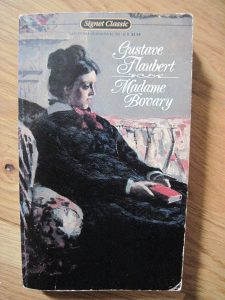
Monsieur Homais is one of the key secondary characters in Yonville, this small town near Rouen. He’s a middling community member who’s gotten above himself, yet he succeeds whereas Emma is crushed. The very last line of the novel goes to him: “He has just received the Legion of Honor.” In the introduction to my Signet Classic edition, Mary McCarthy suggests that Homais is “not just Emma’s foil; he is her alter ego.”
#9. Madame Bovary went on trial.
Appended to my copy is a 78-page transcript of the novel’s trial. As I skimmed it, I was reminded of the Lady Chatterley’s Lover obscenity case, which took place just over 100 years later (1959–60). Flaubert and his publisher were accused of “offenses against public morality and religion,” specifically of portraying Emma as lascivious and making adultery appealing compared to the banality of marriage. The defense countered that Charles receives all the reader’s sympathy and Emma all the reader’s revulsion. Flaubert was acquitted (as was Lady Chatterley), but the judge’s ruling was essentially “Naughty boy, don’t you know literature has a mission to exalt the spirit, not to hold up vice as an object of horror?”
Now for what doesn’t surprise me about Madame Bovary: the beautiful writing and the enduring power of what is ultimately a rather commonplace story line. The percentage of novels with an adultery subplot must be very high nowadays, but Madame Bovary and Anna Karenina were two of the first to consider the female experience.
Flaubert famously declared “Madame Bovary, c’est moi” (“Madame Bovary is me”), and I think every reader must see something of him-/herself in this character: the lure of a romantic and luxurious life, the boredom of the day to day, the longing to make something more out of existence, and an increasing desperation to cover up one’s mistakes. A book that has had meaning for generations, Madame Bovary is a true classic.
Some favorite lines:
“But her life was as cold as an attic with northern exposure, and boredom, that silent spider, was spinning its web in all the dark corners of her heart.”
“Mealtime was the worst of all in that tiny room on the ground floor, with the smoking oven, the creaking door, the damp walls, and the moist flagstones; all the bitterness of her existence seemed to be served up to her on her plate, and the steam from the boiled beef brought up waves of nausea from the depths of her soul.”
“No one can ever express the exact measure of his needs, or conceptions, or sorrows. The human language is like a cracked kettle on which we beat out a tune for a dancing bear, when we hope with our music to move the stars.”
(Isn’t that last sentence incredible?!)
My rating: 
I read a Signet Classic edition of Mildred Marmur’s 1964 translation.
See also Susan’s review of Sophie Divry’s recent update, Madame Bovary of the Suburbs, at A life in books.
 Bookish Beck = Rebecca Foster. American transplant to England. Freelance proofreader and book reviewer.
 Bookish Beck