Dubiously Thematic Easter Reading
In 2015 and 2017 I came up with some appropriately theological reading recommendations for Easter. This year I’m going for a more tongue-in-cheek approach, as befits the unfortunate conjunction of Easter with April Fools’ Day.
Currently reading or reviewing:
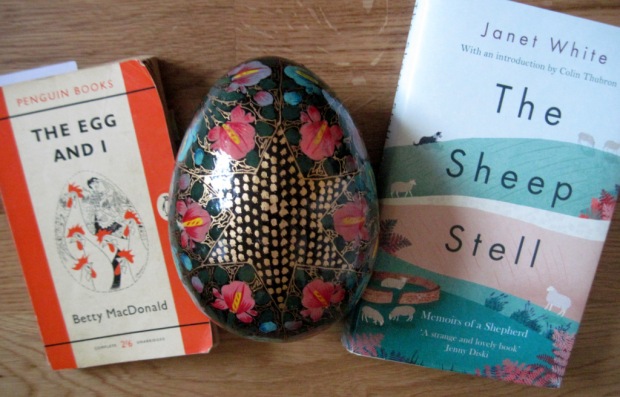
The Egg and I by Betty MacDonald
I bought this on a whim from a local charity shop, based on the title, cover and blurb. I’m about one-third of the way through so far. MacDonald and her husband started a chicken farm in a mountainous area of the Pacific Northwest in the 1940s. Her account of her failure to become the perfect farm wife is rather hilarious. My only hesitation is about her terrible snobbishness towards rednecks and “Indians.”


A representative passage: “Gathering eggs would be like one continual Easter morning if the hens would just be obliging and get off the nests. Co-operation, however, is not a chickenly characteristic and so at egg-gathering time every nest was overflowing with hen, feet planted, and a shoot-if-you-must-this-old-grey-head look in her eye.”
The Sheep Stell by Janet White
 I’m reviewing this reissued memoir for the TLS. It’s a delightful story of finding contentment in the countryside, whether on her own or with family. White, now in her eighties, has been a shepherd for six decades in the British Isles and in New Zealand. While there’s some darker material here about being stalked by a spurned suitor, the tone is mostly lighthearted. I’d recommend it to anyone who’s enjoyed books by Gerald Durrell, James Herriot and Doreen Tovey.
Representative passages: “Shepherding is a strange mixture of tremendous physical work alternating with periods of calm, quiet indolence.” & “A dare, a dream and a challenge. I could have hunted the whole world over and never in a lifetime found anywhere so right: warm, high, pastoral and severed by the sea.”
Read recently:
The Trouble with Goats and Sheep by Joanna Cannon
 Mrs. Creasy disappears one Monday in June 1976, and ten-year-old Grace Bennett and her friend Tilly are determined to figure out what happened. I have a weakness for precocious child detectives (from Harriet the Spy to Flavia de Luce), so I enjoyed Grace’s first-person sections, but it always feels like cheating to me when an author realizes they can’t reveal everything from a child’s perspective so add in third-person narration and flashbacks. These fill in the various neighbors’ sad stories and tell of a rather shocking act of vigilante justice they together undertook nine years ago.
Sheep are a metaphor here for herd behavior and a sense of belonging, but also for good versus evil. Grace and Tilly become obsessed with a Bible passage the vicar reads about Jesus separating the sheep from the goats. But how can he, or they, know who’s truly righteous? As Grace says, “I think that’s the trouble, it’s not always that easy to tell the difference.” It’s a simplistic message about acknowledging the complexity of other lives and situations rather than being judgmental, and matches the undemanding prose.
Reminiscent of Rachel Joyce, but not as good.
My rating:
Vita Nova by Louise Glück
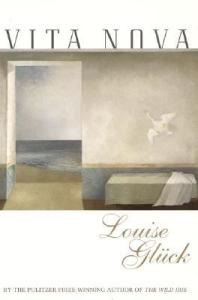 My first collection from the prolific Pulitzer winner. Some of the poems are built around self-interrogation, with a question and answer format; several reflect on the myth of Orpheus and Eurydice. The first and last poems are both entitled “Vita Nova,” while another in the middle is called “The New Life.” I enjoyed the language of spring in the first “Vita Nova” and in “The Nest,” but I was unconvinced by much of what Glück writes about love and self-knowledge, some of it very clichéd indeed, e.g. “I found the years of the climb upward / difficult, filled with anxiety” (from “Descent to the Valley”) and “My life took me many places, / many of them very dark” (from “The Mystery”).
Best lines about spring:
“The spring of the year; young men buying tickets for the ferryboats. / Laughter, because the air is full of apple blossoms.” (from “Vita Nova”)
“Spring / descended. Or should one say / rose? … yellow-green of forsythia, the Commons / planted with new grass— // the new / protected always” (from “Ellsworth Avenue”)
My rating: 
Plucked off the shelf for their dubious thematic significance!

To Rise Again at a Decent Hour by Joshua Ferris
Animal, Vegetable, Miracle by Barbara Kingsolver
Wise Blood by Flannery O’Connor
So You’ve Been Publicly Shamed by Jon Ronson
The Resurrection of Joan Ashby by Cherise Wolas
Happy Easter to all those who mark it, and have a good week. I have a few review-based posts scheduled for while we’re in Wigtown, a trip I hope to report on next Monday, when I will also attempt to catch up on blogs and comments.
What to Look Out for in April
April will be a busy month on the blog what with four Wellcome Book Prize shortlist reviews plus posts on our shadow panel decision and the awards ceremony, three blog tours within a week, and various other review books jostling for my attention.

To be reviewed at any time.
April 5th seems to be a huge day for new releases. I own four print books that are all coming out on that day; alas, the only one I’ve been able to start is Elizabeth J. Church’s All the Beautiful Girls, for an upcoming Shiny New Books review. I’m approaching the one-quarter point. The others may well have to wait for a quieter time.
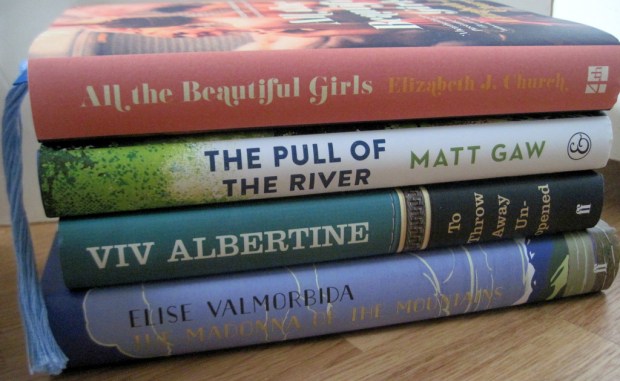
April 5th releases.
 I started another April 5th release on my Kindle a couple of weeks ago, Things Bright and Beautiful by Anbara Salam. It’s about a missionary couple whose lives are disrupted by the return of an older missionary. I was thinking of abandoning it until I got to the last line of the prologue, which threw in a pretty great twist. So maybe I’ll go back to it.
For now, I can recommend the one April 5th release I actually managed to finish:
Dear Mrs. Bird by A.J. Pearce
 If you loved The Guernsey Literary and Potato Peel Pie Society, I have just the book for you: another feel-good World War II-set novel with characters you’ll cheer for. December 1940, London: Twenty-two-year-old Emmeline Lake dreams of being a Lady War Correspondent, but for now she’ll start by typing up the letters submitted to Henrietta Bird’s advice column in Woman’s Friend. All too quickly, though, the job feels too small for Emmy. Mrs. Bird refuses to print letters on Unpleasant subjects, which could include anything from an inappropriate crush to anxiety. She thinks cowardly readers bring their troubles on themselves and need to buck up instead of looking to others for help. But Emmy can’t bear to throw hurting people’s missives away. Perhaps she could send some advice of her own?
Emmy shares a flat with her best friend Bunty, and they each have a fiancé who is part of the war effort. As a volunteer for the Fire Brigade, Emmy sees the effects of Luftwaffe bombings up close. But it’s only after heartache hits home for both of these young women that they really understand how much is at stake in the war. The novel got a little melodramatic for me in its last quarter, but it’s overall a charming “Keep Calm and Carry On” and Stick It to Hitler-style story that never strays far from jollity for too long.
Other readalikes: My Salinger Year by Joanna Rakoff and The Night Watch by Sarah Waters
Some favorite lines:
“I told myself we could all get blown up by tomorrow so we might just as well enjoy ourselves.”
“Granny didn’t spend half her life chaining herself to railings for today’s woman to moon around waiting for some chap to look after her.”
My rating:
 On Monday we’re off to Wigtown, Scotland’s Book Town, for five days. Though we’ve been to Hay-on-Wye, Wales six times, we’ve never been to Wigtown despite meaning to for years. When I read Shaun Bythell’s Wigtown bookselling memoir last autumn, it felt like a sign that it was time. Did you see his The Diary of a Bookseller has been described in French as le quotidien d’un libraire misanthrope écossais (literally, “the daily life of a misanthropic Scottish bookseller”)?

That’s too good! If only it were the official French title. I will of course be visiting his shop, and asking for a signature on my proof copy if I can pluck up the nerve. We’ll strive to be model customers lest we become the subject of a grumpy Tweet or Facebook post.
Coals to Newcastle and all that, but here’s the pile I’ve packed for Wigtown.
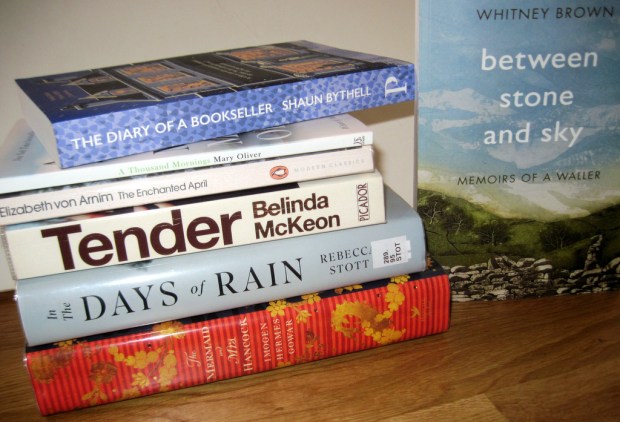
This is mostly for the six-hour car rides there and back. During the days we’ll be busy with outings to the surrounding countryside plus book shopping and café visits, but I daresay there will be some time for reading at the B&B in the afternoons and evenings.
For once I haven’t scoured my shelves for place-appropriate books; I don’t think I own any particularly Scottish reads, unless Michel Faber’s Under the Skin counts (ah wait, I also have an Ali Smith novel on the shelf).
Anyway, this time I’ve really just put together a pile of books I’ve been wanting to read for ages. The only ‘work’-related one is Between Stone and Sky, for a TLS review; otherwise I’m giving myself from Easter through the 6th off. I’m not even sure I’ll take my Kindle, except as a backup – that kind of thing could get you (or, rather, your Kindle) shot in this town. If I do, I’ll be sure to leave it behind in the B&B room or the glove box when we go into town for the day!
What are you up to in April?
Filling One Last Bookcase
Earlier this week I inherited a beautiful antique bookcase from an online friend* who, we learned only recently, lived just 20 minutes away. She has to shed some furniture to move to London, and very kindly thought of me. This is the last major item we could possibly fit in our house, but I was happy to accept because it’s so much nicer than any of our Ikea shelving units. It has the kind of mahogany detail that looks like it could belong on a ship’s wheel.


My goals for the extra shelving space were to be able to keep genres together, to eliminate double stacking where possible, to put all books out on display instead of having some away in an overflow crate, and perhaps to free up the tops of a couple units for knick knacks, etc.


It was a multi-step process undertaken with military precision. Can you tell I used to work in a library?
- Reincorporate Short Stories into General Fiction
- Double-stack the already-read Fiction in the bedroom, leaving the more presentable books at the front; create a Signed Copies area
- Move Poetry in with Classics, double-stacking and putting some books on their sides to make more space; create a Classics priority area, with one book per month chosen for the rest of 2018
- Move oversize Science and Nature, Graphic Novels, Children’s Books, and Coffee Table Books (which, because they’re buried under magazines and newspapers on the coffee table shelf, we never look at) onto the bottom shelf of the new bookcase
- Move all Life Writing (biographies/memoirs), which had been split across a few rooms, onto one bookcase in my study
- Add a selection of Travel and Literary Reference to fill the built-in shelves of my desk, joining Reference and Humor
- Integrate Science and Nature, previously kept separate, into one bookcase


Unread fiction is mostly on the hall bookcase, with an area on the bottom shelf for upcoming projects so I can see what’s awaiting me. I’m keeping these in rough date order from left to right: bibliotherapy prescriptions, possibilities for Reading Ireland month, novellas for November, etc.
However, there are a handful of annoying hardback and trade paperback novels that are just that little bit too tall to fit here, so these have formed a partial shelf on the antique case. I’ve also set aside there the book(s) that I think might be included in my Best of 2018 list and a growing stash of Wellcome Book Prize 2019 hopefuls.
You would never believe it, but I think I need more books! Good thing we have a trip planned to Wigtown, Scotland’s Book Town, for the first week of April. In any case, it’s better to have room to grow into than to already be at capacity or overfull. I can always reshuffle as time goes on if I decide I don’t want any double stacking upstairs or if we ever manage to bring back more of my library from America.


From Book Riot I got the idea of making a personal “hold shelf” of books you own and have been meaning to read. So far I only have four books set aside, arranged as a sort of buffet atop the hall bookcase. Perhaps later I’ll replace this with a full shelf on the antique bookcase. Other ideas for the empty space there would be showcasing my most presentable fiction, or creating a favorites shelf. This was suggested by Paul and corroborated by The Novel Cure, which suggests pulling out the 10 books you love most and are likely to turn to for inspiration.
*If you’re on Instagram, you must check her out. She is a #bookstagram pro: @beth.bonini.
How do you organize your bookshelves?
Christmas Gift Recommendations for 2017
Something tells me my readers are the sort of people who buy books for their family and friends at the holidays. Consider any rating of 3.5 or above on this blog a solid recommendation; 3 stars is still a qualified recommendation, and by my comments you should be able to tell whether the book would be right for you or a friend. I’ll make another plug for the books I’ve already mentioned here as gift ideas and highlight other books I think would be ideal for the right reader. I read all these books this year, and most were released in 2017, but I have a few backlist titles, too – in those cases I’ve specified the publication year. Since I recommend fiction all the time through my reviews, I’ve given significantly more space to nonfiction.
General suggestions:
 For the Shiny New Books Christmas special I chose two books I could see myself giving to lots of people. One was A Glorious Freedom: Older Women Leading Extraordinary Lives by Lisa Congdon, my overall top gift idea. It’s a celebration of women’s attainments after age 40, especially second careers and late-life changes of course. There’s a lively mixture of interviews, first-person essays, inspirational quotes, and profiles of figures like Vera Wang, Laura Ingalls Wilder and Grandma Moses, with Congdon’s whimsical drawings dotted all through. This would make a perfect gift for any woman who’s feeling her age, even if that’s younger than 40. (An essay on gray hair particularly hit home for me.) It’s a reminder that great things can be achieved at any age, and that with the right attitude, we will only grow in confidence and courage over the years. (See my full Nudge review.)
 One Year Wiser: An Illustrated Guide to Mindfulness by Mike Medaglia
Drawn like an adult coloring book, this mindfulness guide is divided into color-block sections according to the seasons and tackles themes like happiness, gratitude, fighting anxiety and developing a healthy thought life. The layout is varied and unexpected, with abstract ideas represented by bodies in everyday situations. It’s a fresh delivery of familiar concepts.


My thanks to SelfMadeHero for the free copy for review.
An Almost Perfect Christmas by Nina Stibbe
 With its short chapters and stocking stuffer dimensions, this is a perfect book to dip into over the holidays. The autobiographical pieces involve Stibbe begrudgingly coming round to things she’s resisted, from Slade’s “Merry Xmas Everybody” to a flaming Christmas pudding. The four short stories, whether nostalgic or macabre, share a wicked sense of humor. You’ll also find an acerbic shopping guide and – best of all – a tongue-in-cheek Christmas A-to-Z. Nearly as funny as Love, Nina. (I reviewed this for the Nov. 29th Stylist “Book Wars” column.)
For some reason book- and nature-themed books seem to particularly lend themselves to gifting. Do you find that too?
For the fellow book and word lovers in your life:
The Diary of a Bookseller by Shaun Bythell
It’s a pleasure to spend a vicarious year running The Book Shop in Wigtown, Scotland with the curmudgeonly Bythell. I enjoyed the nitty-gritty details about acquiring and pricing books, and the unfailingly quirky customer encounters. This would make a great one-year bedside book. (See my full review.)
The Cabinet of Linguistic Curiosities: A Yearbook of Forgotten Words by Paul Anthony Jones
 Another perfect bedside book: this is composed of daily one-page entries that link etymology with events from history. I’ve been reading it a page a day since mid-October. A favorite word so far: “vandemonianism” (rowdy, unmannerly behavior), named after the penal colony of Van Diemen’s Land (Tasmania), first sighted by Europeans on 24 November 1642.
“The Gifts of Reading” by Robert Macfarlane (2016)
 This was my other Christmas recommendation for Shiny New Books. A love of literature shared with friends and the books he now gifts to students and a new generation of nature writers are the main themes of this perfect essay. First printed as a stand-alone pamphlet in aid of the Migrant Offshore Aid Station, this is just right for slipping in a stocking.
A Girl Walks into a Book: What the Brontës Taught Me about Life, Love, and Women’s Work by Miranda K. Pennington
 This charming bibliomemoir reflects on Pennington’s two-decade love affair with the work of the Brontë sisters, especially Charlotte. It cleverly gives side-by-side chronological tours through the Brontës’ biographies and careers and her own life, drawing parallels and noting where she might have been better off if she’d followed in Brontë heroines’ footsteps.
For the nature enthusiasts in your life:
 A Sand County Almanac and Sketches Here and There by Aldo Leopold
Few know how much of our current philosophy of wilderness and the human impact on the world is indebted to Aldo Leopold. This was first published in 1949, but it still rings true. A month-by-month account of life in Wisconsin gives way to pieces set everywhere from Mexico to Manitoba. Beautiful, incisive prose; wonderful illustrations by Charles W. Schwartz.
The History of Bees by Maja Lunde
 Blending historical, contemporary and future story lines, this inventive novel, originally published in Norway in 2015, is a hymn to the dying art of beekeeping and a wake-up call about the environmental disaster the disappearance of bees signals. The plot strands share the themes of troubled parenthood and the drive to fulfill one’s purpose. Like David Mitchell, Lunde juggles her divergent time periods and voices admirably. It’s also a beautifully produced book, with an embossed bee on the dust jacket and a black and gold honeycomb pattern across the spine and boards. (See my full Bookbag review.)
 Epitaph for a Peach: Four Seasons on My Family Farm by David Mas Masumoto (1995)
Masumoto is a third-generation Japanese-American peach and grape farmer in California. He takes readers on a quiet journey through the typical events of the farming calendar. It’s a lovely, meditative book about the challenges and joys of this way of life. I would highly recommend it to readers of Wendell Berry.
A Wood of One’s Own by Ruth Pavey
 This pleasantly meandering memoir, an account of two decades spent restoring land to orchard in Somerset, will appeal to readers of modern nature writers. Local history weaves through this story, too: everything from the English Civil War to Cecil Sharp’s collecting of folk songs. Bonus: Pavey’s lovely black-and-white line drawings. (See my full review.)
It’s not just books…
There are terrific ideas for other book-related gifts at Sarah’s Book Shelves and Parchment Girl.
 With this year’s Christmas money from my mother I bought the five-disc back catalogue of albums from The Bookshop Band. I crowdfunded their nine-disc, 100+-track recording project last year; it was money extremely well spent. So much quality music, and all the songs are based on books. I listen to these albums all the time while I’m working. I look forward to catching up on older songs I don’t know. Check out their Bandcamp site and see if there’s a physical or digital album you’d like to own or give to a fellow book and music lover. They played two commissioned songs at the launch event for The Book of Dust: La Belle Sauvage, so if you’re a Philip Pullman fan you might start by downloading those.
Would you like to give – or get – any of my recommendations for Christmas?
The Diary of a Bookseller by Shaun Bythell
So you think you’d like to run a bookshop? Here’s a book to tempt and deter you in equal measure. In 2001 Shaun Bythell acquired The Bookshop, the flagship bookstore in Wigtown, the Book Town in Galloway in the southwest of Scotland. Here he gives a one-year snapshot of life at the shop, from February 2014 to February 2015. At the start you can feel the winter chill in the old granite building, and as months pass you sense mounting excitement at preparations for the annual Book Festival (going on now) and the Scottish referendum. It’s a pleasure to spend a vicarious year at the shop. This would make a great bedside book for a bookish type to parcel out 5–10 pages at a time (another Christmas gift idea?).
 Bythell frequently ventures out to buy book collections in auctions and from estates, and occasionally goes fishing with his father or friends. But mostly we see what daily life is like for a bookshop owner. He can’t afford full-time staff, so gets sporadic help from university-age gals; his most “reliable” part-timer is Nicky, a ski suit-wearing, Dumpster-diving Jehovah’s Witness who blithely ignores much of what he asks her to do.
Every entry opens and closes with statistics on the day’s takings and online orders. Profits range from £5 to £500 a day, rising in the summer and peaking around £1200 during the festival. Also listed is the number of customers who make purchases, which represents only one-fifth of daily footfall. Nowadays most bookstores sell online too, and The Bookshop reluctantly partners with Amazon as a marketplace seller. There’s also ABE and eBay; as a last-ditch option, some outfits take books in bulk, even if just to recycle them. Alongside online sales, it’s essential for bookstores to have sidelines. Bythell does video production and sells furniture, antiques and walking sticks carved by “Sandy, the tattooed pagan.”
As with Wendy Welch’s The Little Bookstore of Big Stone Gap, I enjoyed the nitty-gritty details about acquiring and pricing books, especially the serendipitous moments of coming across real treasures, like a book signed by Sir Walter Scott and a 1679 edition of the Decameron with an interesting provenance. The book is also full of quirky customer behavior, the kind of stuff that fills The Bookshop’s Facebook feed. Bythell cultivates a curmudgeonly persona – he once shot a broken Kindle and mounted it on the bookshop wall – and maintains a tone that’s somewhere between George Orwell (excerpts from whose “Bookshop Memories” serve as monthly epigraphs) and Jen Campbell (Weird Things Customers Say in Bookshops et al.). Here’s a few of the best encounters:
a whistling customer with a ponytail and what I can only assume was a hat he’d borrowed from a clown bought a copy of Paolo Coelho’s The Alchemist, I suspect deliberately to undermine my faith in humanity and dampen my spirits further.
A man smelling of TCP [antiseptic] was the only customer in the shop for the first hour of opening, during which time I attempted to put out fresh stock. He had an uncanny ability to be standing in front of every shelf to which I needed access, regardless of the subject or where in the shop the relevant shelves were.
While I was repairing a broken shelf in the crime section, I overheard an elderly customer confusing E. L. James and M. R. James while discussing horror fiction with her friend. She is either going to be pleasantly surprised or deeply shocked when she gets home with the copy of Fifty Shades of Grey she bought.
I’ve been to Hay-on-Wye six times now but haven’t made it to Wigtown yet. It’s high on my bookish wish list. I had two additional reasons for wanting to read this particular book: I’d read Three Things You Need to Know about Rockets, a memoir by Bythell’s former partner, the American Jessica Fox (here known as “Anna”; in her book he’s “Ewan”), about coming to Scotland on a whim and falling in love with a bookshop owner; and I’m awfully fond of The Bookshop Band, a folky husband–wife musical duo who this year relocated from Bath to Wigtown. It was such fun to read about their first time playing in Wigtown and their stay as the inaugural guests/temporary store managers via The Open Book Airbnb project.

Colin Kinnear [CC BY-SA 2.0 (https://creativecommons.org/licenses/by-sa/2.0)%5D, via Wikimedia Commons.
The Book Shop trivia:
- December is by far the quietest month. (“The few people who give second-hand books as gifts for Christmas are usually eccentric” – count me as one of them!)
- Railway books sell best.
- Terry Pratchett, John Buchan, P.G. Wodehouse and E.F. Benson books are also perennial best sellers.
- You’ll be amazed at how many customers try to haggle over prices. It’s a shop, not a rummage sale, for goodness’ sake! I can’t imagine ever having the cheek to offer less than the advertised price.
My rating:
The Diary of a Bookseller was released in the UK on September 28th. My thanks to Profile Books for the free review copy.
 Bookish Beck = Rebecca Foster. American transplant to England. Freelance proofreader and book reviewer.
 Bookish Beck