The Woman in Black, Train Dreams, and Absolutely & Forever (#NovNov23)
I’ve been slow off the mark this year, mostly because instead of reading a sensible one or two novellas at a time, I’ve had 10 or 15 on the go. It might mean I’ll read more overall, but from day to day it feels like crawling through loads of books, never to finish any. Except I did finally finish these three, all of which were great reads. After my thoughts on each, I’ll ponder this week’s prompt, “What Is a Novella?”
The Woman in Black by Susan Hill (1983)
This was a reread for me and our November book club book, as well as part of my casual project to read books from my birth year. I’ve generally been underwhelmed by Hill’s ghost stories, but I found this spookier than remembered and enjoyed spotting the nods to Victorian literature and to classic ghost story tropes. (Best of all, because it was so short, everyone actually read the book and came to the discussion. All 12 group members. I can’t recall the last time that happened!)
 Hill keeps the setting deliberately vague, but it seems that it might be the Lincolnshire Fens in the 1930s or so. Arthur Kipps is a young lawyer tasked with attending the funeral of old Mrs Drablow and sorting through her papers. Locals don’t envy him the time spent in Eel Marsh House, and when he starts seeing a wasting-away, smallpox-pocked woman dressed in black in the churchyard, he understands why. This place harbours a malevolent ghost, and from the empty nursery with its creaking rocking chair to the marsh’s treacherous mud, Arthur fears that it’s out to get him.
The rational male narrator who insists he doesn’t believe in ghosts until he can’t deny an experience of one is a feature of the traditional ghost story à la M.R. James – and indeed, one of the chapter titles here (“Whistle and I’ll Come to You”) is a direct adaptation of a James story title. A framing story has Kipps as an older man writing the ghost story to share with his stepchildren. Some secondary characters have Dickensian names and there’s a Bleak House-esque description of a thick fog. The novel’s title must be an homage to Wilkie Collins’s sensation novel The Woman in White, with which it shares the theme of debated parentage.
A few members of our book club had seen the play or one of two film versions. Curiously, it seems like both movies alter the ending. Why, when the last four pages are such a perfect kicker? I might have dismissed the whole as a bit dull were it not for the brilliant conclusion. (Public library) [160 pages] 
Train Dreams by Denis Johnson (2002)
This is Cathy’s example of a perfect novella. I picked it up on her recommendation and read it within a few days (though you could easily do so in one sitting). Robert Grainier is a manual labourer in the American West. His body shattered by logging before he turns 40 and his spirit nearly broken by the loss of his home to a forest fire, he looks for meaning in the tragedy and a purpose to the rest of his long life. Is he being punished for participating in the attempted lynching of a Chinese worker decried as a thief? Or for not helping an injured man he came across in the woods as a teenager?
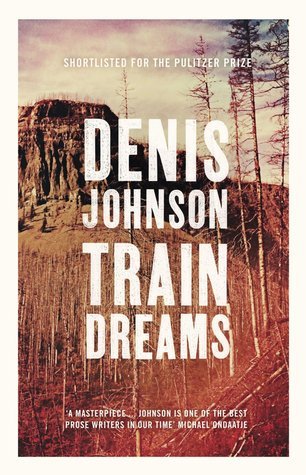 Although Grainier might appear to be a Job-like figure, his loneliness never shades into despair, lightened by comic dialogues and the mildest of supernatural interventions. He starts a haulage business and keeps dogs. There are rumours of a wolf-girl in the area, and, convinced that his dog’s new pups are part-wolf, he teaches them to howl – his own favourite way of letting off steam.
A couple of gratuitously bleak scenes (a confession of incest and an accidental death) made me think Cormac McCarthy would be a major influence, but the tone is lighter than that. Richard Brautigan came to mind, and I imagine many contemporary writers have found inspiration here: Carys Davies, Ash Davidson, Donald Ray Pollock, even Patrick deWitt.
Gritty yet light, this presents life as an arbitrary accumulation of error and incident, longing (“Pulchritude!”) and effort. Grainier is an effective Everyman, such that his story feels not just all-American but universal. (Free from a neighbour) [116 pages] 
Absolutely and Forever by Rose Tremain (2023)
I had lost track of Tremain’s career a bit; I find her work hit and miss – perhaps too varied, though judging by her last five novels, she seems to have settled on historical fiction as her wheelhouse. I wasn’t sure what to expect from this latest book, but seeing that it was novella length, I was willing to give it a try. Tremain follows her heroine, Marianne Clifford, from the 1950s up to perhaps 1970. At age 15, she falls hopelessly in love with an 18-year-old aspiring writer, Simon Hurst, and loses her virginity in the back of his pale blue Morris Minor. She feels grown-up and sophisticated, and imagines their romance as a grand adventure that will whisk her away from her parents’ stultifying ordinariness –
when I thought about my future as Mrs Simon Hurst (riding a camel in Egypt, floating along in a gondola in Venice, driving through the Grand Canyon in an open-topped Cadillac, watching elephants drink from a waterhole in Africa) and about Mummy’s future (in the red-brick house in Berkshire with the shivery birch tree and the two white columns, playing Scrabble with Daddy and shopping at Bartlett’s of Newbury), I could see that my life was going to be more interesting than hers and that she might already be envious
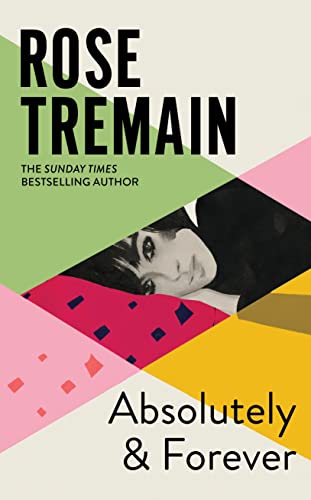 – but his new post-school life in Paris doesn’t have room for her. As she moves to London and trains for secretarial work, Marianne is bolstered by friendships with plain-speaking Scot Petronella (“Pet”) and Hugo Forster-Pellisier, her surfing and ping-pong partner on their parents’ Cornwall getaways. Forasmuch as her life changes over the next 15 years or so – taking on a traditional wife and homemaker role; her parents quietly declining – her attachment to her first love never falters.
This has the chic and convincing 1960s setting of Tessa Hadley’s work. Marianne’s narration is a delight, droll but not as blasé as she tries to appear. Tremain could have easily fallen into the trap of making her purely naïve (in the moment) or nostalgic (looking back), but instead she’s rendered her voice knowing yet compassionate, and made her a real wit (“I thought, Everything in Paris looks as if it’s practising the waltz, whereas quite a lot of things in London … appear as if they’ve just come out of hospital after a leg operation”). Pet is very funny, too. And it’s always fun for me to have nearby locations: Newbury, Reading, Marlborough. In imagining a different life for herself, Marianne resists repeating her mother’s mistakes and coincides with the rising feminist movement. There are two characters named Marianne, and two named Simon; the revelations about these doubles are breathtaking.
This really put me through an emotional wringer. It’s no cheap tear-jerker but a tender depiction of love in all its forms. I think, with Academy Street by Mary Costello, it may be my near-perfect novella. (Public library) [181 pages] 
Novellas in November, Week 2: What Is a Novella?
- Ponder the definition, list favourites, or choose ones you think best capture the ‘spirit’ of a novella.

A novella is defined by its length in words, but because that’s often difficult for readers to gauge, for this challenge we go by the number of pages instead, making 200 an absolute maximum – though some books with wide margins and spacing may top that but still seem slight enough to count (while those with tiny type can feel much longer than 160–200 pages).
Thematically, a novella is said to be concentrated on one character or small set of characters, with one plotline rather than several. This week I’ve been musing on a theory: a novella is to a novel what a memoir is to an autobiography. That is, if the latter is a comprehensive and often chronological story, the former focuses on a particular time or experience and shapes a narrative around it. What it potentially sacrifices in scope it makes up for with intensity.
But as soon as I’d formulated this hypothesis to myself, I started thinking of exceptions on either side. Train Dreams, like Silk by Alessandro Baricco and A Whole Life by Robert Seethaler, conveys a pretty complete life story. And no doubt there are many full-length novels that are almost claustrophobic in their adherence to one point of view and timeline.

The simplest way I’d put it is that a novella is a book that doesn’t outstay its welcome. I think it must be easier to write a doorstopper than a novella. Once you’ve arrived at a voice and a style, just keeping going can become a question of habit. But to continue paring back to get at the essence of a character and a situation – that takes real discipline. My other criterion would be that it has to portray the full range of human emotion, even if within a limited set of circumstances. Based on that, Train Dreams and Absolutely and Forever both triumph.
A few classic novellas that do this particularly well (links to my reviews):
Giovanni’s Room by James Baldwin
A Month in the Country by J. L. Carr
Miss Lonelyhearts by Nathanael West
Ethan Frome by Edith Wharton



A few more contemporary novellas that do this particularly well (links to my reviews):
A Lie Someone Told You about Yourself by Peter Ho Davies
Our Souls at Night by Kent Haruf
Foster by Claire Keegan
A Feather on the Breath of God by Sigrid Nunez


The Suspicions of Mr Whicher Stage Production
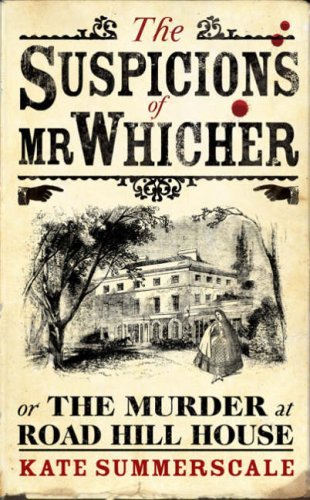
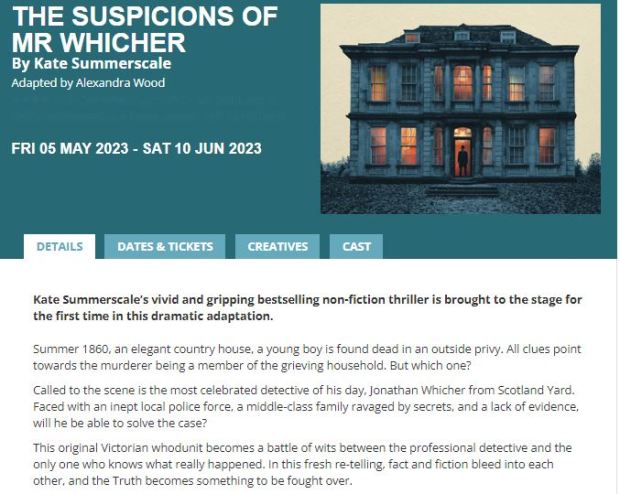
Just a few months after Notes from a Small Island, it was back to one of my local theatres, The Watermill, for the stage adaptation of another book club selection, this time the Victorian true crime narrative The Suspicions of Mr Whicher by Kate Summerscale, which won the Samuel Johnson Prize (now called the Baillie Gifford Prize) for non-fiction in 2008.
{SPOILERS ENSUE}
I must have read the book in 2009, the year after it first came out, and while I had the best intentions of rereading it in time for our book club meeting earlier this month, I didn’t even manage to skim it. I remembered one fact alone, the method of murder, which is not surprising as it was particularly gruesome: A young boy had his throat slit and was stuffed down the privy. But that was all that had remained with me. My husband filled me in on the basics and the discussion, held at our house, reminded me of the rest. We then made it a book club outing to the theatre.
The crime took place in late June 1860 at the Wiltshire home of the Kent family: the patriarch, a factory inspector; his four children from his first marriage; his second wife, formerly the older set’s governess; and their three young children. Jonathan “Jack” Whicher, sent by Scotland Yard to investigate, was one of London’s first modern detectives and inspired Wilkie Collins and Charles Dickens. Constance Kent, 16, later confessed to the murder of her three-year-old half-brother, Saville, motivated by anger at her stepmother for replacing her mentally ill mother, but uncertainty remained as to whether she had acted alone.
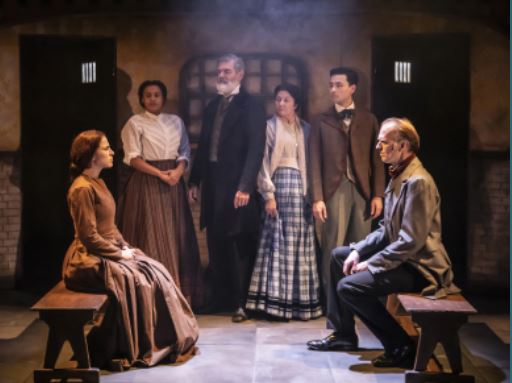
The play was very well done, maintaining tension even though there was a decision to introduce Constance as the killer immediately: the action opens on her and Mr Whicher in her cell at Fulham Prison in the 1880s. This is an invented scene in which he has come to visit, begging her to tell him the whole truth in exchange for him writing a letter to try to secure her early release. (She appealed four times but ended up serving a full 20-year sentence.)
Cold, stark lighting and a minimal set of two benches against a backdrop of steel doors and a mullioned window evoke the prison setting, with only the subtle change to warmer lighting indicating flashbacks as Constance and Whicher remember or act out events from 20 or more years before. These two remain on stage for the entirety of the first act. Four other actors cycle in and out, playing Kent family members and various other small roles. For instance, the bearded middle-aged actor who plays Mr Kent also appears as a coroner giving a precis of Saville’s autopsy – he mentions Collins and Dickens, but the evolution of the Victorian detective is, by necessity, a much smaller element of the play than it was in the book.
It’s a tiny theatre, but projections on a screen (such as a sinuous family tree) and a balcony, used for wordless presence or loud pronouncements, made it seem bigger than it was. Saville himself is only depicted as a mute figure on that upper level, in the truly spooky scene that closes the first act. I remember when the Watermill put out a discreet call for child actors, warning parents about the sort of content to expect. Three children play the role (plus one other bit part) in rotation. Pulsing violin music enhanced the feeling of dread, and each act was no more than 45 minutes, so the atmosphere remained taut.

Production photographs by Pamela Raith.
A missing nightdress – presumably blood-stained – as well as her own father’s hunch, were among the main evidence against Constance, so Whicher did not secure a conviction at the time and was publicly ridiculed for his failure to crack the case. That and his own loss of a child are suggested to be behind his obsession with tying up loose ends. While Constance expresses regret for her actions and calmly takes him through the accepted timeline of the murder, she refuses to give him anything extra.
The second act delves into what happened next for Constance: living among nuns in France and then in Brighton, where she decided to confess, and then relocating to Australia, where she worked in a halfway house for lepers and troubled youth, as if to make up for the harm she caused earlier in her life (and she lived to age 100!). This involved the most significant change of set and actors, with the former Mr. and Mrs. Kent now filling in as the older Constance and William, the brother closest to her in age.
The play fixates on the siblings’ relationship, returning several times to their whim to run away to Bristol and be “cabin boys” together. I wondered if there was even meant to be a sexual undercurrent to their connection. William Savill-Kent went on to be a successful marine biologist specialising in corals and Australian fisheries. One theory is that they were accomplices in the murder but Constance took the fall so that her brother could live a full life.
Intriguingly, the team behind the production decided to espouse this hypothesis explicitly. In the chilling final scene, then, a crib is wheeled out to the centre of the stage and Constance floats on in a white nightdress to lower the side closest to the audience. Just before the lights go down, William, too, appears in a white nightdress and stands over the far side of the crib.
Although I referred to the book as “compulsive” in the one mention I find of it in my computer files, from 2011, I only gave it 3 stars – my most common rating in those years, an indication that a book was alright but I moved right along to the next in the stack and it didn’t stick with me. My book club had mixed feelings, too, generally feeling that there was too much extraneous detail, which perhaps kept a narrative that could have read as fluidly as a novel from being truly gripping. The play, though, was thrilling.
Book (c. 2009): 
Play:
Buy The Suspicions of Mr. Whicher from Bookshop.org [affiliate link]
 Bookish Beck = Rebecca Foster. American transplant to England. Freelance proofreader and book reviewer.
 Bookish Beck