Sapphira and the Slave Girl & Portrait of the Artist as a Young Dog (#1940Club)
(I was disgusted by the ad-ridden appearance of my blog, and defeated by the task of culling my media library, so I’ve upgraded to a paid plan for a trial year. I had until now vowed not to spend any money on the site since I don’t make any money from it, but WordPress hooked me in with a 30% off deal, and I’ll appreciate the no ads and extra storage space. I hope it looks better now!)

A year club hosted by Karen and Simon is always a great excuse to read more classics. One of these was a winner, if peculiar; the other was so-so, but helped clarify for me what a particular literary prize is looking for.
Sapphira and the Slave Girl by Willa Cather
{SPOILERS IN THIS ONE}
I was surprised to find that this was my seventh book by Cather, so I’ve actually read over half of her novels now. I think all her other works I know were set on the prairies of the Midwest (or in Santa Fe in the case of Death Comes for the Archbishop), so Sapphira and the Slave Girl feels like an odd one out not just for its antebellum historical subject matter but also for its setting in Cather’s hometown of Winchester, Virginia.
In 1856, the Colberts’ is a house divided: Henry, a miller from Quaker stock, disapproves of slavery; his wife, Sapphira, grew up with slaves and treats them severely. While the other Colbert brothers’ meddling with Black women is an open secret – one of them is assumed to have fathered Henry and Sapphira’s mixed-race teenage slave, Nancy – Henry looks fondly on Nancy and thinks of her almost like a second daughter. Sapphira resents that attention. When her Colbert nephew, Martin, a known cad, comes to visit, she arranges, or at least allows, convenient opportunities for Martin to be alone with Nancy.
 Nancy appeals to the Colberts’ adult daughter, Rachel Blake, to accompany her on her walks so that Martin will not “overtake” her in the woods. Although none of the white characters take the repeated threat of attempted rape seriously enough, Henry and Rachel do eventually help Nancy escape to Canada via the Underground Railroad. When Sapphira realizes her ‘property’ has been taken from her, she informs Rachel she is now persona non grata, but changes her mind when illness brings tragedy into Rachel’s household.
Had this been written 40–80 years later, it would have been completely different: first of all, I would expect it to much more graphically recount Black suffering, rather than depicting generally happy “darkies” with folksy accents and quirky character traits; secondly, there would be either a redemptive or a punitive plot arc for Sapphira. Instead, Cather paints her as a flawed human being who accepts the status quo but is also graceful in disability (she has dropsy and is in a wheelchair) and accepting of the approach of death.
I wish I remembered from the Hermione Lee biography more about the immediate inspiration for this novel, and its reception. Simply taking an interest in Black characters must have set it apart. For instance, there is a whole chapter on Nancy’s grandmother, Aunt Jezebel, the first generation kidnapped from Africa; and the final section has Nancy, now a sophisticated Montreal housekeeper dressed in silk and fur, visiting her mother 20 years after the Civil War. That Cather’s characterization otherwise doesn’t rise above cheerful mammy stereotypes can hardly be counted against her given the time period, right? It was good to experience a lesser-known American classic that I can imagine appealing to fans of Thomas Hardy and Edith Wharton as well. (From a Little Free Library in Queen Camel, Somerset; April 2021)
Portrait of the Artist as a Young Dog by Dylan Thomas
 Published when Thomas was in his mid-twenties, this is a series of 10 sketches, some of which are more explicitly autobiographical (as in first person, with a narrator named Dylan Thomas) than others. There is a rough chronological trajectory to the stories, with the main character a mischievous boy, then a grandstanding teenager, then a young journalist in his first job. The countryside and seaside towns of South Wales recur as settings, and – as will be no surprise to readers of Under Milk Wood – banter-filled dialogue is the priority. I most enjoyed the childhood japes in the first two pieces, “The Peaches” and “A Visit to Grandpa’s.” The rest failed to hold my attention, but I marked out two long passages that to me represent the voice and scene-setting that the Dylan Thomas Prize is looking for. The latter is the ending of the book and reminds me of the close of James Joyce’s “The Dead.” (University library)
I was a lonely night-walker and a steady stander-at-corners. I liked to walk through the wet town after midnight, when the streets were deserted and the window lights out, alone and alive on the glistening tram-lines in dead and empty High Street under the moon, gigantically sad in the damp streets by ghostly Ebenezer Chapel. And I never felt more a part of the remote and overpressing world, or more full of love and arrogance and pity and humility, not for myself alone, but for the living earth I suffered on… [etc.]
For a long time he waited on the stairs, though there was no love now to wait for and no bed but his own too many miles away to lie in, and only the approaching day to remember his discovery. All around him the disturbed inhabitants of the house were falling back into sleep. Then he walked out of the house on to the waste space and under the leaning cranes and ladders. The light of the one weak lamp in a rusty circle fell across the brick-heaps and the broken wood and the dust that had been houses once, where the small and hardly known and never-to-be-forgotten people of the dirty town had lived and loved and died and, always, lost.
(I’ve previously participated in the 1920 Club, 1956 Club, 1936 Club, 1976 Club, 1954 Club and 1929 Club.)
Constructing a Nervous System by Margo Jefferson
I’ve had mixed feelings about the online nature of life recently. On Sunday I avoided the Internet altogether so as not to be bombarded with (UK) Mother’s Day memes and notifications. Yesterday our home broadband dropped out completely, such that I couldn’t do any freelance work or post about the Folio Prize poetry shortlist as I’d meant to do on World Poetry Day. Too much connectivity or not enough. Today – just as a line engineer is due to arrive; that usual irony – all is normal and I’m back in the swing of working and blogging.
Using my husband’s phone as a hotspot, I was at least still able to watch yesterday evening’s free 5×15 event with the Rathbones Folio Prize, featuring Amy Bloom, NoViolet Bulawayo, Sheila Heti, Margo Jefferson and Elizabeth Strout and hosted by interviewer Alex Clark. Over the next couple of days I’ll review Heti and Strout’s novels and the entire poetry shortlist, but for now I’ll weave some of the insight I gained last night into a review of Constructing a Nervous System by Margo Jefferson (2022), the new-to-me book from the nonfiction shortlist that I was most interested in reading.
Although the subtitle is “A Memoir,” this experimental text does such novel things with the genre that it bears little resemblance to most memoirs I’ve read. For that reason alone, I can see why the judges shortlisted it. During the 5×15 event, Jefferson described her book as “an assemblage of ideas, memories, sensations, feelings, and other people’s words—not just my own.” It’s also a reckoning with culture – particularly jazz music and dance by African Americans, but also particular examples from the white literary canon.
Jefferson was a long-time theatre and book critic for Newsweek and The New York Times and won a Pulitzer Prize for her criticism in 1995; she now teaches writing at Columbia University. She has previously published another memoir, Negroland, and a biography of Michael Jackson. Here she blends her chosen genres of life writing and cultural criticism. Her aim, she said, was to craft “criticism with the intensities and intimacies of memoir” and “memoir with the range of criticism.”

Jefferson mentioned that the deaths of her mother and older sister (who was like her muse) left her an orphan and, strangely, “cleared the stage for me to step out and speak my lines.” Indeed, the book is loosely structured as a play, opening with the metaphor of an empty stage and ending with the direction “BLACKOUT.” In between there are many imagined dialogues with herself or between historical figures, such as the bizarre pairing of George Eliot and W.E.B. Du Bois. Some quotations and definitions appear in italics or bold face. Ella Fitzgerald and Josephine Baker play major roles, but there’s also a surprisingly long section devoted to Willa Cather’s The Song of the Lark, which Jefferson loves and has often taught, yet finds problematic for how it enshrines whiteness (“Confederate Southern mythmaking”).
I don’t feel that I got much of a sense of the sweep of Jefferson’s life from the book, just a vague impression of an upper-middle-class Black upbringing. (Perhaps Negroland is a more straightforward memoir?) To be sure, she was keen to avoid “slogging through chronology,” as she explained, instead welcoming onto the page “a repertory company of myself as I encounter all the materials of my life—the factual and historical as well as the creative.” And so I do feel I have met her as an industrious mind, drawing connections between disparate aspects of experience and cultural consumption. This is a model of how a critic (like myself) might incorporate a body of work into a record of life. Yet when so many of her touchstones do not overlap with mine, I could only observe and admire from afar, not be truly drawn in.
Some lines I loved:
“Remember: Memoir is your present negotiating with versions of your past for a future you’re willing to show up in.”
“Older women’s tales— ‘Une femme d’un certain âge’ tales—are hard to pull off. They risk being arch.”
(of Ella Fitzgerald) “You turned the maw of black female labor into the wonderland of black female art.”
“Women’s anger needs to be honored—celebrated and protected—the way virginity used to be! … I’ve spent my adult years working on an assemblage of black feminist anger modes.”
With thanks to FMcM Associates and Granta Books for the free copy for review.
I was very impressed with both Amy Bloom and Margo Jefferson ‘in person’ (on Zoom): elegant, intellectual, well-spoken; authors at the top of their game. I reviewed Amy Bloom’s affecting memoir In Love, about her husband Brian’s early-onset Alzheimer’s and the decision to end his life at Dignitas in Zurich, last year. She told Alex Clark that the book started as a caregiver’s notes, but Brian made it clear that he wanted her to write about the experience, to inform people about end-of-life options. She believes that ultimately the memoir is about what it means to be a person and the decisions that make up a life. Her children joke that her only four subjects – in fiction or otherwise – are love, sex, family and death. Well, what else is there, really?
I know only the barest facts about the other three books on the Folio nonfiction shortlist but none of them screams ‘must read’ to me:
- The Passengers by Will Ashon – oral narratives from contemporary Britain
- The Escape Artist by Jonathan Freedland – biography of an Auschwitz whistle-blower
- The Social Distance Between Us by Darren McGarvey – a rapper’s book about inequality and antisocial behaviour
Have you read, or would you read, anything from the Folio nonfiction shortlist?
Tomorrow: Five poetry shortlist reviews
Friday: Two fiction shortlist reviews; my predictions for the category winners and overall prize winner
Christmas and Snow Reading: George Mackay Brown & More
I’ve never had a Christmas Day without my immediate family or in-laws before, but when West Berkshire leapt into the Tier 4 (highest) COVID-19 risk category on Saturday it was clear that even our modest plans to spend 48 hours at my parents-in-law’s home by the coast would be dashed. How we’d looked forward to seeing other people and going somewhere else! Nothing dramatic; just a change of scene and an excuse to pack an overnight bag and a giant tote full of books. The bright side, if there is one, is that we can choose exactly how to spend the holidays, and my husband – a fantastic cook – will have total control over the feast.
To keep our spirits up, we’ve done more Christmas decorating than usual. Our lounge is dominated by the biggest tree we’ve had yet, there’s holly all over, and we strung colored fairy lights across one wall. After Saturday’s bad news, we brought forward our annual viewing of Elf. And of course, I have a stack of seasonally appropriate books at the ready.
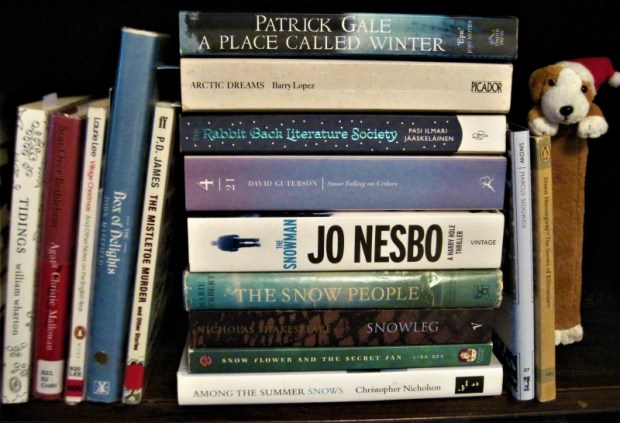
Here’s the first two I managed to read for review:
Christmas Stories by George Mackay Brown
 Many of these 30 short stories originally appeared in publications like the Scotsman, Tablet and Glasgow Herald between the 1940s and 1990s, with some also reprinted in previous Mackay Brown story volumes. This posthumous collection of seasonal tales by Orkney’s best-known writer runs the gamut from historical fiction to timeless fable, and travels from the Holy Land to Scotland’s islands. Often, Orkney is contrasted with Edinburgh, as in one of my favorites, “A Christmas Exile,” in which a boy is sent off to Granny’s house in Orkney one winter while his mother is in hospital and longs to make it home in time for Christmas.
Although the main characters are usually crofters, fishermen and lairds, they take on other roles in Nativity and Christmas Carol-like setups. For instance, a skipper, a miller, and a shepherd play the part of the Three Kings, while a greedy general merchant who won’t close his shop for Christmas Day is like Ebenezer Scrooge. Biblical and Dickensian figures merge in “An Epiphany Tale,” in which a deaf-blind-mute boy is visited by three strangers who give him back each of his senses, in turn, for one magical day. Characters get visions of the past or glimpses of how the other half live (“The Poor Man in His Castle”). Children are disabused of the idea of Santa Claus, but the unexplained still fuels a sense of wonder, as in Jeanette Winterson’s holiday stories. Even the poor have small gifts and pleasures to look forward to.
As editor William S. Peterson notes in his introduction, Calvinism had erased much of the joy from Christmas in Scotland, but in Mackay Brown’s lifetime he saw Yule traditions returning and was keen to emphasize that Christmas was not just about one day of celebration but was a whole season running from Advent through to Epiphany. The story “I Saw Three Ships…” remembers an oppressed past, though: set at the end of the Civil War, after King Charles I was beheaded, it is set at a time when the government declared “‘There will be no more Christmas. Christmas is abolished and forbid in the islands here, as it has been put down everywhere in this commonwealth. We will have no more of such ancient mummery.’ … Men reckoned that that was the longest coldest dreichest winter ever known in Orkney.” Those words might feel gloomily appropriate, but let’s celebrate all the more in defiance.
With thanks to Galileo Publishers for the free copy for review.
Fifty Words for Snow by Nancy Campbell
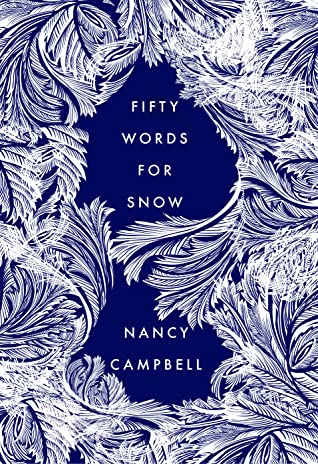 Words for snow exist in most of the world’s languages – even those spoken in countries where it rarely, if ever, snows. For instance, Thai has “hima” at the ready even though there were only once claims of a snow flurry in Thailand, in 1955. Campbell meanders through history, legend, and science in these one- to five-page essays. I was most taken by the pieces on German “kunstschnee” (the fake snow used on movie sets), Icelandic “hundslappadrifa” (snowflakes big as a dog’s paw, a phrase used as a track title on one of Jónsi’s albums – an excuse for discussing the amazing Sigur Rós), and Estonian “jäätee” (the terrifying ice road that runs between the mainland and the island of Hiiumaa – only when the ice is 22 cm thick, and with cars traveling 2 minutes apart and maintaining a speed of 25–40 km/hour).
The white and blue tendrils of the naked hardback’s cover creep over onto the endpapers, each essay is headed by a Wilson Bentley photograph of a snowflake, and the type is in a subtle dark blue ink rather than black. Too many of the essays are thin or dull, such that the contents don’t live up to the gorgeous physical object they fill. Still, I imagine you have a snow-loving relative who would appreciate a copy as a seasonal coffee table book.
With thanks to Elliott & Thompson for the free copy for review.
And a bonus:
“The Burglar’s Christmas” by Willa Cather (1896)
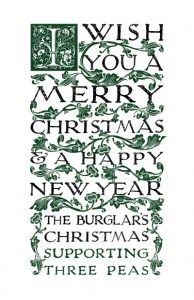 This Renard Press pamphlet supporting the Three Peas charity (in aid of Europe’s refugees) was sent to me as a Christmas card alternative by Annabel/Shiny New Books. A young man wanders the slushy streets of Chicago one Christmas Eve. On this, his 24th birthday, he laments how low he has sunk that he has to rob the rich in order to get money to eat. But in this take on the Prodigal Son story, there is a second chance at forgiveness and a good life. I was reminded of the high society atmosphere of Edith Wharton’s work and the moral fables of O. Henry. The lovely little story has a William Morris design on the cover. I’ll keep it with my small collection of Christmas books and bring it out to reread in future years.
Are you reading any Christmas or wintry books?
What are your plans for the holidays?
Blog Tour: Literary Landscapes, edited by John Sutherland
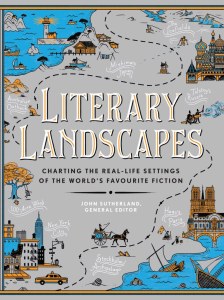 The sense of place can be a major factor in a book’s success – did you know there is a whole literary prize devoted to just this? (The Royal Society of Literature’s Ondaatje Prize, “for a distinguished work of fiction, non-fiction or poetry, evoking the spirit of a place.”) No matter when or where a story is set, an author can bring it to life through authentic details that appeal to all the senses, making you feel like you’re on Prince Edward Island or in the Gaudarrama Mountains even if you’ve never visited Atlantic Canada or central Spain. The 75 essays of Literary Landscapes, a follow-up volume to 2016’s celebrated Literary Wonderlands, illuminate the real-life settings of fiction from Jane Austen’s time to today. Maps, author and cover images, period and modern photographs, and other full-color illustrations abound.
Each essay serves as a compact introduction to a literary work, incorporating biographical information about the author, useful background and context on the book’s publication, and observations on the geographical location as it is presented in the story – often through a set of direct quotations. (Because each work is considered as a whole, you may come across spoilers, so keep that in mind before you set out to read an essay about a classic you haven’t read but still intend to.) The authors profiled range from Mark Twain to Yukio Mishima and from Willa Cather to Elena Ferrante. A few of the world’s great cities appear in multiple essays, though New York City as variously depicted by Edith Wharton, Jay McInerney and Francis Spufford is so different as to be almost unrecognizable as the same place.
One of my favorite pieces is on Charles Dickens’s Bleak House. “Dickens was not interested in writing a literary tourist’s guide,” it explains; “He was using the city as a metaphor for how the human condition could, unattended, go wrong.” I also particularly enjoyed those on Thomas Hardy’s The Return of the Native and Robert Louis Stevenson’s Kidnapped. The fact that I used to live in Woking gave me a special appreciation for the essay on H. G. Wells’s The War of the Worlds, “a novel that takes the known landscape and, brilliantly, estranges it.” The two novels I’ve been most inspired to read are Thomas Wharton’s Icefields (1995; set in Jasper, Alberta) and Kate Grenville’s The Secret River (2005; set in New South Wales).

The essays vary subtly in terms of length and depth, with some focusing on plot and themes and others thinking more about the author’s experiences and geographical referents. They were contributed by academics, writers and critics, some of whom were familiar names for me – including Nicholas Lezard, Robert Macfarlane, Laura Miller, Tim Parks and Adam Roberts. My main gripe about the book would be that the individual essays have no bylines, so to find out who wrote a certain one you have to flick to the back and skim through all the contributor biographies until you spot the book in question. There are also a few more typos than I tend to expect from a finished book from a traditional press (e.g. “Lady Deadlock” in the Bleak House essay!). Still, it is a beautifully produced, richly informative tome that should make it onto many a Christmas wish list this year; it would make an especially suitable gift for a young person heading off to study English at university. It’s one to have for reference and dip into when you want to be inspired to discover a new place via an armchair visit.
Literary Landscapes will be published by Modern Books on Thursday, October 25th. My thanks to Alison Menzies for arranging my free copy for review.
Reviews Roundup, February–March
One of my goals with this blog was to have one convenient place where I could gather together all my writing that appears in disparate online locations. To that end, once a month I provide links to all book reviews I’ve published elsewhere, with a rating (below each description) and a taster so you can decide whether to read more. A few exceptions: I don’t point out my Kirkus Indie, BlueInk or Publishers Weekly reviews since I don’t get a byline. Meanwhile, I’ve done my first article for the Los Angeles Review of Books – exciting!
The Bookbag
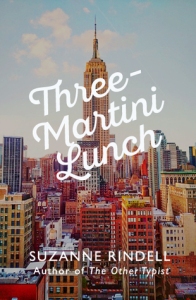
Three-Martini Lunch by Suzanne Rindell: Brings the late 1950s, specifically the bustling, cutthroat New York City publishing world, to life through the connections between three young people who collide over a debated manuscript. The three first-person voices fit together like a dream. It’s an expert evocation of Beat culture and post-war paranoia over Communism and homosexuality. Walking into Eden’s office, especially, you’ll think you’ve landed on the set of Mad Men. This classy, well-plotted follow-up will win Rindell even more fans and tide us all over until the film version of The Other Typist – produced by and starring Keira Knightley – appears. Releases May 19th in the UK.

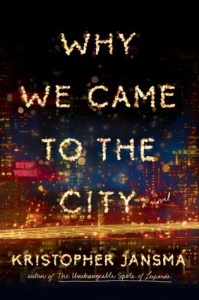 Why We Came to the City by Kristopher Jansma: Five university friends strive to make their lives count against the indifferent backdrop of recession-era New York City. When one of them falls ill, they pull together like a family. The tone of the novel lies somewhere between A Little Life and the sitcom Friends (a Mexican version of which the characters watch obsessively). Even as his characters realize that they are not special and not in control of their lives, Jansma never lets his book descend too far into gloom. Narrowly misses out on 5 stars from me because the storyline loses momentum in Part Two. Rich with emotion and literary allusions (from Walden to The Iliad), this is my favorite novel of the year so far.
Waltzing in Vienna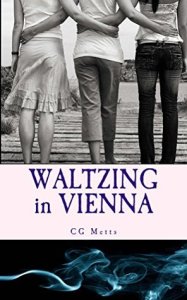 by C.G. Metts (& interview): Three girlfriends – a singer staging a comeback, a psychology professor reawakening to sexuality after being widowed, and a socialite Southern Belle – are reunited in Charleston, South Carolina in their early forties. Remembering their wild college days, they wonder how to make midlife count. There’s a fun Sex and the City or Ya-Ya Sisterhood vibe to this recommended debut novel. I liked the mixture of nostalgia and gentle feminism, and I think this may also inspire readers to see South Carolina’s coastal landscape for themselves. The title phrase is the friends’ shorthand for smoking marijuana together.

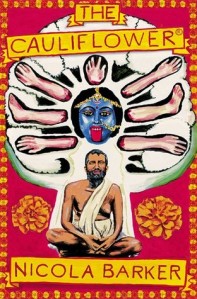 The Cauliflower® by Nicola Barker: Put simply, this is a fictionalized biography of the largely illiterate Hindu guru Sri Ramakrishna (1836–1886). That may sound dry as dust, but Barker makes it a playful delight by skipping around in time and interspersing aphorisms, imagined film scenes, questions and answers, and even a recipe with the narrative chapters. The kernel of the story – set in 1857 at the Dakshineswar Kali Temple, six miles north of Calcutta – is narrated in the first person by the guru’s nephew, Hriday. Scripture of all types (the Bible is also cited) is a relevant, joyful echo here rather than a dull set of rules. Bizarre but very readable. Releases April 21st.
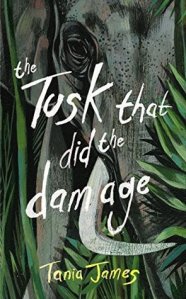 The Tusk That Did the Damage by Tania James: This composite picture of the state of wildlife conservation in India is told from three perspectives: an elephant named the Gravedigger, a poacher, and a documentary filmmaker. James ably intersperses three voices as she explores how people fail to live up to their ideals and make harmful assumptions. Despite these attributes, it was one of those books I had to force myself through. Perhaps it was the environmental agenda: if a book is going to wear its message so openly, it has to live up to it in terms of the writing. I might have preferred it if the whole novel had been from Emma’s point of view, with one climactic encounter with the Gravedigger to make the poaching question immediate and not simply academic.

BookBrowse
Dog Run Moon: Stories by Callan Wink [subscription service]: Wink’s debut story collection, set mostly under Montana’s open skies, stars a motley cast of aimless young men, ranchers, Native Americans, and animals live and dead. He plays around with Western stereotypes in intriguing ways. A few of the tales are a bit less compelling, and I would have preferred more variety in narration (8 of 9 are third person), but the stand-outs more than make up for it. My two favorites were “Runoff” (there’s a double meaning to the title) and “Exotics,” in which all the characters are lured by the life they don’t currently have.
 For Books’ Sake
Interview with Rachel B. Glaser, author of Paulina & Fran [my review of which was in last month’s roundup]
Foreword Reviews
 Night Ringing by Laura Foley: Foley’s strong fifth collection ruminates on romance and family via autobiographical free verse. One of the collection highlights is “In the Honda Service Area,” which unexpectedly unites modern technology with ancient literature. While a woman describes her impending hip replacement surgery to a friend, Foley tries to concentrate on Homer’s Iliad. The collection is dedicated to Foley’s partner, Clara Giménez, and lesbian romance is a subtle undercurrent. Especially recommended for fans of Jane Hilberry and Adrienne Rich.
The Temple of Paris by Laura DeBruce: This second volume in Laura DeBruce’s Quicksilver Legacy trilogy is a fast-paced fantasy adventure novel. In the previous book, the author introduced the “Immortals,” centuries-old creatures who are impervious to disease and aging due to a magic elixir. If Hana, the teenage protagonist, can learn how to use the elixir in her possession correctly, she can save her mother from a potentially fatal blood disorder. Although the complicated plot might be challenging for those new to the series, older teens will appreciate the rollicking story and the chance for vicarious European sightseeing.

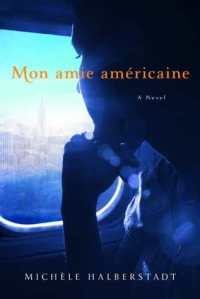 Mon amie américaine by Michèle Halberstadt: After years of heavy smoking and migraines, a brain aneurysm plunges forty-year-old Molly into a coma. The novel is presented as Michèle’s confessional letter to her American friend Molly, addressed in the second person. During Molly’s coma and after she wakes up, Michèle ponders their unlikely friendship and also frets over her threatened marriage. The novella is like a cross between Jenny Offill’s Dept. of Speculation and Jean-Dominique Bauby’s The Diving-Bell and the Butterfly, and bears tantalizing traces of deliberate homage to Pedro Almodóvar’s coma-themed Talk to Her: an understated dual account of betrayal and disability.
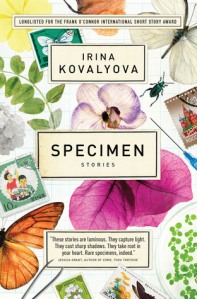 Specimen: Stories by Irina Kovalyova: “People like to pretend that our genes define the truth for us. But I assure you that’s not the case,” a character insists in the title story. Diverse in setting and form, these nine stories, long-listed for the Frank O’Connor International Short Story Award, contrast the scientific understanding of genetics with deeper wisdom about the bonds of love and family. Nestling science into rich psychological narratives, Kovalyova’s work is reminiscent of that of Andrea Barrett and A. S. Byatt; in fact, the latter is directly referenced in one story. She also channels Anthony Marra and Adam Johnson by affirming love’s survival in spite of repressive situations.
Of Crime and Passion by Jonathan Harnisch: In this novella, a proud young man seeks to transcend his underprivileged upbringing by worming his way into the homes of the rich and seducing powerful women. At its heart, the book is about the ongoing conflict between economic and social classes. With the melodramatic action and old-fashioned dialogue, though, it is easy to imagine this coming-of-age tale working better in the form of a play.
Hakai Magazine
(a Canadian publication highlighting coastal ecosystems)
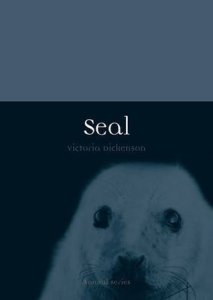 Seal by Victoria Dickenson: “It is hard to imagine a creature more distant from the human species in bodily form, habits, and habitat than the seal,” Dickenson writes in her introduction, “yet our mutual regard tells of a long, shared history of interaction.” Seal is the latest in the 80-strong Animal series from Reaktion Books. Like other volumes, this gives a brief discussion of the featured animal’s evolutionary biology, followed by an interdisciplinary survey of how it has entered human culture throughout history. In the final two chapters—the highlight of an occasionally dry book—Dickenson gives a balanced account of the history of hunting seals.
Los Angeles Review of Books
“Rediscovering an Overlooked Woman Novelist”: A dual review of Constance Fenimore Woolson: Portrait of a Lady Novelist by Anne Boyd Rioux () and Miss Grief and Other Stories (), a new selection of Woolson’s short fiction.
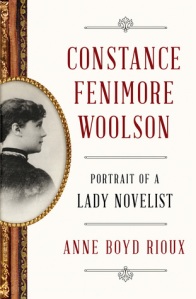
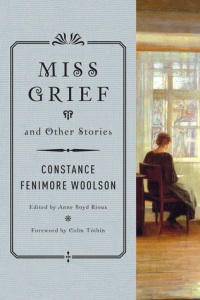 Constance Fenimore Woolson (1840–1894) is most often remembered for her connection to male writers; her great-uncle was pioneering American novelist James Fenimore Cooper, and in her later years as an expatriate in Europe she associated with Henry James, fueling rumors of a romance between them. Deserving to be known in her own right, Woolson represents key junctures between realism and regionalism, and between American and European styles. Gives a remarkable picture of a bold, bright woman who paved the way for writers such as Edith Wharton, E. M. Forster, and Willa Cather, and who arguably might be hailed in the same breath as Henry James and George Eliot.
Nudge
My quick response to Instructions for a Heatwave, for a Maggie O’Farrell retrospective: Another spot-on tale of family and romantic relationships – O’Farrell always gets the emotional tenor just right. You may spot hints of Rachel Joyce’s The Unlikely Pilgrimage of Harold Fry or Bernhard Schlink’s The Reader, but the psychological and linguistic precision is all O’Farrell’s own. Her descriptive language is unfailingly elegant. I love how she opens with the heat as the most notable character: “It inhabits the house like a guest who has outstayed his welcome: it lies along corridors, it circles around curtains, it lolls heavily on sofas and chairs.”
Pretentiousness: Why It Matters by Dan Fox: This wide-ranging essay discusses pretentiousness as it relates to class, taste, and modern art. Fox grew up outside of Oxford but now lives in New York City, where he is the co-editor of frieze. From its Latin etymology we learn that pretentious means “to stretch before,” so to hold something in front of you like a mask. He thus starts off by talking about acting techniques and rhetoric, then broadens this out to themes of authenticity and self-discovery. The most interesting part of the book concerns class connotations. This is a somewhat meandering work, and though it has good individual lines it is not always riveting.
 Third Way magazine
I’ve reviewed books, mostly fiction, for them for the last 2.5 years; sadly, the April 2016 issue will be the final one. It’s a shame; the progressive Christian perspective on popular culture is a niche it will be hard to fill.
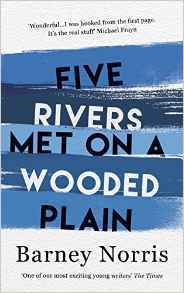
Five Rivers Met on a Wooded Plain by Barney Norris: Barney Norris is a playwright in his twenties, so it’s no surprise that there’s something a little staged to his debut novel. The lives of the book’s five narrators collide one night when a car hits a moped in Salisbury town center. We hear from each protagonist in turn as they reflect on their losses and wonder whether religion – represented by Salisbury Cathedral and the scripture and rituals of Christianity – might help. Rita is the liveliest and most engaging character, difficult as her expletive-strewn narrative might be to traverse. Like David Nicholls, Norris prizes emotional connection and delivers a theatrical plot. If he can avoid the more clichéd aspects of a novel like One Day, he could have a long career in fiction ahead of him. Releases April 21st.
I also post reviews of most of my casual reading and skimming on Goodreads:
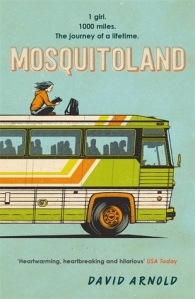 Mosquitoland by David Arnold: I don’t read a whole lot of YA, but the voice of this one captured me right away. Like Hazel in The Fault in Our Stars, Mim (Mary Iris Malone) is a lovably sarcastic oddball – she describes herself as “a young Ellen Page” à la Juno – with some hidden issues that come out over the course of the book. Here Mim’s journey takes the form of a road trip from Mississippi, where she lives with her father and new stepmother, back to Ohio to be with her sick mother. She meets a kooky cast of secondary characters along the way, narrowly escapes danger, and even gets a chance at romance.
A Change of World: Poems by Adrienne Rich: This is a forthcoming Norton reissue of Rich’s first collection from 1951. I’d always thought of her as a later, feminist poet, so it was jolting to see an introduction from W.H. Auden – that made it feel like a real generational crossover. It’s a very impressive debut, full of mannered, rhyme-rich verse. Two favorites were “Walden 1950” (“Thoreau, lank ghost, comes back to visit Concord, / Finds the town like all towns, much the same— / A little less remote, less independent”) and “The Innocents.” I’ll be interested to read some of her later work and see if she loosened up with form. Releases June 21st.
 The Shadow Hour by Kate Riordan: A clever dual-timeline novel with a pleasing Gothic flavor. In 1922 Grace Fairford takes up a governess position at Fenix House near Cheltenham, the very place where her grandmother, Harriet Jenner, worked in 1878. Every few chapters the perspective shifts from Grace (first person) to Harriet (third person). The novel is full of coincidences and the sense of history repeating itself. Riordan’s writing is capable, sometimes clichéd, but the echoes of Jane Eyre and The Turn of the Screw make this a delicious guilty-pleasure read.
Life’s Too Short to Pretend You’re Not Religious by David Dark: Etymologically, the word “religion” means to bind together again. Simply put, Dark’s thesis is that we’re all connected: we are in relationship with the people around us and can’t pretend otherwise. What we need is a shared vision for our shared life, and that involves engaging with other people. No pie-in-the-sky theology here; Dark affirms Daniel Berrigan’s assertion that “the actual world is our only world,” so things like climate change, gun control, immigration, and foreign policy are religious issues because they affect us all in this life. Together we have to imagine another story that isn’t capitalism and American imperialism as usual.
Adios, Cowboy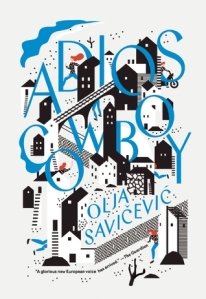 by Olja Savičević Ivančević: In summer 2009, Dada (aka Rusty) returns to her Croatian hometown to care for her mother. Going home facing up to the fact of her brother’s death – when he was 18 he threw himself under a train. “One has to sit down beside one’s demon and mollify it until it’s calm – that’s all, perhaps, that can be done,” she muses. Now for the title: Dada’s late father, brother, and friends (“the Iroquois Brothers”) were all big on cowboys and Indians. When news comes that a spaghetti western actor/director named Ned Montgomery will be passing through town, it causes Dada to think about her father and her brother and, what’s more, about the workings of her own memory.
Now Go Out There: (and Get Curious) by Mary Karr: There’s not much to this Syracuse University commencement speech. Leftovers of sob-story autobiography and clichéd advice cobbled together. Disappointing given how much I loved Karr’s recent The Art of Memoir. For a truly inspirational graduation address, I recommend David Foster Wallace’s This Is Water.

 How to Be Here: A Guide to Creating a Life Worth Living by Rob Bell: Bell left his pastoral role to become a motivational speaker so, unsurprisingly, this book is closer to self-help than theology. He’s good pals with Elizabeth Gilbert, and this book would make a great companion piece to her Big Magic. It’s about how to find what gets you out of bed in the morning and live mindfully. As always, his formatting – bite-size paragraphs, stretching out phrases with line breaks – is slightly annoying. I didn’t learn a whole lot; it was more a case of being reminded of things I knew deep down. He prefaces most chapters with an anecdote about his creative ventures, some of which were utter failures.
And my highest recommendation goes to…
The Summer Guest by Alison Anderson: The kernel of the novel is a true story: for two summers in the late 1880s, Chekhov stayed at the Lintvaryovs’ guest house in Luka, Ukraine. One strand of the narration is a journal kept during those years by Zinaida, the family’s eldest daughter, a doctor dying of a brain tumor. Zina’s story is offset by those of two contemporary women. Katya, a Russian émigré in London who’s trying to keep her failing publishing house afloat, sends the never-before-published diary to Ana, a translator based near the French border with Switzerland. There’s a touch of mystery here: where was the diary found? And what became of the novel Chekhov mentions he had in progress? Ana’s search for answers takes her to the Lintvaryov estate, even though Ukraine in 2014 is a hotbed of unrest. Having recently watched the BBC War & Peace miniseries with rapt interest and seen a Tchaikovsky symphony performance, it was the perfect time to get lost in an intricate, playful novel about how Russian literature still resonates. I’ll certainly be looking up Anderson’s other novels.
 Bookish Beck = Rebecca Foster. American transplant to England. Freelance proofreader and book reviewer.
 Bookish Beck