August Releases: Bright Fear, Uprooting, The Farmer’s Wife, Windswept
This month I have three memoirs by women, all based on a connection to land – whether gardening, farming or crofting – and a sophomore poetry collection that engages with themes of pandemic anxiety as well as crossing cultural and gender boundaries.
My August highlight:
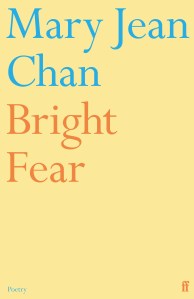
Bright Fear by Mary Jean Chan
Chan’s Flèche was my favourite poetry collection of 2019. Their follow-up returns to many of the same foundational subjects: race, family, language and sexuality. But this time, the pandemic is a lens through which all is filtered. This is particularly evident in Part I, “Grief Lessons.” “London, 2020” and “Hong Kong, 2003,” on facing pages, contrast Covid-19 with SARS, the major threat when they were a teenager. People have always made assumptions about them based on their appearance or speech. At a time when Asian heritage merited extra suspicion, English was both a means of frank expression and a source of ambivalence:
“At times, English feels like the best kind of evening light. On other days, English becomes something harder, like a white shield.” (from “In the Beginning Was the Word”)
“my Chinese / face struck like the glow of a torch on a white question: / why is your English so good, the compliment uncertain / of itself.” (from “Sestina”)
 At the centre of the book, “Ars Poetica,” a multi-part collage incorporating lines from other poets, forms a kind of autobiography in verse. Chan also questions the lines between genres, wondering whether to label their work poetry, nonfiction or fiction (“The novel feels like a springer spaniel running off-/leash the poem a warm basket it returns to always”).
The poems’ structure varies, with paragraphs and stanzas of different lengths and placement on the page (including, in one instance, a goblet shape). The enjambment, as you can see in lines I’ve quoted above and below, is noteworthy. Part III, “Field Notes on a Family,” reflects on the pressures of being an only child whose mother would prefer to pretend lives alone rather than with a female partner. The book ends with hope that Chan might be able to be open about their identity. The title references the paradoxical nature of the sublime, beautifully captured via the alliteration that closes “Circles”: “a commotion of coots convincing / me to withstand the quotidian tug-/of-war between terror and love.”
Although Flèche still has the edge for me, this is another excellent work I would recommend even to those wary of poetry. 
Some more favourite lines, from “Ars Poetica”:
“What my mother taught me was how
to revere the light language emitted.”
“Home, my therapist suggests, is where
you don’t have to explain yourself.”
With thanks to Faber for the free copy for review.
Three land-based memoirs:
(All:  )
)
Uprooting: From the Caribbean to the Countryside – Finding Home in an English Country Garden by Marchelle Farrell
 This Nan Shepherd Prize-winning memoir shares Chan’s attention to pandemic-era restrictions and how they prompt ruminations about identity and belonging. Farrell is from Trinidad but came to the UK as a student and has stayed, working as a psychiatrist and then becoming a wife and mother. Just before Covid hit, she moved to the outskirts of Bath and started rejuvenating her home’s large and neglected garden. Under thematic headings that also correspond to the four seasons, chapters are named after different plants she discovered or deliberately cultivated. The peace she finds in her garden helps her to preserve her mental health even though, with the deaths of George Floyd and so many other Black people, she is always painfully aware of her fragile status as a woman of colour, and sometimes feels trapped in the confining routines of homeschooling. I enjoyed the exploration of postcolonial family history and the descriptions of landscapes large and small but often found Farrell’s metaphors and psychological connections obvious or strained.
With thanks to Canongate for the free copy for review.
The Farmer’s Wife: My Life in Days by Helen Rebanks
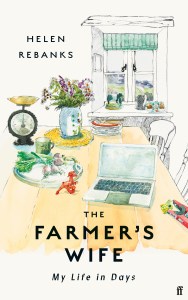 I fancied a sideways look at James Rebanks (The Shepherd’s Life and Wainwright Prize winner English Pastoral) and his regenerative farming project in the Lake District. (My husband spotted their dale from a mountaintop on holiday earlier in the month.) Helen Rebanks is a third-generation farmer’s wife and food and family are the most important things to her. One gets the sense that she has felt looked down on for only ever wanting to be a wife and mother. Her memoir, its recollections structured to metaphorically fall into a typical day, is primarily a defence of the life she has chosen, and secondarily a recipe-stuffed manifesto for eating simple, quality home cooking. (She paints processed food as the enemy.)
Growing up, Rebanks started cooking for her family early on, and got a job in a café as a teenager; her mother ran their farm home as a B&B but was forgetful to the point of being neglectful. She met James at 17 and accompanied him to Oxford, where they must have been the only student couple cooking and eating proper food. This period, when she was working an office job, baking cakes for a café, and mourning the devastating foot-and-mouth disease epidemic from a distance, is most memorable. Stories from travels, her wedding, and the births of her four children are pleasant enough, yet there’s nothing to make these experiences, or the telling of them, stand out. I wouldn’t make any of the dishes; most you could find a recipe for anywhere. Eleanor Crow’s black-and-white illustrations are lovely, though.
With thanks to Faber for the free copy for review.
Windswept: Life, Nature and Deep Time in the Scottish Highlands by Annie Worsley
 I’d come across Worsley in the Wildlife Trusts’ Seasons anthologies. For a decade she has lived on Red River Croft, in a little-known pocket of northwest Scotland. In word pictures as much as in the colour photographs that illustrate this volume, she depicts it as a wild land shaped mostly by natural forces – also, sometimes, manmade. From one September to the next, she documents wildlife spectacles and the influence of weather patterns. Chronic illness sometimes limited her daily walks to the fence at the cliff-top. (But what a view from there!) There is more here about local history and ecology than any but the keenest Scotland-phile may be interested to read. Worsley also touches on her upbringing in polluted Lancashire, and her former academic career and fieldwork in Papua New Guinea. Her descriptions are full of colours and alliteration, though perhaps a little wordy: “Pale-gold autumnal days are spliced by fickle and feisty bouts of turbulent weather. … Sunrises and sunsets may pour with cinnabar and henna; dawn and dusk can ripple with crimson and purple.” The kind of writing I could appreciate for the length of an essay but not a whole book.
With thanks to William Collins for the free copy for review.
Would you read one or more of these?
Reading Across the Seasons: England in All Weathers
Recently, I toured multiple seasons via these three pleasantly meandering books for Anglophiles. All: 
Orchard by Benedict Macdonald and Nicholas Gates (2020)
 Bristol friends and BBC colleagues Ben Macdonald and Nick Gates set out to chronicle a year in the life of a traditional Herefordshire orchard that has been managed differently from the industrial norm. Operations are designed to maximize wildlife as well as production, so the orchard has become a bastion for birds and insects. After a brief history of apple cultivation and orchard design, it’s straight into a month-by-month rundown of what can be seen and heard on this particular patch. For the most part, the co-authors trade off chapters. They observe and describe the kinds of behaviours that most of us never get to see. A central section of remarkable photographs, some of them by the authors, illustrates the year as vividly as the passionate prose. (See my full review at Shiny New Books.)
With thanks to William Collins for the free copy for review.
Light Rains Sometimes Fall by Lev Parikian (2021)
It was only 2018 that I read Why Do Birds Suddenly Disappear? but since then we’ve had another three books from Lev Parikian. It’s now hard to imagine a year without one of his genial nature books. Here he adapts Japan’s famous 72 microseasons to an English year, with every five days or so taking on a slightly different character and welcoming in the subtle changes that add up to big ones. Given the Japanese inspiration, it’s appropriate that his entries sometimes read like haikus. Here’s one from the start of 2–7 September: “The streets. Rumble of traffic. Gentle wind in trees. Soft chrrr of blue tit. Furious cawing, stage left.”
 Parikian’s patch is South London, specifically his local cemetery – which, since the book starts in February 2020, was closed off to him for a short time a month later when the first UK lockdown hit. This only served to increase his appreciation for the place when it reopened. (Cemeteries are amazing places for wildlife in general, especially the more park-like ones: I can remember seeing muntjac at Cemetery Junction in Reading, and red-tailed hawks perched in the trees in Mount Auburn Cemetery in Cambridge, Massachusetts.) Here, his star sighting was an occasional peregrine on the church tower.
The idea behind this book of mini nature essays is to try to see things again as if for the first time. In the pandemic year, he finds that time is elastic: it seems both fast and slow, and paying close attention is a way of valuing nature and experience. After all, as Parikian quotes from Confucius, “Everything has beauty, but not everyone can see it.” This reminded me particularly of Birdsong in a Time of Silence, but the tone is refreshingly light, as readers will have come to expect of Parikian.
Controversially, because I picked this up in September, I started reading it from the first September chapter, carried on to the end and then began again at the beginning and caught myself up, a strategy I have only ever taken with Mark Cocker’s Claxton (another month-by-month nature diary-type narrative) before. Initially, it was a nice way of following along with the seasons. I kept this as a bedside book and would read a chapter before bed. Most of us live in cities or suburbs, so I particularly appreciated the enthusiastic advocacy for the value of urban spaces for nature. I recommend this one for reading your way slowly and attentively through the seasons.
With thanks to Elliott & Thompson for the proof copy for review.
England for All Seasons by Susan Allen Toth (1997)
A reread. As I was getting ready to go overseas for the first time in the summer of 2003, Toth’s trilogy of memoirs whetted my appetite for travel in Britain. (They’re on my Landmark Books in My Life, Part II list.) I loved how warmly she invites readers to join her itineraries and shares tips for lesser-known destinations.
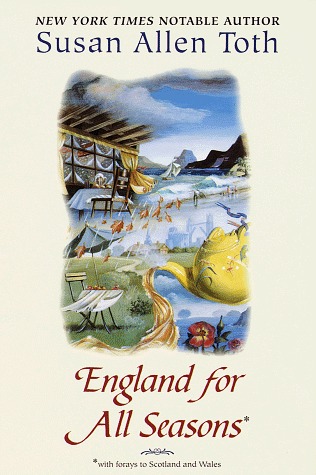 This was her third set of England essays, prompted by a question she frequently got from friends and readers: when is the best time to go? Her answer would be to go whenever you can, as often as you can, because rain can be delightful and in the off season you’ll have special places to yourself. I can see that I have this book to thank for the memorable Cornwall vacation I had with my mom and sister in April 2004, midway through my study abroad year: two of the sites she highlights here, St. Ives and the seal sanctuary at Gweek (part of the “Touring England’s Ark” chapter) were among our chosen stops.
Toth is a particular fan of gardens and literary sites, but loves London museums and theatres as much as windswept coastal and island scenery. When in England she lets herself sample multiple desserts from the sweet trolley, fill her suitcase with secondhand books, and pepper her speech with exclamations of “Lovely!” and “Brilliant!” I was relieved to be reminded of her suggested one-hour time limit for any museum – “depart without guilt, as soon as your eyes droop or your feet hurt or your heavy shoulder bag sinks to the floor. When you begin wondering if it is too early for lunch, head for the door.” (I poop out at museums very quickly.) The practical information she includes at the end of each chapter is probably entirely out of date, but her ideas are solid, and a quick web search will update any details.
The final essay, “Travel Time,” perfectly captures the holiday spirit: “Because our travel time is so densely filled, with intense if often quiet experiences, I am always astonished at what has happened—or rather, what has not happened—when we return home. After two weeks of living so vividly, newness in each hour, I feel as if I must have changed in significant ways.” (Free from The Book Thing of Baltimore)
Review Book Catch-Up: Dennis, Galloway, Leland-St. John and Sampson
Capsule reviews today, of four books I am inexcusably late in reviewing. I have a record of personal experience with species reintroductions, a memoir about living among reindeer herders in the far north of Norway, a set of elegiac poems, and a biography of a Victorian woman poet who struggled with poor health for most of her life.
Restoring the Wild: Sixty Years of Rewilding Our Skies, Woods and Waterways by Roy Dennis
 Rewilding is a big buzz word in current nature and environmental writing. Few could be said to have played as major a role in the UK’s successful species reintroduction projects as Roy Dennis, who has been involved with the RSPB and other key organizations since the late 1950s. He trained as a warden at two of the country’s most famous bird observatories, Lundy Island and Fair Isle. Most of his later work was to focus on birds: white-tailed eagles, red kites, and ospreys. Some of these projects extended into continental Europe. He also writes about the special challenges posed by mammal reintroductions; beavers get a chapter of their own. Every initiative is described in exhaustive detail, full of names and dates, whereas I would have been okay with an overview. This feels like more of an insider’s history rather than a layman’s introduction. I have popped it on my husband’s bedside table in hopes that, with his degree in wildlife conservation, he’ll be more interested in the nitty-gritty.
Favourite lines:
“Tenacity and a long view to the future are important in wildlife conservation.”
“for every successful project that gets the go-ahead, there are others into which people put great effort but which then run up against problems.”
With thanks to William Collins for the free copy for review.
Dálvi: Six Years in the Arctic Tundra by Laura Galloway
 The title is the word for winter in the Northern Sámi language. Galloway, a journalist, traded in New York City for Arctic Norway after a) a DNA test told her that she had Sámi blood and b) she met and fell for Áilu, a reindeer herder, at a wedding. She enrolled in an intensive language learning course at university level and got used to some major cultural changes: animals were co-workers here rather than pets (like the two cats she brought with her); communal meals and drawn-out goodbyes were not the done thing; and shamans were still active (one helped them find a key she lost). Footwear neatly sums up the difference. The Prada heels she brought “just in case” ended up serving as hammers; instead, she helped Áilu’s mother make reindeer skins into boots. Two factors undermined my enjoyment: Alternating chapters about her unhappy upbringing in Indiana don’t add much of interest, and, after her relationship with Áilu ends, the book feels aimless. However, I appreciated her words about DNA not defining you, and family being what you make it.
With thanks to Atlantic Books for the free copy for review.
A Raga for George Harrison by Sharmagne Leland St.-John (2020)
 Native American poet Sharmagne Leland St.-John’s fifth collection is a nostalgic and bittersweet look at people and places from one’s past. There are multiple elegies for public figures – everyone from Janis Joplin to Virginia Woolf – as well as for some who aren’t household names but have important stories that should be commemorated, like Hector Pieterson, a 12-year-old boy killed during the Soweto Uprising for protesting enforced teaching of Afrikaans in South Africa in 1976. Many of the elegies are presented as songs. Personal sources of sadness, such as a stillbirth, disagreements with a daughter, and ageing, weigh as heavily as tragic world events.
Rhyming and alliteration create inviting rhythms throughout the book, and details of colour and fashion animate poems like “La Kalima.” Leland St.-John remembers meeting street children in Mexico, while bamboo calls to mind time spent in Japan. “Promised Land” is an ironic account of land being seized from natives and people of colour. I especially liked “Things I Would Have Given to My Mother Had She Asked” (some literal and some more abstract), which opens “A piece of my liberal mind. 5 more minutes of my time”, and the sombre “Cat’s Cradle” (“Drenched starlings perch on a cat’s cradle of telephone wires”).
You can read “I Said Coffee” and a few more of her poems online.
With thanks to the author for sending a free e-copy for review.
Two-Way Mirror: The Life of Elizabeth Barrett Browning by Fiona Sampson
 Coming in at under 260 pages, this isn’t your standard comprehensive biography. Sampson instead describes it as a “portrait,” one that takes up the structure of EBB’s nine-book epic poem, Aurora Leigh, and is concerned with themes of identity and the framing of stories. Elizabeth, as she is cosily called throughout the book, wrote poems that lend themselves to autobiographical interpretation – “her body of work creates a kind of looking glass in which, dimly, we make out the person who wrote it,” Sampson asserts.
Nicknamed “Ba,” Elizabeth was born in 1806 and brought up with 11 younger siblings at a Herefordshire estate, Hope End. Her father, Edward, had been born in Jamaica and the family fortune was based on sugar – and slavery. Sampson makes much of this inherited guilt, and also places an emphasis on EBB’s lifelong ill health, which involved headaches, back and side pain, and depression. She also suffered from respiratory complaints. The modern medically minded reader tries to come up with a concrete diagnosis. Tardive dystonia? Post-viral syndrome? The author offers many potential explanations, and notes that her subject was the very type of the Victorian female invalid. She would also suffer from miscarriages, but had one son, Pen. The Brownings were in the unusual position of the wife being the more famous partner.
Sampson draws heavily on correspondence and earnestly interrogates scenes and remembrances, but her use of the present tense is a bit odd for a historical narrative, and I found my casual curiosity about the Brownings wasn’t enough to sustain my interest. However, this did make me eager to try more of EBB’s poetry. I wonder if I still have that copy of Sonnets from the Portuguese in a box in the States?
Favourite lines:
“Within the continual process of reputation-making and remaking that is literary history, Elizabeth Barrett Browning remains a bellwether for the rising and sinking stock of women writers. … Elizabeth dramatizes the two-way creation of every writing self, from without and from within. That the life of the body both enables and limits the life of the mind is the paradox of the thinking self.”
With thanks to Profile Books for the free copy for review.
Would you be interested in reading one or more of these?
Review Book Catch-Up: Gange, Mann, O’Donoghue
The end of the year is fast approaching, and one of my main reading goals is to follow through on all the rest of the review books I’ve received from publishers. I have another handful on the go, including a few holiday- and snow-themed ones I’ll review together.
Today, I have a history-rich travelogue that explores the Atlantic coast of Britain and Ireland, a memoir by an Anglican priest who has transitioned and experienced chronic illness, and a humorous, offbeat novel about finding the real Ireland.
The Frayed Atlantic Edge: A Historian’s Journey from Shetland to the Channel by David Gange (2019)
 This was one of the 2020 Wainwright Prize finalists. Having now experienced the entire nature writing shortlist, I stick with my early September pronouncement that it should have won. I was consistently impressed with the intricacy of the interdisciplinary approach. While kayaking down the western coast of the British Isles and Ireland, Gange delved into the folklore, geology, history, local language and wildlife of each region and island group. From the extreme north of Scotland at Muckle Flugga to the southwest tip of Cornwall, he devoted a month to each Atlantic-facing area, often squeezing in expeditions between commitments as a history lecturer at Birmingham.
Gange’s thesis is that the sea has done more to shape Britain and Ireland than we generally recognize, and that to be truly representative history books must ascribe the same importance to coastal communities that they do to major inland cities. Everywhere he goes he meets locals, trawls regional archives and museums, and surveys the art and literature (especially poetry) that a place has produced. Though dense with information, the book is a rollicking travelogue that – in words no less than in the two sections of stunning colour photographs – captures the elation and fear of an intrepid solo journey. He hunkers on snowy cliffs in his sleeping bag and comes face to face with otters, seals and seabirds in his kayak; at the mercy of the weather, he has deep respect for the Atlantic waves’ power.
I enjoyed revisiting places I’ve seen in person (Shetland, the Orkney Islands, Skomer) and getting a taste of others I’ve not been to but would like to go (like the Western Isles and the west coast of Ireland). Gange’s allusive writing reminds me of Tim Dee’s and Adam Nicolson’s, and Madeleine Bunting’s Love of Country is a similar read I also loved.
With thanks to William Collins for the free copy for review.
Dazzling Darkness: Gender, sexuality, illness and God by Rachel Mann (2012; 2020)
 I’ve so enjoyed discovering Rev. Rachel Mann’s work: poetry collection A Kingdom of Love, Advent devotional In the Bleak Midwinter, and novel The Gospel of Eve. This is a revised edition of her memoir, which is less an autobiographical blow-by-blow of becoming a trans priest in the Church of England than it is a vibrant theological meditation based around keywords like loneliness, reconciliation and vocation. She reflects on the apparent contradictions of her life: she was a typical boy who loved nothing more than toy guns, and then a young man obsessed with drugs and guitars; as ‘Nick’, she was married to a woman at the time of coming out, but continued to have relationships with women after transitioning and undergoing reassignment surgery, so considers herself a lesbian.
Ambiguities like this make us uncomfortable, Mann notes, but change and loss, and making the best of impossible situations, are all a part of the human condition. I appreciated how she characterizes herself as a perennial beginner: having to face the world anew after the second adolescence of becoming a woman as well as after the end of a long-term relationship and the last in a series of hospitalizations for severe Crohn’s disease.
While I’ve read other trans memoirs (Amateur by Thomas Page McBee and Conundrum by Jan Morris), this is my first from a Christian perspective, apart from the essays in The Book of Queer Prophets. Mann describes her early faith as intense but shallow, like falling in love; later it became deeper but darker as she followed Jesus’s path of suffering. Ministry has been a gift but is not without challenges: At synod meetings she is unsure whether to speak out or remain silent, but at least she bears witness to the presence of trans people in the Church.
With thanks to Wild Goose Publications for the free copy for review.
Scenes of a Graphic Nature by Caroline O’Donoghue (2020)
 Charlotte “Charlie” Regan is a 29-year-old filmmaker based in London. Her father has had cancer on and off for four years, but he got his ‘survivor’ label in a different way: when he was a child on an island off the western coast of Ireland, his teacher and 18 classmates died of carbon monoxide poisoning from the faulty secondhand oil burner in the schoolhouse; he was the only one left alive. Although her film commemorates this story, Charlie has never actually been to Ireland, so an invitation to Cork Film Festival is the perfect opportunity to see the place before her father dies. Travelling with her is her former best friend and roommate, Laura Shingle. There’s sexual tension between these two: Charlie is a lesbian, but Laura is determined to think of herself as straight even though she and Charlie would occasionally share a bed. To prove herself, Laura goes too far the other way, making homophobic comments about strangers.
If initially Charlie thinks this trip to Ireland will be about shamrock-green nostalgia, she soon snaps out of her idealism as she has to face some tough truths about the film and her family’s history. Charlie is a companionable narrator, but, while I enjoyed the pub scenes and found some of the one-liners very funny (“Everything in our room is a faint brown, as though it were daubed very gently by a child with a teabag” and “He had an X-ray and there’s legumes all over it.” / “Legumes? Do you mean lesions?”), I was underwhelmed overall. My interest peaked at the halfway point and waned thereafter. This is one I might recommend to fans of Caoilinn Hughes.
With thanks to Virago for the free copy for review.
Would you be interested in reading one or more of these?
Nonfiction Review Books Roundup: Hay, Hope et al., Lee, Long, McLaren, Zuckerman
I’m continuing with the Nonfiction November focus by catching up on six nonfiction review books I’ve been sent over the last half a year. We’ve got a record of elderly parents’ decline, letters and poems written about the climate crisis, a family memoir set between Taiwan and Canada, a widow’s mushroom-hunting quest, a work of ecotheology that reflects on travels in the Galápagos Islands, and a defense of an entirely secular basis for morality. You can’t say I don’t read a variety, even within nonfiction! See if one or more of these tempts you.
All Things Consoled: A Daughter’s Memoir by Elizabeth Hay
 Gordon and Jean Hay stumbled into their early nineties in an Ottawa retirement home starting in 2009. Elizabeth Hay is one of four children, but caregiving fell to her for one reason and another, and it was a fraught task because of her parents’ prickly personalities: Jean was critical and thrifty to the point of absurdity, spooning thick mold off apple sauce before serving it and needling Elizabeth for dumping perfectly good chicken juice a year before; Gordon had a terrible temper and a history of corporal punishment of his children and of his students when he was a school principal. Jean’s knee surgery and subsequent infection finally put paid to their independence; her mind was never the same and she could no longer paint.
There are many harsh moments in this memoir, but almost as many wry ones, with Hay picking just the right anecdotes to illustrate her parents’ behavior and the shifting family dynamic. She never looks away, no matter how hard it all gets. Her father’s rage against the dying of the light contrasts with her mother’s fade into confusion – lightened by the surprisingly poetic turns of phrase she came out with despite her dementia and aphasia. The title phrase, for instance, was her attempt at “all things considered.” I would wholeheartedly recommend this to readers of Hay’s novels, but anyone can appreciate the picture of complicated love and grief. (See also Susan’s review.)
With thanks to MacLehose Press for the free copy for review.
Letters to the Earth: Writing to a Planet in Crisis, edited by Anna Hope et al.
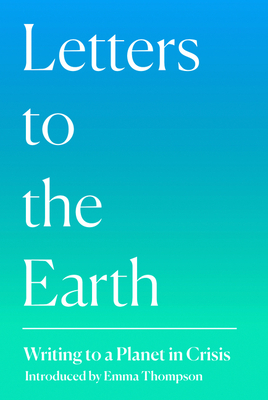 Culture Declares Emergency launched in April to bring the arts into the conversation about the climate emergency. Letters to the Earth compiles 100 short pieces by known and unknown names alike. Alongside published authors, songwriters, professors and politicians are lots of ordinary folk, including children as young as seven. The brief was broad: to write a letter in response to environmental crisis, whether to or from the Earth, to future generations (there are wrenching pieces written to children: “What can I say, now that it’s too late? … that I’m sorry, that I tried,” writes Stuart Capstick), to the government or to other species.
There are certainly relatable emotions here, especially the feeling of helplessness. “We take the train, go vegan, refuse plastic, buy less and less. But that is tiny. We are tiny,” novelist Jo Baker writes. I loved retired bishop Richard Holloway’s wry letter calling the author of Genesis to account for unhelpful language of dominion, Rob Cowen’s poem to a starling, and Anna Hope’s essay about parenting in a time of uncertainty. Unfortunately, much of the rest is twee or haranguing, e.g. “Forest fires are scorching INNOCENT wildlife. Plastic is strangling INNOCENT turtles and dolphins,” a 12-year-old writes. This was put together in a matter of months, and it shows. There is not enough tonal variety, a lot of overwriting has crept through, and errors, especially in the kids’ work, remain uncorrected. Perhaps six to 10 pieces stood out to me overall. I’d recommend the Extinction Rebellion handbook instead.
With thanks to Alison Menzies / William Collins for the free copy for review.
Two Trees Make a Forest: On Memory, Migration and Taiwan by Jessica J. Lee
 I loved Turning, Lee’s 2017 memoir about swimming in one of Berlin’s lakes per week for a year, so I jumped at the chance to read her follow-up, which delves into her maternal line’s history in Taiwan. She travels to Taipei for three months to brush up on her Chinese, write and hike. Interspersed with the lush descriptions of her walks are reflections on Taiwan’s history and on the hidden aspects of her grandfather Gong’s past that only came to light after Lee’s grandmother, Po, died and she and her mother discovered an autobiographical letter he’d written before he drifted into dementia. Nature, language, history and memory flow together in a delicate blend of genres – “I moved from the human timescale of my family’s story through green and unfurling dendrological time,” she writes.
This has got to be one of the most striking title and cover combinations of the year. Along with Chinese characters, the book includes some looping text and Nico Taylor’s maps and illustrations of Taiwanese flora and fauna. While you will likely get more out of this if you have a particular interest in Asian history, languages and culture, it’s impressive how Lee brings the different strands of her story together to form a hybrid nature memoir that I hope will be recognized by next year’s Wainwright Prize and Young Writer of the Year Award shortlists. She’d also be a perfect New Networks for Nature speaker.
With thanks to Virago for the free copy for review.
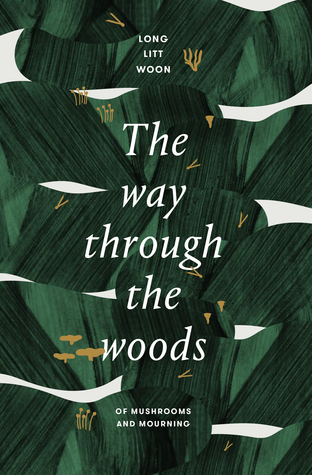
The Way through the Woods: Of Mushrooms and Mourning by Long Lit Woon
 [Trans. from the Norwegian by Barbara J. Haveland]
I couldn’t resist the sound of a bereavement memoir crossed with a mushroom hunting guide. When Long met her husband, Eiolf Olsen, she was an 18-year-old Malaysian exchange student in Stavanger, Norway. Meeting Eiolf changed the whole course of her life, keeping her in Europe for good; decades later, her life changed forever once again when Eiolf dropped dead at work one morning. “If anyone had told me that mushrooms would be my lifeline, the thing that would help me back onto my feet and quite literally back onto life’s track, I would have rolled my eyes. What had mushrooms to do with mourning?” she writes.
 The answer to that rhetorical question is nothing much, at least not inherently, so this ends up becoming a book of two parts, with the bereavement strand (printed in green and in a different font – green is for grief? I suppose) engaging me much more than the mushroom-hunting one, which takes her to Central Park and the annual Telluride, Colorado mushroom festival as well as to Norway’s woods again and again – “In Norway, outdoor life is tantamount to a religion.” But the quest for wonder and for meaning is a universal one. In addition, if you’re a mushroom fan you’ll find gathering advice, tasting notes, and even recipes. I fancy trying the “mushroom bacon” made out of oven-dried shiitakes.
With thanks to Scribe for the free copy for review.
God Unbound: Theology in the Wild by Brian McLaren
 McLaren was commissioned to launch a series that was part travel guide, part spiritual memoir and part theological reflection. Specifically, he was asked to write about the Galápagos Islands because he’d been before and they were important to him. He joins a six-day eco-cruise that tours around the island chain off Ecuador, with little to do except observe the birds, tortoises and iguanas, and swim with fish and sea turtles. For him this is a peaceful, even sacred place that reminds him of the beauty that still exists in the world despite so much human desecration. Although he avoids using his phone except to quickly check in with his wife, modernity encroaches unhelpfully through a potential disaster with his laptop.
I was surprised to see that McLaren leaves the Galápagos at the midpoint – whatever could fill the rest of the book, I wondered? He starts by reassessing Darwin, so often painted as a villain by Evangelical Christianity but actually a model of close, loving attention to nature. He also recalls how some of his most intense spiritual experiences have arisen from time in nature. McLaren’s books have been pivotal to my spiritual journey as we’ve both gradually become more liberal and environmentalist. His definition of God might horrify traditionalists, but holds appeal for me: “a centering singularity whose gravity holds me in insistent orbit, pulling me deeper into mystery, pondering who I am and what my life means.” This is an unusual but gently entrancing book full of photos and quotes from other thinkers including John Muir, Pope Francis and Richard Rohr. It’s an ideal introduction to ecotheology.
With thanks to Canterbury Press for the free copy for review.
What It Means to Be Moral: Why Religion Is Not Necessary for Living an Ethical Life by Phil Zuckerman
 From one end of the spectrum (progressive Christianity) to the other (atheism). Here’s a different perspective from a sociology professor at California’s Pitzer College. Zuckerman’s central argument is that humanism and free choice can fuel ethical behavior; since there’s no proof of God’s existence and theists have such a wide range of beliefs, it’s absurd to slap a “because God says so” label on our subjective judgments. Morals maintain the small communities our primate ancestors evolved into, with specific views (such as on homosexuality) a result of our socialization. Alas, the in-group/out-group thinking from our evolutionary heritage is what can lead to genocide. Instead of thinking in terms of ‘evil’, though, Zuckerman prefers Dr. Simon Baron-Cohen’s term, “empathy erosion.”
To tackle violent crime, Zuckerman contends, we need a more equal society, with the Scandinavian countries a model of how to achieve that through higher taxes, social services and the rehabilitation of prisoners. He uses a lot of relatable examples from history and from his own experience, as well as theoretical situations, to think through practical morality. I found his indictment of American Christianity accurate – how does it make sense for people who say they follow the way of Jesus to fight against equality, tolerance and scientific advances and instead advocate guns, the death penalty and Trump? Well, indeed.
It might seem odd for me to recommend this alongside the McLaren, but there is much to be gained from both viewpoints. Zuckerman’s work overlaps a fair bit with another I’ve read on the topic, Richard Holloway’s Godless Morality – even a bishop agrees we needn’t take our societal ethics straight from the Bible! I can’t go along fully with Zuckerman because I think progressive religion has been and can continue to be a force for good, but I would agree that atheists can be just as moral as people of faith – and often more so.
With thanks to Counterpoint Press for sending a proof copy for review.
Would you be interested in reading one or more of these?
The Lost Properties of Love by Sophie Ratcliffe
Everything was in its place.
Particulars moved
along designated rails.
Even the arranged meeting
occurred. […]
In paradise lost
of probability.
From “Railway station” by Wisława Szymborska
The art of losing isn’t hard to master;
so many things seem filled with the intent
to be lost that their loss is no disaster.
From “One Art” by Elizabeth Bishop
 This is not your average memoir. For one thing, it ends with 34 pages of notes and bibliography. Sophie Ratcliffe is an associate professor of English at the University of Oxford, and it’s clear that her life and the narrative have been indelibly shaped by literature. In this work of creative nonfiction she is particularly interested in the lives and works of Leo Tolstoy and Anthony Trollope and the women they loved. For another, the book is based around train journeys – real and fictional, remembered and imagined. Trains are appropriate symbols for many of the book’s dichotomies: scheduling versus unpredictability, having or lacking a direction in life, monotony versus momentous events, and fleeting versus lasting connections.
Each chapter, marked with a location and a year, functions as a mini-essay; as the nonchronological pieces accrete you develop a sense of what have been the most important elements of Ratcliffe’s life. One was her father’s death from cancer when she was 13, an early loss that inevitably affected the years that followed. Another was a love affair with a married photographer 30 years her senior. A number of chapters are addressed directly to this ex-lover in the second person. Although they’ve had no contact since she got married, she still thinks about him – and wonders if she’ll have a right to mourn him when he dies.
Could she have been his muse, as Kate Field was for Trollope? Field appeared in fictional guises in much of his work and thereby inspired Anna Karenina, for Tolstoy was a devoted reader of Trollope and gave his heroine a penchant for reading English novels, too. Ratcliffe seems to see herself in Anna, a wife and mother who longs for a life of her own: she writes of her love for her two children but also of the boredom that comes with motherhood’s minutiae.

Sophie Ratcliffe
Much of life’s daily tedium is bound up in physical objects, like the random objects that litter the cover. “I am a lover of small things – and of clutter,” Ratcliffe confesses. She notes that generations of literary critics have asked what was in the red handbag Anna Karenina left behind, too. What does such lost property say about its owner? What can be saved from a life in which loss is so prevalent? These are questions the book explores through its metaphors, stories and memories. It ends with the hope that writing things down gives them meaning.
If you enjoy nonstandard memoirs (like Jean Hannah Edelstein’s This Really Isn’t About You) and books about how what we read makes us who we are (such as Samantha Ellis’s How to Be a Heroine and Lucy Mangan’s Bookworm), you have a real treat in store here.
Some favorite lines:
“Life is in the between-ness, the space in the margins – not in the headlines.”
“Books, like trains, are another way of tricking time, of moving to a different beat, a different space.”
“Has my reading been a way of keeping me company – of helping me through the worlds of nearlys and barelys and the feelings of missing, and the hopeless messiness?”
“Writing is better than nothing. Better than thin air.”
My rating:
With thanks to William Collins for the free copy for review.
I first heard of the author when she was a Wellcome Book Prize judge in 2018. I was delighted to be invited to take part in the blog tour for The Lost Properties of Love.
 Bookish Beck = Rebecca Foster. American transplant to England. Freelance proofreader and book reviewer.
 Bookish Beck