Women’s Prize for Non-Fiction, Writers’ Prize & Young Writer of the Year Award Catch-Up
This time of year, it’s hard to keep up with all of the literary prize announcements: longlists, shortlists, winners. I’m mostly focussing on the Carol Shields Prize for Fiction this year, but I like to dip a toe into the others where I can. I ask: What do I have time to read? What can I find at the library? and Which books are on multiple lists so I can tick off several at a go??
Women’s Prize for Non-Fiction

(Shortlist to be announced on 27 March.)
Read so far: Intervals by Marianne Brooker, Matrescence by Lucy Jones
&
A Flat Place by Noreen Masud
Past: Sunday Times/Charlotte Aitken Young Writer of the Year Award shortlist
Currently: Jhalak Prize longlist
I also expect this to be a strong contender for the Wainwright Prize for nature writing, and hope it doesn’t end up being a multi-prize bridesmaid as it is an excellent book but an unusual one that is hard to pin down by genre. Most simply, it is a travel memoir taking in flat landscapes of the British Isles: the Cambridgeshire fens, Orford Ness in Suffolk, Morecambe Bay, Newcastle Moor, and the Orkney Islands.
 But flatness is a psychological motif as well as a physical reality here. Growing up in Pakistan with a violent Pakistani father and a passive Scottish mother, Masud chose the “freeze” option when in fight-or-flight situations. When she was 15, her father disowned her and she moved with her mother and sisters to Scotland. Though no particularly awful things happened, a childhood lack of safety, belonging and love left her with complex PTSD that still affects how she relates to her body and to other people, even after her father’s death.
Masud is clear-eyed about her self and gains a new understanding of what her mother went through during their trip to Orkney. The Newcastle chapter explores lockdown as a literal Covid-era circumstance but also as a state of mind – the enforced solitude and stillness suited her just fine. Her descriptions of landscapes and journeys are engaging and her metaphors are vibrant: “South Nuns Moor stretched wide, like mint in my throat”; “I couldn’t stop thinking about the Holm of Grimbister, floating like a communion wafer on the blue water.” Although she is an academic, her language is never off-puttingly scholarly. There is a political message here about the fundamental trauma of colonialism and its ongoing effects on people of colour. “I don’t want ever to be wholly relaxed, wholly at home, in a world of flowing fresh water built on the parched pain of others,” she writes.
What initially seems like a flat authorial affect softens through the book as Masud learns strategies for relating to her past. “All families are cults. All parents let their children down.” Geography, history and social justice are all a backdrop for a stirring personal story. Literally my only annoyance was the pseudonyms she gives to her sisters (Rabbit, Spot and Forget-Me-Not). (Read via Edelweiss) 
And a quick skim:
Doppelganger: A Trip into the Mirror World by Naomi Klein
Past: Writers’ Prize shortlist, nonfiction category
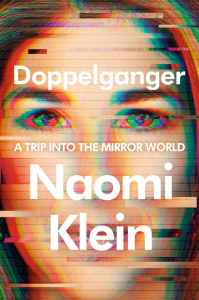 For years people have been confusing Naomi Klein (geography professor, climate commentator, author of No Logo, etc.) with Naomi Wolf (feminist author of The Beauty Myth, Vagina, etc.). This became problematic when “Other Naomi” espoused various right-wing conspiracy theories, culminating with allying herself with Steve Bannon in antivaxxer propaganda. Klein theorizes on Wolf’s ideological journey and motivations, weaving in information about the doppelganger in popular culture (e.g., Philip Roth’s novels) and her own concerns about personal branding. I’m not politically minded enough to stay engaged with this but what I did read I found interesting and shrewdly written. I do wonder how her publisher was confident this wouldn’t attract libel allegations? (Public library)
Predictions: Cumming (see below) and Klein are very likely to advance. I’m less drawn to the history or popular science/tech titles. I’d most like to read Some People Need Killing: A Memoir of Murder in the Philippines by Patricia Evangelista, Wifedom: Mrs Orwell’s Invisible Life by Anna Funder, and How to Say Babylon: A Jamaican Memoir by Safiya Sinclair. I’d be delighted for Brooker, Jones and Masud to be on the shortlist. Three or more by BIPOC would seem appropriate. I expect they’ll go for diversity of subject matter as well.
Writers’ Prize
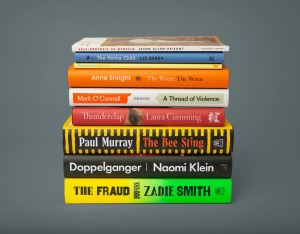
Last year I read most books from the shortlists and so was able to make informed (and, amazingly, thoroughly correct) predictions of the winners. I didn’t do as well this year. In particular, I failed with the nonfiction list in that I DNFed Mark O’Connell’s book and twice borrowed the Cumming from the library but never managed to make myself start it; I thought her On Chapel Sands overrated. (I did skim the Klein, as above.) But at least I read the poetry shortlist in full:
 Self-Portrait as Othello by Jason Allen-Paisant: I found more to sink my teeth into here than I did with his debut collection, Thinking with Trees (2021). Part I’s childhood memories of Jamaica open out into a wider world as the poet travels to London, Paris and Venice, working in snippets of French and Italian and engaging with art and literature. “I’m haunted as much by the character Othello as by the silences in the story.” Part III returns home for the death of his grandmother and a coming to terms with identity. [Winner: Forward Prize for Best Collection; Past: T.S. Eliot Prize shortlist] (Public library)
 The Home Child by Liz Berry: A novel in verse “loosely inspired,” as Berry puts it, by her great-aunt Eliza Showell’s experience: she was a 12-year-old orphan when, in 1908, she was forcibly migrated from the English Midlands to Nova Scotia. The scenes follow her from her home to the Children’s Emigration Home in Birmingham, on the sea voyage, and in her new situation as a maid to an elderly invalid. Life is gruelling and lonely until a boy named Daniel also comes to the McPhail farm. This was a slow and not especially engaging read because of the use of dialect, which for me really got in the way of the story. (Public library)
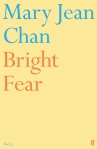 & Bright Fear by Mary Jean Chan (Current: Dylan Thomas Prize shortlist)
Three category winners:
- The Wren, The Wren by Anne Enright (Fiction)
- Thunderclap by Laura Cumming (Nonfiction) (Current: Women’s Prize for Non-Fiction longlist)
- The Home Child by Liz Berry (Poetry)
Overall winner: The Home Child by Liz Berry
Observations: The academy values books that cross genres. It appreciates when authors try something new, or use language in interesting ways (e.g. dialect – there’s also some in the Allen-Paisant, but not as much as in the Berry). But my taste rarely aligns with theirs, such that I am unlikely to agree with its judgements. Based on my reading, I would have given the category awards to Murray, Klein and Chan and the overall award perhaps to Murray. (He recently won the inaugural Nero Book Awards’ Gold Prize instead.)
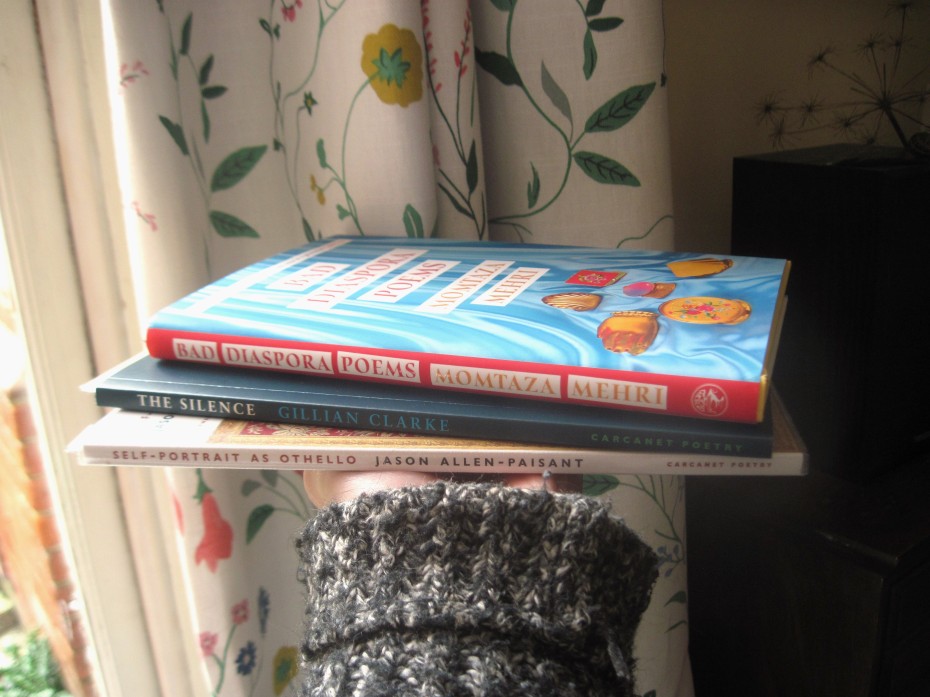
World Poetry Day stack last week
Young Writer of the Year Award
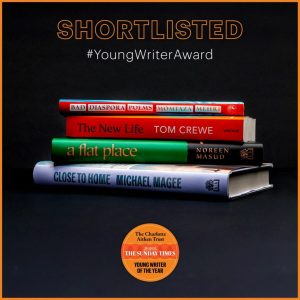
Shortlist:
- The New Life by Tom Crewe
 (Past: Nero Book Award shortlist, debut fiction)
 - Close to Home by Michael Magee (Winner: Nero Book Award, debut fiction category)
- A Flat Place by Noreen Masud (see above)
&
Bad Diaspora Poems by Momtaza Mehri
Winner: Forward Prize for Best First Collection
Nostalgia is bidirectional. Vantage point makes all the difference. Africa becomes a repository of unceasing fantasies, the sublimation of our curdled angst.
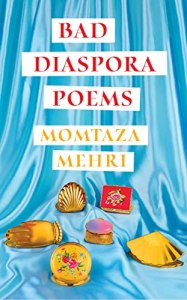 Crossing between Somalia, Italy and London and proceeding from the 1830s to the present day, this debut collection sets family history amid wider global movements. It’s peopled with nomads, colonisers, immigrants and refugees. In stanzas and prose paragraphs, wordplay and truth-telling, Mehri captures the welter of emotions for those whose identity is split between countries and complicated by conflict and migration. I particularly admired “Wink Wink,” which is presented in two columns and opens with the suspension of time before the speaker knew their father was safe after a terrorist attack. There’s super-clever enjambment in this one: “this time it happened / after evening prayer // cascade of iced tea / & sugared straws // then a line / break // hot spray of bullets & / reverb & // in less than thirty minutes we / they the land // lose twenty of our children”. Confident and sophisticated, this is a first-rate debut.
A few more favourite lines:
IX. Art is something we do when the war ends.
X. Even when no one dies on the journey, something always does.
(from “A Few Facts We Hesitantly Know to Be Somewhat True”)
You think of how casually our bodies are overruled by kin,
by blood, by heartaches disguised as homelands.
How you can count the years you have lived for yourself on one hand.
History is the hammer. You are the nail.
(from “Reciprocity is a Two-way Street”)
With thanks to Jonathan Cape (Penguin) for the free copy for review.
I hadn’t been following the Award on Instagram so totally missed the news of them bringing back a shadow panel for the first time since 2020. The four young female Bookstagrammers chose Mehri’s collection as their winner – well deserved.
Winner: The New Life by Tom Crewe
This was no surprise given that it was the Sunday Times book of the year last year (and my book of the year, to be fair). I’ve had no interest in reading the Magee. It’s a shame that a young woman of colour did not win as this year would have been a good opportunity for it. (What happened last year, seriously?!) But in that this award is supposed to be tied into the zeitgeist and honour an author on their way up in the world – as with Sally Rooney in my shadowing year – I do think the judges got it right.
This and That (The January Blahs)
The January blahs have well and truly arrived. The last few months of 2023 (December in particular) were too full: I had so much going on that I was always rushing from one thing to the next and worrying I didn’t have the time to adequately appreciate any of it. Now my problem is the opposite: very little to do, work or otherwise; not much on the calendar to look forward to; and the weather and house so cold I struggle to get up each morning and push past the brain fog to settle to any task. As I kept thinking to myself all autumn, there has to be a middle ground between manic busyness and boredom. That’s the head space where I’d like to be living, instead of having to choose between hibernation and having no time to myself.
At least these frigid January days are good for being buried in books. Unusually for me, I’m in the middle of seven doorstoppers, including King by Jonathan Eig (perfect timing as Monday is Martin Luther King Jr. Day), Wellness by Nathan Hill, and Babel by R.F. Kuang (a nominal buddy read with my husband).
Another is Carol Shields’s Collected Short Stories for a buddy rereading project with Marcie of Buried in Print. We’re partway through the first volume, Various Miracles, after a hiccup when we realized my UK edition had a different story order and, in fact, different contents – it must have been released as a best-of. We’ll read one volume per month in January–March. I also plan to join Heaven Ali in reading at least one Margaret Drabble book this year. I have The Waterfall lined up, and her Arnold Bennett biography lurking. Meanwhile, the Read Indies challenge, hosted by Karen and Lizzy in February, will be a great excuse to catch up on some review books from independent publishers.
Literary prize season will be heating up soon. I put all of the Women’s Prize (fiction and nonfiction!) dates on my calendar and I have a running list, in a file on my desktop, of all the novels I’ve come across that would be eligible for this year’s race. I’m currently reading two memoirs from the Nero Book Awards nonfiction shortlist. Last year it looked like the Folio Prize was set to replace the Costa Awards, giving category prizes and choosing an overall winner. But then another coffee chain, Caffè Nero, came along and picked up the mantle.
This year the Folio has been rebranded as The Writers’ Prize, again with three categories, which don’t quite overlap with the Costa/Nero ones. The Writers’ Prize shortlists just came out on Tuesday. I happen to have read one of the poetry nominees (Chan) and one of the fiction (Enright). I’m going to have a go at reading the others that I can source via the library. I’ll even try The Bee Sting given it’s on both the Nero and Writers’ shortlists (ditto the Booker) and I have a newfound tolerance of doorstoppers.
As for my own literary prize involvement, my McKitterick Prize manuscript longlist is due on the 31st. I think I have it finalized. Out of 80 manuscripts, I’ve chosen 5. The first 3 stood out by a mile, but deciding on the other 2 was really tricky. We judges are meeting up online next week.
I’m listening to my second-ever audiobook, an Audible book I was sent as a birthday gift: There Plant Eyes by M. Leona Godin. My routine is to find a relatively mindless data entry task to do and put on a chapter at a time.
There are a handful of authors I follow on Substack to keep up with what they’re doing in between books: Susan Cain, Jean Hannah Edelstein, Catherine Newman, Anne Boyd Rioux, Nell Stevens (who seems to have gone dormant?), Emma Straub and Molly Wizenberg. So far I haven’t gone for the paid option on any of the subscriptions, so sometimes I don’t get to read the whole post, or can only see selected posts. But it’s still so nice to ‘hear’ these women’s voices occasionally, right in my inbox.
My current earworms are from Belle and Sebastian’s Late Developers album, which I was given for Christmas. These lyrics from the title track – saved, refreshingly, for last; it’s a great strategy to end on a peppy song (an uplifting anthem with gospel choir and horn section!) instead of tailing off – feel particularly apt:
Live inside your head
Get out of your bed
Brush the cobwebs off
I feel most awake and alive when I’m on my daily walk by the canal. It’s such a joy to hear the birdsong and see whatever is out there to be seen. The other day there was a red kite zooming up from a field and over the houses, the sun turning his tail into a burnished chestnut. And on the opposite bank, a cuboid rump that turned out to belong to a muntjac deer. Poetry fragments from two of my bedside books resonated with me.
This is the earnest work. Each of us is given
only so many mornings to do it—
to look around and love
the oily fur of our lives,
the hoof and the grass-stained muzzle.
Days I don’t do this
I feel the terror of idleness
like a red thirst.
That is from “The Deer,” from Mary Oliver’s House of Light, and reminds me that it’s always worthwhile to get outside and just look. Even if what you’re looking at doesn’t seem to be extraordinary in any way…
Importance leaves me cold,
as does all the information that is classed as ‘news’.
I like those events that the centre ignores:
small branches falling, the slow decay
of wood into humus, how a puddle’s eye
silts up slowly, till, eventually,
the birds can’t bathe there. I admire the edge;
the sides of roads where the ragwort blooms
low but exotic in the traffic fumes;
the scruffy ponies in a scrubland field
like bits of a jigsaw you can’t complete;
the colour of rubbish in a stagnant leat.
There are rarest enjoyments, for connoisseurs
of blankness, an acquired taste,
once recognised, it’s impossible to shake,
this thirst for the lovely commonplace.
(from “Six Poems on Nothing,” III by Gwyneth Lewis, in Parables & Faxes)
This was basically a placeholder post because who knows when I’ll next finish any books and write about them … probably not until later in the month. But I hope you’ve found at least one interesting nugget!
What ‘lovely commonplace’ things are keeping you going this month?
 Bookish Beck = Rebecca Foster. American transplant to England. Freelance proofreader and book reviewer.
 Bookish Beck