Love Your Library: June 2026
Thanks to Eleanor, Marcie and Skai for posting about their recent library reads!
I went to a very different sort of library early this month: Liquid Library, a cocktail bar and restaurant in Westminster, Maryland. Their cocktail menu is extensive and the prices reasonable – heaven! I had two gin-based drinks – a Lychee Fizz and a 1920s classic, Aviation (violet and maraschino liqueurs) – and my sister, for whose 50th birthday it was a belated celebration, had two vodka ones. The Prohibition theme was stronger than the library motif, but it was still fun. We’ll have to go back next time I’m visiting so I can try more!


My local library system was the key to my being able to follow the Jhalak Poetry Prize (for writers of colour) and the Women’s Prize for Fiction this year. I heartily agree with the judges’ selections of I Sing to the Greenhearts and The Correspondent! I’ve also read the Queen’s Knickers Prize nominees (that’s the Society of Authors’ prize for picture books!) that happened to be available in my library and liked the runner-up, The Tour at School, but not as much as the Bently (below).
My library use over the last month:
(links are to any book reviews not already featured on the blog)
READ
- Lost Lambs by Madeline Cash

- The Correspondent by Virginia Evans (Women’s Prize for Fiction winner)

- I Sing to the Greenhearts by Maggie Harris (Jhalak Prize winner)
- Kingfisher by Rozie Kelly (Women’s Prize for Fiction shortlist)

- A Hymn to Life: Shame Has to Change Sides by Gisèle Pelicot

- Saving Graces: Images of Women in European Cemeteries by David Robinson

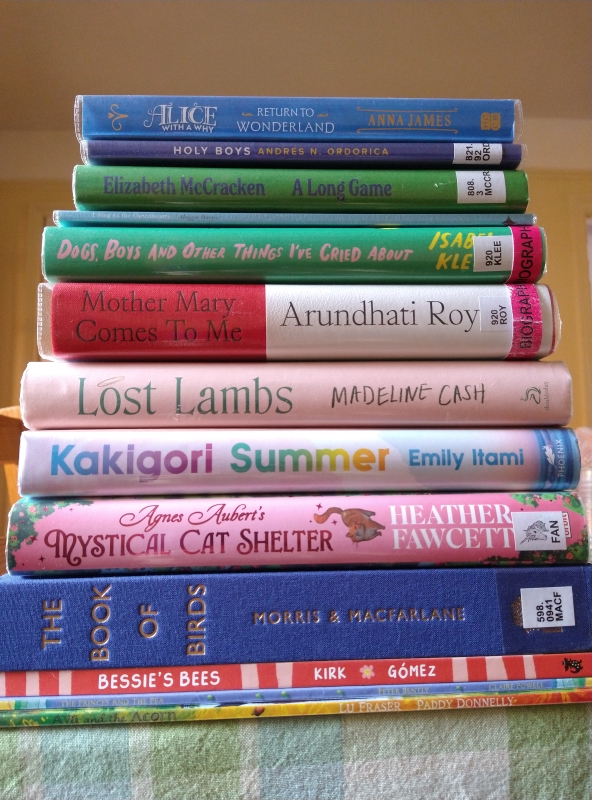
Also a few children’s picture books (which don’t count towards my year totals) from the Queen’s Knickers shortlist:
- The Tour at School by Katie Clapham; illus. by Nadia Shireen – About being the new kid in school. Good diversity rep.
- Ava and the Acorn by Paddy Donnelly – About the changing of seasons and the ageing and inevitable death of all things human and natural – though there’s hope of new life yet. Mawkish but well-meaning.
- Bessie’s Bees by George Kirk; illus. by Ana Gómez – About making the most of ADHD rather than seeing it as a problem. Cute.
Plus my brief thoughts on a few queer books I happened to experience during Pride Month:
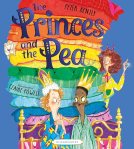 The Princes and the Pea by Peter Bently; illus. by Claire Powell (Queen’s Knickers Prize shortlist) – A perfect kids’ book for Pride Month! Prince Fredwin is about to turn 21 and knows he’s supposed to find a princess to marry, even though he prefers spending his time with his BFF Prince Zac. When Princess Ardwenna stumbles in sopping wet from a hike, she overhears the pair about to set up the old pea test for her and decides to play a trick back on them. The message about following your heart comes through loud and clear in this fabulous rainbow-hued page-turner.
Queer as Folklore: The Hidden Queer History of Myths and Monsters by Sacha Coward – We saw Coward give a talk at the second annual Queer Folk Festival at Cecil Sharp House at the end of May. (Also enjoyed fantastic music by Amit Chadda, Bailey and Keely, and Belinda O’Hooley.) His whistlestop rundown of mermaids (starting with his childhood fascination with Disney’s The Little Mermaid, especially Ursula the drag queen-esque Sea Witch), werewolves, witches and vampires and their historical overlap with ‘aberrant’ sexualities was very engaging, but I failed to get into his book-length account and just gave it a quick skim. He comes to the material as a museum professional. The simplified highlights for the lecture were as much as I needed. I appreciated his theory that queer people have always felt like Others or in-betweeners, buoyed by magic, storytelling, and weirdness.
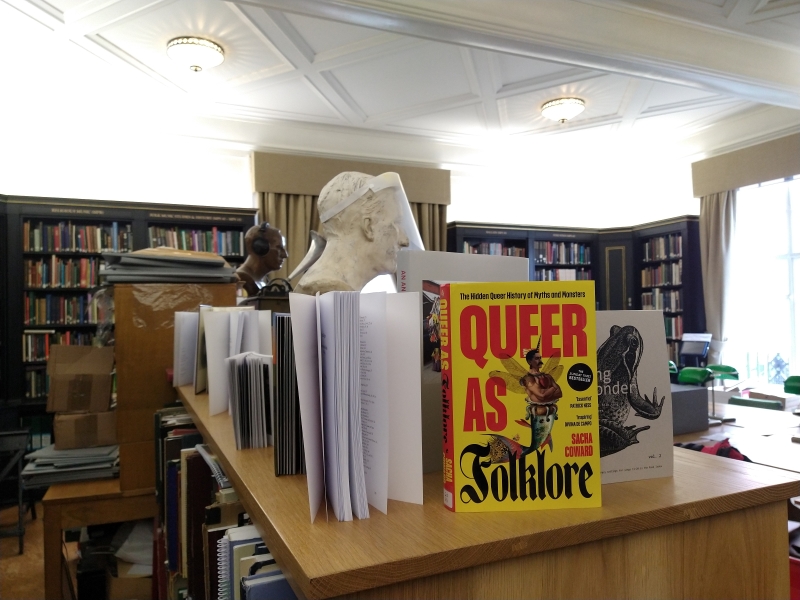
The Cecil Sharp House Library
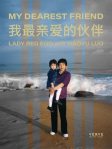 My Dearest Friend by Lady Red Ego (Jhalak Prize shortlist) – This is the pseudonym of a Chinese Scottish lesbian writer. She wrote these poems for her mother, who had cancer for six years before her death in 2025. It’s a dual-language edition, with her mother Xiaoyu Luo’s translations following each poem plus an introductory letter from mother to daughter and a closing one from daughter to mother. Childhood, adjusting to a new country, mourning … there’s nothing ground-breaking here, but the poems are very readable. Lines I liked: “Grief is so clean, it rearranges / the parts of me I can’t see / like surgery.”
 Holy Boys by Andrés N. Ordorica (Jhalak Prize shortlist) – His poetry is SO much better than his fiction (How We Named the Stars was a massive disappointment). He writes about his Mexican upbringing, visions of masculinity, his growing awareness of his sexuality, and his travels. Often, he incorporates Spanish phrases and biblical language and imagery.
SKIMMED
- The Book of Birds by Robert Macfarlane and Jackie Morris
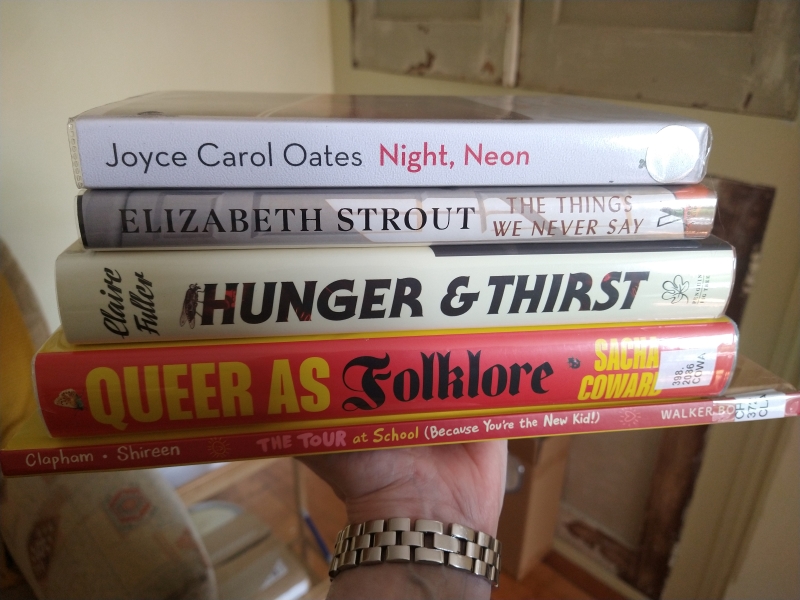
CURRENTLY READING
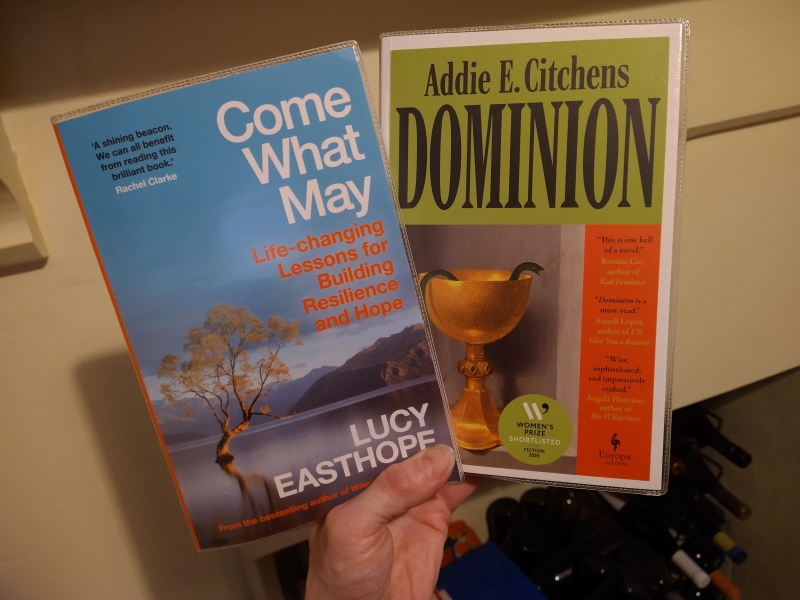
- Dominion by Addie E. Citchens (Women’s Prize for Fiction shortlist)
- Hunger and Thirst by Claire Fuller
- Kakigori Summer by Emily Itami
- The New Carthaginians by Nick Makoha (Jhalak Prize shortlist)
- A Long Game: How to Write Fiction by Elizabeth McCracken
- Night, Neon and Other Stories of Suspense by Joyce Carol Oates
- Mother Mary Comes to Me by Arundhati Roy (Women’s Prize for Non-Fiction shortlist)
- The Things We Never Say by Elizabeth Strout
- The Queen’s Gambit by Walter S. Tevis
CHECKED OUT, TO BE READ
- Come What May: Life-Changing Lessons for Coping with Crisis by Lucy Easthope
- Crossing the Water by Sylvia Plath
ON HOLD, TO BE COLLECTED
- Receipts from the Bookshop: A Bookseller’s Year by Katie Clapham
- The Typing Lady and Other Fictions by Ruth Ozeki
- Hum by Helen Phillips
- The Saltwater: A Midsummer Ghost Story by E.S. Thomson
IN THE RESERVATION QUEUE
- Honour & Other People’s Children by Helen Garner
- The Shock of the Light by Lori Inglis Hall
- Why I Am Not a Bus Driver by Ashley Hickson-Lovence
- Country People by Daniel Mason
- Land by Maggie O’Farrell
- Persepolis by Marjane Satrapi (to reread)
- Original by Nell Stevens
RETURNED UNFINISHED
- Pathfinding: On Walking, Motherhood and Freedom by Kerri Andrews – Requested off of me before I could get further than the introduction. I’ll borrow it again another time.
- Agnes Aubert’s Mystical Cat Shelter by Heather Fawcett – Even the first couple of pages were so twee I knew this wasn’t going to happen for me.
- Greenwild by Pari Thomson – I was enjoying this well enough but felt no need to keep going after 30-some pages. I’m not in a middle grade phase at the moment.
RETURNED UNREAD
- Yesteryear by Caro Claire Burke – I’d read too many middling responses to bother with this buzzy novel.
- Alice with a Why by Anna James – I read one of her series but it really tapered off in quality towards the end, so I’ve decided against reading more from her.
- Dogs, Boys and Other Things I’ve Cried About by Isabel Klee – I guess I requested this for the title? It looks kinda dumb.
What have you been reading or reviewing from the library recently?

Share a link to your own post in the comments. Feel free to use the above image. The hashtag is #LoveYourLibrary.
Women’s Prize for Non-Fiction, Writers’ Prize & Young Writer of the Year Award Catch-Up
This time of year, it’s hard to keep up with all of the literary prize announcements: longlists, shortlists, winners. I’m mostly focussing on the Carol Shields Prize for Fiction this year, but I like to dip a toe into the others where I can. I ask: What do I have time to read? What can I find at the library? and Which books are on multiple lists so I can tick off several at a go??
Women’s Prize for Non-Fiction

(Shortlist to be announced on 27 March.)
Read so far: Intervals by Marianne Brooker, Matrescence by Lucy Jones
&
A Flat Place by Noreen Masud
Past: Sunday Times/Charlotte Aitken Young Writer of the Year Award shortlist
Currently: Jhalak Prize longlist
I also expect this to be a strong contender for the Wainwright Prize for nature writing, and hope it doesn’t end up being a multi-prize bridesmaid as it is an excellent book but an unusual one that is hard to pin down by genre. Most simply, it is a travel memoir taking in flat landscapes of the British Isles: the Cambridgeshire fens, Orford Ness in Suffolk, Morecambe Bay, Newcastle Moor, and the Orkney Islands.
 But flatness is a psychological motif as well as a physical reality here. Growing up in Pakistan with a violent Pakistani father and a passive Scottish mother, Masud chose the “freeze” option when in fight-or-flight situations. When she was 15, her father disowned her and she moved with her mother and sisters to Scotland. Though no particularly awful things happened, a childhood lack of safety, belonging and love left her with complex PTSD that still affects how she relates to her body and to other people, even after her father’s death.
Masud is clear-eyed about her self and gains a new understanding of what her mother went through during their trip to Orkney. The Newcastle chapter explores lockdown as a literal Covid-era circumstance but also as a state of mind – the enforced solitude and stillness suited her just fine. Her descriptions of landscapes and journeys are engaging and her metaphors are vibrant: “South Nuns Moor stretched wide, like mint in my throat”; “I couldn’t stop thinking about the Holm of Grimbister, floating like a communion wafer on the blue water.” Although she is an academic, her language is never off-puttingly scholarly. There is a political message here about the fundamental trauma of colonialism and its ongoing effects on people of colour. “I don’t want ever to be wholly relaxed, wholly at home, in a world of flowing fresh water built on the parched pain of others,” she writes.
What initially seems like a flat authorial affect softens through the book as Masud learns strategies for relating to her past. “All families are cults. All parents let their children down.” Geography, history and social justice are all a backdrop for a stirring personal story. Literally my only annoyance was the pseudonyms she gives to her sisters (Rabbit, Spot and Forget-Me-Not). (Read via Edelweiss) 
And a quick skim:
Doppelganger: A Trip into the Mirror World by Naomi Klein
Past: Writers’ Prize shortlist, nonfiction category
 For years people have been confusing Naomi Klein (geography professor, climate commentator, author of No Logo, etc.) with Naomi Wolf (feminist author of The Beauty Myth, Vagina, etc.). This became problematic when “Other Naomi” espoused various right-wing conspiracy theories, culminating with allying herself with Steve Bannon in antivaxxer propaganda. Klein theorizes on Wolf’s ideological journey and motivations, weaving in information about the doppelganger in popular culture (e.g., Philip Roth’s novels) and her own concerns about personal branding. I’m not politically minded enough to stay engaged with this but what I did read I found interesting and shrewdly written. I do wonder how her publisher was confident this wouldn’t attract libel allegations? (Public library)
Predictions: Cumming (see below) and Klein are very likely to advance. I’m less drawn to the history or popular science/tech titles. I’d most like to read Some People Need Killing: A Memoir of Murder in the Philippines by Patricia Evangelista, Wifedom: Mrs Orwell’s Invisible Life by Anna Funder, and How to Say Babylon: A Jamaican Memoir by Safiya Sinclair. I’d be delighted for Brooker, Jones and Masud to be on the shortlist. Three or more by BIPOC would seem appropriate. I expect they’ll go for diversity of subject matter as well.
Writers’ Prize
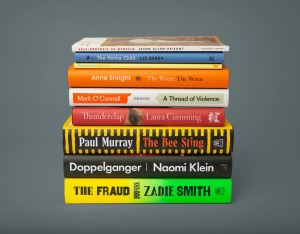
Last year I read most books from the shortlists and so was able to make informed (and, amazingly, thoroughly correct) predictions of the winners. I didn’t do as well this year. In particular, I failed with the nonfiction list in that I DNFed Mark O’Connell’s book and twice borrowed the Cumming from the library but never managed to make myself start it; I thought her On Chapel Sands overrated. (I did skim the Klein, as above.) But at least I read the poetry shortlist in full:
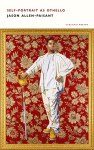 Self-Portrait as Othello by Jason Allen-Paisant: I found more to sink my teeth into here than I did with his debut collection, Thinking with Trees (2021). Part I’s childhood memories of Jamaica open out into a wider world as the poet travels to London, Paris and Venice, working in snippets of French and Italian and engaging with art and literature. “I’m haunted as much by the character Othello as by the silences in the story.” Part III returns home for the death of his grandmother and a coming to terms with identity. [Winner: Forward Prize for Best Collection; Past: T.S. Eliot Prize shortlist] (Public library)
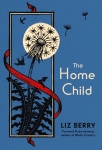 The Home Child by Liz Berry: A novel in verse “loosely inspired,” as Berry puts it, by her great-aunt Eliza Showell’s experience: she was a 12-year-old orphan when, in 1908, she was forcibly migrated from the English Midlands to Nova Scotia. The scenes follow her from her home to the Children’s Emigration Home in Birmingham, on the sea voyage, and in her new situation as a maid to an elderly invalid. Life is gruelling and lonely until a boy named Daniel also comes to the McPhail farm. This was a slow and not especially engaging read because of the use of dialect, which for me really got in the way of the story. (Public library)
 & Bright Fear by Mary Jean Chan (Current: Dylan Thomas Prize shortlist)
Three category winners:
- The Wren, The Wren by Anne Enright (Fiction)
- Thunderclap by Laura Cumming (Nonfiction) (Current: Women’s Prize for Non-Fiction longlist)
- The Home Child by Liz Berry (Poetry)
Overall winner: The Home Child by Liz Berry
Observations: The academy values books that cross genres. It appreciates when authors try something new, or use language in interesting ways (e.g. dialect – there’s also some in the Allen-Paisant, but not as much as in the Berry). But my taste rarely aligns with theirs, such that I am unlikely to agree with its judgements. Based on my reading, I would have given the category awards to Murray, Klein and Chan and the overall award perhaps to Murray. (He recently won the inaugural Nero Book Awards’ Gold Prize instead.)
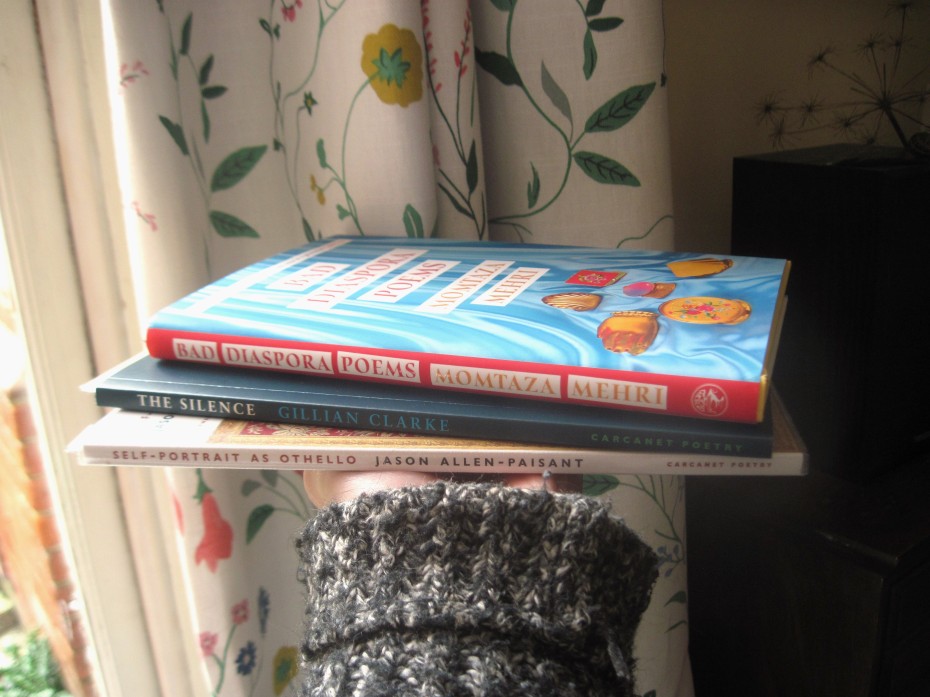
World Poetry Day stack last week
Young Writer of the Year Award
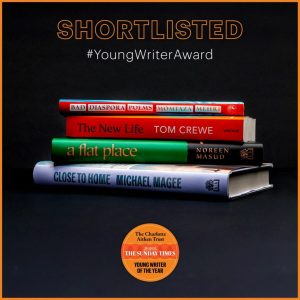
Shortlist:
- The New Life by Tom Crewe (Past: Nero Book Award shortlist, debut fiction)
- Close to Home by Michael Magee (Winner: Nero Book Award, debut fiction category)
- A Flat Place by Noreen Masud (see above)
&
Bad Diaspora Poems by Momtaza Mehri
Winner: Forward Prize for Best First Collection
Nostalgia is bidirectional. Vantage point makes all the difference. Africa becomes a repository of unceasing fantasies, the sublimation of our curdled angst.
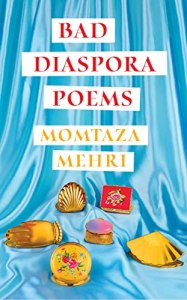 Crossing between Somalia, Italy and London and proceeding from the 1830s to the present day, this debut collection sets family history amid wider global movements. It’s peopled with nomads, colonisers, immigrants and refugees. In stanzas and prose paragraphs, wordplay and truth-telling, Mehri captures the welter of emotions for those whose identity is split between countries and complicated by conflict and migration. I particularly admired “Wink Wink,” which is presented in two columns and opens with the suspension of time before the speaker knew their father was safe after a terrorist attack. There’s super-clever enjambment in this one: “this time it happened / after evening prayer // cascade of iced tea / & sugared straws // then a line / break // hot spray of bullets & / reverb & // in less than thirty minutes we / they the land // lose twenty of our children”. Confident and sophisticated, this is a first-rate debut.
A few more favourite lines:
IX. Art is something we do when the war ends.
X. Even when no one dies on the journey, something always does.
(from “A Few Facts We Hesitantly Know to Be Somewhat True”)
You think of how casually our bodies are overruled by kin,
by blood, by heartaches disguised as homelands.
How you can count the years you have lived for yourself on one hand.
History is the hammer. You are the nail.
(from “Reciprocity is a Two-way Street”)
With thanks to Jonathan Cape (Penguin) for the free copy for review.
I hadn’t been following the Award on Instagram so totally missed the news of them bringing back a shadow panel for the first time since 2020. The four young female Bookstagrammers chose Mehri’s collection as their winner – well deserved.
Winner: The New Life by Tom Crewe
This was no surprise given that it was the Sunday Times book of the year last year (and my book of the year, to be fair). I’ve had no interest in reading the Magee. It’s a shame that a young woman of colour did not win as this year would have been a good opportunity for it. (What happened last year, seriously?!) But in that this award is supposed to be tied into the zeitgeist and honour an author on their way up in the world – as with Sally Rooney in my shadowing year – I do think the judges got it right.
Assisted Dying: Intervals by Marianne Brooker; Wendy Mitchell; and a Local Panel Discussion
Intervals by Marianne Brooker is on the longlist for the inaugural Women’s Prize for Non-Fiction, which my book club has applied to shadow. I’ve now read three of the nominees, the others being Matrescence and A Flat Place (review coming up tomorrow). Unsurprisingly, I’ve gravitated towards the ones based around a personal narrative – although all three are also political and incorporate research and cultural critique. Brooker’s is an extended essay about her mother’s protracted death with multiple sclerosis and the issues it brought up around disability, poverty, and inequality of access to medical care and services.

Specifically, Brooker decries the injustice of the wealthy having the option of travelling to Dignitas in Switzerland for an assisted death (current cost: £15,000), whereas her single mother, who lived in rented accommodation and had long been disabled and unable to work, apart from crafting and reading tarot, had so such relief in sight. Instead, she resorted to refusing life-sustaining nourishment. VSED, or voluntarily stopping eating and drinking, was a topic much on my mind anyway because of Wendy Mitchell’s death last month.
 Mitchell was diagnosed with early-onset Alzheimer’s in her fifties and was an energetic campaigner for dementia education and research for the last decade of her life. With a co-author, she wrote three books that give a valuable insider’s view of life with dementia: Somebody I Used to Know, What I Wish People Knew About Dementia, and One Last Thing, in which she specifically discusses VSED. She was determined to live independently. For her, a dignified life was being able to meet her own daily physical needs. She did not want to be in a care home, or to exist past the point where she could no longer recognise her daughters. So when, in January, she fell and broke both wrists, giving her a taste of dependency and derailing her plans to travel to Dignitas, she knew that the time had come. VSED was her way out. You can read her farewell message here.
Is wilful starvation a good death? I don’t really know. It’s peaceful, at least; a person simply gets weaker and weaker, spending more and more time asleep until they fade out, at home. But it can take two weeks to die in this way. Should loved ones have to watch this process?
Denied a liveable life and a legal right to die, my mum made a choice within and between the lines of the law. A decade after her diagnosis, when she was forty-nine and I was twenty-six, she decided to stop eating and drinking to end her suffering and her life. Her MS symptoms were barely treatable and certainly incurable: severe pain, incontinence, fatigue, the gradual but intensifying loss of mobility, vision and speech. But these medical symptoms were compounded by social conditions: isolation, stress, debt and fear of a future in which she would not be able to live or die in her chosen home. We were caught in a perfect storm.
Brooker’s description of the vigil of these last days, like her account of her vivacious mother’s life, is both tender and unflinching. It’s almost like a counterpoint to Simone de Beauvoir’s A Very Easy Death, but with the same incisive attention and emotional transfer between mother and daughter. The book also incorporates political commentary and quotations from psychologists and cultural critics. This somewhat distances the reader; it feels less like a bereavement memoir and more like an impassioned, personally inspired treatise. But that’s not to say there isn’t some levity. She remembers good times from their earlier life together, and reckons with her new role as her mother’s memorial and archivist in a way that really rang true for me. I wish the title was more evocative so as to draw the right readers to this book.
With thanks to Fitzcarraldo Editions for the free copy for review.
Also on this topic, I have read In Love by Amy Bloom, That One Patient by Ellen de Visser, The Inevitable by Katie Engelhart, Darke Matter by Rick Gekoski, and Wild and Precious Life by Deborah Ziegler.
Last night I attended a local panel discussion put on by the Campaign for Dignity in Dying. It wasn’t a debate in that 3.5 of the 4 members on the panel were pro-assisted dying, and I would guess more than four-fifths of the audience as well. In fact, the only anti- voice of the evening was from a young Catholic man during question time. I knew about the event because one panelist attends my church: George Carey, a former archbishop of Canterbury.
The Anglican Church’s line – the religious response in general – is to uphold the sanctity of life and thus to oppose assisted suicide, so for Lord Carey to do otherwise is noteworthy. He changed his mind in 2014, he explained, after the high-profile case of Tony Nicklinson, who was paralysed after a stroke and lost his appeal over the right to die. “There is no theological contradiction between valuing life and wanting a good death,” Carey insisted. Jesus showed mercy to the ill and dying, and so should we. (He also, more facetiously, described King Saul’s mercy killing by an enemy soldier in 2 Samuel as an assisted death.)
The other panelists were a lawyer, a retired doctor, and a Member of Parliament. Lawyer Graham Wood noted that the 1961 Suicide Act, under which anyone who assists a suicide can be prosecuted, would have to be abolished, and that there would also need to be a negotiation regarding Article 2 of the European Convention on Human Rights, which protects the “right to life.” He was the most wary of the speakers, warning of the danger of undue influence being exerted by relatives when money and assets are involved – he said he sees the worst of humanity in his line of work.

Dr Barry Newman pinned his support for assisted dying to compassion and autonomy, two overriding values of a liberal society. He acknowledged the current professional risk for doctors, and noted that the UK’s main medical bodies remain neutral. However, he brought up a loophole, “double effect,” administering a medication that might end life but whose intent is to alleviate suffering, e.g., a high dose of morphine to an end-stage cancer patient.
Kit Malthouse, Conservative MP for northwest Hampshire, co-chairs a group on end-of-life and has campaigned for assisted dying. (American readers may be surprised by a conservative politician having liberal views on an ethical matter. In the UK, morality is not in lockstep with religions and/or political parties as it is in the USA. This was something it took me a while to get used to: I have Christian friends who vote for four different political parties.) He was disappointed that a members’ bill on assisted dying failed in 2015, but has hope that multiple recent cases (e.g., Esther Rantzen) will put it back on the agenda and believes support in the Commons is sufficient to push legislation through in six months.
“It’s coming,” he assured, not least because many of the UK’s European neighbours and other allies have introduced assisted dying. The UK bill does not go as far as the Dutch legislation, about which all the panelists expressed doubt, and can be tailored to this country’s health system. The status quo, Malthouse cautioned, is people suffering. We know from Oregon that the current proposal will work well, he said; there is vanishingly little abuse of the system in any of the places that have instituted assisted dying legislation.
It was all preaching to the choir as far as I was concerned. Indeed, the spontaneous applause and affirming subvocalizations reminded me of a Pentecostal church service. Clearly, many from the audience had witnessed loved ones dying in horrible ways (a few of these stories came out during question time, such as a woman whose husband went to Dignitas and another who had to fight for her terminally ill sister’s wishes when she was mistakenly resuscitated by paramedics after a suicide attempt). Malthouse observed that supporters of assisted dying have often been through horrific experiences with relatives or spouses.
I was already firmly in support so last night didn’t sway me in any way, but I was encouraged that so many people are thinking and talking about these issues. Maybe by the time I face such a crisis myself, or on someone else’s behalf, a compassionate law will be in place.
 Bookish Beck = Rebecca Foster. American transplant to England. Freelance proofreader and book reviewer.
