R.I.P. Reads, Part II: Feito, King, Link, Paver & Taylor
Soon it’ll be all novellas, all the time around here. But first I have a few more October reads to review.
A belated Happy Halloween! As a kid in the U.S. suburbs, I loved Halloween. It was such fun planning costumes – pumpkin, cowgirl and picnic table are a few memorable ones that I remember thanks to photographs – and my hoard of candy would last me for months. But these days, I tend to be pretty grumpy about the holiday. It never used to be a thing in the UK, but it has been creeping in year on year. I don’t mind a creatively carved jack o’ lantern, tasteful decoration or clever homemade costume. What does get my goat is plastic tat, gratuitous gore and the dozens of sodden sweets and wrappers littering the streets after last night’s rain and wind.
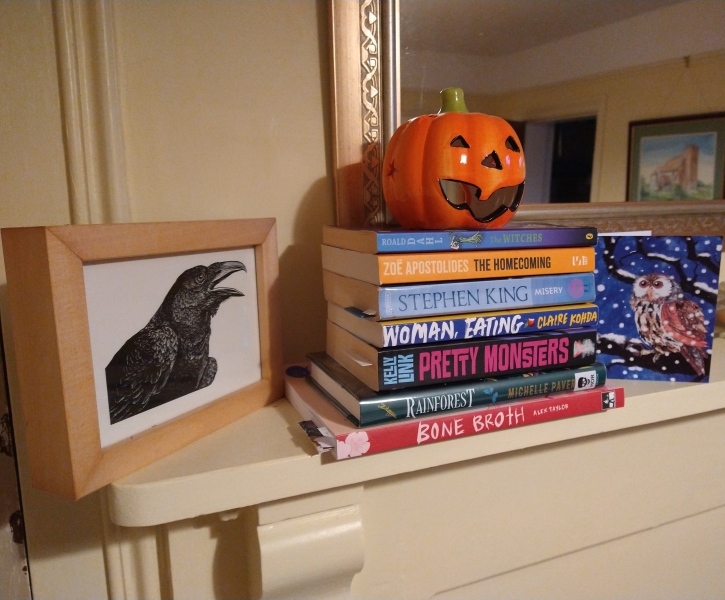
Anyway, we enjoyed the stormy evening because we spent it at friends’ having delicious autumnal lasagne and parkin, playing instruments and board games and eavesdropping on the trick-or-treaters. I had to laugh when J said “Take a couple” and one little girl replied, “That’s okay, I don’t really like sweeties.” These friends were keeping some ancient traditions alive: carving a turnip, wearing one’s clothes inside out and walking between two fires to ward off fairies. They also put potatoes in the treats bowl, which definitely confused the kids. (One did take a spud!)
I really leaned into the Readers Imbibing Peril reading this year. I had a somewhat lacklustre first batch, but these five were great!
Victorian Psycho by Virginia Feito (2025)
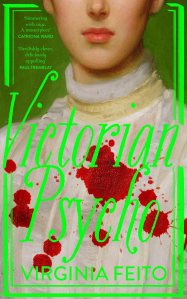 This was among my Most Anticipated titles of the year – for the bonkers blurb but also because of how much I’d enjoyed Feito’s debut, Mrs. March. Both novels go deep with mentally disturbed protagonists. The first channeled Patricia Highsmith with its stylish psychological suspense; here we have a full-on blend of slasher horror and sadistic humour, wrapped up in a Victorian pastiche. Winifred Notty (naughty girl indeed) is the new governess at Ensor House on the Yorkshire moors. She couldn’t care less about her charges, Andrew and Drusilla. No, she’s here to exact revenge on the master of the house, Mr. Pounds. But not before she’s dispatched many a random servant and baby. “Bodies pile up in the attic.” Her brutal fantasies are so realistic that at times it’s difficult to separate them from what she actually carries out. Miss Notty is also a highly sexual being whose fixations could certainly be interpreted in Freudian ways. Feito spins a traumatic backstory for her antiheroine but doesn’t make it any excuse for her gleeful reign of terror. It’s delicious fun, especially for a Victorianist, but don’t attempt if you’re squeamish. (Read via NetGalley)
Misery by Stephen King (1987)
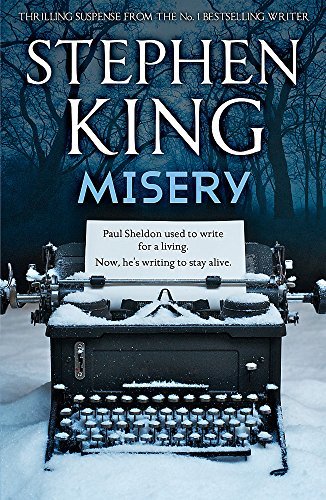 All these years I’d had two 1989–1990 films conflated: Misery and My Left Foot. I’ve not seen either but as an impressionable young’un I made a mental mash-up of the posters’ stills into a film featuring Daniel Day-Lewis as a paralyzed writer and Kathy Bates as a madwoman wielding an axe. (Turns out the left foot is relevant!)
Paul Sheldon wakes in a fog of pain, his legs shattered from a one-car accident on a snowy Colorado backroad. He’s famous for his historical potboilers about Misery Chastain but, like Arthur Conan Doyle with Sherlock Holmes, has killed off his most beloved character. Except now he’s in the home of Annie Wilkes, his rescuer and biggest fan, and she demands he resurrect Misery. Annie is a former nurse who left the profession after numerous suspicious deaths on her watch. She keeps Paul dependent on her – and on Novril, a fictional opiate. In a case of ‘Scheherazade complex’, he’ll be her prisoner until he’s completed a sequel that’s to her satisfaction. Compared to Pet Sematary, the only other King novel I’ve read, this was slow to draw me in because of the repetitive scenes in a claustrophobic setting, and I wearied of the excerpts from Paul’s manuscript. But eventually I was riveted, desperate to know how Paul was going to get out of this predicament and what the final showdown could be. Extremes of pain and obsession make this an intense study of the psychology of a wretched pair. (Public library)
Pretty Monsters by Kelly Link (2008)
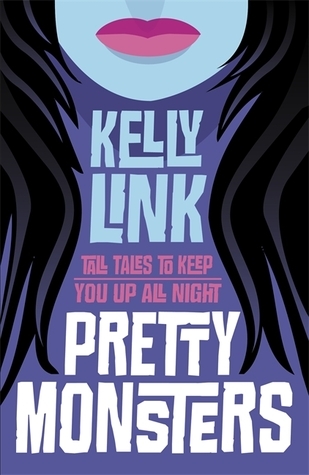 This is a reissue edition geared towards young adults. All but one of the 10 stories were originally published in literary magazines or anthologies. The stories are long, some approaching novella length, and took me quite a while to read. I got through the first three and will save the rest for next year. In “The Wrong Grave,” a teen decides to dig up his dead girlfriend’s casket to reclaim the poems he rashly buried with her last year – as did Dante Gabriel Rossetti, which Link makes a point of mentioning. A terrific blend of spookiness and comedy ensues.
“The Wizards of Perfil” and the title story are 50-some and 60-some pages, respectively, which allows a lot of space for intriguing weirdness and side plots. In the former, Onion’s cousin Halsa is purchased to be a servant to a wizard. The cousins both have the gift of foresight but can’t get the wizards to take them seriously when they beg that something to be done to prevent human disasters. It’s a brilliant allegory of the danger of waiting for an external force – God, the government, whatever – to solve everything versus getting on with it yourself. In the title story, a group of teens are obsessed with a mysterious Doctor Who-esque television show called The Library, which colours all their interactions. The main character Jeremy’s father is an eccentric sci-fi novelist named Gordon Strangle Mars who has written his son into his latest plot in a disturbing way. Jeremy recently inherited a gas station and phone box in Las Vegas and occasionally calls the phone box to air his grievances and solicit supernatural aid. My only other experience of Link was a standalone story I was once sent for review, “The Summer People,” which I didn’t get on with, so I was surprised to encounter such top-notch fantasy/horror tales. (Little Free Library)
Rainforest by Michelle Paver (2025)
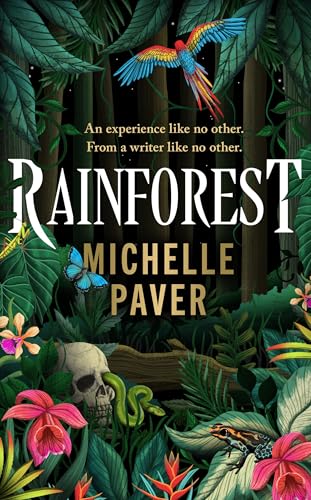 I’d read all three of Paver’s previous horror novels for adults (Thin Air, Dark Matter and Wakenhyrst) and found them easy, atmospheric reading but not nearly as scary as billed. This is her best yet. Set in 1973 on an expedition to Mexico, it has as its unreliable narrator Dr. Simon Corbett, an English entomologist. Adding to the findings of the archaeological dig he’s accompanying, he’ll be hunting for mantids (praying mantises, stick insects and the like) by fogging sacred trees with pesticides. He also experiments with taking a hallucinogenic plant extract used by the Indigenous shamans, hoping to be reunited with his lost love, Penelope.
We know that Corbett’s employment is tenuous and that he’s seeing a therapist. Paver authentically reproduces the casual racism and sexism of the time and seeds little hints that this protagonist may not be telling the whole truth about his relationship with Penelope. The long sequence where he’s lost in the jungle is fantastic. Corbett seems fated to repeat ancient masochistic rites, as if in penance for what he’s done wrong. My husband is an entomologist, so I was interested to read about period collecting practices. The novelty of the setting is a bonus to this high-quality psychological thriller and ghost story. (Public library)
Bone Broth by Alex Taylor (2025)
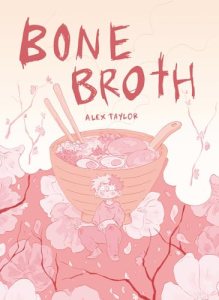 Ash is a trans man who starts working at a hole-in-the-wall ramen restaurant underneath a London railway arch. All he wants is to “pay for hormones, pay rent, [and] make enough to take a cutie on a date.” Bug’s Bones is run by an irascible elderly proprietor but staffed by a young multicultural bunch: Sock, Blue, Honey and Creamy. They quickly show Ash the ropes and within a month he’s turning out perfect bowls. He’s creeped out by the restaurant’s trademark bone broth, though, with its reminders of creatures turning into food. At the end of a drunken staff party, they find Bug lying dead and have to figure out what to do about it.
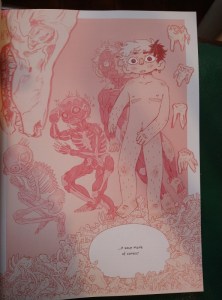 This storyline is in purple, whereas the alternating sequences of flashbacks are in a fleshy pinkish-red. As the two finally meet and meld, we see Ash trying to imitate the masculinity he sees on display while he waits for the surface to match what’s inside. I didn’t love the drawing style – though the full-page tableaux are a lot better than the high-school-sketchbook small panes – so that was an issue for me throughout, but this was an interesting, ghoulish take on the transmasc experience. Taylor won a First Graphic Novel Award.
With thanks to SelfMadeHero for the free copy for review.
And one DNF: Saltwash by Andrew Michael Hurley. (I was warned!) It had no menace or momentum at all…
Any stand-out creepy reading for you this year?
20 Books of Summer, 7–9: Furies, The Earthquake Bird, and Greta & Valdin
It might seem that I’m very behind on 20 Books of Summer, and I am, but that’s mostly because I’ve done my usual trick of starting loads of books at once so that I’m currently in the middle of another nine with no prospect of finishing any particularly soon. I will eventually review more, but probably all in a rush and on the later side. It doesn’t help that quite a few happen to be lacklustre reads, such that I have to push myself through them instead of enjoying spending time with the stack. For today, though, I have a pretty readable trio made up of feminist short stories, a mild Japan-set mystery, and a highly random queer dysfunctional family novel that rose from indie obscurity in New Zealand. (Also a DNF.)
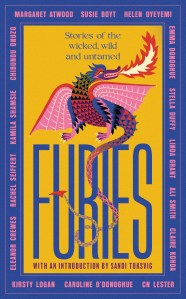
Furies: Stories of the Wicked, Wild and Untamed (2023)
It was my second attempt at this Virago anthology; I borrowed it from the library last year but never opened it, as far as I can remember. Each story is named after a synonym for “virago,” so the focus is on strong and unconventional women, but given that brief there is huge variety, including memoir (Ali Smith’s “Spitfire,” about her late mother’s WAAF service), historical research (CN Lester on sexology and early trans figures, Emma Donoghue on early-twentieth-century activist and lesbian Kathlyn Oliver, Stella Duffy on menopause) and even one graphic short, the mother–daughter horror story “She-Devil” by comics artist Eleanor Crewes.
 As with any anthology, some pieces stand out more than others. Caroline O’Donoghue, Helen Oyeyemi and Kamila Shamsie’s contributions were unlikely to convert me into a fan. Margaret Atwood is ever sly and accessible, with “Siren” opening with the line “Today’s Liminal Beings Knitting Circle will now be called to order.” I was surprised to get on really well with Kirsty Logan’s “Wench,” about girls ostracized by their religious community because of their desire for each other – I’ll have to read Now She Is Witch, as it’s set in the same fictional world – and Chibundu Onuzo’s “Warrior,” about Deborah, an Israelite leader in the book of Judges. And while I doubt I need to read a whole novel by Rachel Seiffert, I did enjoy “Fury,” about a group of Polish women who fended off Nazi invaders.
A few of my favourites were “Harridan” by Linda Grant, about an older woman who frightens the young couple who share her flat’s garden during lockdown (“this old lady, this hag she sees, this bitter travesty of her celestial youth and beauty is not her. Inside she’s a flame, she’s a pistol”); “Muckraker” by Susie Boyt, in which a woman makes conquests of breast cancer widowers; and “Tygress” by Claire Kohda, where the stereotype of the Asian ‘tiger mother’ turns literal. Duffy’s “Dragon” closes the collection with a very interesting blend of autofiction, interviews and medical reportage about different experiences of objectification in youth and invisibility in ageing. It brings the whole together nicely: “Tell me your tale and, in the telling, feel it all drop away. You are, and you are not, your story. Keep what serves you now, make space for new maybes.” (Free from a neighbour) 
The Earthquake Bird: A Novel of Mystery by Susanna Jones (2001)
 Susanna Jones’s When Nights Are Cold is one of my favourite novels that no one else has ever heard of, so I jumped at the chance to buy a bargain copy of her debut back in 2020. Lucy Fly has lived in Tokyo for ten years, working as a translator of machinery manuals. She wanted to get as far away as possible from her conventional family of six brothers, so she’s less than thrilled to meet fellow Yorkshire lass Lily Bridges, a nurse new to the country and looking for someone to help her find an apartment and learn some basic Japanese. Lucy is a prickly loner with only a few friends – and a lover, photographer Teiji – but she reluctantly agrees to be Lily’s guide.
We know from the start that Lucy is in custody being questioned about events leading up to Lily’s murder. She refuses to tell the police anything, but what we are reading is her confession, in which she does eventually tell all. We learn that there have already been three accidental deaths among her family and acquaintances – she seems cursed to attract them – and that her feelings about Lily changed over the months she showed the woman around. This short and reasonably compelling book gives glimpses of mountain scenery, noodle bars, and spartan apartments. Perhaps inevitably, it reminded me a bit of Murakami. It’s hard to resist an unreliable narrator. However, I felt Jones’s habit of having Lucy speak of herself in the third person was overdone. (Secondhand – Broad Street Book Centre, Hay-on-Wye) 
Greta & Valdin by Rebecca K Reilly (2021; 2024)
 The title characters are a brother and sister in their late twenties who share a flat and a tendency to sabotage romantic relationships. Both are matter-of-factly queer and biracial (Māori/Russian). The novel flips back and forth between their present-tense first-person narration with each short chapter. It takes quite a while to pick up on who is who in the extended Vladisavljevic clan and their New Zealand university milieu (their father is a science professor and Greta an English department PhD and tutor), so I was glad of the character list at the start.
I was expecting a breezy, snarky read and to an extent that’s what I got. Not a whole lot happens; situations advance infinitesimally through quirky dialogue thick with pop culture references. There are some quite funny one-liners, but the plot is so meandering and the voices so deadpan that I struggled to remain engaged. (On her website, Reilly, who is Māori, ascribes the book’s randomness to her neurodivergence.)
The protagonists seem so affectedly cynical that when they exhibit strong feelings for new partners, you’re a bit taken aback. Really, Reilly can do serious? One of the siblings is reunited with a former partner and starts to think about settling down and even adopting a child. This is the last novel I would have expected to end with a wedding, but so it does. If you’re a big fan of Elif Batuman and Naoise Dolan, this might be up your street. Below are some sample lines that should help you make up your mind (quotes unattributed to minimize spoilers).
I don’t really feel like anything these days, just a beautiful husk filled with opinions about globalism and a strong desire to go out for dinner.
I don’t think you’re the weirdest person I’ve ever met even though you do sometimes talk like a philosophical narrator in an independent film.
I’m trying to write my wedding speech, so I don’t go off on a tangent and start listing my favourite Arnold Schwarzenegger movies. I was thinking I could write an acrostic poem, but I’ve made the foolish decision of marrying someone whose name begins with X.
With thanks to Hutchinson Heinemann (Penguin Random House) for the free copy for review.
And a DNF:
 The Lost Love Songs of Boysie Singh by Ingrid Persaud – I thought Persaud’s debut novel, Love after Love, was fantastic, but I was right to be daunted by the length of this follow-up. The strategy is similar to that in Mrs. Hemingway by Naomi Wood: giving sideways looks at a famous man through the women he collected around him. John Boysie Singh was a real-life Trinidadian gangster who was hanged for his crimes in 1957 (as the article reprinted on the first page reveals). The major problem here is that all four of the dialect voices sound much the same, so I couldn’t tell them apart. Each time I opened the book, I had to look back at the blurb to be reminded that Popo was his prostitute mistress while Mana Lala was the mother of his son Chunksee. In the 103 pages I read (less than one-fifth of the total), there were so few chapters by Doris and Rosie that I never got a handle on who they were. Nor did I come to understand, or care about, Boysie. The editor needed to make drastic changes to this to ensure widespread readability. (Signed copy won in a Faber Instagram giveaway)
Short Stories in September, Part I: Byatt, Hildyard, Okorie, Simpson
Each September I make a special effort to read short stories, which otherwise tend to languish on my shelves unread. In 2020 I read eight collections for this challenge. This year I hope to outdo myself. I’m knee-deep in seven more collections at the moment, including a couple from the library and two from my set-aside-temporarily shelf. Here’s my first four.
Medusa’s Ankles: Selected Stories by A.S. Byatt (2021)
I’ve long considered Byatt my favourite author, and have read all of her published short story collections before. One I even reread last year. So when approaching this chronological selection of 18 stories, I skipped the couple I’d read recently, even though that includes perhaps my favourite stand-alone story of all time (“Medusa’s Ankles”), plus a few more that I’d read before. This time around, I found I wasn’t as interested in the historical stories in the Angels and Insects or Possession vein – chiefly “Precipice-Encurled,” a long story about Robert Browning from her first collection – and instead focused on stories where fantasy or horror breaks into everyday life, and writerly or metafictional ones.
As David Mitchell notes in his introduction, Byatt’s range, from fairy tales to historical realism, is almost overwhelming; it’s hard to do it justice in a short review, but I’ll highlight five brilliant stories beyond the title one. “The July Ghost,” an early story, is another that has stuck with me over the years, turning up in one of my Six Degrees posts. It’s a straight-up ghost story but also a tale within a tale being recounted by a man at a party, and blends sex and death in a creepy way. “Racine and the Tablecloth” pits a clever boarding school girl and her literature professor against each other in a tacit psychological conflict. “Who won, you will ask, Emily or Miss Crichton-Walker, since the Reader is mythical and detached?”

“A Lamia in the Cévennes,” about a seductive snake-spirit living in a painter’s swimming pool, provides a delicious lick of magic. I’m surprised I didn’t remember “Raw Material,” as it was a favourite on this reread. A working-class author teaches his creative writing students to write what they know and avoid melodrama. Yet most of them craft over-the-top graphic tales of torture and revenge. Only an unassuming octogenarian follows his instructions, spinning lovingly meticulous accounts of polishing stoves and washing laundry by hand in the old days. He is captivated by her stories, reading them aloud to an unappreciative class and even entering them into a competition. But the old woman’s life holds a sordid surprise. It’s mind-blowing how Byatt turns all our expectations for this story on their head and forces us to question nostalgia and the therapeutic value of writing fiction.
Five of the late stories were originally printed in other publications and had not previously been collected. Of these, I most liked “Dolls’ Eyes” (2013), which is available as a Comma Singles e-book and was in the anthology The New Uncanny. A schoolteacher who lives in a house full of dolls welcomes a new fellow teacher to be her lodger and trusts her with her love and her dolls, only to be betrayed and call down vengeance. “Sea Story,” which appeared in the Guardian, is a thoroughly depressing closer about the persistence of plastic (but how about that last line?!).
One of the things I most admire about Byatt is her use of colour, and visual detail in general. As Mitchell puts it, “It is not easy to think of another writer with so painterly and exact an eye for the colours, textures and appearances of things. The visual is in constant dialogue with the textual.” Witness in the autobiographical “Sugar” the descriptions of boiled sweets being made almost like blown glass in a grandfather’s factory, or the colourful minerals participating in the metamorphosis in “A Stone Woman.”
If you’re new to Byatt’s work, picking a handful of stories from this collection would be a great way of trying out her style and figuring out which of her full-length books you might like to read. Fans of Margaret Atwood, Julian Barnes and Michèle Roberts are specially invited to the feast. (Public library) 
Some favourite lines:
“Such wonder, such amazement, are the opposite, the exact opposite, of boredom, and many people only know them after fear and loss. Once known, I believe, they cannot be completely forgotten; they cast flashes and floods of paradisal light in odd places and at odd times.”
“the world is full of light and life, and the true crime is not to be interested in it. You have a way in. Take it. It may incidentally be a way out, too, as all skills are.”
After that in-depth review, I’ll give just brief responses to the next three slim volumes.
Slaughter by Rosanna Hildyard (2021)
 A debut trio of raw stories set in the Yorkshire countryside. In “Offcomers,” the 2001 foot and mouth disease outbreak threatens the happiness of a sheep-farming couple. The effects of rural isolation on a relationship resurface in “Outside Are the Dogs.” In “Cull Yaw,” a vegetarian gets involved with a butcher who’s keen on marketing mutton and ends up helping him with a grisly project. This was the stand-out for me. I appreciated the clear-eyed look at where food comes from. At the same time, narrator Star’s mother is ailing: a reminder that decay is inevitable and we are all naught but flesh and blood. I liked the prose well enough, but found the characterization a bit thin. One for readers of Andrew Michael Hurley and Cynan Jones. (See also Annabel’s review.)
A favourite passage:
“his mother silently spoons out second helpings of beef lasagne. Outside, the lasagne’s sisters cavort in the paddock.”
This story pamphlet was released by Broken Sleep Books, an indie publisher in Wales, in March. My thanks to Annabel for passing on her review copy.
This Hostel Life by Melatu Uche Okorie (2018)
 Okorie emigrated from Nigeria to Ireland in 2005. Her time living in a direct provision hostel for asylum seekers informed the title story about women queuing for and squabbling over food rations, written in an African pidgin. In “Under the Awning,” a Black woman fictionalizes her experiences of racism into a second-person short story her classmates deem too bleak. The Author’s Note reveals that Okorie based this one on comments she herself got in a writers’ group. “The Egg Broke” returns to Nigeria and its old superstition about twins.
Fans of Chimamanda Ngozi Adichie will find a similar voice here, and enough variety to distract from the low page count (the book is padded out with an essay on refugees in Ireland) and so-so writing. (Little Free Library)
Dear George and Other Stories by Helen Simpson (1995)
 This is the third time Simpson has made it into one of my September features (after Four Bare Legs in a Bed in 2018 and In the Driver’s Seat in 2019); safe to say she’s becoming one of my favourite short story writers. Deciding to have children (or not) looms large. In “When in Rome,” Geraldine is relieved to get her period as her relationship limps to an end. In “Last Orders,” the heavily pregnant protagonist, now 12 days overdue, fears the transformation ahead of her. “To Her Unready Boyfriend,” echoing Andrew Marvell’s “To His Coy Mistress,” has the narrator warn him time runs short for babymaking.
I also liked “Bed and Breakfast,” about a young couple hoping not to turn into their boring parents; “Caput Apri” and its magical twist on the story behind “The Boar’s Head Carol” (a Christmas story or two is a trademark of Simpson’s collections, like the focus on motherhood); and “Heavy Weather,” in which parents of two small children have a manic Dorset holiday that takes in some beloved sites like Hardy’s cottage and marvel at the simultaneous joys and tyranny of childrearing.
The gentle absurdity of “The Immaculate Bridegroom” reminded me of a previous Simpson story in which a woman marries herself, and “Creative Writing” connects back to two of the other collections I’ve featured here with its writers’ workshop setting. (Secondhand purchase from Oxfam Books, Hexham)
Some favourite lines:
“You will not be you any more, her ego told her id. Not only will you have produced somebody else from inside you, someone quite different and separate, but you yourself will change into somebody quite different, overnight – a Mother.”
“Children were petal-skinned ogres, Frances realized, callous and whimsical, holding autocratic sway over lower, larger vassals like herself.”
Are you a short story fan? Read any good ones recently?
Summery Classics by J. L. Carr and L. P. Hartley
“Do you remember what that summer was like? – how much more beautiful than any since?”
These two slightly under-the-radar classics made for perfect heatwave reading over the past couple of weeks: very English and very much of the historical periods that they evoke, they are nostalgic works remembering one summer when everything changed – or could have.
A Month in the Country by J. L. Carr (1980)
 Summer 1920, North Yorkshire. Tom Birkin, a First World War veteran whose wife has left him, arrives in Oxgodby to uncover the local church’s wall painting of the Judgment Day, assumed to be the work of a medieval monk and long since whitewashed over. With nothing waiting for him back in London and no plans beyond this commission, he gives himself over to the daily rhythms of working, eating and sleeping – “There was so much time that marvelous summer.” This simple life is punctuated by occasional incidents like a Sunday school hayride and picnic, and filling in as a lay preacher at a nearby chapel. Also embarked on a quest into the past is Charles Moon, who is searching for the grave of their patroness’ ancestor in the churchyard. Moon, too, has a war history he’d rather forget.
Though it barely exceeds 100 pages, this novella is full of surprises – about Moon, about the presumed identity and fate of the centuries-dead figures he and Birkin come to be obsessed with, and about the emotional connection that builds between Birkin and Reverend Keach’s wife, Alice. “It is now or never; we must snatch at happiness as it flies,” Birkin declares, but did he take his own advice? There is something achingly gorgeous about this not-quite-love story, as evanescent as ideal summer days. Carr writes in a foreword that he intended to write “a rural idyll along the lines of Thomas Hardy’s Under the Greenwood Tree.” He indeed created something Hardyesque with this tragicomic rustic romance; I was also reminded of another very English classic I reviewed earlier in the year: Cider with Rosie by Laurie Lee.
Source: Free bookshop
My rating: 
A contemporary readalike: The Offing by Benjamin Myers
The Go-Between by L. P. Hartley (1953)
Summer 1900, Norfolk. Twelve-year-old Leo Colston is invited to spend the several July weeks leading up to his birthday at his school friend Marcus Maudsley’s home, Brandham Hall. Although the fatherless boy is keenly aware of the class difference between their families, in a year of learning to evade bullies he’s developed some confidence in his skills and pluck, fancying himself an amateur magician and gifted singer. Being useful makes him feel less like a charity case, so he eagerly agrees to act as “postman” for Marcus’s older sister, Marian, who exchanges frequent letters with their tenant farmer, Ted Burgess. Marian, engaged to Hugh, a viscount and injured Boer War veteran, insists the correspondence is purely business-related, but Leo suspects he’s abetting trysts the family would disapprove of.
 Leo is right on the cusp of adolescence, a moment of transition that mirrors the crossing into a new century. As he glories in the summer’s mounting heat, “a liberating power with its own laws,” and mentally goads the weather into hitting ever greater extremes, he pushes against the limits of his innocence, begging Ted to tell him about “spooning” (that is, the facts of life). The heat becomes a character in its own right, gloweringly presiding over the emotional tension caused by secrets, spells and betrayals. And yet this is also a very funny novel: I loved Leo’s Franglais conversations with Marcus, and the confusion over mispronouncing “Hugh” as “you.” In places the tone even reminded me of Cold Comfort Farm.
Like A Month in the Country, this autobiographical story is an old man’s reminiscences, going back half a century in memory – but here Leo gets the chance to go back in person as well, seeing what has become of Brandham Hall and meeting one of the major players from that summer drama that branded him for life. I thought this masterfully done in every way: the class divide, the picture of childhood tipping over into the teenage years, the oppressive atmosphere, the comical touches. You know from the famous first line onwards (“The past is a foreign country: they do things differently there”) that this will juxtapose past and present – which, of course, has now become past and further past – in a powerful way, similar to Moon Tiger, my favorite fiction read of last year. I’ll be exploring more of Hartley’s work.
(Note: Although I am a firm advocate of DNFing if a book is not working for you, I would also like to put in a good word for trying a book again another time. Ironically, this had been a DNF for me last summer: I found the prologue, with all its talk of the zodiac, utterly dull. I had the same problem with Cold Comfort Farm, literally trying about three times to get through the prologue and failing. So, for both, I eventually let myself skip the prologue, read the whole novel, and then go back to the prologue. Worked a treat.)
Source: Ex-library copy bought from Lambeth Library when I worked in London
My rating: 
A contemporary readalike: Atonement by Ian McEwan
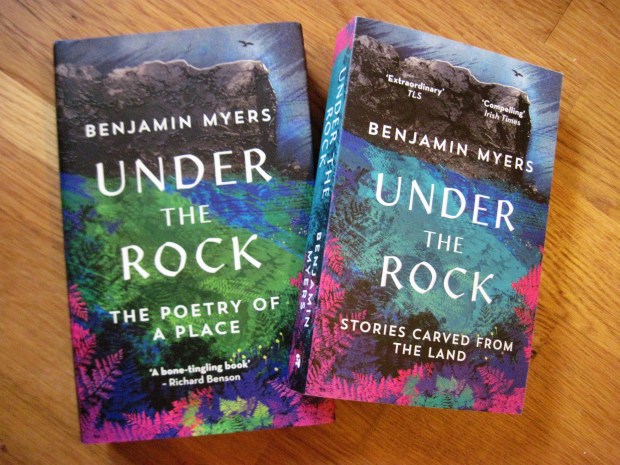
Under the Rock by Benjamin Myers: Paperback Giveaway
Benjamin Myers’s Under the Rock was my nonfiction book of 2018, so I’m delighted to be kicking off the blog tour for its paperback release on the 25th (with a new subtitle, “Stories Carved from the Land”). I’m reprinting my Shiny New Books review below, with permission, and on behalf of Elliott & Thompson I am also hosting a giveaway of a copy of the paperback. Leave a comment saying that you’d like to win and I will choose one entry at random at the end of the day on Tuesday the 30th. (Sorry, UK only.)
My review:
Benjamin Myers has been having a bit of a moment. In 2017 Bluemoose Books published his fifth novel, The Gallows Pole, which went on to win the Roger Deakin Award and the Walter Scott Prize for Historical Fiction and is now on its fourth printing. This taste of fame has brought renewed attention to his earlier work, including Beastings (2014), recipient of the Northern Writers’ Award. I’ve been interested in Myers’s work ever since I read an extract from the then-unpublished The Gallows Pole in Autumn, the Wildlife Trusts anthology edited by Melissa Harrison, but this is the first of his books that I’ve managed to read.
“Unremarkable places are made remarkable by the minds that map them,” Myers writes, and that is certainly true of Scout Rock, a landmark overlooking Mytholmroyd, near where the author lives in the Calder Valley of West Yorkshire. When he moved up there from London over a decade ago, he and his wife lived in a rental cottage built in 1640. He approached his new patch with admirable curiosity, and supplemented the observations he made from his study window with frequent long walks with his dog, Heathcliff (“Walking is writing with your feet”), and research into the history of the area. The result is a divagating, lyrical book that ranges from geology to true crime but has an underlying autobiographical vein.
Ted Hughes was born nearby, the Brontës not that much further away, and Hebden Bridge, in particular, has become a bastion of avant-garde artists and musicians. Myers also gets plenty of mileage out of his eccentric neighbours and postman. It’s a town that seems to attract oddballs and renegades, from the vigilantes who poisoned the fishing hole to an overdose victim who turns up beneath a stand of Himalayan balsam. A strange preponderance of criminals has come from the region, too, including sexual offenders like Jimmy Savile and serial killers such as the Yorkshire Ripper and Harold Shipman (‘Doctor Death’).
On his walks Myers discovers the old town tip, still full of junk that won’t biodegrade for hundreds more years, and finds traces of the asbestos that was dumped by Acre Mill, creating a national scandal. This isn’t old-style nature writing in search of a few remaining unspoiled places. Instead, it’s part of a growing literary interest in the ‘edgelands’ between settlement and the wild – places where the human impact is undeniable but nature is creeping back in. (Other recent examples would be Common Ground by Rob Cowen, Landfill by Tim Dee, Edgelands by Paul Farley and Michael Symmons Roberts, and Outskirts by John Grindrod.)
Under the Rock gives a keen sense of the seasons’ change and the seemingly inevitable melancholy that accompanies bad weather. A winter of non-stop rain left Myers nigh on delirious with flu; Storm Eva caused the Calder River to flood. He was a part of the effort to rescue trapped pensioners. Heartening as it is to see how the disaster brought people together – Sikh and Muslim charities and Syrian refugees were among the first to help – looting also resulted. One of the most remarkable things about this book is how Myers takes in such extremes of behaviour, along with mundanities, and makes them all part of a tapestry of life.
The book’s recurring themes tangle through all of the sections, even though it has been given a somewhat arbitrary four-part structure (Wood – Earth – Water – Rock). Interludes between these major parts transcribe Myers’s field notes, which are more like impromptu poems that he wrote in a notebook kept in his coat pocket. The artistry of these snippets of poetry is incredible given that they were written in situ, and their alliteration bleeds into his prose as well. My favourite of the poems was “On Lighting the First Fire”:
Autumn burns
the sky
the woods
the valley
death is everywhere
but beneath
the golden cloak
the seeds of
a summer’s
dreaming still sing.
The Field Notes sections are illustrated with Myers’s own photographs, which, again, are of enviable quality. I came away from this feeling like Myers could write anything – a thank-you note, a shopping list – and make it read as profound literature. Every sentence is well-crafted and memorable. There is also a wonderful sense of rhythm to his pages, with a pithy sentence appearing every couple of paragraphs to jolt you to attention.
“Writing is a form of alchemy,” Myers declares. “It’s a spell, and the writer is the magician.” I certainly fell under the author’s spell here. While his eyes are open to the many distressing political and environmental changes of the last few years, the ancient perspective of the Rock reminds him that, though humans are ultimately insignificant and individual lives are short, we can still rejoice in our experiences of the world’s beauty while we’re here.
From the publisher:
“Benjamin Myers was born in Durham in 1976. He is a prize-winning author, journalist and poet. His recent novels are each set in a different county of northern England, and are heavily inspired by rural landscapes, mythology, marginalised characters, morality, class, nature, dialect and post-industrialisation. They include The Gallows Pole, winner of the Walter Scott Prize for Historical Fiction, and recipient of the Roger Deakin Award; Turning Blue, 2016; Beastings, 2014 (Portico Prize for Literature & Northern Writers’ Award winner), Pig Iron, 2012 (Gordon Burn Prize winner & Guardian Not the Booker Prize runner-up); and Richard, a Sunday Times Book of the Year 2010. Bloomsbury will publish his new novel, The Offing, in August 2019.
As a journalist, he has written widely about music, arts and nature. He lives in the Upper Calder Valley, West Yorkshire, the inspiration for Under the Rock.”
Recent Writing for BookBrowse, Shiny New Books and the TLS
Here are excerpts from (and links to, where available) some of my recent reviews for other places. A few of these books will undoubtedly be showing up on my end-of-year best lists in a couple weeks’ time.
BookBrowse
I was pleased to have three of the books I reviewed show up on BookBrowse’s list of the top 20 books of the year, as voted for by the site’s readers. What’s more, Educated was voted their top nonfiction book of the year and Where the Crawdads Sing (below) their #1 debut novel. (The third on the list was Unsheltered.)
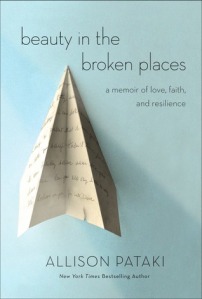 Beauty in the Broken Places by Allison Pataki: Ernest Hemingway wrote that we are strong at the broken places, and Allison Pataki found that to be true when her husband, David Levy, a third-year orthopedic surgery resident in Chicago, had a near-fatal stroke at age 30. On June 9, 2015, Dave and five-months-pregnant Allison were on a flight from Chicago to Hawaii for their babymoon, planning to stop in Seattle to visit Dave’s brothers. But they never made it there. On the plane Dave told her he couldn’t see out of his right eye.The plane made an emergency landing in Fargo, North Dakota and Dave was rushed to a hospital for testing. Doctors found he had suffered a bithalamic midbrain ischemic stroke, even though he’d had no risk factors and this stroke type was virtually unknown in patients of his age. Pataki goes back and forth between the details of this health crisis and her past with Dave. Hers is a relatable story of surviving the worst life can throw at you and finding the beauty in it.
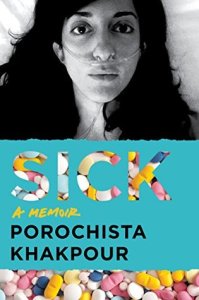 Sick by Porochista Khakpour: Khakpour can’t remember a time when she didn’t feel unwell and like she wanted to escape. “I had no idea what normal was. I never felt good,” she writes in her bracing memoir. Related to this sense of not being at home in her body was the feeling of not having a place where she fit in. Throughout Sick, she gives excellent descriptions of physical and mental symptoms. Her story is a powerful one of being mired in sickness and not getting the necessary help from medical professionals. Lyme disease has cost her $140,000 so far, and a lack of money and health insurance likely delayed her diagnosis by years. There is, unfortunately, some inherent repetition in a book of this nature. At times it feels like an endless cycle of doctors, appointments, and treatment strategies. However, the overall arc of struggling with one’s body and coming to terms with limitations will resonate widely.
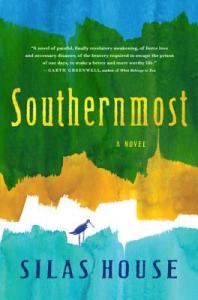 Southernmost by Silas House: In Silas House’s sixth novel, a Tennessee preacher’s family life falls apart when he accepts a gay couple into his church. We go on a long journey in Southernmost: not just a literal road trip from Tennessee to Florida, but also a spiritual passage from judgment to grace. Reconciliation is a major theme, but so is facing up to the consequences of poor decisions. I found the plotting decisions rewarding but also realistic. The pattern of a narrow religious worldview ebbing away to no faith at all and eventually surging back as a broader and more universal spirituality truly resonates. I loved House’s characters and setups, as well as his gentle evocation of the South. His striking metaphors draw on the natural world, like “She had the coloring of a whip-poor-will” and “The sky is the pink of grapefruit meat.” It’s a beautiful, quietly moving novel of redemption and openness to what life might teach us.
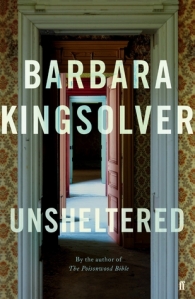 Unsheltered by Barbara Kingsolver: Kingsolver’s bold eighth novel has a dual timeline that compares the America of the 1870s and the recent past, revealing how they are linked by distrust and displacement. The book’s themes and structure emphasize similarities between two time periods that might initially appear very different. Chapters alternate between the story lines, and the last words of one chapter form the title of the next. It’s a clever and elegant connecting strategy, as is the habit of using variations on the title word as frequently as possible – something Jonathan Franzen also does in his novels. (I counted 22 instances of “shelter” and its variants in the text; how many can you spot?) Kingsolver can be heavy-handed with her messages about science, American politics and healthcare, etc. All the same, Unsheltered is a rich, rewarding novel and an important one for our time, with many issues worth pondering and discussing.
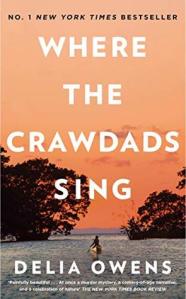 Where the Crawdads Sing by Delia Owens: It’s easy to see why so many have taken this debut novel into their hearts: it’s a gripping mystery but also a tender coming-of-age story about one woman’s desperately lonely upbringing and her rocky route to finding love and a vocation. Not only that, but its North Carolina marsh setting is described in lyrical language that evinces Delia Owens’s background in nature writing, tempered with folksy Southern dialect. The title refers to places where wild creatures do what comes naturally, and throughout the book we are invited to ponder how instinct and altruism interact and what impact human actions can have in the grand scheme of things. In Kya, Owens has created a truly outstanding character. The extremity of her situation makes her a sympathetic figure in spite of her oddities. Crawdads is a real treat.
Shiny New Books
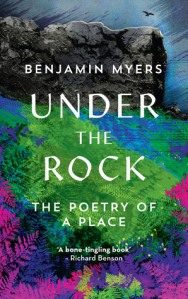 Under the Rock by Benjamin Myers: When Myers moved to the Calder Valley of West Yorkshire from London over a decade ago, he approached his new patch with admirable curiosity, and supplemented the observations he made from his study window with frequent long walks with his dog (“Walking is writing with your feet”) and research into the history of the area. The result is a divagating, lyrical book that ranges from literature and geology to true crime but has an underlying autobiographical vein. This isn’t old-style nature writing in search of unspoiled places. Instead, it’s part of a growing interest in the ‘edgelands’ where human impact is undeniable but nature is creeping back in. Interludes transcribe his field notes, which are stunning impromptu poems. I came away from this feeling that Myers could write anything – a thank-you note, a shopping list – and make it profound literature. Every sentence is well-crafted and memorable. “Writing is a form of alchemy,” he declares. “It’s a spell, and the writer is the magician.” I certainly fell under his spell here.
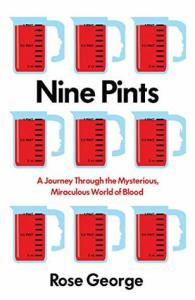 Nine Pints by Rose George: Nine Pints dives deep into the science and cultural history of blood. George’s journalistic tenacity keeps her pushing through the statistics to find the human stories that animate the book. In the first chapter we track the journey of a pint of blood that she donates in her hometown of Leeds. I was particularly interested, if morbidly so, in the chapter on leeches and bloodletting. Other sections journey further afield, chiefly to South Africa and India, to explore AIDS and menstruation taboos. The style can be choppy and repetitive, given to short sentences and identical paragraph openers, and there are a couple of places where the nine-chapter structure shows its weaknesses. While Nine Pints is quite uneven, it does convey a lot of important information about the past, present and future of our relationship to blood.
Times Literary Supplement
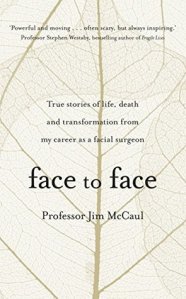 Face to Face: True stories of life, death and transformation from my career as a facial surgeon by Jim McCaul: Eighty percent of a facial surgeon’s work is the removal of face, mouth and neck tumors in surgeries lasting eight hours or more. McCaul also restores patients’ appearance as much as possible after disfiguring accidents. Here he pulls back the curtain on the everyday details of his work life: everything from his footwear (white Crocs that soon become stained with blood and other fluids) to his musical choices (pop for the early phases; classical for the more challenging microsurgery stage). Like neurosurgeon Henry Marsh, he describes the awe of the first incision – “an almost overwhelming sense of entering into a sanctuary.” There’s a vicarious thrill to being let into this insider zone, and the book’s prose is perfectly clear and conversational, with unexpectedly apt metaphors such as “Sometimes the blood vessels can be of such poor quality that it is like trying to sew together two damp cornflakes.” This is a book that inspires wonder at all that modern medicine can achieve.
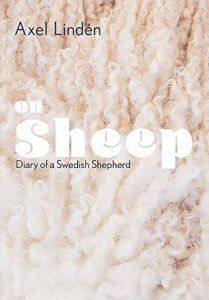 On Sheep: Diary of a Swedish Shepherd by Axel Lindén: Lindén left city life behind to take on his parents’ rural collective in southeast Sweden. This documents two years in his life as a shepherd aspiring to self-sufficiency and a small-scale model of food production. Published diaries can devolve into tedium, but the brevity and selectiveness of this one prevent its accounts of everyday tasks from becoming tiresome. Instead, the rural routines are comforting, even humbling, as the shepherd practices being present with these “quiet and unpretentious and stoical” creatures. The attention paid to slaughtering and sustainability issues – especially as the business starts scaling up and streamlining activities – lends the book a wider significance. It is thus more realistic and less twee than its stocking-stuffer dimensions and jolly title font seem to suggest.
The Booker Dark Horse: Elmet by Fiona Mozley
The dark horse in this year’s Man Booker Prize race is Elmet, a brilliant, twisted fable about the clash of the land-owning and serf classes in contemporary England. I’d love to see this win the Booker, or make the shortlist at the very least. You’d hardly believe it’s a debut novel, or that it’s by a 29-year-old PhD candidate in medieval history. The epigraph from Ted Hughes defines “Elmet” as an ancient Celtic kingdom encompassing what is now West Yorkshire. The word still appears in a few Yorkshire place names today. Metaphorically, Hughes notes, the region was a “‘badlands’, a sanctuary for refugees from the law.” That’s an apt setting for Mozley’s central characters: a family living on the edge of poverty and respectability – off-grid and not quite legal.
 Daniel and Cathy Oliver – 14 and 15, respectively – live with their father, John Smythe, in a simple house he built with his own hands in a copse. They mostly eat whatever they can hunt. Daddy is a renowned pugilist not above beating people up when they owe his friends money. Feisty Cathy is bullied by boys at school; when teachers don’t believe her, she has no choice but to hit back. There’s a strong us-against-the-world ethos to the novel, but underneath that defensiveness there’s a sense of unease: Daniel, the narrator, isn’t a fighter like his father and sister. He’s a sensitive soul who’s happiest cooking and playing with his dogs.
Like the reader, Daniel watches in grim fascination as Mr. Price, a powerful local landlord, starts issuing threats. Price warns Daddy that his family is trespassing. If they don’t leave he’ll make life difficult for them. A group of tenants, many of them just out of prison and barely getting by, bands together to take revenge on Price, planning to withhold rent and farm labor until conditions improve. No longer will they accept £20 payments for 10-hour work days. At first it seems their fight for rights might be successful, but Price and his goons retrench. Things come to a head when Price promises to sign their plot of land over to Daniel – if Daddy agrees to call off the strike and fight one last climactic match in the woods.
The final 70 pages of Elmet blew me away: a crescendo of fateful violence that reaches Shakespearean proportions. This knocks all those Hogarth remakes (which generally, with the exception of Hag-Seed, adhere too slavishly to the plots and so fail to channel the spirit) into a cocked hat. Though oddly similar to two other novels on the Booker longlist that unearth disturbing doings in a superficially pastoral England – Reservoir 13 by Jon McGregor and Autumn by Ali Smith – Elmet achieves the better balance between lush nature writing and Hardyesque pessimism. Mozley’s countryside is no idyll but a fallen edgeland:
And if the hare was made of myths then so too was the land at which she scratched. Now pocked with clutches of trees, once the whole county had been woodland and the ghosts of the ancient forest could be marked when the wind blew. The soil was alive with ruptured stories that cascaded and rotted then found form once more and pushed up through the undergrowth and back into our lives.
The characters usually speak in Yorkshire dialect, but where many authors would render the definite article as “t’,” Mozley simply elides it. For instance, here’s John shaking his head over the injustice of land ownership:
It’s idea a person can write summat on a bit of paper about a piece of land that lives and breathes, and changes and quakes and floods and dries, and that that person can use it as he will, or not at all, and that he can keep others off it, all because of a piece of paper. That’s part which means nowt to me.
The author is not entirely consistent with the transcription of dialect, though, and sometimes her use of spoken language is off: too ornate to be believable in certain characters’ mouths, like Cathy or a man who comes to the door to deliver bad news late on. These are such minor lapses of authorial control that I barely think them worth mentioning, but take it as proof that Mozley will only get better in the years to come. This is a gorgeous, timeless tale of the determination to overcome helplessness by facing down those who might harm the body but cannot destroy the spirit.
My rating:
Elmet was published in the UK by JM Originals on August 10th. With thanks to Yassine Belkacemi and Katherine Burdon at John Murray Press for the free review copy.
Literary Connections in Whitby
This past weekend marked my second trip to Whitby in North Yorkshire, more than 10 years after my first. It was, appropriately, on the occasion of a 10-year anniversary – namely, of the existence of Emmanuel Café Church, an informal group based at the University of Leeds chaplaincy center that I was involved in during my master’s year in 2005–6. I was there for the very first year and it was a welcome source of friendship during a tough year of loneliness and homesickness, so it’s gratifying that it’s still going nearly 11 years later (but also scary that it’s all quite that long ago). The reunion was held at Sneaton Castle, a lovely venue with a resident order of Anglican nuns that’s about a half-hour walk from central Whitby.
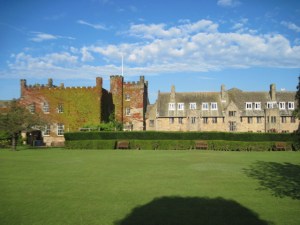
Sneaton Castle and grounds
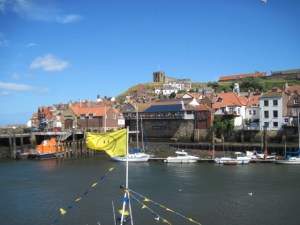
Whitby harbor, with St. Mary’s Church on the hill.
The more I think about it, Leeds was a fine place to do a Victorian Literature degree – it’s not too far from Haworth, the home of the Brontës, or Whitby, a setting used in Bram Stoker’s Dracula. Two of my classmates and I made our own pilgrimages to both sites in 2006. The Whitby Abbey ruins rising above the churchyard of St. Mary’s certainly create a suitably creepy atmosphere. No wonder Whitby is enduringly popular with Goths and at Halloween.

Another resident of Victorian Whitby, unknown to me until I saw a plaque designating her cottage on the walk from Sneaton into town, was Mary Linskill (1840–91), who wrote short stories and novels including Between the Heather and the Northern Sea (1884), The Haven under the Hill (1886) and In Exchange for a Soul (1887). I checked Project Gutenberg and couldn’t find a trace of her work, but the University of Reading holds a copy of her Tales of the North Riding in their off-site store. Perhaps I’ll have a gander!
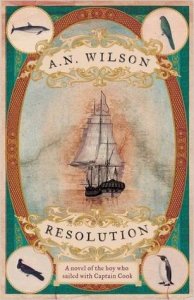
 There are other connections to be made with Whitby, too. For one thing, it has a long maritime history: it was home to William Scoresby (“Whaler, Arctic Voyager and Inventor of the Crow’s Nest,” as the plaque outside his house reads), and Captain James Cook grew up 30 miles away and served an apprenticeship in the town. There’s a statue of Cook plus a big whalebone arch on the hill the other side of the harbor from the church and abbey. It felt particularly fitting that I’ve been reading A.N. Wilson’s forthcoming novel Resolution, about the naturalists who sailed on Captain Cook’s second major expedition in the 1770s.
(My other apt reading for the sunny August weekend was Vanessa Lafaye’s Summertime.)
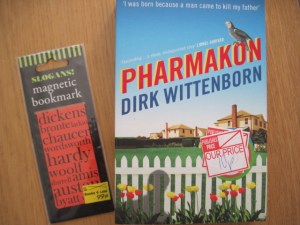
On our Sunday afternoon browse of Whitby’s town center we couldn’t resist a stop into a bargain bookshop, where my husband bought a cheap copy of David Lebovitz’s all-desserts cookbook; I picked up a classy magnetic bookmark and a novel I’d never heard of for a grand total of £1.09. I know nothing about Dirk Wittenborn’s Pharmakon, but this 10 pence paperback comes with high praise from Lionel Shriver, Bret Easton Ellis and the Guardian, so I’ll give it a try and let you know how it works out in terms of literary value for money!
 Bookish Beck = Rebecca Foster. American transplant to England. Freelance proofreader and book reviewer.
 Bookish Beck