Our trip to Germany in September whetted my appetite to read more German-language fiction, and November also being German Literature Month (hosted this year by Caroline of Beauty Is a Sleeping Cat and Tony of Tony’s Reading List) was a perfect excuse. K names only this year, please. (Perhaps next year I’ll make it S and finally get to those Sebald and Seethaler novels I have on the shelf.) These three works – a children’s classic, a set of linked short stories about the writer’s craft, and a mother–son spending spree – have coy metafictional touches, plus there’s a connection I wasn’t expecting between the Kehlmann and Kracht. All: 

Emil and the Detectives by Erich Kästner (1929; 1931)
[Translated by Eileen Hall]
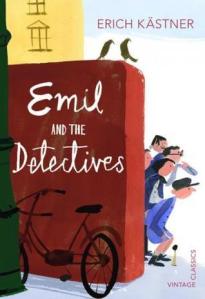 If only I’d realized this was set on a train to Berlin, I could have read it in the same situation! Instead, it was a random find while shelving in the children’s section of the library. Emil sets out on a slow train from Neustadt to stay with his aunt, grandmother and cousin in Berlin for a week’s holiday. His mother gives him £7 in an envelope he pins inside his coat for safekeeping. There are four adults in the carriage with him, but three get off early, leaving Emil alone with a man in a bowler hat. Much as he strives to stay awake, Emil drops off. No sooner has the train pulled into Berlin than he realizes the envelope is gone along with his fellow traveller. “There were four million people in Berlin at that moment, and not one of them cared what was happening to Emil Tischbein.” He’s sure he’ll have to chase the man in the bowler hat all by himself, but instead he enlists the help of a whole gang of boys, including Gustav who carries a motor-horn and poses as a bellhop, Professor with the glasses, and Little Tuesday who mans the phone lines. Together they get justice for Emil, deliver a wanted criminal to the police, and earn a hefty reward. This was a cute story and it was refreshing for children’s word to be taken seriously. There’s also the in-joke of the journalist who interviews Emil being Kästner. I’m sure as a kid I would have found this a thrilling adventure, but the cynical me of today deemed it unrealistic. (Public library) [153 pages]
Fame by Daniel Kehlmann (2009; 2010)
[Translated by Carol Brown Janeway]
 I’ve been equally enchanted by Kehlmann’s historical fiction (Measuring the World) and contemporary metafiction (F is one of my all-time favourites) in the past. These nine linked stories feature writers and their characters, actors and their look-alikes, and are about how life translates into – or is sometimes transformed by – art. Ralf Tanner starts to feel like he doesn’t exist when his calls gets diverted to someone else’s phone and an impersonator is more convincing at playing him than he is himself. Leo Richter’s new girlfriend is curiously similar to his most famous character, Lara Gaspard, a doctor working for a medical charity. Crime writer Maria Rubinstein takes Leo’s place on a cultural exchange to Central Asia and gets stuck in a Kafka-esque situation without a visa. Leo’s fan and Ralf’s call recipient are subjects of their own stories. References to Miguel Auristos Blanco’s spiritual self-help books recur and he, too, eventually becomes a character. I liked the pointed little jokes about what writers have to put up with (“Do you know how often I’ve been asked today where I get my ideas from? Fourteen. And nine times whether I work in the morning or the afternoon,” Leo complains). Mostly, these stories struck me as clever yet had me wondering what the point was. My favourite was “Rosalie Goes Off to Die,” in which Leo’s character travels to Zurich for an assisted death but he the writer decides to interfere before she can get her last wish. (Secondhand – Awesomebooks.com) [206 pages – but fairly large print]
Eurotrash by Christian Kracht (2021; 2024)
[Translated by Daniel Bowles]
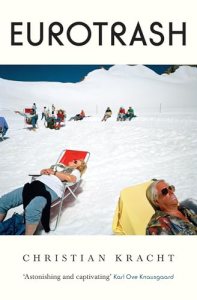 This was longlisted for the International Booker Prize and is the current Waterstones book of the month. The Swiss author’s seventh novel appears to be autofiction: the protagonist is named Christian Kracht and there are references to his previous works. Whether he actually went on a profligate road trip with his 80-year-old mother, who could say. I tend to think some details might be drawn from life – her physical and mental health struggles, her father’s Nazism, his father’s weird collections and sexual predilections – but brewed into a madcap maelstrom of a plot that sees the pair literally throwing away thousands of francs. Her fortune was gained through arms industry investment and she wants rid of it, so they hire private taxis and planes. If his mother has a whim to pick some edelweiss, off they go to find it. All the while she swigs vodka and swallows pills, and Christian changes her colostomy bags. I was wowed by individual lines (“This was the katabasis: the decline of the family expressed in the topography of her face”; “everything that does not rise into consciousness will return as fate”; “the glacial sun shone from above, unceasing and relentless, upon our little tableau vivant”) but was left chilly overall by the satire on the ultra-wealthy and those who seek to airbrush history. The fun connections: Like the Kehlmann, this involves arbitrary travel and happens to end in Africa. More than once, Kracht is confused for Kehlmann. (Little Free Library) [190 pages]
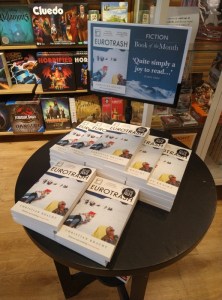
Spotted in my local Waterstones…

 Bookish Beck = Rebecca Foster. American transplant to England. Freelance proofreader and book reviewer.
 Bookish Beck
I read ‘Emile and the Detectives’ way back, at school. I can’t remember a thing about it, but I’m sure I liked it at the time. 🙂
LikeLiked by 1 person
I think childhood would be the best time to encounter it. How neat that you read it at school!
LikeLiked by 1 person
I’m a big fan of Kehlmann and really enjoyed Fame
LikeLiked by 1 person
Not one of my favourites of his, but he’s always a bold and interesting writer.
LikeLiked by 1 person
Hi Rebecca
Nearly every German child of my generation read “Emil und die Detektive” (and Kästner’s “Pünktchen und Anton”). We loved Kästner’s books.
We find Kehlmann’s “Fame” an interesting book which partly reflects the nowadays Germany. We read all of Kehlmann’s books and like “Tyll” and “Lichtspiel” best. Kracht’s “Eurotrash” – We like this one the least of these three books. Sloterdijk wrote, for our taste, much better about this topic.
Thanks for presenting German books here
The Fab Four of Cley
🙂 🙂 🙂 🙂
LikeLiked by 1 person
My pleasure! I still have Tyll and The Director to read — both are on my Kindle.
LikeLiked by 1 person
Isn’t it great to have some books left you know they are worth reading?
The Fab Four of Cley
🙂 🙂 🙂 🙂
LikeLike
Coincidentally I was in Dresden not so long ago. There’s an Erich Kästner museum, but it was either too far away to walk to or closed, so I didn’t visit. Not that I’ve read any of his books, but I’d heard of Emil. I also have a Christian Kracht book to read, Imperium. I ordered it online and it was supposed to be the English translation, but they sent a copy in German. I sent it back and reordered the English, but once again I received a German copy. Customer service came to the conclusion they didn’t have it in stock . I could have returned it, but in the end I kept it. But then I bought another German book in Dresden, so now I shall have to brush up my rusty German. At least I don’t have to speak!
LikeLiked by 1 person
Gosh, you can read German as well as Dutch?! I’m ever so impressed. I’ve heard about Imperium but I’m not sure I’m up for another by Kracht now.
LikeLike
I can indeed, though I haven’t read a whole book in German since A-level. French too, but they express things in such a convoluted way, particularly using slang in magazines, that it’s more difficult. My French A-level was language only, so I’m not sure I’ve ever read a whole book in French. My level of French was really good for a while when I left school, but last time I tried to speak French, the lady I phoned asked me if I was Dutch. 😂
LikeLiked by 1 person
On my first trip to France I got asked if I was German. (And here in the UK I’m asked surprisingly frequently if I’m Irish.)
LikeLike
Emil and the Detectives would probably make a brilliant animated film – I wonder if anyone’s ever adapted it?
LikeLiked by 1 person
Emil and the detectives has been made into a film eight times, seven in German and one in English.
LikeLiked by 1 person
Eight times!! Wow, I was more right than I knew.
LikeLiked by 1 person
Oh, it certainly would!
LikeLiked by 1 person
Note to self: Get that Novellas in November post organised pronto!
LikeLiked by 1 person
The link-up will be open through the whole first week of December but yes, why not get one ready soon? 🙂
LikeLiked by 1 person
👍
LikeLike
I was amused by that Kehlmann/Kracht connection, too, but found Eurotrash disappointing on the whole. I hope you enjoy Tyll when you get to it.
LikeLiked by 1 person
Good work there! My short nonfiction reading got a bit stymied by a virus, but I’m trying to rattle through getting some more read and reviewed in a last-ditch attempt to catch up.
LikeLiked by 1 person
Same here. Where did the first three weeks disappear to?
LikeLiked by 1 person
The only one of these I’ve read is the kids’ book, and to be honest, with all respect, I’m not convinced that’s going to change 😉
LikeLiked by 1 person
Fair enough! I’ve read much better from Kehlmann and I’m not convinced about Kracht. Thanks for hosting this year. I always enjoy contributing one or more reviews.
LikeLiked by 1 person
Oh I just LOVED Emil and the Detectives. But I am very easily entertained. I think I still have my original second-hand copy and now want to go look!
LikeLiked by 1 person
A reminder of a more innocent time, in Germany and in general.
LikeLike
I am so late responding on this – I find it hard to keep up. I really enjoyed Eurotrash, I read it last month just before Novella November, my review is here: https://yarrabookclub.wordpress.com/2025/10/22/eurotrash-christian-kracht/
I then on the back of it went out and got Imperium, but did not enjoy that one as much.
I also agree with the other comment that this would make a great movie!
LikeLike
I was very impressed by Fame
LikeLike