A memoir of gardening to come to terms with midlife and a new island home, a work of autofiction about memory and technology, and an arresting graphic novel tracing the life of a child Holocaust survivor: it was a real variety last month. (But then again, I say that every month, don’t I?)
The Apothecary by the Sea: A Year in an Orkney Garden by Victoria Bennett
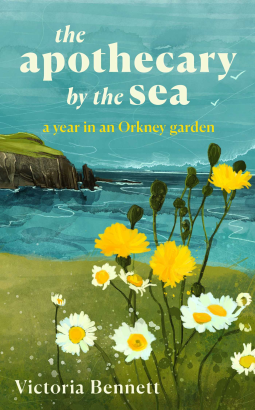 I’ve been hankering to get back to the Orkney Islands after two decades but haven’t managed it yet; reading about it was the next-best thing. There’s a similar make-do attitude to Bennett’s second book, which is about adapting to the unexpected and being in tune with nature. After being forced out of their rented home in Cumbria (and, disastrously, having to raze the abundant garden they’d made there), Bennett and her husband and son resettled in South Ronaldsay. Moving to Orkney was a long-held dream that allowed the couple to become property owners for the first time in their fifties. Chronic illness restricts what she can do, but over the course of a little over a year, she slowly, steadily turns their little outdoor space into a bountiful apothecary garden when not out exploring a new landscape.
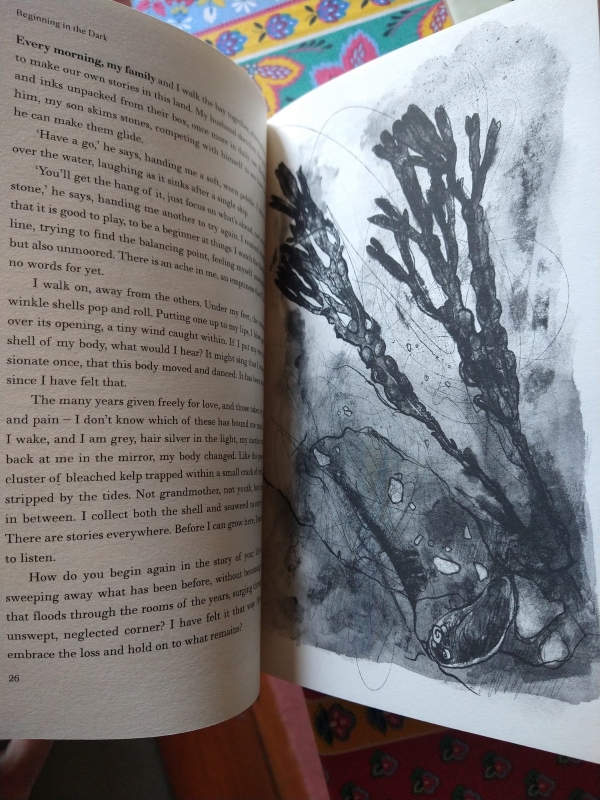
I loved Bennett’s 2023 debut memoir, All My Wild Mothers. Both employ a similar structure of short chapters named after plants with medicinal uses. However, the first book is a lot richer, distilling as it does the experiences and wisdom of an entire life. The format is fresh there, whereas this sequel needed new strategies to set it apart. It’s so short – with sections of gardening tips, further plant rundowns, and recipes for padding – that I suspected the author and publisher were scratching around for enough material to fill a book. The editing is also lacking this time around; dangling modifiers and minor typos abound. This could have been more substantial had Bennett waited a few more years to develop an intimate knowledge of Orkney and make connections with people to draw on. Still, there are reassuring sentiments about accepting one’s limitations, welcoming the changes of age, and setting humble goals (“The garden, like life, is not perfect. Start with what you have”), and the black-and-white illustrations by Bennett’s husband, Adam Clarke, are gorgeous. Though it’s fairly niche, I can, offhand, think of several people to whom I would recommend Bennett’s work.
Written while listening to Doing This for Love, the fab new album by Kris Drever, everyone’s favourite Orkney singer.
With thanks to Elliott & Thompson for the free copy for review.
{SPOILERS IN THE NEXT TWO}
Transcription by Ben Lerner

The UK cover
You know what you’re in for with a Ben Lerner work, in much the same way as when you pick up something by Rachel Cusk, Katie Kitamura or Deborah Levy. The narrator resembles Lerner in that he is a 45-year-old writer who graduated from Brown University and has spent significant time in Madrid. The novella opens with him on a train to Providence, Rhode Island to write a long profile of his mentor, a German writer named Thomas. Thomas is turning 90 and there is a sense that this is to be his “exit interview” – yet he’s as sharp as ever, describing his early life as if composed of film scenes.
There is a strong emphasis on the visual here, but also on the oral. Thomas’s first memory is of hearing Hitler’s voice on the radio, and the narrator fully intended to record this conversation, but dropped his phone in the sink at the hotel and now it won’t turn on. He decides this evening will just be a pre-chat, and tomorrow they’ll get into things properly. For some reason, though, he can’t admit his technological failure to Thomas and instead brings his dead phone out, puts it face down on the table, and pretends that this is all on the record.

I prefer the U.S. cover, as per usual!
The book is in three long sections, named after different hotels. The second is set in Madrid, where, a few years later, the narrator gives a talk as part of a Festschrift for Thomas. He’s turned the story about his phone into a self-deprecating joke, but it turns out that his conference co-organizer, Rosa, is not the only one angry with him for what she perceives as falsifying Thomas’s last testament. This causes him to second-guess himself.
The third section is, ostensibly, a conversation between the narrator and Thomas’s son, Max – except the former can hardly get a word in edgewise (as was the case with Thomas, too), so it’s really more of a monologue. And, strangely, the subject is Max’s young daughter Emmie’s extreme food issues: a sort of pre-anorexia. Except Thomas would philosophize his granddaughter’s struggle, or query her screen time. Max remembers that when Thomas was hospitalized with Covid, apparently near death, he poured out many warm words to his father. Then Thomas recovered. On their first post-Covid visit, Max recorded his father’s speech without telling him he was doing so – an ironic counterpart to the narrator’s actions.
The themes drew me in, and the writing is addictively lucid. But what does it all mean? Lerner’s repeated references to father-and-son glassmakers and their beautiful glass flowers indicate his interest in questions of talent, (metaphorical) inheritance and legacy. The narrator’s version of Thomas’s memories being presented as gospel raises the question of whether fiction is the more appropriate vehicle for biography. There is also a message about overreliance on technology. The narrator feels helpless without his phone, even for one night: He can’t communicate with his family or confirm his walking route with online maps. But I wasn’t sure how Max’s daughter fits in, except perhaps as an emblem of multigenerational mental health struggles. This was an odd little book that I might like to discuss in a book club but found stubbornly unsatisfying to ponder on my own. (Read via Edelweiss)
Emmie Arbel: The Colour of Memory by Barbara Yelin (2023; 2026)
[Translated from German by Helge R. Dascher]
Edited by Charlotte Schallié and Alexander Korb
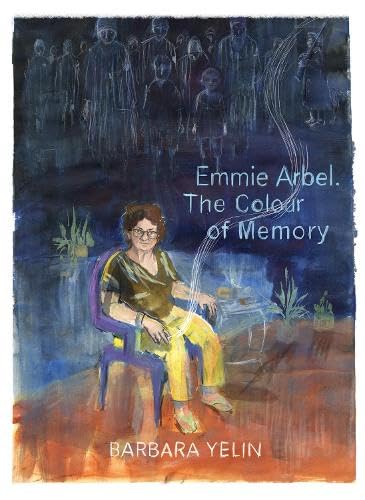 Barbara Yelin’s Irmina was the subject of an early review on my blog (just over 10 years ago!); I called it “one of the most visually stunning graphic novels I’ve ever come across” and noted that it was “based on a fascinating family story.” Such is even truer of this illustrated biography of a child Holocaust survivor. Yelin met Emmie Arbel at Ravensbrück Memorial in 2019 and over the next several years they had many conversations in person and online, which Yelin has memorialized in this solemn, powerful graphic novel. Emmie was born in the Netherlands in 1937 and first sent to a transport camp at age five. She then spent time in Ravensbrück and Bergen-Belsen, where her mother died. After the war, she and her brothers were displaced persons in Sweden before returning to the Netherlands to live with a foster family. Since then she has had a career, raised three daughters, divorced, retired early, lost a daughter, and traveled extensively but mostly lived in Israel. Yelin recreates scenes from Emmie’s life but mostly recounts recent conversations (and so is herself a repeated presence in the book). The narrative moves back and forth in time in imitation of memory. Emmie’s ever-present cigarette is a crutch as she tries to find words for the unspeakable.
A key motivation for this book is to face the facts that survival is not a one-time event and that trauma is complex and ongoing. In Emmie’s case, her foster father (himself a Holocaust survivor) molested her for years. The memory of rape remained locked inside until a breakdown in 1977, when she started seeing a therapist – which, she insists, saved her life.
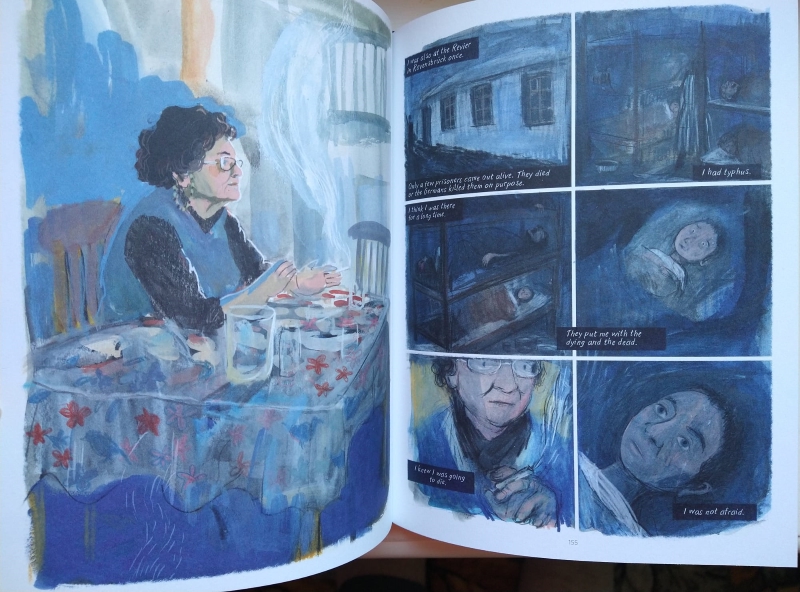
The colour palette is appropriately sombre: lots of dark blue and grey shading into black, which is the colour of memory for Emmie. And yet there is vibrant colour in the depiction of Emmie’s home and garden in Tiv’on, and in her interactions with her children and grandchildren. I can’t revisit particular spreads of this book without crying. One is the final few pages before the epilogue, in which Emmie remembers lying in a camp with typhus.
“They put me with the dying and the dead. I knew I was going to die. I was not afraid. I think I remember how it felt to be dying. It was a good feeling. There was no pain, no hunger, no noise. Nothing. It was quiet and good. But I live.”
This is a work of real courage, of speaking out in spite of a suspicion that all is bleak and meaningless.
“Humiliation. I was not a human being. I was a number, you know. I feel like no one can understand what I’m feeling. But if I don’t talk about it, the others can’t understand. They can’t understand what happened. And it must not happen again. And that’s why I have to speak.”
With thanks to SelfMadeHero for the free copy for review.
 Bookish Beck = Rebecca Foster. American transplant to England. Freelance proofreader and book reviewer.
 Bookish Beck
We’re going to Orkney next Spring, so that’s good timing thanks!
LikeLiked by 1 person
Lucky you! We might try to go back next year as well. We love our Scottish island getaways.
LikeLiked by 1 person
Transcription felt even more like an internal musing to me than the other books of Lerner’s I’ve read. It would make an interesting book club choice for a group that’s open to that kind of fiction.
LikeLike
I don’t seem to be able to get on the same wavelength with Lerner, but he keeps getting nominated for shortlists I read, so I keep having to read him. Oh well. At least I find him readable. I just don’t relate to his characters, especially the ones that are him.
LikeLike
I’ve just reserved Irmina from the library. Thi more recent book they don’t have, but you clearly recommend both. The Orkney book looks worth a punt. The Lerner? Maybe some time in the future.
LikeLike
I hadn’t realised that Bennett’s written a second book! I reviewed her first when it came out, back in 2023. What you say about the thin content here makes me wonder if she signed a two-book deal; that often accounts for a scramble for material.
LikeLike