What a strange backstory this modern classic has. Written by a Belgian psychoanalyst whose family fled the Nazis, it was originally published in French in 1995; when first translated into English in 1997, it barely sold any copies. But when reissued in a new translation in 2019, it struck a chord. In his Afterword, Vintage Classics’ publishing director, Nick Skidmore, theorizes that this had something to do with the resurgence of dystopian fiction during the first Trump presidency. Since then, it’s found word-of-mouth success and been a TikTok phenomenon, earning a younger fan base. Indeed, though the book was familiar to me, we added it to our book club roster on one member’s young adult daughter’s recommendation.
I was surprised that my library didn’t own a copy, so put in a stock purchase request late last year and first read the book when it arrived in February. To my relief, it seemed like a perfect book club choice, packing many issues and ideas, as well as nearly half a century of events, into its novella length and inviting readers to ponder what is essential to being human. I enjoyed it even more on a reread in preparation for our meeting earlier this month.*
At the start of this dark, disorienting but intriguing story, a teenage girl is being held in a cage along with 39 adult women. When, by a fluke, the women escape after the guards evacuate for an emergency, they emerge into a featureless plain studded with similar underground bunkers they loot for supplies; all the other prisoners and guards they encounter are dead, leading them to believe that they are the last humans left alive. With privacy and dignity restored to them, they form an improvised culture based on remembered snippets of knowledge. As the women wander this wilderness (which may even be another planet), they form pair bonds, build houses and villages, and – as the years pass – mourn their dead.
The narrator has a methodical, scientific mind. She feels like an outsider and functions almost as an alien anthropologist reporting on the last days of humanity. Cogito ergo sum: “For a very long time, the days went by, each one just like the day before, then I began to think, and everything changed.” Initially, the bunker setup is slightly tedious, yet I was fascinated by how she creates a sense of time and future possibility by counting her heartbeats to quantify the hours and imagining romantic scenarios with the youngest guard. What we are reading – a record of her life that she feels compelled to write even though she doesn’t know if anyone else exists to read it someday – serves as proof of humanity and a remembered past that led into this untethered present. “Perhaps I have tried to create time through writing these pages.”
Like a play, the book unfolds in three acts. Just as one setting or storyline threatens to outstay its welcome (in a Beckettian ‘nothing ever happens and no one ever comes’ sort of way), the narrator is plunged into a whole new existence, first in the wider world and then on her own. On one level, this might be read allegorically: a primitive society’s evolution from nomadism to settlement; or the trauma that results from the early separation from the mother. Perhaps it even draws on archetypal stories from the Hebrew Bible – Genesis’s introduction to the last humans rather than the first; the Exodus from imprisonment into the wilderness.
I found this mysterious and profound and didn’t mind the bevy of unanswered questions. The only thing I noted with disappointment is the scant awareness of nature; no other creatures are mentioned (maybe once she talks about seeing birds in the sky?) – I could only assume that this is truly a post-apocalyptic landscape where everything else has died. Normally, I shrink from vagueness in dystopian novels (cf. The End of Everything!), but to me this is more about inner psychology and group sociology. It’s an essential meditation on forms of freedom and captivity, solitude versus group identity, and how memory and language persist.
* To my dismay, most of our book club members hated the book. They got hung up on perceived gaps in the world-building and were put off by the overall bleakness. At the end of the meeting, I asked us to reflect on what makes us human and we came up with the following partial list: hope, relationships, connection/love, language, mortality (knowledge of), sarcasm/humour, curiosity, and dignity.
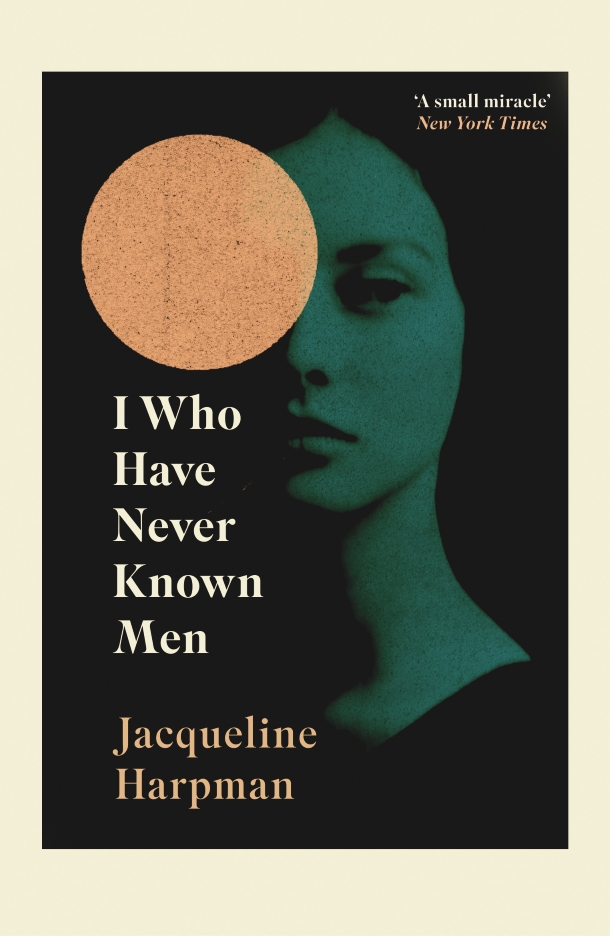
I Who Have Never Known Men by Jacqueline Harpman (1995; 2019)
[Translated from French by Ros Schwartz]
(Public library)
Rating in February 2026: 
Rating in November 2026: 
Average rating: 
[188 pages]
 Bookish Beck = Rebecca Foster. American transplant to England. Freelance proofreader and book reviewer.

