Today Is World Read Aloud Day
 An unprecedented second post in one day for me. I recently learned from Ron Charles’s article in the Washington Post that today, February 1st, is World Read Aloud Day, an annual celebration hosted by LitWorld to draw attention to ongoing literacy challenges. I mentioned in my write-up of my bibliotherapy experience that one recommendation I was given was to try reading aloud with my husband. To that end, I got hold of the three suggested books below and we’ve dipped into all of them on recent evenings. At the moment we’re managing to do a bit of reading aloud every few days, which isn’t so bad for a start.
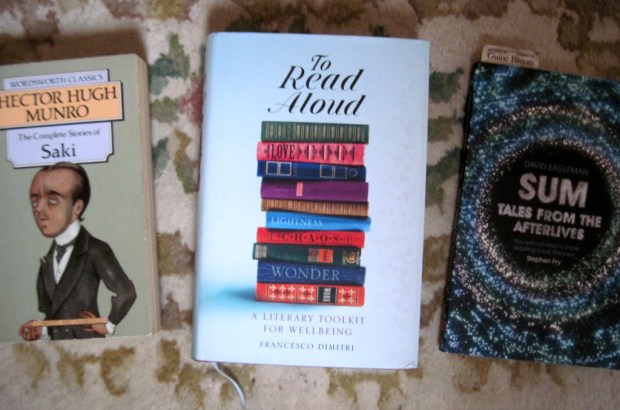
Dimitri’s book includes extracts by everyone from Neil Gaiman to Robert Macfarlane, all arranged under thematic headings. A special index at the back of the book orders the pieces according to how long they are estimated to take to read, ranging from three minutes to more like 15. So far we’ve tackled a handful of the shorter pieces; any of the longer ones we’ll probably split and each take half.
David Eagleman’s flash fiction collection is billed as being about the afterlife. The first story was a laugh-out-loud inventory of all the time the average human spends on different activities. Thirty-three hours sleeping versus 14 minutes experiencing pure joy. That kind of thing. I look forward to the rest.
Ella Berthoud particularly recommended Saki’s short story “Tobermory” since it’s about a talking cat (but is rather dark!), so we started with that one. Many of the others are only a couple of small-print pages. Have you read any Saki? What can you recommend?
Apart from classroom experiences, the last time I remember doing concerted reading aloud was with my mother when I was in my early teens. After I got home from school in the afternoons we’d convene on her bed to read Mark Twain short stories like “The Celebrated Jumping Frog of Calaveras County.”
Have you done any reading aloud lately?
My Bibliotherapy Appointment at the School of Life
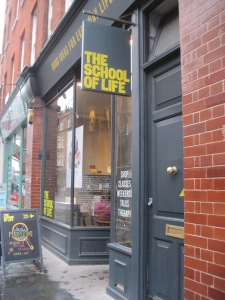 I’ve been interested in bibliotherapy for years, and I love The Novel Cure (see my review), the learned and playful advice book from Ella Berthoud and Susan Elderkin, two of the bibliotherapists at Alain de Botton’s London School of Life. Earlier this month I had the tremendous opportunity to have a personalized bibliotherapy appointment with Ella Berthoud at the School of Life. She’d put out a call on Twitter for volunteers to come for a free session (usually £100) to be observed by a journalist from La Repubblica writing about bibliotherapy – the translation of The Novel Cure has sold remarkably well in Italy. The feature will be part of a special color supplement in February, and I look forward to seeing if my story makes the cut! That is, if I can decipher any of the Italian.
Now, you might not think I’m the kind of person who needs a bibliotherapy assessment since I already find 300+ books per year I want to read; I worried that too, and felt a little bit guilty, but in the end I couldn’t pass up the chance, and Ella was happy to have me.

I took my copy of The Novel Cure along for Ella to sign.
Before my appointment I’d been asked to complete a two-page questionnaire about my reading habits and likes/dislikes, along with what’s going on in my life in general (the ‘therapy’ aspect is real). Once we were set up in the basement therapy room with hot drinks, Ella asked me more about how I read. I’d told her my reading was about two-thirds print books and one-third e-books. Had I ever tried audiobooks or reading aloud, she asked? The answer to both of those is no, I’m afraid. There’s no obvious place for audiobooks in my life because I work from home. However, as I’d mentioned I haven’t been able to get through a Dickens novel in five years, Ella suggested I try listening to one – abridged, it can be more like eight hours long instead of 42, and you still get a terrific story. She also highly recommended New Yorker and Guardian podcasts based around short stories and discussion.
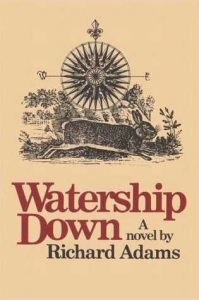 For reading aloud with my husband, Ella prescribed one short story per evening sitting – a way for me to get through short story collections, which I sometimes struggle to finish, and a different way to engage with books. We also talked about the value of rereading childhood favorites such as Watership Down and Little Women, which I haven’t gone back to since I was nine and 12, respectively. In this anniversary year, Little Women would be the ideal book to reread (and the new television adaptation is pretty good too, Ella thinks).
One other reading habit Ella is adamant about is keeping a physical reading journal in which you record the title of each book you read, where you read it, and about a paragraph of thoughts about it. It’s not meant to be a comprehensive response to every book; more like an aide-mémoire that you can get off the shelf in years to come to remind yourself of what you thought about a book. Specifically, Ella thinks writing down the location of your reading (e.g., on a train to Scotland) allows you to put yourself back in the moment. I tend to note where I bought a book, but not necessarily where I read it – for that, I would probably have to cross-reference my annual book list against a calendar. Since 2010 I’ve kept my book lists and responses in computer files, and I also keep full records via Goodreads, but I can see why having a physical journal would be a good back-up as well as a more pleasant representation of my reading. I’ll think about starting one.
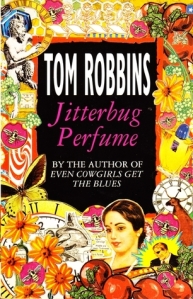 Various books came up over the course of our conversation: Abraham Verghese’s Cutting for Stone [appearance in The Novel Cure: The Ten Best Novels to Cure the Xenophobic, but Ella brought it up because of the medical theme], Tom Robbins’ Jitterbug Perfume [cure: ageing, horror of], and Julia Cameron’s The Artist’s Way, a nonfiction guide to thinking creatively about your life, chiefly through 20-minute automatic writing exercises every morning. We agreed that it’s impossible to dismiss a whole genre, even if I do find myself weary of certain trends, like dystopian fiction (I introduced Ella to Claire Vaye Watkins’ Gold Fame Citrus, one of my favorite recent examples).
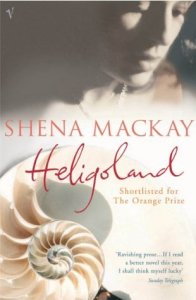 I came away with two instant prescriptions: Heligoland by Shena Mackay [cure: moving house], about a shell-shaped island house that used to be the headquarters of a cult. It’s a perfect short book, Ella tells me, and will help dose my feelings of rootlessness after moving more than 10 times in the last 10 years. She also prescribed Family Matters by Rohinton Mistry [cure: ageing parents] and an eventual reread of Jonathan Franzen’s The Corrections. As we discussed various other issues, such as my uncertainty about having children, Ella said she could think of 20 or more books to recommend me. “That’s a good thing, right?!” I asked.


Before I left, I asked Ella if she would ever prescribe nonfiction. She said they have been known to do so, usually if it’s written in a literary style (e.g. Robert Macfarlane and Alain de Botton). We chatted about medical memoirs and reading with the seasons for a little while, and then I thanked her and headed on my way. I walked around the corner to Skoob Books but, alas, didn’t find any of the books Ella had mentioned during our session. On the way back to the Tube station, though, I stopped at Judd Books and bought several secondhand and remaindered goodies, including these two:


(Imagine my surprise when I spotted The Year of the Hare in The Novel Cure under midlife crisis! Age seemed to be the theme of the day.)
 As soon as I got back from London I ordered secondhand copies of Heligoland, Jitterbug Perfume and The Artist’s Way, and borrowed Family Matters from the public library the next day. Within a few days four further book prescriptions arrived for me by e-mail. Ella did say that her job is made harder when her clients read a lot, so kudos to her for prescribing books I’d not read – with the one exception of Sebastian Barry’s Days Without End, which I love.
I’ve put in another order for Maggie and Me, the memoir by Damian Barr, plus (for reading aloud) Sum: Forty Tales from the Afterlives by David Eagleman and the collected short stories of Saki. I’m also keen to find The Victorian Chaise-Longue by Marghanita Laski, Ella’s final prescription, but as the Persephone Books reprint is pricey at the moment I may hold off and hope to chance upon a secondhand copy later in the year. Ella has been very generous with her recommendations, especially considering that I didn’t pay a penny. I certainly have plenty to be getting on with for now! I’ll report back later on in the year when I’ve had the chance to read some of these prescriptions.

The prescribed books I have gotten hold of so far.
Young Writer of the Year Award Ceremony
Yesterday evening all of us on the Sunday Times / Peters Fraser + Dunlop Young Writer of the Year Award shadow panel met up again for the official prize-giving ceremony at the London Library.
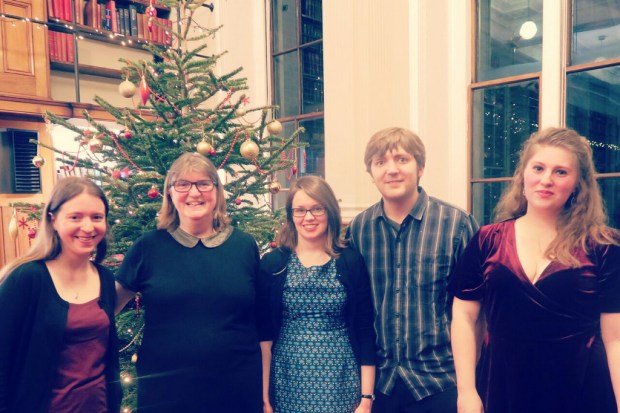
My train arrived late and then I got lost, twice (I don’t own a smartphone and hadn’t brought a map – foolish!), so I walked through the door just moments before the prize announcement, but as that was the most important part of the event it didn’t matter in the end. If you haven’t already heard, the prize went to Sally Rooney for Conversations with Friends. She’s the first Irish winner and the joint youngest along with Zadie Smith.

This did not really come as a surprise to the shadow panel, even though we unanimously chose Julianne Pachico’s The Lucky Ones as our winner.
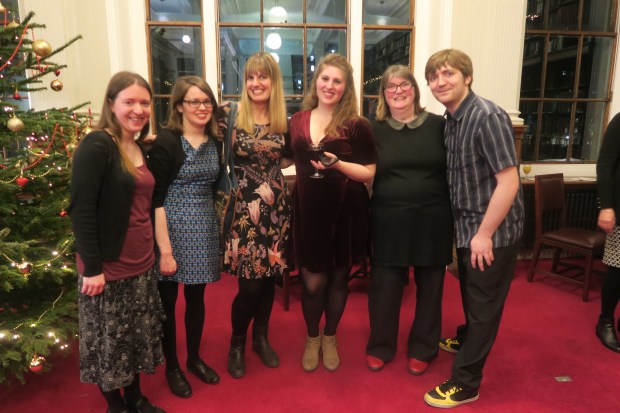
Julianne Pachico is third from left.
Three of us had chosen Rooney’s novel as our runner-up, and when I saw it appear in the Times’ Books of the Year feature, I thought to myself that this was probably a clue. In the official press release, judge and Sunday Times literary editor Andrew Holgate writes, “for line by line quality, emotional complexity, sly sophistication and sheer brio and enjoyment, Sally Rooney’s Conversations with Friends really stood out.”


Judge Elif Shafak states, “I salute Rooney’s intelligent prose, lucid style, and fierce intensity.” Judge Lucy Hughes-Hallett says, “This book stood out for its glittering intelligence, its formal elegance and its capacity to grip the reader. At first reading I was looking forward to bus journeys so that I could read some more. Second time round I was still delighted by the sophistication of its erotic quadrille.”


Being a part of the shadow panel was a wonderful experience and one of the highlights of my literary year.
Young Writer of the Year Award: Shortlist Readings Event
On Saturday I attended an exclusive bloggers’ event at the Groucho Club in London with four of the authors shortlisted for the Sunday Times / Peters Fraser + Dunlop Young Writer of the Year Award (Sally Rooney was unable to make it from Dublin). Also in attendance were fellow shadow panelists Annabel and Clare and some other notable names from the UK blogging community, including Eric Karl Anderson and Naomi Frisby. It was lovely to meet them, and Annabel, for the first time, and to have time to chat with the shortlisted authors.

That’s me with Clare and Annabel. Thanks to Eric Karl Anderson for taking the photo.
The event was chaired by Robert Collins, a former deputy literary editor of the Sunday Times now with Intelligence Squared. Each author gave a short reading from their book and answered questions from the chair and the audience. In every case, what I heard helped me appreciate the work and the author more. All four writers were so funny and warm, and seemed equally humbled and delighted to be in the running for this award.
Minoo Dinshaw reminded me of an Oxford don twice his age. (Indeed, his father is an Oxford don, and his mother is Scottish writer Candia McWilliam, so he has a proud literary pedigree.) He first became aware of Steven Runciman as a child when he and his mother spotted the wizened old man in a hotel lobby in Edinburgh, where they had traveled for the book festival. He then read Runciman’s Crusades books at school, and when in 2011 he met Runciman’s niece and she asked him to write the biography, he said he couldn’t think of anything else he wanted to do. (And still can’t.) Reading from his Kindle as “I didn’t want to break my wrist” (!), he chose a late passage featuring Steven in his nineties. Dinshaw said that while writing about Runciman he felt by turns flirted with and accused. Living in his subject’s house, working in his library, even sleeping in his bed (just the once), he felt he “had a very strange ghost in my life.” Dinshaw said the project captured his attention because he’s romantic and competitive, but that he’d like to try writing fiction in the future.
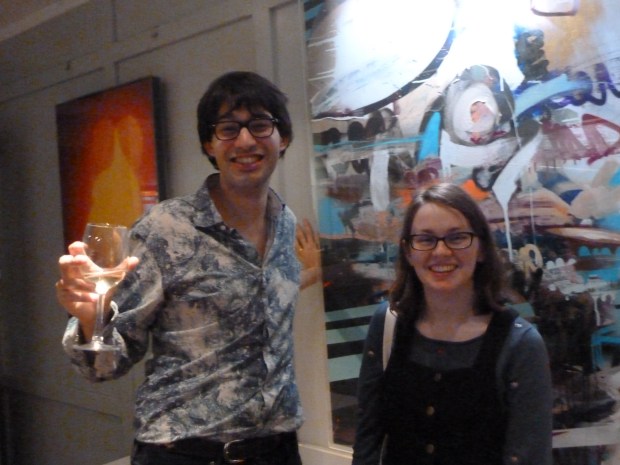
Clare with Minoo Dinshaw. Photo by Annabel Gaskell.
Julianne Pachico read a party scene from “The Tourists,” as it’s approaching the festive season. I was intrigued to learn that the interlinking structure of her book only emerged late on in the editing process; she’d originally meant to write a post-apocalyptic novel set all in one house, but found that setting too limiting. “I sort of work it out as I go along,” she said. So is it short stories or a novel? She’s sick of this question! Really she just wanted to write the kind of book she likes to read, citing Jennifer Egan’s A Visit from the Goon Squad and David Mitchell’s Ghostwritten as examples. Asked about her mentors, Pachico cited her mother, who told her “you’ll never be lonely, you’ll never be bored” as long as you read; and her first tutor, Andrew Cowan, who told her no one out there was writing anything like her story “Junkie Rabbit” – just the affirmation she needed. With all that’s happened in 2017, Pachico said she plans to turn to writing as a way “to outcreate the abyss” (a phrase from her twin sister, who’s also a writer). Pachico also teaches creative writing at Sheffield Hallam.

Julianne Pachico signing my book. Photo by Annabel Gaskell.
(As Sally Rooney was not in attendance, Collins read on her behalf a passage about Frances and Bobbi’s early friendship at school.)
 Claire North, aka “Cat” (real name: Catherine Webb; her fantasy and science fiction books are under various names) was in a way the odd one out at this event. Collins opened by saying that this award is all about getting in on the ground level with these writers, several of whom are debut authors. But North is a teen phenom who published her first book at age 14 and is set to release #20 next year. All along her parents called her a freak and demanded that she get her GCSEs and go to uni because writing “isn’t a proper job” (“but we’re very proud of you!” they’d usually append). She’s experienced the full gamut of responses over the years: some swore she wouldn’t have anything to say until age 40; others sighed that once she turned 18 she could no longer be marketed as “young.” She read the perfect passage from The End of the Day: a frantic, bravura account of the riders of the apocalypse together on a plane. She loves that science fiction “makes the extraordinary domestic” and playing with death appealed to her “flippant nature.” Charlie is, she thinks, the kindest character she’s ever written.
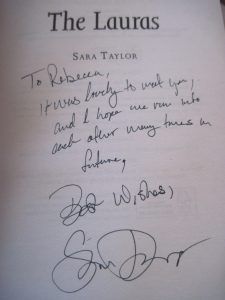 Sara Taylor read from one of Ma’s earliest stories about how her parents met. She wrote The Lauras while she was supposed to be completing her PhD thesis on censorship in American literature. At the time she was coming to terms with the fact that she was going to be staying in the UK, as well as remembering family road trips and aspects of her relationship with her mother that she wishes were otherwise. Her agent wasn’t comfortable with the focus on an “agender” character, but Taylor held firm. She’s used to ignoring the advice her (older, male) professors and advisors tend to give her. Instead, she gets tips from her ten-years-younger sister back in the States, who knows exactly how to “fix” her work. Taylor feels the USA is 5–10 years behind the UK on gender issues, and revealed that The Lauras is a response to the novel Love Child (1971) by Maureen Duffy. She has recently finished her third novel and hopes to get back into teaching since writing non-stop for nine months makes her “go a little funny.”
This was such a special event. There were no more than 20 people in the room, and at the end I got a chance to speak to each of the authors as they signed my books. I normally get shy in such situations, but everyone was completely approachable. (Sara Taylor and I confirmed that we were indeed on the same study abroad program to England, a few years apart, so spent some time reminiscing about Reading and our formerly women-only colleges. Her mother went to Hood College, my alma mater – thus the brief mention of it in The Lauras.)


Important upcoming dates:
- November 24th: shadow panel meeting in London
- November 27th: deadline for shadow panel winner decision
- November 29th: shadow panel winner announced on STPFD website
- December 3rd: shadow panel winner announced in Sunday Times
- December 7th: prize-giving ceremony at the London Library
I’ll be aiming to post my last couple of reviews on Wednesday.
Hungerford Literary Festival: Simon Fenwick on Joan Leigh Fermor
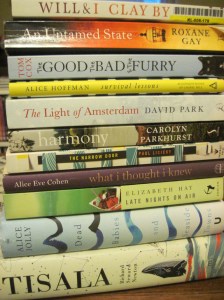
Birthday book haul.
I had a pleasant birthday weekend: a five-mile country walk with some foraging of sloes, reading in the armchair with the cat, catching up with Poldark on DVD, and a three-course Italian feast my husband made from a River Café cookbook (plus a homemade Sachertorte). And I got 11 secondhand books for my birthday, if you were wondering!
We also attended a couple of Hungerford Literary Festival events. This year the theme was “Journeys,” so all of the featured books and authors were broadly travel-related Alas, the talk we were meant to attend on Saturday by Sunday Times writer Jonathan Dean, based on I Must Belong Somewhere, his memoir about researching his family’s European history, was cancelled due to insufficient ticket sales – we felt so sorry for the poor author!
However, on Sunday my husband saw Nick Hunt speak about his recent travelogue on famous European winds such as the mistral, and I saw Simon Fenwick in conversation with journalist Elinor Goodman about his new biography of Joan Leigh Fermor, the wife of celebrated travel writer Patrick Leigh Fermor (whom Fenwick and Goodman consistently called Paddy).
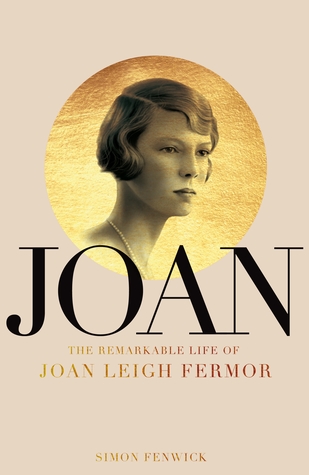 Fenwick considers Joan an enigmatic figure; although she could be quite a bitch, she also brought out the best in certain people, including Paddy. From a wealthy Yorkshire wool merchant family, she met golden writers like John Betjeman at bohemian parties. Although she was a fairly successful photographer – there will be a major exhibition of her work in London next year – she cast herself in a supporting role, as was traditional for the time: she would say that her career was all about helping Paddy in his, financially as well as morally. (I could just imagine what a novel about her would be called: The Travel Writer’s Wife.)
Although Fenwick believes Joan is a worthy biographical subject in her own right, her relationship with Paddy dominated the talk. When the couple met in Egypt in 1944, he was famous for having kidnapped a Nazi general, a stunt of debatable military benefit though it was certainly great for publicity. Women flocked to the handsome Paddy: he was carrying on two affairs at this time, and his one lover got pregnant and had an abortion.

Patrick Leigh Fermor. By Δημήτρης Παπαδήμος (Ιωάννης Δ.Παπαδήμος) [CC BY-SA 3.0], via Wikimedia Commons.
Joan was known as a wonderful cook and entertainer. In Greece they had a rotating cast of guests, and people would frequently just turn up uninvited. From afar the house looks like an ancient monastery, Fenwick said, though it’s now surrounded by modern buildings. Much of it is one huge room that serves as library, living room and dining room, with a corridor leading to the outside. In Joan’s time there were cats galore. Fenwick remembers the strong smell of jasmine the first time he walked through the archway into the courtyard.

The Fermors’ Greek villa. By Rodolph at English Wikipedia [CC BY-SA 3.0], via Wikimedia Commons.
Although Fenwick did not wish to comment on another biographer’s work, he noted that in comparison to Cooper’s his is perhaps a bit of a new view on Paddy, a “not wholly heroic but fascinating” figure, flawed “on a grand scale.” Fenwick was impressed by “his pure energy – in his writing and in everything he did.” While Paddy must have been exhausting to live with, Fenwick believes he and Joan recognized in each other a similar approach to life.
As a speaker Fenwick wasn’t particularly engaging: even with a microphone he seemed to mutter, and left awkward gaps before answering. Is it fair that his dull manner made me wonder whether his book would be worth reading? Not all authors can be charismatic in person, I’m sure; I would definitely struggle with public speaking if I ever had to go on a book tour. But I do wish he had perhaps read a section from his book so I could have gotten a sense of the style. I think Joan’s life is interesting enough that I will still read her biography someday, but perhaps only after I’ve read more of Paddy’s travel books and the Cooper biography, which I own in paperback.
Have you attended any literary events recently? Does an author’s personality influence your opinion of their books?
Harvest Supper, Scrabble Tournament & Book Haul: A Great Trip to Bookbarn
I manage about an annual trip to Bookbarn International, one of my favorite secondhand bookshops in the UK. Apart from the stock in their newly opened Darwin Rare Books room and the 50-pence children’s books, everything in the shop is £1. I never fail to come out with a great stack of finds. Our trip on Thursday was extra special because we were going for the café’s Harvest Supper and Scrabble tournament, held as part of The Great Bath Feast.


We played one 45-minute game against another team of two, broke for an excellent vegetarian supper of squash, spinach and goat’s cheese pie with mashed potatoes and baby roast vegetables, then played a second match before dessert (vegan plum crumble with custard or gluten-free fig brownie with ice cream). Over the years my husband and I have become quite the Scrabble fiends, and together on one team I’m afraid we were unbeatable. Our bingo starting off Game #2 helped, but we worried we were at an overall advantage because the other boards each had three teams playing.


It was a special pleasure to meet William Pryor, the chairman of Bookbarn. Last year he spotted my blog posts about Bookbarn and offered me a copy of his memoir, The Survival of the Coolest. It’s a wonderful book about growing up a descendant of Charles Darwin but going off the rails and ending up addicted to heroin in his 20s:
This family of mine! On the one hand you have the royalty of science and Bloomsbury, on the other the fading world of the English landed gentry. … We had no religion but Darwin.
The months ran into each other as a blur of the chase for relief, the wheeling and dealing … One of the most striking aspects of hell is that it goes round and round; the same torments over and over again.
Mr. Pryor let me have a sneak peek at the Darwin room after the shop closed and kindly gave me a copy of his grandmother Gwen Raverat’s memoir, Period Piece. Over pudding we chatted about literary festivals, the Bookshop Band, his failed idea to return a portion of secondhand books’ resale value to the authors, and the latest Nobel Prize winner.
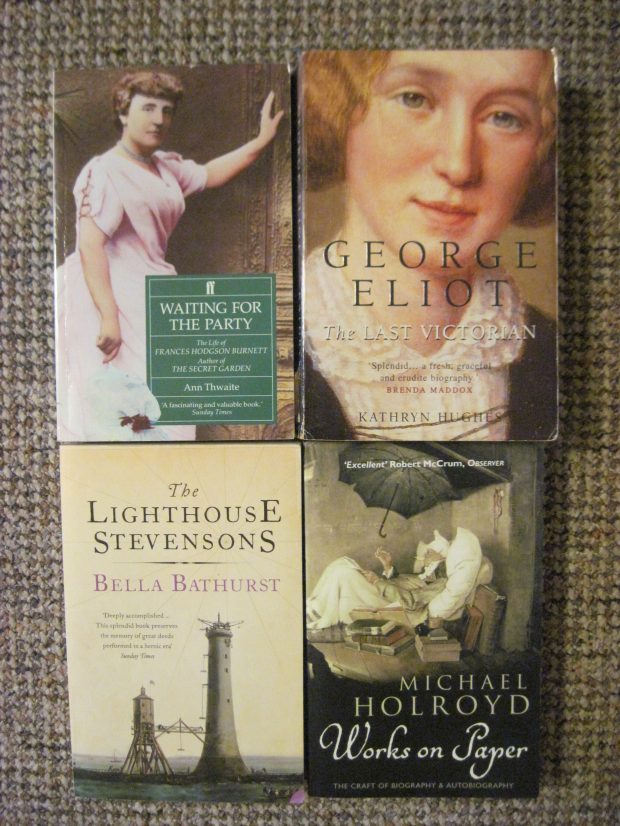
As to that book haul: I feel like I have fiction coming out of my ears, so with our hour of book browsing time I mainly focused on biographies and memoirs. Here are my finds:
Biographies and essays on writing biography:
Bereavement memoirs:
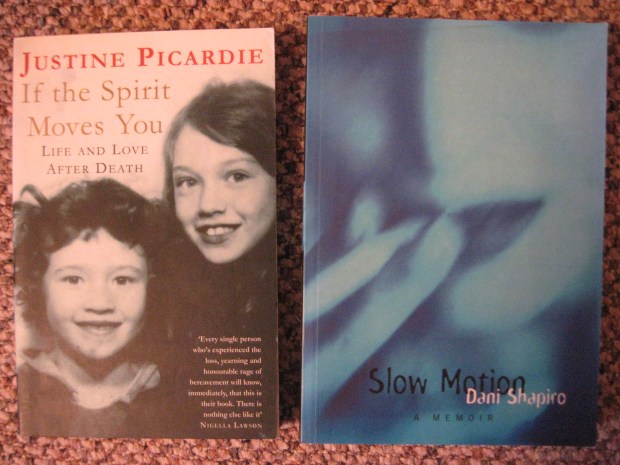
(Two of my purchases will go especially well as pairs with books I already own.)


Medical memoirs:
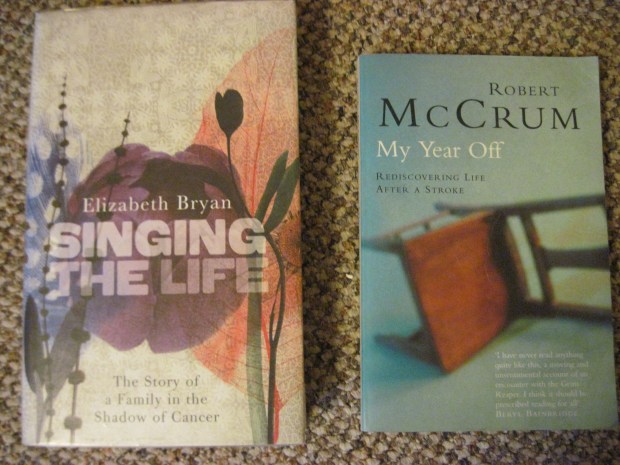
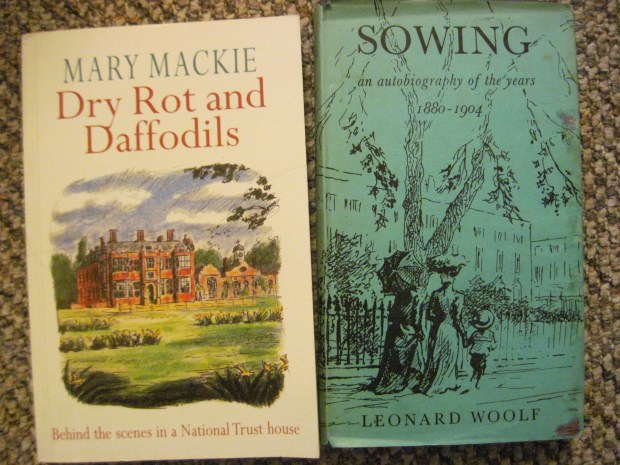
General memoirs (I was especially pleased to find the sequel to Cobwebs and Cream Teas, which I bought at Bookbarn last time and read early this year):
Plus two poetry books (one of them signed!):


And two novels I happened to grab on the way to the till:

My unexpected freebies. The Raverat is a lovely small-format hardback with gilt-edge pages and a maroon ribbon bookmark; on the right is our prize for winning the Scrabble tournament:


I’ve already had a peek inside a few of the books I bought and found some excellent passages. Leonard Woolf’s memoir opens with an extraordinary passage of almost biblical language about existence and non-existence; one of Marge Piercy’s poems struck me right away for its description of a Jewish holiday and the line “there is no justice we don’t make daily / like bread and love.”
My husband came away with three natural history books, and we also found a few children’s books to give to nieces and nephews.
Thanks to this book haul plus a trip to Book-Cycle in early September and some charity shopping last week, I’ve had to start a double stack on my biography/memoir shelves. There’s already a double stack on one of my unread fiction shelves. Next week is my birthday, so the book acquisitions are only likely to continue…
An All-Female Picture of Dorian Gray
A female Doctor Who, a proposed all-woman The Lord of the Flies – you can sense a cultural movement toward giving traditionally male roles to women. On Friday my husband and I saw an all-female production of Oscar Wilde’s only novel, The Picture of Dorian Gray (1891), at the lovely nearby Watermill Theatre. Adapted by Phoebe Eclair-Powell and directed by Owen Horsley, this is a brisk 67-minute performance by three young actresses.
With no intermission and no drastic scene changes, there was never the need for any of the players to leave the stage. Two of the actresses, Eva Feiler and Emily Stott, shared narration duties and rotated through all the supporting roles: mostly Dorian’s friends Lord Henry Wotton (Emily) and Basil Hallward (Eva), but also Sibyl Vane, the actress he falls for, her mother and brother, and so on – signifying their character changes through a simple prop like a flat cap, cane or ruffled cape. On the other hand, Emma McDonald, the Black British woman who played Dorian, had only that one part.
The costumes were all a variation on black and white, with Dorian in a form-fitting black dress with feathery epaulettes and the other two in more androgynous shirt and trouser combinations. A large white door frame was the only major item on stage: it served as the titular portrait’s frame and as the stage-within-the-stage for Sibyl’s performances, as well as the site for all comings and goings. Beyond that, the only stage furniture was a couple of chairs and a table with a wine bottle and some glasses on it.
I’ve never read The Picture of Dorian Gray, but it’s one of those story lines you’re probably familiar with whether or not you’ve encountered the original and/or an adaptation. Dorian, led to believe that youth and beauty are the only things that matter in life, makes a devilish pact by which he transmits his soul to the portrait Basil painted of him: the painting will age and reflect the true state of Dorian’s character, while his body remains perfect. So as he goes his merry way through life, breaking the hearts of men and women alike and pursuing pleasure everywhere from London’s opium dens to China and Mexico, his face never changes.
I thought it was particularly meaningful to examine cultural ideals of age and attractiveness with female players. However, there was an odd disconnect for me here: the original names were retained, along with male pronouns throughout. Why wasn’t it “Dora Gray”, her hard-partying friend “Henrietta”, and so on? The contrast was especially striking in moments where the characters pause to refresh their lipstick.
Well, the director answered that query – or, rather, sidestepped it – during the question and answer session that followed this short production. Horsley mentioned that Eclair-Powell only wanted to work with the play if she could have an all-female cast, and that she didn’t want to try to feminize the story in any way. She just wanted to put it out there, the same way Shakespeare might have – as with his cases of men playing woman playing men – and let audiences decide what they thought.
After a week at the Watermill, the production is moving on to a several-week tour of local schools, where it will be aimed at teenage audiences. I reckon it will be more effective in that context: the themes of vanity and selfishness should ring true for young people, and they will probably appreciate the comic flashes (e.g. when the narrators joke about who’s going to play which part, with what accent) more than I did, as well as the slightly melodramatic moments when Dorian is standing in front of the painting and telling us what ‘he’ sees.
In any case, I think I’ll make Dorian Gray one of my spooky pre-Halloween reads. I’ve downloaded it from Project Gutenberg.
My rating: 
Do you think you would have enjoyed this production, or found it off-putting?
The Wellcome Book Prize 2017 Awards Ceremony
Yesterday evening’s Wellcome Book Prize announcement was my first time attending a literary prize awards ceremony. Despite my nerves going in, there was quite a relaxed atmosphere (I felt almost overdressed in my H&M dress) and it was no different to any party where one struggles to make small talk – except that here all the talk was of books!
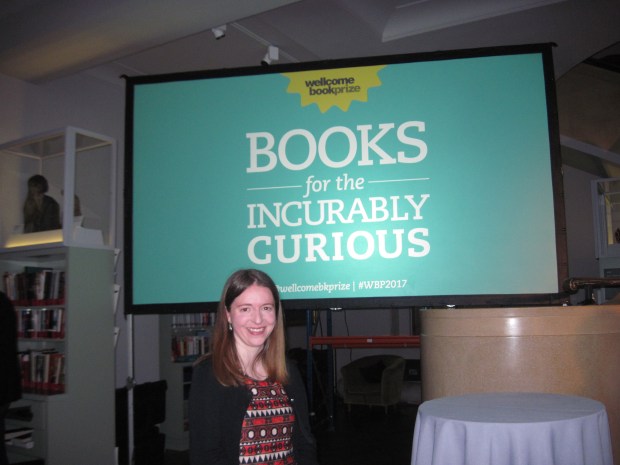
The new high-ceilinged Reading Room at the Wellcome Library (across from London’s Euston station) was a suitably swanky setting, with the unusual collection of health-themed books surrounded by an equally odd set of curios, such as death masks, paintings showing medical conditions, and a columnar red dress designed to resemble a neural tube. There was even a jazz duo playing.


It was especially lovely to meet up with Clare (A Little Blog of Books) and Ruby (My Booking Great Blog) and compare notes on book blogging while nursing a flute of prosecco and some superlative canapés. We also indulged in some subtle celebrity spotting – or, at least, the sort of authors and public figures I consider celebrities: Ned Beauman, Sarah Churchwell, A.C. Grayling, Cathy Rentzenbrink, and Suzanne O’Sullivan, last year’s Wellcome Prize winner. Three of the shortlisted authors were also present.
About 45 minutes into the event, the official proceedings began. Crime writer Val McDermid, the chair of this year’s judging panel, gave introductory remarks about the Prize and the attributes they were looking for when assessing the 140 books in the running this year. She said they were in search of books that went beyond the superficial and revealed more layers upon each rereading – as by now they’ve read the shortlisted books three times.
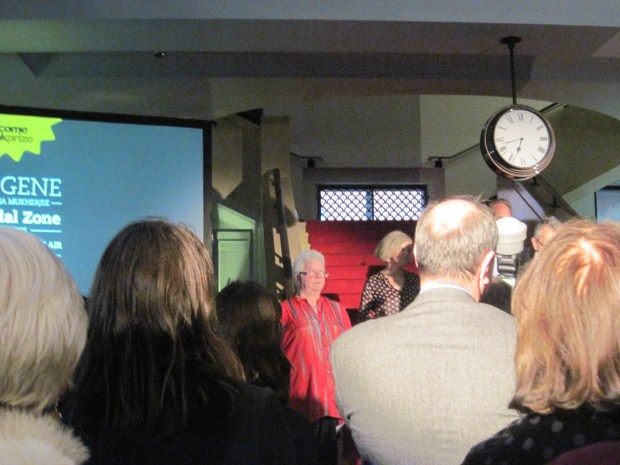
Chair of judges Val McDermid in center; fellow judge and BBC Radio books editor Di Spiers to her left.
Each of the judges then came to the podium to explain what they had all admired about a particular shortlisted book before presenting the author or author’s representative (editor, publisher or, in the case of Paul Kalanithi, his younger brother Jeevan, over from America) with flowers. When McDermid returned to the microphone to announce the winner, she started off by speaking of a book that combined two stories, the medical and the personal. Hmm, this might describe at least four or five of the books from the shortlist, I thought. Could it be When Breath Becomes Air, our shadow panel favorite? Or The Tidal Zone, our runner-up?
Within seconds the wait was over and we learned the actual winner was Mend the Living by Maylis de Kerangal. There was a pleased roar from the room, but also plenty of blinks and head shakes of surprise, I think. De Kerangal gave a few words of thanks, especially to the U.K. translator and publisher who made this edition of her book possible. This was the first work in translation to win the Wellcome Book Prize, and only the second novel (after Turn of Mind by Alice LaPlante in 2011).
Clare and I stuck around for another hour and were unexpectedly asked for book recommendations by a member of the Wellcome legal team who was kind enough to take an interest in us as book bloggers. She confessed that since uni she doesn’t read much anymore, but said that at school she enjoyed Jane Austen and she’s recently read Elena Ferrante’s books. Based on that rather thin history, we suggested she try Zadie Smith, and I also spoke up for Yaa Gyasi’s Homegoing.
On the way out we were given terrific bookish swag bags! Mine contained a paperback reissue copy of The Tidal Zone, a Wellcome Prize bookmark and commemorative booklet, and a blank notebook featuring optician’s glass eyes.

I can’t see such London events ever being frequent for me, especially given the cost of travel in from Newbury, but if a similar opportunity arises again I won’t hesitate to take advantage of it, especially if it means putting faces to names from the U.K. blogging community.
Pride and Prejudice: The Panto
On Wednesday I attended my second-ever pantomime. If you grew up with them, pantomimes might be totally commonplace for you, but imagine how peculiar they’d seem to anyone unfamiliar with the tradition. I was introduced to this campy theatrical genre in early 2006, when I saw my first panto, Jack and the Beanstalk, with my in-laws in Winchester.
Luckily I’d been given a brief primer, so I knew vaguely what to expect: a fairytale or other traditional story (e.g. Cinderella, Aladdin or Peter Pan), often featuring a young hero played by a female, a central female role played by a man in outrageous drag (this is the “pantomime dame”), stock lines including “It/He/She’s behind you!” and “Oh yes, it is”/ “Oh no, it isn’t,” an obvious villain whom the audience is invited to boo, and a mixture of puns, inane and/or raunchy jokes frequently referencing popular culture, and silly musical numbers. (The Wikipedia entry on pantomimes is actually quite a helpful history lesson.)
My mother- and father-in-law take part in an annual pantomime put on by the Steventon Players near their home in Hampshire, and this year the theme was Pride and Prejudice – appropriate given that 2017 marks 200 years since Jane Austen’s death and that she lived for her first 25 years in Steventon, where her father was the rector. In fact, she completed a first draft of Pride and Prejudice, then titled First Impressions, at home in Steventon in 1796.

The whole cast in the final musical number. My mother-in-law, as Mary Bennet, is at the front, second from left (white dress). My father-in-law, as Mr. Collins, is at the back in the center (large black hat).
We had the chance to see the panto on the opening night of four. My mother-in-law, the priest at Steventon and other local churches, played Mary Bennet (a rather thankless role that involved sitting with her nose in a book and issuing the occasional sharp reproach to her mother or Lydia), and my father-in-law was a suitably fawning, cringing Reverend Collins.

Mr. Collins’s marriage proposal to Lizzy is swiftly rejected.
The play was narrated by “Jane Austen’s ghost,” an actress in period costume who sat to one side of the stage and gave bits of information in a wry, knowing voice to move the plot along between scenes (she also helpfully called out prompts for forgotten lines!). I’d conveniently forgotten about the pantomime dame custom, so was taken aback at the first appearance of Mrs. Bennet. Not one but two actors appeared in drag, the other being a fabulously beturbaned Lady Catherine de Bourgh, who was presented as the clear villain of the piece.
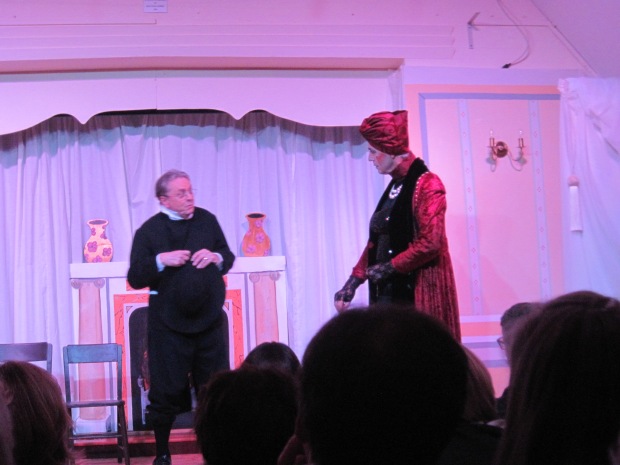
Mr. Collins quails before his patroness, Lady Catherine de Bourgh.
Impressively, the panto remained almost entirely faithful to the plot of the novel, just cutting and combining scenes to keep it under two hours and make it fit into a two-act structure. For instance, Mr. Collins and Wickham make their first appearance at the same time, and Mr. Collins proposes to Lizzy pretty much immediately. Instead of hearing of Lydia and Wickham’s elopement secondhand, we see it for ourselves in a scene set on their midnight ride to Gretna Green, with Mr. Gardiner and Mr. Darcy accosting them like highwaymen.
Highlights included a joke about Mr. Darcy’s manhood, Mrs. Bennet getting sozzled at the ball hosted by Mr. Bingley, Mr. Darcy traipsing up the aisle in flippers and goggles in homage to the BBC’s lake-and-wet-shirt scene, and Lizzy’s repartee with Lady Catherine. Audience participation was welcome on musical numbers such as “Money, Money, Money” and “I’m a Believer.”

Mrs. B. and her five daughters (my MIL is at far left).
Other running gags were Mrs. Bennet’s dramatic entries (to her “Hello, everybody!” the audience was meant to reply “Mrs. B., is it time for tea?”), the Bennets’ servant’s general uselessness, and Mr. Bingley’s two hapless footmen (I’m told that Tweedledee and Tweedledum-style characters are also common in pantomimes).
We were impressed with the authentic costuming and set design in this amateur village hall production. Anachronistic pop music aside, you might well have believed you were in the Regency period during the dance scene at the ball. I’d certainly never seen Pride and Prejudice like this before, but it was great fun.
Where do you stand on pantomimes? What’s your favorite P&P adaptation?
A Saturday Jaunt to Bath
 We heard that The Bookshop Band would be playing at a free seasonal concert on Saturday night, so on something of a whim we planned a daytrip to Bath. Even though it wasn’t exactly on the way (my husband’s regular, feeble refrain), I take any opportunity of being in the Bath/Bristol area to make a pilgrimage to Bookbarn International. This was a delightful surprise since I’d been in late July and never thought I’d get to go again this year.
This turned out to be our best trip yet. We were unrushed for once, so had plenty of time for browsing. I had particularly good luck in the orange-spined all-Penguins section, and even found three books I wanted from the “Unsorted” shelves, which was something of a miracle. We finally tried out their newish café and got a darned good cup of coffee and a cake each.


All told, we came away with a better haul than on any previous visit: 13 books for me, 10 nature books plus a River Café cookbook for my husband, and eight books to give away as presents. And for all that (books + refreshments), less than £40. Add on a couple of books from a charity shop in Bath and I got some real steals – no book more than £1.
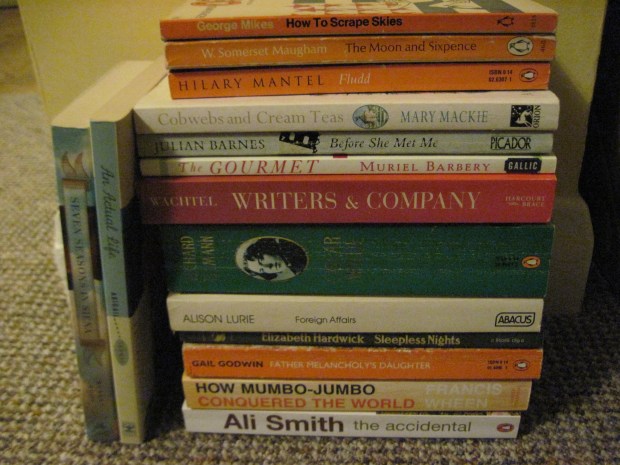
I’m particularly pleased with:
- Richard Ellmann’s biography of Oscar Wilde
- Writers & Company, a collection of Canadian radio interviews with authors
- A signed copy of Francis Wheen’s How Mumbo-Jumbo Conquered the World
- An Actual Life by Abigail Thomas – I love her memoirs so have been looking forward to trying her fiction.
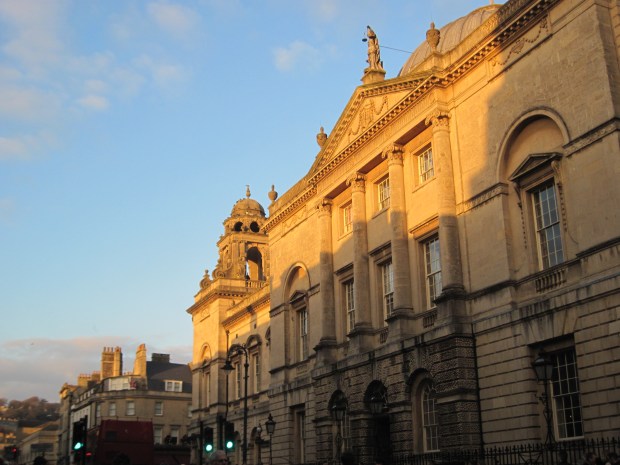
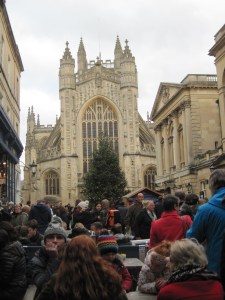
Bath Abbey
This was my fifth trip to Bath, which was looking lovely and golden in the wintry afternoon light but was certainly bustling, to put it politely. More accurately, you could barely move through the main streets, particularly around the Christmas market. At one point we weren’t sure we were going to get any hot food for dinner – it had never occurred to us to book ahead, and the brasserie and pub we tried were both full. Luckily the Real Italian Pizza Co. had a table for two, and I enjoyed a gloriously doughy calzone before we headed up to St Swithin’s Church for a holiday concert featuring Songways Choir and The Bookshop Band.
St Swithin’s has had a church on site since the tenth century, a sort of age we Americans can barely get our heads round. Jane Austen’s parents married here; so did William Wilberforce. It was something of a bittersweet occasion because the couple who make up The Bookshop Band are moving to Wigtown, Scotland’s town of books, in January and expecting their first booklet in May. So this was most likely my last chance to see them for quite a while. They only played a mini-set of five songs after the choir performance. Most of these I’d heard before, but “Wagons and Wheels,” based on Carol Birch’s Orphans of the Carnival (which I have on my Kindle and have been meaning to read), was new to me and a highlight.


Earlier in the evening we’d had a chance to stop by Mr B’s Emporium of Reading Delights, the independent bookshop in Bath where the band got their start. It’s such a cozy and welcoming shop, and I added a goodly number of books to my wish list while I was there. It’s something of a shame that we never got to see them perform in situ (though I don’t know how more than 20 people could fit in the upstairs space!), but I’ve managed to see them live three times and by funding their 2016 recording project have had excellent music streaming to my computer the whole year.
Thanks to last night’s holiday concert and the university carol service we’ll be attending tomorrow evening, I should certainly be feeling in the Christmas spirit. Look out for my two posts on seasonal reading coming up this week.
 Bookish Beck = Rebecca Foster. American transplant to England. Freelance proofreader and book reviewer.
 Bookish Beck