Other 2018 Superlatives and Some Early 2019 Recommendations
My Best Discoveries of the Year: Neil Ansell, James Baldwin, Janet Frame, Rohinton Mistry, Blake Morrison, Dani Shapiro, Sarah Vowell; Roald Dahl’s work for adults
The Author I Read the Most By: Anne Tyler (four novels)
 My Proudest Reading Achievement: Getting through a whole Rachel Cusk book (it was my third attempt to read her).
The 2018 Books Everybody Else Loved but I Didn’t: Melmoth by Sarah Perry and Normal People by Sally Rooney
The Year’s Biggest Disappointments: The Travelling Cat Chronicles by Hiro Arikawa and Sabrina by Nick Drnaso
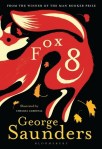 The Funniest Books I Read This Year: Fox 8 by George Saunders and Calypso by David Sedaris
Books that Made Me Cry: Leaving Before the Rains Come by Alexandra Fuller and The Long Goodbye by Meghan O’Rourke
 The Downright Strangest Books I Read This Year: The Bus on Thursday by Sheila Barrett, The Pisces by Melissa Broder and I Love Dick by Chris Kraus
The Debut Authors Whose Next Work I’m Most Looking Forward To: Julie Buntin, Lisa Ko and R.O. Kwon
The Best First Line of the Year: “Dust and ashes though I am, I sleep the sleep of angels.” (from The Western Wind by Samantha Harvey)
Some Early 2019 Recommendations
(in release date order)
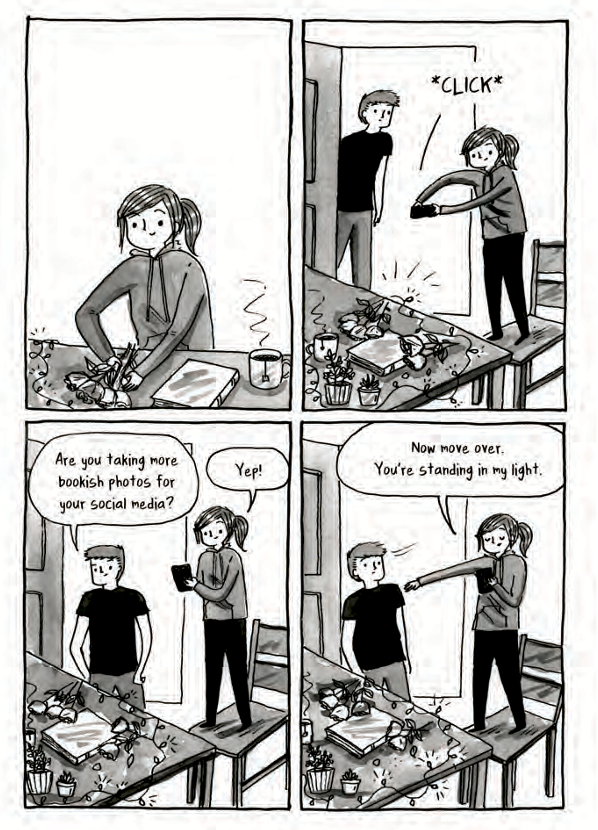
 Book Love by Debbie Tung: Bookworms will get a real kick out of these cartoons, which capture everyday moments in the life of a book-obsessed young woman (perpetually in hoodie and ponytail). She reads anything, anytime, anywhere. Even though she has piles of books staring her in the face everywhere she looks, she can never resist a trip to the bookstore or library. The very idea of culling her books or finding herself short of reading material makes her panic, and she makes a friend sign a written agreement before he can borrow one of her books. Her partner and friends think she’s batty, but she doesn’t care. I found the content a little bit repetitive and the drawing style not particularly distinguished, but Tung gets the bibliophile’s psyche just right. (Out January 1.)
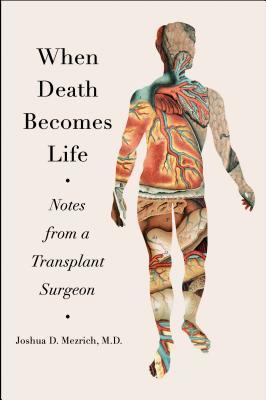 When Death Becomes Life: Notes from a Transplant Surgeon by Joshua D. Mezrich: In this debut memoir a surgeon surveys the history of organ transplantation, recalling his own medical education and the special patients he’s met along the way. In the 1940s and 1950s patient after patient was lost to rejection of the transplanted organ, post-surgery infection, or hemorrhaging. Mezrich marvels at how few decades passed between transplantation seeming like something out of a science-fiction future and becoming a commonplace procedure. His aim is to never lose his sense of wonder at the life-saving possibilities of organ donation, and he conveys that awe to readers through his descriptions of a typical procedure. One day I will likely need a donated kidney to save my life. How grateful I am to live at a time when this is a possibility. (Out January 15.)
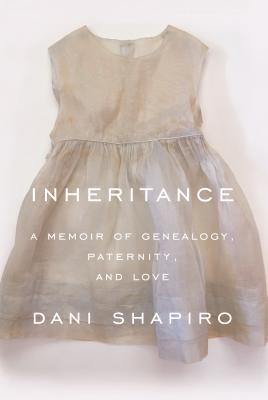 Inheritance: A Memoir of Genealogy, Paternity, and Love by Dani Shapiro: Shapiro was used to strangers’ comments about her blond hair and blue eyes. How could it be that she was an Orthodox Jew? people wondered. It never occurred to her that there was any truth to these hurtful jokes. On a whim, in her fifties, she joined her husband in sending off a DNA test kit. It came back with alarming results. Within 36 hours of starting research into her origins, Shapiro had found her biological father, a sperm donor whom she calls Dr. Ben Walden, and in the year that followed, their families carefully built up a relationship. The whole experience was memoirist’s gold, for sure. This is a moving account of her emotional state as she pondered her identity and what her sense of family would be in the future. (Out January 15.)

 Constellations: Reflections from Life by Sinéad Gleeson: Perfect for fans of I Am, I Am, I Am by Maggie O’Farrell, this is a set of trenchant autobiographical essays about being in a female body, especially one wracked by pain. As a child Gleeson had arthritis that weakened her hip bones, and eventually she had to have a total hip replacement. She ranges from the seemingly trivial to life-and-death matters as she writes about hairstyles, blood types, pregnancy, the abortion debate in Ireland and having a rare type of leukemia. In the tradition of Virginia Woolf, Frida Kahlo and Susan Sontag, Gleeson turns pain into art, particularly in a set of 20 poems based on the McGill Pain Index. The book feels timely and is inventive in how it brings together disparate topics to explore the possibilities and limitations of women’s bodies. (Out April 4.)
 The Hot Young Widows Club: Lessons on Survival from the Front Lines of Grief by Nora McInerny: In June 2016 I read It’s Okay to Laugh (Crying Is Cool Too), McInerny’s memoir about losing her father and her husband to cancer and her second child to a miscarriage – all within a few weeks – when she was 31. In this short book, an expansion of her TED talk, she argues that we are all incompetent when it comes to grief. There’s no rule book for how to do it well or how to help other people who are experiencing a bereavement, and comparing one loss to another doesn’t help anyone. I especially appreciated her rundown of the difference between pity and true empathy. “Pity keeps our hearts closed up, locked away. Empathy opens our heart up to the possibility that the pain of others could one day be our own pain.” (Out April 30.)
Coming tomorrow: Library Checkout & Final statistics for the year
Have you read any 2019 releases you can recommend?
How I Did on My 2018 Reading Goals & The Year’s Cover Trends
The year-end coverage continues!
So, how did I do with the 2018 reading goals I set for myself about this time last year? Rather poorly! is the short answer.
- I only read one book that might be considered a travel classic (by Patrick Leigh Fermor), though I did read some modern travel books.
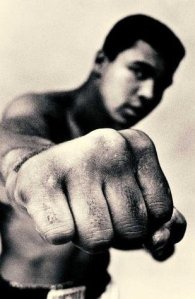 I only read Ali and the first half of a biography of May Sarton. What I’d envisioned being a monthly biography feature on the blog turned into a one-off.
- I need to work out my literature in translation percentage and compare it to last year’s to see if I’ve improved at all.
However, I do feel that I did well at reading my own books, as boosted by my 20 Books of Summer being chosen exclusively from my own shelves. Once I’m back from America I’ll have to do another full inventory and see how many unread books are still in the house, as compared to the 327 at this time last year.
Out of my 31 most anticipated reads of the second half of the year, I read 20 (of which 5 were at least somewhat disappointing), abandoned 2, still have 2 to read, lost interest in 1, have 1 in progress, and can’t find 5. For the whole year, the statistics are at 38/61 read (13 disappointments = more than 1/3 – that’s really bad and needs to be fixed!), 7 DNF, 4 still to read, 9 not found, 2 lost interest, and 1 in progress.
As for my non-reading-related goal … my accordion-playing fell by the wayside in July because I went away to America for three weeks unexpectedly, and after that never got back into the habit of daily practice and biweekly lessons the other side of Reading. I’d still like to pick it back up in the near future. I was at a point where I knew five notes and a few bass chords and could play both hands on a number of very simple tunes.

The poor cat was alarmed at yet another folk instrument entering his abode.
This Year’s Cover Trends
Mostly flora, which I noticed before 2018 had even begun.


The other one that kept jumping out at me was rubber gloves. Weird!


I’ll be back on the 26th to begin the countdown of my favorite books of the year, starting with nonfiction.
Merry Christmas!
The Rest of the Books I Abandoned in 2018
Almost without exception, if I do not finish a book it’s because I WAS BORED AND COULDN’T BE BOTHERED. But that’s obviously not an acceptable review, even if it is the truth, so I always push myself to say a little more. What didn’t work for me? Why couldn’t I connect? I try not to go on too much about the books I don’t finish, since I feel a touch guilty about them and it doesn’t particularly serve anyone to list my failures. However, these occasional posts on abandoned books are very popular, I think because readers want permission to give up on books they’re not enjoying. (You have my express permission!) But also, if you enjoyed some of the below and think I should give them another try, do say. I apologize in advance for not getting on with a book you loved.
These are all the DNFs since late June, not mentioning again any that I described in my monthly Library Checkout posts. No tags, cover images, links or full reviews here – though I might write that little bit more if I got the book from the publisher. In total this year I abandoned about 50 books, equating to roughly 14% of the ones that I started. They are in chronological order of my attempted reads, with the pages or percentages read in brackets.
A Degree of Mastery: A Journey through Book Arts Apprenticeship by Annie Tremmel Wilcox: I bought this from The Open Book (Airbnb) shop in Wigtown. Of course I love books as physical objects, and repairing damaged books was my favorite task when I worked in a university library, so I thought I’d enjoy learning about the traditional bookbinding techniques the author learned from Bill Anthony at the University of Iowa. Yet this was somehow disappointingly tedious with technical detail. [57 pages]
Nevermore by Andrew McNeillie (poetry): I enjoyed the short bird portraits that form “Plato’s Aviary,” and “Elegy,” about the advancing dearth of common songbirds. None of what followed, especially the long ones, drew me in. [61 pages]
Kinship Theory by Hester Kaplan: “Maggie Crown was pregnant with her daughter’s baby,” the first line tells us, acting as a surrogate to fulfill Dale’s overpowering desire to become a mother. It’s a great setup, and I warmed to 48-year-old Maggie with her “burden of maternal guilt” she hopes to ease through this sacrificial act, but not to Dale (the odd, male-sounding name doesn’t help). I think this could have been a good short story, but I don’t have the patience to follow such a slow and quiet plot through nearly 300 pages. [24 pages]
The Shakespeare Requirement by Julie Schumacher: This sequel to Dear Committee Members was only mildly amusing. Jason Fitger is now Payne’s chair of English, a shabby and underfunded department that always seems to get passed over while Economics receives special treatment. His hapless floundering – wasp stings, dental treatment, accidentally getting high on pills before a party – induced a few cringes but no real laughs. The supporting characters are well drawn, but overall I had zero qualms about setting this aside. [44%]
The Librarian by Salley Vickers: The vintage cover design is adorable, and probably drew me in against my better judgment. An idealistic young woman takes up the post of Children’s Librarian in a small town populated by good-hearted busybodies and urchins. On the twee side of pleasant. Promises to be a predictable love story. An excuse for the author to list off her favorite books from childhood? I’m not sure I’d try anything else by Vickers. [48 pages]
If You Leave Me by Crystal Hana Kim: This feels SO similar to Pachinko that I was unable to evaluate it on its own merit. [11%]
Spectra by Ashley Toliver (poetry): I couldn’t make much literal or metaphorical sense out of these poems at all. I highlighted one passage I kind of liked – a play on the two meanings of ‘bulb’? – on my Kindle: “Away from the glow, a dumb bulb freezes in its wintery malaise, covering the rest of the light.” [37%]
Our Homesick Songs by Emma Hooper: I should have known from my experience with Etta and Otto that Hooper’s style is too twee for me, but I was lured in by the accordion on the cover! I did like the existence of the library boat and Cora redecorating the rooms of a derelict house to match the latest travel book she’s read. [14%]
When Rap Spoke Straight to God: A Poem by Erica Dawson: Not for me at all; I should have figured that out before even opening my Edelweiss download. [14%]
Pretend I’m Dead by Jen Beagin: I read the first long chapter (almost like a standalone novella) called “Hole.” Mona, a 23-year-old art school dropout turned cleaner, was raised by a cousin after her addict parents’ death. Like Beagin, who cleaned houses for five years to support her art, Mona collects vacuum cleaners and considers vacuuming her primary hobby. She enjoys the repetition and inadvertent intimacy of her job – it gives her glimpses into other people’s inner lives. In her spare time she volunteers for a needle exchange program and thus falls in with “Mr. Disgusting,” the nickname she gives to a thief and Dumpster diver 21 years her senior. It’s all super-quirky and unnecessarily crass. The closest comparison I can make is with Miranda July’s The First Bad Man. Throughout I kept thinking to myself, this should really be written in the first person. This is a strong character who can describe things for herself. The style is readable; I could have forced myself through the last two-thirds. But with so many other books waiting for me, I decided I didn’t want or need to keep going. [65 pages] My apologies and thanks to Oneworld for the review copy.
Famous Adopted People by Alice Stephens: This felt very college literary magazine. Perfectly competent writing, but with so much thrown in: details, descriptions, profanity and sassy slang in the dialogue. After skimming the first couple of chapters I’d warmed to none of the characters and had no clear idea of where this was going. I wonder if the opposite to the previous book is true: third person would have been a better choice. Each chapter opens with a Korean propaganda image and an epigraph from a famous adopted person. [5 pages]
The Western Wind by Samantha Harvey: Set in the English village of Oakham in 1491, this is narrated by local priest John Reve, who learns more than he might prefer to know about his neighbors through the confession box. The writing and the period detail are strong, but there’s little narrative drive despite Harvey’s unusual strategy of proceeding backwards and this ostensibly being a (murder) mystery. Reve writes of the “endless watermill of days,” and though the action takes place over just four days it still has that repetitive quality: a cycle of confessions, meals, and village rituals that doesn’t feel like it’s going anywhere. [60 pages]
Swan Song by Kelleigh Greenberg-Jephcott: Full of glitzy atmosphere contrasted with washed-up torpor. I have no doubt the author’s picture of Truman Capote is accurate, and there are great glimpses into the private lives of his catty circle. I always enjoy first person plural narration, too. However, I quickly realized that I don’t have sufficient interest in the figures or the time period to sustain me through nearly 500 pages. [18 pages]
Middle England by Jonathan Coe: In 2015 I very much enjoyed Number 11, Coe’s state-of-the-nation novel about wealth, celebrity and suspicion in contemporary England. Middle England uses roughly the same format, of multiple linked characters and story lines, and seems to make many of the same points, too. However, by embedding his book so completely in 2011–18 history, he limits its fictional possibilities. I often wonder how the history books will look back on recent events (Brexit, Trump), but revisiting them in fiction feels depressing and pointless – I was there, I remember all this stuff, I don’t need reminding of how we got here. The book is far too long and there were no characters I immediately latched onto. [22 pages] My apologies and thanks to Viking for the review copy.
The Man Who Came Uptown by George Pelecanos: I’m interested in trying more literary/crossover crime novels and liked the synopsis of this one, but didn’t enjoy the hardboiled style. [20 pages]
A Well-Behaved Woman by Therese Anne Fowler: “Alva did not need to love William Vanderbilt; she needed only to marry him.” I was a huge fan of Fowler’s Z and jumped at the chance to read this, but found the first couple of chapters dull. Alva is one of four sisters and has an invalid father. She’s desperate not to become a spinster or a caregiver, so she goes along with her best friend Consuelo’s plan to set her up with W.K. Vanderbilt, even if they share lingering snobbism about his nouveau riche background. There’s always a danger of historical fiction devolving into a biography-lite information dump about social history (manners, fashion, etc.), and unfortunately that felt like the case here. I might have been able to stomach Alva as part of a group biography, but she wasn’t promising as the focus of a novel. [25 pages] My apologies and thanks to Two Roads for the review copy.
Sea of Ink by Richard Weihe: Lots of names and dates of Chinese dynasties; not a lot of story. Started for a potential Novellas in November review. [7 pages]
The House of Impossible Beauties by Joseph Cassara: I couldn’t get into the sassy Spanglish voice. Doesn’t feel like a book for me, which is a real shame as I won a signed copy in a Oneworld Twitter competition. [5 pages]
Winter by Ali Smith: I’ve read six of her books before, but it’s looking unlikely that I’ll try another at this point (though I might make an exception for How to be both). I knew what to expect style-wise: no speech marks; a fairly repetitive stream-of-consciousness studded with subtle jokes and wordplay. I was enjoying the mock-Dickensian opening and Sophia’s run-in with British bureaucracy (a bank this time, as opposed to the post office in Autumn) on Christmas Eve. But by the time Art came along, I was done. [47 pages]
Crimson by Niviaq Korneliussen [translated from the Greenlandic by Anna Halagar]: I was keen to try this because Greenland has been one of my surprise reading themes this year in both travel books and novels, but this was definitely not for me. I didn’t get far enough into the story to comment on it, but what I did read was drenched in sex talk, with f***ing appearing in pretty much every sentence. One line I liked: “Dry kisses stiffening like desiccated fish.” [7%]
Don’t Skip Out on Me by Willy Vlautin: I picked up a free copy at the Faber Spring Party. It’s perfectly serviceably written in a contemporary Western style and I’m convinced by the setting, but I have no sense of the characters, especially the main character, and no desire to accompany him for another 250+ pages. I’ve seen the movie of Lean on Pete, so I know the sort of emotional tenor to expect. Sorry, Willy. Maybe I’ll try The Free instead. [30 pages]
The Madonna of the Mountains by Elise Valmorbida: Also from the Faber Spring Party. Nice writing, nice details. Italian woman fearing spinsterhood: “She must keep the wedding sheet clean and white, like her soul, like her body, immaculate and new. But she is old. Twenty-five years old and untouched by a husband. Her fingers are without thimbles. She has hands that can wring an animal’s neck. Arms to stir a pot of boiling polenta. She’s a good investment for any man, if only he can overlook her age.” I never built up momentum. [20 pages]
House of Glass by Susan Fletcher: I liked the Jane Eyre vibe of this novel about a young woman with osteogenesis imperfecta who travels from London to a rundown Gloucestershire manor house to create a collection of Kew Gardens’ plants. Clara seems feisty and there’s a neat connection between her brittle bones and the glasshouse she’s to set up. But there’s not enough suspense to this slow build, and based on the other Fletcher novel I read the payout won’t be sufficient. [87 pages]
What books disappointed you this year? Were there any you just couldn’t finish?
A Retrospective of 2018’s Events, Reading Projects and Themes
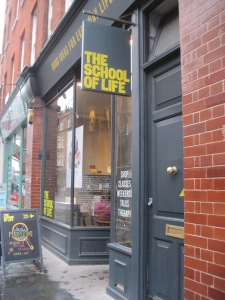 In January I had the tremendous opportunity to have a free personalized bibliotherapy appointment with Ella Berthoud at the School of Life in London. I’ve since read three of her prescriptions plus parts of a few others, but I still have several more awaiting me in the early days of 2019, and will plan to report back at some point on what I got out of all of them.
In March to April I ran a Wellcome Book Prize shadow panel for the second time. This year it was much more successful; I plan to do it again next year, too. (I actually proffered myself as an official judge for next year’s prize and got a very kind but entirely noncommittal e-mail back from the chairwoman, which I will have to take as victory enough.)
 Early April saw us visiting Wigtown, Scotland’s book town, for the first time. It was a terrific trip, but thus far I have not been all that successful at reading the 13 books that I bought! (Just two and a quarter so far.)
I reviewed three novels for Liz Dexter’s Iris Murdoch Readalong project: A Severed Head in March, The Italian Girl in June, and The Nice and the Good in September. In February I’ll pop back in with one more paperback that I own, The Sacred and Profane Love Machine. November was Margaret Atwood Reading Month, hosted by Marcie of Buried in Print and Naomi of Consumed by Ink, and provided me with a good excuse to read her first two novels.
 I did some “buddy reads” for the first time: Andrea Levy’s Small Island with Canadian blogger friends, including Marcie and Naomi; and West With the Night with Laila of Big Reading Life and Late Nights on Air with Naomi as well as Penny of Literary Hoarders during 20 Books of Summer, which I took part in for the first time. In May my mother and I read W. Somerset Maugham’s The Painted Veil and shared reading notes via e-mail. (A planned buddy read of The Left Hand of Darkness with Annabel and Laura was, alas, a fail.)
Besides the official Wellcome Book Prize blog tour in April, I participated in another 11 blog tours, averaging out at one a month. I’m going to scale back on these next year because I have too often found, after I accepted, that the book was a dud and I had to just run an extract because I could see I wasn’t going to get through it and write a review.
I joined my neighborhood book club in September and have attended every month since then. Our first four selections were Ladder of Years by Anne Tyler, The Gracekeepers by Kirsty Logan, Noonday by Pat Barker, and Number 11 by Jonathan Coe. I’d already read the Logan and Coe years ago and didn’t fancy rereading them, so wasn’t able to participate as much in those months, but was still glad to go along for the socializing. My husband even read the Coe and came to December’s meeting (was it just for the mince pies and mulled wine?!). We’ve set our first four reads for 2019 – the three below, in order from left to right, plus Ernest Hemingway’s The Garden of Eden, which I’ll borrow from the university library.

 In October I won tickets to see a production of Angela Carter’s Wise Children at the Old Vic in London. Just a few weeks later I won tickets to see Barbara Kingsolver in conversation about Unsheltered at the Southbank Centre. I don’t often make it into London, so it was a treat to have bookish reasons to go and blogging friends to meet up with (Clare of A Little Blog of Books joined me for both, and Laura T. was also at the Kingsolver event).
November was mostly devoted to novellas, for the third year in a row. Although I didn’t officially participate in Nonfiction November, I still enjoyed coming up with some fiction/nonfiction pairings and an “expert’s” list of women’s religious memoirs.
My husband wrote pretty much his entire PhD thesis this year and on Friday the 14th had his graduation ceremony. I was the moral support / proofreader / preparer of simple meals during the months when he was in the throes of writing up, so I will consider myself as sharing in the accomplishment. Congratulations, Dr. Foster!
This month and into January I’ll be reading the last few nominees for the National Book Critics Circle’s John Leonard Prize.

When the list of finalists was released, I was relieved to see I’d already read four out of seven (and three of those were ones I’d nominated); the other three – the Adjei-Brenyah and Brinkley stories and There There – were books I was keen to read but hadn’t managed to get hold of. About 80 of us NBCC members are reading the shortlist and voting for the best first book of the year by January 8th. Plus I’m technically up for an NBCC prize myself, in that I nominated myself (that’s how it works) for the 2018 Nona Balakian Citation for Excellence in Reviewing and sent in an application with five of my best reviews from the year.
The Ones that Got Away
 Two posts I planned but never got around to putting together would have commemorated the 50th anniversary of Thomas Merton’s death (I own several of his books but am most interested in reading The Seven-Storey Mountain, which celebrated its 70th birthday in October) and the 40th anniversary of the publication of The Snow Leopard by the late Peter Matthiessen. Perhaps I’ll try these authors for the first time next year instead.
Final Book Serendipity Incidents
In the second half of the year I started keeping track of all my weird reading coincidences, posting about them on Twitter or Instagram before collecting them into a blog post a couple months ago. Here are a few that popped up since then or recalled earlier reads from the year:
- Two protagonists named Willa: Anne Tyler’s Clock Dance and Barbara Kingsolver’s Unsheltered
- Two novels featuring bog people: Anne Youngson’s Meet Me at the Museum and Sarah Moss’s Ghost Wall
- Two dogs named Flash: Ben Crane’s Blood Ties and Andrew Marshall’s The Power of Dog
- Multiple sclerosis is an element in Christian Donlan’s The Unmapped Mind: A Memoir of Neurology, Incurable Disease and Learning How to Live, Jennifer Richardson’s Americashire and Michelle Obama’s Becoming (her father had it)
- The ideas of Freud are mentioned in a 1910s setting in Nancy Horan’s Loving Frank, Annabel Abbs’s Frieda and Daniel Mason’s The Winter Soldier
- Mermaids (or ‘mermaids’) and/or mermen appear in Imogen Hermes Gowar’s The Mermaid and Mrs Hancock, Melissa Broder’s The Pisces, Daniel Mason’s The Winter Soldier, and a series of poems in Miriam Darlington’s Windfall
- Bohemian writer dies young of tuberculosis (or similar) in novels about their wives: Annabel Abbs’s Frieda (D.H. Lawrence) and Nancy Horan’s Under the Wide and Starry Sky (Robert Louis Stevenson)
- Two books that mention the Indonesian practice of keeping dead relatives as mummies and bringing them out on occasion for ritual celebrations: From Here to Eternity by Caitlin Doughty and The Hot Young Widows Club by Nora McInerny
- Two books that include a trip to Lourdes for healing: Heal Me by Julia Buckley and Constellations by Sinéad Gleeson
- Two books that mention the irony of some of the most well-loved modern Christmas songs being written by Jews: In Mid-Air by Adam Gopnik and Christmas Days by Jeanette Winterson
Surprise Themes from My Year’s Reading
A few of these make sense – cults fit with my interest in narratives of religious experience, and it doesn’t take a psychologist to see that my relationship with my father has been an ongoing issue in recent years (I wonder how the numbers would compare for books about mothers?) – but most are completely random.
I decided a theme had to show up at least three times to make the list. Some topics I enjoyed so much I’ll keep reading about them next year. Within a category the books are in rough chronological order of my reading, and I include skims, DNFs and books in progress.
 Fathers (absent/difficult) + fatherhood in general: Educated by Tara Westover, And When Did You Last See Your Father? by Blake Morrison, The Italian Teacher by Tom Rachman, In the Days of Rain by Rebecca Stott, Implosion by Elizabeth W. Garber, Little Women by Louisa May Alcott & March by Geraldine Brooks, The Unmapped Mind by Christian Donlan, Never Mind and Bad News by Edward St. Aubyn, The Reading Promise by Alice Ozma, How to Build a Boat by Jonathan Gornall, Lake Success by Gary Shteyngart, Normal People by Sally Rooney, Rosie by Rose Tremain, My Father and Myself by J.R. Ackerley, Everything Under by Daisy Johnson, Ghost Wall by Sarah Moss, Surfacing by Margaret Atwood, Heart Berries by Terese Marie Mailhot, Blood Ties by Ben Crane, To Throw Away Unopened by Viv Albertine, Small Fry by Lisa Brennan-Jobs
Addiction: The Leavers by Lisa Ko, Mayhem by Sigrid Rausing, The Only Story by Julian Barnes, The Small Door of Your Death by Sheryl St. Germain, Writing and Madness in a Time of Terror by Afarin Majidi, Marlena by Julie Buntin, Ninety Days by Bill Clegg, Bad News by Edward St. Aubyn, Pretend I’m Dead by Jen Beagin, Heart Berries by Terese Marie Mailhot
 Greenland: A Wilder Time by William E. Glassley, This Cold Heaven by Gretel Ehrlich, Miss Smilla’s Feeling for Snow by Peter Høeg, On Balance by Sinéad Morrissey (the poem “Whitelessness”), Cold Earth by Sarah Moss, Crimson by Niviaq Korneliussen, The Library of Ice by Nancy Campbell
Cults: Educated by Tara Westover, Harmony by Carolyn Parkhurst, In the Days of Rain by Rebecca Stott, The Incendiaries by R.O. Kwon, A River Could Be a Tree by Angela Himsel
Trees: Ladders to Heaven by Mike Shanahan, The Overstory by Richard Powers, The Man Who Planted Trees by Jean Giono, The Wood and The Secret Life of the Oak by John Lewis-Stempel
 Flying: Skybound by Rebecca Loncraine, West With the Night by Beryl Markham, Going Solo by Roald Dahl, Skyfaring by Mark Vanhoenacker
The Anglo experience in Africa: Free Woman: Life, Love and Doris Lessing by Lara Feigel, Leaving Before the Rains Come by Alexandra Fuller, West With the Night by Beryl Markham, Going Solo by Roald Dahl
Korean-American women: The Incendiaries by R.O. Kwon, If You Leave Me by Crystal Hana Kim, All You Can Ever Know by Nicole Chung, Famous Adopted People by Alice Stephens, Digging to America by Anne Tyler
 New Zealand: The Garden Party and Other Stories by Katherine Mansfield, To the Is-Land by Janet Frame, Dunedin by Shena Mackay
Life in the White House: Living History by Hillary Rodham Clinton, All the Presidents’ Pastries by Roland Mesnier, Becoming by Michelle Obama
Lighthouses: Stargazing: Memoirs of a Young Lighthouse Keeper by Peter Hill, The Bird Artist by Howard Norman, Under the Wide and Starry Sky by Nancy Horan (about Robert Louis Stevenson, whose family built lighthouses)

More lighthouse books ready for next year.
Butterflies: Four Wings and a Prayer by Sue Halpern, Magdalena Mountain by Robert Michael Pyle, Mama Amazonica by Pascale Petit

More butterfly books ready for next year.
What were some of the highlights of your bookish year?
What odd coincidences and recurring themes have you spotted in your year’s reading?
Season’s Readings: What I’ll Be Reading This Christmas
With part of my birthday book token I treated myself to the new paperback edition of Jeanette Winterson’s Christmas Days, which I’ll read off and on over the holidays this year and next, probably. I recently finished Rachel Joyce’s wintry short story collection and started Madeleine L’Engle’s third Crosswicks Journal, An Irrational Season. The first two chapters are set at Advent and Christmas and the rest later in the liturgical year; I’ve set the book aside to come back to in January. L’Engle is a great author to read if you’d like some liberal, non-threatening theology at this time of year. I particularly recommend her Christmas-themed book that I read last year. (Mini-reviews of the Joyce and L’Engle are below.)
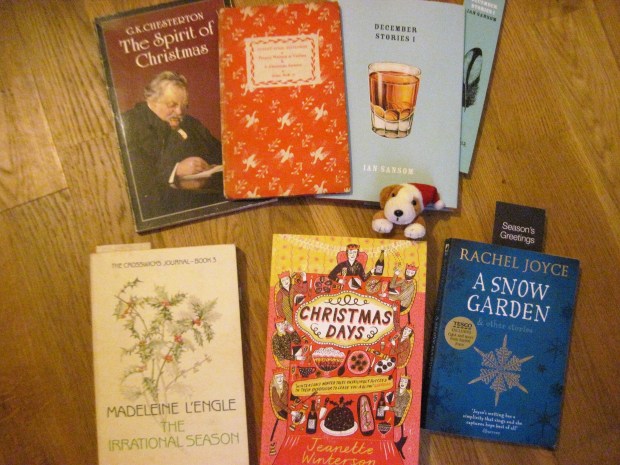
I also have a signed copy of Ian Sansom’s December Stories I that I won in a giveaway on Cathy’s blog, so I’ll be dipping into plenty of seasonally appropriate short stories this year. Earlier this year I picked up copies of the G.K. Chesterton collection (signed by the anthology editor) and the Robert Louis Stevenson volume (which contains prayers plus a sermon written during his time in Samoa) free at church from the theological library of a woman who’d died and donated her books to the church family.


A Snow Garden and Other Stories by Rachel Joyce
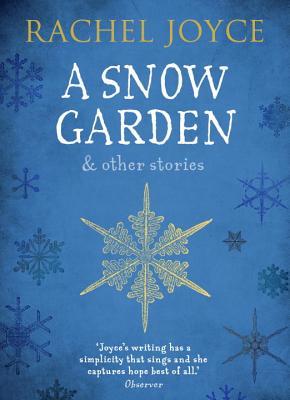 Two stand-outs were “The Boxing Day Ball,” a prequel to The Unlikely Pilgrimage of Harold Fry, describing how Harold and Maureen met, and “A Faraway Smell of Lemon,” in which a woman mourning the end of her relationship wanders into a cleaning supplies store and learns the simple lesson that everybody hurts. (“Life is hard sometimes” – fair enough, but can we say it without a cliché?) “I’ll Be Home for Christmas” is about the boy formerly known as Tim, now the mega pop star X. All he wants is a quiet few days back home, but he can’t seem to escape his reputation. Characters and little elements from previous stories reappear in later ones. My favorite was probably the title story, about a father trying to make the holidays perfect for his sons after his breakdown and divorce.
Joyce chooses to write about ordinary and forgotten people, but sometimes her vision of chavvy types doesn’t quite ring true, and when she isn’t being melancholy she’s twee. “Christmas Day at the Airport” was so contrived it made me groan. While I don’t think any of her books are truly great, they’re pleasant, relatable and easy to read.
My rating: 
Favorite lines:
“There is much to do, much to prepare, much to mend, but it cannot be done in a day and sometimes it is better to do one small thing.” (from “A Faraway Smell of Lemon”)
“The truth was, there were no instructions when you got married. There was no manual in the birthing suite that explained how to bring up a happy child. No one said, you do this, and then you do this, and after that this will happen. You made it up as you went along.” (from “The Marriage Manual”)
Bright Evening Star: Mystery of the Incarnation by Madeleine L’Engle
 “The story of Jesus’ birth has been oversentimentalized until it no longer has the ring of truth, and once we’d sentimentalized it we could commercialize it and so forget what Christmas is really about.” L’Engle believes in the power of storytelling, and in this short volume of memoir she retells the life story of Jesus and recalls her own experiences with suffering and joy: losing her father young (his lungs damaged by poison gas in WWI) and the death of her husband of 40 years versus the sustaining nature of family love and late-life friendships. Chapters 4 and 5 are particular highlights.
L’Engle was not at all your average American Christian: raised in the Episcopal tradition, she didn’t even encounter Evangelicalism until her mid-forties, and she doesn’t understand the focus on creationism and sexual morality. She also writes about free will and the adoration of Mary and how A Wrinkle in Time (rejected by many a publisher) was her fable of light in the midst of darkness. The title comes from The New Zealand Prayer Book, which also gives helpful alternate names for the persons of the Trinity: Earth Maker, Pain Bearer, Life Giver. This isn’t a particularly Christmas-y book, but it still lends itself to being read a chapter at a time during Advent.
My rating: 
Some other favorite lines:
“Christ, in being born as Jesus, broke into time for us, so that time will never be the same again.”
“Family can be a movable feast. It can be a group of friends sitting around the dining table for an evening. It can be one or two people coming to stay with me for a few nights or a few weeks. It should be the church, and I am grateful that my church is a small church.”
Are you reading any particularly wintry or Christmasy books this year?
Library Checkout: November 2018

This month I focused on novella-length books, though I also managed a doorstopper from the Booker Prize shortlist. I only have another three weeks until I fly to America for Christmas, so I may end up canceling some of the reservations below, or just taking a chance that they won’t come in for me until the new year. (As usual, I’ve added in star ratings and links to Goodreads reviews where I haven’t already featured the books on the blog in some way.)
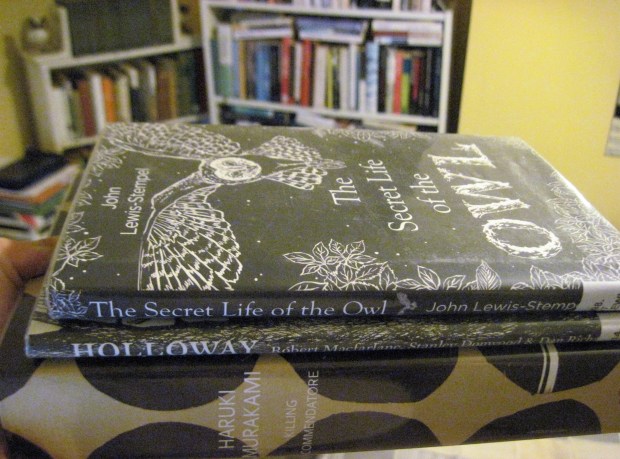
LIBRARY BOOKS READ
- Surfacing by Margaret Atwood
- The Bus on Thursday by Shirley Barrett
- Sincerity by Carol Ann Duffy [poetry]

- The Old Man and the Sea by Ernest Hemingway

- Everything Under by Daisy Johnson
- The Glorious Life of the Oak by John Lewis-Stempel
- The Secret Life of the Owl by John Lewis-Stempel
- Holloway by Robert Macfarlane
- Ghost Wall by Sarah Moss
- The Overstory by Richard Powers
- Cassandra Darke by Posy Simmonds [graphic novel]
CURRENTLY READING
- West by Carys Davies
- House of Glass by Susan Fletcher
- Becoming by Michelle Obama
- The Catcher in the Rye by J.D. Salinger
- Winter by Ali Smith
CURRENTLY SKIMMING
- In Miniature: How Small Things Illuminate the World by Simon Garfield
- Under the Knife: A History of Surgery in 28 Remarkable Operations by Arnold van de Laar
TO SKIM ONLY
- Rewild Yourself : 23 Spellbinding Ways To Make Nature More Visible by Simon Barnes
- Dare to Lead: Brave Work, Tough Conversations, Whole Hearts by Brené Brown
- The Angry Chef: Bad Science and the Truth about Healthy Eating by Anthony Warner

IN THE RESERVATION QUEUE
- Selected Poems by Edmund Blunden
- Daphne by Will Boast
- Louis & Louise by Julie Cohen
- The Binding by Bridget Collins
- Owl Sense by Miriam Darlington
- Dream Sequence by Adam Foulds
- A Honeybee Heart Has Five Openings by Helen Jukes
- Fox 8 by George Saunders
- The Brief Life of Flowers by Fiona Stafford
RETURNED UNFINISHED
- Killing Commendatore by Haruki Murakami – I cut my losses at page 120. At that point the story still hadn’t taken off. The setup is fairly similar to that of The Wind-Up Bird Chronicle, and so was not fresh or enticing enough.
- The House on Vesper Sands by Paraic O’Donnell – I read the first chapter (21 pages) and enjoyed it well enough, but didn’t feel any need to continue.
- The Man Who Came Uptown by George Pelecanos – I’m interested in trying more literary/crossover crime novels and liked the synopsis of this one, but didn’t enjoy the hardboiled style. I read the first 20 pages.
RETURNED UNREAD
- Varina by Charles Frazier – I tried the first few pages and wasn’t drawn in.
- The Tattooist of Auschwitz by Heather Morris – I put it down when I found a dangling modifier on page 2! Some people might be willing to look past issues of writing quality and appreciate a story, but I have so many hundreds of books waiting to be read that I am keen not to waste my time on anything even remotely subpar.
- The Long Take by Robin Robertson – Getting through 240 pages of a novel in verse was never really going to happen. (I managed about two.)
- The Mussel Feast by Birgit Vanderbeke – No chapters, okay. No heading breaks, maybe alright. But no paragraphs? That’s a step too far!
What have you been reading from your local libraries? Does anything appeal from my stacks?
I don’t have an official link-up system, so please just pop a link to your blog in the comments if you’ve taken part in Library Checkout this month. (Feel free to use the feature image in your post.)
November Reading Plans: Novellas, Margaret Atwood and More
This is my third year joining Laura Frey and others in reading novellas in November. Laura has put together a history of the challenge here; it has had various incarnations but has no particular host or rules. Join us if you like! (#NovNov) The definition of a novella seems to be loose – it’s based more on word count than page count – so it’s up to you what you’d like to classify as one. I generally limit myself to books of 150 pages or fewer, though in some cases I’d probably go as high as 180-some. I’ve trawled my shelves and library pile and have four stacks to select from: fiction, classics, novella-length nonfiction, and slightly longer novels (160–190 pages) that I’ll keep around as backups but likely won’t get to.


Between what I have in these stacks, holds I’m waiting on at the library (West by Carys Davies, The Glorious Life of the Oak by John Lewis-Stempel and Holloway by Robert Macfarlane), and some additional choices on my e-readers (Lady into Fox by David Garnett, Heart Berries by Terese Marie Mailhot and Childhood: Two Novellas by Gerard Reve), I easily have enough for a book a day. In a future year maybe I’d be able to clear my schedule such that I could indeed read one novella per day, but I have so many review books on the go that I won’t aim for that. Besides, I’m not the kind of reader who’d sit down and read a 160-page book in one sitting; I’d be more likely to read 20 pages each in eight different books.
This is the pile I’ll be starting later today. (The Evans looks long but is 164 pages of text with various full- and half-page black-and-white illustrations dotted through.)
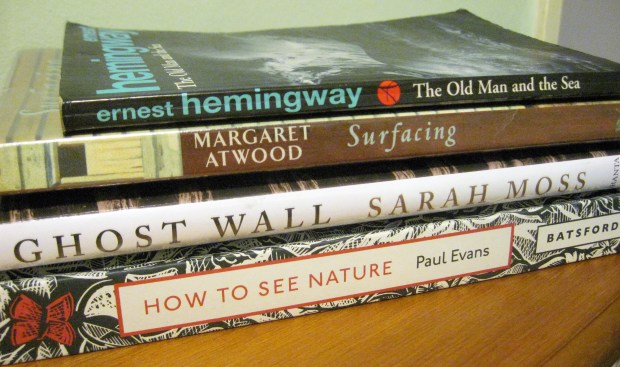
I got a headstart on Novellas in November with this Canongate volume published today.
Courage Calls to Courage Everywhere by Jeanette Winterson
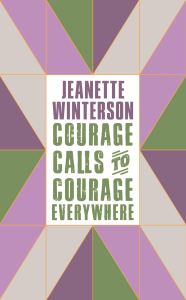 Last year it was Mary Beard’s Women and Power; in 2018 this is the Christmas gift to slip into every feminist book-lover’s stocking. Adapted from Winterson’s Richard Dimbleby Lecture and supplemented by the text of Emmeline Pankhurst’s 1913 speech “Freedom or Death,” this is a slim, attractive volume that feels timely if insubstantial. Winterson gives a potted history of suffragism and argues that female brains are not wired differently; it’s just social programming that tells us so. Gender imbalances in university admissions and the job market continued into the 1970s, so it’s no surprise, she says, that women are still catching up 40 years later – and she supports measures that could be labeled as positive discrimination.
From the #MeToo movement she makes what seems like an odd swerve into discussing AI because computer science/Silicon Valley is very male-dominated and she wants to be sure women have a respected role in the future. My reaction to this was the same as to Beard’s book and Chimamanda Ngozi Adichie’s We Should All Be Feminists: you can’t (and I don’t) dispute what the author has to say; for the most part the points are compelling and well made. Yet I don’t necessarily feel that I learned anything, or saw something familiar in a new way.
Favorite lines:
“When prejudice and bad science are no longer in the way, women always prove themselves as capable as men.”
“that’s how it is with patriarchy – we don’t notice the all-male panels, the movies where women are just the love interest, the number of male presenters on TV and radio […] and we do need parity, because women are one half of the population.”
My rating:
Other November reading plans…
 Margaret Atwood Reading Month
One of my longer novellas is a library copy of Surfacing (1972), which will be my first of two reads for the Margaret Atwood Reading Month hosted by Marcie and Naomi. I also own a copy of The Edible Woman (1969) and look forward to trying both of these early works.
Young Writer of the Year Award
Being involved with the Sunday Times/PFD Young Writer of the Year Award was one of my highlights of 2017. I’m excited for this year’s shadow panelists, several of whom are longtime blogging friends, and look forward to following along with the shortlist reads even though I can’t attend this year’s events. With any luck I will already have read at least one or two of the nominees (fingers crossed for Daisy Johnson and Fiona Mozley) so that there’s only a couple more to discover.
John Leonard Prize committee
In May I joined the National Book Critics Circle. One of the awards they give annually is the John Leonard Prize for the best first book in any genre. The pool of nominees is based on member recommendations, and a volunteer panel of members (as many as are interested!) then reads the 5–7 finalists and votes for a winner by January 8th. I signed up to be on the panel, so I’m committed to reading all the finalists in e-book format within about six weeks. Again, I hope to find that I’ve already read at least a few of the nominees. Regardless, it will be a fun project to keep me busy over our two weeks in America for the holidays.

Any reading plans for November? Will you be joining in with novellas or Margaret Atwood’s books?
Library Checkout: October 2018
It’s been a year since I relaunched the Library Checkout meme. I want to say a big thank you to the handful of bloggers who have joined in since then. It’s such a quick, fun and easy post to put together by the final Monday of each month. Why not take part?!
In the past month I’ve been reading from the Booker Prize longlist. Although I also read within my comfort zones of historical fiction and memoirs, I’ve dabbled in genres I don’t read as often, like graphic novels and middle-grade fiction.
For November’s challenges I’m stockpiling novella-length books, one of them for Margaret Atwood Reading Month. At some point I’ll have to get real about how many more 2018 releases I can read before I fly to America for Christmas, which may mean canceling some reservations. I’m holding out for at least the Murakami and Obama titles to arrive in time!
(As usual, I’ve added in star ratings and links to Goodreads reviews where I haven’t already featured the books on the blog in some way.)
LIBRARY BOOKS READ
- Another Year of Plumdog by Emma Chichester Clark [graphic novel]
- French Exit by Patrick deWitt
- Sabrina by Nick Drnaso [graphic novel]

- Washington Black by Esi Edugyan
- All Among the Barley by Melissa Harrison
- Tilly & the Bookwanderers (Pages & Co., #1) by Anna James
- The Seabird’s Cry: The Lives and Loves of Puffins, Gannets and Other Ocean Voyagers by Adam Nicolson

- Rosie: Scenes from a Vanished Life by Rose Tremain
SKIMMED ONLY
- My Father and Myself by J.R. Ackerley
- Noonday by Pat Barker
- The Gracekeepers by Kirsty Logan [Read in 2015; re-skimmed for book club.]
- Wilding by Isabella Tree
CURRENTLY READING
- Everything Under by Daisy Johnson
- The Overstory by Richard Powers
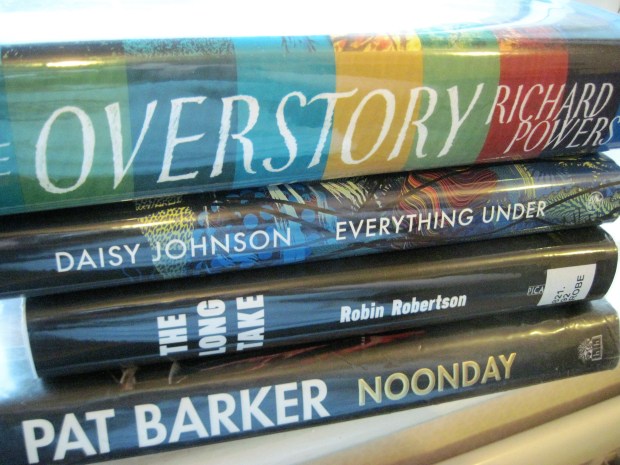
CURRENTLY READING-ish (set aside temporarily)
- The Catcher in the Rye by J.D. Salinger
CHECKED OUT, TO BE READ
- Surfacing by Margaret Atwood
- The Old Man and the Sea by Ernest Hemingway
- Ghost Wall by Sarah Moss
- The Man Who Came Uptown by George Pelecanos
- The Long Take by Robin Robertson
- The Mussel Feast by Birgit Vanderbeke
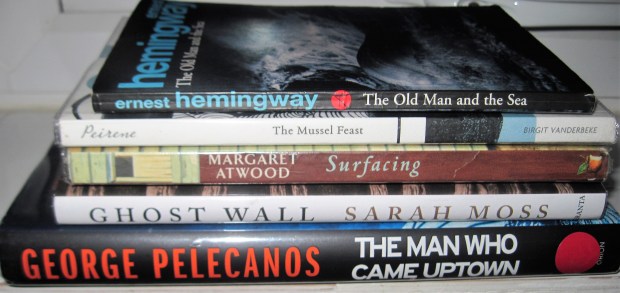
ON HOLD, TO BE PICKED UP
- Varina by Charles Frazier
IN THE RESERVATION QUEUE
- The Bus on Thursday by Shirley Barrett
- Boy Erased: A Memoir of Identity, Faith, and Family by Garrard Conley
- West by Carys Davies
- Sincerity by Carol Ann Duffy [poetry]
- House of Glass by Susan Fletcher
- In Miniature: How Small Things Illuminate the World by Simon Garfield
- The Glorious Life of the Oak by John Lewis-Stempel
- Holloway by Robert Macfarlane et al.
- Killing Commendatore by Haruki Murakami
- Becoming by Michelle Obama
- Fox 8 by George Saunders
- Cassandra Darke by Posy Simmonds [graphic novel]
RETURNED UNFINISHED
- Swan Song by Kelleigh Greenberg-Jephcott
RETURNED UNREAD
- A Man in Love by Karl Ove Knausgaard – Too dang long! Tiny print and over 500 pages. I don’t think I’ll be completing the My Struggle series.
- Now We Shall Be Entirely Free by Andrew Miller – This was requested after me, and I knew I wouldn’t have time for it. Also, I think I’ve lost interest for now.
What have you been reading from your local libraries? Does anything appeal from my stacks?
I don’t have an official link-up system, so please just pop a link to your blog in the comments if you’ve taken part in Library Checkout this month. (Feel free to use the image in your post.)
Incidents of Book Serendipity
Since May I’ve been posting my occasional reading coincidences on Twitter and/or Instagram. This is when two or more books that I’m reading at the same time or in quick succession have something pretty bizarre in common. Because I have so many books on the go at once – usually between 10 and 20 – I guess I’m more prone to such serendipitous incidents. What’s the weirdest one you’ve had lately? (The following are in rough chronological order.)
- Two historical novels set (partially) among the slaves of Martinique and featuring snippets of Creole (Patrick Chamoiseau’s Slave Old Man and Jane Harris’s Sugar Money)
- A book about epilepsy and a conductor’s memoir, followed by a novel with a conductor character and another who has seizures (Suzanne O’Sullivan’s Brainstorm and Lev Parikian’s Why Do Birds Suddenly Disappear? to Caoilinn Hughes’s Orchid & the Wasp)
- Two characters mistake pregnancy for cholera (in Alexandra Fuller’s Leaving Before the Rains Come and W. Somerset Maugham’s The Painted Veil)
 Two characters are reading Ursula K. Le Guin’s The Left Hand of Darkness (in Lily Brooks-Dalton’s Good Morning, Midnight and Julie Buntin’s Marlena) … I’ve since tried again with Le Guin’s book myself, but it’s so dry I can only bear to skim it.
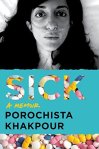
- Two memoirs by Iranian-American novelists with mental health and drug use issues (Porochista Khakpour’s Sick and Afarin Majidi’s Writing and Madness in a Time of Terror)

- References to the blasé response to Martin Luther King’s assassination in North Carolina (in Paulette Bates Alden’s Crossing the Moon and David Sedaris’s Calypso)
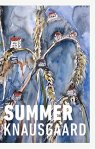
- The Police lyrics (in Less by Andrew Sean Greer and Summer by Karl Ove Knausgaard [a whole essay called “Sting”])

- Salmon croquettes mentioned in Less by Andrew Sean Greer and An American Marriage by Tayari Jones
 I’m reading Beryl Markham’s West with the Night … and then Glynnis MacNicol picks that very book up to read on a plane in No One Tells You This
- Starting two books with the word “Ladder” in the title, one right after the other: Ladders to Heaven by Mike Shanahan and Ladder of Years by Anne Tyler (followed just a couple of weeks later by A Ladder to the Sky by John Boyne!)


 Two books set in Dunedin, New Zealand, one right after the other – I planned it that way, BUT both have a character called Myrtle (To the Is-Land by Janet Frame and Dunedin by Shena Mackay). Then I encountered Harold Gillies, the father of plastic surgery, in Jim McCaul’s Face to Face, and guess what? He was from Dunedin!
- Then I was skimming Louisa Young’s You Left Early and she mentioned that her grandmother was a sculptor who worked with Gillies on prostheses, which was the inspiration for her WWI novel, My Dear I Wanted to Tell You.
- Two novels featuring drug addicts (Pretend I’m Dead by Jen Beagin and Bad News by Edward St. Aubyn)
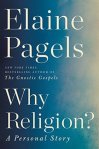
- The same Wallace Stevens lines that appear as an epigraph to Barbara Kingsolver’s Unsheltered are mentioned in Elaine Pagels’s Why Religion? – “After the final no there comes a yes / And on that yes the future world depends.”

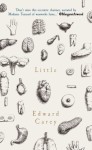 “Twinkle, Twinkle, Little Star” is mentioned in Little by Edward Carey and Marilla of Green Gables by Sarah McCoy
- Reading Nine Pints, Rose George’s book about blood, at the same time as Deborah Harkness’s Time’s Convert, which is partially about vampires; in this it takes 90 days for a human to become fully vampirized – the same time it takes to be cured of an addiction according to the memoir Ninety Days by Bill Clegg.
Library Checkout: September 2018
I figured out how to set up an alert for 2018 and 2019 releases in my library system’s catalogue so that I get e-mail digests listing all the new books on order. This means I can instantly place holds on loads of buzzy new books. I started with a bunch of the Booker longlistees, even the ones I wasn’t entirely sure about. The only downside is that all the brand-new books tend to start arriving at once. Gah! To make things more manageable for myself, I went ahead and canceled the holds on most of the books that didn’t advance to the Booker shortlist.
(As usual, I’ve added in star ratings and links to Goodreads reviews where I haven’t already featured the books on the blog in some way.)
LIBRARY BOOKS READ
- A Ladder to the Sky by John Boyne
- Madame Zero by Sarah Hall
- Taking Mesopotamia by Jenny Lewis [poetry]
- Bad News by Edward St. Aubyn

SKIMMED ONLY
- First, We Make the Beast Beautiful: A New Story about Anxiety by Sarah Wilson
- You Left Early: A True Story of Love and Alcohol by Louisa Young
CURRENTLY READING
- The Seabird’s Cry: The Lives and Loves of Puffins, Gannets and Other Ocean Voyagers by Adam Nicolson
- Rosie: Scenes from a Vanished Life by Rose Tremain
CURRENTLY READING-ish (set aside temporarily)
- The Catcher in the Rye by J.D. Salinger

CHECKED OUT, TO BE READ
- All Among the Barley by Melissa Harrison
- The Gracekeepers by Kirsty Logan [I’ve already read this one, some years ago, but it’s my book club’s October selection, so I will at least look back over it before the meeting.]
- Now We Shall Be Entirely Free by Andrew Miller
- Wilding by Isabella Tree
IN THE RESERVATION QUEUE
- The Bus on Thursday by Shirley Barrett
- Boy Erased: A Memoir of Identity, Faith, and Family by Garrard Conley
- French Exit by Patrick deWitt
- Washington Black by Esi Edugyan
- Sabrina by Nick Drnaso [graphic novel]
- Swan Song by Kelleigh Greenberg-Jephcott
- Tilly and the Bookwanderers (Pages & Co., #1) by Anna James
- Everything Under by Daisy Johnson
- A Man in Love: My Struggle, Volume 2 by Karl Ove Knausgaard
- The Mars Room by Rachel Kushner
- Johannesburg by Fiona Melrose
- The Tattooist of Auschwitz by Heather Morris
- Ghost Wall by Sarah Moss
- Killing Commendatore by Haruki Murakami
- The Overstory by Richard Powers
RETURNED UNREAD
- Happiness by Aminatta Forna – I loved the premise of this one (it was on my most anticipated list) but didn’t enjoy the style of the first 10 or 15 pages.
- The Sealwoman’s Gift by Sally Magnusson – It’s requested after me and I know I just don’t have time for it, especially if I want to prioritize the Booker-shortlisted books as they arrive.
What have you been reading from your local libraries? Does anything appeal from my stacks?
I don’t have an official link-up system, so please just post a link to your blog in the comments if you’ve taken part in Library Checkout this month. (Feel free to use the image at the top.)
 Bookish Beck = Rebecca Foster. American transplant to England. Freelance proofreader and book reviewer.
 Bookish Beck