Wellcome Prize Shortlist, Pt. 3: The Gene, Siddhartha Mukherjee
Siddhartha Mukherjee is an assistant professor of medicine at Columbia University, where his lab specializes in stem cells and blood cancers. His book The Emperor of All Maladies, which won a Pulitzer Prize in 2011, is among my most memorable reads of the past decade. Along with Rebecca Skloot’s The Immortal Life of Henrietta Lacks, it was one of the first books to turn me on to health-themed reading.
 So it was a disappointment to find that I could never really engage with his second full-length work, The Gene: An Intimate History. There’s no denying this book’s impressive scope: it’s a comprehensive survey of the past 150 years of genetics research, but it also stretches back to antiquity to see the different ways people have imagined that heredity works. It’s a no-holds-barred science and social history text, both chronological and thematic in approach, and it also surprises with its breadth of literary reference (as in the epigraphs from 1Q84 and The Importance of Being Earnest). However, my favorite snippets were those that constitute a mini family memoir of the schizophrenia that runs through the author’s India-based family.
Part of the problem was that a lot of the early material concerning Gregor Mendel and Charles Darwin is very familiar to me. High school genetics material has stayed fresh in my mind even though so many other subjects have faded, and I’ve done a lot of reading on Darwin for my Victorian Literature MA and on my own time. Darwin’s cousin, Francis Galton, then provides a segue into the dark side of genetics: eugenics. A lot of space is given to Nazism, but Mukherjee also hits closer to home with the case of Carrie Buck, a “feeble-minded” woman whose enforced sterilization the U.S. Supreme Court affirmed in 1927.
Other important figures in the history of genetics include Dutch botanist Hugo de Vries, Hermann Muller, Oswald Avery, Linus Pauling, and the famous English team that discovered the structure of DNA, Watson, Crick & Franklin. Parts Three and Four, which chronicle the advances in genetics that fell between the 1970s and early 2000s, struck me as particularly dull, whereas Part Five held my interest much more strongly in that it brings things up to date with the developments of the last 15 years, including epigenetics, genetic testing for breast cancer and schizophrenia, stem cell therapy and the search for a “gay gene.”
The book did leave me with a strong sense that our knowledge of genes – the least divisible unit of information about life – affects our understanding of the human identity and future:
In the early decades of the twenty-first century, we are learning to speak yet another language of cause and effect, and constructing a new epidemiology of self: we are beginning to describe illness, identity, affinity, temperament, preferences—and, ultimately, fate and choice—in terms of genes and genomes. This is not to make the absurd claim that genes are the only lenses through which fundamental aspects of our nature and destiny can be viewed. But it is to propose and to give serious consideration to one of the most provocative ideas about our history and future: that the influence of genes on our lives and beings is richer, deeper, and more unnerving than we had imagined. This idea becomes even more provocative and destabilizing as we learn to interpret, alter, and manipulate the genome intentionally, thereby acquiring the ability to alter future fates and choices.
However, at nearly 500 very dense, small-print pages, this book will, I fear, struggle to find a broad readership. Is it for science majors and graduate students? They’re likely to have their own university-approved textbooks. Is it an introduction for the general layman? Without a keen interest in science and a determination to learn the last word about genetics, readers are unlikely to persist with such a tome. I have a greater than average interest in genetic diseases, yet couldn’t manage more than a desultory skim. Unlike The Emperor of All Maladies, I can’t see this becoming a modern classic of popular science writing. For me it’s this year’s Citizen Kane: an achievement I can objectively admire but not personally warm to.
My rating: 
My gut feeling: This was also shortlisted for the 2016 Royal Society Insight Investment Science Book Prize. I think it was better suited to that prize’s aims than to the Wellcome Prize’s. Keeping in mind that “the Wellcome Book Prize aims to excite public interest and encourage debate around these topics [birth and beginnings, illness and loss, pain, memory, and identity],” I unfortunately can’t see Mukherjee having the necessary universal appeal.
More reviews:
Paul’s at Nudge; he’s also on the Wellcome Book Prize blog tour for this title on Wednesday.
Shortlist strategy: I’m reviewing Ed Yong’s I Contain Multitudes for the Wellcome Book Prize blog tour on Friday. The last hurdle is David France’s How to Survive a Plague, another doorstopper I’m having to skim to get through. I plan to review it here on Saturday and on Sunday we will announce our shadow panel winner.
Three Theology Books for Easter
If you’ve been celebrating Passover or gearing up for Easter this past week, you might be interested in picking up one of these three recent (or forthcoming) theology titles I’ve encountered. (See also the more extensive Easter reading list I compiled two years ago.)
Misfit Faith: Confessions of a Drunk Ex-Pastor, Jason J. Stellman
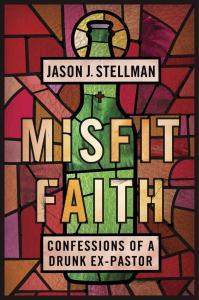 Stellman is a former pastor who runs a podcast called “Drunk Ex-Pastors” with his best friend and agnostic cohost, Christian Kingery. His book suffers a bit, I think, from an unclear aim: it started off as an apologia for his conversion to Catholicism after an unchurched upbringing and fervently Evangelical teen years. What it turned into is more of a theological ramble about how to see God and the world anew. For instance, God is Father, but also flesh, so we don’t need to condemn the secular: “embracing a Christianity that reflects the Incarnation by validating the physical world rather than vilifying it.”
With (dated, geeky) pop culture references, Stellman encourages a rejection of xenophobia and an embrace of narrative and ritual, which Roman Catholicism perhaps makes more space for than your average Protestant tradition. The last few lines of the book are a wonderful plea for openness, hearkening back to the very definition of ‘catholic’ – broad and inclusive:
Is misfit faith about love or suffering? Feasting or fasting? Divinity or humanity? Heaven or earth? The answer is yes, to all of it. And yeah, I want it all: the now and the later, the spirit and the flesh, the head, the heart, and the stations of the cross. I would rather embrace way too much than way too little, because something tells me that as wide as I can open my arms and heart, God’s are always open wider.
I’d recommend this to readers of David Dark and Rob Bell.
My rating:
I received this e-book from Blogging for Books (via Edelweiss) for this review.
What Is the Bible? How an Ancient Library of Poems, Letters, and Stories Can Transform the Way You Think and Feel about Everything, Rob Bell
 Speaking of Rob Bell…this is one of his stronger books. Not as fresh and vibrant as Velvet Elvis, but it will have a big impact on teens and twentysomethings starting to question the narrow interpretations of the Bible they’ve grown up with in conservative churches. Bell stresses the importance of reading the Bible literately rather than literally: always looking deeper than surface facts to see what’s really going on here; striving to understand the background of Jewish practice and Roman occupation at the time of Jesus.
Bell emphasizes that the Bible is a disparate set of books written by fallible people who were defined by their own historical context, yet if you ask why they wrote down these stories of their interactions with the divine in this way – why they mattered to them then – you might get a glimpse of why they might still matter to us now. The “haphazard humanity” of the Bible, then is for him stronger evidence of its reliability than some rigid perfection would be.
He chooses a number of the more unusual incidents in the Bible to illuminate with a closer reading, such as Jesus writing in the dust, Ehud assassinating tubby King Eglon, and the Book of Revelation. Part 4 is usefully structured around FAQs (e.g. “So how would you define the word of God? The creative action of God speaking in and through the world, bringing new creation and new life into being”). This is like listening to a really good sermon series. (Releases May 16th.)
My rating: 
My Jewish Year: 18 Holidays, One Wondering Jew, Abigail Pogrebin
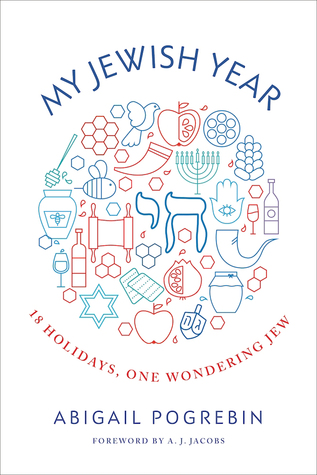 One thing Bell stresses is that Jesus was Jewish, so you can’t understand the stories about him apart from their Jewish context. This bighearted, open-minded book strikes me as a perfect model for how any person of faith should engage with their tradition: not just offering lip service and grudgingly showing up to a few services a year, but knowing what you believe and practice, and why.
Like many an American Jew, Pogrebin marked a limited set of holidays: Hanukkah, the Passover seder, Rosh Hashanah, Yom Kippur, and Shabbat. She circumcised her son, and hosted bar/bat mitzvahs for him and her daughter. Yet she had a nagging feeling that she had never genuinely locked into her own religion, and longed to go beyond the beginner stage.
So from September 2014 to September 2015, she celebrated all the holidays in the Jewish calendar, seeking to move beyond clichés and simplistic interpretations; interviewing rabbis and scholars of every stripe and reading Torah commentaries to discover meanings she’d missed before. Yom Kippur isn’t just a day of atonement; it’s for pondering the fact of your own death, taking stock of your life and asking what must change. Hanukkah, uncomfortably, is not just about persecution but about Jew-on-Jew violence.
There are opposite strands running through the Jewish ritual year: gratitude for survival (Purim) versus sorrow at tragedies (Holocaust Remembrance Day); feasting versus fasting. I was consistently impressed by how Pogrebin draws thematic connections and locates the resonance of religious ritual in her daily life.
Favorite lines:
“[I]t’s a quintessential Jewish act: seeking, grappling. If you’re reaching, it’s because you believe there’s something to grab hold of.”
“I’m beginning to think that Judaism is obsessed with brevity and instability. But rather than finding the message depressing, it’s clarifying.”
“Judaism is always asking us to apply epic stories to everyday decisions.”
“Judaism reminds us not to run from transitions, but to consecrate them.”
My rating: 
Blog Tour: My Mourning Year by Andrew Marshall
Andrew G. Marshall is the author of 18 self-help books about relationships. He has written for newspapers, appeared on television and radio programs, and worked as a marriage therapist. However, he has shared little about his own experience of relationships until now. Twenty years have passed since the death of his long-term partner, Thomas Hartwig. Sharing this diary of Thom’s death with several friends and family members who’d suffered recent bereavements seemed to help, so he’s hoping that in book form it can be of wider benefit to those who are in the midst of grief.
Marshall met Thom, then the headmaster of a German language school, on a holiday to Spain in September 1989. They alternated between Germany and England every other weekend for years, and in 1995 Thom finally relocated to join Marshall near Brighton. Thom had plans to start an interior design business, but fell ill just six months later. By early 1997, he had a diagnosis of liver failure and was given weeks to live. They traveled to Germany to get Thom a second opinion and, despite his resolution to die back in England, he breathed his last at the German hospital on March 9th, aged 43.
The above constitutes a brief Part One, while the rest of the book recounts the first full year after Thom’s death. Marshall tracks the changes in several areas of his life:
Family Life: “People become counselors to make sense of their difficult families, and of course I am no exception,” Marshall notes. He grew up in a conservative middle-class family in Bedford and didn’t come out until he was nearly 30. Hugely disappointed that his parents and sister didn’t make it to Thom’s memorial service, Marshall moves from not talking to his family at all to making tentative overtures of reconciliation. There’s a particularly touching scene where he confronts his parents about the way they repressed emotion while he was growing up and hears the words “I love you” from his father for the first time.
 Career: For part of his mourning year, Marshall worked on the Agony television program as an “agony uncle.” He took a break from Relate counseling, but continued to write freelance articles, many of them touching on illness and death, and contributed a “Revelations” celebrity profile column to the Independent, in which he interviewed authors and pop stars about life’s turning points. Two of my favorite moments in the book arise from this: Jim Crace (promoting Quarantine) tells how he realized the emptiness of atheism when burying his father; and Carol Shields’s Larry’s Party provides Marshall’s gateway into literary fiction, which he’d never attempted before.
Home Life: “There is something terribly sad about the clutter we accumulate,” Marshall sighs. “I was loved and I did love, but now all I had was this debris.” Thom moved to England with 87 packing cases; even at the hospital in Germany there were two bags of stuff to look through. Back in England, though Marshall tries to navigate around “Thom-shaped holes” in his life, especially near holidays, he realizes this relationship hasn’t ended: he kisses his lover’s ashes goodnight, and heeds Thom’s late advice to replace the vacuum cleaner. Meanwhile he goes on short vacations, sees friends, dogsits, and even tries counseling – but finds it’s “like watching a conjurer saw a lady in half, but knowing how he does it.”
Spirituality: Marshall has several experiences he has trouble explaining. For instance, at certain points he smells vanilla all around him and chooses to take it as a sign of Thom’s enduring presence – a trace of the vanilla candle that burned beside his deathbed. He also has some psychic messages conveyed, by both friends and strangers, and attends a spiritualist service. But it is an interview with forensics expert Kathy Reichs that helps him to once and for all detach the idea of Thom’s dead body from that of his spirit.
Self-Expression: Writing the “Revelations” column and this diary proved better therapy for Marshall than traditional counseling sessions. Towards the end of this book he also takes an introduction to playwriting course, and in the intervening years several of the plays he has written have been performed around the UK.
Love: After Thom’s death, Marshall was desperate for physical comfort, and temporarily found it with Peter, whom he met at a gay sauna. I admired Marshall’s honesty about this fling; it must have been tempting to excise it from the record to make himself look better. But their relationship never went beyond a few dates. This sad story has a happy coda, though: In 2001 Marshall met Ignacio, who became his civil partner in 2008 and his husband in 2015.
I’ve read many bereavement memoirs, but the diary format makes this one a unique blend of momentous occasions – Princess Diana’s funeral and the preparations for a catered dinner party on the anniversary of Thom’s death – and the challenges of everyday life. I would not hesitate to recommend it to anyone who has experienced or is currently enduring bereavement; it will be reassuring to read about the flux in Marshall’s emotions and see an example of how to rebuild after loss.
Perhaps this is the reality of mourning: you never get over the loss but reassemble the daily minutiae into a new life. At the beginning it feels like a box of flat-pack furniture with the instructions in Swedish, but finally you discover that tab A can slide into slot B. Eventually you own something quite functional – even though there are always a few screws left over and it never looks as good as it does in the catalogue.
Whether the clairvoyants are correct and Thom has become my guardian spirit is not important[;] he is always with me. I have integrated his personality into mine and in that way he lives on through me.
(For more on the author, and Thom, see the book’s website.)
My Mourning Year will be released by RedDoor Publishing on Thursday, April 20th. Thanks to Anna Burtt for the review copy.
My rating:
Wellcome Prize Shortlist, Part 1: de Kerangal and Kalanithi
I’m delighted to announce the final members of our Wellcome Book Prize 2017 shadow panel:
Ruby blogs at My Booking Great Blog.
GrrlScientist is an ornithologist and science journalist who was on the judging panel for the 2016 Royal Society Insight Investment Science Book Prize.
Along with Paul and Amy, this brings us up to five people – the same number as the official judging panel.
Luckily, I’ve already read two of the shortlisted titles, one quite recently and one nearly a year and a half ago. Here are the reviews I published on Goodreads at the time. I’ll be getting both books back out of the library soon to have another look before we choose our winner.
Mend the Living by Maylis de Kerangal
(translated from the French by Jessica Moore; published in the USA as The Heart)
[This is the French author’s second novel to be translated into English. It has been made into a film and won the Prix Orange du Livre and the Grand prix RTL du livre. It was also recently shortlisted for the Albertine Prize, an American readers’ choice award for contemporary French fiction. If you’re based in the States, feel free to vote by April 30th!]
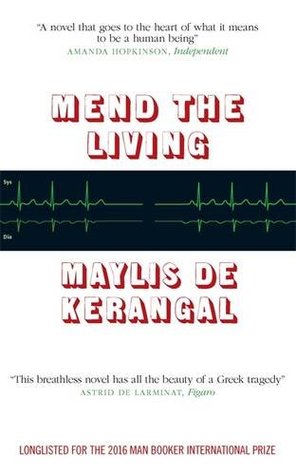 Nineteen-year-old Simon Limbeau is declared brain dead in a French hospital after a car accident, but his heart lives on: metaphorically through the love of his parents, sister, friends, and girlfriend; but also literally, in the recipient of his organ donation. Again and again de Kerangal makes a distinction between the physical reality of organs and what they represent: “Simon’s eyes are not just his nervous retina, his taffeta iris, his pupil of pure black in front of the crystalline – they are also his gaze; his skin isn’t just the threaded mesh of his epidermis, his porous cavities – it’s his light and his touch, the living sensors of his body.”
The novel spends time with Simon’s family, especially his mother, but also with the transplant coordinator, the surgeons, the nurse, and so on. I was reminded of ER as well as the French TV show The Returned – this would work really well on screen, and would be a way of avoiding the more off-putting aspects of the author’s style. She writes long, run-on sentences: sometimes half a page, sometimes even stretching to two pages, and stuffs her prose with abstruse vocabulary (or at least that’s how the translator has rendered it), a lot of it medical but some of it simply inaccessible: “emollient conjugality” plus at least a dozen English words I’d never encountered (e.g. abulic, tumid, atony, claudicant, auscultation, precellence, torticollis, naevi, scialytic).
The worst example of the unnecessary opacity is “the digitigrade gait of the sardana dancer when he’s nearing a quintal, the corpulence of an ex-obese man calibrating him in thickness, in fullness, but without visible excrescence” – in plain English, the guy is stocky.
Read in November 2016.
My rating: 
My gut feeling: The novel gives a vivid sense of the fragility of life and imbues parts of the body with metaphorical meaning. However, I think the style makes it too inaccessible and I can’t see its appeal ever being more than niche.
More reviews:
Annabel’s at Shiny New Books
Carolyn’s at Rosemary and Reading Glasses
When Breath Becomes Air by Paul Kalanithi
[The first posthumous nominee for the Wellcome Book Prize. I’ll be interested to see what I make of this one when I revisit it.]
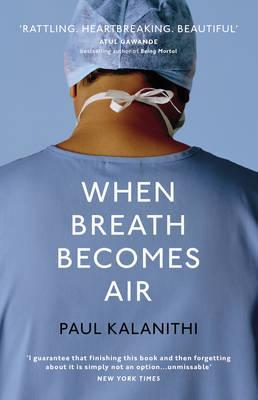 Paul Kalanithi was 36 and just completing his neurosurgery residency in Stanford, California when he was diagnosed with advanced lung cancer that did not respond well to treatment. It came as a complete surprise to this non-smoker, and set his life on a new course. He and his coterie of doctors managed his symptoms so he could operate for as long as possible, but when the time came he knew he wanted to devote his last year to writing this memoir. In addition, he would get a brief, sweet taste of fatherhood: he and his wife Lucy, also in the medical field, decided to have a child, a daughter named Cady.
Kalanithi grew up the son of Indian immigrants in Arizona. “I was driven less by achievement than by trying to understand, in earnest: What makes human life meaningful?” he recalls. Degrees in English literature and human biology were disparate attempts to find an answer. Like Henry Marsh (Do No Harm), he has a surgeon’s knowledge of the anatomy of reasoning, but realizes that does not provide the full picture. He recognizes the responsibility of holding others’ lives in the balance, and regrets occasional failures of empathy.
Those burdens are what make medicine holy and wholly impossible: in taking up another’s cross, one must sometimes get crushed by the weight.
It’s intriguing to see religious language in that statement – indeed, Kalanithi saw his work as a calling, and one with moral connotations. Christian imagery shows up repeatedly:
Instead of being the pastoral figure aiding a life transition, I found myself the sheep, lost and confused.
Openness to human relationality does not mean revealing grand truths from the apse; it means meeting patients where they are, in the narthex or nave, and bringing them as far as you can.
When’s the last time you encountered the word “narthex”?! The vocabulary is striking throughout, as in another favorite passage: “A tureen of tragedy was best allotted by the spoonful. Only a few patients demanded the whole at once; most needed time to digest.”
Kalanithi died in March 2015. In addition to the foreword by Abraham Verghese, there’s a lovely epilogue from his widow, who’s more than competent to carry on his legacy.
I appreciate stories lived on the knife edge of life and death, but I would recommend this to those who don’t normally choose to read illness narratives, simply for the beauty of its prose – a fine blend of literature and medicine – and the wholehearted picture of a life cut short.
Read in October 2015 (Random House were looking for early readers via NetGalley).
My rating: 
My gut feeling: I suspect this is by far the most popular and best-selling title on this year’s shortlist. So many people have taken it to their hearts. It will take a truly special book to knock it from the top spot.
More reviews:
Shadow panelist Paul’s at Nudge
Shadow panelist Ruby’s at My Booking Great Blog
Susan’s at A life in books
Shortlist strategy:
Currently reading: The Tidal Zone by Sarah Moss – about halfway through.
Up next: Whichever of the remaining nonfiction titles turns up to the library for me first!
I’ve also sent off an emergency e-mail to Bodley Head asking for a copy of Ed Yong’s I Contain Multitudes; it’s on loan through my library system until April 19th, which gives me no time to read it even if it comes back on time.
Blog Tour: Foxes Unearthed by Lucy Jones
Cold, delicately as the dark snow
A fox’s nose touches twig, leaf;
[…]
Across clearings, an eye,
A widening deepening greenness,
Brilliantly, concentratedly,
Coming about its own business
~Ted Hughes, “The Thought-Fox” (1957)
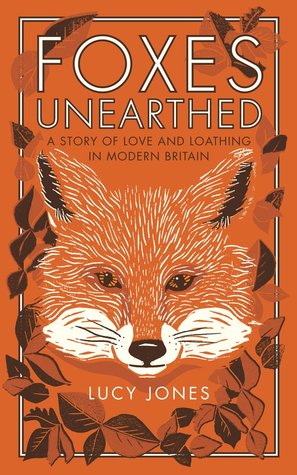
Foxes Unearthed, freelance journalist Lucy Jones’s first book, won a Society of Authors’ Roger Deakin Award for nature writing. If you’re familiar with Patrick Barkham’s Badgerlands, you’ll recognize this as a book with a comparable breadth and a similar aim: clearing the reputation of an often unfairly reviled British mammal. Jones ranges from history to science and from mythology to children’s literature in her search for the truth about foxes. Given the media’s obsession with fox attacks, this is a noble and worthwhile undertaking.
 The book proper opens with a visit to Roald Dahl’s house, now a Buckinghamshire museum, where he wrote Fantastic Mr. Fox. Still one of the best-known representations of foxes in British literature, Dahl’s Mr. Fox is a Robin Hood-like hero, outsmarting a trio of mean-spirited farmers to provide a feast for his family. Foxes’ seemingly innate wiliness prompts ambivalent reactions, though; we admire it, but we also view it as a threat or an annoyance. As Jones puts it, the fox of fables and traditional stories is “a villain we cheer for.”
Not everyone cheers, of course. Under Henry VIII, the Vermin Acts of 1532 (not repealed until the 1750s) promised a reward to anyone who killed foxes, then considered a nuisance animal. Fox hunting and the cruel sport of “tossing” have a long history that eventually came up against the movement towards animal welfare, starting with Jeremy Bentham in the 1740s and codified by the 1911 Protection of Animals Act. Meanwhile, Jones notes, children’s books advocating compassion for animals, such as Anna Sewell’s Black Beauty (1877), ensured that the message made it out of the legislative chamber and into everyday life.
The second chapter is a useful survey of fox behavior. Foxes are omnivores, and in recent decades have started to move into Britain’s cities, where they find plenty of food to scavenge. In rural settings, foxes are still the subject of farmers’ loathing even though they rarely take lambs and actually help keep rabbit numbers in check. Still, the stereotype of foxes killing for fun instead of for hunger persists, whereas they in fact cache their surplus food. Chapter 3 asks whether fox numbers have reached pest status and considers various control strategies, from straightforward culling to the non-lethal methods supported by conservationists.
I enjoyed Jones’s meetings with figures from both sides of the debate. She goes along on a fox hunt, but also meets or quotes animal rights activists, academics, and high-profile nature promoters like Chris Packham. All told, though, I felt the book could have been closer to 200 pages than 300. Most chapters are very long, and some could easily be combined and/or shortened. For instance, Chapter 1 relays the amount of information about fox hunting that most readers will be prepared to absorb, yet it’s then the subject of two more chapters.

At the British Wildlife Centre in Surrey. Photo by Chris Foster.
This is an important book for correcting misconceptions, but your enjoyment of it may be in proportion to your personal interest in the subject. In terms of fonts and cover design, though, you’re unlikely to come across a more gorgeous book this year.
Foxes Unearthed was published in paperback by Elliott & Thompson on March 16th. Thanks to Alison Menzies for arranging my free copy for review.
To encounter foxes in fiction, try the following:
- Glow by Ned Beauman
- The Many Selves of Katherine North by Emma Geen
- Midwinter by Fiona Melrose
- The Soho Leopard by Ruth Padel (a poetry book with a sequence on urban foxes)
& the forthcoming How to Be Human by Paula Cocozza (April 6th).
Blog Tour: Two Voices, One Story
“[B]eing an adoptive parent is like parenting in Technicolor: everything is just a little more intense. This means the highs can be really high, but it also means that the lows are going to be really low. You have to prepare yourself.”
~Sharon Roszia, quoted in A Book about Love, by Jonah Lehrer
Two Voices, One Story is a mother–daughter memoir that splits narration duties between Elaine Rizzo and Amy Masters, the now-teenage daughter she adopted from China in 1999. Elaine’s sections provide the main thread of their story, while Amy’s passages, generally shorter and printed in italics, chime in to give her perspective on various events and relationships that have been important in her life.
 Elaine is forthright about her infertility and the miscarriage that led to her decision to adopt. In the late 1990s, China’s one-child policy was still in place, but it was the severe flooding of the Yangtze River that led directly to Amy’s adoption. Thousands died and millions more were displaced. Given the context, it’s not so surprising that baby Amy was left outside a welfare center. She was given the Chinese name Tong Fang – “Copper Child.”
For me the highlight of the book was Elaine and Lee’s trip to China to pick up Amy. Although they were nervous and disoriented, they experienced the kindness of strangers and responded with compassion of their own, taking along extra toiletries and clothes of different sizes and leaving the surplus with the care center. Amy had bronchitis, one more worry on top of all the paperwork and red tape they had to go through to finalize the adoption.
Back in England, Amy had some behavioral problems that were likely vestiges of her time at the orphanage. She hated noise, especially thunderstorms; she hit herself and others; and she often woke up screaming. Private schooling ensured she wouldn’t get left behind, and there were many happy times with extended family and holidays to Australia and the west coast of Wales, where Elaine and Amy would later settle with Elaine’s second husband.
But life wasn’t always rosy: Amy was strong-willed and uncooperative – perhaps nothing out of the ordinary for a teenager, but still a challenge for her parents. Elaine recalls a social worker telling them “that very often adoptive parents don’t feel like they have the right to tell their child off, or that they think they shouldn’t say or do anything which might upset the child, because they are trying to compensate for what has happened prior to the adoption.”
Lengthy commuting to her job back in England and years-long house renovations demanded much of Elaine’s attention, yet she remained alert to what was going on with Amy. Unfortunately, in her teen years Amy experienced racism from a few schoolmates, including abusive Facebook messages that drove the family to contact the police. Amy herself, though, always comes across as easygoing about being different: “Every Christmas we used to do a Nativity show and I remember being an angel first and then one of the kings, which I suppose was the right role for me because I really do come from the East.”
Even though this is a very quick read, my interest waxed and waned. The telling can be clichéd and sentimental, and I felt too much space was given to banal details that added little to an understanding of the central mother–daughter relationship. This self-published book has a very appealing cover but needs another look from an experienced editor who could fix the fairly frequent typos and punctuation issues and cut out the bullet points (nine pages’ worth) and speech tics like “I will also say…” and “I have to comment…”
I would certainly recommend this book to those who have a personal experience of or interest in adoption, particularly from overseas (for a fictional take on adoption from China, you might also try The Fortunes by Peter Ho Davies, The Red Thread by Ann Hood, and This Must Be the Place by Maggie O’Farrell), as well as to anyone wondering how to parent or educate a child who is in some way different.
I’ll end with some lovely words from Amy:
when my Chinese mum left me outside the gates of the welfare center almost eighteen years ago now, because there was nothing left for me in Tongling, she must have had the desperate hope that I would find a happy life with people who loved me. I can only say that her wish did come true.
My rating:
Two Voices, One Story will be published by Clink Street Publishing on March 21st. Thanks to Rachel Gilbey of Authoright Marketing & Publicity for arranging my free copy for review.
I was pleased to participate in the blog tour for Two Voices, One Story.
Medical Mysteries: Joselin Linder’s The Family Gene
Yes, another memoir on a medical theme! I really do read a lot of them. My eye was drawn to The Family Gene: A Mission to Turn My Deadly Inheritance into a Hopeful Future by Joselin Linder because of the medical mystery aspect: 14 members of Linder’s Ashkenazi Jewish family are the only known exemplars of their particular genetic disease, so rare it doesn’t have a name or surefire treatment protocol, but now at least has a location on a chromosome.
 Linder’s awareness of her family’s peculiar medical problems began when her father, William, himself a doctor near their home in Columbus, Ohio, started having a persistent build-up of lymph (also known as chyle) in his abdomen – usually a sign of heart or liver failure. At one point doctors tapped four liters of the stuff from his lungs. Her father’s illness threw Linder, then a junior in college, for a loop; drugs and music started to replace academics. After he died, aged 49, in September 1996, she became a nomad, moving from Prague to San Francisco to Brooklyn and dabbling in different careers.
Only gradually did they all realize that the same thing had happened to William’s uncle, Nathan, in the 1960s and his grandmother, Mae, before that. While Mae lived to age 54, Nathan died at 34, even after treatment at NIH. Along with the lymphedema, a heart murmur was a common factor. William’s brother, Norman; Linder and her older sister, Hilary; and various cousins of their generation were diagnosed in this way. The author’s own symptoms were initially easily to ignore – swollen ankles and a low platelet count – but escalated in her thirties: a blocked vein in her liver meant she was in danger of bleeding out if she vomited.
It’s rare to be able to trace a genetic disease from its founder through to the present. In Linder’s case, her great-great-grandmother, Ester Bloom, is the first known sufferer. Researchers eventually isolated their family’s gene on the X chromosome, near the location for asthma. This explained why, historically, female family members had a better prognosis than males – they have one normal X chromosome and one diseased one; men only get the defective X chromosome – and why asthma medication helped to an extent.
There are a couple of chapters here on the basics of genetics that felt a little condescending to me; for anyone with a high school or A level biology qualification, the simplistic metaphors explaining the workings of DNA may seem superfluous. I also had trouble relating to Linder’s immediate reaction to her father’s death. Although he’d been severely ill for years by then, her attitude still seems a little heartless. Of the decision to take him off dialysis, she writes, “I was on board. It was time to call it a day.” When the family went around expressing opinions, she said, “I think it’s time, Dad. You’ve been through so much,” to which he replied “F— you”! An ex-boyfriend’s suicide a couple years later affected her much more than her own father’s death. Grief affects people in strange and unpredictable ways, I guess.
What I most appreciated was how the book sensitively reveals the ways a genetic condition complicates life, especially in America: Linder had to do without health insurance for 10 years, having been denied it in Ohio on the grounds of a pre-existing condition. In addition, she and her sister faced a quandary common to those who carry genetic diseases: should they have children? While Hilary underwent pre-implantation genetic diagnosis, a form of IVF, to bear healthy twins, Linder ultimately decided against having children.
I enjoyed the earlier part of this genetic quest narrative a bit more than the later material about Linder’s symptoms. Still, I can recommend this to viewers of House and readers of Susannah Cahalan’s Brain on Fire and the like.
The Family Gene is released by Ecco today. With thanks to Beth Parker and James Faccinto for the electronic review copy via Edelweiss.
My rating: 
Four Books for World Kidney Day
Today, March 9th, is World Kidney Day. “The kidneys are like the Rodney Dangerfield of vital organs—they get no popular respect,” Vanessa Grubbs (whose memoir I discuss below) wryly comments. Chances are you rarely have occasion to think about your kidneys. But I’m honoring them with a reading list because several years ago I was diagnosed with polycystic kidney disease, a degenerative condition that runs in my family. My maternal grandmother had it – we’ve never definitively traced it further back than her – and four of her six children have it, too. (If you took a high school genetics class, you might remember that with an autosomal dominant condition offspring have a 50% chance of inheriting the gene for the disease.) A few cousins of my generation also have PKD, and starting with my mom we’ve had a few successful kidney transplants in the family so far.
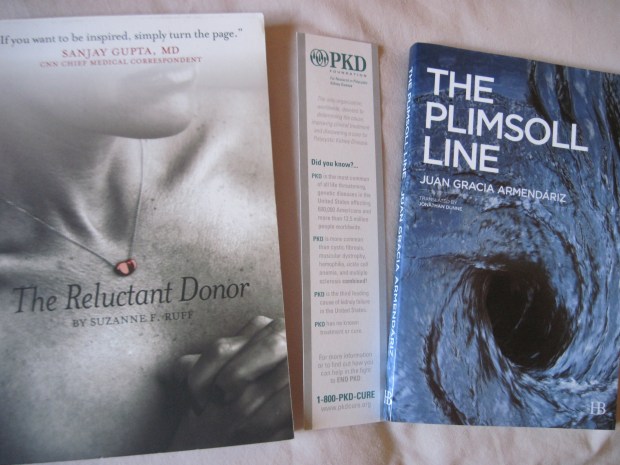
I must mention the excellent work done by the PKD Foundation in the States and the PKD Charity here in the UK. Both are a great support and source of information for me and my wider family.
The Plimsoll Line by Juan Gracia Armendáriz
As soon as I read Melissa’s review at The Book Binder’s Daughter, I knew I had to get this one. “The Plimsoll line” is a maritime term indicating how low a cargo-laden ship can sit in the water without sinking; here it’s used metaphorically to ask just how much one man can take. Gabriel Ariz is a 52-year-old art professor who lives not far from the city yet surrounded by oak woods. He’s divorced from Ana, who’s pressuring him to sell the house, and their young adult daughter Laura died a few years ago in a car accident. Now this pack-a-day smoker who gets drunk with his brother, traveling photographer Óscar, learns that he has end-stage renal disease and his life will have to change. On indefinite leave from work, he attends a dialysis clinic several times a week and joins the organ transplant list.
 At times this was a bit overwritten for my tastes – some paragraphs stretch to several pages, and I’ve had to look up words, including “lentitude” and “logomachy” – but I did love the author’s trick of jumping into different perspectives. On multiple occasions he employs an “anonymous observer,” and in various chapters the point-of-view shifts to a member of the animal kingdom: Polanski the cat, a black kite flying overhead, a mole popping up in the garden, or a beetle winging across the detritus of Gabriel’s untidy household. We also get an extended section from Laura’s journals that reveals a disturbing family secret.
This is not one for the squeamish as it gives an unflinching account of dialysis: “His forearm throbbed, lacerated by needle marks. Sara had taken a while to find the fistula, and now the pain spread under the surgical tape like a jellyfish sting.” But for every passage that makes you cringe there’s a beautiful one that captures things perfectly: “he is living in constant deferment, between parentheses” and “If the succubus of his bad dreams were to say to him, ‘Make a wish,’ he would ask to be able to mold himself to the geological quietude of stones.”
The Plimsoll Line won Spain’s Premio Tiflos de Novela in 2008 and first appeared in English translation in 2015. It is part of a “Trilogy of Illness”; I presume the other volumes are not yet available in English, though I’ve enquired of the translator, Jonathan Dunne, via a Facebook message just in case. Forget Ferrante and Knausgaard; this is the semi-autobiographical series I’ll be awaiting the next installment of with bated breath.
My rating: 
Hundreds of Interlaced Fingers by Vanessa Grubbs
 Grubbs is a nephrologist and assistant professor of medicine at San Francisco General Hospital. Well before she made the kidneys her clinical area of expertise, a personal encounter made them special to her. In 2003 she met Robert Phillips when she was an attending trying to get support for her Office of Diversity Affairs; he was a hospital trustee. She only later learned, after they started dating, that due to FSGS his kidneys had failed in his twenties and he’d been on dialysis for years. In 2005 she donated him one of her kidneys. Robert’s health was touch-and-go for a little while there, but he proposed to her soon afterwards. I read about a third of this and then skimmed the rest because I wasn’t all that interested in their separate histories. However, I did like the context Grubbs gives, such as a brief history of dialysis, nephrology case studies, and a great set of FAQs. She also notes that minorities are less likely to get organ transplants, a disparity she is working to rectify.
This memoir grew out of an essay for Health Affairs, “Good for Harvest, Bad for Planting.” Releases June 13th.
My rating:
The A to Z of You and Me by James Hannah
 (First reviewed in November 2015; here’s a shortened version.) Lying in a hospice bed, 40-year-old Ivo looks back on his life. Even after just four short decades and a modest career at a garden center, he has plenty to regret. Hard partying and drug use exacerbated his diabetes and prompted kidney failure. His lifestyle also led indirectly to his girlfriend, nursing student Mia (the “you” he often addresses directly), leaving him. He’s estranged from his sister and his friends from school days, especially Mal. How did he mess up so badly and cut himself off so completely that he’s now dying alone? And how much can he put right before he goes?
There’s plenty of affecting writing in Hannah’s debut novel. I liked how he captures the routines of institutional life. Nurse Sheila’s A to Z game, encouraging Ivo to think of a memory attached to body parts starting with each letter of the alphabet, provides a hokey but effective structure. Keeping in mind that in British English Z is pronounced ‘zed’, the title doesn’t rhyme, but this is still somewhat sappy. I’d recommend it to fans of Mark Haddon and David Nicholls. I’ll follow Hannah’s career and hope he avoids melodrama and a contrived setup – the two near-pitfalls of this one – in the future.
My rating: 
The Reluctant Donor by Suzanne F. Ruff
A sepia-toned photograph at the centerfold tells a solemn tale: six of these eight members of Ruff’s Irish-Catholic Chicago family died, directly or indirectly, as a result of PKD. I’ve always known there’s a long waiting list for transplant kidneys, but I was surprised to learn that dialysis machines used to be rare; demand far exceeded supply, and the procedure was not covered by Medicare until 1973. Ruff’s aunt, Sister Mike, decided the lives of people with children were more important than her own, so didn’t press for dialysis; when her kidneys failed in her forties, death followed just a few months later.
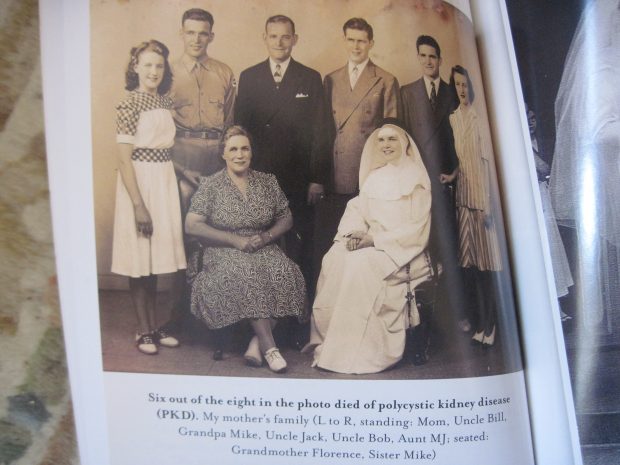 Things had greatly improved by the time Ruff’s mother needed a transplant. Joan sounds like a feisty, lovable character, with plenty of good advice on being a patient: fight for your rights (the meek ones often end up being carried out feet first), get up and walk as soon after surgery as you possibly can, and appreciate the joy of an entirely ordinary day. Ruff’s parents had her and her sisters tested for PKD when they were teenagers. Having gone to the trouble, they then lied about the results! They said no one had PKD, but in the end two out of three did; only Ruff was spared. This is how she ended up donating a kidney to her younger sister, JoAnn. The more interesting sections of the book are about Ruff’s family history; her internal struggle to convince herself to commit to organ donation makes for pretty repetitive moaning.
 In general, the writing isn’t great. Skimming through, I found a page with 16 of my proofreading marks; on most pages it’s more like 2–3. There’s also a tendency to over-write when portraying emotion: “Genetic disease. Those two words made my spine shiver, my ears ring, my throat close, and my heart pound; I became lightheaded and faint. Terror crept into my core and gripped me in its vice [sic].” While I’m not sure I could recommend this to someone who doesn’t have a personal stake in organ donation, for those who are interested in an autobiographical account of genetic disease/transplant surgery, it’s a quick, pleasant read.
My rating:
Plus two more kidney-themed novels I’m on the look-out for:
- Useful, Debra Oswald, about a man who decides to donate a kidney to a stranger
- The Kidney Hypothetical: Or How to Ruin Your Life in Seven Days, Lisa Yee, a YA comedy in which a girl asks her boyfriend if he’d give her a kidney. Hypothetically, right?
 I’m on the fence about:
- Larry’s Kidney: Being the True Story of How I Found Myself in China with My Black Sheep Cousin and His Mail-Order Bride, Skirting the Law to Get Him a Transplant—and Save His Life, Daniel Asa Rose (I think the subtitle says it all!)
- I, Kidney, Chris Six: a self-published, semi-autobiographical novel
Midwinter Cedes to Spring
I’ve marked the turn of the seasons by following a ‘Midwinter’ book with a ‘Spring’ one.
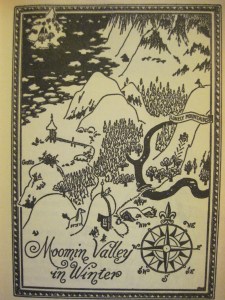
Moominland Midwinter by Tove Jansson
 My third and favorite Moomins book (so far).
Moomins are supposed to sleep through the winter, but this year young Moomintroll awakens and finds himself in a “strange and dangerous” world transformed by snowdrifts. He can’t get his parents to wake up so is effectively a temporary orphan, surrounded by peculiar creatures from Jansson’s menagerie, this time including a dim-witted squirrel, invisible shrews, a glum little dog who wishes he could run with wolves, and the Dweller Under the Sink (with its exceptionally bushy eyebrows).
While Moomintroll searches for totems of familiarity—
He looked at the cupboard in the corner and thought of how nice it was to know that his own old bath-gown was hanging inside it. That something certain and cosy still remained in the middle of all the new and worrying things.
—Too-ticky has the opposite mindset: “All things are so very uncertain, and that’s exactly what makes me feel reassured.” She goes fishing under the ice, builds a life-size horse out of snow, and assembles tree trunks and old furniture for the midwinter ritual of a huge bonfire.
 When they receive a visit from the Hemulen, who’s keen on skiing and declares the indoors too stuffy in winter, the creatures quickly tire of his energetic optimism. The truth is that they like sitting around being miserable. “I’m cold! I’m lonely! I want the sun back again!” Moomintroll pouts, but even he is too affable to make the Hemulen leave.
Of course the spring finally arrives, as it does every year, but it’s depressingly long in coming and for Moomintroll becomes a matter of faith. I love the strangeness of Jansson’s imagination, the balance of melancholy and comedy, and the little philosophical nuggets buried along the way – children and adult readers alike will get a lot out of this. It doesn’t talk down to children with a rosy message about everything being alright.
My rating:
Spring: An anthology for the changing seasons, edited by Melissa Harrison
Although this was the first of the Wildlife Trusts anthologies published in 2016, I got a late start last year so am reading this as the final of four. In common with the other volumes, it’s a terrific mix of contemporary and historical writing, big names and newcomers, observation and reflection. Compared with the other books, it seems to have more about WT sites in particular, with a few pieces from current volunteers or former employees. I also noticed that there’s a bit more of a focus on birds – with essays on the chiffchaff, the birds encountered on the Cley Marshes, cuckoo festivals, young dippers, and a tawny owl chick.
 That said, there’s still plenty of variety here, with everything from spring flora* to adders fueling the generally two- to three-page essays. I especially liked Kate Long’s piece on filming hedgehogs at night and Vijay Medtia’s on how people of color living in cities have little access to nature; he recalls spotting a magpie with a twig in its beak at a train station and having to ask someone what it was called. Of the previously published authors, I enjoyed hearing more from Rob Cowen and Miriam Darlington and laughed at Will Cohu’s ice cream and underwear metaphors applied to varieties of cherry trees.
You can’t beat George Orwell on toad sex, and it’s fun to encounter excerpts from classic novels in the context of a nature book: The Wind in the Willows, Lorna Doone, and Jane Eyre (which, shamefully, I didn’t recognize until Lowood was mentioned in the last paragraph). I think my favorite piece of all, though, was Jo Sinclair’s about watching spring’s arrival after a major operation and noting nature’s inscrutable jumble of beauty and brutality.
And my favorite passage:
Year after year all this loveliness for eye and ear recurs: in early days, in youth, it was anticipated with confidence; in later years, as the season approaches, experience and age qualify the confidence with apprehension lest clouds of war or civil strife, or some emergency of work, or declining health, or some other form of human ill may destroy the pleasure or even the sight of it: and when once again it has been enjoyed we have a sense of gratitude greater than in the days of confident and thoughtless youth. Perhaps the memory of those days, having become part of our being, helps us in later life to enjoy each passing season.
(from Sir Edward Grey’s The Charm of Birds, 1927)
This passage from Reverend Francis Kilvert’s diary (April 14, 1871) makes me look forward to our trip to nearby Hay-on-Wye next month: “The village is in a blaze of fruit blossom. Clyro is at its loveliest. What more can be said?” Simply that these anthologies are an essential companion to the seasons.
*Like my husband’s piece, positioned right before the R.D. Blackmore extract.
(See also my reviews of Summer, Autumn and Winter.)
My rating:
Yet More Books about Cats
I reviewed two sets of cat books last year, one in April and another in October. When you start looking, you realize there are endless pet books out there, with cat books seemingly second only to dog books in popularity. In the past few months I’ve encountered five more books about cats: a Christmas classic, a scientist’s introduction to cat behavior, an anthology of church-themed fiction, an installment of a charming children’s series, and a very funny memoir.
The Cat Who Came for Christmas by Cleveland Amory
 In the late 1970s Amory was a bona fide animal lover (he’d founded the NYC-based Fund for Animals, after all) but didn’t have a pet of his own until he was involved in the rescue of an unprepossessing stray one Christmas: Polar Bear, the cat who would introduce his fussy habits to a bachelor’s household and complicate his life in all kinds of ways. Cat owners will recognize so many things – the 3 a.m. bowl-emptying snack, testy relations with various other species – but I found the book strangely belabored and irrelevant as it goes into the history of the domestic cat, the business of naming cats, and Amory’s travels on behalf of the Fund. [Public library]
Favorite lines:
- “For an animal person, an animal-less home is no home at all.”
- “The fact is that most cats, most of the time, have already met everybody they care to meet.”
Cat Sense: The Feline Enigma Revealed by John Bradshaw
 Bradshaw is the founder and director of the Anthrozoology Institute at the University of Bristol. He writes as both an expert in animal behavior and a cat lover. I only skimmed this one rather than reading it in full because I expected it would repeat a lot of the information in Abigail Tucker’s The Lion in the Living Room. There is indeed a fair amount of overlap in the discussion of domestic cat evolution and the environmental effects of cats’ hunting instinct, but Bradshaw’s book is unique for the amount of time it gives to cat genetics and behavior, especially things like breeding and how cats interact with other cats and with people. This would be a good halfway house if you want a readable but quite scientific book about cats. The Lion in the Living Room is the better all-round introduction, though. [Public library]
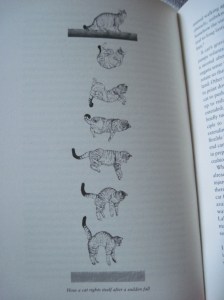
Bradshaw’s diagram of a cat landing on its feet.
Favorite lines:
- “Part of the pleasure of owning a pet comes from projecting our thoughts and feelings on to the animal, treating it as if it were almost human. We talk to our cats as if they could understand our every word, while knowing full well that they certainly can’t.”
- “Purring therefore seems to convey a general request: ‘Please settle down next to me.’ In the gentlest way, the purring cat is asking someone else, whether cat or human, to do something for it.”
The Church Cat: Clerical Cats in Stories and Verse, edited by Mark Bryant
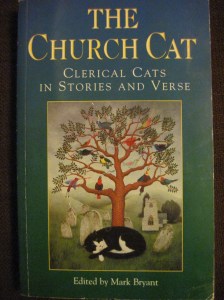 This seems like an impossibly narrow category: stories and poems that combine cats with a church setting. But Bryant has found some real gems that fulfill just that criterion. A few of the short stories, by Ellis Peters, M.R. James and Ernest Dudley, are compact murder mysteries. I most enjoyed Arnold Bennett’s “The Cat and Cupid,” about spinster sisters and “notorious cat-idolaters” who squabble over the handsome new organist; W.L. Alden’s “The Yellow Terror,” about a ship’s cat who insists that his owner hold church services onboard; and Christopher Park’s “The Case of the Cross-eyed Sphinx and the Holy Ghost” (my overall favorite) in which a newly married man meets his wife’s family, including a defrocked chaplain in a wheelchair and his barking mad wife, all of whom have “had an overdose of cat worship.” Of the 21 pieces, only five or six stood out for me (and none of the poetry, really). [Charity shop]
The Church Mice Adrift by Graham Oakley
This 1976 picture book was my introduction to the 14-strong “Church Mice” series. The town of Wortlethorpe is looking to modernize: tearing down all its heritage buildings in favor of glass-fronted monstrosities. This leaves a troop of rats without a home, but they spy an opportunity when they sneak through Sampson’s catflap in the church door. The wily creatures displace the church mice and even Sampson the ginger wonder cat can’t take back his territory. So the cat and his mice are forced to get creative, and come up with a plan that involves a doll’s house turned into a floating café for rats…
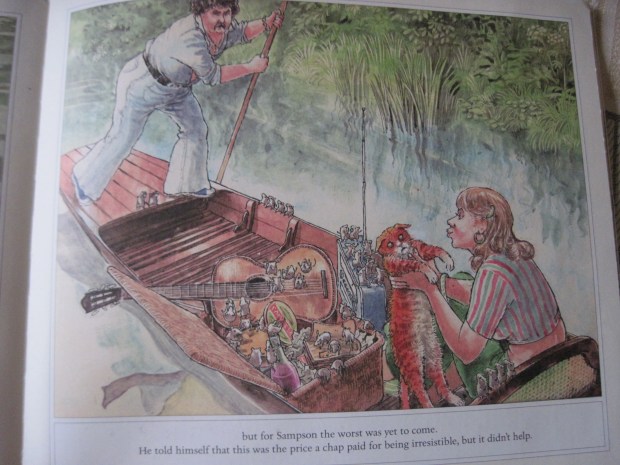
I loved the illustrations (the 1970s clothing on the few human characters cracked me up!) and the plot, a good mixture of humor and mild peril. There’s a fair number of words on each page, yet not too many. I can see this being ideal to read aloud with young children before having them take over the reading at age 5 or 6. I look forward to experiencing more of the church mice’s adventures. My thanks to Margaret of From Pyrenees to Pennines for recommending this charming series. [Public library]
Cats in the Belfry by Doreen Tovey
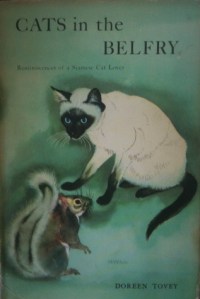
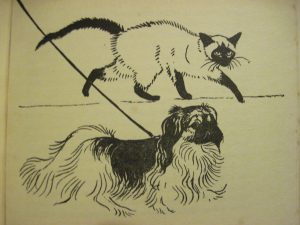
Solomon stalking a neighbor dog.
Do you think your cat is noisy and troublesome? Be thankful you don’t have Doreen Tovey’s Siamese cats! This 1957 book was the first of her many cat-themed memoirs and is perfectly delightful for any animal lover. Their first Siamese was Sugieh, who loved nothing more than to jump into a full bath and frighten the life out of the bather. They bred her and kept two of the littermates, Solomon and Sheba, a mischievous pair whose first three years of antics fill much of the book: terrorizing dogs, pulling down the curtains, following horses, and developing, er, ‘refined’ tastes – “What with spiders, string, and the occasional butterfly caught napping on a cabbage which he ate wings and all, Solomon was, of course, frequently sick. But never, ever, was he so gloriously sick as the day he ate the cream cakes.” [Charity shop]
Up next:
 I have Thomas McNamee’s The Inner Life of Cats (coming out on March 28th) and Jason Hazeley’s The Fireside Grown-Up Guide to the Cat (coming out on April 4th) on my e-readers.
- I’m sure to borrow more books from the public library by Tovey and Bradshaw, who has a book about training your cat (ha!).
- I covet I Could Pee on This, Too: And More Poems by More Cats by Francesco Marciuliano.
 Bookish Beck = Rebecca Foster. American transplant to England. Freelance proofreader and book reviewer.
 Bookish Beck