First Encounter: Maggie Nelson
Maggie Nelson is the author of four volumes of poetry and five wide-ranging works of nonfiction that delve into the nature of violence and sexuality. From what I’d heard about her writing, I knew to expect an important and unconventional thinker with a distinctive, lyrical style. As of early June, Vintage has made some of her backlist, including The Red Parts: Autobiography of a Trial and Bluets, available for the first time in the UK.
I read The Red Parts for The Bookbag. Here’s an excerpt from my full review:
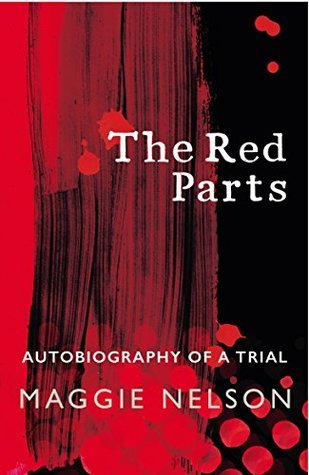 Nelson’s aunt was murdered in Michigan in 1969. Thirty-five years later, just as Nelson had completed writing a poetry collection about her, the case was reopened when new DNA evidence emerged. Most authors would quickly zero in on the trial itself, giving a blow-by-blow of the lawyers’ questioning and witnesses’ statements. Although Nelson does document important developments in the month-long trial, and describes autopsy photographs in blunt detail, her account is much more diffuse than one might expect. Interspersed with Jane’s history are other dark memories: Nelson’s father’s sudden death, her sister’s wild years, aborted love affairs. The title phrase tangentially refers to the words of Jesus in the New Testament, traditionally printed in red, so it has a sort of dual meaning: this is a (futile) search for the gospel truth about her aunt’s death, and also a conscious dive into the parts of life that frighten us. This fluid, engrossing narrative is no ordinary true crime story, but a meditative reflection on loss and identity.
My rating: 
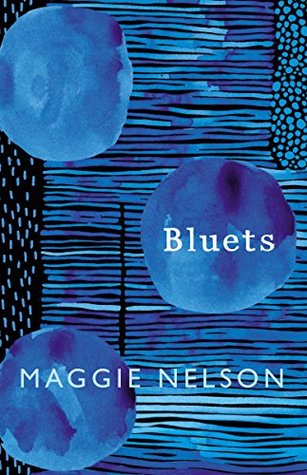 Bluets is a fragmentary record of Nelson’s arbitrary obsession with the color blue. It’s composed of 240 short numbered essays of about a paragraph each; some are just one or two sentences. At one point Nelson refers to these as “propositions,” but really they are more like metaphorical musings. Blue takes on so many meanings: with the connotation of “depressed”, it applies to her loneliness and sense of loss after the breakdown of a relationship (she continues addressing her former partner as “you” here) and a friend’s serious accident:
Loneliness is solitude with a problem. Can blue solve the problem, or can it at least keep me company within it?
Mostly I have felt myself becoming a servant of sadness. I am still looking for the beauty in that.
Then there’s blues music (Billie Holiday), seedy sex (“blue movies”), Joan Mitchell’s 1973 abstract painting Les Bluets, Novalis’ blue flower (which gives the title to a Penelope Fitzgerald novel), and so on. Nelson likens herself to a male bowerbird lining her nest with blue – sometimes literally, as with the collection of “blue amulets” that she keeps on a windowsill so sunlight can pass through the glass and illuminate the stones. I recalled that Sarah Perry lists Bluets as one inspiration for The Essex Serpent, in which the character Stella is fascinated with the color blue and keeps a similar trove of trinkets.
Bluets is a difficult work to characterize, but it seems closest in style to Jenny Offill’s Dept. of Speculation, which is also built on loosely linked aphorisms. The problem with books like these is that individual lines may stand out as profound but don’t contribute to an overall story line or argument. Moreover, Nelson’s forthrightness about sex, which edges towards crassness and feels out of place in this dreamily academic text, took me some getting used to.
Two more favorite lines:
I walked around Brooklyn and noticed that the faded periwinkle of the abandoned Mobil gas station on the corner was suddenly blooming.
If I were today on my deathbed, I would name my love of the color blue and making love with you as two of the sweetest sensations I knew on this earth.
My rating: 
Many thanks to Cat Mitchell of Penguin Random House for the free review copy.
The Red Parts was the more straightforward and satisfying read of this pair, but Bluets is certainly an original and artful bedside book. I would certainly read more by Nelson; I’m particularly interested in The Argonauts (2015), a memoir about forming her unconventional family – her partner, Harry Dodge, is transgender.
Have you read anything by Maggie Nelson? Do her books appeal?
Four Recommended June Releases
Here are four enjoyable books due out next month that I was lucky enough to read in advance. The first is the sophomore novel from an author whose work I’ve enjoyed before, the second is a highly anticipated memoir from an author new to me, and the third and fourth – both among my favorite books of 2017 so far – strike me as 2018 Wellcome Book Prize hopefuls: one is a highly autobiographical novel about bereavement, and the other is a courageous memoir about facing terminal cancer. I’ve pulled 250-word extracts from my full reviews and hope you’ll be tempted by one or more of these.
The Gypsy Moth Summer by Julia Fierro
(Coming from St. Martin’s Press on June 6th)
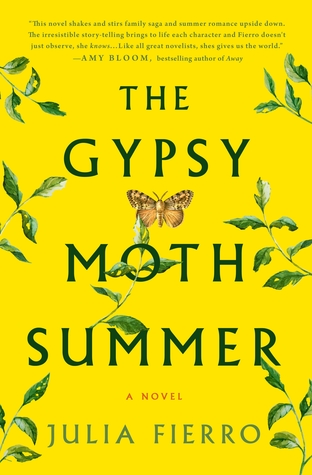 It’s the summer of 1992 and a plague of gypsy moth caterpillars has hit Avalon Island, a community built around Grudder Aviation. The creatures are just one of many threats to this would-be fairy tale world. For Maddie Pencott LaRosa, it’s no simple Sweet Sixteen time of testing out drugs and sex at parties. Her grandfather, Grudder’s president, is back in town with her grandmother, Veronica, and they’re eager to hide the fact that he’s losing his marbles. Also recently returned is Leslie Day Marshall, daughter of the previous Grudder president; she’s inherited “The Castle” and shocked everyone with the family she brought back: Jules, an African-American landscape architect, and their two mixed-race children.
Depending on when you were born, you might not think of the 1990s as “history,” but this novel does what the best historical fiction does: expertly evoke a time period. Moving between the perspectives of six major characters, the novel captures all the promise and peril of life, especially for those who love the ‘wrong’ people. I especially loved small meetings of worlds, like Maddie and Veronica getting together for tea and Oprah.
My main criticism would be that there is a lot going on here – racism, domestic violence, alcohol and prescription drug abuse, cancer, teen sex (a whole lotta sex in general) – and that can make things feel melodramatic. But in general I loved the atmosphere: a sultry summer of Gatsby-esque glittering parties and garden mazes, a time dripping with secrets, sex and caterpillar poop.


[It felt like I kept seeing references to gypsy moths in the run-up to reading this book, like a passage from Amy Poehler’s Yes Please, and a random secondhand book I spotted in Hay-on-Wye (though in that case it’s actually the name of a ship and is a record of a sea voyage).]
Read-alike: The Seed Collectors by Scarlett Thomas
My rating: 
Hunger: A Memoir of (My) Body by Roxane Gay
(Coming from HarperCollins on June 13th [USA] and from Corsair on August 3rd [UK])
 I’d never read anything by Roxane Gay before, but somehow already knew the basics of her story: the daughter of Haitian immigrants to the American Midwest, she was gang raped at age 12, and to some extent everything she’s done and become since then has been influenced by that one horrific experience. Not least her compulsive overeating: “I ate and ate and ate to build my body into a fortress,”she writes. At her heaviest Gay was super morbidly obese according to her BMI, a term that “frames fat people like we are the walking dead.”
Though presented as a memoir, this is more like a collection of short autobiographical essays (88 of them, in six sections). The portions that could together be dubbed her life story take up about a third of the book, and the rest is riffs around a cluster of related topics: weight, diet, exercise and body image. The writing style is matter-of-fact (e.g. “My body is a cage of my own making”), which means she never comes across as self-pitying. I appreciate how she holds opposing notions in tension: she doesn’t know how she developed such an “unruly” body; she knows exactly how it happened.
The structure of the book made it a little repetitive for me, but I think what Gay has written will be of tremendous value, not just to rape victims or those whose BMI is classed as obese, but to anyone who has struggled with body image – so pretty much everyone, especially women.
Read-alike: I Know Why the Caged Bird Sings by Maya Angelou
My rating:
In Every Moment We Are Still Alive by Tom Malmquist
(Coming on from Sceptre on June 1st [UK] and from Melville House on February 6, 2018 [USA])
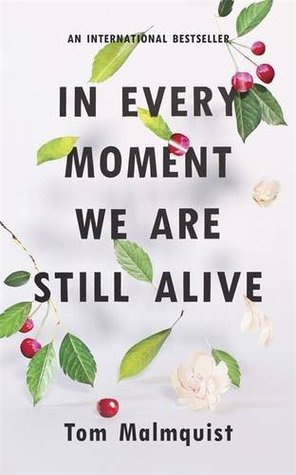 In this autobiographical novel from a Swedish poet, Tom faces the loss of his partner and his father in quick succession. The novel opens in medias res at Söder hospital, where Tom’s long-time girlfriend, Karin, has been rushed for breathing problems. Doctors initially suspect pneumonia or a blood clot, but a huge increase in her white blood cells confirms leukemia. This might seem manageable if it weren’t for Karin, 33, being pregnant with their first child. The next morning she’s transferred to another hospital for a Cesarean section and, before he can catch his breath, Tom is effectively a single parent to Livia, delivered six weeks early.
Malmquist does an extraordinary job of depicting Tom’s bewilderment. He records word for word what busy doctors and jobsworth nurses have to say, but because there are no speech marks their monologues merge with Tom’s thoughts, conversations and descriptions of the disorienting hospital atmosphere to produce a seamless narrative of frightened confusion. There is an especially effective contrast set up between Karin’s frantic emergency room treatment and the peaceful neonatal ward where Livia is being cared for.
While it’s being marketed as a novel, this reads more like a stylized memoir. Similar to Karl Ove Knausgaard’s books, it features the author as the central character and narrator, and the story of grief it tells is a highly personal one.With its frank look at medical crises, this is a book I fully expect to see on next year’s Wellcome Book Prize shortlist.
Read-alike: Mend the Living by Maylis de Kerangal
My rating: 
The Bright Hour: A Memoir of Living and Dying by Nina Riggs
(Coming on June 6th from Simon & Schuster [USA] and from Text Publishing on August 3rd [UK])
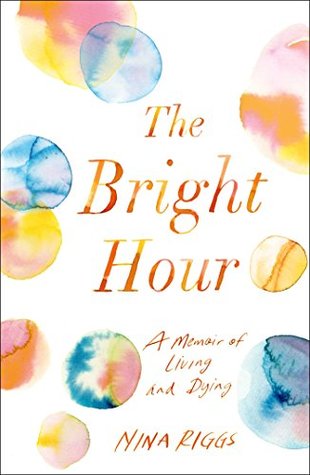 You’re going to hear a lot about this one. It’s been likened to When Breath Becomes Air, an apt comparison given the beauty of the prose and the literary and philosophical approach to terminal cancer. It’s a wonderful book, so wry and honest, with a voice that reminds me of Anne Lamott and Elizabeth McCracken.
It started with a tiny spot of cancer in the breast. “No one dies from one small spot,” Nina Riggs and her husband told themselves. Until it wasn’t just a spot but a larger tumor that required a mastectomy. And then there was the severe back pain that alerted them to metastases in her spine, and later in her lungs. Riggs was a great-great-great-granddaughter of Ralph Waldo Emerson, and she quotes from her ancestor’s essays as well as from Michel de Montaigne’s philosophy of life to put things in perspective.
Riggs started out as a poet, and you can tell. She’s an expert at capturing the moments that make life alternately euphoric and unbearable – sometimes both at once. Usually these moments are experienced with family: her tough mother, who died after nine years with multiple myeloma, providing her with a kind of “morbid test drive” for her own death; and her husband and their two precocious sons. Whether she’s choosing an expensive couch, bringing home a puppy, or surprising her sons with a trip to Universal Studios, she’s always engaged in life. You never get a sense of resignation or despair.
Some of my favorite lines:
“inside the MRI machine, where it sounded like hostile aliens had formed a punk band”
“my pubic hair all falls out at once in the shower and shows up like a drowned muskrat in the drain.”
“My wig smells toxic and makes me feel like a bank robber. But maybe it is just a cloak for riding out into suspicious country.”
“‘Merry Christmas,’ says a nurse who is measuring my urine into a jug in the bathroom. ‘Do you want some pain meds? Do you want another stool softener?’”
(Nina Riggs died at age 39 on February 23, 2017.)
Read-alike: A Series of Catastrophes and Miracles by Mary Elizabeth Williams
My rating: 
What June books do you have on the docket? Have you already read any that you can recommend?
Brain vs. Heart Surgery: Admissions and Fragile Lives
It’s never too early to start thinking about which books might make it onto next year’s Wellcome Book Prize nominees list, open to any medical-themed books published in the UK in calendar year 2017. I’ve already read some cracking contenders, including these two memoirs from British surgeons.
Brain surgeon Henry Marsh’s first book, Do No Harm, was one of my favorite reads of 2015. In short, enthrallingly detailed chapters named after conditions he had treated or observed, he reflected on life as a surgeon, expressing sorrow over botched operations and marveling at the God-like power he wields over people’s quality of life. That first memoir saw him approaching retirement age and nearing the end of his tether with NHS bureaucracy.
Admissions: A Life in Brain Surgery serves as a sort of sequel, recording Marsh’s last few weeks at his London hospital and the projects that have driven him during his first years of retirement: woodworking, renovating a derelict lock-keeper’s cottage by the canal in Oxford, and yet more neurosurgery on medical missions to Nepal and the Ukraine. But he also ranges widely over his past, recalling cases from his early years in medicine as well as from recent memory, and describing his schooling and his parents. If I were being unkind, I might say that this feels like a collection of leftover incidents from the previous book project.
However, the life of a brain surgeon is so undeniably exciting that, even if these stories are the scraps, they are delicious ones. The title has a double meaning, of course, referring not only to the patients who are admitted to the hospital but also to a surgeon’s confessions. And there are certainly many cases Marsh regrets, including operating on the wrong side in a trapped nerve patient, failing to spot that a patient was on the verge of a diabetic coma before surgery, and a young woman going blind after an operation in the Ukraine. Often there is no clear right decision, though; operating or not operating could lead to equal damage.

Once again I was struck by Marsh’s trenchant humor: he recognizes the absurdities as well as the injustices of life. In Houston he taught on a neurosurgery workshop in which students created and then treated aneurysms in live pigs. When asked “Professor, can you give us some surgical pearls?” he “thought a little apologetically of the swine in the nearby bay undergoing surgery.” A year or so later, discussing the case of a twenty-two-year-old with a fractured spine, he bitterly says, “Christopher Reeve was a millionaire and lived in America and he eventually died from complications, so what chance a poor peasant in Nepal?”
Although some slightly odd structural decisions have gone into this book – the narrative keeps jumping back to Nepal and the Ukraine, and a late chapter called “Memory” is particularly scattered in focus – I still thoroughly enjoyed reading more of Marsh’s anecdotes. The final chapter is suitably melancholy, with its sense of winding down capturing not just the somewhat slower pace of his retired life but also his awareness of the inevitable approach of death. Recalling two particularly hideous deaths he observed in his first years as a doctor, he lends theoretical approval for euthanasia as a way of maintaining dignity until the end.
What I most admire about Marsh’s writing is how he blends realism and wonder. “When my brain dies, ‘I’ will die. ‘I’ am a transient electrochemical dance, made of myriad bits of information,” he recognizes. But that doesn’t deter him from producing lyrical passages like this one: “The white corpus callosum came into view at the floor of the chasm, like a white beach between two cliffs. Running along it, like two rivers, were the anterior cerebral arteries, one on other side, bright red, pulsing gently with the heartbeat.” I highly recommend his work to readers of Atul Gawande and Paul Kalanithi.
My rating: 
Admissions: A Life in Brain Surgery was published in the UK by Weidenfeld & Nicolson on May 4th. My thanks to the publisher for sending a free copy for review. It will be published in the USA by Thomas Dunne Books on October 3rd.
What Marsh does for brain surgery in his pair of memoirs, Professor Stephen Westaby does for heart surgery in Fragile Lives, a vivid, compassionate set of stories culled from his long career. A working class lad from Scunthorpe who watched his grandfather die of heart failure, he made his way up from hospital porter to world-leading surgeon after training at Charing Cross Hospital Medical School.
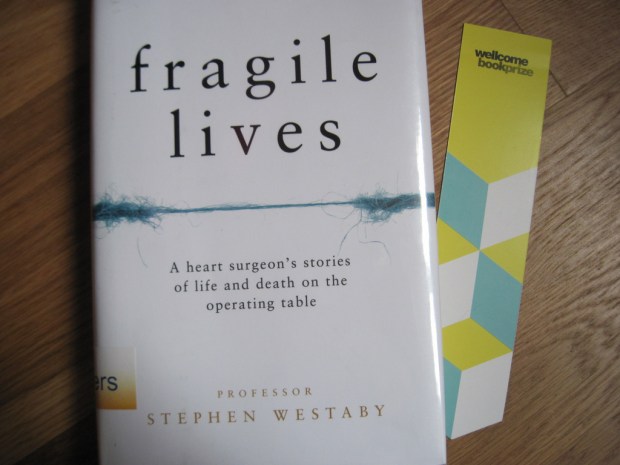
Each of these case studies, from a young African mother and her sick child whom he met while working in Saudi Arabia in the 1980s to a university student who collapses not far from his hospital in Oxford, is told in impressive depth. Although the surgery details are not for the squeamish, I found them riveting. Westaby conveys a keen sense of the adrenaline rush a surgeon gets while operating with the Grim Reaper looking on. I am not a little envious of all that he has achieved: not just saving the occasional life despite his high-mortality field – as if that weren’t enough – but also pioneering various artificial heart solutions and a tracheal bypass tube that’s named after him.
Like Marsh, he tries not to get emotionally attached to his patients, but often fails in this respect. “Surgeons are meant to be objective, not human,” he shrugs. But, also like Marsh, at his retirement he feels that NHS bureaucracy has tied his hands, denying necessary funds and equipment. Both authors come across as mavericks who don’t play by the rules, but save lives anyway. This is a fascinating read for anyone who enjoys books on a medical theme.
A few favorite lines:
“We stop life and start it again, making things better, taking calculated risks.”
“We were adrenaline junkies living on a continuous high, craving action. From bleeding patients to cardiac arrests. From theatre to intensive care. From pub to party.”
My rating:
Fragile Lives: A Heart Surgeon’s Stories of Life and Death on the Operating Table was published in the UK by HarperCollins on February 9th. I read a public library copy. It will be published in the USA, by Basic Books, under the title Open Heart on June 20th.
Books in Brief: Five I Loved Recently
Ironically, Tuesday’s post on all the books I’ve abandoned so far in 2017 was my most popular in ages; it received nearly twice as many views as most of my recent posts. I think readers must find it reassuring that they’re ‘allowed’ to give up on a book rather than struggle through to the end of something they’re really not enjoying. However, I unwittingly stirred up some controversy when I shared the post on a Facebook group for book bloggers and authors and got a few replies along the lines of “I would never write about a book I didn’t like or didn’t finish. It’s not fair to the author.” Hmmm.
Anyway, today I have five pretty much unreserved recommendations instead. An original take on the American Civil War, a retelling of a Shakespearean tragedy, a highly unusual travel book, a creative blending of poems and recipes, and a wonderful book about sisters and betrayal from a Canadian author new to me. I hope you’ll find something here to enjoy.
Days Without End
By Sebastian Barry
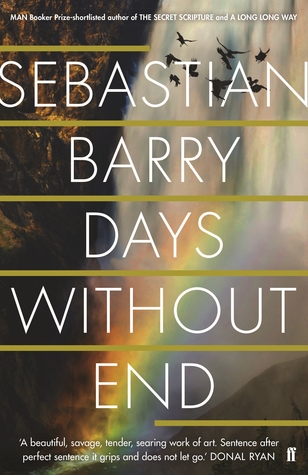 An entirely believable look at the life of the American soldier in the 1850s and 1860s, this novel succeeds due to its folksy dialect and a perfect balance between adventuresome spirit and repulsion at wartime carnage. While it shares some elements with Westerns and Civil War fiction, it’s unique in several ways. Though thrilling and episodic, it’s deeply thoughtful as well. Thomas writes semi-literate English but delivers profound, beautiful statements all the same. Lovely metaphors and memorable turns of phrase abound. Finally, this book is the most matter-of-fact consideration of same-sex relationships I’ve ever encountered in historical fiction. Heart-breaking, life-affirming, laugh-out-loud: these may be clichés, but here’s one novel that is all these things and more. Truly unforgettable. (See my full review at BookBrowse. See also my related article on the Native American practice of cross-dressing, known as winkte or berdache.)
My rating:
New Boy: Othello Retold
By Tracy Chevalier
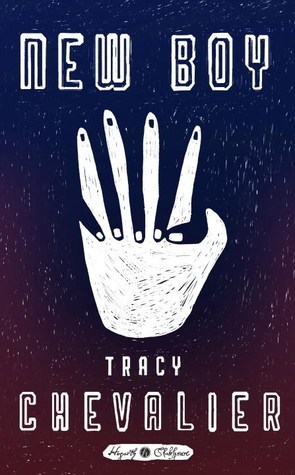 (My second favorite in the Hogarth Shakespeare series, after Margaret Atwood’s Hag-Seed.) Chevalier is known for historical fiction, but here she gives Othello a near-contemporary situation and a backdrop much closer to home: her native Washington, D.C. Spring 1974: it’s Ghanaian diplomat’s son Osei Kokote’s first day at a new school. Fortunately, he’s taken under the wing of one of the most popular sixth grade girls, Dee, and they’re soon inseparable. The novel takes place all in one day, divided into discrete sections by recess periods and a lunch break. Jump rope rhymes, jungle gyms, kickball games, arts and crafts, and a typical cafeteria meal of Salisbury steak and tater tots: it’s impressive how Chevalier takes ordinary elements and transforms them into symbols of a complex hierarchy and shifting loyalties. The language of possession and desire felt overly dramatic to me when applied to eleven-year-olds. However, it’s a remarkable exploration of the psyche of a boy isolated by his race. (Full review forthcoming at the Pittsburgh Post-Gazette website.)
My rating: (maybe more like 3.75)
Tragic Shores: A Memoir of Dark Travel
By Thomas H. Cook
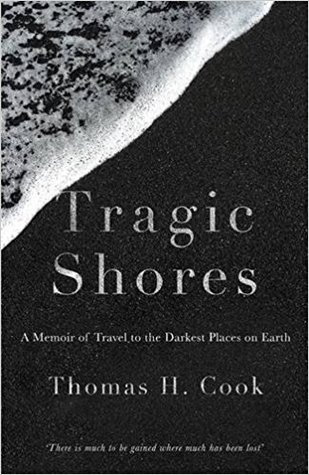 Cook is a crime writer. In this out-of-the-ordinary travel memoir he blends personal experience and history to tell of the ‘dark places’ he’s drawn to visiting. In 28 chapters that jump around in chronological order, he chronicles journeys he’s made to places associated with war, massacres, doomed lovers, suicides and other evidence of human suffering. Some are well known – Lourdes, Auschwitz, Verdun and Ground Zero – while others, like a Hawaiian leper colony and the hideaway of a fifteenth-century serial killer, require more background. A section on Okinawa and Hiroshima is among the book’s highlights: excellent descriptions of the mass suicide rooms where the Japanese retreated as the Americans approached and the atomic bomb drop itself bring history to life. But the most memorable chapter of all is one in which suffering touches Cook in a personal way. A meditative and often melancholy picture of humanity at its best and worst. (See my full review at Nudge.)
My rating:
Eat This Poem: A Literary Feast of Recipes Inspired by Poetry
By Nicole Gulotta
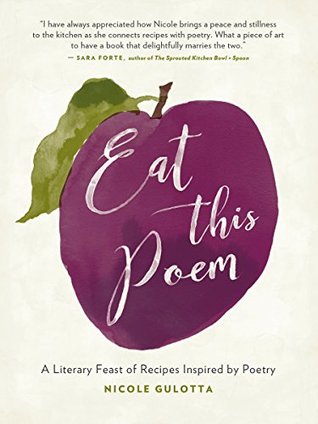 This arose from Gulotta’s blog of the same title. It’s a luscious mix of food-themed poems – none of which I’d ever encountered before, even if certain of the poets were familiar to me (like Mary Oliver, Sharon Olds and Wendell Berry) – commentary, personal anecdote and recipes that manage to hit the sweet spot in a Venn diagram between trendy, frugal, simple and indulgent. I could see myself making and eating any of these recipes, but my eye was particularly drawn to baked sweet potatoes with maple yogurt, vanilla-pear crumble, butternut squash macaroni and cheese, olive oil pumpkin bread, and cornmeal waffles. It might seem like this is a book that would only have niche appeal, but I don’t think that’s the case. Whether you like to cook or just like to eat, whether you love poetry or struggle to understand it, I’d recommend this for pleasant occasional reading. It only misses out on five stars because some of the observations are fairly obvious; these poems mostly speak for themselves.
My rating:
A Student of Weather
By Elizabeth Hay
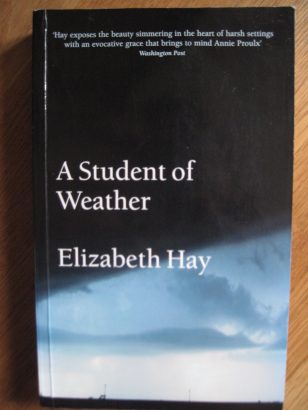 Set between the 1930s and 1970s, Hay’s debut (shortlisted for Canada’s Giller Prize in 2000) focuses on a pair of sisters, Norma Joyce and Lucinda Hardy, and the frostbitten young weather researcher who stumbles upon their Saskatchewan farmhouse one January evening in 1938. “Two sisters fell down the same well, and the well was Maurice Dove.” Seventeen-year-old Lucinda became the capable family housekeeper after their mother’s death. Norma Joyce is a precocious, sneaky eight-year-old. On each of Maurice’s visits, and in the years to come, they quietly jostle for his attention. Despite the upheaval of war and a move to Ontario, some things never change. Hay lends her story allusive depth by referencing biblical pairs of opposites: Jacob and Esau, Mary and Martha, and the Prodigal Son and his jealous older brother. My favorite parts were when the sisters were together in Canada; once Norma Joyce moves to New York, the book starts drifting a bit. However, there are such astute observations about what goes on in family and romantic relationships, and many perfect sentences. I thoroughly enjoyed reading this slowly over the course of a month, and I’d gladly read anything else from Hay.
My rating:
Have you read any of these? Which one takes your fancy?
All the Books I’ve Abandoned So Far This Year
Last year’s abandoned books posts were popular ones – strangely so considering that, instead of giving recommendations like usual, I was instead listing books I’d probably steer you away from. This is such a subjective thing, though; I know that at least a few of the books I discuss below (especially the Mervyn Peake and Rachel Cusk) have admirers among my trusted fellow bloggers. So consider this a record of some books that didn’t work for me: take my caution with a grain of salt, and don’t let me put you off if you think there’s something here that you’d really like to try. (For some unfinished books I give ratings, while for others where I haven’t read far enough to get a good sense of the contents I refrain from rating. This list is in chronological order of my reading rather than alphabetical by title or author.)
 Titus Groan by Mervyn Peake: Vivid scene setting and amusingly exaggerated characters, but I couldn’t seem to get anywhere. It takes over 50 pages for one servant to tell another that the master has had a son?! Hearing that the book only lasts until Titus’s second birthday made me fear the next 400+ pages would just be more of the same. I bought the whole trilogy secondhand, so I hope I’ll be successful on a future attempt. (Set aside at page 62.)
 Seven Seasons in Siena: My Quixotic Quest for Acceptance among Tuscany’s Proudest People, by Robert Rodi: I read the first 49 pages but found the information about the city’s different districts and horse races tedious. Favorite passage: “it’s what’s drawn me to Italians in general—their theatricality, their love of tradition, their spirit. Ever since my first trip to Rome, some ten years ago, I’ve found the robustness of the Italians’ appetites (for food, for music, for fashion) to be a welcome antidote to the dismaying anemia of modern American culture.”
A Book about Love by Jonah Lehrer: Read the first 31% of the Kindle book. Featured in my Valentine’s Day post about “Love” titles. 
 Pondlife: A Swimmer’s Journal by Al Alvarez: I read the first 57 pages but found the entries fairly repetitive. The book spans nine years, but up to that point it was all set in 2002, when Alvarez was 73, and he reported so frequently that the conditions (weather, etc.) at the Hampstead Heath ponds didn’t differ enough to keep this interesting. Unless he’s traveling, you can count on each entry remarking on the traffic getting there, the relative scarcity or overabundance of fellow swimmers at the pond, the chilly start and the ultimately invigorating, calming effect of the water. Impressive that he’d been taking early-morning swims there since age 11, though. Favorite line (from a warm, late June day): “the water is like tepid soup – duck soup with swan-turd croutons.”
 The Best of Adam Sharp by Graeme Simsion: I read the first 36 pages of a library copy and gave up in grave disappointment. Compared to the two Rosie books, this felt like it had no spark. It’s just lots of name-dropping of 1960s and ’70s songs. I felt no connection to either Adam’s current life in England or his memories of his nascent relationship with soap actress Angelina back in Australia.
 The Wild Other: A Memoir by Clover Stroud: Normally I love memoirs that center on bereavement or major illness, but there’s so much going on in this book that drowns out the story of her mother falling off her horse and suffering a TBI when Stroud was 16. For instance, there’s a lot about the blended family she grew up in, embarrassing detail about her early sexual experiences, and an account of postnatal depression that plunges her back into memories of her mother’s accident. “Horses are the source of powerful magic that’s changed my life,” Stroud asserts, so she talks a lot about both real horses and chalk figures of them, but that’s not the same as affirming the healing power of nature, which is how this book has been marketed. Well written, yet I couldn’t warm to the story of a posh Home Counties upbringing, which means I never got as far as the more tantalizing contents set in Ireland and Texas. (Read the first 78 pages.)
 The Evening Road by Laird Hunt: I read about the first 50 pages, skimmed the rest of the first part, and barely glanced at the remainder. Hunt’s previous novel, Neverhome, was a pretty unforgettable take on the Civil War narrative. This latest book is trying to do something new with Jim Crow violence. In the 1920s–30s history Hunt draws on, lynchings were entertainment in the same way other forms of execution were in previous centuries; buses have even been put on to take people to “the show” up at Marvel, Indiana. Hateful Ottie Lee narrates the first half of the novel as she rides with her handsy boss Bud Lancer and her unappealing husband Dale to see the lynching. Their road trip includes a catfish supper, plenty of drinking, and a stop at a dance hall. It ends up feeling like a less entertaining The Help. A feel-good picaresque about a lynching? It might work if there were a contrasting tone, a hint that somewhere in this fictional universe there is an appropriate sense of horror about what is happening. I think Hunt’s mistake is to stick with Ottie Lee the whole time rather than switching between her and Calla Destry (the black narrator of the second half) or an omniscient narrator. I’d long given up on the novel by the time Calla came into play.
 Outline by Rachel Cusk: I read the first 66 pages before setting this aside. I didn’t dislike the writing; I even found it quite profound in places, but there’s not enough story to peg such philosophical depth on. This makes it the very opposite of unputdownable. Last year I read the first few pages of Aftermath, about her divorce, and found it similarly detached. In general I just think her style doesn’t connect with me. I’m unlikely to pick up another of her books, although I have had her memoir of motherhood recommended. Lines I appreciated: “your failures keep returning to you, while your successes are something you always have to convince yourself of”; “it’s a bit like marriage, he said. You build a whole structure on a period of intensity that’s never repeated. It’s the basis of your faith and sometimes you doubt it, but you never renounce it because too much of your life stands on that ground.”
Last but not least, Our Mutual Friend by Charles Dickens, in which I barely made it a few chapters.
Only nine in five months – not too shabby? There’s also a handful of other books that I decided to skim instead of read in their entirety, though.
I’ll be interested to hear if you’ve read any of these books – or plan to read them – and believe that they are worth persisting with.
Two Mother–Daughter Author Pairs for Mother’s Day
This coming Sunday is Mother’s Day in the USA. (Mothering Sunday generally falls in March here in the UK, so every year I have to buy a card early to send to my mother back in the States, but I still associate Mother’s Day with May.) Earlier in the year I got over halfway through a Goodreads giveaway book, Beyond the Pale by Emily Urquhart, before I realized its author was the daughter of a Canadian novelist I’d read before, Jane Urquhart. That got me thinking about other mother–daughter pairs that might be on my shelves. I found one in the form of Sue Monk Kidd’s The Secret Life of Bees plus an advance e-copy of her daughter Ann Kidd Taylor’s upcoming debut novel, The Shark Club. (I’ve previously reviewed their joint memoir, Traveling with Pomegranates.) And, as a bonus, I have a mini-review of Graham Swift’s novella Mothering Sunday: A Romance.
The Whirlpool, Jane Urquhart
 From 1986, this was Urquhart’s first novel. Overall it reminded me of A. S. Byatt (especially The Virgin in the Garden) and John Fowles’s The French Lieutenant’s Woman. Set in 1889 on the Canadian side of Niagara Falls, it features characters who, each in their separate ways, are stuck in the past and obsessed with death and its symbolic stand-in, the whirlpool. Maud Grady, the local undertaker’s widow, takes possession of the corpses of those who’ve tried to swim the Falls. Her creepy young son starts off mute and becomes an expert mimic. Major David McDougal is fixated on the War of 1812, while his wife Fleda camps out in a tent reading Victorian poetry, especially Robert Browning, and awaiting a house that may never be built. Local poet Patrick sees Fleda from afar and develops romanticized ideas about her.
Each of these narratives is entertaining, but I was less convinced by their intersections – except for the brilliant scenes when Patrick and Maud’s son engage in wordplay. In particular, I was unsure what the prologue and epilogue (in which Robert Browning, dying in Venice, is visited by images of Shelley’s death by drowning) were meant to add. This is the second Urquhart novel I’ve read, after Sanctuary Line. I admire her writing but her plots don’t always come together. However, I’m sure to try more of her work: I have a copy of Away on the shelf, and Changing Heaven (1990) sounds unmissable – it features the ghost of Emily Brontë! [Bought from a Lambeth charity shop for 20p.]
My rating: 
Beyond the Pale: Folklore, Family and the Mystery of Our Hidden Genes, Emily Urquhart
 In December 2010, the author’s first child, Sadie, was born with white hair. It took weeks to confirm that Sadie had albinism, a genetic condition associated with extreme light sensitivity and poor eyesight. A Canadian folklorist, Urquhart is well placed to trace the legends that have arisen about albinos through time and across the world, ranging from the Dead Sea Scroll story of Noah being born with blinding white skin and hair to the enduring superstition that accounts for African albinos being maimed or killed to use their body parts in folk medicine.
She attends a NOAH (America’s National Organization for Albinism and Hypopigmentation) conference, discovers potential evidence of a family history of albinism, and even makes a pilgrimage to Tanzania to meet some victims. It’s all written up in as engaging present-tense narrative of coming to terms with disability: to start with Urquhart is annoyed at people reassuring her “it could be worse,” but by the end she’s ever so slightly disappointed to learn that her second child, a boy, will not be an albino like his sister. [Goodreads giveaway copy]
My rating:
The Secret Life of Bees, Sue Monk Kidd
 It’s hard to believe it was 15 years ago that this debut novel was an It book, and harder to believe that I’d never managed to get around to it until now. However, in some ways it felt familiar because I’d read a fair bit of background via Kidd’s chapter in Why We Write about Ourselves and Traveling with Pomegranates, in which she and her daughter explored the Black Madonna tradition in Europe.
It joins unusual elements you wouldn’t expect to find in fiction – beekeeping and the divine feminine – with more well-trodden territory: the Civil Rights movement in the South in the 1960s, unhappy family relationships, secrets, and a teenage girl’s coming of age. Fourteen-year-old Lily is an appealing narrator who runs away from her memories of her mother’s death and her angry father, peach farmer T. Ray. You can’t help but fall in love with the rest of her new African-American, matriarchal clan, including their housekeeper, Rosaleen, who scandalizes the town by registering to vote, and the bee-keeping Boatwright sisters, August, June, and May, who give Lily and Rosaleen refuge when they skip town.
Although this crams in a lot of happenings and emotional ups and downs, it’s a charming story that draws you into the brutal heat of a South Carolina summer and keeps you hoping Lily will forgive herself and slip into the rhythms of a purposeful life of sisterhood. [Secondhand purchase in America]
A favorite line: “The way people lived their lives, settling for grits and cow shit, made me sick.”
My rating:
The Shark Club, Ann Kidd Taylor
 Dr. Maeve Donnelly loves sharks even though she was bitten by one as a child. She’s now a leading researcher with a Florida conservancy and travels around the world to gather data. Her professional life goes from strength to strength, but her personal life is another matter. Aged 30, she’s smarting from a broken engagement to her childhood sweetheart, Daniel, and isn’t ready to open her heart to Nicholas, a British colleague going through a divorce.
Things get complicated when Daniel returns to their southwest Florida island to work as the chef at her grandmother’s hotel – with his six-year-old daughter in tow. Maeve is soon taken with precocious Hazel, who founds the title club (pledge: “With this fin, I do swear. To love sharks even when they bite. When they lose their teeth, I will find them. When I catch one, I will let it go”), but isn’t sure she can pick up where she left off with Daniel. Meanwhile, evidence has surfaced of a local shark finning operation, and she’s determined to get to the bottom of it.
This is a little bit romance and a little bit mystery, and Taylor brings the Florida Keys setting to vibrant life. It took a while to suspend disbelief about Maeve’s background – an orphan and a twin and a shark bite survivor and a kid brought up in a hotel? – but I enjoyed the sweet yet unpredictable story line. Nothing earth-shattering, but great light reading for a summer day at the beach. Releases June 6th from Viking. [Edelweiss download]
My rating:
Mothering Sunday: A Romance, Graham Swift
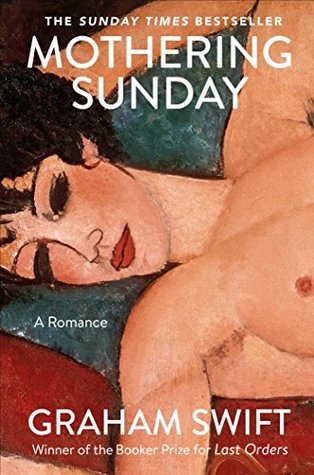 If you’re expecting a cozy tale of maternal love, let the Modigliani nude on the U.K. cover wipe that notion out of your mind. Part of me was impressed by Swift’s compact picture of one sexy, fateful day in 1924 and the reverberations it had for a budding writer even decades later. Interesting class connotations, too. But another part of me thought, isn’t this what you would get if Ian McEwan directed a middling episode of Downton Abbey? It has undeniable similarities to Atonement and On Chesil Beach, after all, and unlike those novels it’s repetitive; it keeps cycling round to restate its main events and points. There’s some good lines, but overall this felt like a strong short story stretched out to try to achieve book length. [Library read]
My rating: 
The Folded Clock by Heidi Julavits
I keep a long list of books that I’d love to read but know are only currently available in the USA. Occasionally I manage to chip away at it through my public library borrowing during trips back to visit my family, but I’m adding more titles all the time. I was pleased, then, to learn that The Folded Clock, a book I’ve wanted to get hold of ever since it was first released in the States in 2015, was recently published in the UK.
Heidi Julavits is a founding editor of The Believer magazine as well as a novelist and an associate professor of writing at Columbia University. She lives in New York City during the academic year and spends the rest of the time in Maine, where she was born and raised. The Folded Clock is a diary of two fairly average years in her life, but its dated entries (month and day only) are not in order; they’ve been rearranged into what at times feels like an arbitrary sequence. Yet this is in keeping with the overall theme of time’s fluidity.
The title comes from her daughter’s mishearing of “folded cloth” but is apt in that it suggests time stretching and collapsing back on itself. Indeed, one reason for starting the journal was that Julavits felt time had started to pass differently from how it did in her childhood. Whereas she once thought in terms of days, she realized in her forties that she now worked in weeks and months. She was also inspired by digging out her adolescent diary – though it was not nearly as profound or revelatory about her future writing career as she might have hoped.
Every single entry begins with “Today,” reflecting a determination to live in the present. But of course, that format still offers a broad scope for memory, with certain activities and objects provoking flashbacks. For instance, she finds her ten-year-old marriage vows in the pocket of an old coat, and rereads a biography of Edie Sedgwick (from Andy Warhol’s circle, she died of a drug overdose at 28), as she periodically does to gauge how her response changes as she ages.
Julavits also situates her writing in the context of other famous diarists, such as the Goncourt brothers and Henry David Thoreau. As the latter did in Walden, she’s seeking to live deliberately, though within her regular life and without venturing into nature all that much; “I am an outdoorsman of the indoors,” she quips.
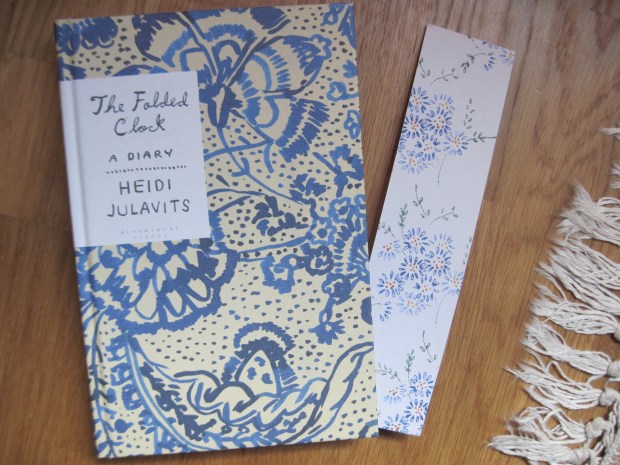
The cover design is by Leanne Shapton.
There’s a huge variety of topics here. She writes about being afraid of sharks, stealing names to use for characters in her novels, entering her small Maine town’s Fourth of July parade float competition, visiting E.B. White’s grave, mourning a tree half-lost to a hurricane, her insistence on dwelling in west-facing rooms, and regretting never telling her doctor how much she appreciated him before he died in a cycling accident. Travel features heavily, too, what with accompanying her husband to a fellowship in Germany and spending time at an art colony in Italy. Often it’s the tiny encounters and incidents that remain in her mind, though, like accidentally buying bitter apricot kernels instead of almonds at a German market and worrying that her husband might have given himself cyanide poisoning by eating 14 at once.
Some of these pieces would function well as stand-alone essays, like the one about her obsession with The Bachelor, an American reality television franchise, which leads into her belief that crushes are fostered by small spaces – she fell for her second husband (author Ben Marcus) at an arts colony even though they were both attached to other people at the time.
I was delighted to see Julavits quote the Julian Barnes passage on episodicism versus narrativism that inspired my post on that topic back in January. Unsurprisingly, Julavits sees herself as a narrativist, drawing connections between different points in her life. She’s always pondering what small incidents reveal about her character. We learn that she’s so averse to inconveniencing others that she continued a phone call while nursing a wasp sting and once planned to pee in an airsickness bag rather than wake the two sleepers between her and the aisle on a flight. She avoids yard sales because she’s so cutthroat, and she’s been known to romanticize her daily life when e-mailing a friend in London: “I probably didn’t tell the truthiest truths. I never made stuff up. But I did strive to be entertaining. Such embellishments do not constitute lies. They constitute your personality.”
In one of the pieces that stood out most for me, Julavits feels typecast as a woman of a certain age when she attends a Virginia Woolf reading. “I am of that age now where I am looking for the next age I will be. How will I dress? How will I act?” It’s a good example of how she uses these mini-essays to negotiate the stages of life and contemplate her changing roles. Elsewhere she sums up her composite identity and what she seeks from her writing:
I am a jack-of-all-trades. I edit and teach and at times desire to be a clothing designer or an artist … and I write everything but poetry and I am a mother and a social maniac and a misanthrope and a burgeoning self-help guru and a girl who wants to look pretty and a girl who wants to look sexy and a girl who wants to look girly and a woman in her middle forties who wishes not to look like anything at all, who wishes sometimes to vanish.
I sometimes think this is why I became a writer. Here was a way to regularly exercise my desire. I could desire to do this thing that no one does perfectly, and by doing it and doing it I could learn how to desire more, and better. Here was an activity that would always leave me wanting … not youth exactly, but the opposite of death. That to me is a way to always feel like I am nowhere near the end.
Inevitably, some entries are more interesting than others, and Julavits’ neuroticism may grate for some readers, but I found this book to be chock-full of quotable lines and insights into what it means to be a time-bound human being. Like one of May Sarton’s journals, I read it slowly, just a few pieces at a time over the course of weeks, and I’ll be keeping it on the shelf to flick through if I ever need an example of how to write a piercing, bite-sized fragment of autobiography. I highly recommend it.
(See also this brief Guardian interview with Julavits.)
The Folded Clock: A Diary was published by Bloomsbury Circus on March 9th. My thanks to the publisher for the free copy for review.
My rating:
A Spate of Swimming Memoirs
In the first four months of this year, I got my hands on no fewer than four swimming memoirs. For the upcoming July/August issue of Foreword Reviews magazine I’ve reviewed Floating: A Life Regained by Joe Minihane, in which the author recreates the late nature writer Roger Deakin’s wild swimming journeys from Waterlog (1999) in an attempt to overcome anxiety; I have Leap In by Alexandra Heminsley on my Kindle; and I read roughly the first 60 pages of a library copy of Al Álvarez’s 2013 Pondlife: A Swimmer’s Journal.
For now, I’m featuring Turning by Jessica J. Lee, which has strong similarities to these other memoirs – especially Minihane’s – but is its own beautifully reflective personal story. The book arose from Lee’s resolution, when she was 28 and in Berlin on a research placement for her dissertation in environmental history, to swim in 52 local lakes – a year’s worth – no matter the weather. At the time she blogged about her “52 Lakes Project” for Slow Travel Berlin, and kept friends and family up to date through social media as well. Her focus would be on the former East German region of Brandenburg, which has Berlin at its center and was first popularized by Theodor Fontane’s 1862 travel book.
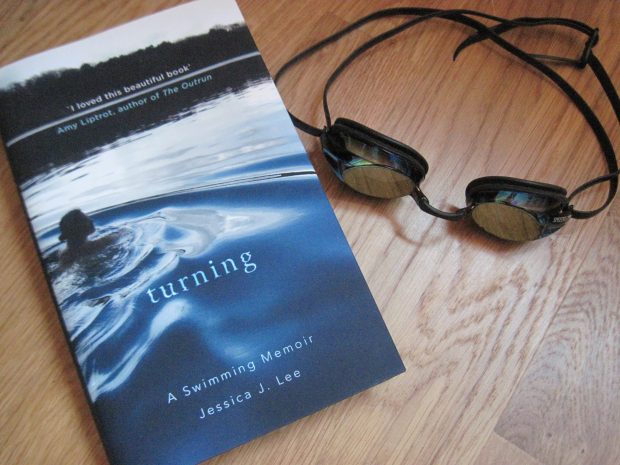
Lee traveled to the lakes under her own steam, using trains and her bicycle; occasionally she took friends with her, but most often she was alone, which became a chance to cultivate solitude – not the same as loneliness. The challenge entailed all kinds of practical difficulties like bike trouble, getting lost, and a dead phone battery, but gradually it became routine and held less fear for her. On summer days she could manage multiple lakes in a day, and even small encounters with Germans gave her a newfound sense of belonging.
Within chapters, the memoir gracefully alternates pieces of the author’s past with her lake travels. With a father from Wales and a mother from Taiwan, Lee grew up in Ontario and spent summers in Florida. She remembers taking YMCA swimming lessons alongside her mother, and swimming in Canadian lakes. Back then the water usually intimidated her, but over the years her feelings have changed:
Water feels different in each place. The water I grew up with was hard, cutting, and when I go back to visit it now, I feel it in my ears when I dive in. something different, more like rock. The lake a whetted blade. The water in Berlin has a softness to it. Maybe it’s the sand, buffing the edges off the water like splinters from a beam. It slips over you like a blanket. There’s a safety in this feeling. In the lakes here, there is a feeling of enclosure and security that Canada can’t replicate. And it shouldn’t – the pelagic vastness there is entirely its own, and I’ve learned to love that too.
Swimming fulfills many functions for Lee. It served variously as necessary discipline after going mildly off the rails in young adulthood (drinking, smoking pot and having an abortion during college; a short-lived marriage in her early twenties); as a way of bouncing back from depression when her planned life in London didn’t pan out and a budding relationship failed; and as a way of being in touch with the turning seasons and coming to know the German landscape intimately. Symbolically, of course, it’s also a baptism into a new life.
Yet I had to wonder if there was also something masochistic about this pursuit, especially in the winter months. On the back cover there’s a photograph of Lee using a hammer to chip out a path through the ice so she can do her minimum of 45 strokes. (No wetsuit!) As spring came, ironically, the water felt almost too warm to her. She had learned to master the timing of a winter swim: “Between pain and numbness there’s a brightness, a crisp, heightened sensation in the cold: that’s the place to swim through. When it ends, when numbness arrives, it’s time to get out.”
The end of Lee’s year-long project is bittersweet, but she’s consoled by the fact that she didn’t have to leave her ordinary life in order to complete it. It was a companion alongside the frantic last-minute work on her dissertation and it never got in the way of her relationships; on the contrary, it strengthened certain friendships. And with Berlin looking like her home for the foreseeable future, she’s committed to seeking out more lakes, too.
There are a lot of year quest books out there, but this one never feels formulaic because there’s such a fluid intermingling of past and present. As memoirs go, it is somewhat like Amy Liptrot’s The Outrun – but much better. It’s also comparable to Angela Palm’s Riverine, with a watery metaphor at the heart to reflect the author’s conception of life as a meandering route. Unlike the other swimming memoirs I’ve sampled, I can recommend this one to a general reader with no particular interest in wild swimming or any other sport. It’s for you if you enjoy reading about the ebb and flow of women’s lives.
In the stillness of the lakes, the border between nature and culture is thinned. Swimming takes place at this border, as if constantly searching for home. Water is a place in which I don’t belong, but where I find myself nonetheless. Out of my culture, out of my depth.
There is more space inside than I can imagine, more hope and possibility than I’d known. Feeling as clear as the day, as deep as the lake.
Turning: A Swimming Memoir was published in the UK by Virago on May 4th. My thanks to the publisher for sending a free copy for review.
My rating:
Gauguin Gets the Graphic Novel Treatment
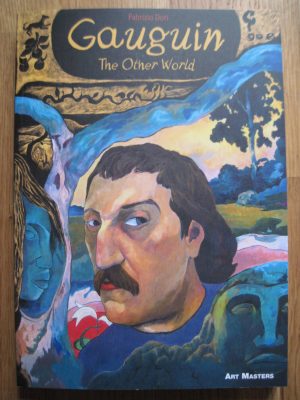 Fabrizio Dori’s Gauguin: The Other World is the third graphic novel I’ve reviewed from SelfMadeHero’s “Art Masters” series, after Munch and Vincent. Like those previous volumes, it delivers salient snippets of biography alongside drawings that cleverly echo the subject’s artistic style. Here the focus is on the last 12 years of Paul Gauguin’s life (1848–1903), which were largely spent in the South Pacific.
The book opens with a macro, cosmic view – the myth of the origin of Tahiti and a prophecy of fully clothed, soulless men arriving in a great canoe – before zeroing in on Gauguin’s arrival in June 1891. Although he returned to Europe in 1893–5, Tahiti and the Marquesas Islands would be his final homes. This is all covered in a whirlwind Chapter 1 that ends by, Christmas Carol-like, introducing a Spirit (as pictured in his 1892 painting Manaó Tupapaù (Spirit of the Dead Watching)) who will lead Gauguin – in a morphine haze on his deathbed in 1903 – and readers on a tour through his past.
Gauguin grew up in Peru and Paris, and at age 17 joined the crew of a merchant marine vessel to South America and the West Indies. Back in Paris, he tried to make a living as a stockbroker and salesman while developing as a self-taught artist. He married Mette, a Danish woman, but left her and their children behind in Copenhagen when he departed for Tahiti. The paintings he sent back were unprofitable, and she soon came to curse his career choice.
The locals called Gauguin “the man who makes men” for his skill in portraiture, but also “the woman man” because he wore his hair long. He moved from Papeete, Tahiti’s European-style colonial town, to a cabin in the woods to become more like a savage, and also explored the ghost-haunted island interior. Teura came to live with him as his muse and his lover.
The book is full of wonderful colors and spooky imagery. The palette shifts to suit the mood: dusky blue and purple for the nighttime visit of the Spirit, contrasting with lush greens, pinks and orange for other island scenes and simple ocher and black for the sequences where Gauguin is justifying his decisions. The black-robed, hollow-faced Spirit reminded me of similar figures imagined by Ingmar Bergman and Hayao Miyazaki – could these film directors have been inspired by Gauguin’s Polynesian emissary of death?
Overall this struck me as a very original and atmospheric way of delivering a life story. Although the font is a little bit difficult to read and I ultimately preferred the art to the narration, they still combine to build a portrait of a brazen genius who shunned conventional duties to pursue his art and cultivate the primitive tradition in new ways. Gauguin ends with a short sequence set in Paris in 1907, as Pablo Picasso, fired up by a Gauguin retrospective show, declares, “We must break with formal beauty. We must be savages.”
I appreciated this brief peek into the future, as well as the five-page appendix of critical and biographical information on Gauguin contributed by art critic Céline Delavaux. What I said about Vincent holds true here too: I’d recommend this to anyone with an interest in the lives of artists, whether you think you’re a fan of graphic novels or not. It will be particularly intriguing to see how Dori’s vision of Gauguin compares to that in W. Somerset Maugham’s The Moon and Sixpence, which I plan to start soon.
With thanks to Paul Smith of SelfMadeHero – celebrating its 10th anniversary this year – for the review copy. Translated from the French by Edward Gauvin.
My rating:
Finding a Home in Nature: Singing Meadow by Peri McQuay
For 30 years Peri McQuay and her family lived in the idyllic 700-strong village of Westport in Eastern Ontario. Her husband, Barry, was the park supervisor at Foley Mountain Conservation Area, the subject of her first nature-themed memoir, The View from Foley Mountain (1995), and they lived on site amid its 800 acres. The constant push to engage in fundraising gradually made it a less pleasant place to live and work, so as Barry’s retirement neared they knew it was time to find a new home of their own. That quest is the subject of her third book, Singing Meadow: The Adventure of Creating a Country Home.
McQuay fantasized about a farmhouse surrounded by 50–100 acres of their own land, but was aware that their limited finances might not stretch to match their dreams. Long before they found their home they were buying little items for it, like an acorn door knocker that functioned as a reassuring totem object during the long, discouraging process of looking at houses. Over the course of two years, McQuay and her husband viewed more than 80 properties! Two pieces of advice they received turned out to be prescient: their loquacious real estate agent opined that “the house you end up in won’t be the one you set out to find,” and a woman in the doctor’s office waiting room counseled her, “don’t try too hard. It’ll happen when it’s time.”
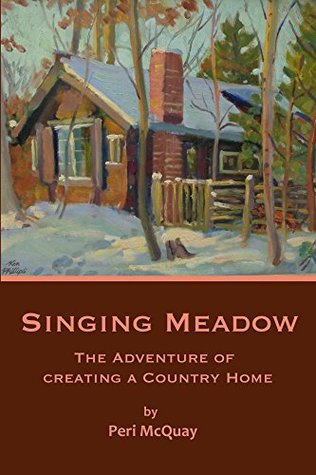 In the end, they fell in love with a plot of land with a water meadow that was home to herons and beavers. With no handyman skills, they never thought they’d embark on building a home of their own. And as it turned out, finding the land was the easy bit, as opposed to the nitty-gritty details of designing what they wanted and meeting with builders who could make it a reality. But as they planted trees and looked ahead to their move in a year’s time, they were already forming a relationship with this place before the house was ever built, learning “the hard lessons of patience and possibility.”
Woven through the book are short flashbacks to other challenging times in McQuay’s life: having chronic fatigue syndrome in her 40s, her mother’s death a few years earlier, and a terrible ice storm at the park that left them without power for 17 days and caused damage to the forest that it might take 30 years to recover from. What all of these situations, as well as looking for a home, have in common is that they forced the author to take the long view, recognizing the healing effects of time rather than the tantalizing option of quick fixes.
I’ve never owned a home, but I’ve lived in 10 properties in the last 10 years. A lot of that nomadism has been foisted upon us rather than chosen, so I could relate to McQuay’s frustration throughout the property search, as well as her feelings of being uprooted – that “the very stuff of my life was being dismantled.” I can also see the wisdom of choosing the place that feeds your soul rather than the one that seems most convenient. She remembers one of the first properties she and Barry rented as a married couple: it was an old place with an outhouse and no running hot water, but they filled it with laughter and music and felt at peace there. It was infinitely better than any soulless town apartment they might have resorted to.
The book ends with a bit of a shocker, one of two moments that brought a lump to my throat. It’s a surprisingly bittersweet turn after what’s gone before, but it’s realistic and serves as a reminder that life is an ongoing story with sad moments we can’t prepare for.
Overall, this memoir reminds me most of Michael Pollan’s A Place of My Own (which appears in McQuay’s bibliography) and May Sarton’s journals, in which the search for a long-term home in Maine is a major element. Although this will appeal to people who like reading about women’s lives and transitions, I would particularly recommend it to readers of nature writing as the book is full of lovely passages like these:
It was bliss visiting the trees and caring for them. Each one was precious. Across the meadow I could see the black, white and yellow nesting bobolink plus an unidentifiable bird with a square seed-eating beak perched on a cattail. A crow flew by, checking to see what I was doing, then a blue jay. In the distance the newly returned yellow warbler was calling “witchetty witchetty.” Over and over, I needed to keep saying that I felt deep down, richly happy in the meadow. In the glassy eye of the pond, water was burbling up in such a powerful spilling-over that it chuckled musically. Indeed, while there was such a flow only the boldest, largest minnows could swim strongly enough to approach the rushing source.
Now I was walking slowly down to the water meadow, hearing the strange, quarrelsome-sounding talk of herons beginning another season here. I was teaching myself how to be aware every moment of every step so I could keep walking longer on this rough land. With any luck, this beloved place would be my last home. And, after the unignorable message of recent fierce summers, I was here to bear witness, to stand with the great maples, beeches, and oaks through whatever might come, to accompany with whatever grace I could for as long as I could sustain it. Living here, this was who I wanted to be—an old woman vanishing into the light.
I’m keen to get hold of McQuay’s other two books as well. Her work makes for very pleasant, meditative reading.
Note: The front cover is an oil painting of Peri’s childhood home by her artist father, Ken Phillips.
Singing Meadow: The Adventure of Creating a Country Home was published by Wintergreen Studios Press in 2016. My thanks to the author for sending a PDF copy for review.
My rating:
 Bookish Beck = Rebecca Foster. American transplant to England. Freelance proofreader and book reviewer.
