20 Books of Summer, 6–7: Helen Dunmore and Stephen King
At least, I managed a pretty terrific pair, and completed half of my intended 4-in-a-row (the second row) on the Bingo card.


(Book featuring ice cream or summer foods)
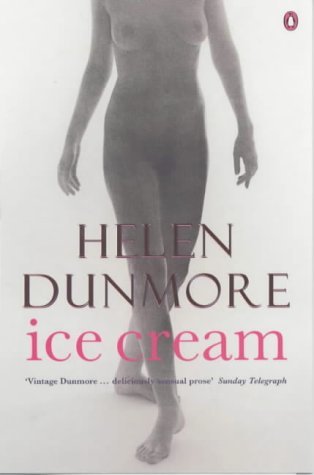
Ice Cream by Helen Dunmore (2000)
These 18 pieces are quite varied: a few have historical settings, two are written in the second person, and several return to the life of Ulli (a recurring character from Love of Fat Men), a Finnish teenager who faces an unexpected pregnancy. Even the slight-seeming ones are satisfying slices of fiction. The title story and its follow-up, “Be Vigilant, Rejoice, Eat Plenty” advocate sensual indulgence, which I guess is the reason for the cover image – which I couldn’t decide whether to hide or flaunt as I was reading it in public.
 Often, there is a hint of menace, whether the topic is salmon fishing, raspberry picking or the history of a lost ring. “The Clear and Rolling Water” has the atmosphere of a Scottish folk ballad, which made it perfect reading for our recent holiday to Scotland. “Leonardo, Michelangelo, SuperStork” and “Mason’s Mini-break” stand out for their dystopian and magic realist touches, respectively. In the former, couples are only allowed to conceive via state- sanctioned services; in the latter, an arrogant Booker Prize-winning author is patronizing when he meets a would-be writer while on holiday in Yorkshire.
Two of my favourites were “The Lighthouse Keeper’s Wife” and “Swimming into the Millennium,” which might have been written by Helen Simpson. All are of a high standard, and though they don’t fit together per se and mostly won’t stay with me, I really do rate Dunmore as a short story writer. (Secondhand – Community Furniture Project, Newbury) 
(Book from a genre you rarely read)
Pet Sematary by Stephen King (1983)
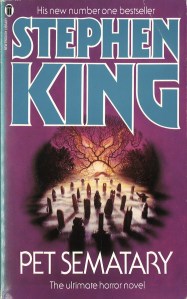 I’d only ever read King’s On Writing and worried I wouldn’t be able to handle his fiction. I could never watch a horror film, but somehow the same content was okay in print. For half the length or more, it’s more of a mildly dread-laced, John Irving-esque novel about how we deal with the reality of death. Dr. Louis Creed and his family – wife Rachel, five-year-old daughter Ellie, two-year-old son Gage and cat Church (short for Winston Churchill) – have recently moved from Chicago to Maine for him to take up a post as head of University Medical Services. Their 83-year-old neighbour across the street, Judson Crandall, becomes a sort of surrogate father to Louis, warning them about the dangerous highway that separates their houses and initiating them with a tour of the pet cemetery and Micmac burial ground that happen to be on their property. Things start getting weird early on: Louis’s first day on the job sees a student killed by a car while jogging; the young man’s cryptic dying words are about the pet cemetery, and he then visits Louis in a particularly vivid dream.
The family surname is no coincidence. “I believe that we go on,” Louis says when Ellie asks him about what happens when we die. “But as to what it’s like, I have no opinion.” So King interrogates what it would be like for the dead to go on literally instead of just figuratively in the remembrance of loved ones. Would bringing the dead back be a cure for grief or a horrible mistake? This sleepy New England town harbours many cautionary tales, and the Creeds have more than their fair share of sorrow. Rachel witnessed her sister’s death from a long illness when she was just a child and has always repressed her memories of it.
Louis is a likable protagonist whose vortex of obsession and mental health (“He walked the balance-beam of rationality”) is gripping. As can be the case with genre fiction, King prioritizes readability over writing quality, though I did pick out an occasional glistening metaphor. It doesn’t get gruesome or schlocky until right towards the end. In the last quarter, which I read on the long train ride home from Edinburgh, I couldn’t get the book closer to my face or the pages turning any faster. It helped that it was a beat-up small-format paperback. When we arrived into London I was about six pages from the end and it was so frustrating to have to wait until I got on my next train to read the rest.


This also counted towards one of my low-key ongoing challenges: reading works published in my birth year. I could imagine the Eighties stylings of an adaptation, especially Rachel’s power suit and pumps when she’s on her race-against-the-clock flight and road trip. I did find the book dated in some of its Murakami-like descriptions (“The … double doors were set into a grassy rise of hill, a shape as natural and as attractive as the swell of a woman’s breast”) and cringey sex scenes, and I wondered if King would get away with using imagery of the Windigo these days. Still, on this evidence, I’ll seek out more of his classic horror – do give me your recommendations. So long as they’re this addictive (and no scarier), I’m game. Pet Sematary was sterling entertainment, but also surprisingly poignant. A message I took away: you just have to live with the pain of loss, not fight it or deny it. “When it started not to hurt, it started not to matter.” (Little Free Library) 
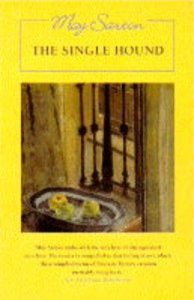
The Single Hound by May Sarton (1938)
I spotted that the 30th anniversary of May Sarton’s death was coming up, so decided to read an unread book of hers from my shelves in time to mark the occasion. Today’s the day: she died on July 16, 1995 in York, Maine. Marcie of Buried in Print joined me for a buddy read (her review). I was drawn by the title, which comes from an Emily Dickinson quote. It’s the ninth Sarton novel I’ve read and, while in general I find her nonfiction more memorable than her fiction, this impressionistic debut novel was a solid read. It was clearly inspired by Virginia Woolf’s work and based on Sarton’s memories of her time on the fringes of the Bloomsbury Group.
 In Part I we are introduced to “the Little Owls,” three dear friends and winsome spinsters in their sixties – Doro, Annette and Claire – who teach and live above their schoolroom in Ghent, Belgium. (I couldn’t help but think of the Brontë sisters’ time in Belgium.) Doro, a poet, seems likely to be a stand-in for the author. I loved the gentle pace of this section; although the novel was published when she was only 26, Sarton was already displaying insight into friendship and ageing and appreciation of life’s small pleasures, elements that would recur in her later autobiographical work.
the three together made a complete world.
Was this life? This slow penetration of experience until nothing had been left untasted, unexplored, unused — until the whole of one’s life became a fabric, a tapestry with a pattern? She could not see the pattern yet.
tea was opium to them both, the time when the past became a soft pleasant country of the imagination, lost its bitterness, ceased to devour, and in some tea-inspired way nourished them.
Part II felt to me like a strange swerve into the story of Mark Taylor, an aspiring English writer who falls in love with a married painter named Georgia Manning. Their flirtation, as soon through the eyes of a young romantic like Mark, is monolithic, earth-shattering, but to readers is more of a clichéd subplot. In the meantime, Mark sticks to his vow of going on a pilgrimage to Belgium to meet Jean Latour, the poet whose work first inspired him. Part III brings the two strands together in an unexpected way, as Mark gains clarity about his hero and his potential future with Georgia, though cleverer readers than I may have been able to predict it – especially if they heeded the Brontë connection.
It was rewarding to spot the seeds of future Sarton themes here, such as discovering the vocation of teaching (The Small Room) and young people meeting their elder role models and soliciting words of wisdom on how to live (Mrs. Stevens Hears the Mermaids Singing). Through Doro, Sarton also expresses trust in poetry’s serendipitous power. “This is why one is a poet, so that some day, sooner or later, one can say the right thing to the right person at the right time.” I enjoyed my time with the Little Owls but mostly viewed this as a dress rehearsal for later, more mature work. (Secondhand – Awesomebooks.com) 
A Return to the Outer Hebrides & What I Read (Including 20 Books of Summer, 4–5)
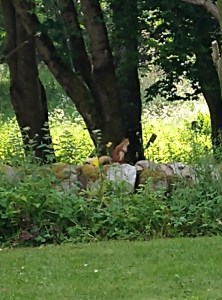
Three summers ago, we first explored the Outer Hebrides, moving south from Lewis through Harris to North Uist and Benbecula. It took longer than expected to make it back to the Western Isles. (It’s also taken longer than expected to write up a trip we took in late June. My excuse is we’ve been having work done in the house for a couple of weeks and it’s thrown off routines, plus we’re now away again on a short break.) We kept our word and completed the southern half of the chain this year, staying on South Uist and journeying via Eriskay to Barra and Vatersay. As last time, we combined public transport and car rental. Unlike last time, we had no major transport disasters. We took the train up to Edinburgh, where we rented a car and headed first of all to the edge of the Cairngorms. The village had little to offer apart from riverside scenery, so while my husband did beetle-collecting fieldwork nearby, I spent my time reading in the idyllic B&B grounds. Here the wildlife came to me: seven stags and a red squirrel! I’ve substituted in two of my relevant trip reads to my 20 Books of Summer roster.
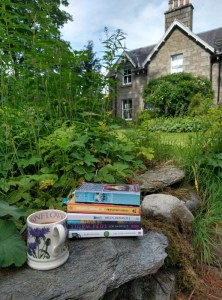

20 Books of Summer, #4
The Cone-Gatherers by Robin Jenkins (1955)
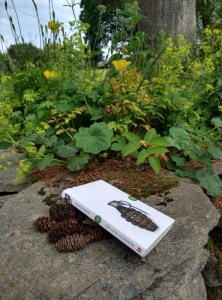
 Rightly likened to Of Mice and Men, this is an engrossing short novel about two brothers, Neil and Calum, tasked with climbing trees and gathering the pinecones of a wealthy Scottish estate. They will be used to replant the many woodlands being cut down to fuel the war effort. Calum, the younger brother, is physically and intellectually disabled but has a deep well of compassion for living creatures. He has unwittingly made an enemy of the estate’s gamekeeper, Duror, by releasing wounded rabbits from his traps. Much of the story is taken up with Duror’s seemingly baseless feud against the brothers – though we’re meant to understand that his bedbound wife’s obesity and his subsequent sexual frustration may have something to do with it – as well as with Lady Runcie-Campbell’s class prejudice. Her son, Roderick, is an unexpected would-be hero and voice of pure empathy. I read this quickly, with grim fascination, knowing tragedy was coming but not quite how things would play out. The introduction to Canongate’s Canons Collection edition is by actor Paul Giamatti, of all people. (Secondhand – Community Furniture Project, Newbury)
Then it was a several-hour drive to Oban to take our rescheduled ferry over to Lochboisdale in South Uist for the holiday proper to begin. With a six-night Airbnb stay booked in the home of a local woman, we relaxed into an unhurried pace of life. It’s more about the landscape than any particular indoor attractions here; during rainy spells we toured the excellent museum, tasted gin and rum at the North Uist (Downpour) and Benbecula (MacMillan Spirits) distilleries, took advantage of 5 for £1 books and CDs at the Benbecula thrift shop, and tried a couple of cafes, but for the most part we just made a few short excursions per day.


-
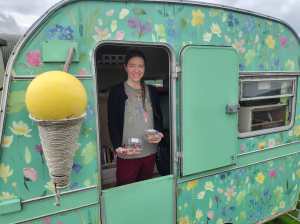
- Honesty box with cakes
-

- Photos by Chris Foster
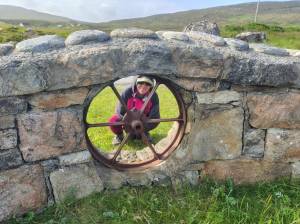
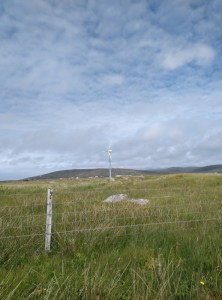
We saw acres of machair (wildflower-rich fields), sand dunes undermined by an empire of rabbits, deserted beaches, and rare patches of woodland. We successfully staked out white-tailed sea eagles, red-throated divers, and a red-necked phalarope; watched cuckoos and short-eared owls (who are active in the daytime) as much as possible; and stared at every likely sea loch but failed to find an otter. Each evening we’d heat up a simple supper – pouches of curry and rice; ravioli with tomato sauce – using the microwave and hob. In quite a contrast to the heatwave-mired south of England, we had 12–16 degrees C (54–61 degrees F) most days, with light rain and high winds. The radiators and Rayburn (a big stove like an Aga) were on most of the time.



20 Books of Summer, #5
The Inn at the Edge of the World by Alice Thomas Ellis (1990)
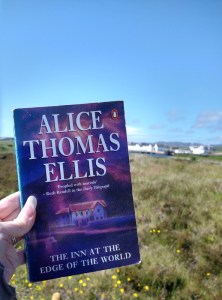 Eric and Mabel moved from the Midlands to run a hotel on a remote Scottish island. He places an advertisement in select London periodicals to lure in some Christmas-haters for the holidays and attracts a motley group: a bereaved former soldier writing a biography of General Gordon, a pair of actors known only for commercials, a psychoanalyst, and a department store buyer looking for a novel sweater pattern. Mabel decides she’s had enough and flees the island just as the guests start arriving. One guest is stalking another; one has history on the island. And all along, there are hints that this is a site of major selkie activity. I found it jarring how the novella moved from Shena Mackay-like social comedy into magic realism and doubt I’ll read more by Ellis (I’d already read one volume of Home Life), though this was light and enjoyable enough. (Secondhand – Awesomebooks.com)
I was pleased that I managed to find two relevant hyperlocal reads. It was so neat to encounter the same place names out the car window and in my books:
To the Edge of the Sea: Schooldays of a Crofter’s Child by Christina Hall (1995)
Hall’s father inherited a South Uist croft and the family struggled so much financially that she was sent to live with her schoolteacher aunts on Benbecula and then Barra. Some things haven’t changed on the islands, such as the rabbits on the machair and the notoriously choppy ferry rides back to the mainland, where she attended a convent school at Fort William. There are some enjoyable pen portraits, such as of an Irish peddler. The most memorable incident was when she ran away from the aunts’ to attend a family wedding on Benbecula. The tone is pleasant, reminiscent of early Diana Athill and Doreen Tovey, but this isn’t one to pick up unless you have a particular interest in the places described. (Public library)
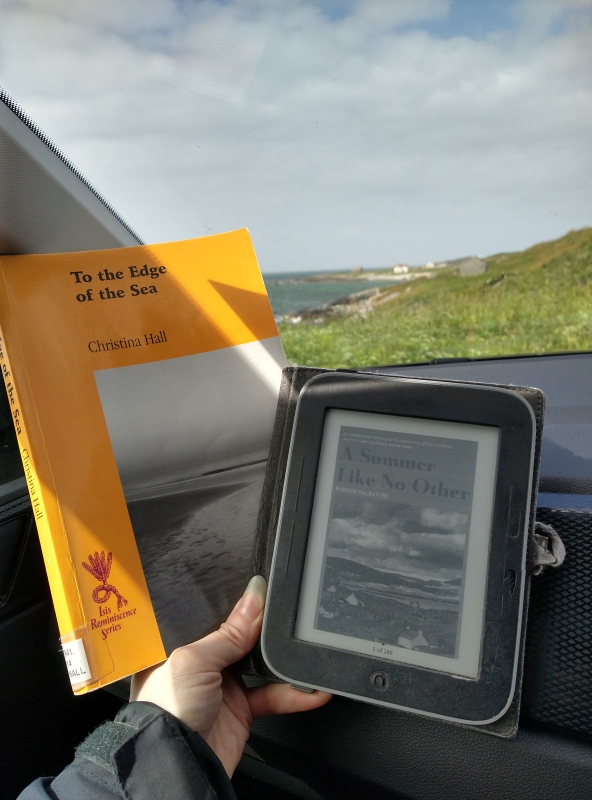
A Summer Like No Other by Martin MacIntyre (2018; 2025)
As World Cup fever ramps up in the summer of 1978, aimless 20-year-old Colin Quinn breaks from his university studies to shadow his uncle, Dr. Ruairidh Gillies, during his locum on South Uist. Between the home medical visits and recording folktales and songs by an eighty-something bard and several other members of the community, Colin gets to know almost everyone – but the person he knows the least well is himself. His involvement with the bard’s great-niece and her abusive husband will change the tenor of the summer for him, and have lasting consequences that only become clear decades later.
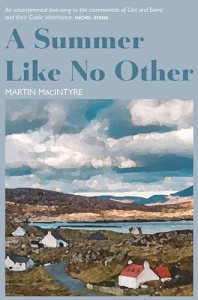 The many Gaelic phrases, defined in footnotes, help to create the atmosphere. The chapter epigraphs from the legend of Oisín (son of Fionn Mac Cumhaill) and Tír Na nÓg, the land of eternal youth, heighten the contrast between Colin’s idealism and the reality of this life-changing season. I think this is the first book I’ve read that was originally published in Gaelic and I hope it will find readers far beyond its island niche. (BookSirens)
There’s Something about Mary
My husband would like it known that he was the clever clogs who spotted a theme to our trip: Mary.
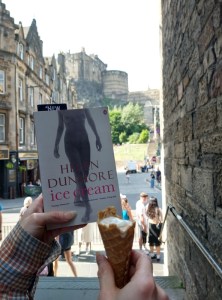 1) Our transit through Edinburgh was brief and muggy, but we made sure to leave just enough time to queue for cones at Mary’s Milk Bar, which has the most interesting flavours you’ll find anywhere. Pictured, though half eaten, are my one scoop of Earl Grey and peach sorbet and one scoop of fig and cardamom ice cream. When we returned to Edinburgh to return the car at the end of our trip, I took the train home by myself but C stayed on for a conference, during which he treated himself to another round at Mary’s.
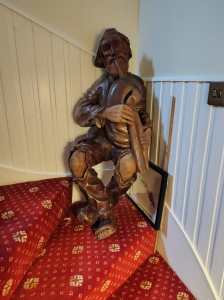
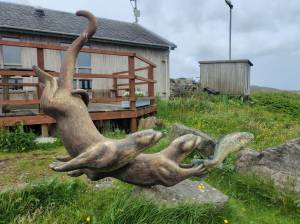
A piper statue at the Airbnb that continually frightened us on the stairs.
2) Our South Uist host was Mary MacInnes, a major mover and shaker in the local Gaelic-speaking community. (Her Alexa even obeyed Gaelic commands.) She is a retired head teacher of one of the schools and had various grandchildren popping in and out. Thanks to her heads-up, we had a unique cultural experience: a local arts venue’s lunchtime ceilidh of live music that was being filmed for BBC Scotland. Between her and others, we heard a lot of spoken Gaelic and got further into the mood by finding Julie Fowlis’s Gaelic-language albums online and playing them in our rental car. Each morning, Mary served us breakfast. We made the mistake of answering “Yes” to the question “D’ye take porridge?” on the first morning and had to slog through a stodgy bowl for five of the next six days. However, she also produced fresh-baked scones on two days and that made up for it. Triangular and baked in a cast-iron skillet, they tasted more like soda bread and were a perfect snack with jam.
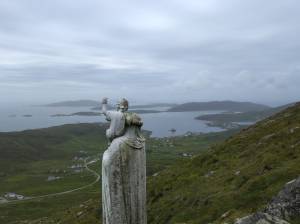
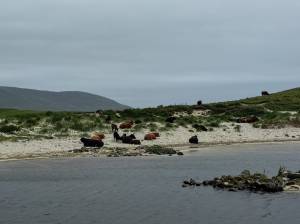
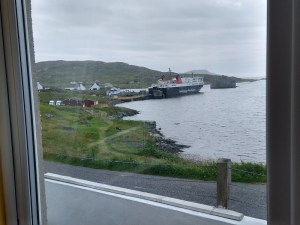
3) The final full day of our trip was spent on Barra, a quick hop from South Uist. Whereas Lewis and Harris are staunchly Protestant, the southern islands are Catholic. We’d found a roadside shrine on South Uist, and on this late June day we devoted a couple of hours to climbing up Heaval, Barra’s highest hill as far as the statue of Mary, Star of the Sea. We were taken with this round, rugged island of secluded coves and beach-lounging cows; I can imagine going back to spend more time there. (I’d also like to see a bit more of Eriskay, from which our ferry departed and where the shipwreck that inspired Whisky Galore – one to read next time – took place.) Our hostel room overlooked the harbour where our ferry for the mainland was docked, which was handy as we had to be in the queue by 6:10 the next morning.
My additional reasonably local or otherwise relevant reading:
Four Ducks on a Pond: A Highland Memory by Nicholas the Cat with Annabel Carothers (2010)
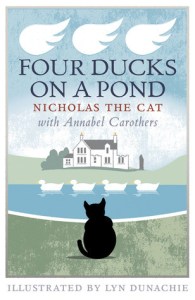 A quaint short memoir set in the 1950s on the island of Mull (which we sailed past on our way to and from the Outer Hebrides). It’s narrated in tongue-in-cheek fashion by Nicholas the Cat, who pals around with the farm’s dogs, horse and goats and comments on the doings of its human inhabitants, such as “Puddy” (Carothers), a war widow, and her daughter Fionna, who goes away to school. “We understand so much about them, yet they understand so little about us,” he opines. Indeed, the animals are all observant and can communicate with each other. Corrieshellach is a fine horse taken to compete in shows. The goats are lucky to escape with their lives after a local outbreak of foot-and-mouth disease among livestock. Nicholas grows fat on rabbits and fathers several litters. He voices some traditional views (the Clearances: bad but the Empire: good; crows: bad); then again, cats would certainly be C/conservatives. A sweet Blyton-esque read for precocious children or sentimental adults, this passed the time nicely on a long drive. It could do with a better title, though; the ducks only play a tiny role. (Favourite aside: “that beverage which humans find so comforting when things aren’t right. Tea.”) (Secondhand – Benbecula thrift shop)
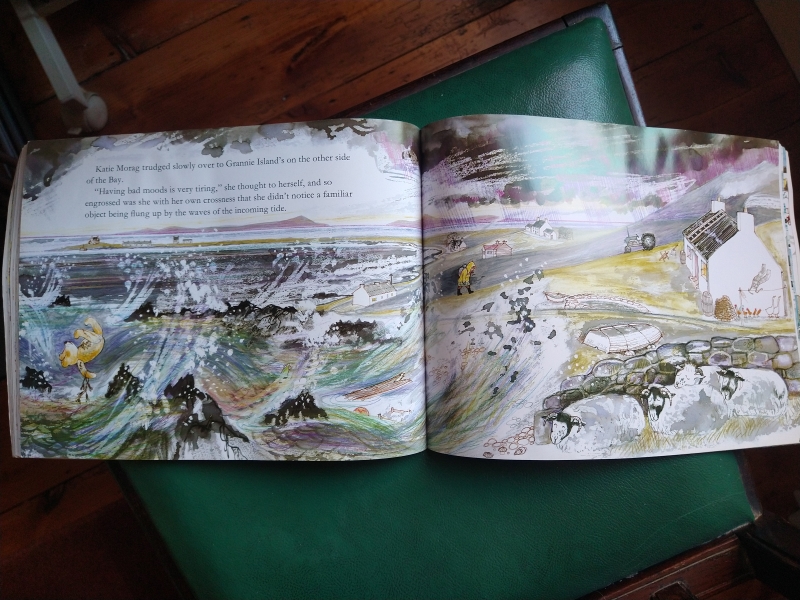
Katie Morag’s Island Stories by Mairi Hedderwick (1995)
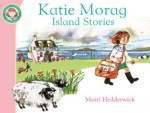 I read half of this large-format paperback before our trip and the rest afterward. It collects four of Hedderwick’s picture books, which are all set on the Isle of Struay, a kind of Hebridean composite that reproduces the islands’ wildlife and scenery beautifully. Katie Morag’s parents run the shop and post office and her mother always seems to be producing another little brother. In Katie Morag Delivers the Mail, the little red-haired girl causes chaos by delivering parcels at random. Sophisticated Granma Mainland and practical Grannie Island are the stars of Katie Morag and the Two Grandmothers. Katie Morag learns to deal with her anger and with being punished, respectively, in …and the Tiresome Ted and …and the Big Boy Cousins. Cute stories with useful lessons, but the illustrations are the main attraction. I’ll get the rest of the books out from the library. (Little Free Library)
Island Calling by Francesca Segal (2025)
The sequel to Welcome to Glorious Tuga, which I reviewed for Shelf Awareness last year. Charlotte Walker is a tortoise researcher who becomes the default veterinarian on this remote South Atlantic island that combines a 1950s English ethos with a cosmopolitan heritage from sailors and settlers. In this volume, Charlotte resolves her troubled love triangle and cements her understanding of her father’s identity. But the main thing that happens is that her posh and entitled mother, Lucinda Compton-Neville, takes a break from her busy job as a QC to travel to the island and demand that Charlotte return to London with her. Motherhood is a strong theme throughout: Natalie Lindo, already a mother of four, has to decide what to do about a high-risk pregnancy; half-feral Annie Goss rejects her mother’s affection, and so on. Some of the characters are lovably quirky, but overall I find the cliché-laden series lackluster, a pointless and indulgent side-track and thus a real waste of talent by Segal (after The Innocents and Mother Ship, especially). If you enjoy romance novels or escapist beach reads, you might feel differently. But I won’t bother reading the third volume.
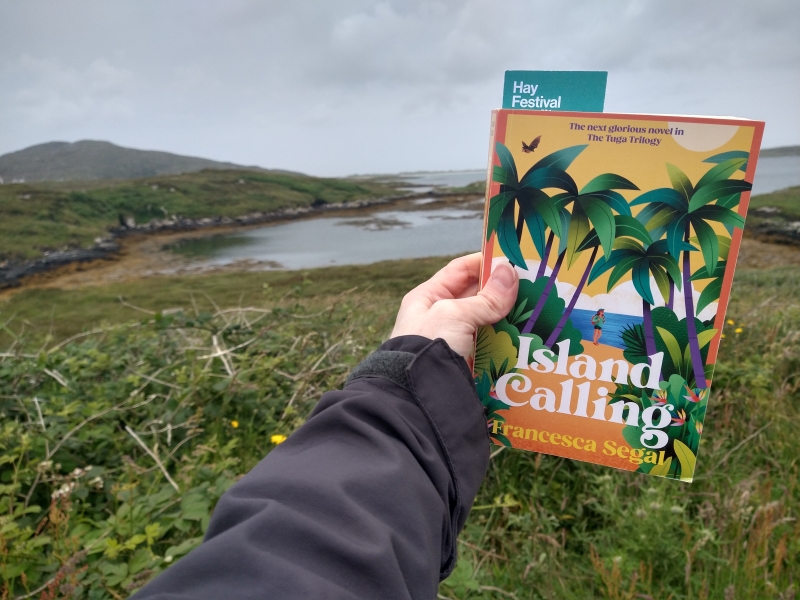
With thanks to Chatto & Windus (Penguin) for the proof copy for review.
I also made good progress on Storm Pegs by Jen Hadfield, a memoir of life in Shetland – different islands with their own character, but still fitting the hardy Scottish spirit.
I’d finished my first 7 Books of Summer by the end of June, so I was on track as of then. (Reviews of two more coming up on Friday.) I’m in the middle of some designated reads, but it’ll be ages before I finish any. I’ll hope to review another batch by the end of July.
The Best Books from the First Half of 2025
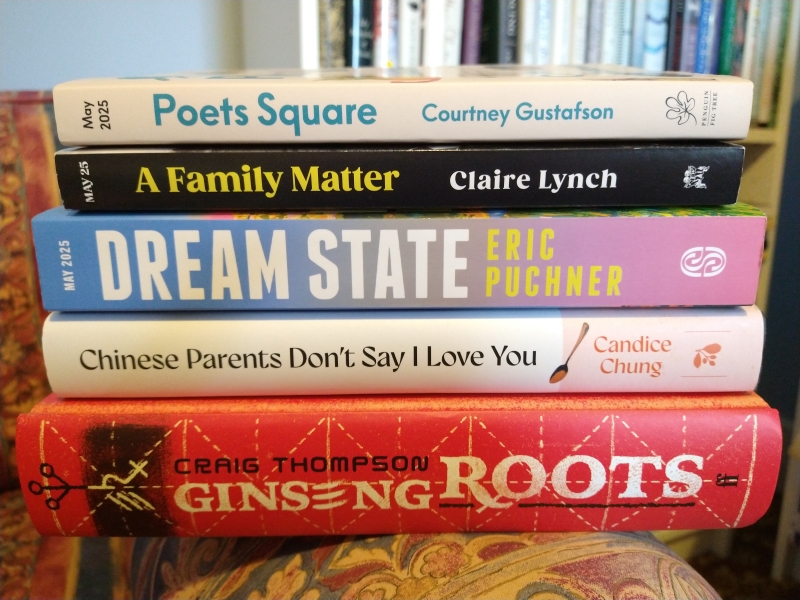
Hard to believe it, but it’s that time of year already. It’s the ninth year in a row that I’ve been making a first-half superlatives list. It remains to be seen how many of these will make it onto my overall best-of year rundown, but for now, these are my 16 favourite 2025 releases that I’ve read so far (representing the top ~21% of my current-year reading). Pictured below are the ones I read in print; all the others were e-copies. Links are to my full reviews.
Fiction
 Spent: A Comic Novel by Alison Bechdel: Alison has writer’s block and is consumed with anxiety about the state of the world. “Who can draw when the world is burning?” Then she has an idea for a book – or maybe a reality TV series – called $UM that will wean people off of capitalism. That creative journey is mirrored here. Through Alison’s ageing hippie friends and their kids, Bechdel showcases alternative ways of living. Even the throwaway phrases are hilarious. It’s a gleeful and zeitgeist-y satire, yet draws to a touching close.
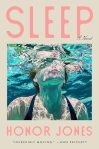 Sleep by Honor Jones: A breathtaking character study of a woman raising young daughters and facing memories of childhood abuse. Margaret’s 1990s New Jersey upbringing seems idyllic, but upper-middle-class suburbia conceals the perils of a dysfunctional family headed by a narcissistic, controlling mother. Jones crafts unforgettable, crystalline scenes. There are subtle echoes throughout as the past threatens to repeat. Reminiscent of Sarah Moss and Evie Wyld, and astonishing for its psychological acuity, this promises great things from Jones.
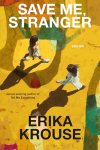 Save Me, Stranger by Erika Krouse: Twelve first-person narratives voiced by people in crisis, for whom encounters with strangers tender the possibility of transformation. In the title story, the narrator is taken hostage in a convenience store hold-up. Others are set in Thailand and Japan as well as various U.S. states. Krouse focuses on young women presented with dilemmas and often eschews tidy endings, leaving characters on the brink and allowing readers to draw inferences. Fans of Danielle Evans and Lauren Groff have a treat in store.
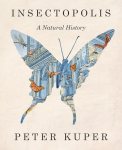 Insectopolis: A Natural History by Peter Kuper: “If insects were to vanish, the environment would collapse into chaos.” (E. O. Wilson) After an unspecified apocalypse, only insects remain. Group by group, they guide readers through an empty New York Public Library exhibit, interacting within and across species. It’s a sly blend of science, history, stories and silliness. There are interludes about insects in literature and unsung heroines of entomology. Informative and entertaining at once; what could be better? Welcome our insect overlords!
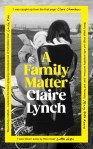 A Family Matter by Claire Lynch: In her research into UK divorce cases in the 1980s, Lynch learned that 90% of lesbian mothers lost custody of their children. Her earnest, delicate debut novel, which bounces between 2022 and 1982, imagines such a situation through close portraits of three family members. Maggie knew only that her mother, Dawn, abandoned her when she was little. Lynch’s compassion is equal for all three characters. This confident, tender story of changing mores and steadfast love is the new Carol for our times.
 Are You Happy? by Lori Ostlund: Nine short fictions form a stunning investigation into how violence and family dysfunction reverberate. “The Peeping Toms” and “The Stalker” are a knockout pair featuring Albuquerque lesbian couples under threat by male acquaintances. Characters are haunted by loss and grapple with moral dilemmas. Each story has the complexity and emotional depth of a novel. Freedom versus safety for queer people is a resonant theme in an engrossing collection ideal for Alice Munro and Edward St. Aubyn fans.
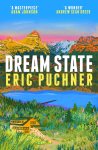 Dream State by Eric Puchner: It starts as a glistening romantic comedy about t Charlie and Cece’s chaotic wedding at a Montana lake house in summer 2004. First half the wedding party falls ill with norovirus, then the best man, Garrett, falls in love with the bride. The rest examines the fallout of this uneasy love triangle as it stretches towards 2050 and imagines a Western USA smothered in smoke from near-constant forest fires. Still, there are funny set-pieces and warm family interactions. Cross Jonathan Franzen and Maggie Shipstead.
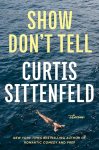 Show Don’t Tell by Curtis Sittenfeld: Sittenfeld’s second collection features characters negotiating principles and privilege in midlife. Split equally between first- and third-person perspectives, the 12 contemporary storylines spotlight everyday marital and parenting challenges. Dual timelines offer opportunities for hindsight on the events of decades ago. Nostalgic yet clear-eyed, these witty stories exploring how decisions determine the future are perfect for fans of Rebecca Makkai, Kiley Reid, and Emma Straub.
Nonfiction
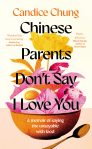 Chinese Parents Don’t Say I Love You: A memoir of saying the unsayable with food by Candice Chung: A vibrant essay collection spotlighting food and family. Chung reconnects with her semi-estranged parents by taking them along on restaurant review gigs for a Sydney newspaper. Fresh from a 13-year relationship with “the psychic reader,” she starts dating again and quickly falls in deep with “the geographer.” The essays range in time and style, delicately contrasting past and present, singleness and being partneredr.
 Poets Square: A Memoir in 30 Cats by Courtney Gustafson: Working for a food bank, trapped in a cycle of dead-end jobs and rising rents: Gustafson saw firsthand how broken systems and poverty wear people down. She’d recently started feeding and getting veterinary care for a feral cat colony in her Tucson, Arizona neighbourhood. With its radiant portraits of individual cats and its realistic perspective on personal and collective problems, this is a cathartic memoir and a probing study of building communities of care in times of hardship.
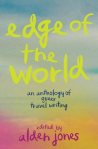 Edge of the World: An Anthology of Queer Travel Writing, ed. Alden Jones: Sixteen authors of diverse sexual orientations and genders contrast here and there and then and now as they narrate sensory memories and personal epiphanies. In these pieces, time abroad sparks clarity. There’s power in queer solidarity, whether one is in Berlin or Key West. Alex Marzano-Lesnevich’s piece is the highlight. A stellar anthology of miniature travelogues that are as illuminating about identity as they are about the places they feature.
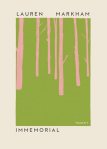 Immemorial by Lauren Markham: An outstanding book-length essay that compares language, memorials, and rituals as strategies for coping with climate anxiety and grief. The dichotomies of the physical versus the abstract and the permanent versus the ephemeral are explored. Forthright, wistful, and determined, the book treats grief as a positive, as “fuel” or a “portal.” Hope is not theoretical in this setup, but solidified in action. This is an elegant meditation on memory and impermanence in an age of climate crisis.
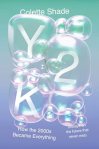 Y2K: How the 2000s Became Everything (Essays on the Future that Never Was) by Colette Shade: Shade’s debut collection contains 10 perceptive essays that contrast the promise and political pitfalls of “the Y2K Era” (1997–2008). The author recalls the thrill of early Internet use and celebrity culture. Consumerism was a fundamental doctrine but the financial crash prompted a loss of faith in progress. Outer space motifs, reality television, Smashmouth lyrics: it’s a feast of millennial nostalgia. Yet this hard-hitting work of cultural criticism, recommended to Jia Tolentino fans, reminisces only to burst bubbles.
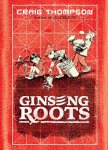 Ginseng Roots by Craig Thompson: A book about everything, by way of ginseng. It begins with Thompson’s childhood summers working on American ginseng farms with his siblings in Marathon, Wisconsin. As an adult, he travels first to Midwest ginseng farms and festivals and then through China and Korea to learn about the plant’s history, cultivation, lore, and medicinal uses. Roots are symbolic of a family story that unfolds in parallel. Both expansive and intimate, this is a surprising gem from one of the best long-form graphic storytellers.
Poetry
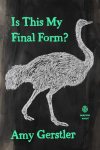 Is This My Final Form? by Amy Gerstler: This delightfully odd collection amazes with its range of voices and techniques. It leaps from surrealism to elegy as it ponders life’s unpredictability. The language of transformation is integrated throughout. Aging and the seasons are examples of everyday changes. Elsewhere, speakers fall in love with the bride of Frankenstein or turn to dinosaur urine for a wellness regimen. Monologues and sonnets recur. Alliteration plus internal and end rhymes create satisfying resonance.
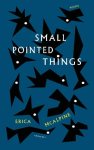 Small Pointed Things by Erica McAlpine: McAlpine’s second collection is full of flora and fauna imagery. The title phrase comes from the opening poem, “Bats and Swallows” – in the “gloaming,” it’s hard to tell the difference between the flying creatures. The verse is bursting with alliteration and end rhymes. She expands the view through conversations, theories and travel. What-ifs, consequences and regrets; mythical allusions, elegies and the concerns of motherhood. Just my sort of poetry: sweet on the ear, rooted in nature and the everyday.
Which of these grab your attention? What other 2025 releases should I catch up on?
20 Books of Summer, 1–3: Chimamanda Ngozi Adichie, Daisy Johnson & Ruth Padel
It’s been a slow start to #20BooksofSummer2025 for me, but I’ll hope to do some catching up during our Scotland holiday and then once we’re home in July. So far, I’m sticking to the list I chose last month. These first few were slightly disappointing, to be honest, but I have no doubt I’ll find some gems among my original selections.
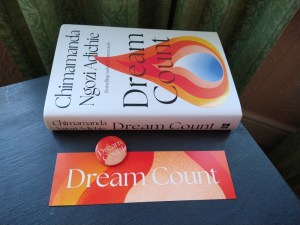
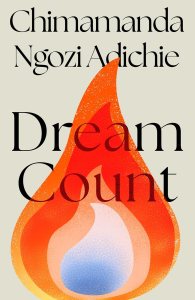
Dream Count by Chimamanda Ngozi Adichie (2025)
This was one of my Most Anticipated books of the year and had a lot to live up to as Adichie’s first novel since the amazing Americanah. When I first attempted to read it, I was dismayed by how much it felt like a rehashing of Americanah, with Chia (a travel writer in Maryland) and her cousin Omelogor (a feminist blogger) together reminiscent of Ifemelu. It did get more readable and somewhat more interesting as it went on. But instead of finding the narration and structure natural, I ended up full of questions about what Adichie intended.
 Why four main characters? Why is it the one non-Nigerian who’s poor, victimized, and less proficient in English? (That Kadiatou is based on a real person doesn’t explain enough. Her plight does at least provide what plot there is.) Why are the other three, to varying extents, rich and pretentious? Why are two narratives in the first person and two in the third person? Why in such long chunks instead of switching the POV more often? Why so many men, all of them more or less useless? (All these heterosexual relationships – so boring!) Why bring Covid into it apart from for verisimilitude? But why is the point in time important? What point is she trying to convey about pornography, the subject of Omelogor’s research?
It’s Adichie, so of course she writes solid prose with engaging characters, convincing dialogue, and provocative ideas. There’s a focus here on women’s experiences of attempted or actual motherhood (e.g., PMDD, fibroids, single parenthood or pressure to adopt), and, as per usual, a bit about race (specifically colorism, ethnic prejudice, and code-switching). But the characters’ connections seem weak, their coverage of the range of women’s experiences narrow. The title is, I suppose, the best clue to what Adichie wanted to do with the novel. Everyone dreams of finding, or preserving, love and family. Chia yearns for someone who will truly know her, and because she’s convinced this will be a romantic bond she devotes lockdown to a mental inventory of past relationships. Kadiatou dreams of peace more than of justice, and only in that she gets what she wants is there a happy ending of sorts. I wish I could be more positive, but this was a slog for me. (New purchase – Hungerford Bookshop) 
The Hotel by Daisy Johnson (2024)
I’d really enjoyed Johnson’s two novels, Everything Under and Sisters, and have a copy of her previous short story collection, Fen, on the shelf. This completely passed my notice last year. I liked the idea of eerie linked short stories, but I wish I’d known this was originally written for radio as I think it accounts for how simplistic and insubstantial the 15 tales are.
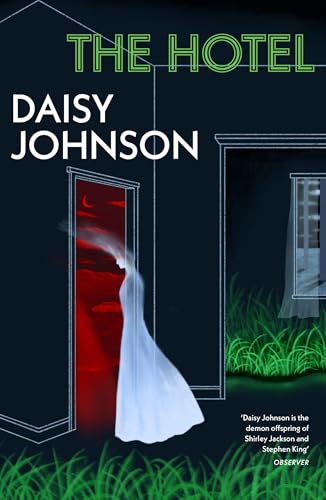 The Hotel is a fenland folly, built on the site of a pond where a suspected witch was drowned. Ever after, it is a cursed place. Those who build the hotel and stay in it are subject to violence, fear, and eruptions of the unexplained – especially if they go in Room 63. Anyone who visits once seems doomed to return. Most of the stories are in the first person, which makes sense for dramatic monologues. The speakers are guests, employees, and monsters. Some are BIPOC or queer, as if to tick off demographic boxes. Just before the Hotel burns down in 2019, it becomes the subject of an amateur student film like The Blair Witch Project.
Scary books don’t tend to work for me because I am often too aware of how they are constructed and so fail to give myself over to the reading experience and take them seriously. I can’t summon much enthusiasm for these stories, though I suppose the setting is rather atmospheric. My favourite was “Infestation,” about two girls – the one (not randomly) named Shirley – who think they discover something down in the laundry room in 1968. Only one of them makes it out alive. Okay, this one was creepy, but the rest left me unmoved. (Gift – purchased with Hungerford Bookshop with Christmas token) 
Girl by Ruth Padel (2024)
Padel is one of my favourite poets and a repeat appearance on my summer reading list; I reviewed her Emerald in 2021. I’ve read 12 of her books now. This collection is about girlhood, by way of personal history and myth.
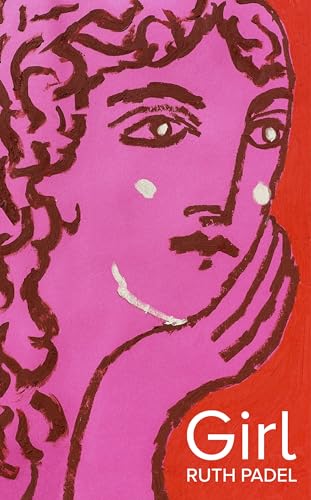 The first section, “When the Angel Comes for You,” is about the Virgin Mary, its 15 poems corresponding to the 15 Mysteries of the Rosary (as Padel explains in a note at the end; had she not, that would have gone over my head). The opening poem about the Annunciation is the most memorable its contemporary imagery emphasizing Mary’s youth and naivete: “a flood of real fear / and your heart / in the cowl-neck T-shirt from Primark / suddenly convulsed. But your old life // now seems dry as a stubbed / cigarette.” The third section, “Lady of the Labyrinth,” is about Ariadne, inspired by the snake goddess figurines in a museum on Crete. The message here is the same: “there is always the question of power / and girl is a trajectory / of learning how to deal with it”.
But the only poems that truly stood out to me are in the central autobiographical section arising from Padel’s own girlhood as well as her observations of her daughter and grandchild (setting up a Maiden–Mother–Crone triad). “Girl in a Forest” and “Tomboy and Panther” draw on the lure of the jungle to depict a wild child who chooses trousers over skirts. I loved “Fair Verona” for its traveler’s nostalgia but also for the hint of menace: so many tourists fondled the breast on a statue of Juliet that it had to be replaced. “How much touching // does it take for a bronze breast to crack?” the poet asks.
There’s some good alliteration throughout, and I warmed to the vision of girlhood as a time of promise and possibility: “the wonder / the where shall I go what new thing / will this day bring of being a girl.” Overall, though, I didn’t think the book had a lot of substance to convey about its theme. (Gift – purchased with Hungerford Bookshop with Christmas token)
Off to Scotland today. I’ve packed Ice Cream by Helen Dunmore and Pet Sematary by Stephen King from my 20 Books list, plus other books I may substitute in. I’m scheduling a few posts for while we’re away; forgive me if I don’t reply to comments until July.
Three on a Theme for Father’s Day: Holt Poetry, Filgate & Virago Anthologies
A rare second post in a day for me; I got behind with my planned cat book reviews. I happen to have had a couple of fatherhood-themed books come my way earlier this year, an essay anthology and a debut poetry collection. To make it a trio, I finished an anthology of autobiographical essays about father–daughter relationships that I’d started last year.
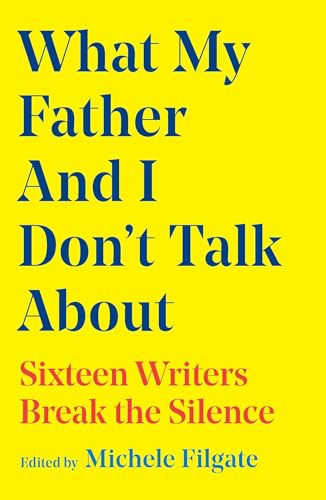
What My Father and I Don’t Talk About: Sixteen Writers Break the Silence, ed. Michele Filgate (2025)
This follow-up to Michele Filgate’s What My Mother and I Don’t Talk About is an anthology of 16 compassionate, nuanced essays probing the intricacies of family relationships.
 Understanding a father’s background can be the key to interpreting his later behavior. Isle McElroy had to fight for scraps of attention from their electrician father, who grew up in foster care; Susan Muaddi Darraj’s Palestinian father was sent to America to make money to send home. Such experiences might explain why the men were unreliable or demanding as adults. Patterns threaten to repeat across the generations: Andrew Altschul realizes his father’s hands-off parenting (he joked he’d changed a diaper “once”) was an outmoded convention he rejects in raising his own son; Jaquira Díaz learns that the depression she and her father battle stemmed from his tragic loss of his first family.
Some take the title brief literally: Heather Sellers dares to ask her father about his cross-dressing when she visits him in a nursing home; Nayomi Munaweera is pleased her 82-year-old father can escape his arranged marriage, but the domestic violence that went on in it remains unspoken. Tomás Q. Morín’s “Operation” has the most original structure, with the board game’s body parts serving as headings. All the essays display psychological insight, but Alex Marzano-Lesnevich’s—contrasting their father’s once-controlling nature with his elderly vulnerability—is the pinnacle.
Despite the heavy topics—estrangement, illness, emotional detachment—these candid pieces thrill with their variety and their resonant themes. (Read via Edelweiss)
Reprinted with permission from Shelf Awareness. (The above is my unedited version.)
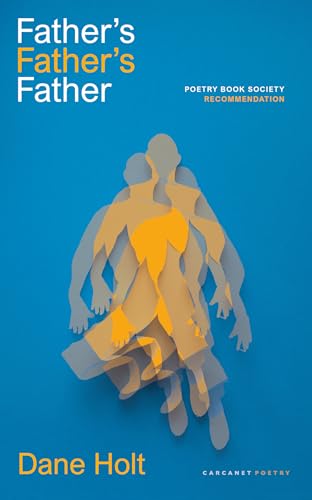
Father’s Father’s Father by Dane Holt (2025)
Holt’s debut collection interrogates masculinity through poems about bodybuilders and professional wrestlers, teenage risk-taking and family misdemeanours.
Your father’s father’s father
poisoned a beautiful horse,
that’s the story. Now you know this
you’ve opened the door marked
‘Family History’.
(from “‘The Granaries are Bursting with Meal’”)
The only records found in my grandmother’s attic
were by scorned women for scorned women
written by men.
(from “Tammy Wynette”)
He writes in the wake of the deaths of his parents, which, as W.S. Merwin observed, makes one feel, “I could do anything,” – though here the poet concludes, “The answer can be nothing.” Stylistically, the collection is more various than cohesive, with some of the late poetry as absurdist as you find in Caroline Bird’s. My favourite poem is “Humphrey Bogart,” with its vision of male toughness reinforced by previous generations’ emotional repression:
My grandfather
never told his son that he loved him.
I said this to a group of strangers
and then said, Consider this:
his son never asked to be told.
They both loved
the men Humphrey Bogart played.
…
There was
one thing my grandfather could
not forgive his son for.
Eventually it was his son’s dying, yes.
With thanks to Carcanet Press for the free e-copy for review.
Fathers: Reflections by Daughters, ed. Ursula Owen (1983; 1994)
“I doubt if my father will ever lose his power to wound me, and yet…”
~Eileen Fairweather
I read the introduction and first seven pieces (one of them a retelling of a fairy tale) last year and reviewed that first batch here. Some common elements I noted in those were service in a world war, Freudian interpretation, and the alignment of the father with God. The writers often depicted their fathers as unknown, aloof, or as disciplinarians. In the remainder of the book, I particularly noted differences in generations and class. Father and daughter are often separated by 40–55 years. The men work in industry; their daughters turn to academia. Her embrace of radicalism or feminism can alienate a man of conservative mores.
 Sometimes a father is defined by his emotional or literal absence. Dinah Brooke addresses her late father directly: “Obsessed with you for years, but blind – seeing only the huge holes you had left in my life, and not you at all. … I did so want someone to be a father to me. You did the best you could. It wasn’t a lot. The desire was there, but the execution was feeble.” Had Mary Gordon been tempted to romanticize her father, who died when she was seven, that aim was shattered when she learned how much he’d lied about and read his reactionary and ironically antisemitic writings (given that he was a Jew who converted to Catholicism).
I mostly skipped over the quotes from novels and academic works printed between the essays. There are solid pieces by Adrienne Rich, Michèle Roberts, Sheila Rowbotham, and Alice Walker, but Alice Munro knocks all the other contributors into a cocked hat with “Working for a Living,” which is as detailed and psychologically incisive as one of her stories (cf. The Beggar Maid with its urban/rural class divide). Her parents owned a fox farm but, as it failed, her father took a job as night watchman at a factory. She didn’t realize, until one day when she went in person to deliver a message, that he was a janitor there as well.
This was a rewarding collection to read and I will keep it around for models of autobiographical writing, but it now feels like a period piece: the fact that so many of the fathers had lived through the world wars, I think, might account for their cold and withdrawn nature – they were damaged, times were tough, and they believed they had to be an authority figure. Things have changed, somewhat, as the Filgate anthology reflects, though father issues will no doubt always be with us. (Secondhand – National Trust bookshop)
#ReadingtheMeow2025, Part II: Books by Mayo, Reinhold, Taylor and More
This year’s Reading the Meow challenge is drawing to a close. I’m adding to my first set of reviews with these selections: a novelty book about women and cats, an autobiographical sequel about an animal-lover’s menagerie in Provence, and a travel book about Scottish wildcats – plus a one-off essay that drew me in for its title and one more children’s book.
Behind Every Great Woman Is a Great Cat (2019)
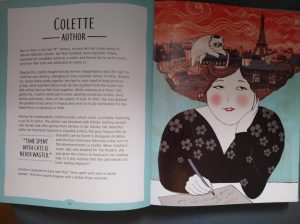
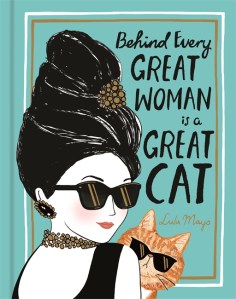 The only name on the cover is Lulu Mayo, who does the illustrations. That’s your clue that the text (by Justine Solomons-Moat) is pretty much incidental; this is basically a YA mini coffee table book. I found it pleasant enough to read bits of at bedtime but it’s not about to win any prizes. (I mean, it prints “prolificate” twice; that ain’t a word. Proliferate is.) Among the famous cat ladies given one-page profiles are Georgia O’Keeffe, Jacinda Ardern, Vivien Leigh, and Anne Frank. I hadn’t heard of the Scottish Fold cat breed, but now I know that they’ve become popular thanks Taylor Swift. The few informational interludes are pretty silly, though I did actually learn that a cat heads straight for the non-cat person in the room (like our friend Steve) because they find eye contact with strangers challenging so find the person who’s ignoring them the least threatening. I liked the end of the piece on Judith Kerr: “To her, cats were symbols of home, sources of inspiration and constant companions. It’s no wonder that she once observed, ‘they’re very interesting people, cats.’” (Christmas gift, secondhand)
Watchers in the Sun: Life at Mas des Chats by Margaret Reinhold (1994)
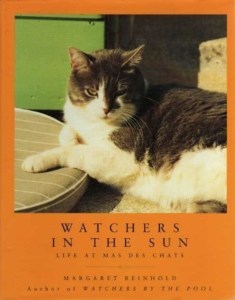 Last year I read the previous book, Sanctuary in the South (also titled Watchers by the Pool) on holiday. This is more of the same: pleasant stories about the personalities and interactions of a rotating cast of cats, some of whom she’d brought with her from England to Provence, others who transformed from strays she fed outdoors to part of the indoor hierarchy. Lily is the grande dame with private quarters upstairs; Monsieur le Gris is the top cat, bullying several younger cats but forming strong bonds with others. Most of the time Reinhold seems to hit a natural limit of nine, but that’s with several dying and being replaced by cats who wandered in or kittens people brought her. She also has two dogs and at one point rescues an old, deaf spaniel from drowning. Her French neighbours seem (to her, and probably us readers) strangely unsentimental about their pets by comparison. I enjoyed this a bit less than the first book because it was so similar – again with the Doreen Tovey-like anecdotes about the local humans – and because with the former I had the benefit of reading it on location in the South of France. The photographs by William Gooddy are a quaint reminder of the days when you shot a roll of film and had no idea how your photos had turned out until you got it developed. Even if some were blurry or underexposed, you used them because that was the best you had! (Secondhand purchase – Awesomebooks.com)
Tracking the Highland Tiger: In Search of Scottish Wildcats by Marianne Taylor (2019)
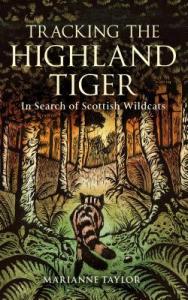 A perfect segue from Reading the Meow to our Scotland holiday coming up on Friday. I’d not heard of Taylor although she’s a prolific natural history writer. Such species quest narratives have become very common. The contextual information about the world’s cat species and the difference between Scottish wildcats and domestic cats, including the example of a half-feral cat she adopted, is fairly interesting, but the way she separates it from her trips to Speyside and Ardnamurchan to look for wildcats in 2013–18, which are each given their own chapter, feels odd. A similar book being published today would have blended the travel, research, and autobiographical information better. There’s plenty of habitat in the Scottish mountains for wildcats; the problem they face is hybridization with domestic cats. There’s no such thing as a purebred anymore. Captive breeding and reintroductions are the only way the species is likely to survive. “Timing a trip to look for Scottish wildcats is difficult in a way, but in another way it’s not: no matter what time you go, you’re almost guaranteed not to see one.” (At least she’s self-deprecating about it.) For most of the way through, you’re convinced the author will never find one. But you’ve got to keep hoping…
[I got this from a Little Free Library on Lewis, probably the most remote one I’ve ever frequented. Alas, it’s the only one in the Outer Hebrides and there aren’t any others that we’ll pass by on our travels in the Highlands.]
And a couple of bonus books:
 The Mousehole Cat by Antonia Barber; illus. Nicola Bayley (1990) – The town of Mousehole in Cornwall (the far southwest of England) relies on fishing. Old Tom brings some of his catch home every day for his cat Mowzer; they have a household menu with a different fishy dish for each day of the week. One winter a storm prevents the fishing boats from leaving the cove and the people – and kitties – start to starve. Tom decides he’ll go out in his boat anyway, and Mowzer goes along to sing and tame the Great Storm-Cat. This story of bravery was ever so cute, words and pictures both, and I especially liked how Mowzer considers Tom her pet. (Free from a neighbour)
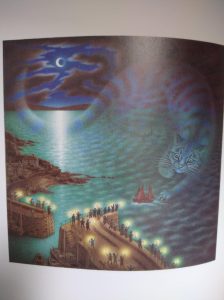
“A Conversation with a Cat” from A Conversation with a Cat and Others by Hilaire Belloc (1931) – I have no idea how I came across this but I had to borrow it for the title. Alas, only the six-page opening story is actually about a cat; the rest is, I suspect, light essays in the vein of Jerome K. Jerome. In the title piece, a man stops for a beer at a railway station bar and a beautiful long-haired cat jumps up onto his lap. “If it be true that nations have the cats they deserve, then the English people deserve well in cats, for there are none so prosperous or friendly in the world,” he thinks. He considers himself chosen and names the cat “Amathea.” He monologues to her about how comforting her presence is (“there is not a man living who knows better than I that the four charms of a cat lie in its closed eyes, its long and lovely hair, its silence, and even its affected love”) and how wonderful it is that she knows nothing of mortality. “You will never leave me. I will respect your sleep and we will sit here together through all uncounted time,” he vows. At which point she, of course, hops down and promptly approaches another patron for attention. Just like a cat. (University library)


I also enjoyed this page from Awkward Family Photos by Mike Bender and Doug Chernack, which I perused from the Little Free Library:

I’ve had such fun with Reading the Meow this year! Thanks again to Mallika for hosting it. My favourite read of the challenge was Poets Square, followed by Mornings without Mii. The Mousehole Cat was great, too. (All are pictured below apart from Mii, which I read on Kindle.)

#ReadingtheMeow2025, Part I: Books by Gustafson, Inaba, Tomlinson and More
It’s the start of the third annual week-long Reading the Meow challenge, hosted by Mallika of Literary Potpourri! For my first set of reviews, I have two lovely memoirs of life with cats, and a few cute children’s books.
Poets Square: A Memoir in Thirty Cats by Courtney Gustafson (2025)
This was on my Most Anticipated list and surpassed my expectations. Because I’m a snob and knew only that the author was a young influencer, I was pleasantly surprised by the quality of the prose and the depth of the social analysis. After Gustafson left academia, she became trapped in a cycle of dead-end jobs and rising rents. Working for a food bank, she saw firsthand how broken systems and poverty wear people down. She’d recently started feeding and getting veterinary care for the 30 feral cats of a colony in her Poets Square neighbourhood in Tucson, Arizona. They all have unique personalities and interactions, such as Sad Boy and Lola, a loyal bonded pair; and MK, who made Georgie her surrogate baby. Gustafson doled out quirky names and made the cats Instagram stars (@PoetsSquareCats). Soon she also became involved in other local trap, neuter and release initiatives.
That the German translation is titled “Cats and Capitalism” gives an idea of how the themes are linked here: cat colonies tend to crop up where deprivation prevails. Stray cats, who live short and difficult lives, more reliably receive compassion than struggling people for whom the same is true. TNR work takes Gustafson to places where residents are only just clinging on to solvency or where hoarding situations have gotten out of control. I also appreciated a chapter that draws a parallel between how she has been perceived as a young woman and how female cats are deemed “slutty.” (Having a cat spayed so she does not undergo constant pregnancies is a kindness.) She also interrogates the “cat mom” stereotype through an account of her relationship with her mother and her own decision not to have children.
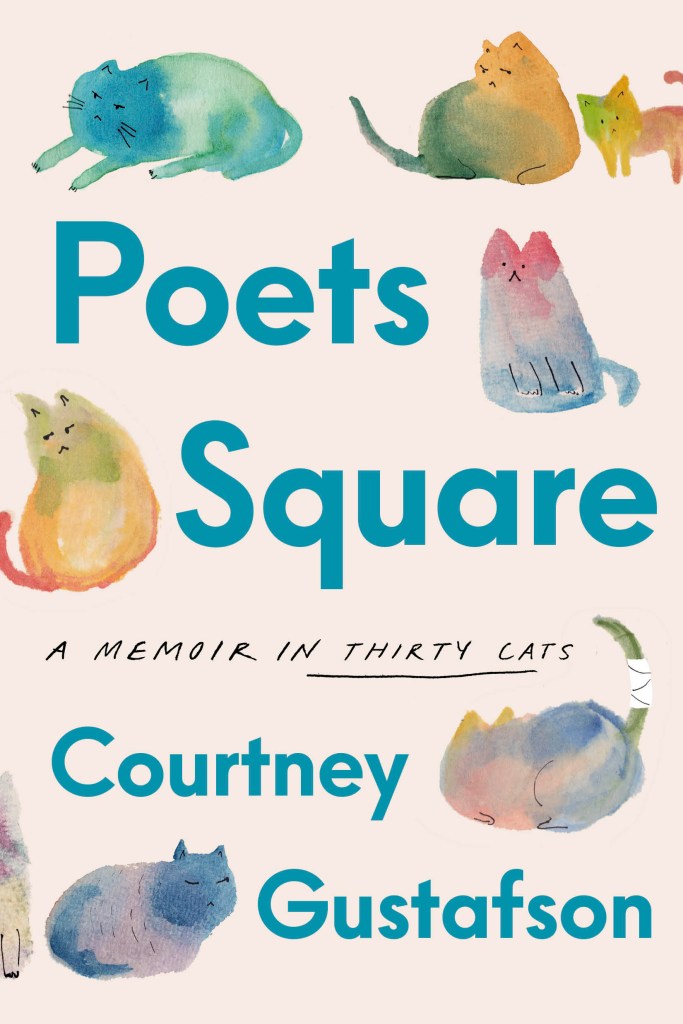
Gustafson knows how lucky she is to have escaped a paycheck-to-paycheck existence. Fame came seemingly out of nowhere when a TikTok video she posted about preparing a mini Thanksgiving dinner for the cats went viral. Social media and cat rescue work helped a shy, often ill person be less lonely, giving her “a community, a sense of rootedness, a purpose outside myself.” (Moreover, her Internet following literally ensured she had a place to live: when her rental house was being sold out from under her, a crowdfunding campaign allowed her to buy the house and save the cats.) However, they have also made her aware of a “constant undercurrent of suffering.” There are multiple cat deaths in the book, as you might expect. The author has become inured over time; she allows herself five minutes to cry, then moves on to help other cats. It’s easy to be overwhelmed or succumb to despair, but she chooses to focus on the “small acts of care by people trying hard” that can reduce suffering.
With its radiant portraits of individual cats and its realistic perspective on personal and collective problems, this is both a cathartic memoir and a probing study of how we build communities of care in times of hardship.
With thanks to Fig Tree (Penguin) for the proof copy for review.
Mornings without Mii by Mayumi Inaba (1999; 2024)
[Translated from Japanese by Ginny Tapley Takemori]
Inaba (1950–2014) was an award-winning novelist and poet. I can’t think why it took 25 years for this to be translated into English but assume it was considered a minor work of hers and was brought out to capitalize on the continuing success of cat-themed Japanese literature from The Guest Cat onward. Interestingly, it’s titled Mornings with Mii in the UK, which shifts the focus and is truer to the contents. Yes, by the end, Inaba is without Mii and dreading the days ahead, but before that she got 20 years of companionship. One day in the summer of 1977, Inaba heard a kitten’s cries on the breeze and finally located it, stuck so high in a school fence that someone must have left her there deliberately. The little fleabitten calico was named after the sound of her cry and ever after was afraid of heights.
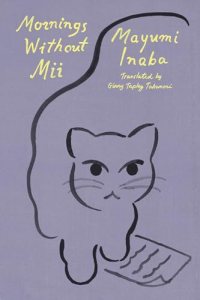 Inaba traces the turning of the seasons and the passing of the years through the changes they brought for her and for Mii. When she separated, moved to a new part of Tokyo, and started devoting her evenings to writing in addition to her full-time job, Mii was her closest friend. The new apartment didn’t have any green space, so instead of wandering in the woods Mii had to get used to exercising in the corridors. There were some scares: a surprise pregnancy nearly killed her, and once she went missing. And then there was the inevitable decline. Mii’s intestinal issues led to incontinence. For four years, Inaba endured her home reeking of urine. Many readers may, like me, be taken aback by how long Inaba kept Mii alive. She manually assisted the cat with elimination for years; 20 days passed between when Mii stopped eating and when she died. On the plus side, she got a “natural” death at home, but her quality of life in these years is somewhat alarming. I cried buckets through these later chapters, thinking of the friendship and intimate communion I had with Alfie. I can understand why Inaba couldn’t bear to say goodbye to Mii any earlier, especially because she’d lived alone since her divorce.
This memoir really captures the mixture of joy and heartache that comes with loving a pet. It’s an emotional connection that can take over your life in a good way but leave you bereft when it’s gone. There is nostalgia for the good days with Mii, but also regret and a heavy sense of responsibility. A number of the chapters end with a poem about Mii, but the prose, too, has haiku-like elegance and simplicity. It’s a beautiful book I can strongly recommend. (Read via Edelweiss)
let’s sleep
So as not to hear your departing footsteps
She won’t be here next year I know
I know we won’t have this time again
On this bright afternoon overcome with an unfathomable sadness
The greenery shines in my cat’s gentle eyes
I didn’t have any particular faith, but the one thing I did believe in was light. Just being in warm light, I could be with the people and the cat I had lost from my life. My mornings without Mii would start tomorrow. … Mii had returned to the light, and I would still be able to meet her there hundreds, thousands of times again.
The Cat Who Wanted to Go Home by Jill Tomlinson (1972)
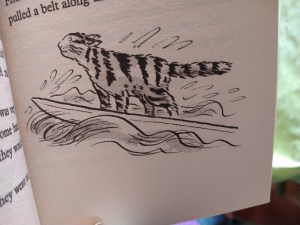
 Suzy the cat lives in a French seaside village with a fisherman and his family of four sons. One day, she curls up to sleep in a basket only to wake up airborne – it’s a hot air balloon, taking her to England! Here the RSPCA place her with old Auntie Jo, who feeds her well, but Suzy longs to get back home. “Chez-moi” is her constant cry, which everyone thinks is an awfully funny way to say miaow (“She purred in French, [too,] but purring sounds the same all over the world”). Each day she hops into the basket of Auntie Jo’s bike for a ride to town to try a new route over the sea: in a kayak, on a surfboard, paddling alongside a Channel swimmer, and so on. Each attempt fails and she returns to her temporary lodgings: shared with a parrot named Biff and comfortable, yet not quite right. Until one day… This is a sweet little story (a 77-page paperback) for new readers to experience along with a parent, with just enough repetition to be soothing and a reassuring message about the benevolence of strangers. Susan Hellard’s illustrations are charming. (Secondhand – local library book sale)
And a couple of other children’s books:
 Mittens for Kittens and Other Rhymes about Cats, ed. Lenore Blegvad; illus. Erik Blegvad (1974) – A selection of traditional English and Scottish nursery rhymes, a few of them true to the nature of cats but most of them just nonsensical. You’ve got to love the drawings, though. (Secondhand – Hay Castle honesty shelves)


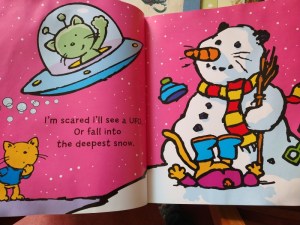
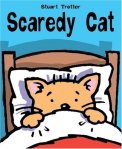 Scaredy Cat by Stuart Trotter (2007) – Rhyming couplets about everyday childhood fears and what makes them better. I thought it unfortunate that the young cat is afraid of other creatures; to be afraid of dogs is understandable, but three pages about not liking invertebrates is the wrong message to be sending. (Little Free Library)
Literary Wives Club: The Constant Wife by W. Somerset Maugham (1927)
As far as I know, this is the first play we’ve chosen for the club. While I’m a Maugham fan, I haven’t read him in a while and I’ve never explored his work for the theatre. The Constant Wife is a straightforward three-act play with one setting: a large parlour in the Middletons’ home in Harley Street, London. A true drawing room comedy, then, with very simple staging.
{SPOILERS IN THE REMAINDER}
Rumours are circulating that surgeon John Middleton has been having an affair with his wife Constance’s best friend, Marie-Louise. It’s news to Mrs. Culver and Martha, Constance’s mother and sister – but not to Constance herself. Mrs. Culver, the traditional voice of a previous generation, opines that men are wont to stray and so long as the wife doesn’t find out, what harm can it do? Women, on the other hand, are “naturally faithful creatures and we’re faithful because we have no particular inclination to be anything else,” she says.
Other characters enter in twos and threes for gossip and repartee and the occasional confrontation. Marie-Louise’s husband, Mortimer Durham, shows up fuming because he’s found John’s cigarette-case under her pillow and assumes it can only mean one thing. Constance is in the odd position of defending her husband’s and best friend’s honour, even though she knows full well that they’re guilty. With her white lies, she does them the kindness of keeping their indiscretion quiet – and gives herself the moral upper hand.
Constance is matter of fact about the fading of romance. She is grateful to have had a blissful first five years of marriage; how convenient that both she and John then fell out of love with each other at the same time. The decade since has been about practicalities. Thanks to John, she has a home, respectability, and fine belongings (also a child, only mentioned in passing); why give all that up? She’s still fond of John, anyway, and his infidelity has only bruised her vanity. However, she wants more from life, and a sheepish John is inclined to give her whatever she asks. So she agrees to join an acquaintance’s interior decorating business.
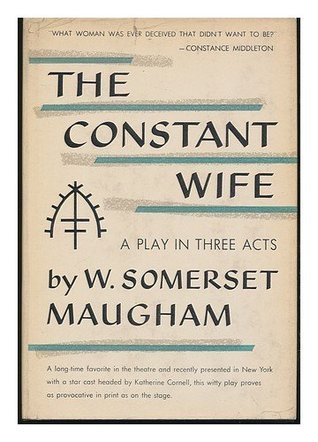
The early reappearance of her old flame Bernard Kersal, who is clearly still smitten with her, seeds her even more daring decision in the final act, set one year after the main events. Having earned £1400 of her own money, she has more than enough to cover a six-week holiday in Italy. She announces to John that she’s deposited the remainder in his account “for my year’s keep,” and slyly adds that she’ll be travelling with Bernard. This part turns out to be a bluff, but it’s her way of testing their new balance of power. “I’m not dependent on John. I’m economically independent, and therefore I claim my sexual independence,” she declares in her mother’s company.
There are some very funny moments in the play, such as when Constance tells her mother she’ll place a handkerchief on the piano as a secret sign during a conversation. Her mother then forgets what it signifies and Constance ends up pulling three hankies in a row from her handbag. I had to laugh at Mrs. Culver’s test for knowing whether you’re in love with someone: “Could you use his toothbrush?” It’s also amusing that Constance ends up being the one to break up with John for Marie-Louise, and with Marie-Louise for John.
However, there are also hidden depths of feeling meant to be brought out by the actors. At least three times in scenes between John and Constance, I noted the stage direction “Breaking down” in parentheses. The audience, therefore, is sometimes privy to the emotion that these characters can’t express to each other because of their sardonic wit and stiff upper lips.
I hardly ever experience plays, so this was interesting for a change. At only 70-some pages, it’s a quick read even if a bit old-fashioned or tedious in places. It does seem ahead of its time in questioning just what being true to a spouse might mean. A clever and iconoclastic comedy of manners, it’s a pleasant waystation between Oscar Wilde and Alan Ayckbourn.
(Free download from Internet Archive – is this legit or a copyright scam??) 
The main question we ask about the books we read for Literary Wives is:
What does this book say about wives or about the experience of being a wife?
Answered by means of quotes from Constance.
- Partnership is important, yes, but so is independence. (Money matters often crop up in the books we read for the club.)
“there is only one freedom that is really important, and that is economic freedom”
- Marriage often outlasts the initial spark of lust, and can survive one or both partners’ sexual peccadilloes. (Maugham, of course, was a closeted homosexual married to a woman.)
“I am tired of being the modern wife.” When her mother asks for clarification, she adds rather bluntly, “A prostitute who doesn’t deliver the goods.”
“I may be unfaithful, but I am constant. I always think that’s my most endearing quality.”
We have a new member joining us this month: Becky, from Australia, who blogs at Aidanvale. Welcome! Here’s the group’s page on Kay’s website.
See Becky’s, Kate’s, Kay’s and Naomi’s reviews, too!
Coming up next, in September: Novel about My Wife by Emily Perkins
May Releases, Part II (Fiction): Le Blevennec, Lynch, Puchner, Stanley, Ullmann, and Wald
A cornucopia of May novels, ranging from novella to doorstopper and from Montana to Tunisia; less of a spread in time: only the 1980s to now. Just a paragraph on each to keep things simple. I’ll catch up soon with May nonfiction and poetry releases I read.
Friends and Lovers by Nolwenn Le Blevennec (2023; 2025)
[Translated from French by Madeleine Rogers]
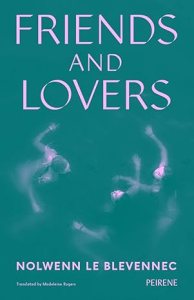 Armelle, Rim, and Anna are best friends – the first two since childhood. They formed a trio a decade or so ago when they worked on the same magazine. Now in their mid-thirties, partnered and with children, they’re all gripped by a sexual “great awakening” and long to escape Paris and their domestic commitments – “we went through it, this mutiny, like three sisters,” poised to blow up the “perfectly executed choreography of work, relationships, children”. The friends travel to Tunisia together in December 2014, then several years later take a completely different holiday: a disaster-prone stay in a lighthouse-keeper’s cottage on an island off the coast of Brittany. They used to tolerate each other’s foibles and infidelities, but now resentment has sprouted up, especially as Armelle (the narrator) is writing a screenplay about female friendship that’s clearly inspired by Rim and Anna. Armelle is relatably neurotic (a hilarious French blurb for the author’s previous novel is not wrong: “Woody Allen meets Annie Ernaux”) and this is wise about intimacy and duplicity, yet I never felt invested in any of the three women or sufficiently knowledgeable about their lives.
With thanks to Peirene Press for the free copy for review.
A Family Matter by Claire Lynch
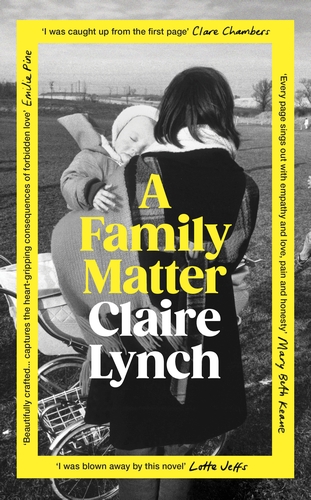 “The fluke of being born at a slightly different time, or in a slightly different place, all that might gift you or cost you.” At events for Small, Lynch’s terrific memoir about how she and her wife had children, women would speak up about how different their experience had been. Lesbians born just 10 or 20 years earlier didn’t have the same options. Often, they were in heterosexual marriages because that’s all they knew to do; certainly the only way they thought they could become mothers. In her research into divorce cases in the UK in the 1980s, Lynch learned that 90% of lesbian mothers lost custody of their children. Her aim with this earnest, delicate debut novel, which bounces between 2022 and 1982, is to imagine such a situation through close portraits of Heron, an ageing man with terminal cancer; his daughter, Maggie, who in her early forties bears responsibility for him and her own children; and Dawn, who loved Maggie desperately but felt when she met Hazel that she was “alive at last, at twenty-three.” How heartbreaking that Maggie knew only that her mother abandoned her when she was little; not until she comes across legal documents and newspaper clippings does she understand the circumstances. Lynch made the wise decision to invite sympathy for Heron from the start, so he doesn’t become the easy villain of the piece. Her compassion, and thus ours, is equal for all three characters. This confident, tender story of changing mores and steadfast love is the new Carol for our times. (Such a lovely but low-key novel was liable to make few ripples, so I’m delighted for Lynch that the U.S. release got a Read with Jenna endorsement.)
With thanks to Chatto & Windus (Penguin) for the proof copy for review.
Dream State by Eric Puchner
 If it starts and ends with a wedding, it must be a comedy. If much of the in between is marked by heartbreak, betrayal, failure, and loss, it must be a tragedy. If it stretches towards 2050 and imagines a Western USA smothered in smoke from near-constant forest fires, it must be an environmental dystopian. Somehow, this novel is all three. The first 163 pages are pure delight: a glistening romantic comedy about the chaos surrounding Charlie and Cece’s wedding at his family’s Montana lake house in the summer of 2004. First half the wedding party falls ill with norovirus, then Charlie’s best friend, Garrett (who’s also the officiant), falls in love with the bride. Do I sound shallow if I admit this was the section I enjoyed the most? The rest of this Oprah’s Book Club doorstopper examines the fallout of this uneasy love triangle. Charlie is an anaesthesiologist, Cece a bookstore owner, and Garrett a wolverine researcher in Glacier National Park, which is steadily losing its wolverines and its glaciers. The next generation comes of age in a diminished world, turning to acting or addiction. There are still plenty of lighter moments: funny set-pieces, warm family interactions, private jokes and quirky descriptions. But this feels like an appropriately grown-up vision of idealism ceding to a reality we all must face. I struggled with a lack of engagement with the children, but loved Puchner’s writing so much on the sentence level that I will certainly seek out more of his work. Imagine this as a cross between Jonathan Franzen and Maggie Shipstead.
With thanks to Sceptre (Hodder) for the proof copy for review.
Consider Yourself Kissed by Jessica Stanley
 Coralie is nearing 30 when her ad agency job transfers her from Australia to London in 2013. Within a few pages, she meets Adam when she rescues his four-year-old, Zora, from a lake. That Adam and Coralie will be together is never really in question. But over the next decade of personal and political events, we wonder whether they have staying power – and whether Coralie, a would-be writer, will lose herself in soul-destroying work and motherhood. Adam’s job as a political journalist and biographer means close coverage of each UK election and referendum. As I’ve thought about some recent Jonathan Coe novels: These events were so depressing to live through, who would want to relive them through fiction? I also found this overlong and drowning in exclamation points. Still, it’s so likable, what with Coralie’s love of literature (the title is from The Group) and adjustment to expat life without her mother; and secondary characters such as Coralie’s brother Daniel and his husband, Adam’s prickly mother and her wife, and the mums Coralie meets through NCT classes. Best of all, though, is her relationship with Zora. This falls solidly between literary fiction and popular/women’s fiction. Given that I was expecting a lighter romance-led read, it surprised me with its depth. It may well be for you if you’re a fan of Meg Mason and David Nicholls.
With thanks to Hutchinson Heinemann for the proof copy for review.
Girl, 1983 by Linn Ullmann (2021; 2025)
[Translated from Norwegian by Martin Aitken]
 Ullmann is the daughter of actress Liv Ullmann and film director Ingmar Bergman. That pedigree perhaps accounts for why she got the opportunity to travel to Paris in the winter of 1983 to model for a renowned photographer. She was 16 at the time and spent the whole trip disoriented: cold, hungry, lost. Unable to retrace the way to her hotel and wearing a blue coat and red hat, she went to the only address she knew – that of the photographer, K, who was in his mid-forties. Their sexual relationship is short-lived and unsurprising, at least in these days of #MeToo revelations. Its specifics would barely fill a page, yet the novel loops around and through the affair for more than 250. Ullmann mostly pulls this off thanks to the language of retrospection. She splits herself both psychically and chronologically. There’s a “you” she keeps addressing, a childhood imaginary friend who morphs into a critical voice of conscience and then the self dissociated from trauma. And there’s the 55-year-old writer looking back with empathy yet still suffering the effects. The repetition made this something of a sombre slog, though. It slots into a feminist autofiction tradition but is not among my favourite examples.
With thanks to Hamish Hamilton (Penguin) for the proof copy for review.
The Bayrose Files by Diane Wald
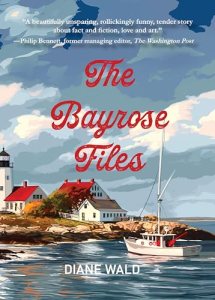 In the 1980s, Boston journalist Violet Maris infiltrates the Provincetown Home for Artists and Writers, intending to write a juicy insider’s exposé of what goes on at this artists’ colony. But to get there she has to commit a deception. Her gay friend Spencer Bayrose has a whole sheaf of unpublished short stories drawing on his Louisiana upbringing, and he offers to let her submit them as her own work to get a place at PHAW. Here Violet finds eccentrics aplenty, and even romance, but when news comes that Spence has AIDS, she has to decide how far she’ll go for a story and what she owes her friend. At barely over 100 pages, this feels more like a long short story, one with a promising setting and a sound plot arc, but not enough time to get to know or particularly care about the characters. I was reminded of books I’ve read by Julia Glass and Sara Maitland. It’s offbeat and good-natured but not top tier.
Published by Regal House Publishing. With thanks to publicist Jackie Karneth of Books Forward for the advanced e-copy for review.
A Family Matter was the best of the bunch for me, followed closely by Dream State.
Which of these do you fancy reading?
 Bookish Beck = Rebecca Foster. American transplant to England. Freelance proofreader and book reviewer.
 Bookish Beck