Review: Hillbilly Elegy by J.D. Vance
“Americans call them hillbillies, rednecks, or white trash. I call them neighbors, friends, and family.”
This is one of those books I’d heard high praise about from America but never thought I’d be able to get hold of in the UK. I looked into borrowing it from the public library on my last trip to the States, but even nearly a year after its publication the reservation list was still a mile long. So I was delighted to hear that Hillbilly Elegy was being released in paperback in the UK last month. For British readers, it will provide a welcome window onto a working-class world that is easily caricatured but harder to understand in a nuanced way.
J.D. Vance knows hillbilly America from the inside but also has the necessary distance to be able to draw helpful conclusions about it: born in the “Rust Belt” of Ohio to parents who didn’t complete high school, he served in the Marine Corps in Iraq, attended Ohio State University and Yale Law School, and became a successful investor with a venture capital firm. He was one of the lucky ones who didn’t give into lower-middle-class despair and widespread vices like alcoholism and hard drugs, even though his mother was an addict and installed a “revolving door of father figures” in his life after his father abandoned them.
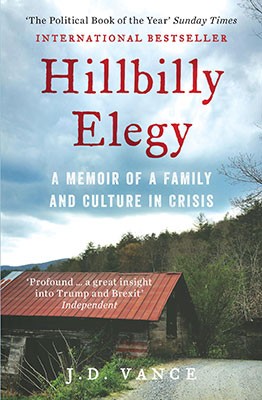 Vance attributes his success to the stability provided by his grandparents, his beloved Mamaw and Papaw. They were part of a large wave of migration from Kentucky to Ohio, where they moved so Papaw could work in the Armco Steel mill. Prejudice assaulted the couple from both sides: Kentucky folk thought they’d grown too big for their britches, while in Ohio they were maligned as dirty hillbillies. Mamaw, in particular, is a wonderful character so eccentric you couldn’t make her up, with her fierce love backed up by a pistol.
The book is powerful because it gives concrete, personal examples of social movements: it’s no dry history of how the Scots-Irish residents of Appalachia switched allegiance from the Democratic Party to the Republican after Richard Nixon, though Vance does fill in these broad brushstrokes, but a family memoir that situates Mamaw and Papaw’s experience, and later his own, in the context of the history of the region and the whole country.
I most appreciated the author’s determined use of the first-person plural, especially later in the book: he includes himself in the hillbilly “we” such that he’s not some newly gentrified snob denouncing welfare queens: he knows these people and this lifestyle and recognizes its contradictions; he also knows that but for the grace of God he could have slipped into the same bad habits.
Jackson [Kentucky] is undoubtedly full of the nicest people in the world; it is also full of drug addicts and at least one man who can find the time to make eight children but can’t find the time to support them. It is unquestionably beautiful, but its beauty is obscured by the environmental waste and loose trash that scatters the countryside. Its people are hardworking, except of course for the many food stamp recipients who show little interest in honest work.
At Yale Law School Vance felt out of place for the first time in his life. One of the most important things he learned from professors like Amy Chua was the value of social capital: in his new world of lawyers, senators and judges it really was all about who you know. At law firm interviews, he had no idea what cutlery to use in restaurants and had to text his girlfriend for help. For as much as he’s adapted to non-hillbilly life in the intervening years, he still notices in himself the hallmarks of a stressful, impoverished upbringing: a fight or flight approach to conflict and an honor culture that makes him prone to nurturing feuds.
Although I enjoyed it simply as a memoir, I can see this book especially appealing to people who are interested in the politics and psychology of the lower middle class (perhaps an American equivalent to Owen Jones’s Chavs, a book I never got through). British readers will, I think, be surprised to learn that Vance is on the conservative end of the spectrum and has political aspirations. Essentially, he doesn’t think the government can fix things for struggling country folk, though certain social policies might help. He seems to think it’s more a question of personal responsibility – and also that churches have a major role to play.
There is a cultural movement in the white working class to blame problems on society or the government, and that movement gains adherents by the day.
Mamaw always had two gods: Jesus Christ and the United States of America. I was no different, and neither was anyone else I knew.
(These strike me as alien ideas in the UK, apart from short-lived strategies like David Cameron’s “Big Society” – except, perhaps, if one goes all the way back to Thatcherism.)
Much has been made in the British press about this book’s ability to explain the rise of Donald Trump. This is an overstatement, and perhaps even misleading, when you consider the author’s conservatism; he never mentions Trump, and never engages in any specific political discussions. But what it is helpful for is exposing a mindset of rugged, defiant individualism that often shades into hopelessness. I have my own share of redneck relatives, and though I feel far removed from the world Vance depicts, I can see its traces in my family tree. I’m glad he had the guts to draw on his experience and write this hard-hitting book.
My rating: 
Hillbilly Elegy: A Memoir of a Family and Culture in Crisis was first published in the UK by William Collins in September 2016. My thanks to Katherine Patrick for sending a free paperback for review.
Note: Ron Howard is to direct and produce a movie version of the book.
Review: How Saints Die by Carmen Marcus
“A story is like a net: you have to make your own; you have to throw the loops just right; you have to be careful what gets in and what gets out, what you catch and what you keep.”
Ten-year-old Ellie Fleck isn’t like the other children in her North Yorkshire town. The daughter of Pete, a grizzled fisherman, and Kate, an Irish Catholic woman who’s in a mental hospital after a presumed suicide attempt, Ellie was raised on stories of selkies and martyrdoms. Superstition infuses her daily life, making her afraid of pool trips with her classmates – it’s bad luck for fishermen to learn to swim – and leading her to expect her dead grandmother’s soul to waft in through an open window on Halloween night.
 What with bullies’ beatings and her teacher Mr. Lockwood’s disapproval, it’s no wonder Ellie misses lots of school, going sea-coaling with her father or running off to the coast alone instead. But with Christmas approaching and Kate due home from the hospital, Ellie’s absences warrant an official visit. Social worker May Fletcher, the mother of Ellie’s new friend Fletch, is also concerned about Ellie’s home life. “How Saints Die,” Ellie and Fletch’s gruesome skit performed as an addendum to the school Nativity play, seems like proof that something is seriously wrong.
This is performance poet Carmen Marcus’s debut novel; from what I can tell it seems partially autobiographical. It powerfully conveys the pull of the sea and the isolation of an unconventional 1980s childhood. The dreamy, hypnotic prose alternates passages from Ellie’s perspective with shorter chapters from the points of view of the adults in her life, including her father, busybody neighbor Mrs. Forster, and May Fletcher. Marcus is equally skilled at the almost stream-of-consciousness passages describing Ellie’s trips to the sea and at humorous one-line descriptions:
Sand and salt in the cut, stinging. Her dad would know what to do. She wants him here, now, to show her. Without him the beach takes her up entirely, the shushshush of the sea and the coarse cackle of the waders at the waters-edge, creakcrackcreakcrackyawyaw; the wind tugging at the shell of her ear. All of it pulling, nipping, cutting at her – snipsnipsnip – and now blood, her edges ragged and wet.
Mrs Forster always smells faintly sweet and acidic like old Christmas cake.
– What are sins?
– They’re like germs but in your thoughts.
It’s easy to get lost in Ellie’s supernatural world of spirits and sea wolves, while the occasional outsider views make it clear just how dangerous some of her notions could be. Like Paula Cocozza’s How to Be Human, this sets up an intriguing contrast between magic realism and madness. The language is full of transformations and fairy tale tropes. I was reminded at times of Amy Sackville’s Orkney and Fiona Melrose’s Midwinter. Although there is perhaps one perilous situation too many at the climax and the resolution is a bit drawn out (and there is also less punctuation than I would like), this is still a strong and absorbing first novel and one I fully expect to see on next year’s Women’s Prize for Fiction longlist.
My rating:
How Saints Die is published in the UK today, July 13th, by Harvill Secker. My thanks to Louise Court for sending a free copy for review.
I Found My Tribe by Ruth Fitzmaurice
Ruth Fitzmaurice’s husband, a filmmaker named Simon, was diagnosed with motor neurone disease in 2008. Like Stephen Hawking, he is wheelchair-bound and motionless, communicating only through the mechanical voice of an eye gaze computer.
My husband is a wonder to me but he is hard to find. I search for him in our home. He breathes through a pipe in his throat. He feels everything but cannot move a muscle. I lie on his chest counting mechanical breaths. I hold his hand but he doesn’t hold back. His darting eyes are the only windows left. I won’t stop searching.
Between their five children under the age of 10 (including twins conceived after Simon’s diagnosis), an aggressive basset hound, and Simon’s army of nurses coming and going 24 hours a day, this is one chaotic household. The recurring challenge is to find pockets of stillness – daydreaming, staring at trees outside her window – and to learn what things can bring her back from the brink of despair, again and again.
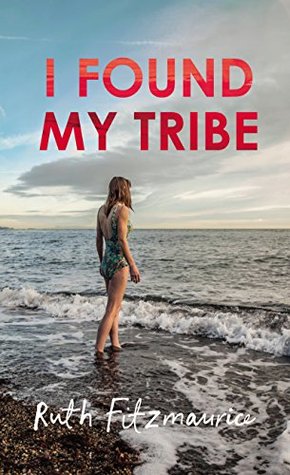 Often these are outdoor experiences: a last hurrah of a six-month holiday in Australia, running, and especially plunging into the Irish Sea with her “Tragic Wives’ Swimming Club” – a group that includes her friend Michelle, whose husband is also in a wheelchair after a motorbike crash, and her favorite of Simon’s nurses, Marian, who has a serious car accident.
Rather than a straight chronological narrative, this is a set of brief thematic essays with titles like “Dancing,” “Fear,” “Twins” and “Holidays.” Fitzmaurice’s story is one you piece together through vivid vignettes from her home life. Her prose is generally composed of short, simple phrases; as with Cathy Rentzenbrink’s The Last Act of Love, you can tell there is deep emotion pulsing under the measured sentences. With such huge questions in play – How much can one person take? What would losing one’s mind look like? – there’s no need for added drama, after all. Instead, the author turns to whimsy, toying with the superhero cliché for caregivers and wondering what magic might be at work in her situation.
I was particularly impressed by how Fitzmaurice holds the past and present in her mind, and by how she uses an outsider’s perspective to imagine herself out of her circumstances. At times she uses the third person for these visions of herself as a younger woman newly in love:
The young wife at her kitchen table knows about deep magic. But I know her future. Life is going to push and pull her like a wave. She doesn’t have a choice and neither do I. Come with me, dear girl, sit at my tablecloth. The journey is upon us and to survive it, you can’t just ride the wave, you have to become one. Can we do this? Let’s go. Becoming a wave just might be the deepest magic of them all.
There are so many poignant moments in this book: memories of their determinedly vegetarian wedding; pulling out all the stops for Simon’s fortieth birthday with customized art installations to brighten his view; leaving the marital bed – now a “hospital contraption” – after six years of MND being a part of their lives; a full moon swim with the Tragic Wives on her and Simon’s anniversary. But all the quiet, everyday stuff has power too, especially her interactions with her precocious children, who are confused about why Dadda is like this.
If I had one tiny complaint, it’s that Simon feels like something of a shadowy figure. In flashbacks we get a real sense of his forceful personality, but this new, silent Simon in the wheelchair is a mystery. Only once or twice does she record words he ‘says’ to her via his computer. Perhaps this is inevitable given how locked into himself he’s become. However, he was still capable of becoming the first person with MND to direct a feature film, on location in County Wicklow (My Name Is Emily). He has told his own story elsewhere; in his wife’s telling, their ventures now seem so separate that they rarely appear as equal partners.
It’s my tenth wedding anniversary tomorrow; as I was reading this I kept thinking that, for as much as I complain (to myself) about how hard marriage is, I’ve had it so easy. The stresses a couple face when caregiving of one partner is involved are immense. Fitzmaurice has found herself part of a tribe she probably never wanted to join: the walking wounded, with pain behind their eyes and worry never far from their minds. But in the midst of it she’s also found the band of family and friends who help her pull through each time. Her lovely book – wry, wise, and realistic – will strike a chord with anyone who has faced illness and family tragedy.
My rating:
I Found My Tribe is published in the UK today, July 6th, by Chatto & Windus. My thanks to the publisher for the review copy.
Note: Fitzmaurice got her book deal on the strength of a series of pieces she wrote for the Irish Times. You can read an extract from the book here. Film rights to her story have been sold to Element Pictures; more details are here. A documentary about Simon’s life, It’s Not Yet Dark, based on his memoir of the same title, has recently been released. For more information see here (this article also showcases multiple family photos).
Update: Simon Fitzmaurice died on October 26, 2017, aged 43.
The Best Books from the First Half of 2017
Believe it or not, but the year is almost half over already. A look back at the “Best of 2017” shelf I’ve started on Goodreads has revealed the eight releases that have stood out most clearly for me so far. All but one of these I have already featured on the blog in some way; links are provided. I’ve also included short excerpts from my reviews to show what makes each of these books so special.
 How to Be Human by Paula Cocozza: There’s something gently magical about the way the perspective occasionally shifts to give a fox’s backstory and impressions as a neologism-rich stream. As much as this is about a summer of enchantment and literal brushes with urban wildlife, it’s also about a woman’s life: loneliness, the patterns we get stuck in, and those unlooked-for experiences that might just liberate us. Cocozza sets up such intriguing contradictions between the domestic and the savage, the humdrum and the unpredictable.
 Swimming Lessons by Claire Fuller: This isn’t a happy family story. It’s full of betrayals and sadness, of failures to connect and communicate. Yet it’s beautifully written, with all its scenes and dialogue just right, and it’s pulsing with emotion. One theme is how there can be different interpretations of the same events even within a small family. The novel is particularly strong on atmosphere, reminding me of Iris Murdoch’s The Sea, The Sea and Diane Setterfield’s The Thirteenth Tale. Fuller also manages her complex structure very well.
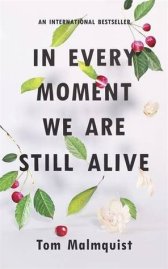 In Every Moment We Are Still Alive by Tom Malmquist: Malmquist does an extraordinary job of depicting his protagonist’s bewilderment at the sudden loss of his partner and his new life as a single father. While it’s being marketed as a novel, this reads more like a stylized memoir. Similar to Karl Ove Knausgaard’s books, it features the author as the central character and narrator, and the story of grief it tells is a highly personal one. This is a book I fully expect to see on next year’s Wellcome Book Prize shortlist.
 My Life with Bob by Pamela Paul: I’ve found a new favorite bibliomemoir. Whether she was hoarding castoffs from her bookstore job, obsessing about ticking off everything in the Norton Anthology, despairing that she’d run out of reading material in a remote yurt in China, or fretting that her new husband took a fundamentally different approach to the works of Thomas Mann, Paul (editor of the New York Times Book Review) always looks beyond the books themselves to ask what they say about her. Just the sort of book I wish I had written.
 My Jewish Year by Abigail Pogrebin: This bighearted, open-minded book strikes me as a perfect model for how any person of faith should engage with their tradition: not just offering lip service and grudgingly showing up to a few services a year, but knowing what you believe and practice, and why. From September 2014 to September 2015, Pogrebin celebrated all the holidays in the Jewish calendar. I was consistently impressed by how she draws thematic connections and locates the resonance of religious ritual in her daily life.
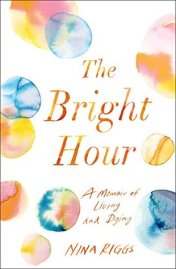 The Bright Hour by Nina Riggs: Beautiful prose enhances this literary and philosophical approach to terminal cancer. Riggs was a great-great-great-granddaughter of Ralph Waldo Emerson, and she quotes from her ancestor’s essays as well as from Michel de Montaigne’s philosophy of life to put things in perspective. She’s an expert at capturing the moments that make life alternately euphoric and unbearable – sometimes both at once. A wonderful book, so wry and honest, with a voice that reminds me of Anne Lamott and Elizabeth McCracken.
 Fragile Lives by Stephen Westaby: This is a vivid, compassionate set of stories culled from the author’s long career in heart surgery. Westaby conveys a keen sense of the adrenaline rush a surgeon gets while operating with the Grim Reaper looking on. I am not a little envious of all that he has achieved: not just saving the occasional life despite his high-mortality field – as if that weren’t enough – but also pioneering various artificial heart solutions and a tracheal bypass tube that’s named after him.
 The Animators by Kayla Rae Whitaker: Though it seems lighthearted on the surface, there’s a lot of meat to this story of the long friendship between two female animators. The cartooning world and the Kentucky–New York City dichotomy together feel like a brand new setting for a literary tragicomedy. I appreciated how Whitaker contrasts the women’s public and private personas and imagines their professional legacy. Plus I love a good road trip narrative, and this novel has two.
And here’s five more 4.5- or 5-star books that I read this year but were not published in 2017:
Days Without End by Sebastian Barry
Homegoing by Yaa Gyasi
When Breath Becomes Air by Paul Kalanithi
The Wind-Up Bird Chronicle by Haruki Murakami
To Say Nothing of the Dog by Connie Willis
What are some of the best books you’ve read so far this year?
What 2017 releases do I need to catch up on right away?
Summer Reads: The Women of the Castle and The Nest
What do you look for in your summer reading? Terms like “beach read” tend to connote light, frothy stories—especially from genres like romance, mystery, and chick lit—but for me a summer read is any book that happens to be totally absorbing, whatever its length. These two novels I recently read are perfect for the summer because you can sink right into them. Whether a trio of widows in postwar Germany or a dysfunctional family in modern-day New York City, the characters and setting come fully to life and tempt you to settle in on a sofa or a beach towel and stay for a while.
The Women of the Castle by Jessica Shattuck
Like Virginia Baily’s Early One Morning and Caroline Lea’s When the Sky Fell Apart, this is a female-centered World War II story that focuses on a lesser-known aspect of history. The main characters are three German women, Marianne, Benita and Ania, who were aligned with different sides in the Nazism vs. Resistance conflict but have all suffered grave losses. These widows band together to raise their children at Burg von Lingenfels, the dilapidated ancestral castle of Marianne’s late husband’s family, but as the years pass regrets and unburied secrets start to come between them.
 Apart from a short prologue from 1938 and a final section that jumps ahead to 1991, the novel is mainly set in 1945–50. I appreciated the look at postwar Germany, a period you rarely encounter in fiction. Refugees, rape victims, and Russian soldiers are everywhere, while American propaganda heaps shame on Germans for supporting Hitler. As with Barbara Yelin’s Irmina, though, there’s an acknowledgment here that it was never a clear-cut matter of pure evil or utter ignorance; “They had known but not known,” is how Shattuck puts it.
What is most intriguing to watch are the shifting relationships between the three main characters. Marianne, as the widow of one of the conspirators in the plot to assassinate Hitler, feels a compulsion to rescue her fellow widows from work camps and to keep the history of the Resistance alive. When her friends disappoint her—Benita falls in love with a former Nazi officer; Ania admits to a past she’d rather forget—Marianne doesn’t know how to absorb the shocks without judgment. A black-and-white thinker, she has trouble seeing life’s gray areas. Only in her old age is she finally able to realize that people are not simply “good or bad, true or false. They have been laid bare, a collection of choices and circumstances.”
You might think that all the WWII stories have been told by now, yet this novel feels fresh and revelatory. I found it both melancholy and hopeful, with strong characters and a haunting atmosphere:
The next week, a heatwave settled over Burg Lingenfels, a shaggy animal brushing against the hills, panting along the river, quieting the birds and making the castle sweat. The ditches were alive with milkweed, nettles, and creeping phlox. In the warmth, the forest looked soft and dense, a black lump against blue sky.
My rating:
The Women of the Castle was released in the UK by Zaffre, an imprint of Bonnier Publishing, on May 18th. My thanks to Imogen Sebba for the free copy for review.
The Nest by Cynthia D’Aprix Sweeney
Leo Plumb has really blown it this time. He’s had problems with drugs and womanizing before, but this time he got behind the wheel of a car after his cousin’s wedding reception with coke and alcohol in his system and a nineteen-year-old waitress, Matilda Rodriguez, at his side. Matilda is injured in the ensuing accident, and after her hefty payout it looks like the four Plumb siblings’ collective trust fund, “the nest,” will be severely diminished.
 They’re all counting on this money: Melody to send her twin daughters to a good college; Jack to save his floundering antiques business; and Bea to keep her afloat until she can write a long-delayed novel to follow up on the success of her “Archie” short stories (based on a figure suspiciously similar to Leo).
The short chapters switch between the siblings as they tweak their plans for the future. The novel also spends time with Melody’s twins, Nora and Louise, who at 16 are just figuring out what they want from their lives; and with Matilda and her new friend Vinnie as they cope with permanent injuries. All of these characters feel like real people who might be in your neighborhood or your extended family. I especially liked Stephanie, the old girlfriend Leo returns to after his wife finally kicks him out.
In places this reminded me of Ann Patchett’s Commonwealth, Delia Ephron’s Siracusa, and especially Hannah Rothschild’s The Improbability of Love due to a subplot about a stolen sculpture. There’s a rather silly set piece involving the sculpture later on; leaving that aside, I thought this was a compelling story about what happens when the truth comes out and we must readjust our expectations. Realistic rather than rosy, this is a novel about letting go. A nest is, of course, also a home, so for as much as this seems to be about money, it is really more about family and how we reclaim our notion of home after a major upheaval.
My rating: 
The Nest was released in paperback in the UK by The Borough Press on June 1st. My thanks to Emilie Chambeyron for the free copy for review.
First Encounter: Maggie Nelson
Maggie Nelson is the author of four volumes of poetry and five wide-ranging works of nonfiction that delve into the nature of violence and sexuality. From what I’d heard about her writing, I knew to expect an important and unconventional thinker with a distinctive, lyrical style. As of early June, Vintage has made some of her backlist, including The Red Parts: Autobiography of a Trial and Bluets, available for the first time in the UK.
I read The Red Parts for The Bookbag. Here’s an excerpt from my full review:
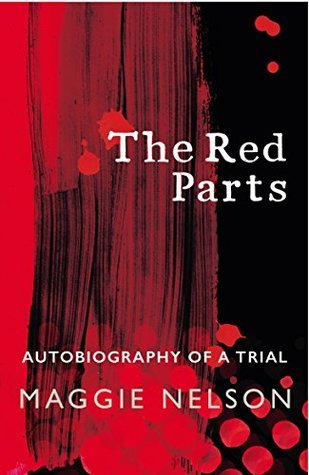 Nelson’s aunt was murdered in Michigan in 1969. Thirty-five years later, just as Nelson had completed writing a poetry collection about her, the case was reopened when new DNA evidence emerged. Most authors would quickly zero in on the trial itself, giving a blow-by-blow of the lawyers’ questioning and witnesses’ statements. Although Nelson does document important developments in the month-long trial, and describes autopsy photographs in blunt detail, her account is much more diffuse than one might expect. Interspersed with Jane’s history are other dark memories: Nelson’s father’s sudden death, her sister’s wild years, aborted love affairs. The title phrase tangentially refers to the words of Jesus in the New Testament, traditionally printed in red, so it has a sort of dual meaning: this is a (futile) search for the gospel truth about her aunt’s death, and also a conscious dive into the parts of life that frighten us. This fluid, engrossing narrative is no ordinary true crime story, but a meditative reflection on loss and identity.
My rating: 
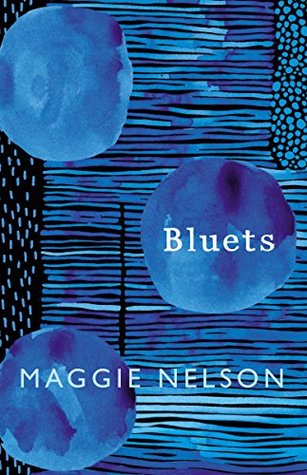 Bluets is a fragmentary record of Nelson’s arbitrary obsession with the color blue. It’s composed of 240 short numbered essays of about a paragraph each; some are just one or two sentences. At one point Nelson refers to these as “propositions,” but really they are more like metaphorical musings. Blue takes on so many meanings: with the connotation of “depressed”, it applies to her loneliness and sense of loss after the breakdown of a relationship (she continues addressing her former partner as “you” here) and a friend’s serious accident:
Loneliness is solitude with a problem. Can blue solve the problem, or can it at least keep me company within it?
Mostly I have felt myself becoming a servant of sadness. I am still looking for the beauty in that.
Then there’s blues music (Billie Holiday), seedy sex (“blue movies”), Joan Mitchell’s 1973 abstract painting Les Bluets, Novalis’ blue flower (which gives the title to a Penelope Fitzgerald novel), and so on. Nelson likens herself to a male bowerbird lining her nest with blue – sometimes literally, as with the collection of “blue amulets” that she keeps on a windowsill so sunlight can pass through the glass and illuminate the stones. I recalled that Sarah Perry lists Bluets as one inspiration for The Essex Serpent, in which the character Stella is fascinated with the color blue and keeps a similar trove of trinkets.
Bluets is a difficult work to characterize, but it seems closest in style to Jenny Offill’s Dept. of Speculation, which is also built on loosely linked aphorisms. The problem with books like these is that individual lines may stand out as profound but don’t contribute to an overall story line or argument. Moreover, Nelson’s forthrightness about sex, which edges towards crassness and feels out of place in this dreamily academic text, took me some getting used to.
Two more favorite lines:
I walked around Brooklyn and noticed that the faded periwinkle of the abandoned Mobil gas station on the corner was suddenly blooming.
If I were today on my deathbed, I would name my love of the color blue and making love with you as two of the sweetest sensations I knew on this earth.
My rating: 
Many thanks to Cat Mitchell of Penguin Random House for the free review copy.
The Red Parts was the more straightforward and satisfying read of this pair, but Bluets is certainly an original and artful bedside book. I would certainly read more by Nelson; I’m particularly interested in The Argonauts (2015), a memoir about forming her unconventional family – her partner, Harry Dodge, is transgender.
Have you read anything by Maggie Nelson? Do her books appeal?
Classic of the Month: Anna of the Five Towns
This was my first experience with Arnold Bennett’s fiction; I’d previously read his Literary Taste. (He is not to be confused, as I’ve done in the past, with novelist and playwright Alan Bennett (An Uncommon Reader, etc.)!) Bennett (1867–1931) was from the Potteries region of Staffordshire and moved to London in his early twenties to work in a law office. Anna of the Five Towns (1902) was his second novel and first moderate success, but it was The Old Wives’ Tale (1908) and the Clayhanger trilogy (1910–16) that truly made his name.
 Bennett was a contemporary of D.H. Lawrence, James Joyce and Thomas Hardy (though Hardy had given up on novels by that point), and Anna reminds me of each of these authors to an extent – but particularly of Lawrence, what with his working-class Midlands roots. I also frequently thought of A Portrait of the Artist as a Young Man (religious angst) and Far from the Madding Crowd (a heroine who faces romantic entanglements and financial responsibility for the first time).
Twenty-year-old Anna Tellwright is a Methodist Sunday school teacher and lives with her twelve-year-old sister, Agnes, and their ill-tempered father, Ephraim, in “Bursley” (Bennett’s name for Burslem, now part of Stoke-on-Trent). The family is well off thanks to Ephraim’s canny property investments and inheritances he and his late wife received. Yet Anna is still dumbfounded to learn, on her twenty-first birthday, that she’s worth £50,000. Ephraim, generally referred to as “the miser” – there’s no nuance here; he’s typecast and never rises above the label – is happy to turn over certain aspects of the business to Anna, like hounding their tenants the Prices for late rent, but doesn’t give her autonomy over her daily spending. She must meekly approach her father each time she wants to purchase something for herself.
Anna has a suitor, Henry Mynors, whose business Ephraim supports as a sleeping partner. She loves the idea of being loved – and the suspicion that she has unwittingly wrenched a desirable prospect away from pretty Beatrice Sutton. But she doesn’t seem to be truly in love with Henry, just like her heart isn’t fully committed to the local revival put on by the Methodists. After all, she hasn’t had the emotional conversion experience that would prove irrefutably that she is saved. Much as she beats herself up over her so-called sins, the desired transformation never arrives. Instead, the closest thing she has to an epiphany comes when she’s standing atop a hill on the Isle of Man on her first-ever holiday:
She perceived that the monotony, the austerity, the melancholy of her existence had been sweet and beautiful of its kind, and she recalled, with a sort of rapture, hours of companionship with the beloved Agnes, when her father was equable and pacific. Nothing was ugly nor mean. Beauty was everywhere, in everything.
The Prices take on unforeseen significance in the novel, and in her dealings with them Anna is caught between a wish to be Christlike in her compassion and the drive to act as the shrewd businesswoman her father expects. Though she is eventually able to wrest back something like financial independence, she remains bound by the social convention of marrying well.

Arnold Bennett.
Anna is more timid and introspective than your average heroine; I felt great sympathy for her not in spite of but because of those character traits. I recently took the Myers-Briggs test for the first time, and wondered if Anna could be an ISTJ like me – she dreads having to visit her pupils’ homes and make small talk with the parents, comes across as curt when nervous, and can’t seem to turn her brain off and just feel instead. (Kate Scott of Parchment Girl runs a blog series about characters who exemplify the different Myers-Briggs personality types.)
There’s a lack of subtlety to Bennett’s writing, something I particularly noted in the physical descriptions (“She was tall, but not unusually so, and sturdily built up. Her figure, though the bust was a little flat, had the lenient curves of absolute maturity”) and some heavy-handed foreshadowing (“It was on the very night after this eager announcement that the approaching tragedy came one step nearer”). But I can let him off considering that this was published 115 years ago. It’s an excellent example of regional literature (can you think of another book set in Staffordshire?), with Anna’s visit to Henry’s pottery works a particular highlight. Bennett takes an unpromising setting and rather humble people and becomes their bard:
Nothing could be more prosaic than the huddled, red-brown streets; nothing more seemingly remote from romance. Yet be it said that romance is even here—
Several miles away, the blast-furnaces of Cauldron Bar Ironworks shot up vast wreaths of yellow flame with canopies of tinted smoke. Still more distant were a thousand other lights crowning chimney and kiln, and nearer, on the waste lands west of Bleakridge, long fields of burning ironstone glowed with all the strange colours of decadence. The entire landscape was illuminated and transformed by these unique pyrotechnics of labour atoning for its grime, and dull, weird sounds, as of the breathings and sighings of gigantic nocturnal creatures, filled the enchanted air.
The tea, made specially magnificent in honour of the betrothal, was such a meal as could only have been compassed in Staffordshire or Yorkshire—a high tea of the last richness and excellence, exquisitely gracious to the palate, but ruthless in its demands on the stomach. At one end of the table … was a fowl which had been boiled for four hours; at the other, a hot pork-pie, islanded in liquor, which might have satisfied a regiment. Between these two dishes were … hot pikelets, hot crumpets, hot toast, sardines with tomatoes, raisin-bread, currant-bread, seed-cake, lettuce, home-made marmalade and home-made jams. The repast occupied over an hour, and even then not a quarter of the food was consumed.
I enjoyed this for the pacey plot, the religious theme, the sympathetic protagonist, and the loving look at an industrial area. I’ll certainly be looking out for copies of Bennett’s other novels in secondhand bookshops; meanwhile, Project Gutenberg also has a good selection of his writings. (My copy was withdrawn from Lambeth Libraries stock and sold for 10 pence.)
My rating:
The Orange Grove by Larry Tremblay (Peirene)
Larry Tremblay is a Francophone writer, theatre director and actor based in Montreal. In addition to three novels, he has published a short story collection and many books of poetry and plays. The Orange Grove (2013), which was longlisted for the 2017 International Dublin (formerly IMPAC) literary award, is the fable-like story of one family in the war-torn Middle East and the way notions of justice and sacrifice drive them to make extreme choices.
Tamara and Zahed live with their twin sons, nine-year-old Aziz and Ahmed, alongside an orange grove planted by Zahed’s father. Soulayed, a militant elder from the next village, describes it thus:
Your father, Mounir, worked his whole life on this arid soil. It was desert here. With God’s help your father worked a miracle. Made oranges grow where there had been only sand and stones.
When Mounir and his wife Shahina are killed in a bombing, Soulayed stands among the ruins and counsels Zahed to seek revenge against their enemies by sending one of his sons to be a suicide bomber. There’s no doubt Soulayed is manipulating this grief-stricken family to his own ends, but he isn’t solely to blame when their culture at large romanticizes martyrdom.
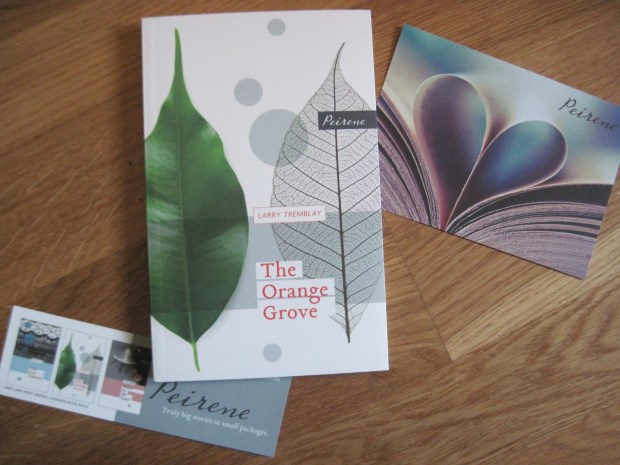
Zahed makes his choice, but Tamara won’t accept it. In a clever reprise of the Genesis story of Jacob and Esau, she helps the boys to make a switch right under their father’s nose. The last third of the book, like a coda, zooms ahead 11 years to show us the surviving brother, coming to the end of a four-year theatre training program in Montreal. He’s given a starring role in his teacher’s wartime play but the story line cuts a little too close to the bone, and for the first time he tells a stranger the story of two brothers: one who died and one who lived.
Peirene Press issues novellas in trios. This is the second in the “East and West: Looking Both Ways” series; I’ve also reviewed the first, The Last Summer by Ricarda Huch. Tremblay and Huch both tackle the theme of betrayal and the practice of choosing one person to die for the crimes of the many. The Orange Grove has a simple style that edges towards flatness but is saved by the occasional striking metaphor (e.g. “Minutes stretched out as if made of dough”). A book about suicide bombing could easily turn mawkish, but the restrained narration reins it in to create a tight and fairly engrossing tale of family ties and religious motivations.
[The third book in the series, Dance by the Canal by Kerstin Hensel, will be released later in 2017.]
The Orange Grove was published in the UK on May 1st. Translated from the French by Sheila Fischman. With thanks to James Tookey of Peirene Press for the free copy for review.
My rating:
Four Recommended June Releases
Here are four enjoyable books due out next month that I was lucky enough to read in advance. The first is the sophomore novel from an author whose work I’ve enjoyed before, the second is a highly anticipated memoir from an author new to me, and the third and fourth – both among my favorite books of 2017 so far – strike me as 2018 Wellcome Book Prize hopefuls: one is a highly autobiographical novel about bereavement, and the other is a courageous memoir about facing terminal cancer. I’ve pulled 250-word extracts from my full reviews and hope you’ll be tempted by one or more of these.
The Gypsy Moth Summer by Julia Fierro
(Coming from St. Martin’s Press on June 6th)
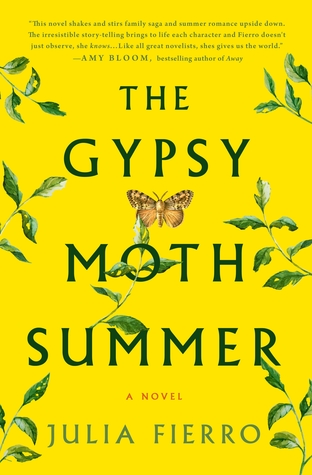 It’s the summer of 1992 and a plague of gypsy moth caterpillars has hit Avalon Island, a community built around Grudder Aviation. The creatures are just one of many threats to this would-be fairy tale world. For Maddie Pencott LaRosa, it’s no simple Sweet Sixteen time of testing out drugs and sex at parties. Her grandfather, Grudder’s president, is back in town with her grandmother, Veronica, and they’re eager to hide the fact that he’s losing his marbles. Also recently returned is Leslie Day Marshall, daughter of the previous Grudder president; she’s inherited “The Castle” and shocked everyone with the family she brought back: Jules, an African-American landscape architect, and their two mixed-race children.
Depending on when you were born, you might not think of the 1990s as “history,” but this novel does what the best historical fiction does: expertly evoke a time period. Moving between the perspectives of six major characters, the novel captures all the promise and peril of life, especially for those who love the ‘wrong’ people. I especially loved small meetings of worlds, like Maddie and Veronica getting together for tea and Oprah.
My main criticism would be that there is a lot going on here – racism, domestic violence, alcohol and prescription drug abuse, cancer, teen sex (a whole lotta sex in general) – and that can make things feel melodramatic. But in general I loved the atmosphere: a sultry summer of Gatsby-esque glittering parties and garden mazes, a time dripping with secrets, sex and caterpillar poop.


[It felt like I kept seeing references to gypsy moths in the run-up to reading this book, like a passage from Amy Poehler’s Yes Please, and a random secondhand book I spotted in Hay-on-Wye (though in that case it’s actually the name of a ship and is a record of a sea voyage).]
Read-alike: The Seed Collectors by Scarlett Thomas
My rating:
Hunger: A Memoir of (My) Body by Roxane Gay
(Coming from HarperCollins on June 13th [USA] and from Corsair on August 3rd [UK])
 I’d never read anything by Roxane Gay before, but somehow already knew the basics of her story: the daughter of Haitian immigrants to the American Midwest, she was gang raped at age 12, and to some extent everything she’s done and become since then has been influenced by that one horrific experience. Not least her compulsive overeating: “I ate and ate and ate to build my body into a fortress,”she writes. At her heaviest Gay was super morbidly obese according to her BMI, a term that “frames fat people like we are the walking dead.”
Though presented as a memoir, this is more like a collection of short autobiographical essays (88 of them, in six sections). The portions that could together be dubbed her life story take up about a third of the book, and the rest is riffs around a cluster of related topics: weight, diet, exercise and body image. The writing style is matter-of-fact (e.g. “My body is a cage of my own making”), which means she never comes across as self-pitying. I appreciate how she holds opposing notions in tension: she doesn’t know how she developed such an “unruly” body; she knows exactly how it happened.
The structure of the book made it a little repetitive for me, but I think what Gay has written will be of tremendous value, not just to rape victims or those whose BMI is classed as obese, but to anyone who has struggled with body image – so pretty much everyone, especially women.
Read-alike: I Know Why the Caged Bird Sings by Maya Angelou
My rating:
In Every Moment We Are Still Alive by Tom Malmquist
(Coming on from Sceptre on June 1st [UK] and from Melville House on February 6, 2018 [USA])
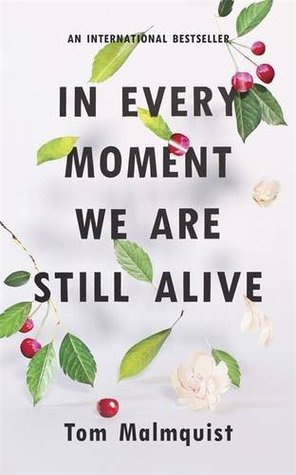 In this autobiographical novel from a Swedish poet, Tom faces the loss of his partner and his father in quick succession. The novel opens in medias res at Söder hospital, where Tom’s long-time girlfriend, Karin, has been rushed for breathing problems. Doctors initially suspect pneumonia or a blood clot, but a huge increase in her white blood cells confirms leukemia. This might seem manageable if it weren’t for Karin, 33, being pregnant with their first child. The next morning she’s transferred to another hospital for a Cesarean section and, before he can catch his breath, Tom is effectively a single parent to Livia, delivered six weeks early.
Malmquist does an extraordinary job of depicting Tom’s bewilderment. He records word for word what busy doctors and jobsworth nurses have to say, but because there are no speech marks their monologues merge with Tom’s thoughts, conversations and descriptions of the disorienting hospital atmosphere to produce a seamless narrative of frightened confusion. There is an especially effective contrast set up between Karin’s frantic emergency room treatment and the peaceful neonatal ward where Livia is being cared for.
While it’s being marketed as a novel, this reads more like a stylized memoir. Similar to Karl Ove Knausgaard’s books, it features the author as the central character and narrator, and the story of grief it tells is a highly personal one.With its frank look at medical crises, this is a book I fully expect to see on next year’s Wellcome Book Prize shortlist.
Read-alike: Mend the Living by Maylis de Kerangal
My rating: 
The Bright Hour: A Memoir of Living and Dying by Nina Riggs
(Coming on June 6th from Simon & Schuster [USA] and from Text Publishing on August 3rd [UK])
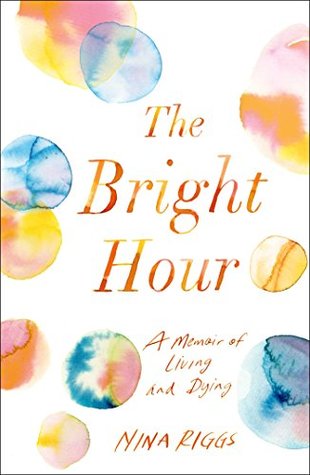 You’re going to hear a lot about this one. It’s been likened to When Breath Becomes Air, an apt comparison given the beauty of the prose and the literary and philosophical approach to terminal cancer. It’s a wonderful book, so wry and honest, with a voice that reminds me of Anne Lamott and Elizabeth McCracken.
It started with a tiny spot of cancer in the breast. “No one dies from one small spot,” Nina Riggs and her husband told themselves. Until it wasn’t just a spot but a larger tumor that required a mastectomy. And then there was the severe back pain that alerted them to metastases in her spine, and later in her lungs. Riggs was a great-great-great-granddaughter of Ralph Waldo Emerson, and she quotes from her ancestor’s essays as well as from Michel de Montaigne’s philosophy of life to put things in perspective.
Riggs started out as a poet, and you can tell. She’s an expert at capturing the moments that make life alternately euphoric and unbearable – sometimes both at once. Usually these moments are experienced with family: her tough mother, who died after nine years with multiple myeloma, providing her with a kind of “morbid test drive” for her own death; and her husband and their two precocious sons. Whether she’s choosing an expensive couch, bringing home a puppy, or surprising her sons with a trip to Universal Studios, she’s always engaged in life. You never get a sense of resignation or despair.
Some of my favorite lines:
“inside the MRI machine, where it sounded like hostile aliens had formed a punk band”
“my pubic hair all falls out at once in the shower and shows up like a drowned muskrat in the drain.”
“My wig smells toxic and makes me feel like a bank robber. But maybe it is just a cloak for riding out into suspicious country.”
“‘Merry Christmas,’ says a nurse who is measuring my urine into a jug in the bathroom. ‘Do you want some pain meds? Do you want another stool softener?’”
(Nina Riggs died at age 39 on February 23, 2017.)
Read-alike: A Series of Catastrophes and Miracles by Mary Elizabeth Williams
My rating: 
What June books do you have on the docket? Have you already read any that you can recommend?
Classic of the Month: The Moon and Sixpence
This was indeed the perfect follow-up to Fabrizio Dori’s Gauguin, the SelfMadeHero graphic novel I reviewed earlier in the month. W. Somerset Maugham’s short novel functioned like a prequel for me because, whereas Dori focuses on Gauguin’s later life in the South Pacific, Maugham concentrates on his character Charles Strickland’s attempt to make a living as a painter in Paris.
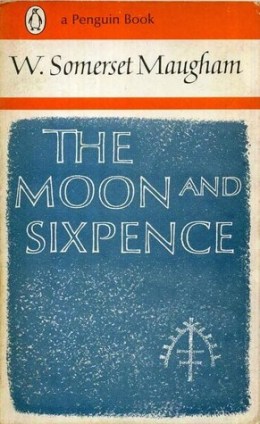 The Moon and Sixpence – the unusual title comes from the TLS reviewer’s description of the protagonist in Of Human Bondage as so absorbed in reaching for the moon that he doesn’t notice the sixpence at his feet – is narrated by an unnamed author drawn into Strickland’s orbit through his wife Amy Strickland’s attendance at London literary soirées. He hasn’t gotten to know the couple very well at all when he hears that Charles, a stockbroker, has abandoned his family and left for Paris to pursue painting – a hobby for which he’s never previously shown any aptitude.
Amy sends the narrator off to Paris to talk sense into her husband, but Charles never shows the least remorse. The narrator marvels at his insouciance and utter conviction that he is meant to be an artist.
He was single-hearted in his aim, and to pursue it he was willing to sacrifice not only himself – many can do that – but others. He had a vision. Strickland was an odious man, but I still think he was a great one.
I noted familiar themes from Of Human Bondage (published in 1915, four years prior to The Moon and Sixpence), especially the artist’s struggle, nomadism and the threat of poverty. Dirk Stroeve, the talentless Dutch painter who becomes friendly with the narrator in Paris and recognizes Strickland’s brilliance even as he lets the man walk all over him, reminded me of the happy-go-lucky Thorpe Athelny in Bondage.
At less than a third of the length of that earlier novel, though, The Moon and Sixpence struck me as a condensed parable about genius and sacrifice.
Beauty is something wonderful and strange that the artist fashions out of the chaos of the world in the torment of his soul. … It was the work of a man who had delved into the hidden depths of nature and had discovered secrets. … There was something primeval there and terrible. It was not human. It brought to … mind vague recollections of black magic. It was beautiful and obscene.
This is a fascinating character study, whether or not you’re aware of Gauguin’s life as the inspiration, and would be a great introduction to Maugham’s work if you’ve not read him before. (Secondhand copy from Bookbarn International.)
My rating:
 Bookish Beck = Rebecca Foster. American transplant to England. Freelance proofreader and book reviewer.
 Bookish Beck