Some Advanced 2017 Reads
I haven’t had much chance to explore 2017’s offerings yet. Although I technically have access to loads of pre-release titles through NetGalley and Edelweiss, the books in front of me and, of course, the ones I’m reading on assignment tend to take priority. Much as I’d like to be ahead of the trend, I’ve only read five 2017 titles, three of which I can recommend. Two of these happen to be poetry books; the third is a wonderful bereavement-themed memoir.
Whereas by Stephen Dunn
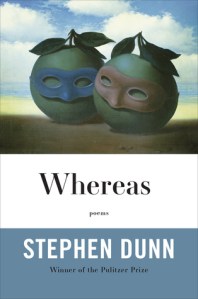 “A Card from Me to Me,” the prefatory poem, sets the tone, as the poet wishes himself a happy 75th birthday and marvels at “the strangeness, the immensity, of what I have / and have had and every small thing that against the odds continues to be.” Much of what follows is about life and death, success and failure, and what we learn from it all. For example, writing about a funeral: “at such moments / everyone is an amateur of feelings.”
I especially liked “Unnatural,” with its meditation on nature vs. artifice, “Let’s Say,” and “Nothing Personal,” about an author killing off a character (or is that God killing off the narrator?). These are very lucid poems, reading like complete sentences and thorough trains of thought, with memorable alliteration and vocabulary. I’d read more from Dunn.
Releases February 21st.
My rating: 
The Analyst by Molly Peacock
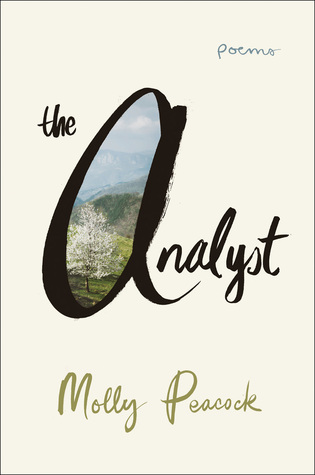 Peacock wrote this in tribute to her longtime psychoanalyst, Joan Workman Stein, who practiced in New York City until she suffered a stroke in 2012. This collection contains a rich mixture of autobiographical reflection and translations. The form and style vary from poem to poem, but I was always struck by the imagery, often drawn from the culinary and art worlds – everything from marinara sauce and a skinned rabbit to paper dolls and methods of expressing gratitude in French. I presumed the entire book would be about Stein, but instead the poems about her pre- and post-stroke life share space with ones about Peacock’s own life, from childhood onward. Having enjoyed The Paper Garden, the author’s biography of eighteenth-century artist Mary Delany, I was especially tickled to see several poems that mention collage and other paper arts, such as “Authors.”
“Mandala in the Making,” the final poem, meditates on the contrast between the drive to make art and the essential impermanence of life: “When they’re done, // they’ll brush it all away. You can’t believe it. / Nothing stays (including the memory you’ve lost). / What lasts?”
I was really impressed with this collection and will be searching out Peacock’s previous poetry books as well.
Releases January 3rd.
My rating: 
Traveling with Ghosts: A Memoir by Shannon Leone Fowler
“This is a story about finding love and learning to live with loss. But mostly, it’s a story about all the places in between.” In August 2002, Fowler was traveling in Thailand with her fiancé Sean. They were embracing in shallow water outside their cabana when Fowler felt something brush past her thigh. The highly toxic box jellyfish stung Sean on his leg, and by the time she brought help he was already dead, though clinic staff went through the motions of trying to resuscitate him.
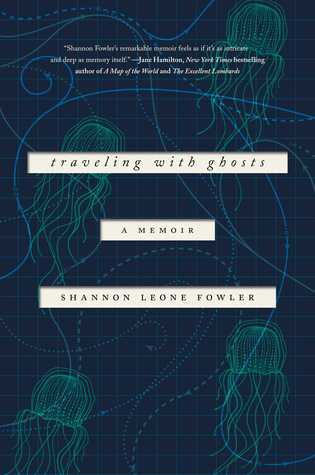 This memoir concentrates on the four and a half months that followed Sean’s death, a time that Fowler filled with constant travel through Eastern Europe – “a place where the endings [in folk tales as well as in real life] were rarely happy, but the stories were told just the same.” She had a compulsion to keep moving, as if Sean’s death was something she could outrun; she sought out risky places, going to Bosnia and then to Tel Aviv to visit the Israeli girls who helped her deal with the practicalities of Sean’s death.
Fowler toggles between her blithe trips with Sean in the few years they had together, her somber travels after his death, and the immediate aftermath of his death. Each short section is headed by the date and place, but the constant time shifts are meant to be disorienting and reflect how traumatic memories linger. Your average memoir might have brought things up to the present day by showing how the author learned and grew from the experience. This is not your average memoir. It delves into the thick of the grief and stays there. It doesn’t give easy answers about how to get over things or suggest life will later be perfect, just in a different way. It’s honest and unusual and has stayed with me. Highly recommended.
(Note: The author is the daughter of novelist Karen Joy Fowler.)
Releases February 21st.
My rating:
Two more 2017 books are on my reading stack:
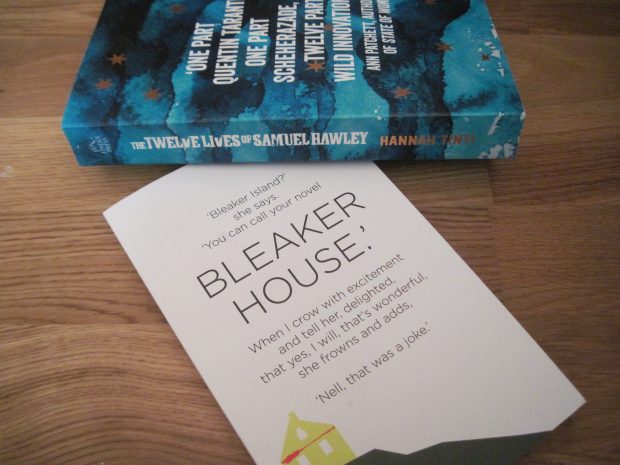
- I’m halfway through Bleaker House by Nell Stevens, a memoir about her failed attempt to write her debut novel during several months of isolation on Bleaker Island in the Falklands. It’s weird but funny, and I think any writer will relate to the feelings of loneliness and a lack of confidence. I’ll be reviewing it for Nudge. (Releases March 14th.)
- I’ll be reviewing The Twelve Lives of Samuel Hawley by Hannah Tinti for The Bookbag sometime before its March 28th release.
Have you sampled any 2017 books yet?
A CanLit Classic: The Stone Angel by Margaret Laurence
Hagar Shipley has earned the right to be curmudgeonly. Now 90 years old, she has already lived with her son Marvin and his wife Doris for 17 years when they spring a surprise on her: they want to sell the house and move somewhere smaller, and they mean to send her to Silver Threads nursing home. What with a recent fall, gallbladder issues and pesky constipation, the old woman’s health is getting to be more than Doris can handle at home. But don’t expect Hagar to give in without a fight.
This is one of those novels where the first-person voice draws you in immediately. “I am rampant with memory,” Hagar says, and as the book proceeds she keeps lapsing back, seemingly involuntarily, into her past. While in a doctor’s waiting room or in the derelict house by the coast where she runs away to escape the threat of the nursing home, she loses the drift of the present and in her growing confusion relives episodes from earlier life.
Many of these are melancholy: her mother’s early death and her difficult relationship with her father, an arrogant, self-made shopkeeper (“Both of us were blunt as bludgeons. We hadn’t a scrap of subtlety between us”); her volatile marriage to Bram, a common fellow considered unworthy of her (“Twenty-four years, in all, were scoured away like sand-banks under the spate of our wrangle and bicker”); and the untimely deaths of both a brother and a son.

The stone angel of the title is the monument on Hagar’s mother’s grave, but it is also an almost oxymoronic description for our protagonist herself. “The night my son died I was transformed to stone and never wept at all,” she remembers. Hagar is harsh-tongued and bitter, always looking for someone or something to blame. Yet she recognizes these tendencies in herself and sometimes overcomes her stubbornness enough to backtrack and apologize. What wisdom she has is hard won through suffering, but she’s still standing. “She’s a holy terror,” son Marvin describes her later in the novel: another paradox.
Originally from 1964, The Stone Angel was reprinted in the UK in September as part of the Apollo Classics series. It’s the first in Laurence’s Manawaka sequence of five novels, set in a fictional town based on her hometown in Manitoba, Canada. It could be argued that this novel paved the way for any number of recent books narrated by or about the elderly and telling of their surprise late-life adventures: everything from Jonas Jonasson’s The Hundred-Year-Old Man Who Climbed Out of the Window and Disappeared to Emma Hooper’s Etta and Otto and Russell and James. I was also reminded of Jane Smiley’s Midwest novels, and wondered if Carol Shields’s The Stone Diaries was possibly intended as an homage.
I loved spending time in Hagar’s company, whether she’s marveling at how age has crept up on her—
I feel that if I were to walk carefully up to my room, approach the mirror softly, take it by surprise, I would see there again that Hagar with the shining hair, the dark-maned colt off to the training ring
trying to picture life going on without her—
Hard to imagine a world and I not in it. Will everything stop when I do? Stupid old baggage, who do you think you are? Hagar. There’s no one like me in this world.
or simply describing a spring day—
The poplar bluffs had budded with sticky leaves, and the frogs had come back to the sloughs and sang like choruses of angels with sore throats, and the marsh marigolds were opening like shavings of sun on the brown river where the tadpoles danced and the blood-suckers lay slimy and low, waiting for the boys’ feet.
It was a delight to experience this classic of Canadian literature.
(The Apollo imprint will be publishing the second Manawaka book, A Jest of God, in March.)
With thanks to Blake Brooks at Head of Zeus/Apollo for the free copy for review.
My rating:
Tidings by Ruth Padel & Other Christmassy Reading
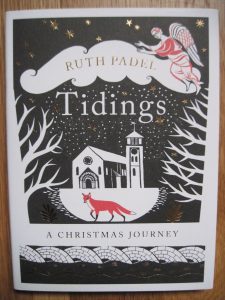 Ruth Padel is one of my favorite poets, so I jumped at the chance to read her new book-length holiday poem, Tidings: A Christmas Journey. Set across one Christmas Eve and Christmas day and narrated by Charoum, the Angel of Silence, the poem switches between Holly, a seven-year-old girl excited for Christmas, and Robin, a forty-four-year-old homeless man who follows a fox to a Crisis Centre. Here he gets a hot meal and some human kindness to make up for the usual bleakness of the holidays:
Christmas is the salt mine.
Salt in the wound, a nothing-time.
I was loved once. Who by? Can’t remember.
I especially liked the fragments that juxtapose this contemporary London story with centuries of history:
Up here the evening glides over golden moss
on the flat-top tomb of Mary Wollstonecraft
&
Pagan Christmas fizzes and teems with ghosts,
midwinter fires, mummers and waites, Yule
logs and mistletoe.
The poem also journeys to Jerusalem and Rome to survey a whole world of Christmas traditions, then and now.
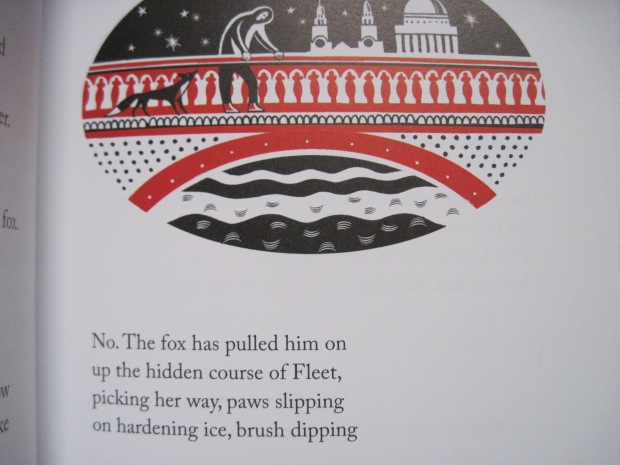
It’s a lovely little volume, with the red, black and white theme offset by touches of gold. The illustrations are gorgeous, but the story line disappointed me: starting with the character names, it all felt rather clichéd. Padel has treated urban foxes much more successfully in her collection The Soho Leopard, and apart from a very few instances – like the above quotes – the verse struck me as largely undistinguished, even awkward (like the out-of-place clinical vocabulary in “Love, / and the lack of it, can change the limbic brain”). This means that, for me, this book fails to earn a place as a Christmas classic I’ll reread year after year.
Tidings was published in the UK by Chatto & Windus on November 3rd. My thanks to Cat Mitchell of Random House for the free review copy.
My rating: 
Other Christmassy Reading
 This year I’m resuming my place in Waiting on the Word, Malcolm Guite’s selection of religious-slanted poems to read from the start of Advent through Epiphany. For those who want to explore the history and interpretation of Christmas, I can recommend The First Christmas by the late Marcus Borg, one of my favorite progressive theologians.
As I have for the past several years, I’ll dip into The Ecco Book of Christmas Stories, edited by Alberto Manguel. My favorites are by Truman Capote, John Cheever, Jane Gardam and Jeanette Winterson (who has a brand-new, full-length Christmas story collection out this year). I’ll also sample some Russian classics via A Very Russian Christmas, which has short stories from Tolstoy, Chekhov and more.
 In addition, I have Cleveland Amory’s The Cat Who Came for Christmas and The Cat Who Stayed for Christmas out from the library, which should make for some very cozy reading under the cat. I’ll browse the numerous Christmas-themed poems in U.A. Fanthorpe’s Collected Poems, another library book. And I may even deign to try Hogfather, one from my husband’s beloved Discworld series by the late Terry Pratchett.
[See also this wonderful list of Christmas reading suggestions from Heaven Ali.]
Are you reading anything special this Christmas season?
More Seasonal Reading
I like this reading with the seasons lark. It’s a shame that my library hold on Ali Smith’s Autumn didn’t come in until well after it turned to winter here in England, but I was intrigued by the sound of her post-Brexit seasonal quartet. Then, as if one winter anthology wasn’t enough, I tried another – this time a broader range of literature, history and travel writing.
Autumn by Ali Smith
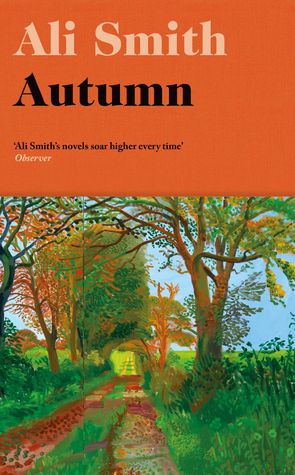 Smith is attempting a sort of state-of-the-nation novel in four parts. Her two main characters are Daniel Gluck, a centenarian dying at a care home, and his former next-door neighbor, Elisabeth Demand, in her early thirties and still figuring out her path in life. The present world Elisabeth and her mother navigate is a true-to-life post-Brexit bureaucratic nightmare where people are building walls and hurling racist epithets – “news right now is like a flock of speeded-up sheep running off the side of a cliff.” Mostly the book is composed of flashbacks to wordplay-filled conversations between Elisabeth and Daniel when he used to babysit for her, as well as dreams/hallucinations Daniel is having on his deathbed. But there’s also a lot of seemingly irrelevant material about pop artist Pauline Boty and Christine Keeler.
This was most likely written very quickly in response to current events, and while some of Smith’s strengths benefit from immediacy – the nearly stream-of-consciousness style (no speech marks) and the jokey dialogue – I think I would have preferred a more circumspect, compressed narrative. In places this was too repetitive, and the seasonal theme felt neither here nor there. I’ll listen out for what the other books are like, but doubt I’ll bother reading them. Aspects of this are very similar to Number 11 by Jonathan Coe (the state-of-Britain remit, even the single mother hoping to appear on a reality show), but I much preferred his take. [Gorgeous cover, though – David Hockney’s Early November Tunnel (2006).]
My rating:
[For more positive reviews, see those by Eric of Lonesome Reader, and Lucy of Hard Book Habit.]
Winter: A Book for the Season, edited by Felicity Trotman
 This seasonal anthology contains a nice mixture of poetry, nature and travel pieces, and excerpts from longer works of fiction. Some favorite pieces were W.H. Hudson on the town birds of Bath in the late nineteenth century, Mark Twain on his determination to keep wearing his trademark white through the winter, a Hans Christian Andersen dialogue between a snowman who longs to be by the stove and the yard-dog that warns him away, and Richard Jefferies on those who go out to work on a winter morning. But I enjoyed the poetry the most. Trotman includes a wide range of celebrated poets, from Shakespeare and Keats to John Clare and Wordsworth. I particularly liked a more recent contribution from Carolyn King, “First Snow,” in which a cat imagines that a giant wallpaper stripper has produced the flakes.
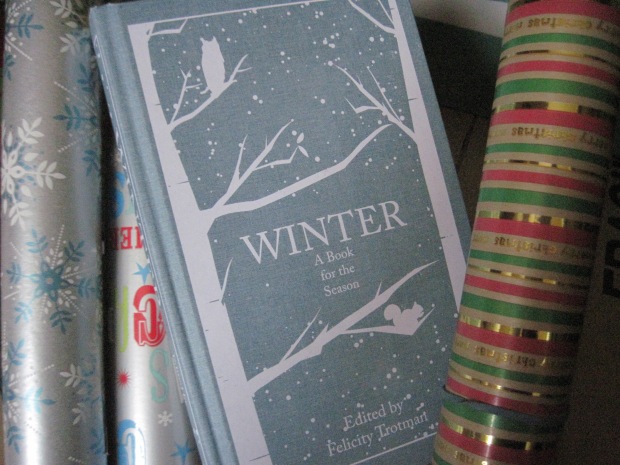
All told, though, there are too many seventeenth-century and older pieces with archaic spellings, and a number of the history and travel extracts, in particular, feel overlong – with nearly 40 pages in total from Ernest Shackleton’s South. Especially given the thin pages and small type, this represents a tediously large chunk of the book. Shorter pieces increase the variety in an anthology and mean the book lends itself to being picked up and read a few stories at a time. This is one to keep on the coffee table each winter and dip into over several years rather than read straight through. (See my full review at The Bookbag.)
My rating:
As it happens, I’ve now read five books titled Winter: besides the Wildlife Trusts anthology and the novel about Thomas Hardy, both of which I’ve already reviewed here, there’s also Rick Bass’s wonderful memoir of his first year in Montana and Adam Gopnik’s wide-ranging book about the season. But beyond those with the simple one-word title, there are a whole host of titles on my TBR containing the word “Winter”. Here’s the whole list!
Have you read any “Autumn” or “Winter” books this year?
Novellas in November
Taking a lead from Laura over at Reading in Bed, I’ve trawled my shelves and my current library pile for some blissfully short books. For this challenge I limited myself to books with fewer than 150 pages and came up with four fiction books and two ‘nonfiction novellas’.
The Library of Unrequited Love by Sophie Divry
[92 pages]
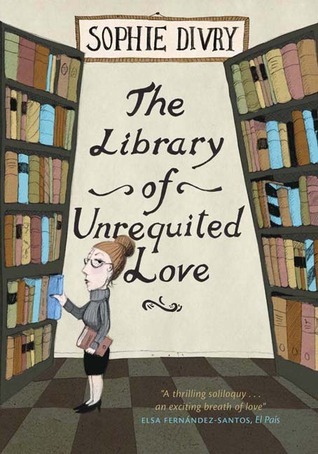 This one-sitting read is a monologue by an embittered librarian who arrives one morning to discover a patron has been locked into the basement overnight—a captive audience. Responsible for Geography, she hopes for a promotion to History, her favorite subject. Alas, no one seems to appreciate this library as a bastion of learning anymore; they only come for DVDs and a place to keep warm. That is, except for Martin, a young PhD researcher who’s caught her eye. But he doesn’t even seem to notice she exists. In one uninterrupted paragraph, this celebrates all that books do for us but suggests that they still can’t fix a broken heart.
My verdict: There are lots of great one-liners about the value of books (“You’re never alone if you live surrounded by books”), but overall it’s a somewhat aimless little experiment and not particularly well translated.
The All of It by Jeannette Haien
[145 pages]
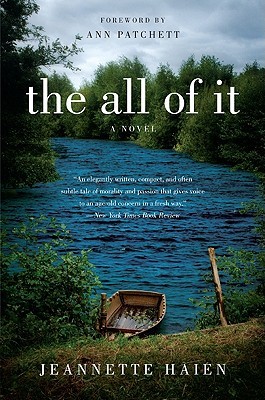 When this won the Sue Kaufman Prize for First Fiction in 1987, the author was in her sixties. It’s since been championed by Ann Patchett, who contributed a Foreword to this 2011 edition. Father Declan de Loughry, fishing for salmon, reflects on the recent death of parishioner Kevin Dennehy. Before he died, Kevin admitted that he and Enda were never properly married. Yet Enda begs the priest to approve a death notice calling Kevin her “beloved husband,” promising she’ll then explain “the all of it” – the very good reason they never married. As she tells her full story, which occupies the bulk of the novella, Father Declan tries to strike a balance between the moral high ground and human compassion.
My verdict: Enda’s initial confession on page 27 is explosive, but the rest of this quiet book doesn’t ever live up to it. I was reminded of Mary Costello’s Academy Street, a more successful short book about an Irish life.
Favorite passage: “One thing I’ve learned, Father—that in this life it’s best to keep the then and the now and the what’s-to-be as close together in your thoughts as you can. It’s when you let gaps creep in, when you separate out the intervals and dwell on them, that you can’t bear the sorrow.”
Thirteen Ways of Looking by Colum McCann
[143 pages]
 This starts off as the simple story of J. Mendelssohn, an octogenarian who wakes up on a snowy morning in his New York City apartment, contemplating his past – Lithuanian/Polish ancestry, work as a judge and marriage to Eileen, whom he met as a boy in Dublin – and planning to meet his son at a restaurant for lunch. But all of a sudden it turns into a murder mystery on page 24: “Later the homicide detectives will be surprised…” In 13 sections headed by epigraphs from the Wallace Stevens poem “Thirteen Ways of Looking at a Blackbird,” McCann flits through Mendelssohn’s thoughts and flips between the events preceding and immediately following the murder. A late interrogation scene is particularly strong – “unlike our poetry, we like our murders to be fully solved.”
My verdict: This is the first I’ve read from McCann, and it’s terrific. He stuffs so much plot and characterization into not many pages. Mendelssohn’s thought life is rich with allusions and wordplay. I was particularly intrigued to read about the autobiographical overlap in the Author’s Note. I haven’t yet read the short stories included in the volume, but for the novella on its own it’s  .
.
As We Are Now by May Sarton
[134 pages]
 On the surface this is similar to a novel I reviewed earlier in the month, The Secret Diary of Hendrik Groen, 83¼ Years Old. But where spunky Hendrik determines to outwit his care home’s sullen staff, Sarton’s narrator, seventy-six-year-old Caroline Spencer, has given in. A retired high school math teacher, she’s landed in a New England old folks’ home because during her recovery from a heart attack she failed to get along with her brother’s younger wife. She finds kindred spirits in Standish Flint, a tough old farmer, and Reverend Thornhill, but her growing confusion and the home’s pretty appalling conditions drive her to despair.
My verdict: This is enjoyable for the unreliable narrator and the twist ending, but overall it struck me as rather melodramatic. However, I appreciated a lot of Caro’s sentiments.
Favorite passages: “Am I senile, I wonder? The trouble is that old age is not interesting until one gets there, a foreign country with an unknown language to the young, and even to the middle-aged. I wish now that I had found out more about it.” & “And what is left of you? A lapis lazuli pin, a faded rose petal, once pink, slipped into the pages of this copybook.”
And two short works of nonfiction:
Excerpts from a Family Medical Dictionary by Rebecca Brown
[113 pages]
 Brown is a novelist from Seattle. This is an account of her mother’s death from what sounds like stomach cancer. The disease progressed quickly and her mother died at home, under hospice care, in New Mexico in 1997. As the title suggests, the brief thematic chapters are arranged around vocabulary words like “anemia” and “metastasis.” My favorite chapters were about washing: her mother’s habit of reading while taking long baths, and the ways Brown and her sister tried to care for their mother’s disintegrating body, including a plan to prepare the corpse themselves. Clinical descriptions of vomiting alternate with magical thinking to accompany her mother’s hallucinations: “You’re packed, Mom, but all of us aren’t going, just you. But you’ve got everything you need.”
My verdict: Brown covers a lot of emotional ground in a very few pages, but I prefer my medical/bereavement memoirs to have more of a narrative and more detail than “when she died it was not peacefully or easy, it was hard.”
Ruined by Reading: A Life in Books by Lynne Sharon Schwartz
[119 pages]
 This 1996 memoir was sparked by reading a quote from a Chinese Buddhist in a New York Times article: he suggested that reading is dangerous as it imposes others’ ideas on you and doesn’t allow you to use your own mind freely. Schwartz, of course, begs to differ. As a novelist, reading has been her lifeline. She looks back at her childhood reading and her pretentious college student opinions on Franz Kafka and Henry James, and explains that she lets serendipity guide her reading choices nowadays, rather than a strict TBR list: “reading at random – letting desire lead – feels like the most faithful kind.”
My verdict: It’s a bibliomemoir; I should have loved it. Instead I thought it unstructured and thin. There are some great lines dotted through, but I wasn’t very interested in the examples she focuses on. Five pages about a children’s book by Eleanor Farjeon? Yawn! 
Favorite passages: “Like the bodies of dancers or athletes, the minds of readers are genuinely happy and self-possessed only when cavorting around, doing their stretches and leaps and jumps to the tune of words.” & “How are we to spend our lives, anyway? That is the real question. We read to seek the answer, and the search itself – the task of a lifetime – becomes the answer.”
Have you read any of these? Which one takes your fancy?
How do you feel about novellas in general?
German Lit Month: The Tobacconist by Robert Seethaler
I don’t participate in a lot of blogger challenges (though I’ll be doing “Novellas in November” on Monday); it’s more of a coincidence that I finished Austrian writer Robert Seethaler’s excellent The Tobacconist (translated from the German by Charlotte Collins) towards the end of German literature month.
You may recall that I read Seethaler’s previous novel, A Whole Life, on my European travels this past summer, and didn’t think too much of it. I’d read so much praise for its sparse style, but I couldn’t grasp the appeal. Here’s what I wrote about it at the time: “This novella set in the Austrian Alps is the story of Andreas Egger – at various times a farmer, a prisoner of war, and a tourist guide. Various things happen to him, most of them bad. I have trouble pinpointing why Stoner is a masterpiece whereas this is just kind of boring. There’s a great avalanche scene, though.”
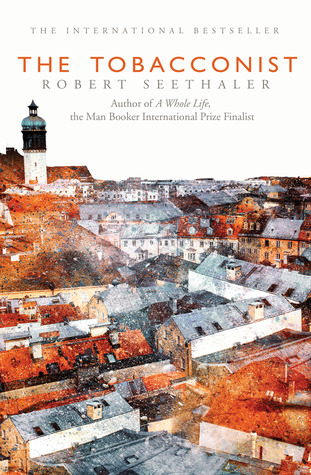 But I’m very glad that I tried again with Seethaler, because The Tobacconist is one of the few best novels I’ve read this year, and very much a book for our times despite being set in 1937–8.
Seventeen-year-old Franz Huchel’s life changes for good when his mother sends him away from his quiet lakeside village to work for her old friend Otto Trsnyek, a Vienna tobacconist. “In [Franz’s] mind’s eye the future appeared like the line of a far distant shore materializing out of the morning fog: still a little blurred and unclear, but promising and beautiful, too.”
Though the First World War left him with only one leg, Trsnyek is a firebrand. Instead of keeping his head down while selling his cigars and newspapers, he makes his political opinions known. This sees him branded as a “Jew lover” and persecuted accordingly. One of the Jews he dares to associate with is Sigmund Freud, who is a regular customer even though he already has throat cancer and will die just two years later.
Especially after he falls in love with Anezka, a flirtatious but mercurial Bohemian girl, Franz turns to Professor Freud for life advice. “So I’m asking you: have I gone mad? Or has the whole world gone mad?” The professor replies, “yes, the world has gone mad. And … have no illusions, it’s going to get a lot madder than this.”
Through free indirect speech, the thought lives of the various characters, and the postcards and letters that pass between Franz and his mother, Seethaler gradually and subtly reveals the deepening worry over the rise of Hitler and the situation of the Jews. This novel is so many things: a coming-of-age story, a bittersweet romance, an out-of-the-ordinary World War II/Holocaust precursor, and a perennially relevant reminder of the importance of finding the inner courage to stand up to oppressive systems.
Freud and his family had enough money and influence to buy their way to England. So many did not escape Hitler’s regime. I knew that, but discovered it anew in this outstanding novel.
Some favorite passages:
Dear Mother,
I’ve been here in the city for quite a while now, yet to be honest it seems to me that everything just gets stranger. But maybe it’s like that all through life—from the moment you’re born, with every single day, you grow a little bit further away from yourself until one day you don’t know where you are any more. Can that really be the way it is?
And as more than twenty thousand supporters bellowed their assent into the clear Tyrolean mountain air, Adolf Hitler was probably sitting beside the radio somewhere in Berlin, licking his lips. Austria lay before him like a steaming schnitzel on a plate. Now was the time to carve it up. … People were cosseting their faint-hearted troubles and hadn’t even noticed yet that the earth beneath their feet was burning.
(from a letter from Mama) Just imagine, Hitler hangs on the wall even in the restaurant and the school now. Right next to Jesus. Although we have no idea what they think of each other.
Freud: “Most paths do at least seem vaguely familiar to me. But it’s not actually our destiny to know the paths. Our destiny is precisely not to know them. We don’t come into this world to find answers, but to ask questions. We grope around, as it were, in perpetual darkness, and it’s only if we’re very lucky that we sometimes see a little flicker of light. And only with a great deal of courage or persistence or stupidity—or, best of all, all three at once—can we make our mark here and there, indicate the way.”
My rating: 
Happy Thanksgiving to all my American readers! In previous years we’ve been able to find canned pumpkin in the UK to make a pumpkin pie, but alas, this year there have been supply issues (my husband blames Brexit). Nor can we find a real pumpkin – they disappear from the shops after Halloween. Without pumpkin pie it doesn’t feel much like Thanksgiving.
At any rate, here’s a flashback to the seasonal posts I wrote last year, one about five things I was grateful for as a freelance writer (they all still hold true!) and a list of recommended Thanksgiving reading.
Review: Midwinter by Fiona Melrose
It was a definite case of judging a book by its cover: I saw a photo of Fiona Melrose’s debut novel, Midwinter, on Twitter and – without reading much about it at all – sent off a quick request e-mail to the publisher. All I knew was that it was about a father and son, that it was set in Suffolk, that a fox featured somewhere, and that Zambia was involved somehow. But that was enough to convince me that this was a book I wanted to read.
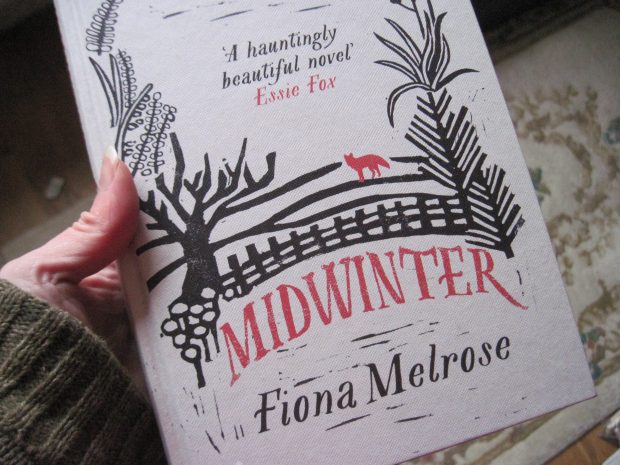
I had assumed the title would refer to the novel’s setting; although it does take place during the colder months of the year, Midwinter is also the main characters’ last name. Landyn Midwinter and his twenty-year-old son, Vale, are farmers in the Suffolk countryside. They’re both joined and divided by the memory of Vale’s mum Cecilia’s violent death ten years ago in Zambia, where the family had gone to seek their fortune after money troubles on the English farm. Vale blames Landyn for Cessie’s murder, and the past still fuels explosions between them in the present day.
The novel opens with Vale and his best friend, Tom, who were raised like brothers, stealing a boat and going for a drunken nighttime sail. This scene reminded me of the cataclysmic maritime sections of Wyl Menmuir’s The Many and ends in near-disaster. Vale is fine, but as Tom spends the next weeks in hospital it becomes clear that he will not escape undamaged. Vale and Landyn don’t see eye to eye about what Vale owes his friend; they also disagree about Landyn’s sentimental attitude towards animals: farm dogs and chickens, as well as a vixen he is thrilled to see on his land, thinking of her as an emissary from his lost wife.
Vale and Landyn narrate the book in alternating first-person chapters. It’s their country voices and the father–son theme that drive the story. “It could never be the end for me and Vale,” Landyn says. “I didn’t have a choice in it. Been like that how many times since Cessie passed, all beaten and tired and nothing left.” And yet Vale “cut me right where he knew there was fresh meat, the type that doesn’t knit.” Landyn’s voice worked better for me, but I liked how the same themes crop up for both men as they go through the motions of everyday farming life: guilt over bad decisions, a hot temper, and awkwardness around women.
 Past and present coexist stylishly through flashbacks to the Midwinters’ brief time in Africa, and there are several climactic scenes of animal deaths, one quite gruesome – something to keep in mind if you are sensitive to such things.
At a certain point, though, the novel started feeling repetitive to me. Some incidents are recounted from both points of view, but the repetition doesn’t add anything. I thought the book could stand to lose 40–60 pages – page 224 would have served as a perfectly good ending, for instance. In fact, the whole thing feels like an early draft: it’s surprisingly poorly edited in terms of punctuation, typos and compound words.
In all, I think this edition of Melrose’s debut novel doesn’t do her justice. Luckily, I was impressed enough by her elegant treatment of fraught relationships and ongoing guilt that I will still be looking out for her future work.
My rating:
Other books (all by women!) this reminded me of:
- Spill Simmer Falter Wither by Sara Baume
- The Other Side of the World by Stephanie Bishop
- Shame by Melanie Finn [U.S. title: The Gloaming]
- The Story of an African Farm by Olive Schreiner
Midwinter was published in the UK by Corsair on November 2nd. My thanks to Helen Upton of Little, Brown for the free review copy.
An Anthology for the Coming Winter
“the short dark days of winter
dear to me
as a bully to his mother.”
~from “Skulking,” a poem from Helen Dunmore’s The Malarkey
After more than ten years here, I still struggle with English winters. It’s not that they’re colder than what I grew up experiencing on America’s east coast. In terms of temperatures, snowfall and ice buildup, there’s no real comparison. I keenly remember the winter of 2004, when the wind-chill was about 10° F and all the fountains in Washington, D.C. froze solid.
But English winters have particularly disheartening qualities: they’re overwhelmingly dark, bone-seepingly wet, and seemingly endless. I’ll never forget when, in my first-ever winter in England (during my study abroad year in 2003), I looked out a University of Reading library window around 3:00 in the afternoon and realized the sun was setting behind the trees.
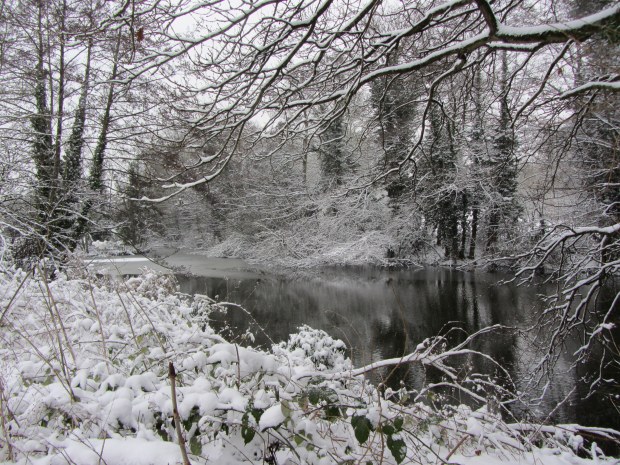
A snowy day on the University of Reading campus (Whiteknights Lake). Photo by Chris Foster.
All these years later, I still find that dim mid-afternoon light depressing, and the damp cold nearly intolerable. In our study abroad information packet we were warned that British interiors are kept 10 degrees cooler than American ones. But because we’re both thrifty and environmentally conscious, our house is significantly colder. Most of the time I’ll wear four to seven layers and huddle under blankets rather than turn on the heat – why warm a whole house for one person and one cat? I’m not entirely joking when I say to my husband that I wish I could hibernate from roughly November to April. Just wake me up for Christmas.
Ahhhhhh, Christmas, which the English do wonderfully – much better than Americans, in my opinion. Carol services, dense dried fruit desserts, booze in and with everything, a gentler tinge to the commercialism, plus maybe some nostalgic Dickensian tint I’m giving it all in my mind. I’ve had some wonderful Christmases here over the past 12 years.
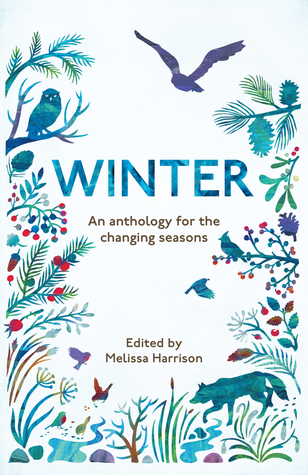 So I’m ambivalent about winter, and was interested to see how the authors collected in Melissa Harrison’s final seasonal anthology would explore its inherent contradictions. I especially appreciated the views of outsiders. Jini Reddy, a Quebec native, calls British winters “a long, grey sigh or a drawn-out ache.” In two of my favorite pieces, Christina McLeish and Nakul Krishna – from Australia and India, respectively – compare the warm, sunny winters they experienced in their homelands with their early experiences in Britain. McLeish remembers finding a disembodied badger paw on a frosty day during one of her first winters in England, while Krishna tells of a time he spent dogsitting in Oxford when all the students were on break. His decorous, timeless prose reminded me of J.R. Ackerley’s.
The series is in support of the Wildlife Trusts, and a key message of this volume in particular is that nature is always there to be experienced – even in what feels like a dead time of year. Kate Blincoe observes an urban starling murmuration in an essay that nicely blends the lofty and the earthy; Nicola Chester takes a wintry beach walk and documents what she finds in the strandline, such as goose barnacles; Joseph Addison celebrates the pleasures of a winter garden; Patrick Barkham examines the ways butterfly life* continues through the winter, usually as eggs; and Richard Adams (author of Watership Down) insists, “Wild flowers are like pubs. There are generally one or two open somewhere, if only you look hard enough.”
As in the other volumes, Harrison has chosen a lovely mixture of older and contemporary pieces. Occasional passages from Gilbert White and Thomas Furly Forster on the timing of natural phenomena help create a sense of chronological progression, from November through to February. The contemporary nature writing scene is represented by previously published material from Robert Macfarlane and Kathleen Jamie. Classic literature is here in the opening of Charles Dickens’s Bleak House and the Great Frost passage from Virginia Woolf’s Orlando. There are also excerpts from Coleridge’s diary and freed slave Olaudah Equiano’s account of seeing snow for the first time. In general, this volume is better at including diverse voices, like the final piece from Anita Sethi on her family’s unlikely garden in Manchester.
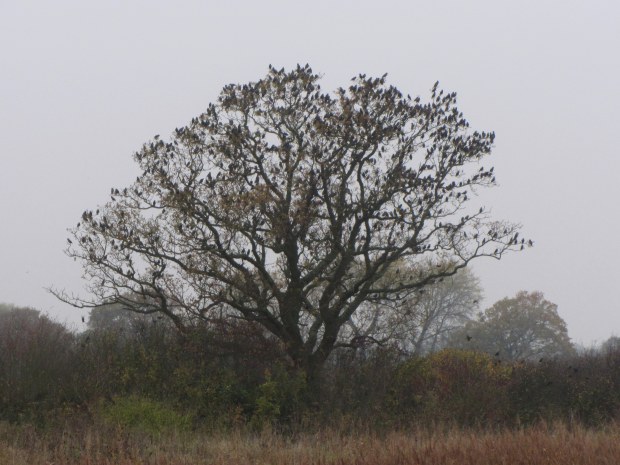
A starling roost at Otmoor RSPB Reserve in Oxfordshire. Photo by Chris Foster.
Christmas doesn’t really appear here; it’s a book about the natural year rather than the cultural year. But another event does, very powerfully: In another of my top few pieces, Jon Dunn (who authored my favorite piece in Autumn) tells how the overpowering darkness of a Shetland winter is broken by the defiant Up Helly Aa festival, in which the residents dress up as Vikings and ceremonially burn a longboat. Life goes on, no matter how bleak everything seems. That’s an important thing to keep in mind after all the troubling events of 2016.
*My husband’s piece, positioned between John Fowles’s and Richard Jeffries’s, is also about the surprising insect life that can be discovered in the winter.
My review of Summer.
My review of Autumn.
[I came late to the series so will be reading, but not reviewing, Spring next year.]
More beautiful lines to treasure:
- “Claws of grey rain break to rake through a gold half-light and the squall moves like a huge aerial jellyfish, obscuring then revealing this wreckers’ coast of muted blue headlands. Swirling white snowflakes move against a grey mass, turning Lundy Island into a Turner painting.” (Nicola Chester)
- “I am the garnet shock / of rosehip on frost / the robin’s titian flare.” (Julian Beach)
- “the tower blocks are advent calendars, / every curtain pulled to reveal a snow-blurred face.” (Liz Berry)
- “A whole year of concerns, worries and squabbles sloughed off in a bone-chilling baptism of copper water.” (Matt Gaw)
- “Two hundred jackdaws drape the skeleton of the winter beech like jet beads around the neck of a Victorian mourner.” (Jane Adams)
With thanks to Jennie Condell at Elliott & Thompson for the free copy for review.
My rating:
Three Perfect November Reads
It occurred to me that I’ve read three novels with “November” in the title. They’re extremely different from each other: one’s a melancholy 1930s American classic; one’s a quirky Icelandic road trip; and the last is a darker entry in a beloved Scandinavian children’s series. All are interesting books, though, and worth reading if you’re in the right mood.
Now in November by Josephine Johnson
(Reviewed here in full back in May.)
 Missouri-born Johnson was just 24 years old when she published Now in November, which won the 1935 Pulitzer Prize. The novel is narrated by the middle Haldmarne daughter, Marget, looking back at a grueling decade on the family farm. The arrival of Grant Koven, a neighbor in his thirties hired to help with hard labor, seems like the only thing that might break the agricultural cycle of futile hope and disappointment. Marget quickly falls in love with him, but it takes her a while to realize that her two sisters are smitten too. They all keep hoping their fortunes will change, but as drought settles in, things only get worse. This is an atmospheric and strangely haunting novel. The plot is simple enough, but the writing elevates it into something special. The plaintive tone, folksy metaphors, and philosophical earnestness all kept me eagerly traveling along with Marget to see where the tragic story might lead.
Butterflies in November by Auður Ava Ólafsdóttir
 This is a whimsical, feminist road trip novel. The unnamed narrator is a translator based in Reykjavík. When her best friend slips on an icy sidewalk and breaks her arm, it falls to the narrator to care for the friend’s deaf-mute four-year-old son, Tumi. Leaving behind romantic troubles and boosted by not one but two lottery wins, she and the boy set off on a snowy voyage around Iceland’s Ring Road, with plenty of madcap adventures ahead. The plot is rather scattered and uneven, with uproarious mishaps followed by tedious passages. However, in this kooky fictional world where “nothing is as it should be any more,” where butterflies are still flying in November, the narrator’s tragicomic travels should still strike a chord. Recommended for fans of zany Scandinavian fiction such as The Hundred-Year-Old Man Who Climbed Out of the Window and Disappeared by Jonas Jonasson, or Doppler by Erlend Loe. (See my full review at For Books’ Sake.)
Moominvalley in November by Tove Jansson
 Jansson said that after the Second World War she was depressed and wanted to write about something naïve and innocent. She wrote the first book of the Moomins series in 1945, about a family of hippo-like white trolls. But the Moomins do not appear in this book at all. It is November, the days are closing in, and no one knows where they have gone and when they might come back. A series of visitors journey to Moominvalley and find the house empty, cold and strange; these interlopers try to make their own merriment with a picnic and a party, but it all falls flat. The book felt unique to me for its Scandinavian qualities: the strange sprite-like creatures, woodland settings and short winter days, and the slight air of depression. As with the best children’s fiction, there is much here to entertain adults. Perhaps the most fun aspect of the book is Jansson’s original black and white line drawings of her peculiarly loveable creations.
Favorite passage: “The quiet transition from autumn to winter is not a bad time at all. It’s a time for protecting and securing things and for making sure you’ve got in as many supplies as you can. It’s nice to gather together everything you possess as close to you as possible, to store up your warmth and your thoughts and burrow yourself into a deep hole inside, a core of safety where you can defend what is important and precious and your very own. Then the cold and the storms and the darkness can do their worst. They can grope their way up the walls looking for a way in, but they won’t find one, everything is shut, and you sit inside, laughing in your warmth and your solitude, for you have had foresight.”
[On my TBR: November Storm by Robert Oldshue, a recent short story collection.]
Have you read these or any other “November” books?
Books in Brief: Five I Loved Recently
Novels narrated by an octogenarian and an unborn child; memoirs about connection with nature and escaping an abusive relationship; and a strong poetry collection that includes some everyday epics: these five wildly different books are all 4-star reads I can highly recommend.
The Secret Diary of Hendrik Groen, 83¼ Years Old
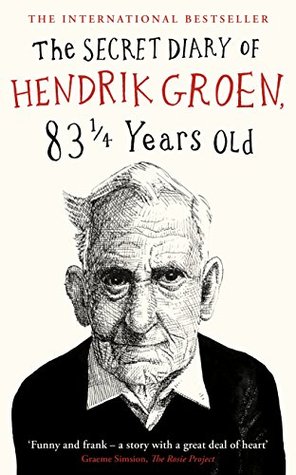 In this anonymous Dutch novel in diary form, Hendrik Groen provides a full reckoning of how 2013 went down in his Amsterdam old folks’ care home. He and five friends form the “Old But Not Dead” club and take turns planning exciting weekly outings. Much comic relief is provided by his incorrigibly tippling friend, Evert, and the arrival of Eefje makes late-life romance seem like a possibility for Hendrik. However, there’s no getting around physical decay: between them these friends suffer from incontinence, dementia, diabetic amputations and a stroke. By the time 2014 rolls around, their number will be reduced by one. Yet this is a tremendously witty and warm-hearted book, despite Hendrik’s sad family history. It’s definitely one for fans of A Man Called Ove – but I liked this more. A sequel from 85-year-old Hendrik came out this year in Dutch; I’ll be looking forward to the English translation.
The Moth Snowstorm: Nature and Joy
By Michael McCarthy
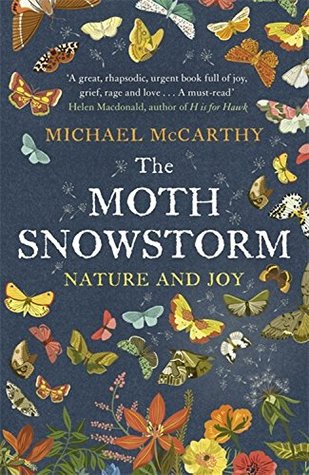 An environmental journalist for the UK’s Independent, McCarthy offers a personal view of how the erstwhile abundance of the natural world has experienced a dramatic thinning, even just in England in his lifetime. He gives both statistical and anecdotal evidence for that decline; as a case study he discusses the construction of a sea wall at Saemangeum in South Korea, responsible for decimating a precious estuary habitat for shorebirds. As if to balance his pessimism about the state of the world, McCarthy remembers singular natural encounters that filled him with joy and wonder – first discovering birdwatching as a lad near Liverpool, seeing a morpho butterfly in South America – but also annual displays that rekindle his love of life: the winter solstice, the arrival of cuckoos, and bluebells. This memoir is more sentimental than I expected from an English author, but I admire his passion and openness.
Nutshell
By Ian McEwan
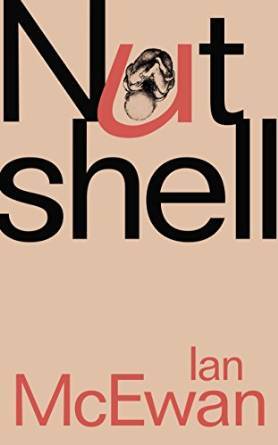 My seventh McEwan novel and one of his strongest. Within the first few pages, I was utterly captivated and convinced by the voice of this contemporary, in utero Hamlet. Provided you suspend disbelief a bit to accept he can see/hear/surmise everything that happens – the most tedious passages are those where McEwan tries to give more precise justification for his narrator’s observations – the plot really works. Not even born and already a snob with an advanced vocabulary and a taste for fine wine, this fetus is a delight to spend time with. His captive state pairs perfectly with Hamlet’s existential despair, but also makes him (and us as readers) part of the conspiracy: even as he wants justice for his father, he has to hope his mother and uncle will get away with their crime; his whole future depends on it.
Favorite line: “I have lungs but not air to shout a warning or weep with shame at my impotence.”
How Snow Falls
By Craig Raine
 One of the few best poetry collections I’ve read this year. It contains nary a dud and is a good one to sink your teeth into – it’s composed of just 20 poems, but several are in-depth epics drawn from everyday life and death. Two elegies, to a dead mother and a former lover, are particularly strong. I loved the mixture of clinical and whimsical vocabulary in “I Remember My Mother” as the poet charts the transformation from person to corpse. “Rashomon” is another stand-out, commissioned as an opera and inspired by the short story “In a Grove” by Ryūnosuke Akutagawa. In couplets with a flexible rhyme scheme, the poem alternates the perspectives of a bandit, a captive husband, his raped wife, and the woodcutter who becomes an unwilling observer. Alliteration is noteworthy throughout the collection, but here produces one of my favorite lines: “Sweet cedar chips were spurting in the gloom like sparks.”
Land of Enchantment
By Leigh Stein
 Stein tells of her abusive relationship with Jason, a reckless younger man with whom she moved to New Mexico. The memoir mostly toggles between their shaky attempt at a functional relationship in 2007 and learning about his death in a motorcycle accident in 2011. Even though they’d drifted apart, Jason’s memory still had power over her. Breaking free from him meant growing up at last and taking responsibility for her future. You might call this a feminist coming-of-age narrative, though that makes it sound more strident and formulaic than it actually is. I admired the skipping around in time, and especially a late chapter in the second person. I also enjoyed how New Mexico provides a metaphorical as well as a literal setting; Stein weaves in references to Georgia O’Keeffe’s art and letters to put into context her own search to become a self-sufficient artist.
 Bookish Beck = Rebecca Foster. American transplant to England. Freelance proofreader and book reviewer.
 Bookish Beck