Review: The Dark Circle by Linda Grant
Linda Grant’s seventh novel, The Dark Circle, stars Lenny and Miriam Lynskey, nineteen-year-old twins and representatives of London’s small Jewish population. It is 1949; Miriam works in a flower shop and Lenny has just been rejected by the army at his National Service medical appointment. He has tuberculosis and there are worries about Miriam’s lungs, too, so it’s off to the Gwendo (the Gwendolyn Downie Memorial Hospital for the Care of Chronic Cases of Tuberculosis, that is) for both of them. We briefly see them through the eyes of the cab driver who takes them down to Kent: “The pair in the back were common as muck.”
It’s clear this is no ordinary sanatorium; it has a “reputation for being a modern, iconoclastic facility for the very best people,” like Lady Anne and Miriam’s Oxford-educated roommate, Valerie. The Lynskeys, as NHS rather than private patients, may be looked down on as a different class of people, but they bring fresh life into the place. That’s doubly true of new arrival Arthur Persky, a twenty-six-year-old Navy man from Brooklyn. He enlivens the bleak, clinical surroundings with rock ’n roll music and a certain sex act. The Gwendo, once a place of boredom and conformity, now seems like a site of quiet rebellion.
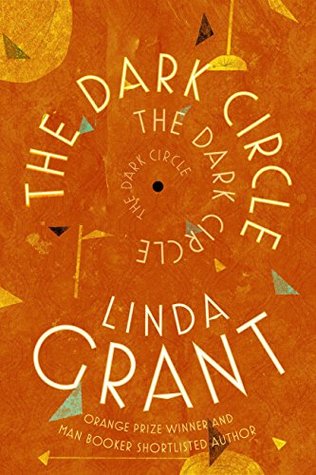 One of Grant’s key skills is characterization, and short chapters from different characters’ perspectives give us access to their backstories. I especially liked getting to know German refugee Hannah Spiegel. Kafka, oddly enough, forms a link between her and the Lynskeys: Valerie has been reading The Metamorphosis aloud to Miriam to try to educate her; Miriam, absolutely captivated, gets Lenny in on the listening sessions, and he asks Hannah to interpret the book for them since she’s read the original German. “No, no-one can explain, it’s not possible to do so,” she replies. “You experience it in your way, it’s a labyrinth you must pass through but the labyrinth is yourself.”
The same might be said of tuberculosis. Each of these patients has the same disease, so Dr. Limb and his nurses sometimes treat them as interchangeable, yet each medical journey is individual and unpredictable. The typical approach was a pneumothorax injection to temporarily collapse one lung so it could ‘rest’, but in extreme cases some patients would have ribs removed. Great hopes were pinned on streptomycin treatment, and on Rosh Hashanah, the Jewish day of reckoning in 1950, Dr. Limb takes on the role of God, weighing up who live and who will die in the coming year. He has seven courses of streptomycin to distribute, but who will get them? The weakest? The woman he’s in love with? Or the ones with the most chance of improving? Meanwhile, Miriam’s condition is worsening, and Lenny and Persky decide they’ll do whatever it takes to make sure she gets one of those injections.
I was impressed by how Grant evokes her period setting through dialogue, slang and music. The novel’s tone is wry yet melancholy, almost nostalgic. The terrific opening paragraph gives you a taste of the no-nonsense style:
London. Big black old place, falling down, hardly any colour apart from a woman’s red hat going into the chemist with her string bag, and if you looked carefully, bottle green leather shoes on that girl, but mostly grey and beige and black and mud-coloured people with dirty hair and unwashed shirt collars, because everything is short, soap is short, joy is short, sex is short, and no one on the street was laughing so jokes must be short too. Four years after the war and still everything is up shit creek.
The final 60 pages are set in the future and reveal what happens to Lenny, Miriam and key others in the decades after they leave the sanatorium. These former patients are bound together in the title’s “dark circle” of suffering, but because TB has been eradicated no one remembers their pain. “From a death sentence to a course of antibiotics in a decade,” Lenny marvels. The novel loses momentum a bit in this short final section. I felt it would have been more powerful if Parts II and III were cut and the book simply ended with the plot coming full circle and Lenny and Miriam leaving the Gwendo in a taxi. But this is a minor quibble. The Dark Circle does what the best fiction does: drops you right into a situation you’ve never thought about and can’t begin to imagine—until a first-class novelist does so for you.
The Dark Circle was published by Virago on November 3rd. My thanks to Poppy Stimpson of Little, Brown for the free review copy.
My rating: 
It was a delight to participate in my first blog tour. See below for details of where other reviews have appeared and will be appearing soon.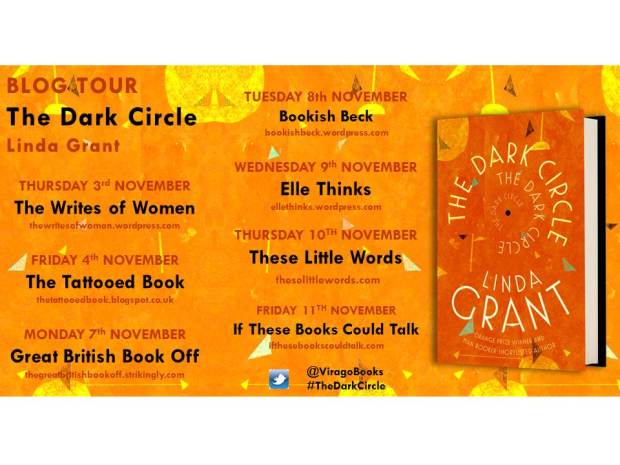
New Bookcases = Reorganizing
I knew the situation was getting desperate when I had to start stacking books on top of the row on top of the bookcase, and sideways on my bedside table so that I couldn’t see the spines.
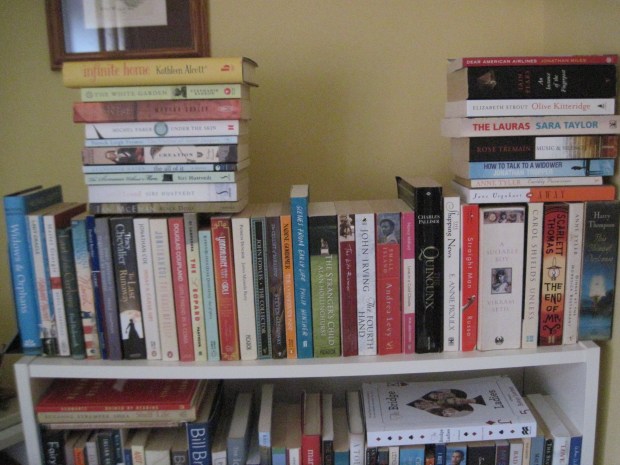
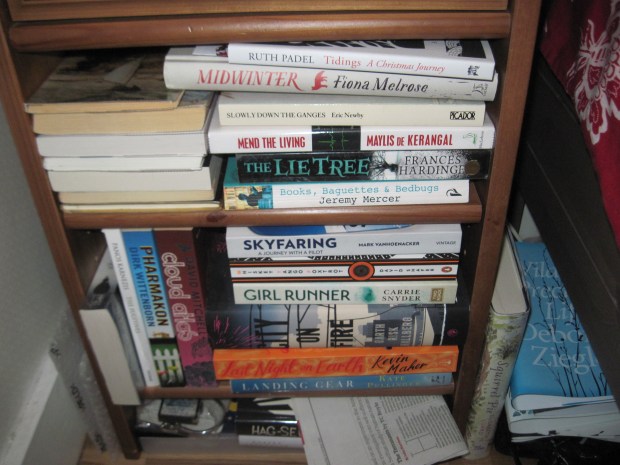
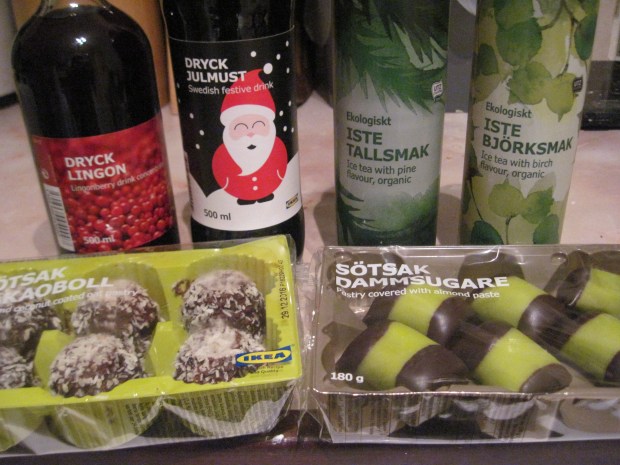
So this weekend we journeyed to the fairly new Ikea store in Reading for two more Billy bookcases. We had a short list of other stuff we were looking for, but kept finding useful items – a desk chair for my husband’s attic workstation, a metal filing unit to replace the impossible stationery box we’ve used for years, two shelving units that would together hold all of our CDs and DVDs, etc. – such that by the time we finished our plates of meatballs we’d blown over £200 in store. But hey, we got loads of useful storage solutions, worked on our Christmas shopping, and found some bizarre Swedish foodstuffs to try too.
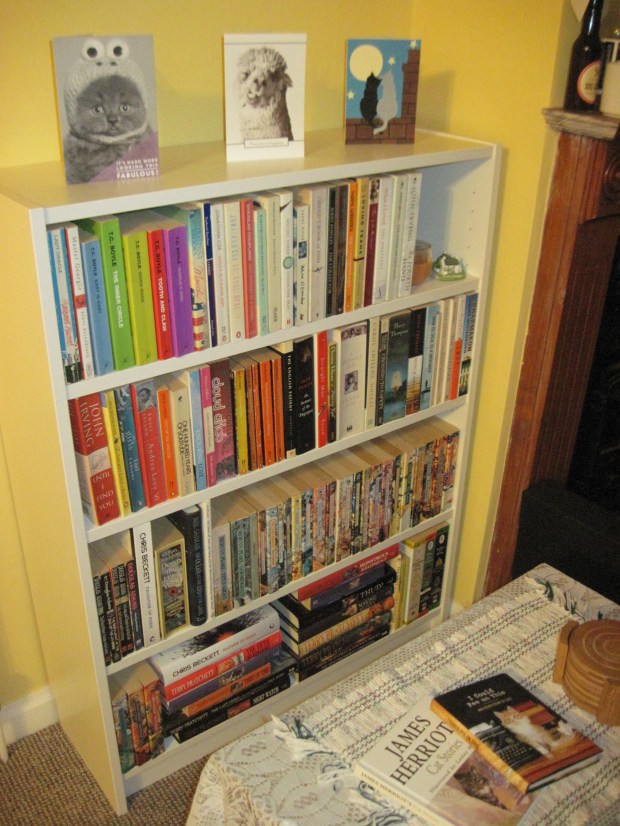
I’ve now been able to eliminate all double-stacking and make some more sensible categories. So upstairs in my study I have all classics in one bookcase, and another with one shelf of priority fiction, two shelves of biography and memoir, and one shelf of literary reference. Downstairs one whole bookcase is devoted to nature and field guides, another houses priority fiction paperbacks (two shelves) and science fiction (two shelves, thanks to my husband’s Terry Pratchett collection), and a third is split between travel (one shelf); general nonfiction, music and cats (together a partial shelf), and religion and poetry (two shelves). With the addition of a side table and floor lamp, my reading corner is now complete.
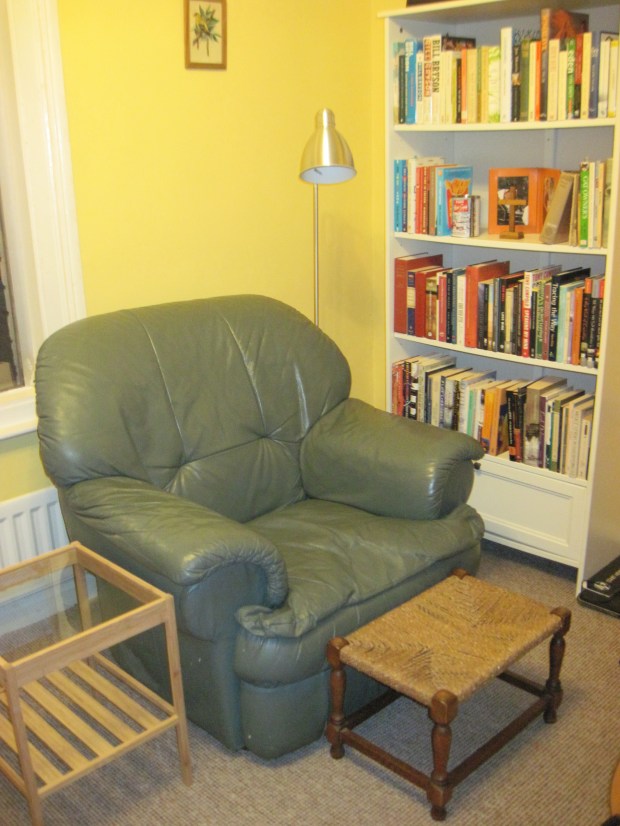
The good news is that I have the equivalent of two small shelves empty, which is unheard of in this household but means we have some room to expand into.
It’s been a busy weekend what with shopping, yardwork, editing and helping my husband make a Christmas cake. The downside is that pretty much zero reading got done. But it’s been fun to do some different things, including walking through chilly, fireworks-lit streets for a pint and a pie at one of our local pubs on Guy Fawkes Night.
How did you spend the weekend? Did any reading get done?
Landmark Books in My Life, Part II
This is a follow-up to a piece I wrote in September about the books that shaped my early life. I think of my twenties in general, and 2005–7 in particular, as a golden period in my reading life, when I started to develop the tastes that still guide my book choices today.

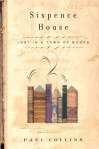 I was an English and Religion major and studied abroad in England for my junior year in 2003–4. As I was getting ready to go overseas for that first time in the summer of 2003, Susan Allen Toth’s trilogy of travel memoirs, starting with My Love Affair with England, and Paul Collins’s Sixpence House whetted my appetite for travel in Great Britain and, in the case of the latter, made me determined to get to Hay-on-Wye, Wales as soon as I could. (I first visited in May 2004 and have gone back several times since.)
 One of the most memorable books I read during my year abroad was Robert Elsmere by Mrs. Humphry Ward. It’s almost forgotten nowadays, but was a bestseller at its release in 1888. The story of a minister’s loss of faith and how it affects his marriage, it’s a stand-in for a whole faith-and-doubt subgenre that was wildly popular at the time. The novel is long, brooding and overwritten—in many ways it exemplifies the worst characteristics of the Victorian novel—but it resonated with my own crisis of faith and planted the seed for my Master’s thesis on women’s faith and doubt narratives in Victorian fiction.
 Part of working through that ongoing crisis of faith was seeing other religions more objectively and being open to the similarities between them. I found Karen Armstrong’s comparative study of the Abrahamic faiths (Christianity, Judaism and Islam), A History of God, absolutely riveting when I read it in my senior year of college. It’s a classic.
 My academic conference career began and ended with one I attended the summer after college graduation. I adapted a paper I’d written about D.H. Lawrence’s new moral framework for sexuality and was accepted to present it at the D.H. Lawrence Society of North America’s annual conference in 2005, which that year was held in Santa Fe, New Mexico. Thankfully, I’ve mostly blanked out my actual paper presentation as part of a panel of three young people, but the trip as a whole was wonderful—it was my first time in the southwest, and the conference included great field trips to Lawrence’s ranch at Taos and the Georgia O’Keeffe museum. I prepared for the experience by reading David Lodge’s Small World, a paperback I’d plucked from the shelves of the bookstore where I worked part-time during my senior year. “A satire about the academic conference circuit? I’m there!” I thought, and since then David Lodge has become one of my two or three favorite authors.
 It wasn’t until I returned to England to get my Master’s in 2005–6 that I really reclaimed reading as a leisure activity. The last couple years of college had been so busy I’d barely been able to cope with my assigned reading; I remember never making it very far in any paperback I picked up from the public library (like Charles Frazier’s Cold Mountain, which I’ve never gone back to). But the long, lonely evenings in Leeds had to be filled somehow, and the upstairs stacks of the magnificent Brotherton Library had plenty to offer in the way of literary fiction. In that year I made my way through loads of books by A.S. Byatt and Julian Barnes, as well as David Lodge (my top 3, probably). Possession made the biggest impression, but I love pretty much all of Byatt’s work. If pressed to name my favorite author, it would be her.
 In the partial year between finishing my Master’s and getting married back in England, I lived at home with my parents and worked part-time at a community college library. My evening shifts were often dead quiet, so I got plenty of reading done behind the circulation desk. One book I selected at random from the public library shelves, Abigail Thomas’s A Three Dog Life, had a big impact on me in 2007. The memoir tells of her husband’s traumatic brain injury and the aftermath. Thomas writes in a fragmentary, episodic format that felt fresh and jolted me. I wasn’t entirely sure I liked the style, but it sure was intriguing.

 I picked up Meredith Hall’s Without a Map around the same time, which cemented my interest in women’s life stories. Memoirs have been among my favorite genres ever since. Mark Doty’s exquisite Heaven’s Coast, which I read the following year, kickstarted my particular fascination with bereavement memoirs. Also, I think it was through following up his memoirs with his collections of poems that I first got into contemporary poetry.
In recent years I’ve tried to branch out (e.g. into graphic novels and literature in translation), but contemporary literary fiction, historical fiction, memoirs, theology and travel books remain my preferred genres. Most of these loves I can trace back to my early twenties.
What books meant the most to you in young adulthood?
Library Checkout: October 2016
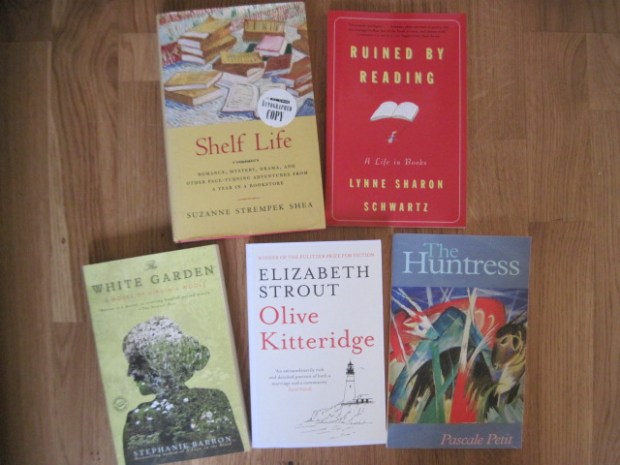
I continue to power through public library books at the same time as I keep acquiring books – including the ones below that I bought with birthday money from my sister: two novels I’ve been keen to read, a book of poetry, and two bibliomemoirs (one of them a signed copy but still stupidly cheap!).
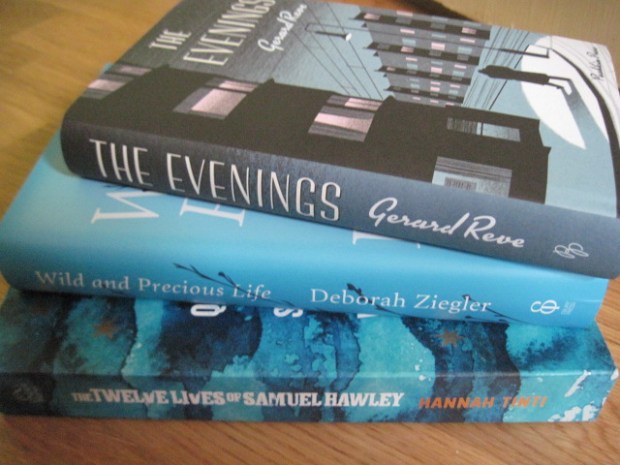
I also have this gorgeous trio of blue-hued books to be reviewing for The Bookbag.
I’ve given ratings for all the books I finished, and added links to reviews for those I managed to write about.
LIBRARY BOOKS READ
- Ozone Journal by Peter Balakian (poetry)

- Thrice the Brinded Cat Hath Mew’d by Alan Bradley

- The Crime Writer by Jill Dawson
- The Library of Unrequited Love by Sophie Divry
- Let Me Tell You about a Man I Knew by Susan Fletcher
- The Man Who Wouldn’t Get Up and Other Stories by David Lodge
- Nutshell by Ian McEwan
- The Many by Wyl Menmuir
- Do Not Say We Have Nothing by Madeleine Thien
CURRENTLY READING
- Keeping an Eye Open: Essays on Art by Julian Barnes
- Open City by Teju Cole
CHECKED OUT, TO BE READ
Many familiar titles still hanging around from last month, plus a few new ones…
- A Chinese street food cookbook to browse for ideas
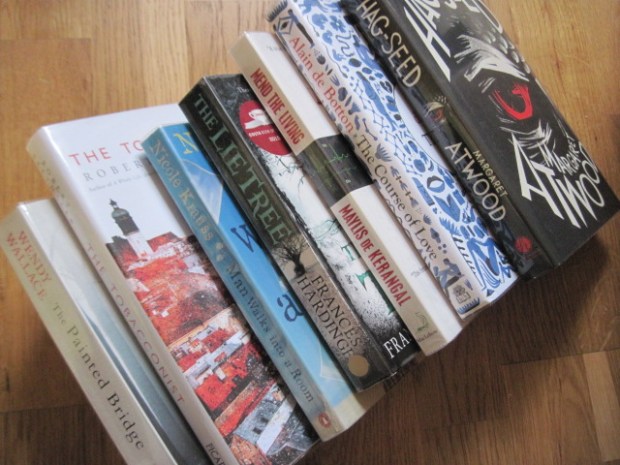
- Hag-Seed: The Tempest Retold by Margaret Atwood
- The Course of Love by Alain de Botton
- Mend the Living by Maylis de Kerangal
- The Lie Tree by Frances Hardinge
- Man Walks into a Room by Nicole Krauss
- Thirteen Ways of Looking by Colum McCann
- The Tobacconist by Robert Seethaler
- The Painted Bridge by Wendy Wallace
IN THE RESERVATION QUEUE
- Poetry Notebook, 2006–2014 by Clive James
- Dear Mr. M by Herman Koch
- Squirrel Pie by Elisabeth Luard
- Cure: A Journey into the Science of Mind over Body by Jo Marchant
- Autumn by Ali Smith
- The Pursuit of Happiness: Why Are We Driving Ourselves Crazy and How Can We Stop? by Ruth Whippman
RETURNED UNREAD
- Two for Joy by Dannie Abse – I read about a third of these poems; not a single one stuck out for me.
- The Most Perfect Thing: Inside (and Outside) a Bird’s Egg by Tim Birkhead – requested; I’ll have to get it back out another time.
- Citizen: An American Lyric by Claudia Rankine – Skimmed. Kudos to Rankine for revealing overt/casual racism in America – Lord knows we still need it in the public eye. (Ditto to Paul Beatty’s The Sellout winning the Booker Prize.) But is this poetry? Not even a quarter of the book is composed of what I would call poems, even prose poems. It’s more like a book of essays, which I wasn’t in the mood for. Best lines: “because white men can’t / police their imagination / black men are dying.”
- The House at the Edge of the World by Julia Rochester – also requested.
(Thanks, as always, go to Shannon of River City Reading for the great blog idea and template!)
Six Books that Disappointed Me Recently
I had high hopes for all of these: long-awaited novels from Jonathan Safran Foer (10 years after his previous one), Maria Semple and Zadie Smith; a Project Gutenberg download from the reliably funny Jerome K. Jerome; a brand new psychological thriller from James Lasdun, whose memoir and poetry I’ve loved; and a horse racing epic that generated Great American Novel buzz. But they all failed to live up to expectations.
Here I Am
By Jonathan Safran Foer
 Is it a simple account of the implosion of two Washington, D.C. fortysomethings’ marriage? Or is it a sweeping epic of Judaism from the biblical patriarchs to imagined all-out Middle Eastern warfare? Can it succeed in being both? I didn’t really think so. The dialogue between this couple as they face the fallout is all too real and cuts to the quick. I enjoyed the preparations for Sam’s bar mitzvah and I could admire Julia’s clear-eyed capability and Sam, Max and Benjy’s almost alarming intelligence and heart at the same time as I wondered to what extent she was Foer’s ex-wife Nicole Krauss and they were the authors’ kids. But about halfway through I thought the book got away from Foer, requiring him to throw in a death, a natural disaster, and a conflict with global implications. This feels more like a novel by Philip Roth or Howard Jacobson, what with frequent masturbation and sex talk on the one hand and constant quarreling about what Jewishness means on the other. The central message about being present for others’ suffering, and your own, got a little lost under the flood of events.
My rating: 
Three Men on the Bummel
 By Jerome K. Jerome
Jerome’s digressive style can be amusing in small doses, but this book is almost nothing but asides. I did enjoy the parts that most closely resemble a travelogue of the cycle trip through Germany, but these are drowned under a bunch of irrelevant memories and anecdotes. I much preferred Diary of a Pilgrimage.
My rating: 
The Fall Guy
By James Lasdun
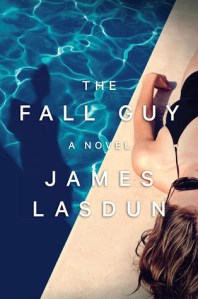 This is a capable psychological thriller about an out-of-work chef who becomes obsessed with the idea that his wealthy cousin’s alluring wife is cheating on him during a summer spent with them in their upstate New York bolthole. I liked hearing about Matthew’s cooking and Chloe’s photography, and it’s interesting how Lasdun draws in a bit about banking and the Occupy movement. However, the complicated Anglo-American family backstory between Matthew and Charlie feels belabored, and the fact that we only see things from Matthew’s perspective is limiting in a bad way. There’s a decent Hitchcock vibe in places, but overall this is somewhat lackluster.
My rating:
The Sport of Kings
By C.E. Morgan
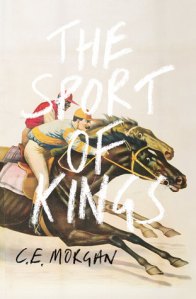 I found this Kentucky-based horse racing novel to be florid and overlong. The novel doesn’t achieve takeoff until Allmon comes on the scene at about page 180. Although there are good descriptions of horses, the main plot – training Hellsmouth to compete in the 2006 Derby – mostly passed me by. Meanwhile, the interpersonal relationships become surprisingly melodramatic, more fit for a late Victorian novel or maybe something by Faulkner. My favorite character was Maryleen, the no-nonsense black house servant. Henry himself, though, makes for pretty unpleasant company. Morgan delivers the occasional great one-liner (“Childhood is the country of question marks, and the streets are solid answers”), but her prose is on the whole incredibly overwritten. There’s a potent message in here somewhere about ambition, inheritance and race, but it’s buried under an overwhelming weight of words. (See my full Nudge review.)
My rating:
Today Will Be Different
By Maria Semple
 Bernadette fans, prepare for disappointment. There’s nothing that bad about the story of middle-aged animator Eleanor Flood, her hand-surgeon-to-the-stars husband Joe, and their precocious kid Timby, but nor is there anything very interesting about it. The novel is one of those rare ones that take place all in one day, a setup that enticed me, but all Eleanor manages to fit into her day – despite the title resolution – is an encounter with a pet poet who listens to her reciting memorized verse, another with a disgruntled former employee, some pondering of her husband’s strange behavior, and plenty of being downright mean to her son (as if his name wasn’t punishment enough). “In the past, I’d often been called crazy. But it was endearing-crazy, kooky-crazy, we’re-all-a-little-crazy-crazy,” Eleanor insists. I didn’t think so. I didn’t like being stuck in her head. In general, it seems like a bad sign if you’re eager to get away from a book’s narrator and her scatty behavior. Compared to Semple’s previous novel, it feels like quirkiness for quirkiness’ sake, with a sudden, contrived ending.
My rating:
Swing Time
By Zadie Smith
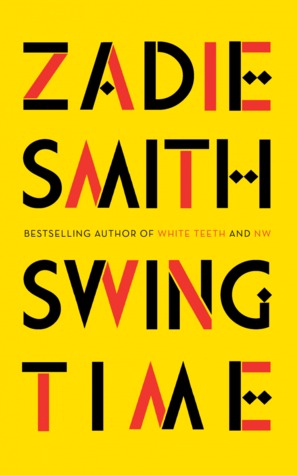 Smith’s fifth novel spans 25 years and journeys from London to New York City and West Africa in tracing the different paths two black girls’ lives take. The narrator (who is never named) and Tracey, both biracial, meet through dance lessons at age seven in 1982 and soon become inseparable. The way this relationship shifts over time is the most potent element of the novel, and will appeal to fans of Elena Ferrante. The narrator alternates chapters about her friendship with Tracey with chapters about her work for pop star Aimee in Africa. Unfortunately, the Africa material is not very convincing or lively and I was impatient for these sections to finish. The Aimee subplot and the way Tracey turns out struck me as equally clichéd. Despite the geographical and chronological sprawl, the claustrophobic narration makes this feel insular, defusing its potential messages about how race, money and class still define and divide us. A new Zadie Smith novel is an event; this one is still worth reading, but it definitely disappointed me in comparison to White Teeth and On Beauty. (Releases Nov. 15th.)
My rating:
Have you read any of these? What did you think?
What’s the last book that really let you down?
And the Winner Is…
In case you haven’t already heard, the winner of the Man Booker Prize 2016 is
The Sellout by Paul Beatty
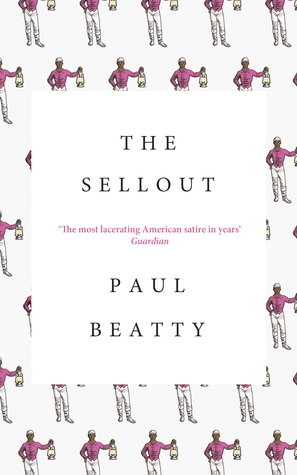 He’s the first American winner of the Booker Prize, for which I must express a modicum of pride. Yet I’m gobsmacked by the judges’ decision. Do you know that lovely bit of British slang? It means, roughly, astounded. You see, I would have placed The Sellout fifth out of six in terms of its likelihood of winning (ahead of only Eileen).
When I reviewed it for Shiny New Books back in early June, I expressed my doubts that this outrageous racial satire would strike a chord in Britain as it had in the States. It’s a zany, irreverent take on racial politics in America today, crammed with old stereotypes of African-Americans. For me, the satire wore thin and I yearned for more of an introspective Bildungsroman. But it’s clear that, with police shootings of black men in America a seemingly daily news phenomenon, the Booker judges chose a timely and incisive winner.
Here’s a taste of the sort of audacious lines the book is chock-full of:
“I understand now that the only time black people don’t feel guilty is when we’ve actually done something wrong, because that relieves us of the cognitive dissonance of being black and innocent, and in a way the prospect of going to jail becomes a relief.”
“When a white bitch got problems, she’s a damsel in distress! When a black bitch got problems, she’s a welfare cheat and a burden on society. How come you never see any black damsels? Rapunzel, Rapunzel, let down your weave!”
Amid the laughs, you still get a sense of how important it is to Beatty that race remain a topic for public discussion. An exchange the narrator has with a police officer could just as easily describe the author’s purpose:
“It’s illegal to yell ‘Fire’ in a crowded theatre, right?”
“It is.”
“Well, I’ve whispered ‘Racism’ in a post-racial world.”
No whisper, this, but a brazen shout.
Did the panel get it right this year?
Polishing off the Booker Prize Shortlist
This is the second year in a row that I’ve managed to read the whole of the Man Booker Prize shortlist before the announcement of the winner. (In 2013 and 2014 I only got through four of the six titles.) Here’s my take on the final two from the shortlist (see my quick impressions of the others here and here), plus one from the longlist. I finish with thoughts about my favorites and the likely winner.
All That Man Is by David Szalay
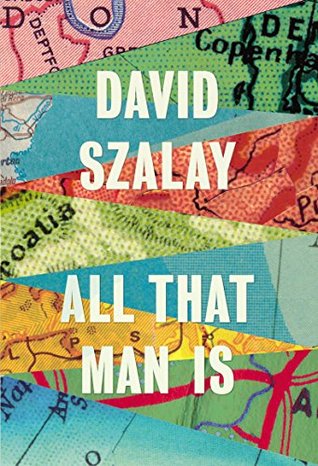 In a riff on the Ages of Man, Szalay gives nine vignettes of men trying to figure out what life is all about. His antiheroes range from age 17 to 73. Each section has several chapters and follows a similar pattern: a man from one European country travels to another European country; there are lots of scenes set at airports or otherwise in transit, and part of the overall atmosphere of dislocation is simply the effort of having to adjust to foreignness. These trips are made for various reasons: feckless French twentysomething Bérnard has been fired by his uncle so goes ahead with a vacation to Cyprus; tabloid journalist Kristian flies from Denmark to Spain to confirm rumors of a government minister’s involvement in a scandal; recently impoverished oligarch Aleksandr takes his yacht for a farewell Adriatic cruise.
Predictably, sex is a major theme: reluctant hook-ups, fantasy lovers, affairs regretted, wild oats never sown. At times I was ready to fill in the title phrase in my best Cockney accent with “All That Man Is…is a bloody wanker.” As individual stories, there’s nothing particularly wrong with these. Inevitably, though, some are more interesting than others, and they don’t quite succeed in feeding into an overarching message, unless to confirm a mood of hedonism and angst. Life is short and pointless; enjoy its moments while you can, eh? Overall, I didn’t find this to be the philosophical and elegiac experience I expected. The prose is great, though; I’d certainly read a more straightforward novel by Szalay.
Favorite lines: “How little we understand about life as it is actually happening. The moments fly past, like trackside pylons seen from a train window.”
My rating:
Do Not Say We Have Nothing by Madeleine Thien
 “Music and stories, even in times like these, were a refuge, a passport, everywhere.” A sweeping epic of life in China in the turbulent 1960s–80s, this is the Canadian novelist’s fourth book. Narrated from the present day by Marie (or Ma-Li), who lives in Vancouver with her mother, the novel plunges into layers of flashbacks about her family’s connection to Ai-Ming and her musician father, Sparrow. With loyalty to the Communist Party (the title is a line from its anthem) considered the gold standard of behavior and Western music widely denounced as revolutionary, these characters are in a bind: will they pursue their identity as artists, or keep their heads down to avoid trouble? This theme reminded me of Julian Barnes’s fictionalized biography of the Russian composer Shostakovich, The Noise of Time, which also asks whether music can withstand political oppression.
If, like me, you know next to nothing about China’s Cultural Revolution and the transition from Chairman Mao to successive leaders, you will learn so much. There is no denying the power of this portrayal of history. In addition, I was consistently impressed by the book’s language. Thien incorporates Chinese characters and wordplay, musical bars, and snatches of poetry and folk songs. However, I didn’t find this easy reading. The flashbacks can feel endless, such that I experienced Marie’s sections as a relief and wished for more of them. I had to set daily reading targets to get through the novel before the library due date. Yet it is the sort of epic the Booker Prize loves – with echoes of Ruth Ozeki’s The Tale for the Time Being (which should have won in 2013) and Richard Flanagan’s The Narrow Road to the Deep North – and is full of wise observations about what keeps us going when life falls apart. (See my full review at Nudge.)
My rating:
And here’s another from the longlist that I read recently:
The Many by Wyl Menmuir
 A short work of muted horror, all about atmosphere and the unexplained. Set in a Cornish fishing village, it sees newcomer Timothy Buchannan trying to figure out what happened to Perran, the man who occupied his rundown cottage until his death 10 years ago, and why everyone refuses to talk about him. Flashbacks in italics give glimpses into Timothy’s life with his wife, Lauren, who is meant to join him when he finishes the renovations; and into the fisherman Ethan’s past. I enjoyed the unsettling mood and the language used to describe the setting and Timothy’s dreams. Ultimately I’m not sure I fully understood the book, especially whether the late turns of the plot are to be viewed literally or allegorically. What I take away from it, and this is perhaps too simplistic, is an assertion that we are all joined in our losses. A quick, creepy read – you could do worse than pick it up this Halloween.
My rating:
My two favorites from the shortlist are #1 His Bloody Project by Graeme Macrae Burnet and #2 Hot Milk by Deborah Levy. But my prediction for tomorrow’s winner is Do Not Say We Have Nothing by Madeleine Thien.
What have you managed to read from the Booker shortlist? What’s your prediction for tomorrow?
Five Reasons I Love My E-Readers
As an inveterate book sniffer and hoarder of musty paperbacks, I was always skeptical about e-readers—that is, until I got my first one three years ago. A birthday present from my husband, my Nook soon became an essential tool in my working life. A year and a bit later, I was sent a Kindle on “permanent loan” through one of my reviewing gigs, and it has quickly become one of my most prized possessions. I know some of my blog readers don’t read e-books at all, and I can sympathize with certain of your feelings. But here are five reasons I love my e-readers, followed by why they will never replace print books for me.
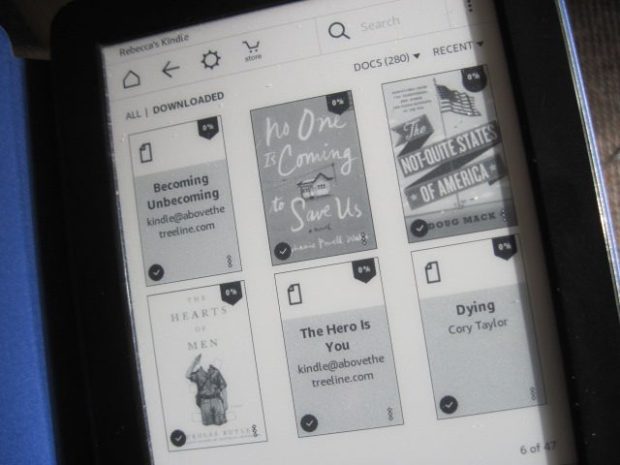
Some recent and upcoming titles I’m keen to try.
- A portable library. I often have between 250 and 300 books on my Kindle. Hundreds of books right at my fingertips, all in a slim 4 x 6 ″ rectangle! If I’m ever stuck somewhere due to delayed or broken-down transport, I’ll never be without ample choices of reading material. E-readers are perfect for cutting down on luggage when traveling (I had to cull 14 books from my suitcase on my last trip to America to stay under the weight limit) and are my usual choice for reading in the car. The Nook’s built-in light is especially useful on nighttime drives. As much as I love my print library, moving house frequently—as we have done over the past decade—always reminds you just how much weight and space books represent.
- Digital review copies. Being willing and able to read PDF and ePUB books is the only thing that has allowed me to work for lots of American companies, which is where the reviewing money seems to be. I can also request advance access to books through NetGalley and Edelweiss, particularly titles not yet published in the UK; and any Kindle downloads do not expire. When traveling I have occasionally found it useful to put other kinds of documents on my Kindle as PDFs, too, like maps and confirmation e-mails. Since I’ve never had a smartphone, this is a kind of compromise between all print and all online.
- Searching and fact-checking. My e-readers’ search function has been invaluable when writing reviews. Often I’ll need to check facts like a character’s last name, the exact city in California, when someone makes their first appearance, or how often a particular word or phrase appears. For instance, I felt that a certain quotation was overused in a memoir, so did a search for it and, indeed, found 12 occurrences!
- Moving between books. I generally have 3 or 4 Kindle books of different genres on the go at any one time, and it couldn’t be easier to move between them with a few finger taps. I’ll often switch books after every couple of chapters, or when I reach a milestone percentage.
- Perfect for certain situations. An e-reader is less obtrusive for reading in public, especially now that etiquette doesn’t seem to preclude phone and tablet use in company. It’s also easier to get one out when you’re going just a few stops on a crowded subway system. I turn to my Kindle for reading over solitary meals/snacks or any other activity that requires my hands, like using a hairdryer. When I think about the lengths I once went to in my former life as a library assistant to read print books—holding pages open with a precariously balanced apple or the edge of a plate during meal breaks; hiding books under the service desk for surreptitious reading at a quiet moment—I think how silly I was not to get an e-reader sooner!
Some of my current reading and review books.
Yet there are definitely things I don’t like about using an e-reader:
- E-books don’t feel like “real” books; I treat them as temporary and disposable and don’t do any nostalgic rebrowsing.
- Battery life can be an issue, though not as often as you might think. (During a period of average use my Kindle probably lasts two weeks, and you can charge it either via a USB cable or at a wall plug.)
- My Nook has a pretty small capacity.
- There are no page numbers on Kindle, just percentages and numerical locations.
- (A pathetic admission) I still haven’t figured out how to highlight passages on my e-readers!
- Because I’m fine with e-copies I don’t get free print books out of most of my review gigs.
- I can’t easily browse the covers/blurbs/first few pages of books to remind myself what they are and decide what I’m in the mood for—as a result, there are dozens of books on my Kindle whose titles I barely recognize.
- I sometimes wonder whether my concentration on and retention of words read on a screen are inevitably lower.
I still love books as physical objects: beautiful covers, delicious smells, the heft of them in your hand and the chance to flick through pages. I like having big stacks of them around as visible signs of progress made and challenges still to come. Arranging and rearranging my library on bookshelves is a periodic treat. So although my e-readers are extremely useful tools, using them is not an unadulterated joy; they will only ever supplement paper books for me, not replace them. I think it’s telling that when given a choice between print and electronic formats—like if I come across an available public library copy of a book I know I have on my Kindle—I’ll choose the print book every time.
How do you feel about e-readers?
More Books about Cats
Back in April I reviewed five books about cats, several of which proved to be a mite disappointing. I’m happy to report that in the meantime I have searched high and low and found some great books about cats that I would not hesitate to recommend to readers with even the slightest interest in our feline friends. I’ve got a book of trivia, a set of heart-warming autobiographical anecdotes, two books of poems, a sweet memoir, and – best of all – a wide-ranging new book that combines the science and cultural history of the domestic cat.
Fifty Nifty Cat Facts by J.M. Chapman and S.M. Davis
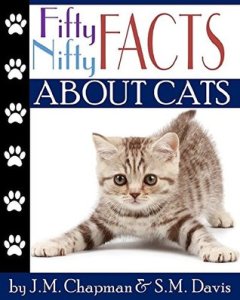 This one’s geared towards children, but I enjoyed the format: each page pairs a cute cat photo with a piece of trivia you might or might not have known. I learned a few neat things:
- a cat’s internal temperature is higher than ours (more like 101.5° F)
- cats have no sweet taste buds and have a dominant paw
- all calicos are female (orange spots being an X-linked genetic trait)
- cats could actually drink seawater – their kidneys are effective enough to process the salt
- people who say they are allergic to cat fur are actually allergic to a protein in the saliva they use to wash themselves!
My rating:
Cat Stories by James Herriot
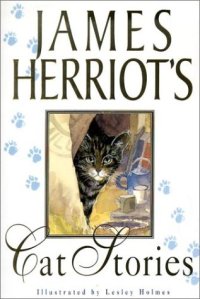 When I was a child my mother and I loved Herriot’s memoirs of life as a primarily large-animal veterinarian in Yorkshire. One story from this volume – the final, Christmas-themed one – is familiar from a picture book we brought out around the holidays. The rest are all drawn from the memoirs, though, so the fact that I don’t remember them must be a function of time; it could be as many as 22 years since I last picked up a Herriot book! In any case, these are charming tales about gentle medical mysteries and even the most aloof of stray cats becoming devoted pets. I especially liked “Alfred: The Sweet-Shop Cat” and “Oscar: The Socialite Cat,” about two endearing creatures known around the village. I also appreciated Herriot’s observation that “cats are connoisseurs of comfort.” With cute watercolor illustrations, this little book would make a great gift for any cat lover.
My rating:
I Could Pee on This: And Other Poems by Cats by Francesco Marciuliano
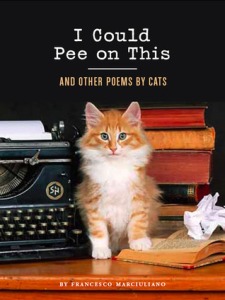 Cat owners must own a copy for the coffee table. That’s just not negotiable. You will recognize so many of the behaviors and attitudes mentioned here. This is a humor book rather than a poetry collection, so the quality of the poems (all from the point-of-view of a cat) is kind of neither here nor there. Even so, Chapter 1 is a lot better than the other three and contains most of the purely hilarious verses, like “I Lick Your Nose” and “Closed Door.” Favorite lines included “I trip you when you walk down the stairs / So you know I’m always near” and “I said I could sit on your lap forever / Don’t you even think of trying to get up / Well, you should have gone to the bathroom beforehand”. “Sushi” is a perfect haiku with a kicker of a last line: “Did you really think / That you could hide fish in rice? / Oh, the green paste burns!”
My rating:
Well-Versed Cats by Lance Percival

 A cute set of poems, most of them describing different breeds of domestic cats and a few of the big cats. There are a lot of puns and jokes along with the end rhymes, making these akin to limericks in tone if not in form. My favorite was “Skimpy the Stray?” – about a wily cat who wanders the neighborhood eliciting sympathetic snacks from various cat lovers. “The routine still goes on, so I mustn’t be too catty, / But she ought to change her name from ‘Skimpy’ into ‘Fatty’.” Our cat had a habit of stealing neighbor kitties’ food and a history of “going visiting,” as the shelter we adopted him from put it, so this particular poem rang all too true. The illustrations (by Lalla Ward, wife of Richard Dawkins) are also great fun.
My rating:
Raining Cats and Donkeys by Doreen Tovey
 Originally from 1967, this lighthearted memoir tells of Tovey’s life in a Somerset village with her husband Charles, two demanding Siamese cats named Solomon and Sheba, and Annabel the donkey. “Nobody misses anything in our village,” Tovey remarks, and along with her charming anecdotes about her pets there are plenty of amusing encounters with the human locals too. In my favorite chapter, Annabel is taken off to mate with a Shetland pony and Solomon has a tussle with a hare. I can recommend this to fans of animal books by Gerald Durrell and Jon Katz. Tovey wrote a whole series of books about her various Siamese cats and life in a 250-year-old cottage. I found a copy of Cats in the Belfry on my visit to Cambridge and will probably read it over Christmas for a cozy treat.
My rating:
The Lion in the Living Room by Abigail Tucker
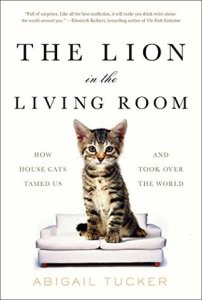 Now this is the amazing cat book I’d been looking for! It’s a fascinating interdisciplinary look at how the domestic cat has taken over the world – both literally and figuratively. A writer for Smithsonian magazine, Tucker writes engaging, accessible popular science. The closest comparison I can make, style-wise, is to Rebecca Skloot’s The Immortal Life of Henrietta Lacks, even though that has much heavier subject matter.
The book traces domestic cat evolution from the big cats of the La Brea tar pits to the modern day, explaining why cats are only built to eat flesh and retain the hunting instinct even though they rarely have to look further than their designated bowls for food nowadays. Alongside the science, though, is plenty of cultural history. You’ll learn about how cats have been an invasive species in many sensitive environments, and about the bizarre, Halloween-scary story of the Toxoplasma gondii parasite. You’ll meet the tender hearts who volunteer for trap, neuter and release campaigns to cut down on the euthanizing of strays at shelters; the enthusiasts who breed unusual varieties of cats and groom them for shows; and the oddballs who buy into the $58 billion pet industry’s novelty accessories.
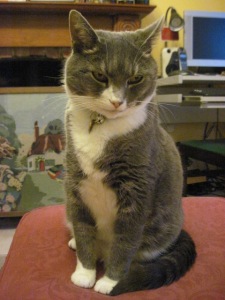
The lion in my living room.
From the earliest domestication of animals to the cat meme-dominated Internet, Tucker – a cat lady herself, as frequent mentions of her ginger tom Cheeto attest – marvels at how cats have succeeded by endearing themselves to humans and adapting as if effortlessly to any habitat in which they find themselves. A must for cat lovers for sure, but I don’t think you even have to be a pet person to find this all-embracing book pretty enthralling.
My rating:
Up next: The Church Cat, an anthology from a recent charity shop haul; The Cat Who Came for Christmas by Cleveland Amory, Cat Sense by John Bradshaw, and Talk to the Tail by Tom Cox from the public library.
Whether you consider yourself a cat lover or not, do any of these books appeal?
Birthday Happenings
One of the best things about being a home-based freelancer is that I can arrange my work schedule to suit my life. Having my birthday fall on a Friday this year was especially good because it meant I got until Monday to submit my daily editing load. My husband was working as usual, so I spent much of the day reading under the cat and charity shopping. I bought seven books, a nice mixture of England-themed nonfiction and juicy novels, plus new-to-me comfy black flats. (Total spend: £10.25.) Being short on time that evening, we lazily ordered delivery pizza for probably the first time in eight years, followed by cocktails and cake.
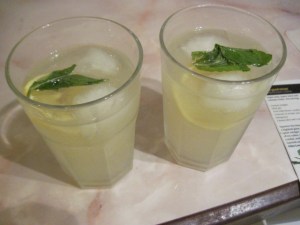 I didn’t end up using my literary cakes and cocktails books this year, but that gives me a chance to proffer my own pun names for what we did make. We tried two gin cocktails we’d found recipes for in the Guardian. The one they called “Elderflower Collins” was absolutely delicious: lemon juice, elderflower cordial and gin, topped up with San Pellegrino Limonata (lemon soda) and garnished with a lemon slice and a mint sprig. I dub it “A Visit from Mr. Collins,” as in the Bennet girls will have to down quite a few of these before…
Unfortunately, the second cocktail was not a hit. The “Miss Polly Hawkins” combines chamomile-flavored gin (I steeped two chamomile teabags in 60 mL of gin for a week), rose syrup (we didn’t have it or want to buy it so substituted our homemade rosehip syrup), plain gin and egg white. Egg white is a fairly frequent ingredient in cocktails – it adds gloss and body – but we found that it made the drink gloopy. That plus the overall floral and medicinal notes meant this was fairly hard to swallow; we had to drown it in sparkling water and ice cubes to get it down. Alas, I modify Iris Murdoch to call this “An Unappealing Rose.”
 However, my cake was an unqualified success. I usually go for chocolate or chocolate/peanut butter desserts, but decided to be different this year and requested the Italian Pear and Ginger Cheesecake from Genevieve Taylor’s cookbook A Good Egg. It was sophisticated and delicious. Running with the Italy thing, I’ll pick out a Forster title and call it “Where Angels Pear to Tread.” (It doesn’t make a whole lot of sense; then again, neither do a lot of the names in Tequila Mockingbird and Scone with the Wind!)
On Sunday the birthday fun continued with a trip to Hungerford Bookshop (our nearest independent bookshop) and a gentle country walk. I bought two secondhand books but came away with a total of four – in the basement they have a table covered in free proof copies, so my husband and I grabbed one each (how I wish I could have taken the lot!). It’s a great idea for rewarding customer loyalty and dealing with unwanted proofs; perhaps I’ll donate a stack of mine to them next time I’m there.


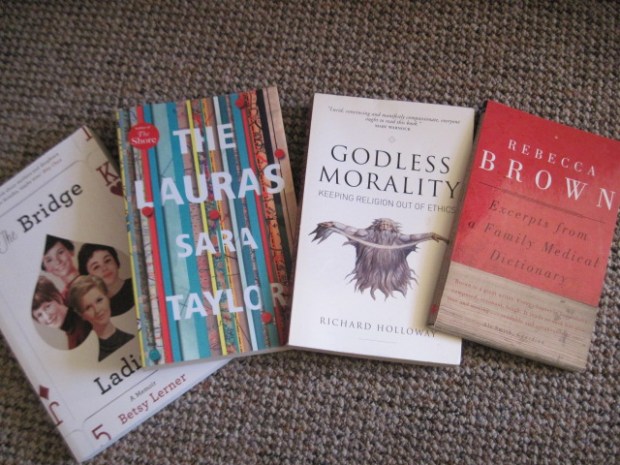
Two proofs (left) and two nonfiction purchases.
This year I got a Kindle case and two bookshop-themed memoirs as presents: The Little Bookstore of Big Stone Gap by Wendy Welch and Books, Baguettes and Bedbugs by Jeremy Mercer. I started reading the former – the story of a married couple opening a bookshop in recession-era Virginia – right away. I also got a poster frame so I can finally hang my literary map of the British Isles on the wall above my desk, and a “Shhhh, reading in progress” mug.


Consuming tasty food and drink + acquiring a baker’s dozen of books + getting out into the countryside = a great birthday weekend!
 Bookish Beck = Rebecca Foster. American transplant to England. Freelance proofreader and book reviewer.
 Bookish Beck