Finishing Off the Barbellion Prize Shortlist: Sam Mills and Dr Amit Patel
The Barbellion Prize 2020 will be awarded tomorrow “to an author whose work has best represented the experience of chronic illness and/or disability.” (See also my reviews of Golem Girl by Riva Lehrer and Sanatorium by Abi Palmer.)
These two memoirs, though very different outwardly, both draw attention to the practical and emotional challenges of life with disability or a mental illness, and call for compassion from individuals and a commitment to help from governing bodies.
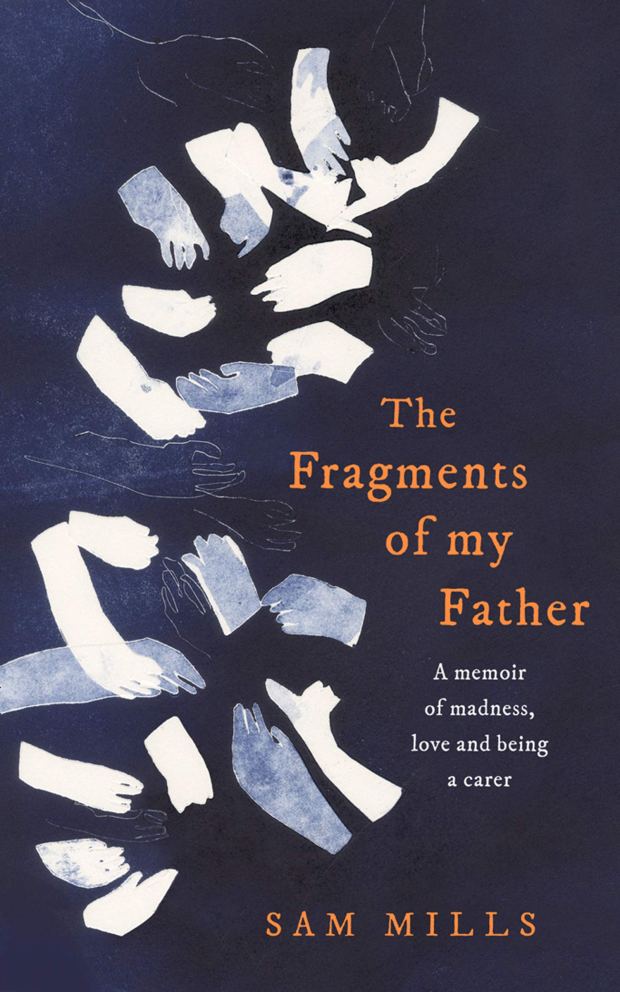
The Fragments of My Father: A memoir of madness, love and being a carer by Sam Mills
One in eight people in the UK cares for an ill or disabled relative. Sam Mills has been a carer for a parent – not once, but twice. The first time was for her mother, who had kidney cancer that spread to her lungs and died one Christmas. A few years later, Mills’s father, Edward, who has paranoid schizophrenia, started having catatonic episodes, as with the incident she opens her memoir on. In 2016, on what would have been her mother’s 70th birthday, Edward locked himself in the toilet of the family home in Surrey. Her brother had to break in with a screwdriver and ambulance staff took him away to a hospital. It wasn’t the first time he’d been institutionalized for a mental health crisis, nor would it be the last. It was always excruciating to decide whether he was better off at home or sectioned on a ward.
Mills darts between past and present as she contrasts her father’s recent condition with earlier points in their family life. She only learned about his diagnosis from her mother when, at age 14, she saw him walk down the stairs naked and then cry when he burned the chips. While schizophrenia can have a genetic element, relatives of a schizophrenic are also more likely to be high achievers. So, although Mills went through a time of suicidal depression as a teenager, meditation got her through and she exhibits more of the positive traits: An author of six books and founder of the small press Dodo Ink, she is creative and driven. Still, being her father’s full-time carer with few breaks often leaves her exhausted and overwhelmed.
The book’s two main points of reference are Leonard Woolf and F. Scott Fitzgerald, who cared for mentally ill wives and had to make difficult choices about their treatment and housing. In a nutshell, Mills concludes that Woolf was a good carer while Fitzgerald was a terrible one. Leonard was excused World War I service due to his nervous exhaustion from being a carer, and he gave up on the idea of children when doctors said that motherhood would be disastrous for Virginia. Virginia herself absolved Leonard in her suicide note, reassuring him that no couple could have been happier and that no one could have looked after her better. Scott, on the other hand, couldn’t cope with Zelda’s unpredictable behaviour – not least because of his own alcoholism – so had her locked up in expensive yet neglectful institutions and censored her work when it came too close to overlapping with his own plots.
The Fragments of My Father brings together a lot of my favourite topics to read about: grief, physical and mental illness, and literary biography. It had already been on my wish list since I first heard about it last year, but I’m glad the Barbellion Prize shortlisting gave me a chance to read it. It helps to have an interest in the Fitzgeralds and Woolfs – though in my case I had read a bit too extensively about them for this strand to feel fully fresh. (I also had a ‘TMI’ response to some revelations about the author’s relationships and sex life.)
Ultimately, I most appreciated the information on being a carer, including the mental burden and the financial and social resources available. (Although there is a government allowance for carers, Mills wasn’t eligible because of her freelance earnings, so she had to apply for Society of Authors grants instead.) With caring so common, especially for women, we need a safety net in place for all whose earnings and relationships will be affected by family duties. I read this with an eye to the future, knowing there’s every possibility that one day I’ll be a carer for a parent(-in-law) or spouse.
Readalikes I have also reviewed:
- Labours of Love: The Crisis of Care by Madeleine Bunting
- All the Lives We Ever Lived: Seeking Solace in Virginia Woolf by Katharine Smyth
Favorite lines:
“had I ever made a conscious choice? Caring felt like something that was happening to me, as though my father’s illness had been an eruption that had flowed like lava over my life. … I can’t think of any other job where someone defines your role by conferring its title on you, as though they are holding out a mould that you must fill.”
“caring is rarely simple because its nature is not static. It creates routines, crafts the days into set shapes, lulls you into states of false security, and then mutates, slaps you with fresh challenges, leaves you lost just when you feel you have gained wisdom.”
With thanks to Fourth Estate for the free copy for review.
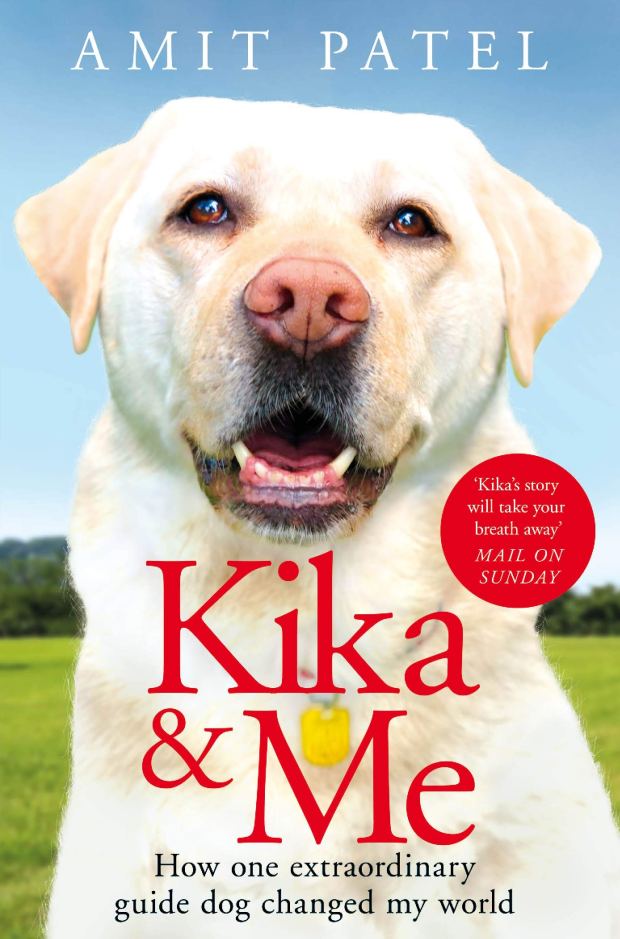
Kika & Me: How one extraordinary guide dog changed my world by Dr Amit Patel with Chris Manby
Dr Patel grew up in Guildford, studied medicine at Cambridge, and specialised in trauma medicine as a junior doctor in London. Diagnosed with keratocornus, which changes the shape of the cornea (it affects 1 in 450), he required first special contact lenses and then a series of cornea transplants. By the time of his eighth transplant, he’d remortgaged his house to pay an American specialist. Meeting and marrying Seema was a time of brightness before, in November 2013, he completely lost his vision within 36 hours. Blindness meant that he could no longer do his job, and constant eye pain and inactivity exacerbated his depression. While white cane and Braille training, plus the Royal National Institute of Blind People’s “Living with Sight Loss” course, started to boost his independence, it was being paired with his guide dog, Kika the Labrador, in 2015 that truly gave Patel his life back.
Trying out guide dogs sounds a little bit like speed dating. The Guide Dogs for the Blind Association (founded in the UK in 1931) warned that Kika was a “Marmite dog,” moody and likely to push boundaries; there was no guarantee she and Patel would get along. But from the start Kika was just right for him. More than once, what seemed like her pure stubbornness – lying on his feet and refusing to move – kept him from dangerous situations, like getting trapped between a busy road and a building site on an unfamiliar route. After a 10-day core skills training course, during which man and dog stayed at a hotel together, Kika was ready to join them at home. In the days to come, she would learn all Patel’s usual routes around their neighbourhood and into the City – with the help of smears of mackerel pâté.
If you’re like me, you’ll be most curious to learn about the nitty-gritty of life for a visually impaired person. I loved hearing about how Patel practiced his Braille letters with an egg container and ping pong balls. Since he went blind, he and his wife have had two children, and with Kika’s help manoeuvring a baby buggy is no problem. Guide dogs are trained to be predictable, e.g., doing their business in the same spot at the same times so it’s much easier to find and clean up. Some dog training tricks also worked for children, like putting a bell on a Labrador or a toddler to know when they wandered off!
Patel has had some unfortunate experiences since he went blind, particularly on the London Underground: teenagers picking him up and spinning him around on a train platform, busy commuters barging past him and Kika on an escalator, and an impatient woman hitting Kika with her handbag. While Patel doesn’t like being negative on social media, he finds that posting video clips of these incidents raises awareness of the challenges VIPs face. Every time he hits a setback, he uses it as an opportunity. For instance, one Diwali he was excited to visit Neasden Temple, only to be dismayed that they wouldn’t allow Kika inside. Since then, he has worked with temples around the world to improve disability services. He is also involved in London’s “Transport for All” work, and advises companies on access issues.
More so than the rest of the shortlist, Kika & Me is illuminating about daily life with a disability and has a campaigning focus. It’s an easy read, and not just for animal lovers. Judging the book by the cover, I might not have picked it up otherwise, so I’m grateful that the Barbellion put it on my radar. I’m deeply impressed by what Patel has achieved and the positive attitude he maintains. (Kika has her own Twitter account! @Kika_GuideDog)
With thanks to Pan Macmillan for the free copy for review.
(Fellow bloggers John Fish and Jackie Law have also been reading along with the Barbellion Prize shortlist. See their reviews thus far: John—Mills and Palmer; Jackie—Mills and Palmer.)
Next year the Barbellion Prize hopes to award more money, including to all nominated authors. They are accepting submissions for 2021, and are grateful for any Paypal donations via their website (see the page footer). I’ve donated to the cause. Can you help, too?
Barbellion Prize Shortlist: Golem Girl by Riva Lehrer
Three memoirs remain on the shortlist; three windows onto living with disability or caring for a relative with an incapacitating mental illness.
First up is a visual artist’s account of growing up with spina bifida, entering Disabled culture, and forming a collaborative style all her own.
Golem Girl: A Memoir by Riva Lehrer (2020)
“My first monster story was Frankenstein,” Lehrer writes. Like Dr. Frankenstein’s creation or the Golem of medieval Jewish legend, she felt like a physical monstrosity in search of an animating purpose. Born with spina bifida, she spent much of her first two years in Cincinnati Children’s Hospital and would endure dozens of surgeries in years to come to repair her spine and urinary tract and attempt to make her legs the same length. In 1958, when she was born, 90% of children with her condition died before age two. Lehrer’s mother, Carole, who grew up in a family pharmacy business and had worked as a medical researcher, was her daughter’s dogged health advocate. Carole fought for Riva even though she was caught up in her own chronic pain after a botched back surgery that left her addicted to painkillers.
Lehrer went to a special school for the disabled in Ohio. It was racially integrated (rare at that time) and offered children physical therapy and normal experiences like Girl Scouts and day camp. But it was clear the teachers didn’t expect these children to achieve anything or have a family life; home ec classes just taught how to wash up from a wheelchair and make meals for one. One horrible day, a substitute teacher locked a classroom door and hectored the children, saying their parents must have drunk and fornicated and they were the wages of sin.
Between the routine or emergency surgeries and family heartaches, Lehrer grew up to attend art school at the University of Cincinnati and Art Institute of Chicago. Professors (most of them male) found her work grotesque and self-indulgent, and she struggled with how to depict her body. There were boyfriends and girlfriends, even a wife (though in the late 1980s, before same-sex marriage was legally recognized). In 1996 she joined the Chicago Disabled Artists Collective and it was a revelation. She learned that Disabled (like Deaf) is a cultural identity as much as a physical reality, adopted vocabulary like crip (a reclaimed term, like queer) and ableism, and began painting fellow artists with dwarfism, prostheses, or wheelchairs.

Becoming a member of the Medical Humanities faculty as well as a visiting artist at two Chicago universities, the School of the Art Institute and Northwestern, gave Lehrer access to Gross Anatomy Labs, where she found in the historical collections – just as she had at the Mütter Museum of medical curiosities in Philadelphia – a fetus in a jar with her very condition. Knowing that she might be the first Disabled person her budding doctors met, she was determined to give them an “inclusive vision” of “the reality of human divergence.” She would have the medical students draw one of the jarred specimens, not as an oddity but as an individual, and give a 15-minute presentation about someone who lives with that disability.
Golem Girl is a touching family memoir delivered in short, essay-like chapters, most of them named after books or films. It is also a primer in Disability theory and – what truly lifts it above the pack – a miniature art gallery, with reproductions of paintings from various of Lehrer’s series as well as self-portraits, family portraits, and photographs. “I fiercely wanted to see a gallery filled with portraits of luminous crips,” she writes; “I suspected I was going to have to make them myself.” And that is just what she has done. The “Circle Stories” featured the Chicago Disabled Artists Collective and “Mirror Shards” included animal daimons, while “The Risk Pictures” of some of her personal heroes were daringly collaborative: she would give the subject an hour alone in her studio with their portrait in progress and allow them to amend it as they wished. Much of her work has bright colors and involves anatomical realism and symbols personal to herself and/or the subject – with Frida Kahlo an acknowledged influence.
I’ve now (just about) read the whole Barbellion Prize shortlist. For how it illuminates a life of being different – through queerness in addition to disability, engages with the academic fields of anatomy and Disability studies, and showcases the achievements of Disabled artists, this would be my clear winner of the inaugural award, with Sanatorium my backup choice. It is also a finalist for the National Book Critics Circle Award for Autobiography.
Readalikes I have also reviewed:
- Constellations by Sinéad Gleeson
- I Am, I Am, I Am by Maggie O’Farrell
Favorite lines:
“The hospital demands surrender. You accept the piercing, the cutting, the swallowing of noxious chemicals. You roll over and stand up even when it’s as impossible as flying around the ceiling. Whoever has authority can remove your clothes and display your stitched-up monster body to crowds of young white-coated men. You’re an assemblage of parts that lack gender and those elusive things called feelings.”
“‘Normal’ beauty is unmarked, smooth, shiny, upright; but my gaze began to slip past normal beauty as if it was coated in baby oil. I wanted crip beauty—variant, iconoclastic, unpredictable. Bodies that were lived in with intentionality and self-knowledge. Crip bodies were fresh.”
With thanks to Virago for the free copy for review.
See my introductory post for more about the Barbellion Prize, which is in its first year and will be awarded on Friday “to an author whose work has best represented the experience of chronic illness and/or disability.”
I will review the final two on the shortlist, The Fragments of My Father by Sam Mills and Kika & Me by Amit Patel, tomorrow.
Three on a Theme: “Love”
I’m really not a Valentine’s Day person, yet this is the fifth year in a row that I’ve put together a themed post featuring books that have “Love” or a similar word in the title in the run-up to mid-February. (Here are the 2017, 2018, 2019 and 2020 posts. I’m also at work on a set of three “Heart” titles to post about on the 14th.) All three of the below books reflect, in their own ways, on how love perplexes and sustains us at different points in our lives.
The Emma Press Anthology of Love, ed. Rachel Piercey and Emma Wright (2018)
 I read my first book from the publisher (Tiny Moons by Nina Mingya Powles) last summer and loved it, so when this one popped up in the Waterstones sale in January I snapped it up. Your average love poetry volume would trot out all the standards from Shakespeare’s sonnets to Carol Ann Duffy, whereas this features recent work from lesser-known contemporary poets. Of the 56 poets, I’d heard of just two before: Stephen Sexton, because I reviewed his collection, If All the World and Love Were Young, last year; and Rachel Long, because I was simultaneously reading her Costa Award-shortlisted debut, My Darling from the Lions.
What I most appreciated about the book is that it’s free of cliché. You can be assured there will be no ‘Roses are red, violets are blue’ simplicity of theme or style. It must be nigh on impossible to write about romantic and erotic love without resorting to the same old symbols, but here there is a fresh, head-turning metaphor every few pages. Rachel Plummer describes her first crush, on a video game character, in “Luigi.” Love is conveyed through endless cups of tea or practical skills that favor postapocalyptic survival; desire is sparked by the downy hair on a woman’s back or the deliberate way a lover pulls on a pair of tights. Anything might be a prelude to seduction: baking, preparing lab specimens, or taking a taster at the off-license.
There are no real duds here, but a couple of my overall favorites were “Note from Edinburgh” by Stav Poleg and “Not the Wallpaper Game” by Jody Porter (“her throat was a landmine grown over with roses / and her arms were the antidote to the sufferings of war”). I’m running low on poetry, so I’ve gone ahead and ordered three more original anthologies direct from The Emma Press (poems on the sea, illness, and aunts!). After all, it’s #ReadIndies month and I’m delighted to support this small publisher based in Birmingham. 
Favorite lines:
I have a friend who always believed
love was like being touched
by a livewire or swimming
on her back in a lightning storm.
I want to tell her it’s homesickness,
how longing pulls us in funny ways.
(from “Falooda” by Cynthia Miller)
It’s today already
and we have only the rest of our lives.
Long may we dabble our feet in the clear Italian lakes.
Long may we mosey through the graveyards of the world.
(from “Romantic” by Stephen Sexton)
Love After Love by Ingrid Persaud (2020)
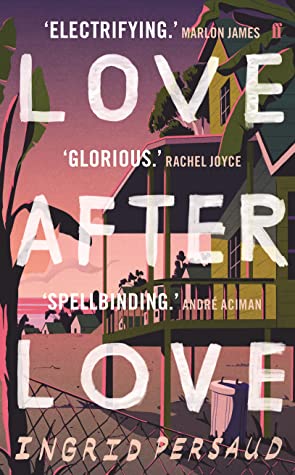 I saw the author read from this in November as part of a virtual Faber Live Fiction Showcase. My interest was then redoubled by the book winning the Costa First Novel Award. All three narrators – Betty, her son Solo, and their lodger Mr Chetan – are absolutely delightful, and I loved the Trini slang and the mix of cultures (for example, there is a Hindu temple where locals of Indian extraction go to practice devotion to the Goddess). Early on, I was reminded most, in voice and content, of Mr Loverman by Bernardine Evaristo.
But the lightness of Part One, which ends with a comically ill-fated tryst, soon fades. When Solo moves to New York City to make his own way in the world, he discovers that life is cruel and not everyone is good at heart. Indeed, my only hesitation in recommending this book is that it gets so very, very dark; the blurb and everything I had heard did not prepare me. If easily triggered, you need to know that there are many upsetting elements here, including alcoholism, domestic violence, self-harm, attempted suicide, sadomasochism, and gruesome murder. Usually, I would not list such plot elements for fear of spoilers, but it seems important to note that what seems for its first 100 pages to be such a fun, rollicking story becomes more of a somber commentary on injustices experienced by both those who leave Trinidad and those who stay behind.
A beautiful moment of reconciliation closes the story, but man, getting to that point is tough. The title speaks of love, yet this novel is a real heartbreaker. What that means, though, is that it makes you feel something. Not every author can manage that. So Persaud is a powerful talent and I would certainly recommend her debut, just with the above caveats.
Readalikes:
- Golden Child by Claire Adam
- A Little Life by Hanya Yanagihara
Love’s Work: A Reckoning with Life by Gillian Rose (1995)
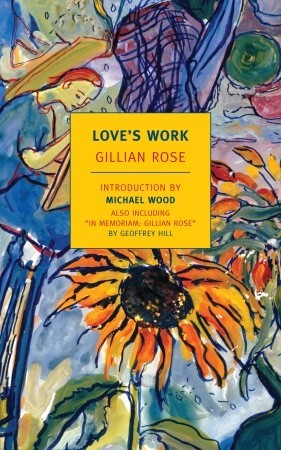 The English philosopher’s memoir-in-essays got on my radar when it was mentioned in two other nonfiction works I read in quick succession (one of my Book Serendipity incidents of late 2019): Notes Made while Falling by Jenn Ashworth and My Year Off by Robert McCrum. I had in mind that it was a cancer memoir, and while receiving a terminal diagnosis of ovarian cancer in her early forties is indeed an element, it is a wide-ranging short book that includes pen portraits of remarkable friends – an elderly woman, a man with AIDS – she met in New York City, musings on her Jewish family history and the place that religious heritage holds in her life, and memories of the contrast between the excitement of starting at Oxford and the dismay at her mother’s marriage to her stepfather (from whom she got her surname, having changed it by deed poll at age 16 from her father’s “Stone”) falling apart.
The mishmash of topics and occasional academic jargon (e.g., “These monitory anecdotes indicate, however, the anxiety of modernity” and “Relativism of authority does not establish the authority of relativism: it opens reason to new claimants”) meant I didn’t enjoy this as much as I’d expected to. 
Words about love:
“However satisfying writing is—that mix of discipline and miracle, which leaves you in control, even when what appears on the page has emerged from regions beyond your control—it is a very poor substitute indeed for the joy and the agony of loving.”
“There is no democracy in any love relation: only mercy. … each party … is absolute power as well as absolute vulnerability. … I am highly qualified in unhappy love affairs. My earliest unhappy love affair was with Roy Rogers.”
“To grow in love-ability is to accept the boundaries of oneself and others, while remaining vulnerable, woundable, around the bounds. Acknowledgement of conditionality is the only unconditionality of human love.”
If you read just one … Make it The Emma Press Anthology of Love. (But, if you’re feeling strong, add on Love After Love, too.)
Have you read any books about love lately?
Six Degrees of Separation: From a Redhead to a Blue Dress
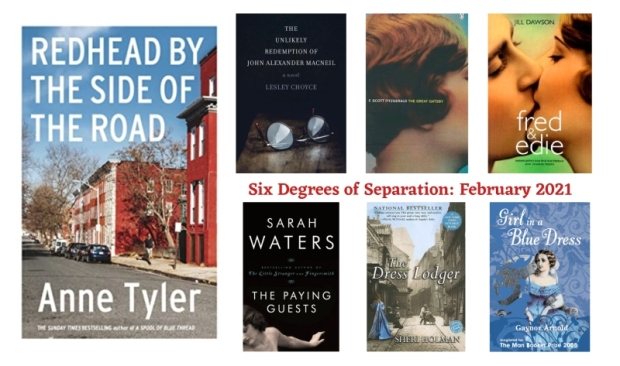
This month we begin with Redhead by the Side of the Road (2020). (See Kate’s opening post.) Anne Tyler’s lackluster latest somehow got longlisted for the Booker Prize. Still, I’m a solid Tyler fan and I’m taking advantage of Liz’s readalong to get to the books of hers that I own but haven’t read yet. Currently reading: The Clock Winder (1972).
#1 Sorry to break it to you if you haven’t read the book yet, but the title refers not to a person with red hair but to a fire hydrant: Micah, a typically useless Tyler antihero, makes this visual mistake commonly when he’s out running without his glasses on.
 The Unlikely Redemption of John Alexander MacNeil by Lesley Choyce (2017) is beloved of a couple of Canadian book blogger friends, including Naomi (here’s her review). I came across it on my Goodreads TBR the other day and the blurb caught my eye. An old man starts doing peculiar things, like picking up a hitchhiker … except that it’s actually a neighbour’s mailbox. This reminded me of Micah’s folly, not least because of the glasses on the cover.
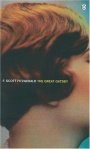 #2 One of the key images in The Great Gatsby (1925) is of the eyes of optician Dr. T. J. Eckleburg peering out from an old billboard. They’re explicitly equated to the eyes of God looking down on the immoral lifestyle of characters blinded by the pursuit of money and happiness. Gatsby was our neighbourhood book club choice this month. Whether we’d read it multiple times before (it was my third read) or not at all, we found a lot to talk about – and two members took the opportunity to dress up in vintage 1920s fashions for the Zoom meeting!
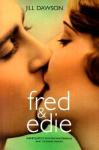 #3 Although those bespectacled eyes appeared on the copy I read in high school, the book group set cover featured a couple of 1920s figures: a woman on the front cover and a man on the back. They look rather like a young Scott and Zelda Fitzgerald, but I can’t find evidence that it’s an original photograph. In any case, I thought the image looked awfully familiar, and finally located it as the cover of Fred & Edie by Jill Dawson (2000), which is set in 1922 and was inspired by a true crime. In a sensational trial, Edith Thompson and her lover, Freddy Bywaters, were found guilty of murdering Edith’s husband and the pair were executed the following year. Cathy’s review whetted my appetite to read it.
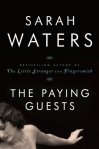 #4 Also featuring a murder committed in 1922 is The Paying Guests by Sarah Waters (2014). I will say no more – not least because I don’t fully remember what happens, though I have a vague sense that it is quite similar in plot to the Dawson – except that this was a stand-out from Waters. (My review for BookBrowse.)
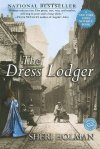 #5 “Paying guests” was an old-fashioned euphemism used by people who didn’t like to admit they had lodgers. Another random recent find on my virtual TBR was The Dress Lodger by Sheri Holman (2000), which is about a 15-year-old prostitute trying to provide for herself and her disabled baby boy during a cholera epidemic in Sunderland, England in 1831. Victorian pastiches can go either way for me, but when they’re good I adore them. There are enough positive friend reviews of this on Goodreads for me to keep it on the list: it sounds reminiscent of The Crimson Petal and the White, and the epidemic theme sure is relevant.
 #6 The blue dress on the cover led me to Girl in a Blue Dress by Gaynor Arnold (2008), a novel about Charles Dickens’s longsuffering wife, Catherine. (Though the central pair are given different names, it’s very clear who they’re based on.) I’m a sucker for any book about Dickens. Like Redhead, this was longlisted for the Booker Prize.
This month I’ve gone round to a different primary colour, by way of a classic and much historical fiction (with 1920s settings aplenty, and lots of marcelled hair!).
Where will your chain take you? Join us for #6Degrees of Separation! (Hosted on the first Saturday of each month by Kate W. of Books Are My Favourite and Best.) Next month’s starting point is Phosphorescence by Julia Baird.
Have you read any of my selections? Are you tempted by any you didn’t know before?
Snow and Winter Reads, Part I
We’ve only had a couple of inches of snow, plus another afternoon of flurries, so far this winter, but January was the UK’s coldest month since 2013. As usual, I’m charting the season’s passage through books as well as by taking walks and looking out the window. I have a few more wintry books on the go that I’ll hope to report on at the end of the month. Today I have a few short works, ranging from poetry to nonfiction, plus a novel set partly in frigid Nebraska.

“The Snows of Kilimanjaro” by Ernest Hemingway (1936)
 During a laughably basic New Testament class in college, a friend and I passed endless notes back and forth, discussing everything but the Bible. I found these the last time I was back in the States going through boxes. My friend’s methodical cursive looked so much more grown-up than my off-topic scrawls. Though she was only two years older, I saw her as a kind of mentor, and when she told me the gist of this Hemingway story I took heed. We must have been comparing our writing ambitions, and I confessed a lack of belief in my ability. She summed up the point of this story more eloquently than Hem himself: if you waited until you were ready to write something perfectly, you’d never write it at all. Well, 19 years later and I’m still held back by lack of confidence, but I have, finally, read the story itself. It’s about a writer on safari in Africa who realizes he is going to die of this gangrene in his leg.
Now he would never write the things that he had saved to write until he knew enough to write them well. Well, he would not have to fail at trying to write them either. Maybe you could never write them, and that was why you put them off and delayed the stating. Well, he would never know, now.
he had always thought that he would write it finally. There was so much to write. He had seen the world change; not just the events; although he had seen many of them and had watched the people, but he had seen the subtler change and he could remember how the people were at different times. He had been in it and he had watched it and it was his duty to write of it; but now he never would.
This duty: to be a witness, to crystallize your perspective and experience as a way of giving back to the world that has sustained you – it’s a compelling vision. Of course, Hemingway was a chauvinist and so the protagonist is annoyingly dismissive of the woman in his life; she might as well be a servant. I still found this everyday tragedy affecting. I couldn’t, however, be bothered to read any further in the volume (mostly Nick Adams autobiographical stories).
The World Before Snow by Tim Liardet (2015)
 I couldn’t resist the title and creepy Magritte cover, so added this to my basket during the Waterstones online sale at the start of the year. Liardet’s name was unfamiliar to me, though this was the Bath University professor’s tenth poetry collection. Most of the unusual titles begin with “Self-Portrait” – for instance, “Self-Portrait as the Nashua Girl’s Reverse Nostalgia” and “Self-Portrait with Blind-Hounding Viewed in Panoramic Lens.” Apparently there is a throughline here, but if it weren’t for the blurb I would have missed it entirely. (“During a record-breaking blizzard in Boston, two poets met, one American and one English. This meeting marked the beginning of a life-transforming love affair.”) There were some turns of phrase and alliteration I liked, but overall I preferred the few poems that were not part of that pretentious central plot, e.g. “Ommerike” (part I) about mysterious mass deaths of birds and fish, “Nonagenaria,” a portrait of an old woman, and “The Guam Fever,” voiced by an ill soldier.
The Magician’s Assistant by Ann Patchett (1997)
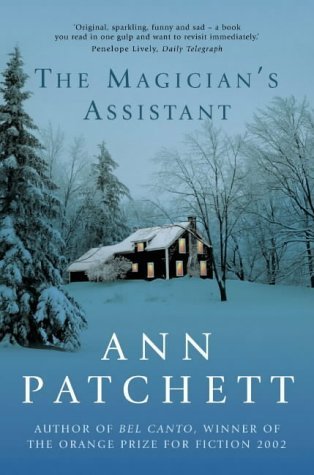 I’d only seen covers with a rabbit and top hat, so was confused that the secondhand copy I ordered with a birthday voucher featured a lit-up farmhouse set back into snowy woods. The first third of the novel takes place in Los Angeles, where Sabine lived with her husband Parsifal, the magician she assisted for 20 years, but the rest is set in winter-encased Nebraska. The contrast between the locations forms a perfect framework for a story of illusions versus reality.
SPOILERS FOLLOW – impossible to avoid them.
Patchett opens with the terrific lines “Parsifal is dead. That is the end of the story.” Ironically, his brain aneurysm burst while he was inside a hospital MRI machine, but it’s a mercy that he died quickly; he could have lingered for years with AIDS – like his lover, Phan, who died 14 months before. You see, while Parsifal while Sabine’s best friend, and in some ways the love of her life, their marriage was only a formality so that she could receive his assets. She knows little of his past; in taking on the name and persona of Parsifal the magician, he created a new life for himself. Only after his death does she learn from the will that his real name was Guy Fetters and that he has a mother, Dot, and sisters, Kitty and Bertie, back in Nebraska.
Dot and Bertie come out to L.A. to see how Guy lived and pay their respects at the cemetery, and then Sabine, lost without a magician to assist, flies out to Nebraska to stay with them for the week leading up to Bertie’s wedding. There is a tacit understanding among the family that Guy was gay, and Sabine assumes that’s why he was sent off to a boys’ reformatory. In fact, it’s because he was involved in his father’s accidental death. This kitchen has seen more than its fair share of climactic events.
END OF SPOILERS
The long section set in Nebraska went in directions I wasn’t expecting. It’s mostly based around late-night kitchen table and bedroom conversations; it’s a wonder it doesn’t become tedious. Patchett keeps the tension high as revelations emerge about what went on in this family. There are two moments when threat looks poised to spill into outright violence, in an echo of previous domestic violence.
For a long time I didn’t know what to make of the novel. It’s odd that all the consequential events happened before the first page and that we never truly meet Parsifal. Yet I loved the way that Sabine’s dreams and flashbacks widen the frame. Magic initially appears to be an arbitrary career choice, but gradually becomes a powerful metaphor of deception and control. Parsifal’s family are obsessed with a Johnny Carson performance he and Sabine once gave: they watch the video recording nightly, longing for the magic to be real. Maybe it is in the end? 
Snow by Marcus Sedgwick (2016)
 This Little Toller book is, at just over 100 pages, the perfect read for a wintry afternoon. It’s a lot like The Snow Tourist by Charlie English, though that book is travel-based, whereas for this one Sedgwick stayed put at his home in the Haute-Savoie, an alpine region of eastern France (and was even snowed in for part of the time), and wandered in his memory instead.
He writes that snow is “a form of nostalgia” for him, bringing back childhood days off school when he could just stay home and play – he loves it for “the freedom it represented.” He asks himself, “did it snow more when I was young, or is it just my desire and recreated memory?” Looking at weather statistics from Kent, he is able to confirm that, yes, it really did snow more in the 1960s and 70s.
Sedgwick briefly considers the science, history, art, and literature of snow, including polar expeditions and film, music, and paintings as well as Thomas Mann’s The Magic Mountain et al. He also likens the blank page to a snow-covered field, such that writers should not be daunted by it but excited by the possibility of creation.
In the Winter Dark by Tim Winton (1988)
 A taut early novella (just 110 pages) set in an Australian valley called the Sink. Animals have been disappearing: a pet dog snatched from its chain; livestock disemboweled. Four locals are drawn together by fear of an unidentified killer. Maurice Stubbs is the only one given a first-person voice, but passages alternate between his perspective and those of his wife Ida, Murray Jaccob, and Veronica, a pregnant teen. These are people on the edge, reckless and haunted by the past. The malevolent force comes to take on a vengeful nature. I was reminded of Andrew Michael Hurley’s novels. My first taste of Winton’s fiction has whetted my appetite to read more by him – I have Cloudstreet on the shelf.
Have you been reading anything particularly wintry this year?
Introducing the Barbellion Prize & A Review of Sanatorium by Abi Palmer
New this year, the Barbellion Prize will be awarded annually “to an author whose work has best represented the experience of chronic illness and/or disability.” It’s named after W.N.P. Barbellion (the pen name of Bruce Frederick Cummings), the English author of The Journal of a Disappointed Man, which he started writing at 13. A self-taught naturalist, he specialized in lice when he worked for the British Museum’s department of natural history in London. He was rejected for war service in 1915 after a doctor found him to have multiple sclerosis. At that time, the diagnosis was like a death sentence; indeed, Cummings died at age 30 in 1919, though by then he had managed to produce two volumes of memoirs as well as a daughter.
Here’s some more information on the prize criteria from the website: “Eligibility for the prize is predicated on the author’s presentation of life with a long-term chronic illness or disability, whether that be in the form of blindness, MS, cystic fibrosis, dwarfism, or another comparable condition that may substantially define one’s life. Authors – such as those in a carer’s capacity – who themselves are not ill may be considered for the prize if their work is truly exceptional as an articulation of life with illness, but authors who themselves deal personally with illness or disability will take priority in any selection for the prize.”


Especially in the absence of the Wellcome Book Prize, which has been on hiatus since the announcement of the 2019 winner, I’m delighted that there is a new prize with a health slant, particularly one that will lead to greater visibility for disabled writers and their stories. From a longlist of eight, in January the Barbellion Prize judges chose a shortlist of four titles: three memoirs and a work of autofiction. The publishers kindly agreed to send me the shortlist for review. Two have arrived so far (there have been postal delays in the UK, as in many places).

I have already read one of the nominees and will do my best to review the rest before the £1000 prize is awarded on the 12th. The others are:
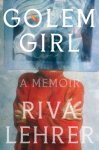
- Golem Girl by Riva Lehrer – An illustrated memoir by a visual artist born with spina bifida.
- The Fragments of My Father by Sam Mills – A memoir of being a carer for her father, who has paranoid schizophrenia; also includes musings on Leonard Woolf and F. Scott Fitzgerald, who cared for mentally ill wives. I’m currently reading this one.
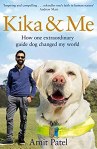 Kika & Me by Amit Patel – Patel was a trauma doctor and lost his sight within 36 hours due to a rare condition. He was paired with his guide dog, Kika, in 2015.
Sanatorium by Abi Palmer (2020)
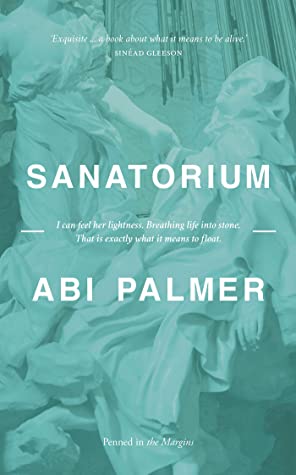 Water is a source of comfort and delight for Abi, the narrator of Sanatorium (whose experiences may or may not be those of the author; always tricky to tell with autofiction). Floating is like dreaming for her – an intermediate state between the solid world where she’s in pain and the prospect of vanishing into the air. In 2017 she spends a few weeks at a sanatorium in Budapest for water therapy; when she returns to London she buys a big inflatable plastic bathtub to keep up the exercises as she tries to wean herself off of opiates.
Abi feels fragile due to a whole host of body issues, some in her past but most continuing into the present: an autoimmune connective tissue disorder, psoriatic arthritis, Crohn’s disease, and sexual assaults. Her knee is most immediately problematic, leading her to use a mobility scooter. As her health waxes and wanes, other people – unable to appreciate any internal or incremental changes – judge her by whether or not she is able to walk well.
 The book is in snippets, often of just a paragraph or even one sentence, and cycles through its several strands: Abi’s time in Budapest and how she captures it in an audio diary; ongoing therapy at her London flat, custom-designed for disabled tenants (except “I was the only cripple who could afford it”); the haunted house she grew up in in Surrey; and notes on plus prayers to St. Teresa of Ávila, accompanied by diagrams of a female figure in yoga poses.
Locations are given in small letters in the top corner of the page, apart from for the more dreamlike segments that can’t be pinned down to any one place. For instance, I was reminded of a George Saunders story by the surreal interlude in which Abi imagines Van Gogh’s Starry Night reproduced in the hair on a detached pair of legs mounted on a wall as a work of art.
The different formats and short chunks of prose generally keep the voice from becoming monotonous, though I did wonder if occasional use of the third person (and some more second person) could have been effective, too. Far from a straightforward memoir, the book incorporates passages that are closer to fantasy and poetry, and the visual elements and fertile imagery attest to Palmer’s background as a mixed-media artist.
Sanatorium is a fascinating work – matter-of-fact, playful and sensual – that vividly conveys the reality of life with a chronic illness. It was already on my wish list, but I’m so glad that this shortlisting gave me a chance to read it. Though I haven’t read the other nominees yet, the passages below are proof that this would be a deserving Barbellion Prize winner.
You go through life as a chronically ill person with so many different people who have so many different opinions about how your treatment should be. They’re not always useful or right. You have to build your own narrative and your own sense of what feels appropriate. You have to learn to trust your body to tell you what’s working. But that’s hard too, when your body keeps changing the rules.
I am one of the more privileged ones and still I’m screaming. God, it would be so nice just to dissolve into nothing and wash up onto a lonely beach.
I wonder if what I’ve learned about chronic illness, more than anything, is that it’s a constant cycle. You fall apart, then you try your best to rebuild again. I wonder what would happen if I stopped trying.
Readalikes I have also reviewed:
- Heal Me by Julia Buckley
- Bodies of Water by V. H. Leslie
- My Year of Rest and Relaxation by Ottessa Moshfegh
With thanks to Penned in the Margins for the free copy for review.
January’s Nonfiction Releases: Clarke, Heminsley and Lalkhen
Three new books with medical themes (no surprise there), including the first Covid wave in the UK; fertility and body issues in a new queer family; and pain management strategies.
Breathtaking: Inside the NHS in a Time of Pandemic by Rachel Clarke
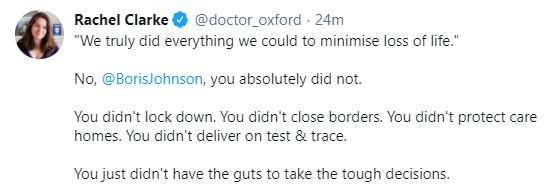
 Clarke is a palliative care doctor based in Oxfordshire. She runs the Katharine House hospice but during the coronavirus pandemic has also been on active duty in the Oxford University Hospitals system. If you’re on social media you have likely come across some of her postings as she has been equally vocal in her praise of the NHS and her criticism of Boris Johnson’s faltering policies, which are often of the too little, too late variety. So I was eager to read her insider’s account of hospital treatment of the first wave of Covid in the UK, especially because her previous book, Dear Life, was one of my top two nonfiction releases of last year.
The focus is on the first four full months of 2020, and the book originated in Clarke’s insomniac diaries and notes made when, even after manically busy shifts, she couldn’t rest her thoughts. Her pilot husband was flying to China even as increasingly alarming reports started coming in from Wuhan. She weaves in the latest news from China and Italy as well as what she hears from colleagues and disease experts in London. But the priority is given to stories: of the first doctor to die in China; of a Yorkshire ICU nurse’s father, who comes down with Covid and is on a ventilator in an Oxford hospital; and of her patients there and in the hospice. She is touched that so many are making great sacrifices, such as by deciding not to visit loved ones at the end of their lives so as not to risk spreading infection.
A shortage of PPE remained a major issue, though Dominic Pimenta (whose Duty of Care was my first COVID-19 book) pulled through for her with an emergency shipment for the hospice – without which it would have had to close. Clarke marvels at the NHS’s ability to create an extra 33,000 beds within a month, but knows that this comes at a cost of other services, including cancer care, being stripped back or cancelled, meaning that many are not receiving the necessary treatment or are pushing inescapable problems further down the road.
From January 26, 2021
A comparison with Gavin Francis’s Intensive Care, published earlier in the month, is inevitable. Both doctors bounce between headlines and everyday stories, government advice and the situation on the ground. Both had their own Covid scare – Clarke didn’t meet the criteria to be tested so simply went back to work two weeks later, when she felt well enough – and had connections to regions that foreshadowed what would soon happen in the UK. Both give a sense of the scope of the crisis and both lament that, just when patients need compassion most, full PPE leads to their doctors feeling more detached from them than ever.
However, within the same page count, Francis manages to convey more of the science behind the virus and its transmission, and helpfully explores the range of effects Covid is having for different groups. He also brings the story more up to the minute with a look back from November, whereas Clarke ends in April and follows up with an epilogue set in August. A book has to end somewhere, yes, but with this crisis ongoing, the later and more relevant its contents can be, the better. And in any book that involves a lot of death, mawkishness is a risk; Clarke so carefully avoided this in Dear Life, but sometimes succumbs here, with an insistence on how the pandemic has brought out the best in people (clapping and rainbows and all that). Her writing is as strong as ever, but I would have appreciated a sharper, more sombre look at the situation a few months later. Perhaps there will be a sequel.

From January 6, 2021
With thanks to Little, Brown UK for the free copy for review.
Some Body to Love: A Family Story by Alexandra Heminsley
 From Heminsley’s previous book, Leap In, I knew about her getting married and undergoing IVF. It was also a book about outdoor swimming; I appreciated her words on acquiring a new skill as an adult and overcoming body issues. This memoir continues the story: in 2017, after a gruelling journey through infertility treatment, Heminsley finally got the baby she wanted. But not before a couple more heart-wrenching moments: the lab made an error and notified her that she shared no DNA with this last embryo, and while heavily pregnant she was assaulted by a drunk man on a train. Both incidents left her feeling a loss of agency. “Why was I consistently being deemed the least reliable witness of my own reality?” she asks.
As they adjusted to new life with a baby, Heminsley started to notice that she wasn’t connecting with her husband, D, like she used to. She felt emotionally unsupported and, in fact, jealous of D’s relationship with their son, L. And while they’d never been the most conventional couple, D’s changes of appearance and wardrobe seemed like a sign of something bigger. Indeed, when L was six months old, D told Heminsley, “this body doesn’t represent who I am” and announced a decision to begin transitioning.
As D moved towards having a body that fit their identity, Heminsley, too, needed to get back in touch with her body. After books like Running Like a Girl, she was considered an exercise guru, but she didn’t see herself in the new obsession with Instagram-ready images of fitness perfection. This is not, then, primarily a memoir of queer family-making, because D’s transitioning was not Heminsley’s story to tell and mostly occurs in the background. Instead she focuses on what she does know and can control: her relationship to her own body.
However, this entails what can feel like irrelevant flashbacks to her teenage years of undergoing rehab at a military clinic in Germany for hypermobility, trips to Trinidad and Italy, and the genesis of her two sporting memoirs. Much as I applaud the sensitivity to trans and body issues, the book ends up feeling scattered. Still, the writing is so candid and the narrative so eventful that you’ll race through this even if you don’t normally pick up nonfiction. (For a bit more information, see my short write-up of the virtual book launch.)
With thanks to Chatto & Windus for the free copy for review.
Pain: The Science of the Feeling Brain by Abdul-Ghaaliq Lalkhen
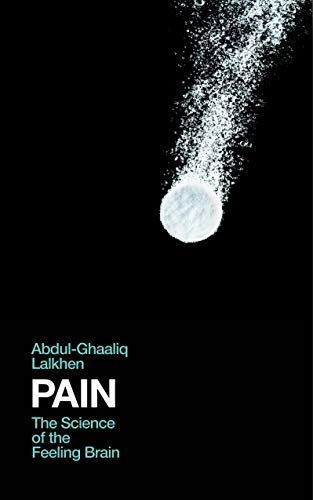 Originally from South Africa, Dr Lalkhen is an anaesthesiology and pain specialist based in Manchester. In a nutshell, his approach is “biopsychosocial,” meaning that he seeks to understand pain not just as a physical phenomenon resulting from acute injury or damage but as an ongoing process that is affected by emotional and psychological factors. Particularly in the context of chronic syndromes, he acknowledges that pain can continue even when its immediate cause has been repaired. Mental preparation can come into the equation: if a patient assumes they’ll wake up from surgery healed, they may be alarmed if pain persists. Lalkhen talks about managing patient expectations, perhaps with something as simple as the promise, “we’ll aim to get your pain down to a 4 after surgery.” In part, he blames Western society’s Cartesian philosophy for treating mind and body as separate rather than a system.
There are genetic and psychological reasons people might be predisposed to chronic pain. Pain itself can then change the brain chemistry, making the body more alert to pain signals. People can choose one of three paths, Lalkhen observes: “You can spend your time agitating about the alarm going off, you can try to ignore it (but the ignoring of it actually takes up more energy), or the final alternative is to learn to live with this deeply unpleasant situation.” Those who opt for pharmacological solutions can become addicted to opiates, which are less effective over time. Non-drug-related therapies involve the desensitization of nerves, the injection of anaesthetics or steroids, or the implanting of spinal cord stimulators. But all of these strategies have their limitations, and can diminish in efficacy. The patients he sees in his pain clinics may be disappointed that, rather than offering a panacea, he wants to wean them off their current pain relief and help them develop a new way of thinking about pain.
I felt I learned a lot from reading this. Lalkhen is careful to state that he is only referring to non-cancer pain (cancer pain in terminal patients will take all the morphine you can throw at it). Like many physicians, he worries about the modern epidemic of overtreatment and our obsession with wellness. I especially enjoyed the discussion of the understanding of pain and its treatment from the ancient world onward, and in particular the history of opiates. The prose is not literary, but this is an accessible and informational read if the subject matter draws you.
With thanks to Atlantic Books for the free copy for review.
What recent nonfiction releases can you recommend?
Fairy Tales, Outlaws, Experimental Prose: Three More January Novels
Today I’m featuring three more works of fiction that were released this month, as a supplement to yesterday’s review of Mrs Death Misses Death. Although the four are hugely different in setting and style, and I liked some better than others (such is the nature of reading and book reviewing), together they’re further proof – as if we needed it – that female authors are pushing the envelope. I wouldn’t be surprised to see any or all of these on the Women’s Prize longlist in March.
The Charmed Wife by Olga Grushin
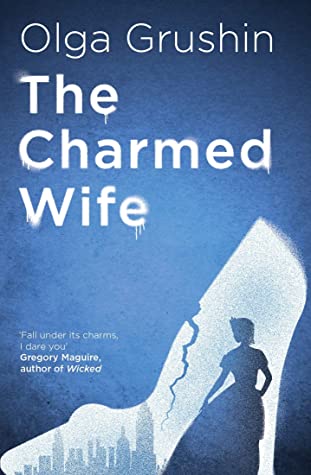 What happens next for Cinderella?
Grushin’s fourth novel unpicks a classic fairy tale narrative, starting 13.5 years into a marriage when, far from being starry-eyed with love for Prince Roland, the narrator hates her philandering husband and wants him dead. As she retells the Cinderella story to her children one bedtime, it only underscores how awry her own romance has gone: “my once-happy ending has proved to be only another beginning, a prelude to a tale dimmer, grittier, far more ambiguous, and far less suitable for children”. She gathers Roland’s hair and nails and goes to a witch for a spell, but her fairy godmother shows up to interfere. The two embark on a good cop/bad cop act as the princess runs backward through her memories: one defending Roland and the other convinced he’s a scoundrel.
Part One toggles back and forth between flashbacks (in the third person and past tense) and the present-day struggle for the narrator’s soul. She comes to acknowledge her own ignorance and bad behaviour. “All I want is to be free—free of him, free of my past, free of my story. Free of myself, the way I was when I was with him.” In Part Two, as the princess tries out different methods of escape, Grushin coyly inserts allusions to other legends and nursery rhymes: a stepsister lives with her many children in a house shaped like a shoe; the witch tells a variation on the Bluebeard story; the fairy godmother lives in a Hansel and Gretel-like candy cottage; the narrator becomes a maid for 12 slovenly sisters; and so on.
 The plot feels fairly aimless in this second half, and the mixture of real-world and fantasy elements is peculiar. I much preferred Grushin’s previous book, Forty Rooms (and Angela Carter’s The Bloody Chamber, one of her chief inspirations). However, her two novels share a concern with how women’s ambitions can take a backseat to their roles, and both weave folktales and dreams into a picture of everyday life. But my favourite part of The Charmed Wife was the subplot: interludes about Brie and Nibbles, the princess’s pet mice; their lives being so much shorter, they run through many generations of a dramatic saga while the narrator (whose name we do finally learn, just a few pages from the end) is stuck in place.
With thanks to Hodder & Stoughton for the free copy for review.
Outlawed by Anna North
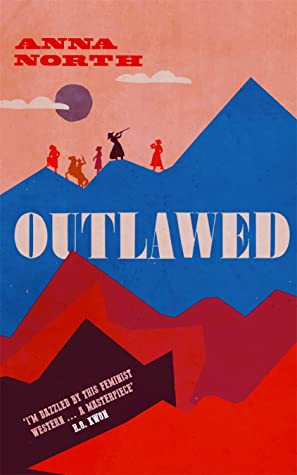 I was a huge fan of North’s previous novel, The Life and Death of Sophie Stark, which cobbles together the story of the title character, a bisexual filmmaker, from accounts by the people who knew her best. Outlawed, an alternative history/speculative take on the traditional Western, could hardly be more different. In a subtly different version of the United States, everyone now alive in the 1890s is descended from those who survived a vicious 1830s flu epidemic. The duty to repopulate the nation has led to a cult of fertility and devotion to the Baby Jesus. From her mother, a midwife and herbalist, Ada has learned the basics of medical care, but the causes of barrenness remain a mystery and childlessness is perceived as a curse.
Ada marries at 17 and fails to get pregnant within a year. After an acquaintance miscarries, rumours start to spread about Ada being a witch. Kicked out by her mother-in-law, she takes shelter first at a convent and then with the Hole in the Wall gang. She’ll be the doctor to this band of female outlaws who weren’t cut out for motherhood and shunned marriage – including lesbians, a mixed-race woman, and their leader, the Kid, who is nonbinary. The Kid is a mentally tortured prophet with a vision of making the world safe for people like them (“we were told a lie about God and what He wants from us”), mainly by, Robin Hood-like, redistributing wealth through hold-ups and bank robberies. Ada, who longs to conduct proper research into reproductive health rather than relying on religious propaganda, falls for another gender nonconformist, Lark, and does what she can to make the Kid’s dream a reality.
Reese Witherspoon choosing this for her Hello Sunshine book club was a great chance for North’s work to get more attention. However, I felt that the ideas behind this novel were more noteworthy than the execution. The similarity to The Handmaid’s Tale is undeniable, though I liked this a bit more. I most enjoyed the medical and religious themes, and appreciated the attention to childless and otherwise unconventional women. But the setup is so condensed and the consequences of the gang’s major heist so rushed that I wondered if the novel needed another 100 pages to stretch its wings. I’ll just have to await North’s next book.
With thanks to W&N for the proof copy for review.
little scratch by Rebecca Watson
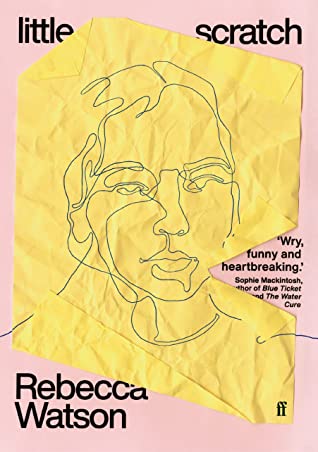 I love a circadian narrative and had heard interesting things about the experimental style used in this debut novel. I even heard Watson read a passage from it as part of the Faber Live Fiction Showcase and found it very funny and engaging. But I really should have tried an excerpt before requesting this for review; I would have seen at a glance that it wasn’t for me. I don’t have a problem with prose being formatted like poetry (Girl, Woman, Other; Stubborn Archivist; the prologue of Wendy McGrath’s Santa Rosa; parts of Mrs Death Misses Death), but here it seemed to me that it was only done to alleviate the tedium of the contents.
A young woman who, like Watson, works for a newspaper, trudges through a typical day: wake up, get ready, commute to the office, waste time and snack in between doing bits of work, get outraged about inconsequential things, think about her boyfriend (only ever referred to as “my him” – probably my biggest specific pet peeve about the book), and push down memories of a sexual assault. Thus, the only thing that really happens happened before the book even started. Her scratching, to the point of open wounds and scabs, seems like a psychosomatic symptom of unprocessed trauma. By the end, she’s getting ready to tell her boyfriend about the assault, which seems like a step in the right direction.
I might have found Watson’s approach captivating in a short story, or as brief passages studded in a longer narrative. At first it’s a fun puzzle to ponder how these mostly unpunctuated words, dotted around the pages in two to six columns, fit together – should one read down each column, or across each row, or both? – but when all the scattershot words are only there to describe a train carriage filling up or repetitive quotidian actions (sifting through e-mails, pedalling a bicycle), the style soon grates. You may have more patience with it than I did if you loved A Girl Is a Half-Formed Thing or books by Emma Glass.


A favourite passage: “got to do this thing again, the waking up thing, the day thing, the work thing, disentangling from my duvet thing, this is something, this is a thing I have to do then,” [appears all as one left-aligned paragraph]
With thanks to Faber & Faber for the free copy for review.
Tomorrow I’ll review three nonfiction works published in January, all on a medical theme.
What recent releases can you recommend?
Mrs Death Misses Death by Salena Godden
 Grief Is the Thing with Feathers meets Girl, Woman, Other would be my marketing shorthand for this one. Poet Salena Godden’s debut novel is a fresh and fizzing work, passionate about exposing injustice but also about celebrating simple joys, and in the end it’s wholly life-affirming despite a narrative stuffed full of deaths real and imagined.
What if Death wasn’t the male Grim Reaper stereotype? What if, instead, she was a poor black woman – a bag lady on a bus, or a hospital cleaner? In this playful and lilting story, we learn of Mrs Death’s work via her unwitting medium, Wolf Willeford, who one Christmas Eve goes walking in London’s Brick Lane area and buys an irresistible desk that reveals flashes of historical deaths. Once Mrs Death’s desk (and resentful at not being a piano), it now transmits her stories to Wolf, giving a whole new meaning to the term ghost writer. Wolf compiles and edits her memoirs, which take the form of diary entries, poems, and songs.
It’s never been more stressful to be Death, what with civil war in Syria, school shootings in the USA, and refugees drowning off the coast of France. But although the book’s frame of reference is up to the minute, wrongful deaths are nothing new, so occasional vignettes dramatize untimely demises – especially of black women – across the centuries: from the days of slavery to Jack the Ripper to police custody a few years ago. There are so many ways to die:
really nearly took that other plane on 9/11
had a coconut fall on your head
saw your village being bombed
slipped taking a selfie by the Grand Canyon
had a fight with an alligator
got stranded in a fierce and fast-moving bushfire
Speaking of fire, and of the title, Wolf (biracial, nonbinary, and possibly bipolar) is here to narrate only because Mrs Death missed one. Their mum died in a house fire. Wolf should have died that day, too, but heard a voice saying “Wake up, Wolf … Can you smell smoke?” Were they spared deliberately, or did Mrs Death make a mistake? (After all, we learn that when a patient briefly wakes up on the operating table before dying for good, it’s because Mrs Death’s printer got jammed.)
Where I think the novel really succeeds is in balancing its two levels: the cosmic, in which Life and Death are sisters and Time is Death’s lover in a sort of creation myth; and the personal, in which Wolf’s family tree, printed at the end, is an appalling litany of accidental deaths and executions. It’s easy to see why Wolf is so traumatized, but Mrs Death, ironically, reminds him that, despite all of the world’s fallen heroes and ongoing crises, there is still such beauty to be found in life.
All the warmth and all the joy is boiled in a soup of memory, we stir the good stuff from the bottom of the pot and hold the ladle up, drink, we say, look at all the good chunks of goodness, take in your share of good times, good music, good books, good food, good laughter, good people, be grateful for the good stuff, life and death, we say, drink.
There were a few spots where I thought the content repetitive and wondered if the miscellany format distracted from the narrative, but overall the book more than lives up to its fantastic cover, title, and premise. And with the pandemic’s global death toll rising daily, it could hardly be more relevant.
Unusual, musical, and a real pleasure to read: this is the first entry on my Best of 2021 shelf.
With thanks to Canongate for the free copy for review.
Tomorrow I’ll review a few more of January’s fiction releases, followed by nonfiction on Saturday.
Library Checkout, January 2021
I’m grateful that, even though the building is closed to the public and volunteering has paused during lockdown, my library is still allowing people to collect their reservations. I’ve got a ton of new books on request! Some are available for me to pick up on Wednesday. So, in the near future, I’m looking forward to reading the whole Costa Award poetry shortlist, and the memoir by the new U.S. Vice President.

I would be delighted to have other bloggers – not just book bloggers – join in this meme. Feel free to use the image above and leave a link to your blog in the comments if you’ve taken part in Library Checkout (on the last Monday of every month), or tag me on Twitter and/or Instagram: @bookishbeck / #TheLibraryCheckout.
READ
- Leonard and Hungry Paul by Rónán Hession (a buddy read with Annabel)
SKIMMED
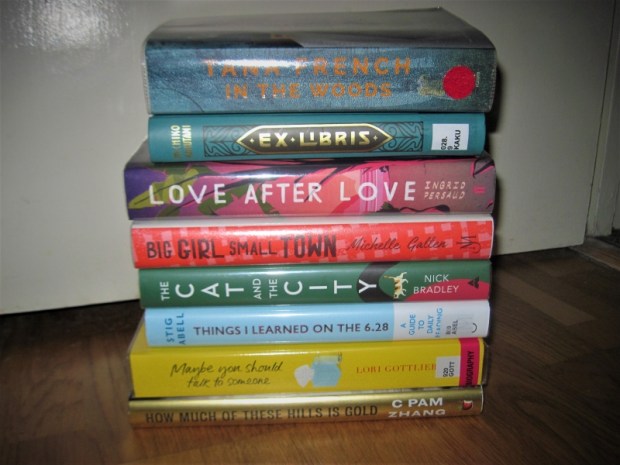
- Things I Learned on the 6.28: A Commuter’s Guide to Reading by Stig Abell
- Livewired: The Inside Story of the Ever-Changing Brain by David Eagleman
- The Marriage of Opposites by Alice Hoffman (for January book club)
- Ex Libris by Michiko Kakutani
- Hormonal: A Conversation about Women’s Bodies, Mental Health and Why We Need to Be Heard by Eleanor Morgan
- The Invention of Surgery: A History of Modern Medicine: From the Renaissance to the Implant Revolution by David Schneider, MD
CURRENTLY READING
- The Great Gatsby by F. Scott Fitzgerald (rereading for book club)
- The Dickens Boy by Thomas Keneally
- Love After Love by Ingrid Persaud
CHECKED OUT, TO BE READ
- Mama’s Boy: A Memoir by Dustin Lance Black
- In the Woods by Tana French
- Maybe You Should Talk to Someone: A Therapist, Her Therapist, and Our Lives Revealed by Lori Gottlieb
- In Our Mad and Furious City by Guy Gunaratne
- How to Do Nothing: Resisting the Attention Economy by Jenny Odell
- Country Doctor: Hilarious True Stories from a Country Practice by Michael Sparrow
- How Much of These Hills Is Gold by C. Pam Zhang
ON HOLD, TO BE PICKED UP
- The Air Year by Caroline Bird (poetry)
- The Historians by Eavan Boland (poetry)
- Daddy by Emma Cline
- The Truths We Hold: An American Journey by Kamala Harris
- My Darling from the Lions by Rachel Long (poetry)
- Citadel by Martha Sprackland (poetry)
- The Mystery of Charles Dickens by A.N. Wilson
IN THE RESERVATION QUEUE
- A Biography of Loneliness: The History of an Emotion by Fay Bound Alberti
- Can Bears Ski? by Raymond Antrobus
- All the Young Men by Ruth Coker Burks
- A Lie Someone Told You about Yourself by Peter Ho Davies
- The Living Sea of Waking Dreams by Richard Flanagan
- Begin Again by Eddie S. Glaude, Jr.
- A Net for Small Fishes by Lucy Jago
- The Prophets by Robert Jones, Jr.
- A Burning by Megha Majumdar
- A Crooked Tree by Una Mannion
- Liquid Gold: Bees and the Pursuit of Midlife Honey by Roger Morgan-Grenville
- You’re Not Listening: What You’re Missing and Why It Matters by Kate Murphy
- Spinning Silver by Naomi Novik
- A Promised Land by Barack Obama
- The Ministry of Bodies: Life and Death in a Modern Hospital by Seamus O’Mahony
- How We Met: A Memoir of Love and Other by Huma Qureshi
- My Dark Vanessa by Kate Elizabeth Russell
- UnPresidented: Politics, Pandemics and the Race that Trumped All Others by Jon Sopel
- Light Perpetual by Francis Spufford
- Asylum Road by Olivia Sudjic
- Square Haunting: Five Women, Freedom and London between the Wars by Francesca Wade
RETURNED UNFINISHED
- Village Christmas and Other Notes on the English Year by Laurie Lee – I looked at the few short Christmas pieces over the holidays, but didn’t realize that the rest of the book would be set in other seasons.
RETURNED UNREAD
- The Cat and the City by Nick Bradley – Requested after me; I’ll get it out another time. There’s a section in manga style!
- Big Girl, Small Town by Michelle Gallen – I knew from the first page that this wasn’t going to be a book for me. Did you love Milkman and The Glorious Heresies? If so, you’ll probably like this, too.
 Bookish Beck = Rebecca Foster. American transplant to England. Freelance proofreader and book reviewer.
 Bookish Beck