Three June Releases: Allen-Paisant, Cowen and Mosse
Two poetry offerings and a short memoir this month. A similar strategy is at work in both verse volumes: Jason Allen-Paisant contrasts Jamaica and England via the medium of trees, and Rob Cowen comments on current events through the prism of the natural world. In Kate Mosse’s first nonfiction book, she reflects on bereavement and caregiving.
Thinking with Trees by Jason Allen-Paisant
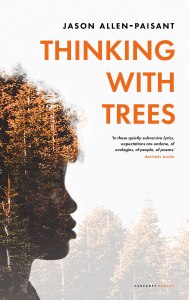 Allen-Paisant, from Jamaica and now based in Leeds, describes walking in the forest as an act of “reclamation.” For people of colour whose ancestors were perhaps sent on forced marches, hiking may seem strange, purposeless (the subject of “Black Walking”). Back in Jamaica, the forest was a place of utility rather than recreation:
In Porus life was un-
pastoral
The woodland was there
not for living in going for walks
or thinking
Trees were answers to our needs
not objects of desire
woodfire
But “I give myself permission / to go outside,” he writes, to notice the turning of the seasons, to commune with trees and birds, even if “there is nobody else like me / around here”. Explicitly calling into question Wordsworth’s model of privileged wandering, he injects a hint of threat into his interactions with nature. Most often this is symbolized by the presence of dogs. Even the most idyllic of scenes harbours the possibility of danger.
beware of spring
believe you are
a sprout of grass
and love all you see
but come out of the woods
before the white boys
with pitbulls
come
The poet cites George Floyd and Christian Cooper, the Central Park birder a white woman called the police on, as proof that being Black outdoors is inherently risky. There’s no denying this is an important topic, but I found the poems repetitive, especially the references to dogs. These felt like overkill. While there is some interesting enjambment, as in the first extended quote above, as well as internal and half-rhymes, I tend to prefer more formal poetry that uses more sonic techniques and punctuation. Still, I would be likely to direct fans of Kei Miller’s work to this collection.
With thanks to Carcanet Press for the free copy for review.
The Heeding by Rob Cowen
This poetry and art collaboration arose out of a “pact to pay attention” during a year of lockdown in the UK and record observations of nature, current events, and everyday life. Cowen is drawn to the moors near his home in Yorkshire, but also yearns to spend time with his friends again. He watches hawks and blue tits, notices the insects that fill his garden, and celebrates the way that allotment gardening brings together all sorts of people.
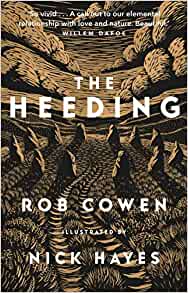 The emotional scope of the poems is broad: the author fondly remembers his brick-making ancestors and his honeymoon; he sombrely imagines the last moments of an old man dying in a hospital; he expresses guilt over accidentally dismembering an ant, yet divulges that he then destroyed the ants’ nest deliberately. There are even a couple of cheeky, carnal poems, one about a couple of teenagers he caught copulating in the street and one, “The Hottest Day of the Year,” about a longing for touch. “Matter,” in ABAB stanzas, is on the theme of racial justice by way of the Black Lives Matter movement.
My two favourites were “Sunday School,” about the rules for life he’s lived by since leaving religion behind, and “The End of This (Drinking Poem),” which serves as a good-riddance farewell to 2020: “Let me shake off / this year the way the otter / slips out of fast, rising water / and makes the holt just in time … / Let me rid my days of caution and fear, / these protocols and tiers / and Zoom funerals for people I love / and will never see again.” The book is worth the price of admission for the latter alone, and Nick Hayes’s black-and-white woodcut-style engravings are a plus.
However, in general I felt that the balance of current events and nature was off, especially compared to books like The Consolation of Nature, and ultimately I was not convinced that this needed to be in verse at all. “Starling,” especially, feels like a straight knockoff of Robert Macfarlane’s The Lost Words (“We forget that you once shimmered through frozen air, ripple bird. / Shape-shifter, dusk-dancer. Murmurer, sky-writer”). Judging from Cowen’s Common Ground, this would have been more successful as a book of short prose diary entries with a few poems dotted through.
With thanks to Elliott & Thompson for the proof copy for review.
An Extra Pair of Hands: A Story of Caring, Ageing and Everyday Acts of Love by Kate Mosse
Mosse’s parents and mother-in-law all moved in to live with her and her husband in their Chichester home when they reached old age. Her father had Parkinson’s and died in 2011, her mother survived him by a few years, and Granny Rosie is still going (reasonably) strong at the age of 90. This is a compact and relatable account of a daughter’s experiences of caregiving and grief, especially with the recent added complications of a pandemic.
 What came through particularly clearly for me was the older generation’s determination to not be a burden: living through the Second World War gave them a sense of perspective, such that they mostly did not complain about their physical ailments and did not expect heroic measures to be made to help them. (Her father knew his condition was “becoming too much” to deal with, and Granny Rosie would sometimes say, “I’ve had enough of me.”) In her father’s case, this was because he held out hope of an afterlife. Although Mosse does not share his religious beliefs, she is glad that he had them as a comfort.
The author recognizes the ways in which she has been lucky: as a full-time writer, she works from home and has the time and energy to devote to caring for elderly parents, whereas for many – generally middle-aged women, who may still have children at home – it is a huge struggle to balance caregiving with the rest of life. What is more, money is no issue for her. Repeating some of the statistics from Madeleine Bunting’s Labours of Love, she acknowledges that the situation is much more challenging for the average person.
I can see how this could serve as a great introduction for someone who hasn’t previously read much about bereavement, caregiving or old age, and I imagine it will especially appeal to existing fans of Mosse’s writing, whereas I was new to her work. I’ve read so much around these topics, including most of the works included in the bibliography, that the book did not offer me anything new, though it was a perfectly pleasant read.
Readalikes I have reviewed:
Notes on Grief by Chimamanda Ngozi Adichie
Be With by Mike Barnes
All Things Consoled by Elizabeth Hay
The Fragments of My Father by Sam Mills
With thanks to Profile Books/Wellcome Collection for the free copy for review.
What recent releases can you recommend?
Six Degrees of Separation: From Margaret to This Cold Heaven
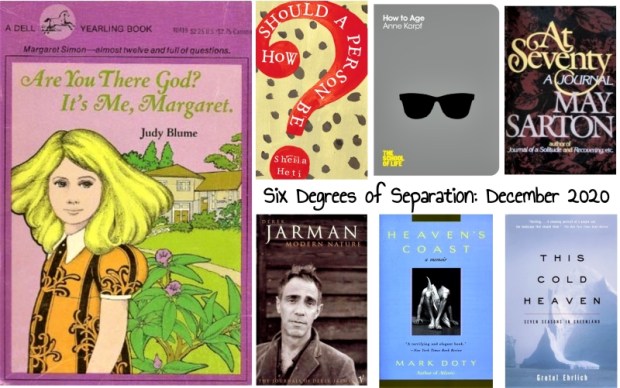
This month we’re starting with Are You There, God? It’s Me, Margaret (which I have punctuated appropriately!). See Kate’s opening post. I know I read this as a child, but other Judy Blume novels were more meaningful for me since I was a tomboy and late bloomer. The only line that stays with me is the chant “We must, we must, we must increase our bust!”
 #1 Another book with a question in the title (and dominating the cover) is How Should a Person Be? by Sheila Heti. I found a hardback copy in the unofficial Little Free Library I ran in our neighborhood during the first lockdown before the public library reopened. Heti is a divisive author, but I loved Motherhood for perfectly encapsulating my situation. I think this one, too, is autofiction, and the title question is one I ask myself variations on frequently.
 #2 I’ve read quite a few “How to” books, whether straightforward explanatory/self-help texts or not. Lots happened to be from the School of Life series. One I found particularly enjoyable and helpful was How to Age by Anne Karpf. She writes frankly about bodily degeneration, the pursuit of wisdom, and preparation for death. “Growth and psychological development aren’t a property of our earliest years but can continue throughout the life cycle.”
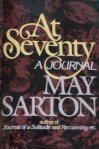 #3 Ageing is a major element in May Sarton’s journals, particularly as she moves from her seventies into her eighties and fights illnesses. I’ve read all but one of her autobiographical works now, and – while my favorite is Journal of a Solitude – the one I’ve chosen as most representative of her usual themes, including inspiration, camaraderie, the pressures of the writing life, and old age, is At Seventy.
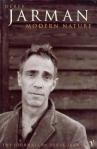 #4 Sarton was a keen gardener, as was Derek Jarman. I learned about him in the context of nature helping people come to terms with their mortality. Modern Nature reproduces the journal the gay, HIV-positive filmmaker kept in 1989–90. Prospect Cottage in Dungeness, Kent, and the unusual garden he cultivated there, was his refuge between trips to London and further afield, and a mental sanctuary when he was marooned in the hospital.
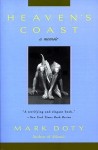 #5 One of the first memoirs I ever read and loved was Heaven’s Coast by Mark Doty, about his partner Wally’s death from AIDS. This sparked my continuing interest in illness and bereavement narratives, and it was through following up Doty’s memoirs with his collections of poems that I first got into contemporary poetry, so he’s had a major influence on my taste. I’ve had Heaven’s Coast on my rereading shelf for ages, so really must get to it in 2021.
 #6 Thinking of heaven, a nice loop back to Blume’s Margaret and her determination to find God … one of the finest travel books I’ve read is This Cold Heaven, about Gretel Ehrlich’s expeditions to Greenland and historical precursors who explored it. Even more than her intrepid wanderings, I was impressed by her prose, which made the icy scenery new every time. “Part jewel, part eye, part lighthouse, part recumbent monolith, the ice is a bright spot on the upper tier of the globe where the world’s purse strings have been pulled tight.”
A fitting final selection for this week’s properly chilly winter temperatures, too. I’ll be writing up my first snowy and/or holiday-themed reads of the year in a couple of weeks.
Join us for #6Degrees of Separation if you haven’t already! (Hosted on the first Saturday of each month by Kate W. of Books Are My Favourite and Best.)
Have you read any of my selections? Are you tempted by any you didn’t know before?
Soul Food: Rereading Anne Lamott
I first read Anne Lamott’s autobiographical essays on faith in about 2005, when I was in my early twenties and a recovering fundamentalist and Republican. She’s a Northern Californian ex-alcoholic, a single mother, a white lady with dreadlocks. Her liberal, hippie approach to Christianity was a bit much for me back then. I especially remember her raging against George W. Bush and the war in Iraq. But even if I couldn’t fully get behind all of her views, her picture of a fumbling faith that doesn’t claim to know much for certain appealed to me. Jesus is for her the herald of a radical path of love and grace. Lamott describes herself stumbling towards kindness and forgiveness while uttering the three simplest and truest prayers she knows, “Help, thanks, wow.” I only own three of her eight spiritual books (though I’ve read them all), so I recently reread them one right after the other – the best kind of soul food binge in a stressful time.
Traveling Mercies: Some Thoughts on Faith (1999)
 Her first and best collection. Many of these pieces first appeared in Salon web magazine. There is a lot of bereavement and other dark stuff here, yet an overall lightness of spirit prevails. Lamott’s father died of melanoma that metastasized to his brain (her work has meant a lot to my sister because her husband, too, died of brain cancer) and her best friend Pammy died of breast cancer – both far too young. A college dropout, alcoholic and drug addict, Lamott didn’t walk into a church and get clean until she was in her early thirties. Newly sober and with the support of the community, she was able to face unexpected motherhood and raise Sam in the church, clinging to fragments of family and nurturing seeds of faith.
The essays sometimes zero in on moments of crisis or decision, but more often on everyday angst, such as coming to terms with a middle-aged body. “Thirst” and “Hunger” are a gorgeous pair about getting sober and addressing disordered eating. “Ashes,” set on one Ash Wednesday, sees her trying to get her young son interested in the liturgical significance and remembering scattering Pammy’s ashes. “Knocking on Heaven’s Door” and “Barn Raising” are two classics about surviving a turbulent flight and supporting a local family whose child has cystic fibrosis. Each essay is perfectly constructed: bringing together multiple incidents and themes in a lucid way, full of meaning but never over-egging the emotion.
Like A Three Dog Life by Abigail Thomas, this was even better the second time around – I can see that the memoir-in-essays is now among my most admired forms.
Some favorite lines:
“The main reason [that she makes Sam go to church] is that I want to give him what I found in the world[: …] a path and a little light to see by. Most of the people I know who have what I want—which is to say, purpose, heart, balance, gratitude, joy—are people with a deep sense of spirituality.”
“You really do have to eat, anything at all you can bear. So we had smoothies, with bananas, which I believe to be the only known cure for existential dread.”
“most of the time, all you have is the moment, and the imperfect love of people.”
“even though I am a feminist and even though I am religious, I secretly believe, in some mean little rat part of my brain, that I am my skin, my hair, and worst of all, those triangles of fat that pooch at the top of my thighs. In other words, that I am my packaging.”
My original rating (c. 2005): 
My rating now: 
Plan B: Further Thoughts on Faith (2005)
 Here’s the more political material I remembered from Lamott. Desperately angry about the impending Iraq War, she struggles to think civilly about Bush. “I wake up some mornings pinned to the bed by centrifugal sadness and frustration.” In the meantime, her difficult mother has died and it takes years to get to a point where she can take the woman’s ashes (with a misspelling on the name label) out of the closet and think of scattering them. Sam is a teenager and there are predictable battles of wills but also touching moments as they rekindle a relationship with his father. Lamott also starts a Sunday School and says goodbye to a dear old dog. A few of the essays (especially “One Hand Clapping”) feel like filler, and there are fewer memorable lines. “Ham of God,” though, is an absolute classic about the everyday miracle of a free ham she could pass on to a family who needed it.
I’ve been surprised that Lamott hasn’t vented her spleen against Donald Trump in her most recent books – he makes Bush look like a saint, after all. But I think it must be some combination of spiritual maturity and not wanting to alienate a potential fan base (though to most evangelicals she’ll be beyond the pale anyway). Although her response to current events makes this book less timeless than Traveling Mercies, I found some of her words applicable to any troubled period: “These are such rich, ripe times for paranoia and despair that each celebration, each occasion of tribal love and music and overeating glows more brightly … People are helping one another keep their spirits up.”
My secondhand copy has had quite the journey: it has a “The Munich Readery” stamp in the front and has sat text block facing out on a shelf for ages judging by the pattern of yellowing; I picked it up from the Community Furniture Project, a local charity warehouse, last year for a matter of pence.
Some favorite lines:
(on caring for an ageing body) “You celebrate what works and you take tender care of what doesn’t, with lotion, polish and kindness.”
“Rest and laughter are the most spiritual and subversive acts of all. Laugh, rest, slow down.”
My original rating (c. 2005):
My rating now:
Small Victories: Spotting Improbable Moments of Grace (2014)
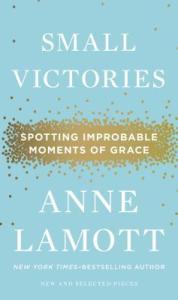 This is a sort of “Greatest Hits” collection of new and selected essays. I skipped over the ones I’d just encountered in Traveling Mercies and Plan B to focus on the newer material. I don’t have a copy of Grace (Eventually), her third set of essays on faith, so I wasn’t sure which were from that and which were previously unpublished in book form. More so than before, Lamott’s thoughts turn to ageing and her changing family dynamic – she’s now a grandmother. As usual, the emphasis is on being kind to oneself and learning the art of forgiveness. Sometimes it seems like her every friend or relative has cancer. Her writing has tailed off noticeably in quality, but I suspect there’s still no one many of us would rather hear from about life and faith. It’s a beautiful book, too, with deckle edge, blue type and gold accents. My favorite of the new stuff was “Matches,” about Internet dating.
My original rating (2015):
My rating now (for the newer material only): 
Currently rereading: Everything Is Illuminated by Jonathan Safran Foer
Considering rereading next: Heaven’s Coast by Mark Doty
Done any rereading lately?
What books have been balm for the soul for you?
Novellas in November, Part 1: 3 Nonfiction, 2 Super-Short Fiction
Short books; short reviews.
Nonfiction:
The Measure of My Days by Florida Scott-Maxwell (1968)
[150 pages]
 I learned about this from one of May Sarton’s journals, which shares its concern with ageing and selfhood. The author was an American suffragist, playwright, mother and analytical psychologist who trained under Jung and lived in England and Scotland with her Scottish husband. She kept this notebook while she was 82, partly while recovering from gallbladder surgery. It’s written in short, sometimes aphoristic paragraphs. While I appreciated her thoughts on suffering, developing “hardihood,” the simplicity that comes with giving up many cares and activities, and the impossibility of solving “one’s own incorrigibility,” I found this somewhat rambly and abstract, especially when she goes off on a dated tangent about the equality of the sexes. (Free from The Book Thing of Baltimore)
Hope in the Dark: Untold Histories, Wild Possibilities by Rebecca Solnit (2004)
[143 pages]
 “Activism is not a journey to the corner store, it is a plunge into the unknown. The future is always dark.” This resonated with the Extinction Rebellion handbook I reviewed earlier in the year. Solnit believes in the power of purposeful individuals working towards social justice, even in the face of dispiriting evidence (the largest protests the world had seen didn’t stop the Iraq War). Instead of perfectionism, she advises flexibility and resilience; things could be even worse had we not acted. At first I thought it depressing that 15 years on we’re still dealing with many of the issues she mentions here, and the environmental crisis has only deepened. But her strong and stirring writing is a reminder that, though injustice is always with us, so is everyday heroism. (Free from The Book Thing of Baltimore)
Lama by Derek Tangye (1966)
[160 pages]
 Tangye wrote a series of cozy animal books similar to Doreen Tovey’s. He and his wife Jean ran a flower farm in Cornwall and had a succession of cats, along with donkeys and a Muscovy duck named Boris. After the death of their beloved cat Monty, Jean wanted a kitten for Christmas but Tangye, who considered himself a one-cat man rather than a wholesale cat lover, hesitated. The matter was decided for them when a little black stray started coming round and soon made herself at home. (Her name is a tribute to the Dalai Lama’s safe flight from Tibet.) Mild adventures ensue, such as Lama going down a badger sett and Jeannie convincing herself that she’s identified another stray as Lama’s mother. Pleasant, if slight; I’ll read more by Tangye. (From Kennet Centre free bookshop)
Fiction:
The Small Miracle by Paul Gallico (1951)
[47 pages]
 Like Tangye, Gallico is known for writing charming animal books, but fables rather than memoirs. Set in postwar Assisi, Italy, this stars Pepino, a 10-year-old orphan boy who runs errands with his donkey Violetta to earn his food and board. When Violetta falls ill, he dreads losing not just his livelihood but also his only friend in the world. But the powers that be won’t let him bring her into the local church so that he can pray to St. Francis for her healing. Pepino takes to heart the maxim an American corporal gave him – “don’t take no for an answer” – and takes his suit all the way to the pope. This story of what faith can achieve just manages to avoid being twee. (From Kennet Centre free bookshop)
Birthday Girl by Haruki Murakami (2002; English translation by Jay Rubin, 2003)
[42 pages]
 Reprinted as a stand-alone pamphlet to celebrate the author’s 70th birthday, this is about a waitress who on her 20th birthday is given the unwonted task of taking dinner up to the restaurant owner, who lives above the establishment. He is taken with the young woman and offers to grant her one wish. We never hear exactly what that wish was. It’s now more than 10 years later and she’s recalling the occasion for a friend, who asks her if the wish came true and whether she regrets what she requested. She surveys her current life and says that it remains to be seen whether her wish will be fulfilled; I could only assume that she wished for happiness, which is shifting and subjective. Encountering this in a larger collection would be fine, but it wasn’t particularly worth reading on its own. (Public library)
I’ve also had a number of novella DNFs so far this month, alas: Atlantic Winds by William Prendiville (not engaging in the least), By Grand Central Station I Sat Down and Wept by Elizabeth Smart (fascinating autobiographical backstory; pretentious prose) and The Dream Life of Balso Snell by Nathanael West (even more bizarre and crass than I’m used to from him).
Onwards!
Have you read any of these novellas? Which one takes your fancy?
My Bibliotherapy Appointment at the School of Life
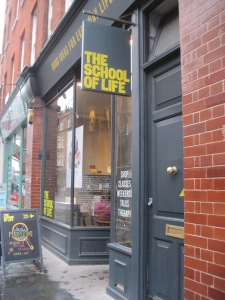 I’ve been interested in bibliotherapy for years, and I love The Novel Cure (see my review), the learned and playful advice book from Ella Berthoud and Susan Elderkin, two of the bibliotherapists at Alain de Botton’s London School of Life. Earlier this month I had the tremendous opportunity to have a personalized bibliotherapy appointment with Ella Berthoud at the School of Life. She’d put out a call on Twitter for volunteers to come for a free session (usually £100) to be observed by a journalist from La Repubblica writing about bibliotherapy – the translation of The Novel Cure has sold remarkably well in Italy. The feature will be part of a special color supplement in February, and I look forward to seeing if my story makes the cut! That is, if I can decipher any of the Italian.
Now, you might not think I’m the kind of person who needs a bibliotherapy assessment since I already find 300+ books per year I want to read; I worried that too, and felt a little bit guilty, but in the end I couldn’t pass up the chance, and Ella was happy to have me.

I took my copy of The Novel Cure along for Ella to sign.
Before my appointment I’d been asked to complete a two-page questionnaire about my reading habits and likes/dislikes, along with what’s going on in my life in general (the ‘therapy’ aspect is real). Once we were set up in the basement therapy room with hot drinks, Ella asked me more about how I read. I’d told her my reading was about two-thirds print books and one-third e-books. Had I ever tried audiobooks or reading aloud, she asked? The answer to both of those is no, I’m afraid. There’s no obvious place for audiobooks in my life because I work from home. However, as I’d mentioned I haven’t been able to get through a Dickens novel in five years, Ella suggested I try listening to one – abridged, it can be more like eight hours long instead of 42, and you still get a terrific story. She also highly recommended New Yorker and Guardian podcasts based around short stories and discussion.
 For reading aloud with my husband, Ella prescribed one short story per evening sitting – a way for me to get through short story collections, which I sometimes struggle to finish, and a different way to engage with books. We also talked about the value of rereading childhood favorites such as Watership Down and Little Women, which I haven’t gone back to since I was nine and 12, respectively. In this anniversary year, Little Women would be the ideal book to reread (and the new television adaptation is pretty good too, Ella thinks).
One other reading habit Ella is adamant about is keeping a physical reading journal in which you record the title of each book you read, where you read it, and about a paragraph of thoughts about it. It’s not meant to be a comprehensive response to every book; more like an aide-mémoire that you can get off the shelf in years to come to remind yourself of what you thought about a book. Specifically, Ella thinks writing down the location of your reading (e.g., on a train to Scotland) allows you to put yourself back in the moment. I tend to note where I bought a book, but not necessarily where I read it – for that, I would probably have to cross-reference my annual book list against a calendar. Since 2010 I’ve kept my book lists and responses in computer files, and I also keep full records via Goodreads, but I can see why having a physical journal would be a good back-up as well as a more pleasant representation of my reading. I’ll think about starting one.
 Various books came up over the course of our conversation: Abraham Verghese’s Cutting for Stone [appearance in The Novel Cure: The Ten Best Novels to Cure the Xenophobic, but Ella brought it up because of the medical theme], Tom Robbins’ Jitterbug Perfume [cure: ageing, horror of], and Julia Cameron’s The Artist’s Way, a nonfiction guide to thinking creatively about your life, chiefly through 20-minute automatic writing exercises every morning. We agreed that it’s impossible to dismiss a whole genre, even if I do find myself weary of certain trends, like dystopian fiction (I introduced Ella to Claire Vaye Watkins’ Gold Fame Citrus, one of my favorite recent examples).
 I came away with two instant prescriptions: Heligoland by Shena Mackay [cure: moving house], about a shell-shaped island house that used to be the headquarters of a cult. It’s a perfect short book, Ella tells me, and will help dose my feelings of rootlessness after moving more than 10 times in the last 10 years. She also prescribed Family Matters by Rohinton Mistry [cure: ageing parents] and an eventual reread of Jonathan Franzen’s The Corrections. As we discussed various other issues, such as my uncertainty about having children, Ella said she could think of 20 or more books to recommend me. “That’s a good thing, right?!” I asked.


Before I left, I asked Ella if she would ever prescribe nonfiction. She said they have been known to do so, usually if it’s written in a literary style (e.g. Robert Macfarlane and Alain de Botton). We chatted about medical memoirs and reading with the seasons for a little while, and then I thanked her and headed on my way. I walked around the corner to Skoob Books but, alas, didn’t find any of the books Ella had mentioned during our session. On the way back to the Tube station, though, I stopped at Judd Books and bought several secondhand and remaindered goodies, including these two:


(Imagine my surprise when I spotted The Year of the Hare in The Novel Cure under midlife crisis! Age seemed to be the theme of the day.)
 As soon as I got back from London I ordered secondhand copies of Heligoland, Jitterbug Perfume and The Artist’s Way, and borrowed Family Matters from the public library the next day. Within a few days four further book prescriptions arrived for me by e-mail. Ella did say that her job is made harder when her clients read a lot, so kudos to her for prescribing books I’d not read – with the one exception of Sebastian Barry’s Days Without End, which I love.
I’ve put in another order for Maggie and Me, the memoir by Damian Barr, plus (for reading aloud) Sum: Forty Tales from the Afterlives by David Eagleman and the collected short stories of Saki. I’m also keen to find The Victorian Chaise-Longue by Marghanita Laski, Ella’s final prescription, but as the Persephone Books reprint is pricey at the moment I may hold off and hope to chance upon a secondhand copy later in the year. Ella has been very generous with her recommendations, especially considering that I didn’t pay a penny. I certainly have plenty to be getting on with for now! I’ll report back later on in the year when I’ve had the chance to read some of these prescriptions.

The prescribed books I have gotten hold of so far.
 Bookish Beck = Rebecca Foster. American transplant to England. Freelance proofreader and book reviewer.
