Two Memoirs of Women’s Freedom: Lara Feigel and Rebecca Loncraine
I have read some truly phenomenal memoirs this year, most of them by women. These two have rather different starting points – frustration with the constraints of marriage and motherhood, and breast cancer treatment – but I’ve paired them because both are journeys of self-discovery in which the author commits to determining how to live a free and true life.
Free Woman: Life, Liberation and Doris Lessing by Lara Feigel
 It started with a spate of weddings one summer. Lara Feigel, a literature lecturer at King’s College London, found herself strangely irked at all this capitulation to marital convention, even though she herself had married in her twenties and had a young son. What did her mild outrage signify? At the same time, she was rereading the works of Doris Lessing, whom she found simultaneously admirable and vexing: Lessing lived by her ideals of free love and Communism, but it came at the price of abandoning her children. Feigel could identify with Lessing in some ways but not in others, and as she entered a rocky time in her mid-thirties – a miscarriage followed by IVF, which was a strain on her marriage; the death of a close friend; and ongoing worry over how motherhood might affect her academic career – she set out to find what Lessing could teach her about how to be free.
Throughout, Feigel holds up her own experiences of marriage and motherhood in parallel to Lessing’s. She maintains a delicate balance between biographical and autobiographical information and brings in references to other writers – everyone from Rachel Cusk to D.H. Lawrence – to explore various opinions on maternal ambivalence and sexual fulfillment. I could relate to the bookworm’s impulse to turn to literature for comfort and direction – “the most enduring novelists … illuminate our lives,” and “we live differently as a result of reading them,” Feigel insists. Lessing seemed to her the perfect “writer to discover in your thirties; a writer who wrote about the lives of grown-up women with an honesty and fullness I had not found in any novelist before or since.”
And yet a familiarity with or fondness of the works of Doris Lessing is not a prerequisite to enjoying this book. I’ve only ever read The Golden Notebook (1962) and Alfred and Emily (2008), a fictionalized biography of Lessing’s parents, both during my mid-twenties. The former I almost certainly read before I could fully appreciate it. It’s about the ways in which women compartmentalize their lives and the struggle to bring various strands into harmony; that’s what Free Woman is all about as well. Feigel often looks for clues in Lessing’s heavily autobiographical Martha Quest novels, which I’d like to read, and also travels to California to meet one of Lessing’s lovers and to Zimbabwe to see the farm where Lessing grew up.
Like Samantha Ellis’s How to Be a Heroine and Rebecca Mead’s My Life in Middlemarch, this is a richly satisfying hybrid of biography, literary criticism and memoir. I would also recommend it to readers of Alexandra Fuller’s Don’t Let’s Go to the Dogs Tonight, Nancy Horan’s Loving Frank, and Adrienne Rich’s Of Woman Born. Feigel’s is a particularly brave and forthright book. I feel proud of her in an oddly personal way: during my years as a library assistant at King’s, I saw her chair countless literature and life writing events. She seemed impossibly young for a professor type, and wore her navy blue shift dress and string of pearls like it was her grown-up’s uniform. I can tell that the years since, including the difficult experiences she recounts here, have both softened and toughened her, sandpapering away what she calls her “diffident angularity” and replacing it with womanly wisdom.
My rating: 
Free Woman was published by Bloomsbury UK on March 8th. My thanks to the publisher for the free copy for review.
Skybound: A Journey in Flight by Rebecca Loncraine
 In 2016 it was When Breath Becomes Air by Paul Kalanithi; in 2017 it was The Bright Hour by Nina Riggs. And now Skybound. Each year seems to bring one exquisite posthumous memoir about facing a death from cancer with dignity. For Rebecca Loncraine, after treatment for breast cancer in her early thirties, taking flying lessons in an unpowered glider was her way of rediscovering joy and experiencing freedom by facing her fears in the sky.
She was a freelance writer based on her parents’ farm in the Black Mountains of Wales, an area that’s familiar to me from trips to Hay-on-Wye and from my reading of Bruce Chatwin’s On the Black Hill. The history and geography of the region, as revealed from the air, weave through the book, as do childhood memories and recollections of chemotherapy. Loncraine discovered a particular love for flying alongside birds: the red kites in Wales, and later vultures in Nepal. The most remarkable passages of the book are the exhilarating descriptions of being thousands of feet up in the air and the reflections on why humans are drawn to flight and what it does for our bodies and spirits. She learned from a British Airways pilot that 500,000 people are airborne at any one moment! We take for granted what should still be acknowledged as a miraculous feat.
“There’s no road in the sky. Each individual glider pilot finds a new pathless way through the air, a unique scribble. We locate a bit of ridge lift, here; fly out to a thermal, there; we wind and manoeuvre over the curving land. We never take the same route twice, so flight offers me a new perspective each time I fly.”
“Influenced by the ancient seam of human thought that associates the sky with the imagination, weaving and circling in the sky begins to feel like sailing through the realm of the subconscious itself.”
This hobby-turned-obsession was not without its inconveniences and dangers. Even when it’s warm at ground level it’s frigid at 13,000 feet, so you have to bundle up. Meanwhile, the strength of the sun means you keep guzzling water and have to wear either a urine-collecting device or adult diapers. The earliest attempts at unpowered flight were generally fatal, and when Loncraine went to New Zealand for a bonus season of flying to replace the Welsh winter, one of her fellow flyers died in a crash. Her instructor told her she’d become fearless, even reckless. But when she met one of the pioneers of gliding, then in his nineties, in New Zealand he spoke an aphorism that perfectly captures the role flying played for Loncraine: “The antidote to fear is fascination.”
There’s a brief afterword by Loncraine’s mother, Trisha. Her daughter had virtually finished this manuscript when the cancer returned, and underwent another 14 grueling months of treatment before her death in September 2016. This is a simply wonderful book; what a shame that we won’t get another.
My rating: 
Skybound was published by Picador on April 19th. My thanks to the publisher for a proof copy for review.
Some Accidental Thematic Overlaps in My Recent Reading
Five of the books I’ve read recently (most of them while traveling to and from the States) have shared an overarching theme of loss, with mental illness, alcoholism, suicide, and dogs as subsidiary topics running through two or more of them. I hadn’t deliberately chosen these books for their commonalities, so it was uncanny to see the same elements keep popping up. I wanted to come up with some kind of impressively complex Venn diagram to show off these unexpected connections but couldn’t quite manage it, so you’ll have to imagine it instead.
Mental Illness
The Archivist by Martha Cooley
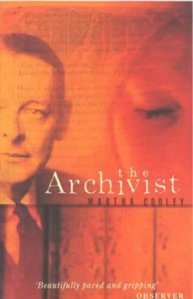 Matthias Lane is the archivist of the Mason Room, a university collection of rare books and literary papers. One of its treasures is a set of letters that passed between T.S. Eliot and his friend Emily Hale (held at Princeton in real life). Matt is haunted by memories of his late wife, Judith, a poet incarcerated in a mental hospital for over five years. A reckoning comes for Matt when he’s approached by Roberta Spire, a graduate student determined to view the Eliot–Hale letters even though they’re legally sealed until 2020. The more time Matt spends with Roberta, the more similarities start to arise between her and Judith; and between his situation and Eliot’s when the latter also put his wife away in a mental hospital. The novel asks what we owe the dead: whether we conform to their wishes or make our own decisions.
The Summer without Men by Siri Hustvedt
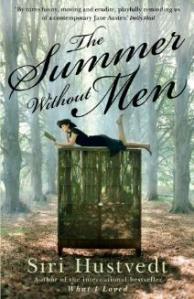 Thirty years on, poet Mia Fredricksen’s husband Boris asks her for a pause in their marriage so he can explore his feelings for his young French lab assistant. First things first: Mia goes crazy and ends up in a mental hospital for a short time. But then she sucks it up and goes back to her Minnesota hometown to teach poetry writing to teen girls for a summer, getting sucked into a bullying drama. This is a capable if not groundbreaking story of the shifts that occur in a long marriage and the strange things we all do as we face down the possibility of death. There are also wry comments about the unappreciated talents of the female artist. However, compared to the other two novels I’ve read from Hustvedt, this seemed feeble. Still, a quick and enjoyable enough read.
The Dogs of Babel by Carolyn Parkhurst
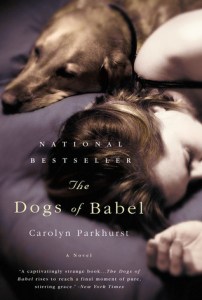 A delicious debut novel intellectual enough to bypass labels like ‘women’s fiction’ and ‘mystery’. One thing that sets it apart is how successfully Parkhurst writes from the perspective of a male narrator, Paul Iverson, who’s been knocked for six by the sudden death of his wife Lexy, a mask designer. While he was at the university where he teaches linguistics, she climbed to the top of the apple tree in their backyard and – what? fell? or jumped? The only ‘witness’ was their Rhodesian Ridgeback, Lorelei; in his grief Paul uses his sabbatical to research efforts to teach dogs to communicate, hoping one day Lorelei might tell all. Woven through are scenes from Paul and Lexy’s courtship and marriage; though Lexy occasionally struggled with her mental health, their dialogue is fun and zippy, like you might hear on The Gilmore Girls.
Suicide
The Archivist by Martha Cooley & The Dogs of Babel by Carolyn Parkhurst


Alcoholism
Don’t Let’s Go to the Dogs Tonight by Alexandra Fuller
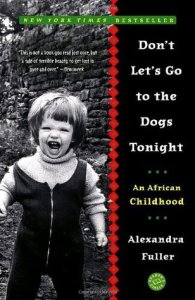 A classic memoir that conjures up all the sights, sounds, smells and feelings of Africa on the cusp of a colonial to postcolonial transition. Fuller’s family were struggling tobacco and cattle farmers in Rhodesia (Zimbabwe), Malawi and Zambia. She had absorbed the notion that white people were there to benevolently shepherd the natives, but came to question it when she met Africans for herself. While giving a sense of the continent’s political shifts, she mostly focuses on her own family: the four-person circus that was Bobo (that’s her), Van (older sister Vanessa), Dad, and Mum (an occasionally hospitalized manic-depressive alcoholic who lost three children) – not to mention an ever-changing menagerie of horses, dogs and other pets. This really takes you away to another place and time, as the best memoirs do, and the plentiful black-and-white photos are a great addition.
Let’s Take the Long Way Home by Gail Caldwell
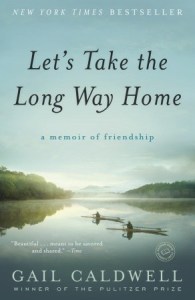 If you loved Ann Patchett’s Truth and Beauty, pick this up immediately. It’s a similar story of best friends: one who dies and one who survives. Caldwell’s best friend was Caroline Knapp (author of Drinking: A Love Story, among other nonfiction), whom she met via puppy ownership in Cambridge, Massachusetts. They were both single and childless, full-time authors with a history of alcoholism. Besides long walks with their dogs, they loved swimming and rowing together. In 2002 Caroline was diagnosed with stage-four lung cancer, inoperable and already metastasized. Despite all their proactive optimism, she was dead a matter of weeks later. In this moving and accessible short memoir, Caldwell drifts through her past, their friendship, Caroline’s illness, and the years of grief that followed the loss of Caroline and then her beloved Samoyed, Clementine, sharing what she learned about bereavement.
Dogs
The Dogs of Babel, Don’t Let’s Go to the Dogs Tonight & Let’s Take the Long Way Home


Do you ever find coincidental thematic connections in your reading?
Making Plans (and Book Lists) for America
On Tuesday we leave for two weeks in America. It’s nearly a year and a half since our last trip – much too long – so we’ll be cramming in lots of visits with friends and family and doing a fair bit of driving around the Mid-Atlantic states. I’m giving myself the whole time off, which means I’ve been working flat out for the past two weeks to get everything done (including my U.K. and U.S. taxes). I’m nearly there: at the 11-day countdown I still had 12 books I wanted to finish and 12 reviews to write; now I’m down to five books, only one of which might be considered essential, and all the reviews are ready to submit/schedule. What with the holiday weekend underway, it should all be manageable.
I’m a compulsive list maker in general, but especially when it comes to preparing for a trip. I’ve kept adding to lists entitled “Pack for America,” “Do in America,” “Buy in America,” and “Bring back from America.” But the more fun lists to make are book-related ones: what paper books should I take to read on the plane? Which of the 315 books on my Kindle ought I to prioritize over the next two weeks? Which exclusively American books should I borrow from the public library? What secondhand books will I try to find? And which of the books in the dozens of boxes in the closet of my old bedroom will I fit in my suitcase for the trip back?
I liked the sound of Laila’s habit of taking an Anne Tyler novel on every flight. That’s just the kind of cozy reading I want, especially as I head back to Maryland – not far at all from Tyler’s home turf of Baltimore. I browsed the blurbs on a few of her paperbacks I have lying around and chose Back When We Were Grownups to be my fifth Tyler and one of my airplane reads.
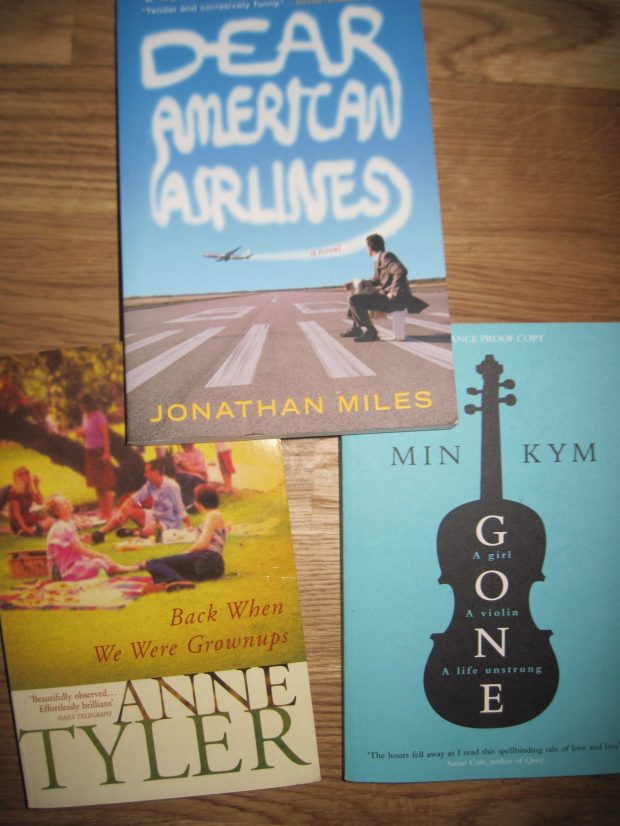
I’m also tempted by Min Kym’s Gone, a memoir by a violin virtuoso about having her Stradivarius stolen. I picked up a proof copy in a 3-for-£1 charity sale a couple of weeks ago. And then I can’t resist the aptness of Jonathan Miles’s Dear American Airlines (even though we’re actually flying on Virgin). I’ll start one or more of these before we go, just to make sure they ‘take’.
I almost certainly won’t need three print books for the trip, particularly if I take advantage of the in-flight entertainment. We only ever seem to watch films while we’re in America or en route there, so between the two legs I’ll at least try to get to La La Land and The Light between Oceans; I’m also considering Nocturnal Animals, Silence, and the live-action Beauty and the Beast – anyone seen these?
However, I’ll also keep my Kindle to hand, as I find it easier to pick up and put down on multi-part journeys like ours to the airport (train ride + coach ride). Some of the books on my Kindle priority list are: The Day that Went Missing by Richard Beard, Cork Dork by Bianca Bosker, Eleanor Oliphant Is Completely Fine by Gail Honeyman, The Fact of a Body by Alexandria Marzano-Lesnevich, Mrs. Fletcher by Tom Perrotta (out in August), The Power by Naomi Alderman, Reservoir 13 by Jon McGregor, The Rules Do Not Apply by Ariel Levy, See What I have Done by Sarah Schmidt, You Should Have Left by Daniel Kehlmann … and the list continues, but I’ll stop there.

My book shopping list is an ongoing one, as the many cross-outs and additions on this sheet show. Finding specific books at my beloved Wonder Book can be a challenge, so I usually just keep in mind the names of authors I’d like to read more by. This time that might include Arnold Bennett, Geoff Dyer, Elizabeth Hay, Bernd Heinrich, W. Somerset Maugham, Haruki Murakami and Kathleen Norris. In addition to the couple of secondhand bookstores we always hit, I hope to visit a few new-to-me ones on stays with friends in Virginia.
As for those poor books sat in boxes in the closet, I have plans to unearth novels by Anita Brookner, Mohsin Hamid, Kent Haruf, Penelope Lively, Howard Norman and Philip Roth – for reading while I’m there and/or bringing back with me. I’m also contemplating borrowing my dad’s omnibus edition of the John Updike “Rabbit” novels. From my nonfiction hoard, I fancy an Alexandra Fuller memoir, D.H. Lawrence’s travel books and more of May Sarton’s journals. If only it weren’t for luggage weight limits!
On Monday I’ll publish my intercontinental Library Checkout, on Tuesday I have a few June releases to recommend, and then I’m scheduling a handful of posts for while I’m away – a couple reviews I happen to have ready, plus some other lightweight stuff. Alas, I read no doorstoppers in May, but I have a list (of course) of potential ones for June, so will attempt to resurrect that monthly column.
Though I may be slow to respond to comments and read your blogs while I’m away, I will do my best and hope to catch up soon after I’m back.
A Book-Themed Concert and Goody Bag
On Saturday my husband and I headed to Hungerford to see The Bookshop Band for the second time. A year and a half ago I first had the chance to see them live at the 2014 Hungerford Literary Festival, when they gave a performance tied in with Rachel Joyce’s release of The Love Song of Miss Queenie Hennessy.
The band formed about five years ago to provide music for author events at their local bookshop, Mr B’s Emporium of Reading Delights in Bath, England. Since then they’ve written somewhere between 120 and 150 songs inspired by books. Their basic genre is indie folk, with plenty of guitar, ukulele and cello as well as a bunch of improvised percussion and three intermingled voices. Depending on the book in question, though, the feel can vary widely, ranging from sweet to bizarre or haunting. Especially when I’ve read the book being sung about, it’s intriguing to see what the musicians have picked up on – often something very different from what I would as a reader and reviewer.
 This year the band (now down to two members) is making an effort to record and release all their songs in 10 albums. I participated in a crowdfunding project so am lucky enough to receive all their new releases in digital format before they’re available as printed CDs. The first album is Curious and Curiouser, the title track of which was inspired by Alice in Wonderland. Other sets of songs are based on A Midsummer Night’s Dream and the steampunk novel The Strange Affair of Spring Heeled Jack by Mark Hodder, while “Once Upon a Time,” a commission for radio, strings together famous first lines from fiction.
My favorite Bookshop Band song (so far) is “Bobo and the Cattle,” inspired by Alexandra Fuller’s Don’t Let’s Go to the Dogs Tonight. Two great ones new to me from Saturday’s performance were “Faith in Weather,” based on Central European fairy tales, and “You Make the Best Plans, Thomas,” about Hilary Mantel’s Bring Up the Bodies.
You can listen to lots of their songs on their Bandcamp page and dozens of videos of their performances are on YouTube and Vimeo (I’ve linked to several above). When performing events they often get the authors to play with them: Louis de Bernières pitched in with mandolin on a song about The Dust that Falls from Dreams, and Yann Martel played glockenspiel while promoting The High Mountains of Portugal.
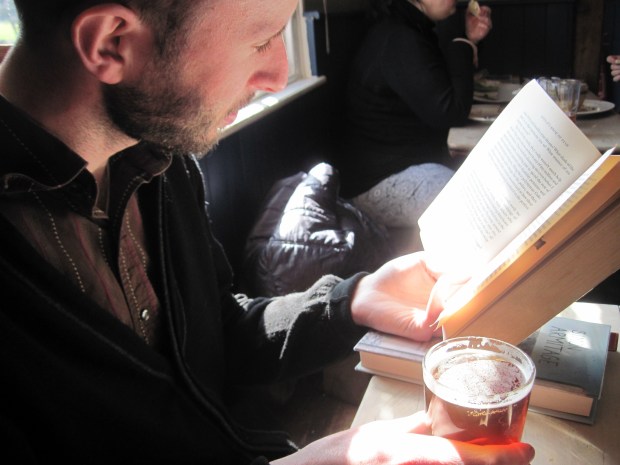
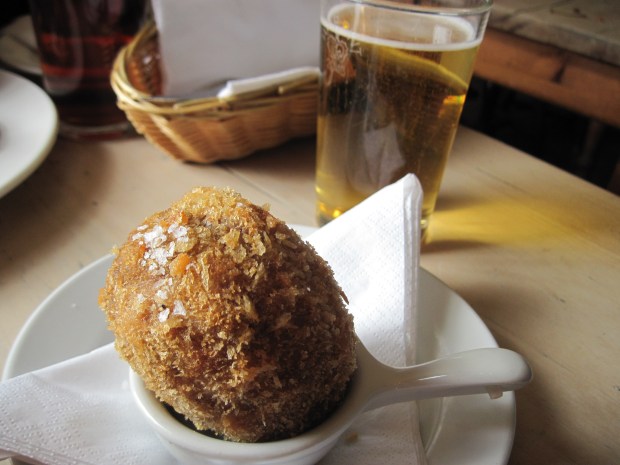
We had started off the day with lunch at a Berkshire country pub, The Pot Kiln, where we didn’t mind the 40-minute wait for food because we had books and half-pints of beer and cider to while away the time over as sunshine poured through the windows. The menu is mostly based around game shot by the chef himself in the fields opposite the pub, so we indulged in a venison and wild boar hot dog and venison Scotch eggs before setting off on a windy several-mile walk near Combe Gibbet and then continuing on to Hungerford.
Now for the goody bag: on the venue tables the owner of Hungerford Bookshop had placed a ten-question literary quiz to work on and hand in during the intermission. I was fairly confident on some of my answers, had a guess at the others, and after literally about 45 minutes of wrestling with anagrams finally figured out that “Lobbing Slates” gives the name of novelist Stella Gibbons. We won with 7 out of 10 correct; an elderly lady joked that we’d Googled all the answers, but I pointed out that we don’t own a smartphone between us! Now, I suspect we were actually the only entry, but that doesn’t diminish our accomplishment, right?! I was delighted to win a couple of free books I hadn’t necessarily intended on reading but now certainly will, plus a metal bookmark and a notebook, all in a limited-edition “Books Are My Bag” tote designed by Tracey Emin.
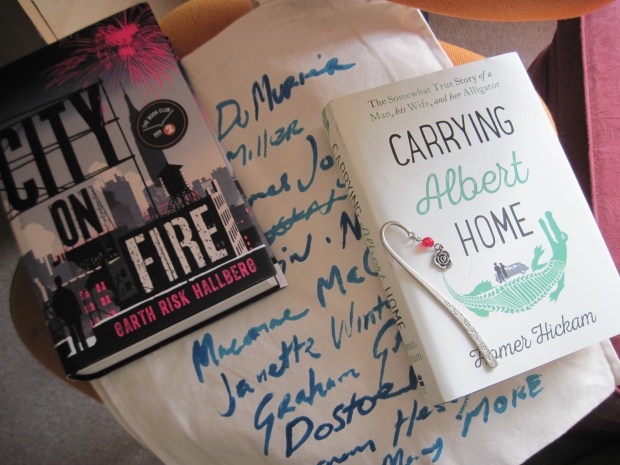
All in all, a fantastic and mostly bookish day out!
If you live in the UK and get the chance, don’t hesitate to go see The Bookshop Band play; they’re touring widely this year.
 Bookish Beck = Rebecca Foster. American transplant to England. Freelance proofreader and book reviewer.
 Bookish Beck