A Review for PKD Awareness Day: The Mourner’s Bestiary by Eiren Caffall
Today is PKD Awareness Day. Because the author and I both have polycystic kidney disease, I’m doing something I rarely do and reprinting an early review of mine that has already appeared on Shelf Awareness. I could hardly believe it when I was trawling through the list of review book offers and saw that Eiren Caffall also has PKD, then even more astonished to learn that it is a major theme in her memoir, which also weaves in marine biology and environmental concerns. An altogether intriguing book that, of course, held personal interest for me.
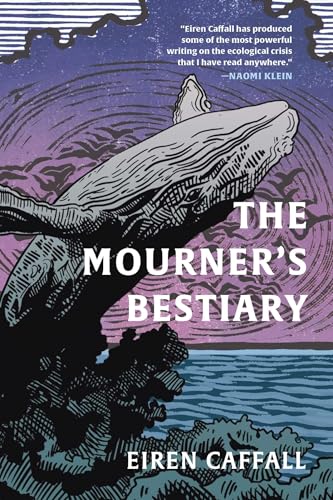
The Mourner’s Bestiary by Eiren Caffall
Eiren Caffall’s debut is an ardent elegy for her illness-haunted family and for the ailing marine environments that inspire her.
For centuries, the author’s family has been subject to “the Caffall Curse.” Polycystic kidney disease, a degenerative genetic condition, causes fluid-filled cysts to proliferate in a person’s enlarged kidneys. PKD can involve pain, fatigue, high blood pressure, kidney failure, and a heightened risk of brain aneurysm. Given Caffall’s paternal family history, she expected to die before age 50.
 Caffall’s melancholy memoir spotlights moments that opened her eyes to medical and environmental catastrophe. In 1980, when she was nine years old, she and her parents vacationed at a rental cottage on Long Island Sound. They nicknamed the pollution-ridden site “Dogshit Beach”—her mother spent idyllic summers there as a child, yet now “both the ecosystem and my father were slipping away.” For the first time, Caffall became aware of her father’s suffering and lack of energy. She realized that she, too, might have inherited PKD and could face similar struggles as an adult.
In 2014, Caffall, then a single mother, took her nine-year-old son, Dex, on vacation to the Gulf of Maine. During the trip, she had a fall that prompted a seizure, and she and Dex were evacuated from Monhegan Island by Coast Guard ship. Although no further seizures ensued and no clear cause emerged, the crisis served as a wake-up call, reminding her of how serious PKD is and that it might afflict her son as well.
The book draws fascinating connections between personal experiences and ecological threats. Caffall structures her story as a gallery of endangered marine animals such as the Longfin Inshore Squid and Humpback Whale, tracing their history and exposing the dangers they face in degraded environments. Red tides (massive algal blooms) and floods are apt metaphors for physical trials: “the Sound was dying, hypoxic … from an overwhelm of nutrients flooding an ecosystem—nitrogen, phosphorus, imbalanced saline—the same things that overwhelm a body when kidneys can no longer filter blood properly.”
Re-created scenes enliven accounts of family illness and therapeutic developments. The lyrical hybrid narrative, informed by scientific journals and government publications, is as impassioned about restoring the environment as it is about ensuring equality of access to health care. Personal and species extinction are just cause for “permanent mourning,” Caffall writes, but adapting to change keeps hope alive.
(Coming out in the USA from Row House Publishing on October 15th)
Posted with permission from Shelf Awareness.
[I couldn’t help but compare family members’ trajectories. Like her father, my mother was on dialysis for a time before getting a transplant, from her cousin. Like her aunt, my uncle died of a brain aneurysm, which is an associated risk. It sounds like Caffall has been much more severely affected than I have thus far. She is 53 and on Tolvaptan, a cutting-edge drug that slows the growth of cysts and thus the decline in kidney function. But even within families, the disease course is so varied. A cousin of mine was in her thirties when she had a transplant, whereas I am still very much in the early stages.]
A shout-out to the PKD Foundation in the States and the PKD Charity here in the UK.
A related post: In 2017 I reviewed four books for World Kidney Day.
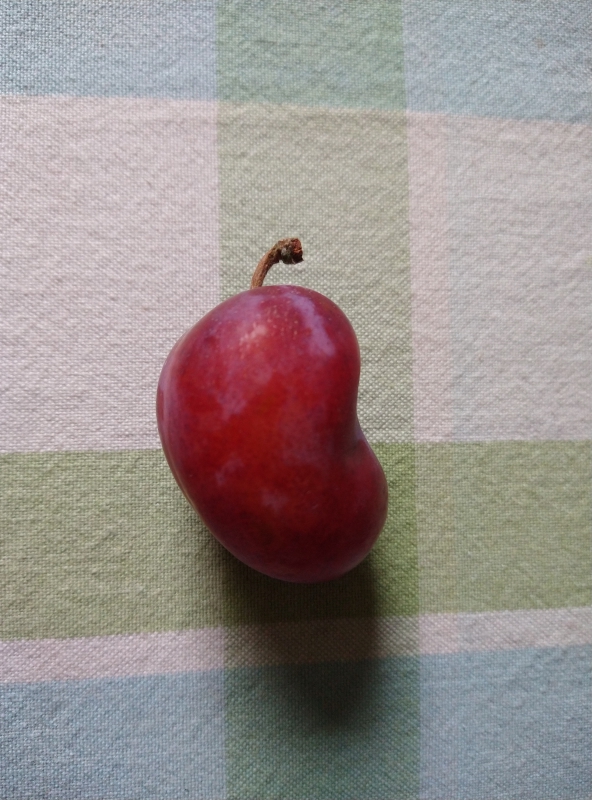
From the supermarket last week: a plum that wanted to be a kidney.
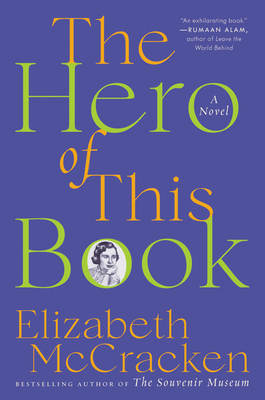
The Hero of This Book by Elizabeth McCracken (#NovNov22)
The hero of this book is Elizabeth McCracken’s mother, Natalie (1935–2018).
Is it autofiction or a bereavement memoir? Both and neither. It’s clear that the subject is her late mother, but less obvious that the first-person narrator must be McCracken or that the framework she has set up – an American writer wanders London, seeing the sights but mostly reminiscing about her mother – is other than fiction.
In August 2019, the writer rents a hotel room in Clerkenwell and plays the flaneuse around the city. Her tour takes in the London Eye, a ferry ride across the Thames from one Tate museum to another, a production of A Midsummer Night’s Dream, and so on. London had been a favourite destination for her and her mother, their final trip together falling just three years before. McCracken is so funny on the quirks of English terminology – and cuisine:
The least appetizing words in the world concern English food: salad cream, baps, butties, carvery, goujons.
Always, though, her thoughts return to her mother, whom she describes through bare facts and apt anecdotes. A twin born with cerebral palsy. A little disabled Jewish lady with unmanageable hair. An editor and writer based at Boston University. Opinionated, outspoken, optimistic; set in her ways. Delightful and maddening in equal measure – like all of us. (“All mothers are unknowable, being a subset of human beings.”)
The writer’s parents were opposites you never would have paired up. (Her father, too, is gone now, but his death is only an aside here.) Their declines were predictably hard to forecast. The New England family home has been emptied and is now on the market; an excruciating memory resurfaces from the auction of the contents.
As well as a tribute to a beloved mother and a matter-of-fact record of dealing with ageing parents and the aftermath of loss, this is a playful cross-examination of literary genres:
I hate novels with unnamed narrators. I didn’t mean to write one.
My mother was known to say with disgust, “Oh, those people who write memoirs about the worst thing that ever happened to them!” I said it, too. Some years later a terrible thing happened to me, and there was nothing to do but to write a memoir.
That was An Exact Replica of a Figment of My Imagination, about the stillbirth of her first child. As bereavement memoirs go, it’s one of the very best and still, 10 years after I read it, stands as one of my absolute favourite books, with some of the strongest last lines out there. McCracken has done it again, producing a book that, though very different in approach and style (this time reminding me most of Jenny Offill’s Weather), somehow achieves the same poignancy and earns a spot in my personal hall of fame, for the reasons you’ll see below…
The hero of this review is my mother, Carolyn (1947–2022).
I find it hard to believe that she’s been gone for three and a half weeks already. One week after her funeral, I was reading this book on my Kindle in London, waiting for a climate march to start. So many lines penetrated my numbness; all could pertain to my own mother:
[Of a bad time when her mother was in hospital with an infection] Those days were a dress rehearsal for my mother’s easy actual death seven years later.
My mother was a great appreciator. It was a pleasure to take her places, because she enjoyed herself so much and so audibly. That was her form of gratitude.
My mother all by herself was a holiday, very good at buying presents and exceptional at receiving them.
Quirky, somebody once called my mother. What a colossally condescending word: I hate it. It means you’ve decided that you don’t have to take that person seriously.
My mother’s last illness was a brain aneurysm.
The dead have no privacy left, is what I’ve decided.
The adrenaline of a busy week back in the States – meeting up with family members, writing and delivering a eulogy, packing up most of her belongings, writing thank-you notes, starting on paperwork (“sadmin”) – has long worn off and I’m back into my routines of work and volunteering and trying to make our house habitable as winter sets in. It would be easy to feel as if that middle-of-the-night phone call in late October, and everything that followed, was merely a vivid, horribly extended dream and that tomorrow she’ll pop back up in my inbox with some everyday gossip.
Reminders of her are everywhere if I look. Clothes she gave me, or I inherited from her, or she sent me the money to buy; a box of extra-strong Earl Grey teabags, left over from what we handed out along with memorial cards at the visitation; her well-worn Bible and delicate gold watch; the five boxes of journals in my sister’s basement – 150 volumes each carefully labelled with a number and date range. I have the first few and the last, incomplete one here with me now. What a trove of family stories, precious or painful, await me when I’m strong enough to read them.
With Thanksgiving coming up tomorrow – a whole holiday devoted to gratitude! nothing could more perfectly suit my mother – I’m grateful for all of those mementoes, and for the books that are getting me through. Starting with this one. [192 pages] (Read via Edelweiss) 

Books in Brief: Five I Enjoyed Recently
Despite my largely successful resolution to focus on my own books for the summer, I’ve also gotten through plenty of e-books from NetGalley and Edelweiss, too. I just find it easier to fit time with the Kindle into my day, whether it’s 20 minutes over lunch (food-themed nonfiction works particularly well for such situations) or 30 minutes on the cross trainer. Here’s a sample of the e-books I’ve enjoyed this summer: four nonfiction and one fiction.
Pancakes in Paris: Living the American Dream in France
By Craig Carlson
 A good-natured memoir about the travails of opening the first American-style diner in Paris. Carlson charts his somewhat chaotic growing-up years in Connecticut, the college study abroad experience that kindled his love for France, his years trying to make it as a screenwriter and director in Hollywood, his long-held dream of opening Breakfast in America, and finding a French sweetheart of his own. Much of the book is devoted to a blow-by-blow of the bureaucratic nightmare of opening a restaurant, starting with getting investors on board and continuing through France’s ridiculously restrictive labor laws. (The impression I came away with was: France – great place to be an employee or rent property; terrible place to start a business.) Next time I’m in Paris, I will be looking to get myself a stack of his signature blueberry and white chocolate chip pancakes. Releases September 6th.
When in French: Love in a Second Language
By Lauren Collins
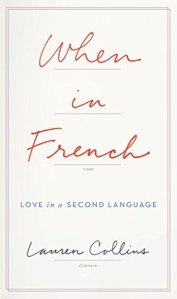 Collins, a journalist from North Carolina, married a Frenchman named Olivier she met while working in London. They then moved to Geneva, a mutually unfamiliar place but one where French reigned. For the first time, she was forced to learn a new language to survive. I love how she blends her own story with the philosophy, history and science behind language use. As she learned how to do things she never expected to have to in French – deal with her in-laws and give birth, for instance – she developed a new appreciation for the marvel that is bilingualism and pondered whether she was the same person in a different language. My favorite section recounts a holiday to Corsica that brought her family and Olivier’s into close quarters and cast her in the unforeseen role of translator. There’s a surprising amount of linguistic detail here, but Collins incorporates it well. Releases September 13th.
A Body, Undone: Living On After Great Pain
By Christina Crosby
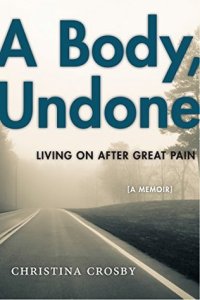 Crosby teaches English and gender studies at Wesleyan University. Her inclusion in this “Sexual Cultures” series has to do with her lesbian feminist ideology but also the new understanding of her body an accident forced upon her at age 50. While she was cycling, a stick stuck in her spokes and she fell over onto concrete, breaking vertebrae in her neck that damaged her spinal cord. In the midst of a full and physical life, she became a quadriplegic. The great irony was that in this she joined her brother Jeff, whose MS had long since reduced him to a wheelchair. Here, in a memoir written 11 years after the accident, she reflects on chronic pain and new limitations – even including bowel habits – with blunt honesty as well as literary allusions. Along the way she remembers physical pleasures now denied to her. Nonetheless, she never comes across as sorry for herself. I found this to be highly absorbing.
The Reader on the 6.27
By Jean-Paul Didierlaurent
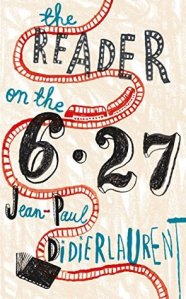 Guylain Vignolles works in a paper pulping plant. Rather than an enemy of books, however, he’s really a champion of the written word and its power to improve people’s lives. Every day when he descends into the belly of “The Thing” to clean it, he rescues the stray pages that escaped destruction and reads them aloud the following morning on his twenty-minute train commute, or to the residents of an old-folks home, no matter what their subject. He also helps his disabled former colleague Giuseppe stockpile all the books made from the recycled paper created on the fateful day the machine shredded his legs. There’s a charming Amélie vibe to this short novel, especially in the later chapters when Guylain sets off on a romantic quest to find the lavatory attendant whose wry diary he finds on a memory stick on the train. Most of the subplots could do with some expanding, but it’s a pleasant and super-quick read.
Stir: My Broken Brain and the Meals that Brought Me Home
By Jessica Fechtor
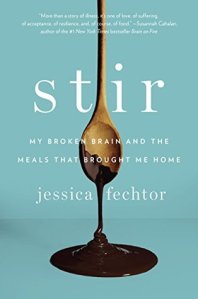 For me this is right up there with Molly Wizenberg and Ruth Reichl in how the author merges food writing with a frank recounting of personal experiences with crisis and heartache. At age 28 Fechtor, then a graduate student in history and Yiddish, collapsed on a treadmill with a brain bleed. Surgery to clip the aneurysm left her blind in one eye. During her long recovery process she started a food blog. At the end of each chapter she shares recipes that alternate between simple, favorite dishes and more involved ones. It’s that unpretentiousness that really endears her to me. She doesn’t think she was particularly brave in getting through an unwanted illness; nor does she think the perfect almond macaroon or cherry clafoutis is beyond anyone’s capability. Instead, she gives a glimpse into an ordinary life turned upside down and the foods that helped her regain a zest for life.
 Bookish Beck = Rebecca Foster. American transplant to England. Freelance proofreader and book reviewer.
 Bookish Beck