Six Degrees of Separation: From Born to Run to Scary Monsters
I take part in this meme every few months. This time we begin with Born to Run, Bruce Springsteen’s memoir. (See Kate’s opening post.)
 #1 Springsteen is one of my musical blind spots – I maybe know two songs by him? – but my husband has been working up a cover of his “Streets of Philadelphia” to perform at the next open mic night at our local arts venue. A great Philadelphia-set novel I’ve read twice is The Sixteenth of June by Maya Lang.
 #2 The 16th of June is, as James Joyce fans out there will know, “Bloomsday,” so I’ll move on to the only novel I’ve read so far by Amy Bloom (and one I felt ambivalent about, though I love her short stories and memoir), White Houses.
 #3 A recent and much-missed occupant of the White House: Barack Obama, whose Dreams from My Father didn’t quite stand up to a reread but is still a strong family memoir when it doesn’t go too deep into community organizing.
 #4 Similar to the Oprah effect, Obama publicly mentioning that he’s read and enjoyed a book is enough to make it a bestseller. On his list of favourite books of 2022 was The Furrows by Namwali Serpell, which I currently have on the go as a buddy read with Laura T.
 #5 The Furrows is longlisted for the inaugural Carol Shields Prize for Fiction. In 2020 I did buddy reads of six Carol Shields novels with Marcie of Buried in Print. One of those was Happenstance, the story of a marriage told from two perspectives, the husband’s and the wife’s.
 #6 My Happenstance volume gives the wife’s story first and then once you’ve read to halfway you flip it over to read the husband’s story. The only other novel I know of that does that (How to Be Both does have two different versions, each of which starts with a different story line, but you don’t physically turn the book over) is Scary Monsters by Michelle de Kretser, which recently won the Rathbones Folio Prize in the fiction category. Perhaps it’s no coincidence that Ali Smith was a judge! (How astonished am I that I predicted all three category winners and the overall winner in this post from three days before the announcement?!) I know nothing else about the novel, but I have a copy out from the library and plan to read it soon.
Where will your chain take you? Join us for #6Degrees of Separation! (Hosted on the first Saturday of each month by Kate W. of Books Are My Favourite and Best.) Next month’s starting book is Hydra by Adriane Howell, from the Stella Prize 2023 shortlist.
Have you read any of my selections? Tempted by any you didn’t know before?
Three on a Theme: “Birds” Short Story Collections
I read these three collections one at a time over three and a half months of last year, initially intending to write them up as part of my short story focus in September but ultimately deciding to spend more time with the latter two (and then falling ill with Covid before I could write them all up in 2022). They topped my Best Backlist Reads.
The word from the title is incidental, really; the books do have a lot in common in terms of theme and tone, though. The environment, fidelity and motherhood are recurring elements. The warmth and psychological depth are palpable. Each story feels fleshed out enough that I could happily read an entire novel set in its realm, but also complete unto itself.
Birds of a Lesser Paradise by Megan Mayhew Bergman (2012)
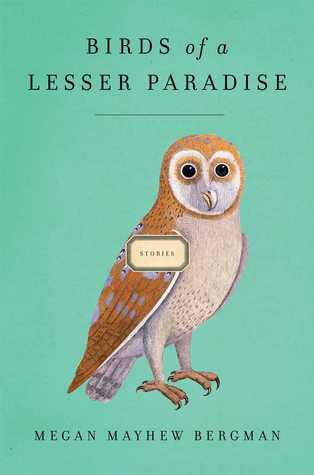 I knew Bergman from her second of three collections, Almost Famous Women; this was her debut. As is common for a first book, it incorporates autobiographical characteristics: North Carolina settings, a preponderance of animals (her husband is a vet), and pregnancy and early motherhood. Eleven of the 12 stories are in the first person, there are no speech marks, and the protagonists are generally women in their twenties or thirties coping with young children, crumbling households, ageing parents, and ethical dilemmas at work.
Creatures are companions or catalysts here. In “Housewifely Arts,” a single mother and her son embark on a road trip to rescue her late mother’s African gray parrot. In the title story, Mae accompanies her father and her new beau on a search for the ivory-billed woodpecker. Fear grapples with openness to change for many of these characters, as expressed in the final lines: “I wished for things to stay the same. I wished for stillness everywhere, but I opened up the rest of the bedroom windows and let the world in.”
Environmental threat blares in the background, but usually fades in comparison to everyday concerns; the 2050-set “The Artificial Heart” is more alarmed about her aged father’s bionic existence than about a dying planet. In “Yesterday’s Whales,” the overall standout for me, ambivalence about motherhood meets climate catastrophism. The narrator’s boyfriend, Malachi, founded a nonprofit called Enough with Us, which asks members to vow not to reproduce so the human race can die out and nature can take over. Embarrassing, then, that she finds herself pregnant and unwilling to tread the hard line he’s drawn. This one is funny and poignant, capturing so many of my own feelings, and seems 10 years ahead of its time.
When someone’s ideal is the absence of all human life, romance is kind of a joke.
I wanted, then, to become what I most admired, what now seemed most real to me. I wanted to be that exalted, complicated presence in someone’s life, the familiar body, the source of another’s existence. But I knew what I wanted was not always what I needed.
I envied my mother’s childhood, the awe with which she’d turned to her country and the world, the confidence she’d had in her right to exist and bear children. The world and mothers alike, I knew, had lost a little freshness.
(Secondhand, a gift from my wish list a couple of years ago)
Delicate Edible Birds by Lauren Groff (2009)
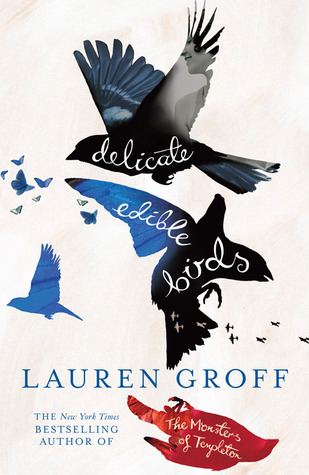 What a clever decision to open with “Lucky Chow Fun,” a story set in Templeton, the location of Groff’s debut novel – it forms a thread of continuity between her first book and her second. Elizabeth, the only girl on the varsity swim team, comes to a number of realizations about her family and her community, including that the title Chinese restaurant is a front for a brothel that exploits trafficked women. The story becomes a wider parable about appearances and suspicion. “In these dark days, there is so much distrust in this town. … You never know quite what to think about people”. And what a brilliant last line: “I like to think it’s a happy ending, though it is the middle that haunts me.”
“L. DeBard and Aliette” recasts in the notorious Héloïse and Abelard romance an Olympic swimmer and a schoolgirl in Spanish flu-plagued New York City. The other seven stories alternate between historical fiction and contemporary, the USA and abroad, first person and third person, speech marks or none. Desire and boundaries, accomplishment and escape, fear and risk are contradictory pulls. While the details have faded for me, I remember that, while I was reading them, each of these stories enveloped me in a particular world – 30 pages seems like the ideal length here to fully explore a set of characters and a situation. If I had to choose a favourite, it would be “Blythe,” about a woman who feels responsible for her alcoholic best friend. (From my birthday book haul last year)
Birds of America by Lorrie Moore (1998)
Life: what an absurd little story it always made.
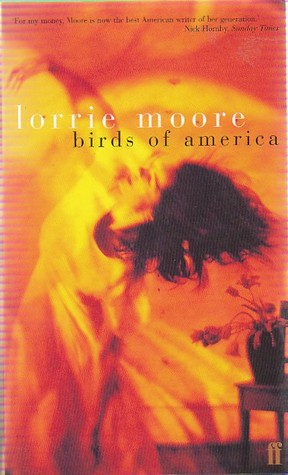 I’d read a few of Moore’s works before (A Gate at the Stairs, Bark, Who Will Run the Frog Hospital?) and not grasped what the fuss is about; turns out I’d just chosen the wrong ones to read. This collection is every bit as good as everyone has been saying for the last 25 years. Amy Bloom, Carol Shields and Helen Simpson are a few other authors who struck me as having a similar tone and themes. Rich with psychological understanding of her characters – many of them women passing from youth to midlife, contemplating or being affected by adultery – and their relationships, the stories are sometimes wry and sometimes wrenching (that setup to “Terrific Mother”!). There were even two dysfunctional-family-at-the-holidays ones (“Charades” and “Four Calling Birds, Three French Hens”) for me to read in December.
I’ll single out four of the 12 as favourites, though, really, any or all would be worthy of anthologizing in a volume epitomizing the art of the short story. “Which Is More than I Can Say about Some People” has a mother and daughter learning new things about each other on a vacation to Ireland. “What You Want to Do Fine,” another road trip narrative, stars an unlikely gay couple, one half of which is the flamboyant (and blind) Quilty. “People Like That Are the Only People Here” is so vivid on the plight of parents with a child in the paediatric oncology ward that I feel I should check whether Moore lived through that too. And the best of the best: “Real Estate” (not least because she dared to print two full pages of laughter: “Ha!”), which turns gently surreal as Ruth and her philandering husband move into a house that turns out to be a wreck, infested by both animal and human pests.
Moore is as great at the sentence level as she is at overarching plots. Here are a few out-of-context lines I saved to go back to:
She was starting to have two speeds: Coma and Hysteria.
In general, people were not road maps. People were not hieroglyphs or books. They were not stories. A person was a collection of accidents. A person was an infinite pile of rocks with things growing underneath.
Never a temple, her body had gone from being a home, to being a house, to being a phone booth, to being a kite. Nothing about it gave her proper shelter.
(From Oxfam Books, Hexham – a stop on our Northumberland trip last year)
Two of these writers are best known for their short stories; the third (Groff), to my mind, should be. Unusual for me to fall so wholeheartedly for short stories – these all earned my rarest rating: 
Women’s Prize Shadowing & Men Reading Books by Women
Back in April I announced that my book club was one of six selected to shadow this year’s Women’s Prize shortlist by reading and discussing one of the finalists. Our assigned title was one I’d already read, but I skimmed back through it before our meet-up and enjoyed getting reacquainted with Martha Friel. Here’s our group’s review:

Sorrow and Bliss by Meg Mason
Readability: 5/5
Characters: 5/5
Storyline: 4/5
Can’t Put It Down: 4.5/5
Total = 18.5/20
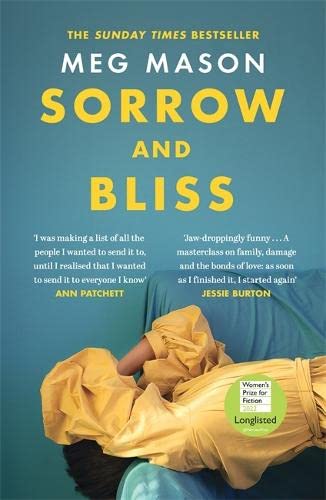 Our joint highest rating, and one of our best discussions – taking in mental illness and its diagnosis and treatment, marriage, childlessness, alcoholism, sisterhood, creativity, neglect, unreliable narrators and loneliness. For several of us, these issues hit close to home due to personal or family experience. We particularly noted the way that Mason sets up parallels between pairs of characters, accurately reflecting how family dynamics can be replicated in later generations.
Even the minor characters are fully rounded, and although Martha is not always pleasant to spend time with, her voice is impressively rendered. The picture of mental illness from the inside feels authentic, including the fact that Martha uses it as an excuse for her bad behaviour, becoming self-absorbed and not seeing how she is affecting others around her. Our main point of disagreement was about Mason’s decision not to name the mental illness Martha is suffering from. It seemed clear to several of us that it was meant to be bipolar disorder, so we wondered if it was a copout not to identify it as such.
We also thought about the meaning of the term “literary fiction”, and whether this has the qualities of a prize winner and will stand the test of time.
We had to fill out a feedback questionnaire about our experience of shadowing, and most of us sent in individual blurbs in response to the book. Some ended up in the final Reading Agency article. Here was mine:
“This deceptively light novel was a perfect book club selection, eliciting deep discussion about mental illness, family relationships and parenthood. Martha’s (unreliable) narration is a delight, wry and deadpan but also with moments of wrenching emotion. Mason masterfully controls the tone to create something that is witty and poignant all at once.”
Probably the main reason we were chosen for this opportunity is that we have a man – my husband, that is! – who attends regularly. This year the prize has been particularly keen to get more men reading books by women (see more below). So, he was responsible for giving The Male Response to the novel. No pressure, right? Luckily, he enjoyed it just as much as the rest of us. From the cover and blurb, it didn’t necessarily seem like the sort of book that he would pick up to read for himself, but he was fully engaged with the themes of mental illness, family relationships, and the question of whether or not to have children, and was so compelled that he read over half of it in a day.
I’m not sure who I expect to be awarded the Women’s Prize tomorrow. We of West Fields Readers would be delighted if it went to Meg Mason for Sorrow and Bliss, but I’d also be happy with a win for Louise Erdrich or Ruth Ozeki – though I wasn’t taken with their latest works compared with earlier ones I’ve read, they are excellent authors who deserve recognition. I don’t think The Bread the Devil Knead has a chance; I’d be disappointed in a win by Elif Shafak in that I would feel obligated to try her novel – the kind that gives magic realism a bad name – again; and, while I’m a Maggie Shipstead fan in general and admire the ambition of Great Circle, it would be galling for a book I DNFed twice to take the title!
Who are you rooting for/predicting?
I’d like to mock you with that thought,
jeer at the man
who won’t read novels
written by women –
at least not if they’re still alive
~from The Poet by Louisa Reid
Maybe you’ve seen on social media that the Women’s Prize has been canvassing opinion on the books by women that all men should read. This was prompted by some shocking statistics suggesting that even bestselling female authors can only attract a 20% male readership, whereas the best-known male authors are almost equally popular with men and women. They solicited 60 nominations from big names and ran a public poll. I voted for these 10:
Half of a Yellow Sun (Chimamanda Ngozi Adichie)
Possession (A.S. Byatt)
Homegoing (Yaa Gyasi)
The Poisonwood Bible (Barbara Kingsolver)
The Sea, The Sea (Iris Murdoch)
The Stone Diaries (Carol Shields)
We Need to Talk about Kevin (Lionel Shriver)
Olive Kitteridge (Elizabeth Strout)
The Goldfinch (Donna Tartt)
Orlando (Virginia Woolf)
*If I could have added to that list, though, my top recommendations for all men to read would be Station Eleven by Emily St. John Mandel and Bring Up the Bodies by Hilary Mantel (and probably a different Octavia E. Butler novel from the one nominated).


Three of my selections were among the 10 essential reads announced on the WP website. Their list was headed by Margaret Atwood’s The Handmaid’s Tale, though of her works I’d be more likely to direct men to Oryx and Crake.
I’ve seen discussions on Twitter about why men don’t read novels (at all, prioritizing nonfiction), or specifically not ones by women. Do you have any theories?
What one book by a woman do you think all men should read?
The Amateur Marriage by Anne Tyler (2004)
 This year I’ve been joining in Liz’s Anne Tyler readalong for most of the novels I own and hadn’t read yet. Just this summer, I’ve discovered two new favourites: Saint Maybe and now The Amateur Marriage – which surprised me because it was her sixteenth novel and not part of what I consider to be her golden mid-period of the 1980s-90s. Both Saint Maybe and The Amateur Marriage are, like Dinner at the Homesick Restaurant (my absolute favourite and, I was gratified to discover, Tyler’s favourite, too), effectively linked short story collections in which the chapters are self-contained narratives set at a particular point in a dysfunctional family’s life, with each one often focusing on a different character.
The Amateur Marriage feels unique in Tyler’s oeuvre for how it bridges historical fiction and her more typical contemporary commentary. Spanning 60 years precisely, it opens with the Pearl Harbor attack in 1941. In this Baltimore neighbourhood full of Polish immigrants, a spontaneous patriotic parade breaks out. In the excitement, Pauline jumps off a tram and hits her head on a lamppost. Her friends rush her to the Antons’ general store for a bandage and when Michael Anton meets her their fate is sealed. Pauline assumes Michael is bound for war and, so as not to disappoint her, he signs up. After his discharge, they marry – though Pauline had a near change of heart because they have so little in common and do nothing but fight.
{SPOILERS FOLLOW}
“Not quite forever”
The Antons’ marriage continues in the same volatile vein – until it doesn’t. I was taken aback that a story about marriage kept going even when Michael + Pauline ended, and even after one of them was no more. About two-thirds of the way through the book, on their 30th wedding anniversary, they find that their reminiscences are mostly of bitter arguments. Pauline wryly shakes her head over their antics, but Michael says to Pauline, “It has not been fun. It’s been hell.” She goads him into leaving, and he does.
I’ve jokingly heard women saying of their husbands, “I’m training him for his second wife,” and that seems to me to be the spirit of the title. These two characters had no idea that ‘opposites attract’ but don’t make for a stable marriage, and have muddled their way through for decades without figuring out how to change anything for the better. I sensed Tyler’s deep compassion for their foibles and how they affect the next generation.
A major thread of the novel is their eldest daughter Lindy’s teenage rebellion and eventual disappearance, reminding me a lot of Mary Lawson’s A Town Called Solace. Michael and Pauline retrieve her young son, Pagan, from San Francisco and raise him themselves, partly via shared custody. This theme of unexpected grandparent responsibility is a link to Saint Maybe and especially (along with the West as a setting) Clock Dance. There is no rapturous reunion to come, but the remnant of the family does eventually get back together.
Michael and Pauline are quintessential Tyler characters: the one easygoing if slightly useless (“He wished he had inhabited more of his life, used it better, filled it fuller”); the other highly strung and contrary, yet strong and efficient – “the ones who kept the planet spinning.” Michael never ceases to admire Pauline, even when he stops being married to her. In the penultimate chapter, the family swaps “Pauline stories” that exemplify how maddening but lovable she could be. You have someone in your family who’s just like that, right?
{END OF SPOILERS}
My U.S. paperback appends an interview with Tyler that I found illuminating. She knows that she doesn’t tend to break new ground with her fiction: “face it, I always write more or less the same sort of story,” she admits. During this reading project I’ve been debating whether this is a bad thing. Does it make her later work redundant? Does it mean she only had a limited store of good ideas? Are her characters types rather than three-dimensional creations? Marcie at Buried in Print loves the connections between the novels. I’m sure Liz does, too, but she’s also acknowledged that she finds individual plots strangely unmemorable.
I haven’t fully answered the above questions for myself. There are certainly Tyler books that I like more than others, but they have all been comforting and (mostly) compulsive reading. Her characters and situations feel so true to life that we don’t observe from the outside, but journey alongside and within them. (Secondhand purchase from 2nd & Charles, Hagerstown, MD, USA) See also Liz’s review.
Favourite lines:
“Was it possible to dislike your own wife? Well, no, of course not. This was just one of those ups-and-downs that every couple experienced.”
“so much about their parents had been embarrassing. Or did all children feel that way? But it seemed to George that the Antons’ lives were more extreme than other people’s. … People didn’t stay on an even keel in the Anton family. They did exaggerated things like throwing out their clothes or running away from home”
Another readalike: Larry’s Party by Carol Shields
My rating: 
The 15 Tyler novels I’ve read, in order of preference (greatest to least), are:
Dinner at the Homesick Restaurant
Saint Maybe
The Amateur Marriage
Ladder of Years
The Accidental Tourist
Earthly Possessions
Breathing Lessons
Digging to America
Vinegar Girl
Back When We Were Grown-ups
Clock Dance
A Blue Spool of Thread
The Beginner’s Goodbye
Redhead by the Side of the Road
The Clock Winder
Next up for me will be Noah’s Compass later in September.
USA Trip and Book Acquisitions
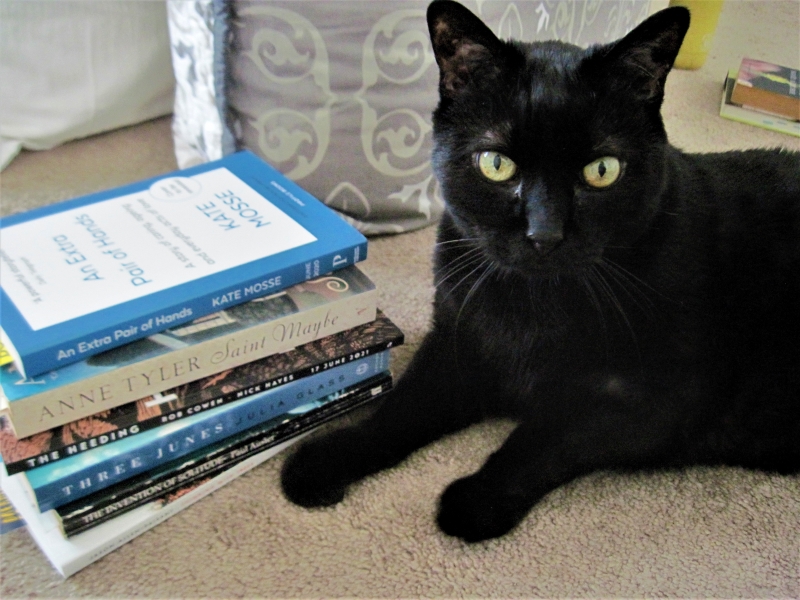
On Wednesday I got back from my first trip to the USA in two years. It was for the special occasion of my mother getting remarried, so was well worth the extra complications of pandemic travelling. While quarantining at my sister’s house for a week, I observed the chaos of a household with FIVE members in virtual schooling. When it all got too noisy for me, I’d retreat upstairs to read with Pierre the cat.
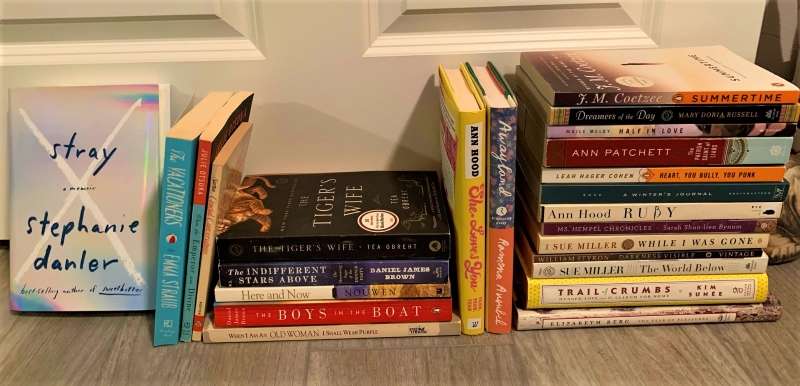
I also spent some time, as always, going through my boxes of mementoes and books in her basement. I later sold back several boxes’ worth of books that I’d weeded out, but of course I acquired more as well. Below are a super-belated Christmas 2019 gift, my Wonder Book haul, hand-me-downs from my stepfather, two Dollar Tree purchases, and my 2nd & Charles haul (mostly from the clearance shelves). Subtracting buyback credit, my total spend was $3.76!
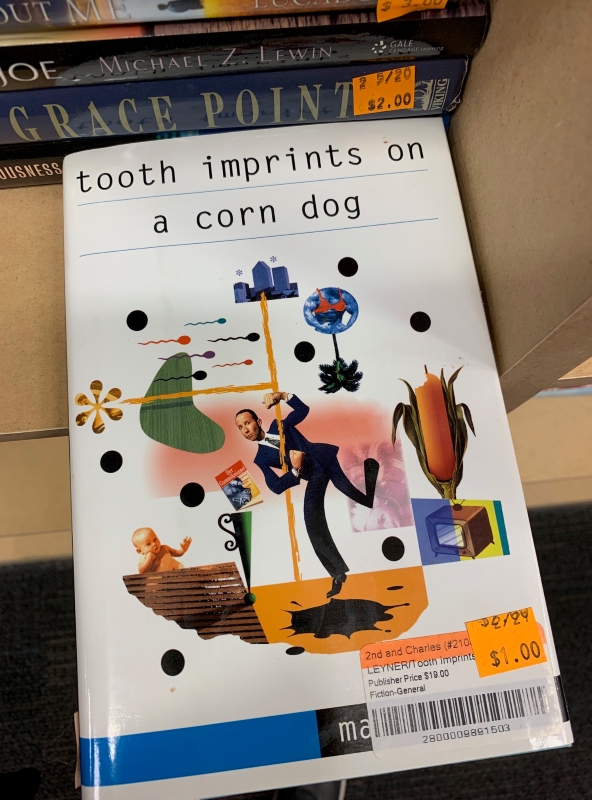
Almost purchased, just for the title.
The wedding itself (and meeting my new stepfather and his daughters) went beautifully. We had hot but not unbearable weather, and bright sun for picture-taking. The below passage from Carol Shields’s The Box Garden, which I’d noted last year while buddy reading it with Buried in Print, felt particularly apt for the occasion.


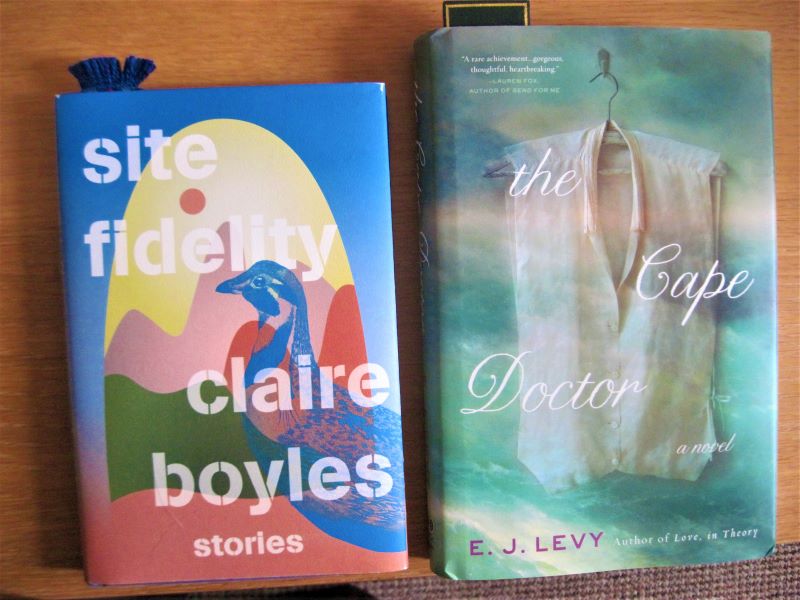
I also acquired two new U.S. releases to review for BookBrowse.
I squeezed most of the new acquisitions, plus another 37 books from storage, into my suitcases. I focused on bringing back books I’m eyeing up for certain challenges, appealing memoirs, and books I want to reread (the far left stack below).


As for those mementoes, I made some amusing finds, including my childhood blankie; the “medical kit” I made at about age nine, inspired by a visit to the National Museum of Health and Medicine and my love for the television show Dr. Quinn, Medicine Woman; and a few early writing attempts. “A Day in the Life of a Gangster” is a story I wrote at probably age seven. I love the old typewriter font, but my “About the Author” note was the funniest bit – I am so not a mystery reader anymore, and I doubt I’d been on a single proper hike at that point in my life. Newsboys: Take Me to Your Concert was my co-written entry for the Write-a-Book Contest in eighth grade, and What Is a Llama? I wrote and illustrated with my own photographs at age 14 as a county 4H project. I even won a ribbon and a cash prize in the random amount of $4.34.


Back in self-isolation here in the UK, I had seven review copies waiting for me, and another five have arrived in the last couple of days, so the cycle never ends: acquire books, read books, write about books, part with or figure out how to store and/or display books…

On with the summer reading!
Adventures in Rereading: Madeleine L’Engle and Posy Simmonds
I’m not doing as well with my rereading goal this year as I did in 2020. So far I’ve gotten to The Republic of Love by Carol Shields and the two below (with another DNF). Considering that I completed 16 rereads last year, I’m looking seriously behind. I still have a bulging shelf of books I’d like to reread, but they never seem to make it onto my current reading stack…
A Wrinkle in Time by Madeleine L’Engle (1962)
 I probably picked this up at age seven or so as a natural follow-on from the Chronicles of Narnia – both are well-regarded children’s sci fi/fantasy from an author with a Christian worldview. In my memory I didn’t connect with L’Engle’s work particularly well, finding it vague and cerebral, if creative, compared to Lewis’s. I don’t think I ever went on to the multiple sequels. As an adult I’ve enjoyed L’Engle’s autobiographical and spiritual writing, especially the Crosswicks Journals, so I thought I’d give her best-known book another try.
On a proverbially dark and stormy night, Meg Murry and her precocious little brother Charles Wallace come down to the kitchen to join their mother for a snack. In blows Mrs. Whatsit with the promise of a way of rescuing their missing scientist father through a “tesseract,” or wrinkle in time. Mrs. Who and Mrs. Which, rounding out a trio of Macbeth-like witches, accompany the children and their friend Calvin on a perilous journey to face up to cosmic darkness in the form of a disembodied brain called IT that keeps their father hostage and tries to entrance Charles Wallace as well.
Interplanetary stories have never held a lot of interest for me. (As a child, I was always more drawn to talking-animal stuff.) Again I found the travels and settings hazy. It’s admirable of L’Engle to introduce kids to basic quantum physics, and famous quotations via Mrs. Who, but this all comes across as consciously intellectual rather than organic and compelling. Even the home and school talk feels dated. I most appreciated the thought of a normal – or even not very bright – child like Meg saving the day through bravery and love. This wasn’t for me, but I hope that for some kids, still, it will be pure magic.
Favorite lines:
“The only way to cope with something deadly serious is to try to treat it a little lightly.”
“we can’t take any credit for our talents. It’s how we use them that counts.”
Original rating (as remembered from childhood): 
My rating now: 
Tamara Drewe by Posy Simmonds (2007)
This must be one of the first graphic novels I ever read. Hearing that it was an adaptation of Thomas Hardy’s Far from the Madding Crowd, one of my favorite novels, was enough to attract me. During the years that I worked at King’s College London, I took full advantage of Lambeth Library’s extensive graphic novel collection and would pick up big piles of all sorts of books on my lunch breaks – I got a gentle ribbing from library staff nearly every time I showed up. Anyway, this is all backstory to me finding a severely underpriced secondhand copy (99p! the dear old ladies pricing things couldn’t have known what they had) in the Hay-on-Wye Oxfam shop in April 2017. It took me until earlier this year to reread it, though.
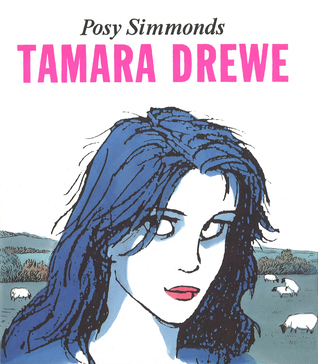 Simmonds recreates the central situation of FFTMC – an alluring young woman returns to her ancestral village and enraptures three very different men – but doesn’t stick slavishly to its plot. Her greatest innovation is in the narration. Set in and around a writers’ retreat, the novel is told in turns by Dr. Glen Larson, a (chubby, Bryson-esque) visiting American academic trying to get to grips with his novel; Beth Hardiman, who runs the retreat center and does all the admin for her philandering crime writer husband, Nicholas; and Casey Shaw, a lower-class teenager who, with her bold pal Jody, observes all the goings-on among the posh folk from the local bus shelter and later gets unexpectedly drawn in to their lives.
Tamara is a hotshot London journalist and, after a nose job, is irresistible to men. Andy Cobb, the Hardimans’ groundsman, runs a small organic food business and is a clear stand-in for Hardy’s Farmer Oak. He’s known Tamara nearly all their lives, and isn’t fussed about her new appearance and glitzy reputation. But she certainly turns Nicholas’s head, and also draws the attention of Ben, former drummer for a washed-up band. Tamara and Ben are a power couple in this sleepy village, and stir up jealousy. Ben is closest to Sergeant Troy, but he and Nicholas (who’s most like Boldwood) aren’t one-to-one equivalents. Casey and Jody fill the role of the servants and rustics, with chavs serving as the early 21st-century peasantry.
So Simmonds takes what she wants from Hardy, but adapts it as it suits her. There are a lot of words on the page compared to some graphic novels, so this would be a good halfway house for someone who’s new to comics for adults and still wants a good story to get the teeth into. At nearly 150 pages, there’s plenty of time for Simmonds to spin an involved, dramatic tale and give insight into her characters and their interactions. One ends up feeling, perhaps inevitably, more sympathy for the narrators than for the other characters, but all are well drawn. There’s a surprise ending, too. Back in 2010 I was probably more interested in getting a straight Hardy remake, so might have been disappointed when Simmonds strayed from the source material, but now I thoroughly enjoyed this for its own sake.
Original rating (2010?):
My rating now: 
And a DNF:
 I’ve long considered A.S. Byatt a favorite author, and early last year my reread of one of her story collections was successful. But trying again with The Biographer’s Tale (2000) – which I remember reading in an airport as I traveled to or from Leeds, where I was doing a Master’s degree, to see my family for Christmas in 2005/6 – was a lost cause. I remembered an intricate, clever, witty take on the biographer’s art, but couldn’t have recited any details for you. I managed about the first 100 pages this time. Phineas G. sets out to write a biography of famous biographer Scholes Destry-Scholes, whose subjects included Francis Galton, Henrik Ibsen, and Carl Linnaeus. The novel quotes extensively from Destry-Scholes’s writing on these three, and his general notes on writing biography. I got lost somewhere in the documents. I think in my early twenties I was more impressed by virtuoso faux-scholarly writing like you often get in Byatt or Julian Barnes. Alas, it engages me less now.
Done any rereading lately?
Book Serendipity, Mid-March to Early May 2021
In early April, the publisher Canongate ran a newsletter competition for one reader to win a stack of their recent releases. All you had to do was reply with your favourite word. On Twitter they gave a rundown of the most popular responses. Turning up several times each were petrichor, mellifluous, and oleaginous. Most frequent of all was serendipity: I was one of 15 to submit it! And one of those entries, but not mine, won. Anyway, fun little story there.
I call it Book Serendipity when two or more books that I read at the same time or in quick succession have something pretty bizarre in common. Because I have so many books on the go at once (usually 20‒30), I suppose I’m more prone to such incidents. I’ve realized that, of course, synchronicity is really the more apt word, but this branding has stuck.
The following are in roughly chronological order.
- A white peacock is mentioned in Indelicacy by Amina Cain and The Mermaid of Black Conch by Monique Roffey, both of which were on the 2021 Rathbones Folio Prize shortlist.

- Speaking of that Rathbones Folio Prize shortlist, four of the eight were paperbacks with French flaps.
- The main character takes ballet lessons in Indelicacy by Amina Cain and A Feather on the Breath of God by Sigrid Nunez.
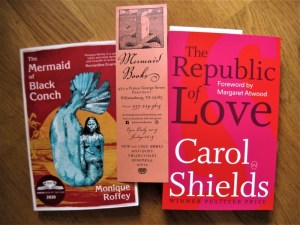
- Mermaids! A big theme in The Mermaid of Black Conch by Monique Roffey (of course) and The Republic of Love by Carol Shields, but they’re also mentioned in the opening story of The Office of Historical Corrections by Danielle Evans and are main characters in “The Pangs of Love” by Jane Gardam in the anthology Close Company.
- The Brothers Grimm story about brothers who have been transformed into swans and their sister who sews shirts out of nettles to turn them back is reworked in The Charmed Wife by Olga Grushin and used as a metaphor in Dusk, Night, Dawn by Anne Lamott.
- An electric carving knife is mentioned as a means of suicide (yipes!) in The Inevitable by Katie Engelhart and Woman on the Edge of Time by Marge Piercy.
- A discussion of the distinction between the fear of dying and the fear of being dead in This Party’s Dead by Erica Buist and The Inevitable by Katie Engelhart.
- Two novels in a row in which an older man is appalled by the squalor of his young girlfriend’s apartment, and she calls him “daddy” during sex (double yipes!), made the Dylan Thomas Prize shortlist: Luster by Raven Leilani and My Dark Vanessa by Kate Elizabeth Russell.


- Architect husbands in The Push by Ashley Audrain and The Art of Falling by Danielle McLaughlin (and, last year, in A Celibate Season by Blanche Howard and Carol Shields), as well as a female architect as a main character in The Living Sea of Waking Dreams by Richard Flanagan earlier this year.
- The next-to-last essay in the Trauma anthology quotes from The Bell Jar by Sylvia Plath, which I was also reading at the time.
- A mention of the eels in London absorbing cocaine from the Thames in the final essay in the Trauma anthology; I then moved right on to the last 40 pages of Nobody Is Talking About This by Patricia Lockwood and the same bizarre fact was mentioned. A week and a half later, there it was again, this time in Asylum Road by Olivia Sudjic.
- A mention of sailors’ habit of getting tattoos of swallows in The Circling Sky by Neil Ansell (who has a swallow tattoo, even though he’s not a sailor) and Birdsong in a Time of Silence by Steven Lovatt.

- A father and teenage child wander an unfamiliar city and enter a sex shop together (yipes yet again!) in Three O’Clock in the Morning by Gianrico Carofiglio and Ten Days by Austin Duffy.
- A mention of the same University of Virginia study in which people self-administered electric shocks to alleviate the boredom of sitting alone with their thoughts in Rooted by Lyanda Lynn Haupt and You’re Not Listening by Kate Murphy.
- Basho’s poetry and George Monbiot’s Feral are both cited in The Circling Sky by Neil Ansell and Rooted by Lyanda Lynn Haupt.
- A dead sister named Mattie in Consent by Annabel Lyon and Drowning Ruth by Christina Schwarz.

- A young Black female protagonist and the same family dynamic (the mother committed suicide and the father is in the Marines/Navy) in The Mothers by Brit Bennett and Luster by Raven Leilani.
- On the same night, I read about two pets encountering snow for the first time: a cat in Close Encounters of the Furred Kind by Tom Cox and a dog in Open Water by Caleb Azumah Nelson.
- A character is described as being as wide as they are tall in Mother for Dinner by Shalom Auslander and The Absolute Book by Elizabeth Knox.


- A character is known as Seventh in Mother for Dinner by Shalom Auslander and the story “The Pangs of Love” by Jane Gardam in the Close Company anthology. Plus, there’s Septimus in Mrs Dalloway by Virginia Woolf, which I’m reading concurrently with those two.
What’s the weirdest reading coincidence you’ve had lately?
Earthly Possessions by Anne Tyler (1977)
This year I’m joining in Liz’s readalong for all of the Anne Tyler novels that I own and haven’t read yet – or at least the ones I can access; others are marooned in a box in the States. Earthly Possessions was Tyler’s seventh novel and is refreshingly different from the 12 of her books I’d read previously. (Liz’s review is here, and Cathy has also recently reviewed it here.) The action begins in a typical Maryland setting but soon hits the road. After years of coasting along unhappily, Charlotte Emory, 35, has finally decided to leave her preacher husband and their two children, and is at the bank in Clarion (a fictional town) to withdraw money for the journey. Jake Simms, recently escaped from the county jail, is here to get cash, too, and Charlotte is his sole hostage in the bungling robbery that follows.
The first-person narration struck me as rare for Tyler – though I’d have to go back to all the others I’ve read to confirm that they’re in the third-person omniscient, as in my memory – and the structure is very effective, alternating chapters about Jake and Charlotte’s hapless road trip to Florida with extended flashbacks to Charlotte’s earlier life, from childhood right up to the moment she decided to leave Saul. Her family background is similar to Daisy’s in Carol Shields’s The Stone Diaries: both characters had an overweight mother who didn’t realize she was pregnant until all of a sudden she gave birth to a daughter. After her father’s death, Charlotte felt obliged to take over his photographic studio and she and her mother had lodgers in their unusual turreted home beside a gas station. One of these lodgers was Saul.

The title contrasts Saul’s heavenly concerns with the mess of life on earth. Charlotte is a Marie Kondo disciple avant la lettre, purging her home of superfluous furniture and cutting herself off from unnecessary people.
“My life has been a history of casting off encumbrances, paring down to the bare essentials, stripping for the journey. Possessions make me anxious.”
“I gave up hope. Then in order not to mind too much I loosened my roots, floated a few feet off, and grew to look at things with a faint, pleasant humorousness that spiced my nose like the beginnings of a sneeze. … My world began to seem…temporary. I saw that I must be planning to leave, eventually.”
A passive woman reaching a breaking point and leaving the life she’s been stuck in is a setup that anticipates Ladder of Years, one of my favourites from Tyler, and the protagonists’ emotional circuit and eventual destination are similar. Themes from The Clock Winder, and from her work in general, recur: a big, quirky family; mental illness; brothers squabbling over a woman; secrets; and bereavement. I enjoyed the touch of reverse Stockholm syndrome as Jake comes to rely on Charlotte for help with placating his pregnant girlfriend. And I was delighted to see a little mention of a character who “suffered one of his lapses and lost three hundred dollars at the Bowie Racetrack” – I grew up in Bowie and my parents lived on Race Track Road, just down from the (now derelict) track, for 13 years.
I’d never heard of this novel before I found it at a charity shop a few years ago. It ended up being a real gem, covering a lot of literal and psychological ground in its 200 small-format pages and doing something a bit different from the standard Tyler narrative while still staying true to her trademark themes and bittersweet sense of humour. I heartily recommend this one.
Favourite lines:
“I saw that all of us lived in a sort of web, criss-crossed by strings of love and need and worry.”
“Oh, I’ve never had the knack of knowing I was happy right while the happiness was going on.”
My rating:
The 13 Tyler novels I’ve read, in order of preference (greatest to least), are:
Dinner at the Homesick Restaurant
Ladder of Years
The Accidental Tourist
Earthly Possessions
Breathing Lessons
Digging to America
Vinegar Girl
Clock Dance
Back When We Were Grown-ups
A Blue Spool of Thread
The Beginner’s Goodbye
Redhead by the Side of the Road
The Clock Winder
Next up for me will be Saint Maybe in late June.
The Republic of Love by Carol Shields (Blog Tour Review)
“Let’s hear it for love.”
Last year I read, or reread, six Carol Shields novels (my roundup post). The ongoing World Editions reissue series is my excuse to continue rereading her this year – Mary Swann, another I’m keen to try again, is due out in August.
The Republic of Love (1992), the seventh of Shields’s 10 novels, was a runner-up for the Guardian Fiction Prize and was adapted into a 2003 film directed by Deepa Mehta. (I love Emilia Fox; how have I not seen this?!)
 The chapters alternate between the perspectives of radio disc jockey Tom Avery and mermaid researcher Fay McLeod, two thirtysomething Winnipeg lonely hearts who each have their share of broken relationships behind them – three divorces for Tom; a string of long-term live-in boyfriends for Fay. It’s clear that these two characters are going to meet and fall in love (at almost exactly halfway through), but Shields is careful to interrogate the myths of love at first sight and happily ever after.
On this reread, I was most struck by the subplot about Fay’s parents’ marriage and especially liked the secondary characters (like Fay’s godmother, Onion) and the surprising small-world moments that take place in Winnipeg even though it was then a city of some 600,000 people. Shields has a habit of recording minor characters’ monologues (friends, family, radio listeners, and colleagues) word for word without letting Fay or Tom’s words in edgewise.
Tom sometimes feels like a caricature – the male/female dynamic is not as successful here as in the Happenstance dual volume, which also divides the perspective half and half – and I wasn’t entirely sure what the mermaid theme is meant to contribute. Mermaids are sexually ambiguous, and in Fay’s Jungian interpretation represent the soul emerging from the unconscious. In any case, they’re an excuse for Fay to present papers at folklore conferences and spend four weeks traveling in Europe (Amsterdam, Copenhagen, northwest France).
The cover on the copy I read in 2016.
Straightforward romance plots don’t hold much appeal for me anymore, but Shields always impresses with her compassionate understanding of human nature and the complexities of relationships.
This was not one of my favorites of hers, and the passage of nearly five years didn’t change that, but it’s still pleasant and will suit readers of similarly low-key, observant novels by women: Kate Grenville’s The Idea of Perfection, Elizabeth Hay’s Late Nights on Air, Mary Lawson’s A Town Called Solace, and Anne Tyler’s The Accidental Tourist.
Favorite lines:
“Most people’s lives don’t wrap up nearly as neatly as they’d like to think. Fay’s sure of that. Most people’s lives are a mess.”
Fay’s mother: “I sometimes think that the best thing about your mermaids is the fact that they never age.”
The Republic of Love was reissued in the UK by World Editions in February. My thanks to the publisher for the free copy for review.
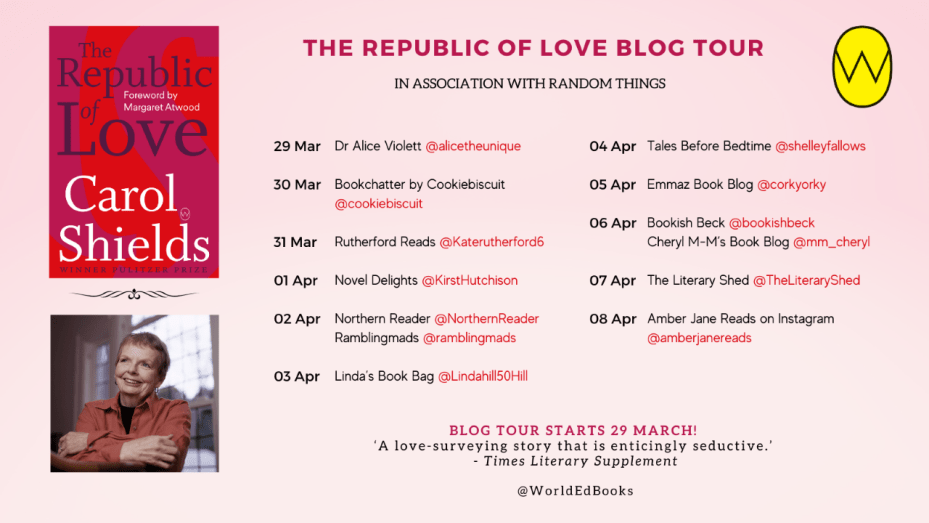
I was delighted to take part in the blog tour for The Republic of Love. See below for details of where other reviews and features have appeared or will be appearing.
Two Novels of Ambivalent Parenthood: The Push & A Lie Someone Told You About Yourself
These 2021 releases I read from the library stood out to me for daring to suggest that sometimes children aren’t little angels and parenthood isn’t all it’s cracked up to be.
The Push by Ashley Audrain
“Do you wish you weren’t a mother?”
“Sometimes I wish I were a different kind of person.”
 A cracking psychological thriller with an unreliable narrator, this is in the same vein as The Woman in the Window, Gone Girl, and A Good Enough Mother. I hardly ever pick up novels that fit into this genre, but these were all well worth making an exception for. The Push feels closer to literary fiction than to crime. Blythe Connor, living alone with her memories, ponders what went wrong with her seemingly perfect family: a handsome architect husband, Fox, and their daughter Violet and baby son Sam. Now reduced to being a stalker and an impersonator, Blythe vows to write everything down as evidence, taking care to note when she first had cause to question whether Violet was normal. A daddy’s girl from the start, Violet never bonded with Blythe and admitted to deliberately hurting other children in her preschool. But how much of what happened next was because of Violet’s nature, and how much was Blythe’s fault for failing to be the mother the girl needed?
The inkblot design of the cover cleverly evokes classical psychological concepts and experiments. A key topic the novel explores is how trauma is passed down through the generations: Blythe had worried that she wasn’t cut out for motherhood, chiefly because her mother and her grandmother both abandoned their daughters. “Blythe, the women in this family, we’re different. You’ll see,” her mother had warned. The exchange between Blythe and her mother that opens my review reiterates her suspicion: some people just aren’t cut out for parenting. Blythe can’t dismiss her daughter as evil because she knows how much guilt rests on her own shoulders, and because she doubts that she saw what she thought she saw. Moreover, the fact that her experience with Sam was completely different makes her feel ambivalent about motherhood: she’s seen how wonderful it can be, but also how it can turn bad. The nuance sets the book apart from run-of-the-mill thrillers. Yet it’s in short, page-turning chapters, so it reads very quickly and would make a great book club selection.
My rating:
A Lie Someone Told You About Yourself by Peter Ho Davies
At its best, autofiction is an intriguing blend of memoir and fiction, all of it true and universal in appeal. Davies’ minimalist approach – short sections skating over the months and years, wryly pulling out representative moments here and there, all in a mere 180 pages – could hardly be more different from Karl Ove Knausgaard’s, but both are equally dedicated to the unique alchemy of crystallizing fatherhood by illuminating its daily heartaches and joys.
 Years ago, “the writer” and his wife were presented with a choice. When genetic tests indicated mosaicism, they terminated their first pregnancy. Instead of a little girl, they later had a baby boy who presented his own challenges, including delayed development and possible ASD. Years later, the abortion still haunts “the father.” He attempts to exorcise his shame (the title = how Anaïs Nin defined it) by volunteering at an abortion clinic. Escorting patients to and from their cars, ignoring the taunts of protestors, he lives out his conviction that you can never fully know what others are going through and why they make the decisions they do.
Davies gets the tone just right in this novella, showing both sides of parenthood and voicing the things you aren’t allowed to think, or at least not to admit to – starting with abortion, which would-be fathers aren’t expected to have strong feelings about. Soon after the writer’s son is born: “He feels about himself for love, the way he might pat his pockets for his wallet and keys. Do I love him yet? Is this love?” As the boy grows into a figure of pathos: “All the things they’ve imagined him growing up to be: A basketball player, a fireman, a chef. [vs. what he actually seems to be] Allergic, friendless, autistic.” Davies also has a gift for zinging phrases, like “the deification of babies” and “the baby-industrial complex” of Babies R Us.
But what I most loved was the rumination on the role that chance plays in a life. “All the coin flips. All the what ifs. Like the litany of prompts he uses in writing class. Heads and tales.” The writer has a background in physics (as Davies himself does), so often brings up Schrödinger’s cat as a metaphor – in any situation, things might have gone either way. Now that the possibilities have narrowed to one and the path has been started, what will you do? The treatment of luck, in particular, led me to think of this as a cross between Larry’s Party by Carol Shields and What Are You Going Through by Sigrid Nunez. The style is similar to Jenny Offill’s; another similar and nearly contemporaneous release is Brood by Jackie Polzin.
I know I read The Fortunes back in 2016 but I retain virtually no memory of it. Davies’s prose, themes, and voice stood out much more for me here. I’ll try his novel The Welsh Girl, too, maybe even for book club later this year. This is an early entry on my Best of 2021 list.
Favorite lines:
“this is also what the internet is for, he thinks. If online porn universalizes shame, social media universalizes judgment. Both exercises in self-gratification.”
“An older colleague told him once cats were baby substitutes. ‘They weigh the same, they sleep on you, they roll around on their backs kicking their legs in the air. They mewl.’”
For more on abortion from a male perspective: The Cider House Rules by John Irving and Ars Botanica by Tim Taranto.
My rating:
 Bookish Beck = Rebecca Foster. American transplant to England. Freelance proofreader and book reviewer.
 Bookish Beck