Victorian-Themed Novels by Annie Elliot and Livi Michael (#ReadIndies)
I’m going back to my roots as a Victorianist (I completed an MA in Victorian Literature at the University of Leeds in 2006) with these two new novels, the one about Charles Dickens’s turbulent marriage and the other about the real-life inspiration for Elizabeth Gaskell’s Ruth. Both redress the balance of Victorian literature by placing women at the centre of the action, and both were comfortably in the 200–300-page range: turns out that’s how I like my Victoriana these days; none of your triple-decker nonsense.
Mr & Mrs Charles Dickens: Her Story by Annie Elliot
I used to proclaim Dickens my favourite author yet haven’t managed to read one of his novels in 15+ years; I seem to be allergic to all that verbiage. He managed to write all those millions of words thanks to his increasing status and wealth, but also thanks to his long-suffering wife, Catherine. Kate sacrificed her health and ambitions to bear and raise his nine children (along with one who died) and – along with sisters and servants – keep a house calm and quiet enough to enable his work.
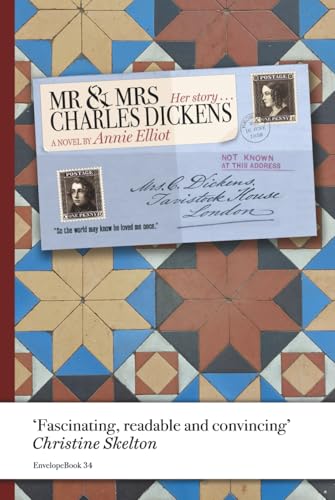 On her deathbed, Kate begged her daughter to give her love letters from Charles to the British Museum “so the world may know he loved me once.” Annie Elliot has used that phrase as the tagline for her absorbing and vigilantly researched debut novel. The structure perfectly mimics romantic illusions ceding to disenchantment. The framing story is set on 10 June 1870 – the day Kate, the estranged wife, learns of Charles’s death. Sections alternate between the bereaved Kate’s fragile state of mind (depicted in the third person) and first-person flashbacks to their relationship, from first meeting in 1834 to infamous separation in 1858.
It’s all narrated in the present tense, which creates an eternal now: nothing can be dated when it’s all happening at once for Kate. To start with, the Dickens marriage seems to be based on real love and physical passion. But before long it’s clear that he’s using Kate as ego boost and sexual outlet. She walks on eggshells lest anything shake his confidence. While the death of their baby daughter Dora nearly breaks her, he keeps up a frenzy of writing, travel, property acquisition, and new ventures such as public speaking and the theatre. And, of course, it’s through dramatics that he meets young Nelly Ternan and finds his excuse to push Kate aside.
Though much of this material was familiar to me from Claire Tomalin’s biographies as well as Gaynor Arnold’s novel about Kate, Girl in a Blue Dress, I appreciated the recreation of Kate’s perspective, the glimpses of their children’s lives, and the flashes of humour such as the proliferation of Pickwick memorabilia and a visit from Hans Christian Andersen. This is – yes, still – a necessary corrective to Dickens’s image as the dutiful husband and paterfamilias. And such a beautifully presented book, too. I wish Elliot well for next year’s McKitterick Prize race.
To be published on 1 March. With thanks to the author and EnvelopeBooks for the free copy for review.
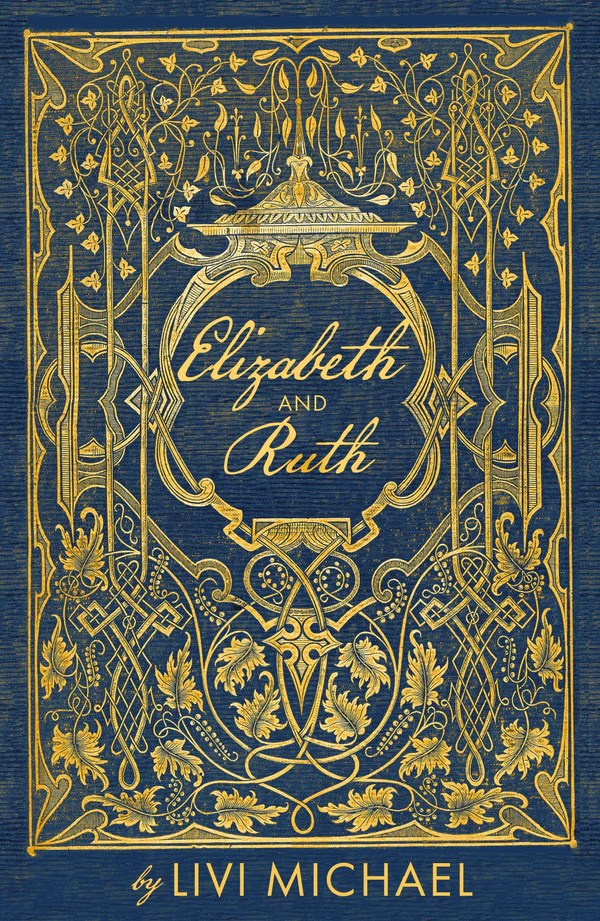
Elizabeth and Ruth by Livi Michael
The Manchester of 1849 is a sordid complex of sweatshops, brothels and workhouses – if you’re Pasley, an Irish teenager abandoned by her mother and shunted from one bad situation to another. Or the Manchester of 1849 is a rarefied colloquium of forward-thinking authors, ministers and politicians – if you’re Elizabeth Gaskell, who’s been revealed as the mind behind the anonymously published sensation Mary Barton.
The two worlds collide when Elizabeth visits Pasley at the New Bailey Prison. She feels for this young woman who’s been a victim of deception, trafficking, and rape and narrowly escaped death by suicide only to end up imprisoned for theft when she made a desperate bid for freedom. There’s only so much that Pasley can bear to tell Mrs Gaskell on these short visits, though; her past would shock a preacher’s wife. Through euphemisms and evasions, Pasley is able to convey that she was taken advantage of by a doctor. Elizabeth suspects that there was a baby, but only readers know the whole truth.
Chapters alternate between Elizabeth’s experience – in an omniscient third person cleverly reminiscent of Victorian prose – and Pasley’s first-person recollections. Elizabeth wants to follow through on her do-gooder reputation and truly help Pasley, who reminds her of her own infant and pregnancy losses. Achieving justice for the girl would be a bonus. All she knows to do is use her pen to change hearts and minds, as she has before (including for Dickens’s magazine) to draw attention to the plight of the poor. Thus, Ruth was born.
This is a riveting and touching novel about the rigidity of convention and the limits of compassion. Livi Michael is a prolific author of whom I’d not heard before Salt sent me this surprise, perfectly suited parcel. Her vivid scenes bring the two-tiered Manchester society to life and reminded me of my visit to the Gaskell House in 2015. My only small complaint would be that the blurb makes it sound as if Gaskell’s correspondence with Dickens will be a central element, when in fact it only appears once, two-thirds of the way through, with one cameo appearance by Dickens right at the end. He’s the better-known author, but after reading this you’ll agree that Gaskell was the subtler, more elegant chronicler.
Published on 9 February. With thanks to Salt Publishing for the proof copy for review.
Winter Reads: Claire Tomalin, Daniel Woodrell & Picture Books
Mid-February approaches and we’re wondering if the snowdrops and primroses emerging here in the South of England mean that it will be farewell to winter soon, or if the cold weather will return as rumoured. (Punxsutawney Phil didn’t see his shadow, but that early-spring prediction is only valid for the USA, right?) I didn’t manage to read many seasonal books this year, but I did pick up several short works with “Winter” in the title: a little-known biographical play from a respected author, a gritty Southern Gothic novella made famous through a Jennifer Lawrence film, and two picture books I picked up at the library last week.
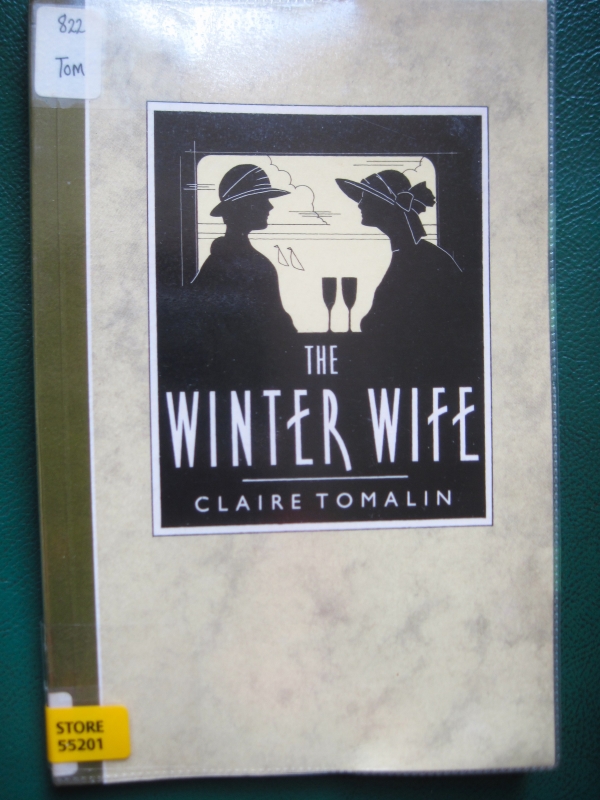
The Winter Wife by Claire Tomalin (1991)
A search of the university library catalogue turned up this Tomalin title I’d never heard of. It turns out to be a very short play (two acts of seven scenes each, but only running to 44 pages in total) about a trip abroad Katherine Mansfield took with her housekeeper?/companion, Ida Baker, in 1920. Ida clucks over Katherine like a nurse or mother hen, but there also seems to be latent, unrequited love there (Mansfield was bisexual, as I knew from fellow New Zealander Sarah Laing’s fab graphic memoir Mansfield and Me). Katherine, for her part, alternately speaks to Ida, whom she nicknames “Jones,” with exasperation and fondness. The title comes from a moment late on when Katherine tells Ida “you’re the perfect friend – more than a friend. You know what you are, you’re what every woman needs: you’re my true wife.” Maybe what we’d call a “work wife” today, but Ida blushes with pride.
Tomalin had already written a full-length biography of Mansfield, but insists she barely referred to it when composing this. The backdrops are minimal: a French sleeper train; Isola Bella, a villa on the French Riviera; and Dr. Bouchage’s office. Mansfield was ill with tuberculosis, and the continental climate was a balm: “The sun gets right into my bones and makes me feel better. All that English damp was killing me. I can’t think why I ever tried to live in England.” There are also financial worries. The Murrys keep just one servant, Marie, a middle-aged French woman who accompanies her on this trip, but Katherine fears they’ll have to let her go if she doesn’t keep earning by her pen.
Through Katherine’s conversations with the doctor, we catch up on her romantic history – a brief first marriage, a miscarriage, and other lovers. Dr. Bouchage believes her infertility is a result of untreated gonorrhea. He echoes Ida in warning Katherine that she’s working too hard – mostly reviewing books for her husband John Middleton Murry’s magazine, but also writing her own short stories – when she should be resting. Katherine retorts, “It is simply none of your business, Jones. Dr Bouchage: if I do not work, I might as well be dead, it’s as simple as that.”
She would die not three years later, a fact that audiences learn through a final flash-forward where Ida, in a monologue, contrasts her own long life (she lived to 90 and Tomalin interviewed her when she was 88) with Katherine’s short one. “I never married. For me, no one ever equalled Katie. There was something golden about her.” Whereas Katherine had mused, “I thought there was going to be so much life then … that it would all be experience I could use. I thought I could live all sorts of different lives, and be unscathed…”
The play is, by its nature, slight, but gives a lovely sense of the subject and her key relationships – I do mean to read more by and about Mansfield. I wonder if it has been performed much since. And how about this for unexpected literary serendipity?
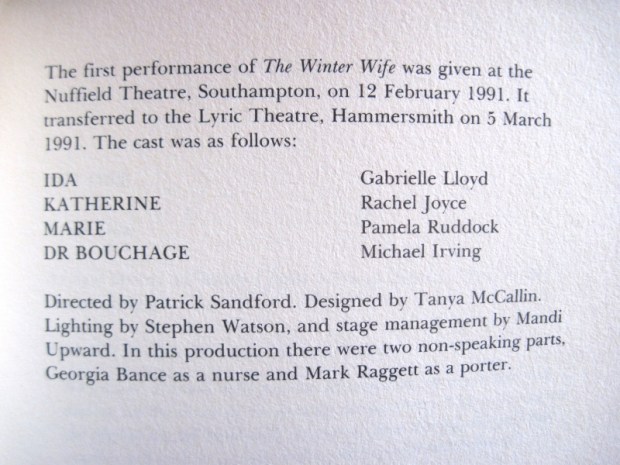
Yes, it’s that Rachel Joyce. (University library) 
Winter’s Bone by Daniel Woodrell (2006)
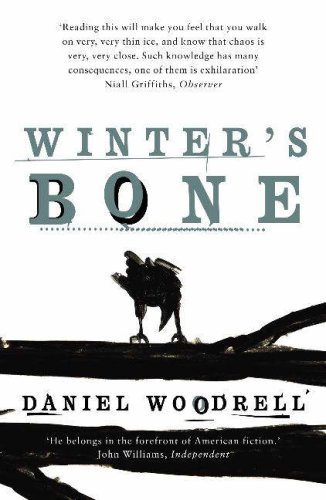 I’d seen the movie but hadn’t remembered just how bleak and violent the story is, especially considering that the main character is a teenage girl. Ree Dolly lives in Ozarks poverty with a mentally ill, almost catatonic mother and two younger brothers whom she is effectively raising on her own. Their father, Jessup, is missing; rumour has it that he lies dead somewhere for snitching on his fellow drug producers. But unless Ree can prove he’s not coming back, the bail bondsman will repossess the house, leaving the family destitute.
Forced to undertake a frozen odyssey to find traces of Jessup, she’s unwelcome everywhere she goes, even among extended family. No one is above hitting a girl, it seems, and just for asking questions Ree gets beaten half to death. Her only comfort is in her best friend, Gail, who’s recently given birth and married the baby daddy. Gail and Ree have long “practiced” on each other romantically. Without labelling anything, Woodrell sensitively portrays the different value the two girls place on their attachment. His prose is sometimes gorgeous –
Pine trees with low limbs spread over fresh snow made a stronger vault for the spirit than pews and pulpits ever could.
– but can be overblown or off-puttingly folksy:
Ree felt bogged and forlorn, doomed to a spreading swamp of hateful obligations.
Merab followed the beam and led them on a slow wamble across a rankled field
This was my second from Woodrell, after the short stories of The Outlaw Album. I don’t think I’ll need to try any more by him, but this was a solid read. (Secondhand – New Chapter Books, Wigtown)
Children’s picture books:
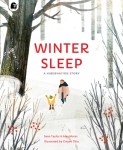 Winter Sleep: A Hibernation Story by Sean Taylor and Alex Morss [illus. Cinyee Chiu] (2019): My second book by this group; I read Busy Spring: Nature Wakes Up a couple of years ago. Granny Sylvie reassures her grandson that everything hasn’t died in winter, but is sleeping or in hiding beneath the ice or behind the scenes. As before, the only niggle is that European and North American species are both mentioned and it’s not made clear that they live in different places. (Public library)
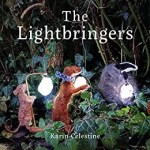 The Lightbringers: Winter by Karin Celestine (2020): An unusual artistic style here: every spread is a photograph of felted woodland creatures. The focus is on midwinter and the hope of the light coming back – depicted as poppy seed heads, lit from within and carried by mouse, hare, badger and more. “The light will always return because it is guarded by small beings and they are steadfast in their task.” The first of four seasonal stories. (Public library)
Any wintry reading (or weather) for you lately?
2017’s Runners-Up and Other Superlatives
The choices below are in alphabetical order by author, with any previously published reviews linked in (many of these books have already appeared on the blog in some way over the course of the year). You know the drill by now: to keep it simple for myself as well as for all of you who are figuring out whether you’re interested in these books or not, I’m limiting myself to two sentences per title. The first is a potted summary; the second tells you why you should read it. Across these three best-of posts (see also my Top Nonfiction and Best Fiction posts), I’ve spotlighted roughly the top 15% of my year’s reading.
Runners-Up:
 As a God Might Be by Neil Griffiths: The themes and central characters were strong enough to keep me powering through this 600-page novel of ideas about encounters with God and the nature of evil. This turned out to be just my sort of book: big and brazen, a deep well of thought that will only give up its deeper meanings upon discussion and repeat readings.
 Spaceman of Bohemia by Jaroslav Kalfař: The story of Jakub Procházka, a Czech astronaut who leaves his wife behind to undertake a noble research mission but soon realizes he can never escape his family history or the hazards of his own mind. A terrific blend of the past and the futuristic, Earth and space.
 English Animals by Laura Kaye: A young Slovakian becomes a housekeeper for a volatile English couple and discovers a talent for taxidermy. A fresh take on themes of art, sex, violence and belonging, this is one of the more striking debut novels I’ve encountered in recent years.
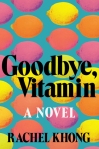 Goodbye, Vitamin by Rachel Khong: Reeling from a broken engagement, Ruth Young returns to her childhood home in California for a year to help look after her father, who has Alzheimer’s. This is a delightfully quirky little book, but you may well read it with a lump in your throat, too.
 Midwinter Break by Bernard MacLaverty: In MacLaverty’s quietly beautiful fifth novel, a retired couple faces up to past trauma and present incompatibility during a short vacation in Amsterdam. My overall response was one of admiration for what this couple has survived and sympathy for their current situation – with hope that they’ll make it through this, too. (Reviewed for BookBrowse.)
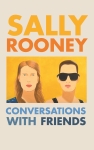 Conversations with Friends by Sally Rooney: An Irish college student navigates friendships and an affair with a married man. This is much more about universals than it is about particulars: realizing you’re stuck with yourself, exploring your sexuality and discovering sex is its own kind of conversation, and deciding whether ‘niceness’ is really the same as morality; a book I was surprised to love, but love it I did.
 Lincoln in the Bardo by George Saunders: The residents of Georgetown cemetery limbo don’t know they’re dead – or at least won’t accept it. An entertaining and truly original treatment of life’s transience; I know it’s on every other best-of-year list out there, but it really is a must-read.
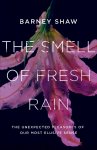 The Smell of Fresh Rain by Barney Shaw: Shaw travels through space, time and literature as he asks why we don’t have the vocabulary to talk about the smells we encounter every day. If you’re interested in exploring connections between smell and memory, discovering what makes the human sense of smell unique, and learning some wine-tasting-style tips for describing odors, this is a perfect introduction.
 A Life of My Own by Claire Tomalin: Tomalin is best known as a biographer of literary figures including Mary Wollstonecraft, Samuel Pepys and Charles Dickens, but her memoir is especially revealing about the social and cultural history of the earlier decades her life covers. A dignified but slightly aloof book – well worth reading for anyone interested in spending time in London’s world of letters in the second half of the twentieth century.
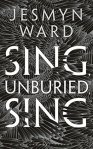 Sing, Unburied, Sing by Jesmyn Ward: The story of a mixed-race family haunted – both literally and figuratively – by the effects of racism, drug abuse and incarceration in Bois Sauvage, a fictional Mississippi town. Beautiful language; perfect for fans of Toni Morrison and Cynthia Bond.
I’ve really struggled with short stories this year, but here are four collections I can wholeheartedly recommend:
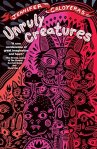 What It Means when a Man Falls from the Sky by Lesley Nneka Arimah (Reviewed for Shiny New Books.)
- Unruly Creatures: Stories by Jennifer Caloyeras
- Bad Dreams and Other Stories by Tessa Hadley
- The Great Profundo and Other Stories by Bernard MacLaverty (1987)
The Best 2017 Books You Probably Never Heard of (Unless You Heard about Them from Me!):
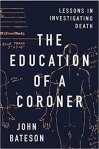 The Education of a Coroner by John Bateson: The coroner’s career is eventful no matter what, but Marin County, California has its fair share of special interest, what with Golden Gate Bridge suicides, misdeeds at San Quentin Prison, and various cases involving celebrities (e.g. Harvey Milk, Jerry Garcia and Tupac) in addition to your everyday sordid homicides. Ken Holmes was a death investigator and coroner in Marin County for 36 years; Bateson successfully recreates Holmes’ cases with plenty of (sometimes gory) details.
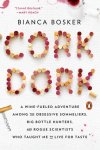 Cork Dork by Bianca Bosker: Tasting notes: gleeful, ebullient, learned, self-deprecating; suggested pairings: Sweetbitter by Stephanie Danler; Top Chef, The Great British Bake Off. A delightful blend of science, memoir and encounters with people who are deadly serious about wine.
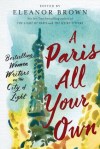 A Paris All Your Own: Bestselling Women Writers on the City of Light, edited by Eleanor Brown: A highly enjoyable set of 18 autobiographical essays that celebrate what’s wonderful about the place but also acknowledge disillusionment; highlights are from Maggie Shipstead, Paula McLain, Therese Anne Fowler, Jennifer Coburn, Julie Powell and Michelle Gable. If you have a special love for Paris, have always wanted to visit, or just enjoy armchair traveling, this collection won’t disappoint you.
 Ashland & Vine by John Burnside: Essentially, it’s about the American story, individual American stories, and how these are constructed out of the chaos and violence of the past – all filtered through a random friendship that forms between a film student and an older woman in the Midwest. This captivated me from the first page.
 Tragic Shores: A Memoir of Dark Travel, Thomas H. Cook: In 28 non-chronological chapters, Cook documents journeys he’s made to places associated with war, massacres, doomed lovers, suicides and other evidence of human suffering. This is by no means your average travel book and it won’t suit those who seek high adventure and/or tropical escapism; instead, it’s a meditative and often melancholy picture of humanity at its best and worst. (Reviewed for Nudge.)
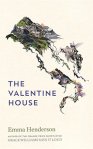 The Valentine House by Emma Henderson: This is a highly enjoyable family saga set mostly between 1914 and 1976 at an English clan’s summer chalet in the French Alps near Geneva, with events seen from the perspective of a local servant girl. You can really imagine yourself into all the mountain scenes and the book moves quickly –a great one to take on vacation.

The year’s runners-up and superlatives that I happen to have around in print.
Various Superlatives, Good and Bad:
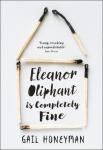 The 2017 Book Everybody Else Loved but I Didn’t: Eleanor Oliphant Is Completely Fine by Gail Honeyman. (See my Goodreads review for why.)
The Year’s Biggest Disappointments: All Grown Up by Jami Attenberg, Future Home of the Living God by Louise Erdrich, Between Them by Richard Ford and George and Lizzie by Nancy Pearl.
The Worst Book I Read This Year: Books by Charlie Hill (ironic, that). My only one-star review of the year.
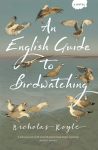 The Downright Strangest Book I Read This Year: An English Guide to Birdwatching by Nicholas Royle.
My Best Discoveries of the Year: Beryl Bainbridge, Saul Bellow, Bernard MacLaverty and Haruki Murakami. I’ve read two books by each of these authors this year and look forward to trying more from them.
The Debut Authors Whose Next Work I’m Most Looking Forward to: Lesley Nneka Arimah, Laura Kaye, Carmen Marcus, Julianne Pachico and Sally Rooney.
 The Best First Line of the Year: “History has failed us, but no matter.” (Pachinko, Min Jin Lee)
The Best Last Line of the Year: “If she was an instance of the goodness in this world then passing through by her side was miracle enough.” (Midwinter Break, Bernard MacLaverty)
Coming tomorrow: Some early recommendations for 2018.
My Top 10 Nonfiction Reads of 2017
Below I’ve chosen my seven favorite nonfiction books published in 2017, followed by three older titles that I only recently discovered. Many of these books have already featured on the blog in some way over the course of the year. To keep it simple for myself as well as for all of you who are figuring out whether you’re interested in these books or not, I’m mostly limiting myself to two sentences per title: the first is a potted summary; the second tells you why you should read it. I also link to any full reviews.
-
 Landslide: True Stories by Minna Zallman Proctor: This gorgeous set of autobiographical essays circles through some of the overarching themes of the author’s life: losing her mother, a composer; the importance Italy had for both of them; a love for the work of Muriel Spark; their loose connection to Judaism; and the relentless and arbitrary nature of time. Proctor provides a fine example of how to write a non-linear memoir that gets to the essence of what matters in life.
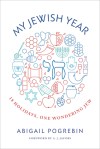 My Jewish Year by Abigail Pogrebin: From September 2014 to September 2015, Pogrebin celebrated all the holidays in the Jewish calendar, drawing thematic connections and looking for the resonance of religious rituals might have in her daily life. This bighearted, open-minded book strikes me as a perfect model for how any person of faith should engage with their tradition: not just offering lip service and grudgingly showing up to a few services a year, but knowing what you believe and practice, and why.
-

The U.S. cover
In Pursuit of Memory: The Fight against Alzheimer’s by Joseph Jebelli: With the world’s population aging, it is expected that by 2050 Alzheimer’s will be the second leading cause of death after heart disease. Research neurologist Joseph Jebelli gives a thorough survey of the history of Alzheimer’s and the development of our efforts to treat and even prevent it, but balances his research with a personal medical story any reader can relate to – his beloved grandfather, Abbas, succumbed to Alzheimer’s back in Iran in 2012. (See my full review for BookBrowse.)
 My Life with Bob by Pamela Paul: Whether she was hoarding castoffs from her bookstore job, obsessing about ticking off everything in the Norton Anthology, despairing that she’d run out of reading material in a remote yurt in China, or fretting that her new husband took a fundamentally different approach to the works of Thomas Mann, Paul (the editor of the New York Times Book Review) always looks beyond the books themselves to ask what they say about her. It’s just the sort of bibliomemoir I wish I had written.
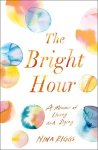 The Bright Hour by Nina Riggs: Beautiful prose enhances this literary and philosophical approach to terminal cancer. Riggs was a great-great-great-granddaughter of Ralph Waldo Emerson and quotes from her ancestor’s essays as well as from Michel de Montaigne’s philosophy to put things into perspective; she’s an expert at capturing the moments that make life alternately euphoric and unbearable – and sometimes both at once.
 Fragile Lives by Stephen Westaby: This is a vivid, compassionate set of stories culled from the author’s long career in heart surgery with the Grim Reaper looking on. I am not a little envious of all that Westaby has achieved: not just saving the occasional life despite his high-mortality field – as if that weren’t enough – but also pioneering various artificial heart solutions and a tracheal bypass tube that’s named after him.
And my nonfiction book of the year was:
1. The Shadow in the Garden: A Biographer’s Tale by James Atlas: I read this in August, planning to contrast it with Claire Tomalin’s A Life of My Own, another biographer’s memoir, for the LARB. It would have been a brilliant article, believe me. But they didn’t bite, and by the time I approached the TLS they’d already arranged coverage of the books. Alas! Such is the life of a freelancer. Since then I’ve struggled to know what to say about Atlas’s book that would explain why I loved it so much that my paperback proof is riddled with Post-It flags. (It’s going to take more than a couple of sentences…)
Much more so than Tomalin, Atlas gave me a real sense of what it’s like to immerse yourself in another person’s life. He made it up as he went along: he was only 25 when he got the contract to write a biography of the poet Delmore Schwartz, who died a penniless alcoholic at age 52. Writing about the deceased was a whole different matter to engaging with a living figure, as Atlas did when he wrote his biography of Saul Bellow in the 1990s.
 Atlas perceptively explores the connections between Schwartz and Bellow (Schwartz was the model for the protagonist of Bellow’s 1975 Pulitzer winner, Humboldt’s Gift) and between Bellow and himself (a Chicago upbringing with Russian Jewish immigrant ancestors), but also sets his work in the context of centuries of biographical achievement – from Boswell’s The Life of Samuel Johnson through master biographers like Richard Holmes, Leon Edel and Richard Ellmann (Atlas’s supervisor during his fellowship at Oxford) to recent controversial biographies of Robert Frost and Vladimir Nabokov.
This book deals with the nitty-gritty of archival research and how technology has changed it; Atlas also talks story-telling strategies and the challenge of impartiality, and ponders how we look for the patterns in a life that might explain what, besides genius, accounts for a writer’s skill. Even the footnotes are illuminating, and from the notes I learned about a whole raft of biographies and books on the biographer’s trade that I’d like to read. After I finished reading it I spent a few days dreamily wondering if I might write a biography some day. For anyone remotely interested in life writing, pick this up with my highest recommendation.
I’ll make it up to an even 10 with a few backlist titles I also loved:
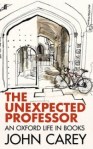 The Unexpected Professor: An Oxford Life in Books by John Carey (2014): Carey gives a thorough picture of events from his personal and professional life, but the focus is always on his literary education: the books that have meant the most to him and the way his taste and academic specialties have developed over the years. Ultimately what this book conveys is the joy of being a lifelong reader.
 A Sand County Almanac and Sketches Here and There by Aldo Leopold (1949): So many of Leopold’s musings ring true today: how we only appreciate wildlife if we can put an economic value on it, the troubles we get into when we eradicate predators and let prey animals run rampant, and the danger of being disconnected from the land that supplies our very life. And all this he delivers in stunning, incisive prose.
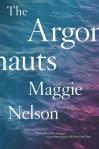 The Argonauts by Maggie Nelson (2015): An exquisite interrogation of gender identity and an invaluable reminder that the supposed complications of making a queer family just boil down to your basic human experiences of birth, love and death. I preferred those passages where Nelson allows herself to string her fragments into more extended autobiographical meditations, like the brilliant final 20 pages interspersing her memories of giving birth to her son Iggy with an account of the deathbed vigil her partner (artist Harry Dodge) held for his mother; it had me breathless and in tears, on a plane of all places.
What were some of your top nonfiction reads of the year?
Tomorrow I’ll be posting my Library Checkout a few days early.
Next week’s planned posts:
26th: Doorstopper of the Month
27th: Top fiction of the year list
28th: Runners-up and other superlatives
29th: Early 2018 recommendations
30th: Final statistics on my 2017 reading
Omnibuses, Built-in Bookmarks, Deckle Edge: Book Traits I Love/Loathe
My reading has tipped more towards physical books than e-books recently, and my book acquisitions have been getting rather out of hand after some cheeky charity shopping and an influx of review copies. Plus this afternoon we’re off to Bookbarn International, one of my favorite secondhand bookstores, for an evening event – and naturally, we’ll fit in some shopping beforehand. It would be rude not to after traveling all that way.
With all this tempting reading material piling up, I’ve been thinking about some of the traits I most appreciate in books…
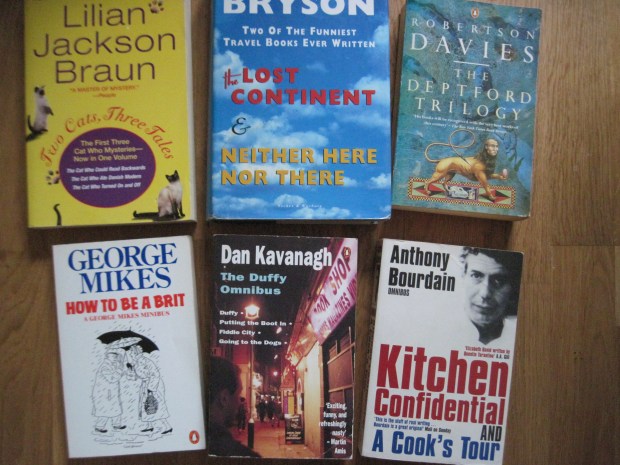
Omnibus editions: two to four books for the price of one. What could be better?
Built-in ribbon bookmarks: elegant as well as helpful. I also love how Peirene Press releases come with a matching paper bookmark for every three-book series.

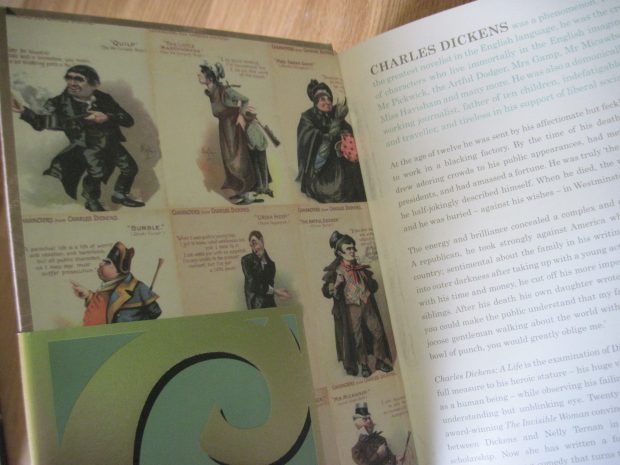
Everything about the hardback edition of Claire Tomalin’s Dickens biography is gorgeous, in fact. I especially love the vintage illustrations on the endpapers and the half-size dustjacket.
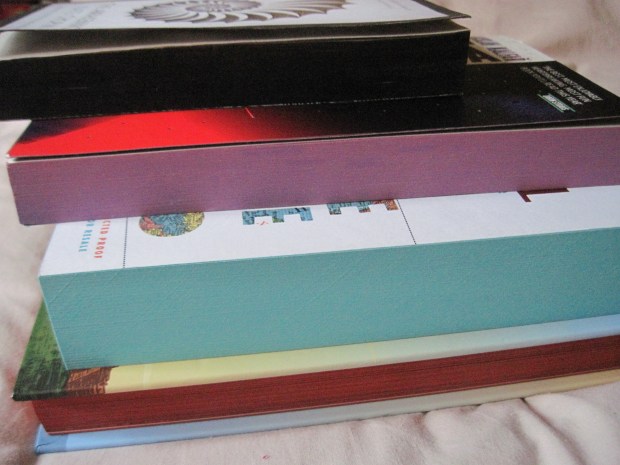
Deckle edge is one of my special loves. For the most part it’s unique to American books (over here I’ve heard it complained about as looking “unfinished”), and always makes me think nostalgically about borrowing books from the public library in my parents’ town.

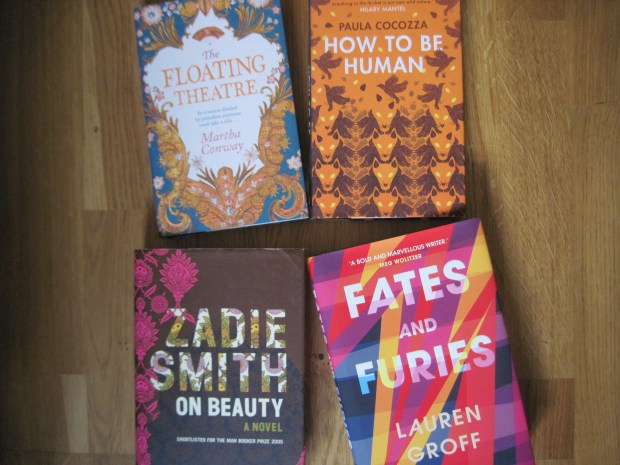
It may sound shallow, but I love these four novels almost as much for their colorful covers as for their contents. (Is it any wonder one of my favorite tags to use on Instagram is #prettycovers?) Several of these covers have raised lettering as well.
The History of Bees is one of the most attractive physical books I’ve acquired recently. The dustjacket has an embossed image; underneath it the book itself is just as striking, with a gold honeycomb pattern. There are also black-and-white bees dotted through the pages.


Colored text blocks (also called sprayed edges) are so unexpected and stylish.
And now for a few physical book traits I’m not as fond of. Perhaps my biggest pet peeve, impossible to photograph, is those matte covers that get permanent fingerprints on them no matter how gingerly you try to handle them.
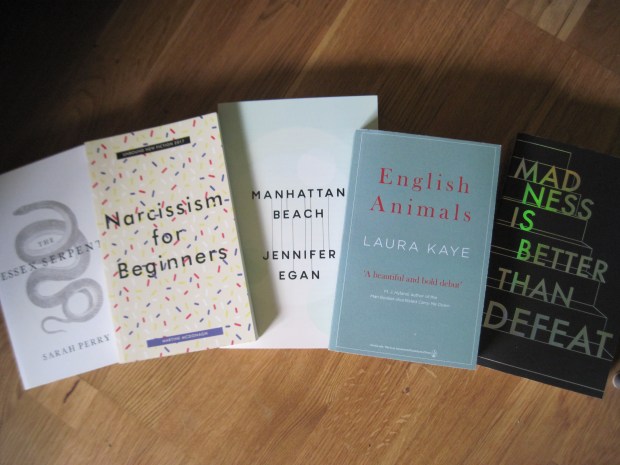
I wish proof copies didn’t often come in nondescript covers that don’t give a sense of what the finished book will look like. (No ice cream cone on Narcissism for Beginners; no leaping fox on English Animals.) However, keeping in mind that I’m lucky to be reading all these books early, I mustn’t be a greedy so-and-so.
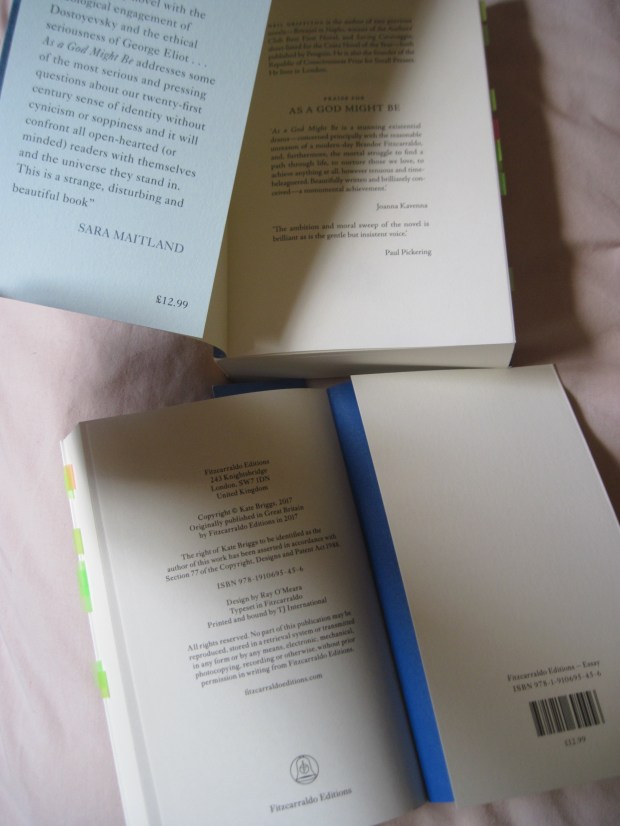
All Fitzcarraldo Editions books are paperbacks with French flaps. Another book I’m reading at the moment, As a God Might Be by Neil Griffiths (from Dodo Ink), also has French flaps. It’s not that I dislike them per se. I just wonder, what’s the point?
(See also two related posts: Books as Objects of Beauty and My (Tiny) Collection of Signed Copies.)
Okay, you opinionated book people: what are your favorite and least favorite book traits?
Literary Power Couples: An Inventory
With Valentine’s Day on the way, I’ve been reading a bunch of books with “Love” in the title to round up in a mini-reviews post next week. One of them was What I Loved by Siri Hustvedt – my second taste of her brilliant fiction after The Blazing World. Yet I’ve not tried a one of her husband Paul Auster’s books. There’s no particular reason for that; I’ve even had his New York Trilogy out from the library in the past, but never got around to reading it.
How about some other literary power couples? Here’s some that came to mind, along with an inventory of what I’ve read from each half. It’s pretty even for the first two couples, but in most of the other cases there’s a clear winner.
Zadie Smith: 5
Nick Laird: 5 (= ALL)
Zadie Smith in 2011. By David Shankbone (CC BY 3.0 (http://creativecommons.org/licenses/by/3.0) via Wikimedia Commons.
I’ve read all of Zadie Smith’s work apart from NW; I only got a few pages into it when it first came out, but I’m determined to try again someday. To my surprise, I’ve read everything her husband Nick Laird has ever published, which includes three poetry collections and two fairly undistinguished ‘lad lit’ novels. I’m pleased to see that his new novel Modern Gods, coming out on June 27th, is about two sisters and looks like a stab at proper literary fiction.
Jonathan Safran Foer: 4 (= ALL)
Nicole Krauss: 3 (= ALL)
Alas, they’re now an ex-couple. In any case, they’re both on the fairly short list of authors I’d read anything by. Foer has published three novels and the nonfiction polemic Eating Animals. Krauss, too, has three novels to her name, but a new one is long overdue after the slight disappointment of 2010’s Great House.
Margaret Drabble: 5
Michael Holroyd: 0
Michael Holroyd is a biographer and general nonfiction dabbler. I have a few of his books on my TBR but don’t feel much compulsion to seek them out. By contrast, I’ve read four novels and a memoir by Margaret Drabble and am likely to devour more of her fiction in the future.

Margaret Drabble in 2011. By summonedbyfells [CC BY 2.0 (http://creativecommons.org/licenses/by/2.0)%5D via Wikimedia Commons.
Claire Tomalin: 2
Michael Frayn: 1
Claire Tomalin’s masterful biographies of Charles Dickens and Thomas Hardy are pillars of my nonfiction collection, and I have her books on Nelly Ternan and Samuel Pepys on the shelf to read as well. From her husband, celebrated playwright Michael Frayn, however, I’ve only read the comic novel Skios. It is very funny indeed, though, about a case of mistaken identity at an academic conference on a Greek island.
Plus a few I only recently found out about:
Ian McEwan: 7 (+ an 8th in progress)
Annalena McAfee: 1 (I’ll be reviewing her novel Hame here on Thursday)
Katie Kitamura: 1 (I just finished A Separation yesterday)
Hari Kunzru: 0
Madeleine Thien: 1 (Do Not Say We Have Nothing)
Rawi Hage: 0
Afterwards I consulted the lists of literary power couples on Flavorwire and The Huffington Post and came up with a few more that had slipped my mind:
Michael Chabon: 1
Ayelet Waldman: 0
I loved Moonglow and am keen to try Michael Chabon’s other novels, but I also have a couple of his wife Ayelet Waldman’s books on my TBR.
Dave Eggers: 5
Vendela Vida: 0
I’ve read a decent proportion of Dave Eggers’s books, fiction and nonfiction, but don’t know anything by his wife and The Believer co-founder Vendela Vida.
David Foster Wallace: 2
Mary Karr: 1
I didn’t even know they were briefly a couple. From Wallace I’ve read the essay collection Consider the Lobster and the commencement address This Is Water. I’ve definitely got to get hold of Karr’s memoirs, having so far only read her book about memoir (The Art of Memoir).
And some classics:
Ted Hughes: 1 (Crow)
Sylvia Plath: 0
F. Scott Fitzgerald: 2 (The Great Gatsby and Tender Is the Night)
Zelda Fitzgerald: 0
![F. Scott and Zelda Fitzgerald in 1921. By Kenneth Melvin Wright (Minnesota Historical Society) [Public domain], via Wikimedia Commons.](https://bookishbeck.com/wp-content/uploads/2017/02/f_scott_fitzgerald_and_wife_zelda_september_1921.jpg?w=208&h=300)
F. Scott and Zelda Fitzgerald in 1921. By Kenneth Melvin Wright (Minnesota Historical Society) [Public domain], via Wikimedia Commons.
How have you fared with these or other literary power couples? Do you generally gravitate towards one or the other from a pair?
Classics of the Month: Hardy and Sackville-West
This is the first post in a new monthly series intended to encourage myself to read more of the classics I own. In January I read two works of classic literature: Under the Greenwood Tree by Thomas Hardy and No Signposts in the Sea by Vita Sackville-West.
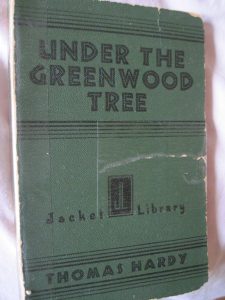
My battered Jacket Library edition.
Between college and grad school I read Hardy’s five major novels, but it’s probably been ten years or more since I tried a new one. Far from the Madding Crowd is one of my favorite books of all time, so I couldn’t help but compare Under the Greenwood Tree* to it – unfavorably, alas – as I was reading.
Greenwood was Hardy’s second novel, published in 1872. That’s just two years before Madding Crowd, and the two are quite similar in a few ways: the main female character is a conceited flirt who has to decide between three potential suitors; the supporting cast is made up of “rustics” who speak in country dialect; and the Dorset setting, including the landscape, weather and traditional activities, is a strong presence in its own right.
But where Bathsheba Everdene, though periodically maddening, is ultimately a sympathetic figure, Greenwood’s Fancy Day is a character I could never warm to. As the new schoolteacher and organist in Mellstock village, she puts on airs and imagines she’s too good for Dick Dewy, a salt-of-the-earth peddler. She’s also incurably vain. “Yes, I must wear the hat, dear Dicky, because I ought to wear a hat, you know,” she says, even though Dick calls the hat “Rather too coquettish.”
A bare-bones summary of the novel makes it sound more entertaining than it actually is: A set of country musicians (the “Mellstock Quire”) learns their services are no longer required at the local church; they are to be replaced by an organ. The novel opens on Christmas Eve and in the early chapters proceeds by way of caroling, cider drinking and dances. It’s rather jolly, but where is it all going? Then, once the plot takes over, Fancy’s weighing up of the wooing attentions of Dick, Mr. Shiner and Parson Maybold soon grows tedious.
Whereas the passages about the rustics are brief, welcome interludes in Madding Crowd, here they are nearly constant and start to feel overpowering. “You are charmed on condition that you accept Hardy’s condescension towards his characters,” Claire Tomalin observes in Thomas Hardy: The Time-Torn Man. They are harmless folk, but their rural way of life will soon be superseded. The novel is set a generation back, in about the 1840s, so has an elegiac tone to it, and Hardy’s subtitles suggest he was trying to freeze an image of a bygone time.
Fancy’s directives for her wedding reception make clear the divide between old and new:
The propriety of every one was intense by reason of the influence of Fancy, who, as an additional precaution in this direction, had strictly charged her father and the tranter [Dick’s father] to carefully avoid saying ‘thee’ and ‘thou’ in their conversation, on the plea that those ancient words sounded so very humiliating to persons of newer taste; also that they were never to be seen drawing the back of the hand across the mouth after drinking—a local English custom of extraordinary antiquity, but stated by Fancy to be decidedly dying out among the upper classes of society.
This is a pleasant enough book, and at just 160 or so pages goes by fairly quickly, yet I found myself losing interest at many points and often could not bear to read more than one short chapter at a time. At this rate, will I ever get to decidedly minor Hardy novels like The Hand of Ethelberta, The Trumpet-Major, A Pair of Blue Eyes, and A Laodicean?

*“Under the greenwood tree” is a line from Shakespeare’s As You Like It.
Favorite unrelated line: “Clar’nets were not made for the service of the Lard; you can see it by looking at ’em.”
No Signposts in the Sea (1961) is my second taste of Sackville-West’s fiction (after All Passion Spent). It was her last novel, published just one year before her death, and was inspired by world cruises she and her husband, Harold Nicolson, took in later life. She was at this point already ill with the cancer that would kill her, though it was as yet undiagnosed.
That context goes a long way towards explaining the preoccupations of No Signposts, set on board a cruise ship and narrated by fifty-year-old Edmund Carr, a journalist who has been told by his doctor that he has just a few months to live. He’s embarked on the voyage to be close to the woman he loves, forty-year-old war widow Laura Drysdale. She has no idea that he’s ill, and as the weeks pass and they share tender moments – dinner on shore at an island based on Macao, a lightning storm viewed from her private balcony – he dares to hope that she might return his feelings but still doesn’t tell her about his imminent death, even as she makes tentative plans for excursions they might take once they’re back in London.
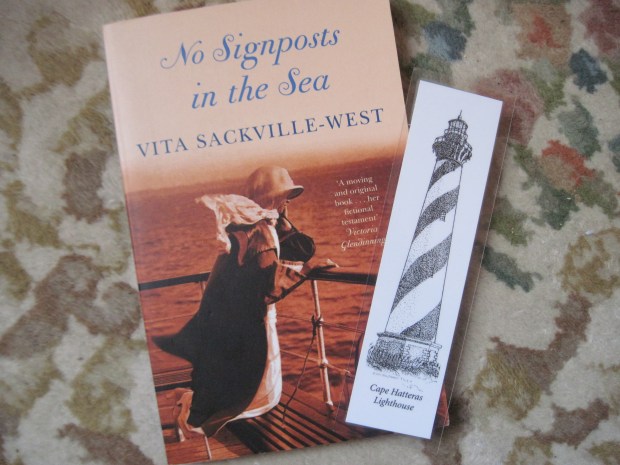
The novel is presented as Edmund’s diary, found after his eventual death. It’s full of his solitary musings but also his conversations with Laura, who is refreshingly unconventional in her approach to relationships:
I can’t abide the Mr. and Mrs. Noah attitude towards marriage; the animals went in two by two, forever stuck together with glue. I resent it as much for other people as I should for myself. It seems to me a degradation of individual dignity.
She also tells a story about a lesbian couple she knows who are aging happily together; it feels a bit out of place, but its inclusion is striking given Sackville-West’s history of lesbian relationships.
I’d recommend this short novel to anyone who’s looking for a quick women’s classic with plenty to say about what matters in life.
Next month: I’ve never read George Orwell’s Nineteen Eighty-Four and it seems to be having something of a resurgence in popularity at the moment, so perhaps now is the time?
 Bookish Beck = Rebecca Foster. American transplant to England. Freelance proofreader and book reviewer.
 Bookish Beck