#NovNov25 and #GermanLitMonth: Kästner, Kehlmann & Kracht
Our trip to Germany in September whetted my appetite to read more German-language fiction, and November also being German Literature Month (hosted this year by Caroline of Beauty Is a Sleeping Cat and Tony of Tony’s Reading List) was a perfect excuse. K names only this year, please. (Perhaps next year I’ll make it S and finally get to those Sebald and Seethaler novels I have on the shelf.) These three works – a children’s classic, a set of linked short stories about the writer’s craft, and a mother–son spending spree – have coy metafictional touches, plus there’s a connection I wasn’t expecting between the Kehlmann and Kracht. All: 

Emil and the Detectives by Erich Kästner (1929; 1931)
[Translated by Eileen Hall]
 If only I’d realized this was set on a train to Berlin, I could have read it in the same situation! Instead, it was a random find while shelving in the children’s section of the library. Emil sets out on a slow train from Neustadt to stay with his aunt, grandmother and cousin in Berlin for a week’s holiday. His mother gives him £7 in an envelope he pins inside his coat for safekeeping. There are four adults in the carriage with him, but three get off early, leaving Emil alone with a man in a bowler hat. Much as he strives to stay awake, Emil drops off. No sooner has the train pulled into Berlin than he realizes the envelope is gone along with his fellow traveller. “There were four million people in Berlin at that moment, and not one of them cared what was happening to Emil Tischbein.” He’s sure he’ll have to chase the man in the bowler hat all by himself, but instead he enlists the help of a whole gang of boys, including Gustav who carries a motor-horn and poses as a bellhop, Professor with the glasses, and Little Tuesday who mans the phone lines. Together they get justice for Emil, deliver a wanted criminal to the police, and earn a hefty reward. This was a cute story and it was refreshing for children’s word to be taken seriously. There’s also the in-joke of the journalist who interviews Emil being Kästner. I’m sure as a kid I would have found this a thrilling adventure, but the cynical me of today deemed it unrealistic. (Public library) [153 pages]
Fame by Daniel Kehlmann (2009; 2010)
[Translated by Carol Brown Janeway]
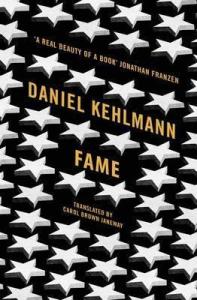 I’ve been equally enchanted by Kehlmann’s historical fiction (Measuring the World) and contemporary metafiction (F is one of my all-time favourites) in the past. These nine linked stories feature writers and their characters, actors and their look-alikes, and are about how life translates into – or is sometimes transformed by – art. Ralf Tanner starts to feel like he doesn’t exist when his calls gets diverted to someone else’s phone and an impersonator is more convincing at playing him than he is himself. Leo Richter’s new girlfriend is curiously similar to his most famous character, Lara Gaspard, a doctor working for a medical charity. Crime writer Maria Rubinstein takes Leo’s place on a cultural exchange to Central Asia and gets stuck in a Kafka-esque situation without a visa. Leo’s fan and Ralf’s call recipient are subjects of their own stories. References to Miguel Auristos Blanco’s spiritual self-help books recur and he, too, eventually becomes a character. I liked the pointed little jokes about what writers have to put up with (“Do you know how often I’ve been asked today where I get my ideas from? Fourteen. And nine times whether I work in the morning or the afternoon,” Leo complains). Mostly, these stories struck me as clever yet had me wondering what the point was. My favourite was “Rosalie Goes Off to Die,” in which Leo’s character travels to Zurich for an assisted death but he the writer decides to interfere before she can get her last wish. (Secondhand – Awesomebooks.com) [206 pages – but fairly large print]
Eurotrash by Christian Kracht (2021; 2024)
[Translated by Daniel Bowles]
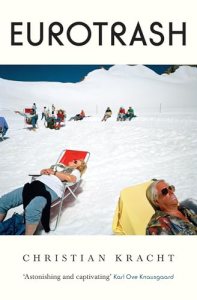 This was longlisted for the International Booker Prize and is the current Waterstones book of the month. The Swiss author’s seventh novel appears to be autofiction: the protagonist is named Christian Kracht and there are references to his previous works. Whether he actually went on a profligate road trip with his 80-year-old mother, who could say. I tend to think some details might be drawn from life – her physical and mental health struggles, her father’s Nazism, his father’s weird collections and sexual predilections – but brewed into a madcap maelstrom of a plot that sees the pair literally throwing away thousands of francs. Her fortune was gained through arms industry investment and she wants rid of it, so they hire private taxis and planes. If his mother has a whim to pick some edelweiss, off they go to find it. All the while she swigs vodka and swallows pills, and Christian changes her colostomy bags. I was wowed by individual lines (“This was the katabasis: the decline of the family expressed in the topography of her face”; “everything that does not rise into consciousness will return as fate”; “the glacial sun shone from above, unceasing and relentless, upon our little tableau vivant”) but was left chilly overall by the satire on the ultra-wealthy and those who seek to airbrush history. The fun connections: Like the Kehlmann, this involves arbitrary travel and happens to end in Africa. More than once, Kracht is confused for Kehlmann. (Little Free Library) [190 pages]
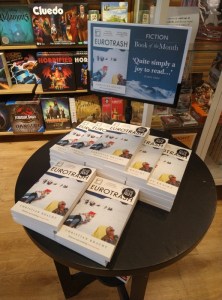
Spotted in my local Waterstones…

Three Books that Originated on the Radio
As the end of the year approaches and I try to get through a final handful of review books, I’m looking for ways to combine posts. It may seem like a fairly arbitrary connection, but all three of these books originated as essays or short stories that were aired on British radio. I never listen to the radio so I miss out on these projects the first time around, but I’ve been interested to note how short forms and conversational styles lend themselves to oral performance.
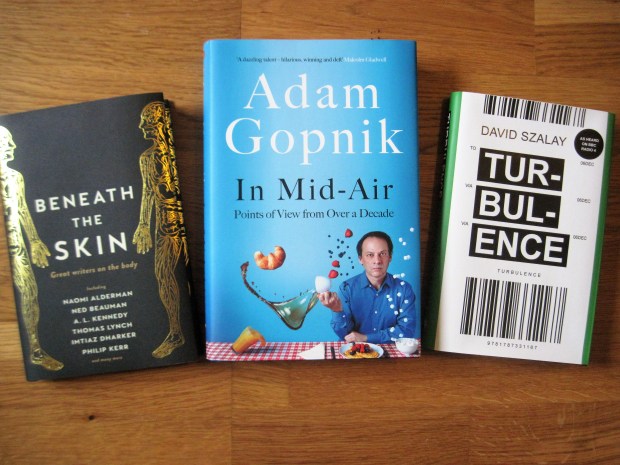
Beneath the Skin: Great Writers on the Body
These 15 pieces were commissioned for the BBC Radio 3 series “A Body of Essays.” Thomas Lynch, a small-town American undertaker and wonderful, unjustly obscure writer, opens and closes the volume. In his introduction he remarks – appropriately as Christmas draws near – that “We are an incarnate species”: we experience the world only through our bodies, which are made of disparate parts that work together as a whole. This project considers single organs by turn “in hopes that by knowing the part we might better know the whole of our predicament and condition.”
 Naomi Alderman, musing on the intestines, draws metaphorical connections between food, sex and death, and gives thanks that digestion and excretion are involuntary processes we don’t have to give any thought. Ned Beauman reports on misconceptions about the appendix as he frets about the odds of his bursting while he’s in America without health insurance. The late Philip Kerr describes the checkered history of the lobotomy, which used to reduce patients to a vegetative state but can now quite effectively treat epilepsy.
The pieces incorporate anatomical knowledge, medical history, current research, cultural connections, and sometimes observation of a hospital procedure. These threads are elegantly woven together, as in Patrick McGuinness’s essay on the ear, which skips between Hamlet’s father’s death, the secretive delight of mining for earwax, Beethoven’s ear trumpet, and what we know about in utero sounds.
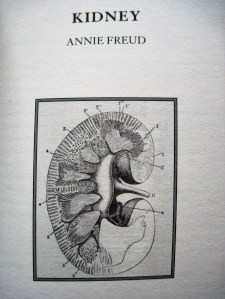 Most authors chose a particular organ because of its importance to their own health. Christina Patterson’s acne was so bad she went to the UK’s top skin specialist for PUVA light treatments, Mark Ravenhill had his gallbladder removed in an emergency surgery, and Daljit Nagra’s asthma led his parents to engage Sikh faith healers for his lungs. Two of my favorite chapters were by William Fiennes, whose extreme Crohn’s disease caused him to have a colostomy bag for two years in his early twenties, and poet Kayo Chingonyi, who has always been ashamed to admit that his parents both died of complications of HIV in Zambia. Such personal connections add poignancy to what could have been information dumps.
As is usual for essay collections, my interest varied somewhat. I had my hopes too high so was disappointed with a scattered piece on the kidneys. But the overall quality is terrific. If you enjoy medical reads to any extent, I recommend this as a bedside book to read occasionally.
Some favorite lines:
“It’s a strange and shifting thing – this sense I have that I am my body, of which some bits are essential and some expendable.” (Mark Ravenhill)
“There are things we only think about when they go wrong: the fan belt, the combi boiler, the bowel.” (William Fiennes)
“Like most of us, I take my body for granted. I live in the most complex, intricate machine and as long as it wakes up in the morning, and goes to bed at night, I am uninterested in its inner workings.” (Chibundu Onuzo, “Thyroid”)
My rating: 
Beneath the Skin was published by the Wellcome Collection imprint of Profile Books on October 25th. My thanks to the publisher for a free copy for review.
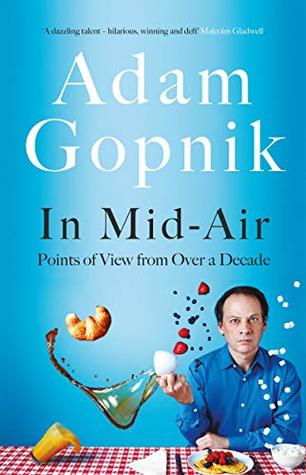
In Mid-Air by Adam Gopnik
New Yorker writer Gopnik contributed to BBC Radio 4’s A Point of View for over a decade. These essays date from 2012 to 2017 and are grouped into three loosely thematic sections on family, culture and politics. Gopnik self-deprecatingly sees himself as “offering measured ambivalences on everything.” As an American who was raised in Canada and has lived in Paris and spent significant time in London, he has a refreshingly cosmopolitan outlook and can appreciate the nuances in different countries’ identities. At the same time, he brings out what’s universal: being annoying to one’s teenage children, gauging the passing of time by family members’ changes, the desire to die with dignity (remembering his father-in-law’s death at age 95), and lessons in a happy marriage from Charles and Emma Darwin – he boils it down to lust, laughter and loyalty.
 During the weeks that I spent with these essays I was frequently reminded of Jan Morris’s In My Mind’s Eye, which casts a similarly twinkling eye over the absurdities of modern life and the aging body. Gopnik endures shingles and shrugs over his funny last name (“drunken lout” in Russian) and short stature. He mostly ignores Twitter and decries our dependence on smartphones. As he’s never learned to drive, he’s amused by the idea of self-driving cars.
My favorite pieces were on significantly more trivial matters, though: the irony of famous Christmas songs being written by Jews, and a satire on society’s addiction to DVD box sets. Other arts references vary from the Beatles and Bob Dylan’s Nobel Prize to Cubism and literary festivals. It’s a quirky blend of high and low culture here. Bizarrely, Gopnik has recently written an oratorio on Alan Turing and a musical about a New York City restaurant.
The author is an unabashed liberal who prizes pluralism above all else but warns how fragile it is. In the final section he prophesies catastrophe under Trump and, afterwards, can only say that at least his election puts lesser issues into perspective. I valued the diagnosis of American insularity and British inwardness – this particular essay was written in 2013 but seems all the more relevant post-Brexit. This was my fifth book from Gopnik. While I didn’t engage with every essay and would have liked them to be chronological so there was a mix of topics all the way through, it was a pleasant and often thought-provoking read.
Some favorite lines:
“Watching the people we love die bit by bit is the hardest thing life demands until we recall that watching the people we love die bit by bit is in a certain sense what life simply is. It just usually takes more time for the bits to go by.”
“We should never believe that people who differ from us about how we ought to spend public money want to commit genocide or end democracy, and we should stop ourselves from saying so, even in the pixellated heat of internet argument. But when we see the three serpents of militarism, nationalism and hatred of difference we should never be afraid to call them out, loudly, by name”
My rating: 
In Mid-Air was published by riverrun, a new Quercus imprint, on October 18th. My thanks to the publisher for a free copy for review.
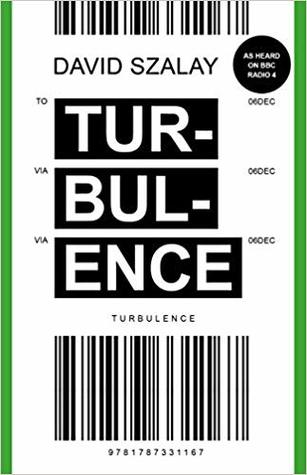
Turbulence by David Szalay
These 12 linked short stories, commissioned for BBC Radio 4, focus on travel and interconnectedness. Each is headed by a shorthand route from one airport to another, and at the destination we set out with a new main character who has crossed paths with the previous one. For instance, in “YYZ – SEA” the writer Marion Mackenzie has to cancel a scheduled interview when her daughter Annie goes into labor. There’s bad news about the baby, and when Marion steps away from the hospital to get Annie a few necessaries from a supermarket and is approached by a pair of kind fans, one of whom teaches Marion’s work back in Hong Kong, she’s overcome at the moment of grace-filled connection. In the next story we journey back to Hong Kong with the teacher, Jackie, and enter into her dilemma over whether to stay with her husband or leave him for the doctor she’s been having an affair with.
 As he ushers readers around the world, Szalay invites us to marvel at how quickly life changes and how – improbable as it may seem – we can have a real impact on people we may only meet once. There’s a strong contrast between impersonal and intimate spaces: airplane cabins and hotel rooms versus the private places where relationships start or end. The title applies to the characters’ tumultuous lives as much as to the flight conditions. They experience illness, infidelity, domestic violence, homophobia and more, but they don’t stay mired in their situations; there’s always a sense of motion and possibility, that things will change one way or another.
My favorite story was “DOH – BUD,” in which Ursula goes to visit her daughter Miri and gains a new appreciation for Miri’s fiancé, Moussa, a Syrian refugee. I also liked how the book goes full circle, with the family from the final story overlapping with that of the first. Though a few of the individual stories are forgettable, I enjoyed this more than Szalay’s Booker-shortlisted All that Man Is, another globe-trotting set of linked stories.
Like Beneath the Skin, this acknowledges the many parts making up the whole of humanity; like In Mid-Air, it encourages a diversity of opinion and experience rather than narrow-mindedness. Maybe the three books had more in common than I first thought?
A favorite line:
“In fact it was hard to understand quite what an insignificant speck this aeroplane was, in terms of the size of the ocean it was flying over, in terms of the quantity of emptiness which surrounded it on all sides.”
My rating:
Turbulence is published by Jonathan Cape today, December 6th. My thanks to the publisher for a free copy for review.
 Bookish Beck = Rebecca Foster. American transplant to England. Freelance proofreader and book reviewer.
 Bookish Beck