#NovNov25 Final Statistics & Some 2026 Novellas to Look Out For (Chapman, Fennelly, Gremaud, Miles, Netherclift & Saunders)
Novellas in November 2025 was a roaring success: In total, we had 50 bloggers contributing 216 posts covering at least 207 books! The buddy read(s) had 14 participants. If you want to take a look back at the link parties, they’re all here. It was our best year yet – thank you.
*For those who are curious, our most reviewed book was The Wax Child by Olga Ravn (4 reviews), followed by The Most by Jessica Anthony (3). Authors covered three times: Franz Kafka and Christian Kracht. Authors with work(s) reviewed twice: Margaret Atwood, Nora Ephron, Hermann Hesse, Claire Keegan, Irmgard Keun, Thomas Mann, Patrick Modiano, Edna O’Brien, Clare O’Dea, Max Porter, Brigitte Reimann, Ivana Sajko, Georges Simenon, Colm Tóibín and Stefan Zweig.*

I read and reviewed 21 novellas in November. I happen to have already read six with 2026 release dates, some of them within November and others a bit earlier for paid reviews. I’ll give a quick preview of each so you’ll know which ones you want to look out for.
The Pass by Katriona Chapman
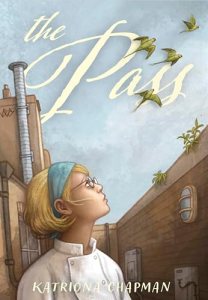 Claudia Grace is a rising star in the London restaurant world: in her early thirties, she’s head chef at Alley. But she and her small team, including sous chef Lisa, her best friend from culinary school; and Ben, the innovative Black bartender, face challenges. Lisa has a young son and disabled husband, while Ben is torn between his love of gardening and his commitment to Alley. Claudia is more stressed than ever as she prepares for a competition. All three struggle with their parents’ expectations. A financial crisis comes out of nowhere, but the greater threat is related to motivation. I was drawn to this graphic novel for the restaurant setting, but it’s more about families and romantic relationships than food. Several characters look too alike or much younger or older than they’re supposed to, while there’s a sudden ending that suggests a sequel might follow. (Fantagraphics, Jan. 20) [184 pages] (Read via Edelweiss)
The Irish Goodbye: Micro-Memoirs by Beth Ann Fennelly
 I’ve also read Fennelly’s previous collection of miniature autobiographical essays, Heating & Cooling. She takes the same approach as in flash fiction: some of these 45 pieces are as short as one sentence, remarking on life’s irony, poignancy or brevity. Again and again she loops back to her sister’s untimely death (the title reference: “without farewells, you slipped out the back door of the party of your life”); other major topics are her mother’s worsening dementia, her happy marriage, her continuing 28-year-old friendships with her college roommates, the pandemic, and her ageing body. Every so often, Fennelly experiments with third- or second-person narration, as when she recalls making a perfect gin and tonic for Tim O’Brien. One of the most in-depth pieces revisits a lonely stint teaching in Czechoslovakia in the early 1990s. Returning to the town recently, she is astounded that so many recognize her and that a time she experienced as bleak is the stuff of others’ fond memories. I also loved the long piece that closes the collection, “Dear Viewer of My Naked Body,” about being one of the 12 people in Oxford, Mississippi to pose nude for a painter in oils. Brilliant last phrase: “Enjoy the bunions.” (W.W. Norton & Company, Feb. 24) [144 pages] (Read via Edelweiss)
Generator by Rinny Gremaud (2023; 2026)
[Trans. from French by Holly James]
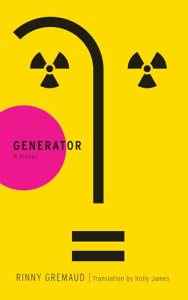 “I was born in 1977 at a nuclear power plant in the south of South Korea,” the unnamed narrator opens. She and her mother then moved to Switzerland with her stepfather. In 2017, news of Korea’s plans to decommission the Kori 1 reactor prompts her to trace her birth father, who was a Welsh engineer on the project. As a way of “walking my hypotheses,” she travels to Wales, Taiwan (where he had a wife and family), Korea, and Michigan, his last known abode. In parallel, she researches the history of nuclear power. By riffing on the possible definitions of generation, this lyrical autofiction comments on creation and legacy. Full Foreword review forthcoming. (Schaffner Press, Jan. 7) [197 pages] (PDF review copy)
Eradication: A Fable by Jonathan Miles
 This taut, powerful fable pits an Everyman against seemingly insurmountable environmental and personal problems. Who wouldn’t take a job that involves “saving the world”? Adi, the antihero of Jonathan Miles’s fourth novel, is drawn to the listing not just for the noble mission but also for the chance at five weeks alone on a Pacific island. Santa Flora once teemed with endemic birds and reptiles, but many species have gone extinct because of the ballooning population of goats. He’s never fired a gun, but the mysterious “foundation” was so desperate it hired him anyway. It’s a taut parable reminiscent of T.C. Boyle’s When the Killing’s Done. My full Shelf Awareness review is here. (riverrun, 5 Feb. / Doubleday, Feb. 10) [176 pages] (Read via Edelweiss)
Vessel: The shape of absent bodies by Dani Netherclift
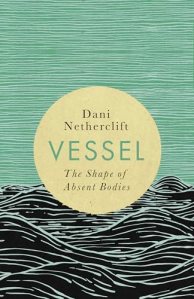 One scorching afternoon in 1993, the author’s father and brother drowned while swimming in an irrigation channel near their Australia home. A joint closed-casket funeral took place six days later. Eighteen at the time, Netherclift witnessed her relatives’ disappearance but didn’t see their bodies. Must one see the corpse to have closure? she wonders. “The presence of absence” is an overarching paradox. There are lacunae everywhere: in her police statement from the fateful day; in her journal and letters from that summer. The contradictions and ironies of the situation defy resolution. Full Foreword review forthcoming. (Assembly Press, Jan. 13) [184 pages] (PDF review copy)
Vigil by George Saunders
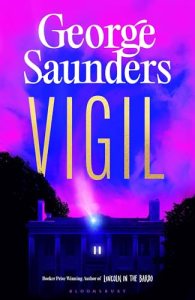 Impossible not to set this against the exceptional Lincoln in the Bardo, focused as both are on the threshold between life and death. Unfortunately, the comparison is not favourable to Vigil. A host of the restive dead visit the dying to offer comfort at the end. Jill Blaine’s life was cut short when she was murdered by a car bomb in a case of mistaken identity. Her latest “charge” is K.J. Boone, a Texas oil tycoon who not only contributed directly to climate breakdown but also deliberately spread anti-environmentalist propaganda through speeches and a documentary. As he lies dying of cancer in his mansion, he’s visited by, among others, the spirits of the repentant Frenchman who invented the engine and an Indian man whose family perished in a natural disaster. I expected a Christmas Carol-type reckoning with climate past and future; in resisting such a formula, Saunders avoids moralizing – oblivion comes for the just and the unjust. However, he instead subjects readers to a slog of repetitive, half-baked comedic monologues. I remain unsure what he hoped to achieve with the combination of an irredeemable character and an inexorable situation. All this does is reinforce randomness and hopelessness, whereas the few other Saunders works I’ve read have at least reassured with the sparkle of human ingenuity. YMMV. (Bloomsbury / Random House, 27 Jan.) [192 pages] (Read via NetGalley)
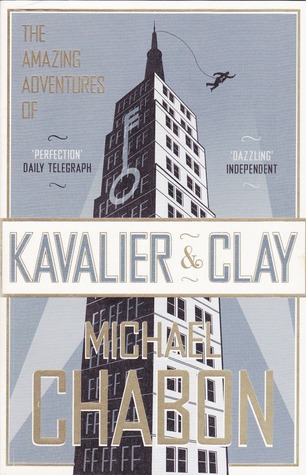
The Amazing Adventures of Kavalier & Clay by Michael Chabon (Doorstopper of the Month)
Annabel and I did a buddy read of The Amazing Adventures of Kavalier & Clay by Michael Chabon; at 636 pages, it worked out to roughly 21 pages a day for the whole month of May. As I went along I summarized each day’s reading on Twitter, so to make things super-easy for myself, especially while I’m away in the States, I’ve put this post together as a collection of tweets.
There’s a lot of plot summary here, and perhaps some spoilers, so if you plan to read the novel you might not want to read too closely. I’ve set out my more general reactions in bold.
6:12 am – 1 May 2019
Kavalier & Clay, #1: Oct. 1939. Teen cousins Sam (American) and Josef (Czech) meet up in Brooklyn. Both dream of fame and fortune, Josef through drawing; Sam through any old scheme. Lots of ref’s to illusionists. Great adjectives and metaphors. Reminds me of The Invisible Bridge.
(Coincidentally, while I was at the Wellcome Collection yesterday I browsed their current exhibit on magic and illusions and there was a vintage Houdini poster advertising one of his famous escapes.)
K&C, #2: Flashback to Josef’s illusionist training under Bernard Kornblum c. 1935. Goaded by his little brother, Thomas, Josef practiced a Houdini-style underwater escape after jumping off a bridge tied up in a laundry bag. Disaster nearly ensued. Madcap and sobering all at once.
K&C, #3: Josef escapes Prague in a coffin housing a golem [animated humanoid figure made of clay]. He has a premonition of the horror to come for the Jews. Close shaves, but he makes it to Brooklyn — as we already know. Looking forward to getting back to NYC and Sam in Part II.
K&C, #4: Brief history of comics in America. Superman was a watershed in 1938. Sam pitches an idea to half-dressed boss Sheldon Anapol and shows Joe’s quick sketch of a golem-like hero. Though skeptical, he decides to give them the weekend to come up with a complete 12-page comic.
K&C, #5: Sam enlists the Glovsky brothers to work for him. We get the story of his late father, a vaudeville strong man named ‘The Mighty Molecule’. Joe breaks into locked premises with a flourish, inspiring The Escapist. Over 1/6 through! Hankering for a proper female character.
K&C, #6: Well, we got a female, Rosa Luxembourg Saks, but so far she hasn’t said a word and is only an object of the male gaze. J draws her nude for $3. My interest waned in Ch. 8 as S and J develop a backstory for The Escapist. He is to free the oppressed with his Golden Key.
K&C, #7: With 5 helpers, S&J pull all-nighters to piece together a 1st issue of Masked Men with mult. 12-pp stories. J draws the Escapist punching Hitler for the cover. Anapol makes them a good offer but wants a new cover. It’s a deal breaker; S&J walk out. Great period dialogue.
K&C, #8: Part III, Oct. 1940. Empire Comics is a phenomenon. Anapol is now so rich he bought a house in FL. Joe toils away at his violent, audacious scenes and pesters the German consulate re: his family. After some bad news, he decides to move to Montreal so he can join the RAF.
K&C, #9: Joe has 2nd thoughts re: RAF. He now seems to cross paths with every pugilistic German in the city. He stumbles on the offices of the “Aryan-American League,” breaks in and learns that he has in Carl Ebling a fan in spite of himself. Sure I’ve heard that name before…
K&C, #10: Joe is so confident a ‘bomb’ on 25th fl. of Empire State Bldg is a bluff by his nemesis, Ebling, that he chains himself to his desk to keep working. S&J realize how foolish it was to sell rights to the Escapist: they won’t make a penny on the upcoming radio adaptation.
K&C, #11: S&J attend a party at which Salvador Dali is in a breathing apparatus. Rosa reappears, saying the F word. She’s empathetic re: J’s family. J plays the hero and saves Dali when he runs out of oxygen. Rosa invites him up to see her paintings (not a euphemism — I think!).
K&C, #12 (catch-up): Rosa paints still lifes and has a room full of moths, a sort of family plague. She sets Joe’s dislocated finger and, via her work for the Transatlantic Rescue Agency, may be able to help him save his brother. They share a kiss before Sam interrupts them.
K&C, #13: Rosa’s boss agrees to help Joe if he pays 3x the regular fare for Thomas … and is the magician for his son’s bar mitzvah. Joe’s new idea for a sexy female superhero is inspired by a Luna moth. He and Sam try to bargain for a greater share of the rights to their work.
K&C, #14-15 (somehow got ahead!): 1941. S&J so rich they don’t know what to do with the $. Sharing apt. with Rosa, who keeps trying to find S a girlfriend. J is performing magic at parties; S is writing a novel, takes a radio actor auditioning for Escapist home to Shabbos dinner.
Some general thoughts at the halfway point, while I’m ahead: delighted to have a solid female character in Rosa, and more interiority with Sam in Part IV. (There are also intriguing hints about his sexuality.) Chabon is an exuberant writer; the novel could definitely be shorter.
K&C, #16: Joe is carrying around an unopened letter from his mother. At one of his bar mitzvah magician gigs, Ebling attacks him with an explosive and both incur minor injuries. The letter mysteriously disappears…
K&C, #17: Sam is a volunteer plane spotter for the war effort, giving him a vantage point high above NYC. Actor Tracy Bacon surprises him by joining him up there at 1 a.m. one day. Literal sparks fly.
K&C, #18: Sam meets Orson Welles, whose “Citizen Kane” is a huge influence on the lads’ work — they want to write for adults more than kids now. Tracy accompanies Sam to his favorite place in NYC: the site of the former World’s Fair. (Traveling tomorrow but will catch up soon.)
Sigh. I hugely lost momentum after we arrived in the States on Sunday. I’ve caught up, but (confession time) have had to do a lot of skimming. I find the dialogue a lot more engaging than the expository prose, unfortunately.
K&C #19-25: Awful news about the ship bearing Joe’s brother. Both Joe and Rosa decide to take drastic action. Carl Ebling is imprisoned for 12 years for the bar mitzvah bombing. J is stationed near the Antarctic as a radioman. JUMP to 1954, with S raising a 12yo kid named Tommy.
K&C, #26: We realize Sam and Rosa have formed an unusual family with her child Tommy, who’s learning magic tricks from Joe, who makes a failed jump…
K&C wrap-up: Joe’s living in the Empire State Building, writing a novel about a golem. Anapol kills off the Escapist. In ’54, Sam appears at a televised hearing about whether comic books create delinquents. He decides to start over in CA, leaving Joe, Rosa and Tommy a family of 3
K&C wrap-up (cont.): I did occasional skimming starting at ~p. 120 and mostly skimmed from p. 400 onwards, so I’ve marked the whole thing as ‘skimmed’ rather than ‘read’. Slightly disappointed with myself for lacking staying power, but I do think the book overlong.
The action should have been condensed, rather than sprawling over 15 years. I often lost patience with the expository prose and wanted more scenes and dialogue. It took too long for Rosa to appear, and too long to get initiated into Sam’s private life.
However, Chabon does have some wonderful turns of phrase. Here’s a few faves. “The view out the windows was pure cloud bank, a gray woolen sock pulled down over the top of the building.”
“Orderly or chaotic, well inventoried and civil or jumbled and squabbling, the Jews of Prague were dust on the boots of the Germans, to be whisked off with an indiscriminate broom.”
“Sammy felt that he was standing on the border of something wonderful, a land where wild cataracts of money and the racing river of his own imagination would, at last, lift his makeshift little raft and carry it out to the boundless freedom of the open sea.”
My favorite passage of all: “Dinner was a fur muff, a dozen clothespins, and some old dish towels boiled up with carrots. The fact that the meal was served with a bottle of prepared horseradish enabled Sammy to conclude that it was intended to pass for braised short ribs of beef”
I also discovered that Chabon coined a word in the novel: “aetataureate,” meaning related to a golden age. It’s a good indication of the overall tone.
My rating: 
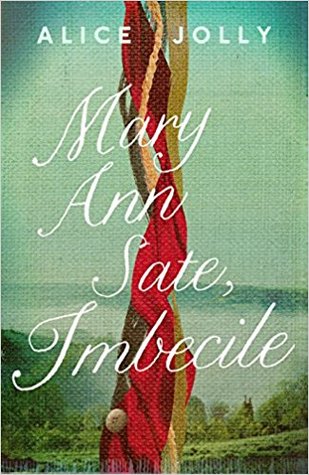 The other doorstopper I finished reading this month was Mary Ann Sate, Imbecile by Alice Jolly, which I reviewed for Nudge. I had heard about this Unbound release before, but my interest was redoubled by its shortlisting for the Rathbones Folio Prize and the RSL Ondaatje Prize. Although I was initially intimidated by the heft of the 600+-page hardback that came through my door for review, I found that I could easily settle into the rhythm and – provided I had no distractions – read 40 or 50 pages of it at a sitting.
As an elderly woman in Gloucestershire in the 1880s, Mary Ann Sate looks back at the events of the 1820s and 1830s, a time of social turmoil and upheaval in the family for whom she worked as a servant. Writing is a compulsion and a form of confession for her. The book has no punctuation, not even apostrophes, and biblical allusions, spelling errors, archaisms and local pronunciation (such as “winder” for window and “zummer” for summer) make it feel absolutely true to the time period and to the narrator’s semi-literate status.
There are no rhymes in this free verse epic, but occasionally Mary Ann comes out with some alliteration, perhaps incidental, or particularly poetic lines (“The road ahead unravel / Like a spool of canary thread / Taking me always away”) that testify to her gifts for storytelling and language, even though she made her living by manual labor for some seven decades.
The manner of the telling makes this a unique work of historical fiction, slightly challenging but very worthwhile. I would particularly recommend it to fans of Jane Harris’s The Observations.
My rating: 
Next month’s plan: The Stillness The Dancing by Wendy Perriam, passed on to me by Liz Dexter.
 Bookish Beck = Rebecca Foster. American transplant to England. Freelance proofreader and book reviewer.
 Bookish Beck