Just Okay for Me, Dawg
This was one of the catchphrases of long-time judge Randy Jackson on the reality TV show American Idol, which was my guilty pleasure viewing for a decade or more. The three recent books for which I provide short-ish reviews below have nothing much in common apart from the fact that I requested or accepted them from publishers and ended up feeling disappointed but like I still owed a review. You can consider them all  .
.
The Friendship Cure by Kate Leaver
(Duckworth, March 22nd)
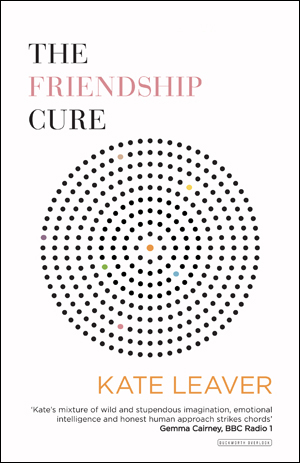 We’re in the middle of a loneliness epidemic, so friends are more important than ever. That’s the impetus for Kate Leaver’s jaunty, somewhat insubstantial book about modern friendship. She observes teen girls on the Tube and reflects on how we as primates still engage in social grooming – though language has replaced much of this more primitive bond-forming behavior. We experience a spike in our number of friends through adolescence and early adulthood, but friendships can fall by the wayside during our thirties as we enter long-term relationships and turn our attention to children and other responsibilities. Leaver argues that female friendships can amplify women’s voices and encourage us to embrace imperfection. She also surveys the bromance, mostly in its TV and film manifestations. There are plenty of pop culture references in the book; while I enjoy a Scrubs or Parks and Recreation scene or quotation as much as the next fan, the reliance on pop culture made the book feel lightweight.
Perhaps the most useful chapter was the one on online friendships (hi, book blogger friends!). We so often hear that these can’t replace IRL friendships, but Leaver sticks up for social media: it allows us to meet like-minded people, and is good for introverted and private people. Anything is better than isolation. The biggest problem I had with the book was the tone: Leaver is going for a Caitlin Moran vibe, and peppers in hip references to Taylor Swift, Lindsay Lohan and the like. But then she sometimes tries for more of a Mary Beard approach, yet doesn’t trust herself to competently talk about science, so renders it in matey, anti-intellectual language like “Robin [Dunbar, of Oxford University] did some fancy maths” (um, I think you mean “Dr. Dunbar”!) or “Let me hit you with a bit of research.”
Favorite lines:
“on some days, somewhere in our souls, we still count the number of social media connections as a measure of who we are”
“When you successfully recruit a new person into your friendship circle, you’re essentially confirming that you are a likable human being, worthy of someone’s time and emotional investment.”
You might choose to read instead: Kory Floyd’s The Loneliness Cure; Ann Patchett’s Truth and Beauty; Anna Quindlen’s essay “Girlfriends” from Lots of Candles, Plenty of Cake.
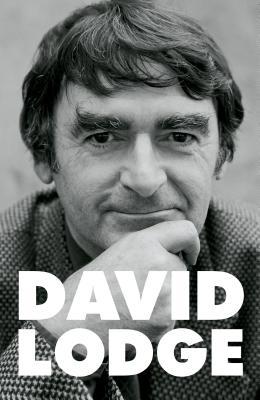
Writer’s Luck: A Memoir: 1976–1991 by David Lodge
(Harvill Secker, January 11th)
David Lodge has been one of my favorite authors for over a decade. His first memoir, Quite a Good Time to Be Born: A Memoir, 1935–1975 (see my Nudge review), is a good standalone read, even for non-fans, for its insight into the social changes of post-war Britain. However, this volume makes the mistake of covering much less ground, in much more detail – thanks to better record-keeping at the peak of his career – and the result is really rather tedious. The book opens with the publication of How Far Can You Go? and carries through to the reception of Paradise News, with a warning that he cannot promise a third volume; he is now 83. Conferences, lecture tours, and travels are described in exhaustive detail. There’s also a slightly bitter edge to Lodge’s attempts to figure out why ventures flopped or novels got negative reviews (Small World, though Booker-shortlisted, was better received in America), though he concludes that his career was characterized by more good luck than bad.
 I liked the account of meeting Muriel Spark in Italy, and valued the behind-the-scenes look at the contentious task of judging the 1989 Booker Prize, which went to Kazuo Ishiguro for The Remains of the Days. Especially enjoyable is a passage about getting hooked on saunas via trips to Finland and to Center Parcs, a chain of all-inclusive holiday activity camps in England. Oh how I laughed at his description of nude sauna-going in midlife (whether I was supposed to or not, I’m not sure): “The difference in pleasure between swimming wearing a costume of any kind and the sensation of swimming without one, the water coursing unimpeded round your loins as you move through it, cannot be exaggerated, and I first discovered it in Center Parcs.” I also cringed at the Lodges placing “our Down’s son” Christopher in a residential care home – I do hope thinking about disability has moved on since the mid-1980s.
Ultimately, I’m not sure Lodge has had an interesting enough life to warrant a several-volume project. He’s an almost reassuringly dull chap; “The fact is that I am constitutionally monogamous,” he admits at one point. Although it was fun for me to see the genesis of novels like Paradise News, I don’t think I’d have the stomach for reading any more about why Lodge thinks his star faded starting in the 1990s. However, I’ll keep this on the shelf to go back to for some context when I finally get around to rereading Small World and Nice Work.
Favorite lines:
“there has been a downside to the Prize Culture which the Booker engendered. It has warped the evaluation of new fiction by measuring success as if it were a competitive sport.”
You might choose to read instead: Lodge’s Quite a Good Time to Be Born or John Carey’s The Unexpected Professor: An Oxford Life in Books – overall the better autobiography of a working-class, bookish lad.
The Parentations by Kate Mayfield
(Point Blank [Oneworld], March 29th)
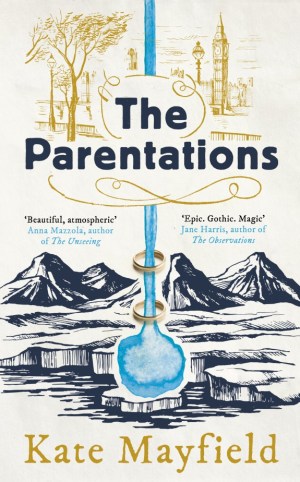 Sisters Constance and Verity Fitzgerald have been alive for over 200 years. A green pool in Iceland, first discovered in 1783, gives them “extended mortality” so long as they take the occasional two-week nap and only swallow two drops of the liquid at a time. In London in 2015, they eat a hearty stew by candlelight and wait for their boy to come. Then they try the churchyard: dead or alive, they are desperate to have him back. Meanwhile, Clovis Fowler is concealing extra phials of the elixir from her husband, their son and the maid. What’s going on here? We go back to Iceland in 1783 to see how the magic pool was first found, and then hop across to 1783 London to meet the sisters as children.
I read the first 67 pages, continued skimming to page 260, and then gave up. At well past the one-third point, the novel still hasn’t established basic connections. A book of nearly 500 pages has to hook the reader in sooner and more securely, not lull them with wordiness (case in point: on the first page of the first chapter, the adjective “macilent” – I looked it up and it means thin or lean, either of which would have been a far preferable word to use).
I could see faint echoes here of so many great books – Jonathan Strange and Mr. Norrell, A Discovery of Witches, Slade House, The Essex Serpent; works by Hannah Kent and Diane Setterfield, maybe even Matt Haig? I liked Mayfield’s memoir The Undertaker’s Daughter and had hoped for improvement with this debut novel. As it is, The Parentations has an interesting premise and lineage, but doesn’t deliver.
Favorite lines:
“His rage foments a decision. He will either take his place in the mounds of the dead, or he will find a good reason to stay alive.”
“Francis and Averil Lawless have impressed upon their daughters the concept of the consequences of a single moment, and there is no better teacher than the river’s majesty and its demand for respect for its waters, which can easily bring violence and ruin as well as wealth and peace.”
You might choose to read instead: Any of the literary fantasy novels listed above.
What books have disappointed or defeated you lately?
Christmas Gift Recommendations for 2017
Something tells me my readers are the sort of people who buy books for their family and friends at the holidays. Consider any rating of 3.5 or above on this blog a solid recommendation; 3 stars is still a qualified recommendation, and by my comments you should be able to tell whether the book would be right for you or a friend. I’ll make another plug for the books I’ve already mentioned here as gift ideas and highlight other books I think would be ideal for the right reader. I read all these books this year, and most were released in 2017, but I have a few backlist titles, too – in those cases I’ve specified the publication year. Since I recommend fiction all the time through my reviews, I’ve given significantly more space to nonfiction.
General suggestions:
 For the Shiny New Books Christmas special I chose two books I could see myself giving to lots of people. One was A Glorious Freedom: Older Women Leading Extraordinary Lives by Lisa Congdon, my overall top gift idea. It’s a celebration of women’s attainments after age 40, especially second careers and late-life changes of course. There’s a lively mixture of interviews, first-person essays, inspirational quotes, and profiles of figures like Vera Wang, Laura Ingalls Wilder and Grandma Moses, with Congdon’s whimsical drawings dotted all through. This would make a perfect gift for any woman who’s feeling her age, even if that’s younger than 40. (An essay on gray hair particularly hit home for me.) It’s a reminder that great things can be achieved at any age, and that with the right attitude, we will only grow in confidence and courage over the years. (See my full Nudge review.)
 One Year Wiser: An Illustrated Guide to Mindfulness by Mike Medaglia
Drawn like an adult coloring book, this mindfulness guide is divided into color-block sections according to the seasons and tackles themes like happiness, gratitude, fighting anxiety and developing a healthy thought life. The layout is varied and unexpected, with abstract ideas represented by bodies in everyday situations. It’s a fresh delivery of familiar concepts.


My thanks to SelfMadeHero for the free copy for review.
An Almost Perfect Christmas by Nina Stibbe
 With its short chapters and stocking stuffer dimensions, this is a perfect book to dip into over the holidays. The autobiographical pieces involve Stibbe begrudgingly coming round to things she’s resisted, from Slade’s “Merry Xmas Everybody” to a flaming Christmas pudding. The four short stories, whether nostalgic or macabre, share a wicked sense of humor. You’ll also find an acerbic shopping guide and – best of all – a tongue-in-cheek Christmas A-to-Z. Nearly as funny as Love, Nina. (I reviewed this for the Nov. 29th Stylist “Book Wars” column.)
For some reason book- and nature-themed books seem to particularly lend themselves to gifting. Do you find that too?
For the fellow book and word lovers in your life:
 The Diary of a Bookseller by Shaun Bythell
It’s a pleasure to spend a vicarious year running The Book Shop in Wigtown, Scotland with the curmudgeonly Bythell. I enjoyed the nitty-gritty details about acquiring and pricing books, and the unfailingly quirky customer encounters. This would make a great one-year bedside book. (See my full review.)
The Cabinet of Linguistic Curiosities: A Yearbook of Forgotten Words by Paul Anthony Jones
 Another perfect bedside book: this is composed of daily one-page entries that link etymology with events from history. I’ve been reading it a page a day since mid-October. A favorite word so far: “vandemonianism” (rowdy, unmannerly behavior), named after the penal colony of Van Diemen’s Land (Tasmania), first sighted by Europeans on 24 November 1642.
“The Gifts of Reading” by Robert Macfarlane (2016)
 This was my other Christmas recommendation for Shiny New Books. A love of literature shared with friends and the books he now gifts to students and a new generation of nature writers are the main themes of this perfect essay. First printed as a stand-alone pamphlet in aid of the Migrant Offshore Aid Station, this is just right for slipping in a stocking.
A Girl Walks into a Book: What the Brontës Taught Me about Life, Love, and Women’s Work by Miranda K. Pennington
 This charming bibliomemoir reflects on Pennington’s two-decade love affair with the work of the Brontë sisters, especially Charlotte. It cleverly gives side-by-side chronological tours through the Brontës’ biographies and careers and her own life, drawing parallels and noting where she might have been better off if she’d followed in Brontë heroines’ footsteps.
For the nature enthusiasts in your life:
 A Sand County Almanac and Sketches Here and There by Aldo Leopold
Few know how much of our current philosophy of wilderness and the human impact on the world is indebted to Aldo Leopold. This was first published in 1949, but it still rings true. A month-by-month account of life in Wisconsin gives way to pieces set everywhere from Mexico to Manitoba. Beautiful, incisive prose; wonderful illustrations by Charles W. Schwartz.
The History of Bees by Maja Lunde
 Blending historical, contemporary and future story lines, this inventive novel, originally published in Norway in 2015, is a hymn to the dying art of beekeeping and a wake-up call about the environmental disaster the disappearance of bees signals. The plot strands share the themes of troubled parenthood and the drive to fulfill one’s purpose. Like David Mitchell, Lunde juggles her divergent time periods and voices admirably. It’s also a beautifully produced book, with an embossed bee on the dust jacket and a black and gold honeycomb pattern across the spine and boards. (See my full Bookbag review.)
 Epitaph for a Peach: Four Seasons on My Family Farm by David Mas Masumoto (1995)
Masumoto is a third-generation Japanese-American peach and grape farmer in California. He takes readers on a quiet journey through the typical events of the farming calendar. It’s a lovely, meditative book about the challenges and joys of this way of life. I would highly recommend it to readers of Wendell Berry.
A Wood of One’s Own by Ruth Pavey
 This pleasantly meandering memoir, an account of two decades spent restoring land to orchard in Somerset, will appeal to readers of modern nature writers. Local history weaves through this story, too: everything from the English Civil War to Cecil Sharp’s collecting of folk songs. Bonus: Pavey’s lovely black-and-white line drawings. (See my full review.)
It’s not just books…
There are terrific ideas for other book-related gifts at Sarah’s Book Shelves and Parchment Girl.
 With this year’s Christmas money from my mother I bought the five-disc back catalogue of albums from The Bookshop Band. I crowdfunded their nine-disc, 100+-track recording project last year; it was money extremely well spent. So much quality music, and all the songs are based on books. I listen to these albums all the time while I’m working. I look forward to catching up on older songs I don’t know. Check out their Bandcamp site and see if there’s a physical or digital album you’d like to own or give to a fellow book and music lover. They played two commissioned songs at the launch event for The Book of Dust: La Belle Sauvage, so if you’re a Philip Pullman fan you might start by downloading those.
Would you like to give – or get – any of my recommendations for Christmas?
Young Writer of the Year Award: Shortlist Readings Event
On Saturday I attended an exclusive bloggers’ event at the Groucho Club in London with four of the authors shortlisted for the Sunday Times / Peters Fraser + Dunlop Young Writer of the Year Award (Sally Rooney was unable to make it from Dublin). Also in attendance were fellow shadow panelists Annabel and Clare and some other notable names from the UK blogging community, including Eric Karl Anderson and Naomi Frisby. It was lovely to meet them, and Annabel, for the first time, and to have time to chat with the shortlisted authors.

That’s me with Clare and Annabel. Thanks to Eric Karl Anderson for taking the photo.
The event was chaired by Robert Collins, a former deputy literary editor of the Sunday Times now with Intelligence Squared. Each author gave a short reading from their book and answered questions from the chair and the audience. In every case, what I heard helped me appreciate the work and the author more. All four writers were so funny and warm, and seemed equally humbled and delighted to be in the running for this award.
Minoo Dinshaw reminded me of an Oxford don twice his age. (Indeed, his father is an Oxford don, and his mother is Scottish writer Candia McWilliam, so he has a proud literary pedigree.) He first became aware of Steven Runciman as a child when he and his mother spotted the wizened old man in a hotel lobby in Edinburgh, where they had traveled for the book festival. He then read Runciman’s Crusades books at school, and when in 2011 he met Runciman’s niece and she asked him to write the biography, he said he couldn’t think of anything else he wanted to do. (And still can’t.) Reading from his Kindle as “I didn’t want to break my wrist” (!), he chose a late passage featuring Steven in his nineties. Dinshaw said that while writing about Runciman he felt by turns flirted with and accused. Living in his subject’s house, working in his library, even sleeping in his bed (just the once), he felt he “had a very strange ghost in my life.” Dinshaw said the project captured his attention because he’s romantic and competitive, but that he’d like to try writing fiction in the future.
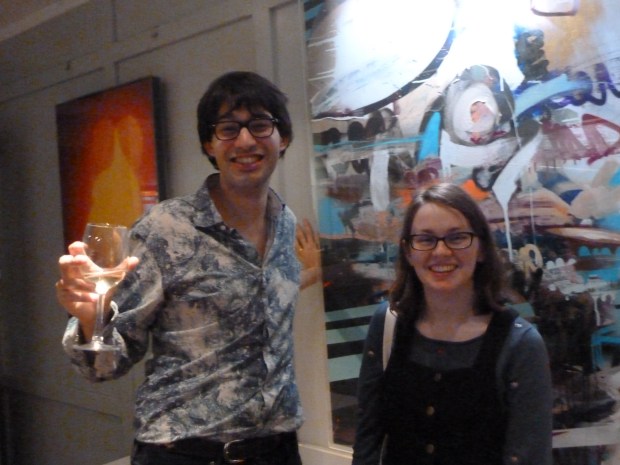
Clare with Minoo Dinshaw. Photo by Annabel Gaskell.
Julianne Pachico read a party scene from “The Tourists,” as it’s approaching the festive season. I was intrigued to learn that the interlinking structure of her book only emerged late on in the editing process; she’d originally meant to write a post-apocalyptic novel set all in one house, but found that setting too limiting. “I sort of work it out as I go along,” she said. So is it short stories or a novel? She’s sick of this question! Really she just wanted to write the kind of book she likes to read, citing Jennifer Egan’s A Visit from the Goon Squad and David Mitchell’s Ghostwritten as examples. Asked about her mentors, Pachico cited her mother, who told her “you’ll never be lonely, you’ll never be bored” as long as you read; and her first tutor, Andrew Cowan, who told her no one out there was writing anything like her story “Junkie Rabbit” – just the affirmation she needed. With all that’s happened in 2017, Pachico said she plans to turn to writing as a way “to outcreate the abyss” (a phrase from her twin sister, who’s also a writer). Pachico also teaches creative writing at Sheffield Hallam.

Julianne Pachico signing my book. Photo by Annabel Gaskell.
(As Sally Rooney was not in attendance, Collins read on her behalf a passage about Frances and Bobbi’s early friendship at school.)
 Claire North, aka “Cat” (real name: Catherine Webb; her fantasy and science fiction books are under various names) was in a way the odd one out at this event. Collins opened by saying that this award is all about getting in on the ground level with these writers, several of whom are debut authors. But North is a teen phenom who published her first book at age 14 and is set to release #20 next year. All along her parents called her a freak and demanded that she get her GCSEs and go to uni because writing “isn’t a proper job” (“but we’re very proud of you!” they’d usually append). She’s experienced the full gamut of responses over the years: some swore she wouldn’t have anything to say until age 40; others sighed that once she turned 18 she could no longer be marketed as “young.” She read the perfect passage from The End of the Day: a frantic, bravura account of the riders of the apocalypse together on a plane. She loves that science fiction “makes the extraordinary domestic” and playing with death appealed to her “flippant nature.” Charlie is, she thinks, the kindest character she’s ever written.
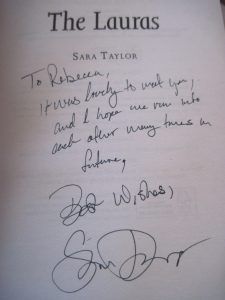 Sara Taylor read from one of Ma’s earliest stories about how her parents met. She wrote The Lauras while she was supposed to be completing her PhD thesis on censorship in American literature. At the time she was coming to terms with the fact that she was going to be staying in the UK, as well as remembering family road trips and aspects of her relationship with her mother that she wishes were otherwise. Her agent wasn’t comfortable with the focus on an “agender” character, but Taylor held firm. She’s used to ignoring the advice her (older, male) professors and advisors tend to give her. Instead, she gets tips from her ten-years-younger sister back in the States, who knows exactly how to “fix” her work. Taylor feels the USA is 5–10 years behind the UK on gender issues, and revealed that The Lauras is a response to the novel Love Child (1971) by Maureen Duffy. She has recently finished her third novel and hopes to get back into teaching since writing non-stop for nine months makes her “go a little funny.”
This was such a special event. There were no more than 20 people in the room, and at the end I got a chance to speak to each of the authors as they signed my books. I normally get shy in such situations, but everyone was completely approachable. (Sara Taylor and I confirmed that we were indeed on the same study abroad program to England, a few years apart, so spent some time reminiscing about Reading and our formerly women-only colleges. Her mother went to Hood College, my alma mater – thus the brief mention of it in The Lauras.)


Important upcoming dates:
- November 24th: shadow panel meeting in London
- November 27th: deadline for shadow panel winner decision
- November 29th: shadow panel winner announced on STPFD website
- December 3rd: shadow panel winner announced in Sunday Times
- December 7th: prize-giving ceremony at the London Library
I’ll be aiming to post my last couple of reviews on Wednesday.
A Few Spooky Reads for Halloween
I’m not at all one for scary books; horror and even crime fiction rarely make it onto my reading agenda. But in advance of Halloween I did read a few books that would count as creepy. Maybe you’ll fancy picking one of them up today?
Ghost Stories of an Antiquary, Vol. II by M.R. James
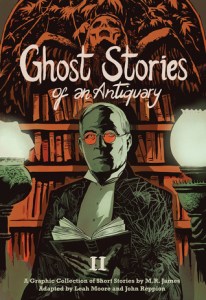 I’ve only ever read one M.R. James piece before, in an anthology of stories about libraries. This was perhaps not an ideal way to encounter his ghost stories for the first time. Though all four (“Number 13,” “Count Magnus,” “Oh, Whistle and I Will Come to You, My Lad” and “The Treasure of Abbot Thomas”) are adapted by the same pair, Leah Moore and John Reppion, each is illustrated by a different artist, so the drawing style ranges from rounded and minimalist to an angular, watercolor Marvel style. The stories have thematic links of research, travel, archaeological discovery and antiquities. Very often there are found documents that must be interpreted. Several narrators are scholars coming across unexplained phenomena: a hotel room that appears and disappears, a sarcophagus lid that opens on its own, a storm summoned by a whistle, and so on.
In a brief introduction, Jason Arnopp applauds the decision to “show readers the ghouls and ghosts,” but I disagree – to me a central problem with using the graphic form for these tales that center around nameless horror is that depicting the source of horror saps it of its power. Still, I appreciated the introduction to James’s ghost stories.
My rating:
With thanks to SelfMadeHero for the free copy for review.
Devil’s Day by Andrew Michael Hurley
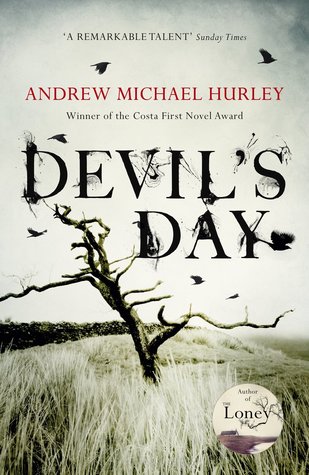 In Hurley’s Lancashire farmland setting, Devil’s Day is a regional Halloween-time ritual when the locals serve up the firstborn lamb of spring as a sacrifice to ward off the Devil’s shape-shifting appearance in the human or animal flock. Is it all a bit of fun, or necessary for surviving supernatural threat? We see the year’s turning through the eyes of John Pentecost, now settled back on his ancestral land with his wife, Kat, and their blind son, Adam. However, he focuses on two points from his past: his bullied childhood and a visit home early on in his marriage that coincided with the funeral of his grandfather, “the Gaffer”. The Endlands is a tight-knit community with a long history of being cut off from everywhere else, which makes it an awfully good place to keep secrets.
The first and last quarters of the book flew by for me, while the middle dragged a bit. The rural atmosphere and the subtle air of menace reminded me of Elmet and Bellman and Black. I’ll certainly seek out Hurley’s acclaimed debut, The Loney. [Read via NetGalley]
Favorite lines:
“Nothing changed in Underclough. Nothing happened. Not really. … elsewhere was always a place where the worst things happened. … The world outside the valley might well collapse but we wouldn’t necessarily feel the ripples here.”
My rating: 
Slade House by David Mitchell
“If I could just see a ghost, just once … Just one ghost, so I know that death’s not game over, but a door.”
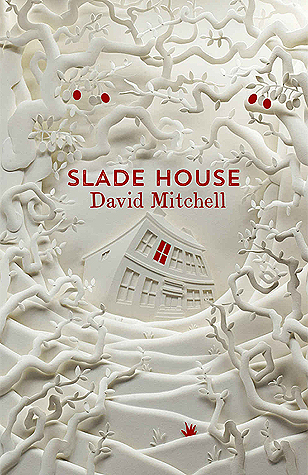 This was so cool! I feel like I’d never experienced a “real” Mitchell book before (having only read The Thousand Autumns of Jacob de Zoet, which is in some ways the odd one out), and I was impressed by how he brings everything together in this short novel. Every nine years between 1979 and 2015, a different visitor gets sucked into the treacherous world-within-a-world of the Grayer twins’ Slade House. This dilapidated mansion located off an unassuming alley morphs to fit each guest’s desires. To reveal more would spoil the fun, so I’ll just say that I love how Mitchell lulls you into a pretty horrific pattern before springing a couple of major surprises in later chapters. Each time period and narrator feels distinct and believable, and I’m told one character is from two other Mitchell novels (and the phrase “bone clock” even makes an appearance). I need to pick up Cloud Atlas soon for sure. [Public library copy]
My rating: 
Recommended spooky listening: The album That Ghost Belongs to Me by The Bookshop Band – all songs inspired by scary books.
Did you read anything scary this Halloween season?
Library Checkout Reboot
The Library Checkout blog meme was created by Shannon of River City Reading and previously hosted by Charleen of It’s a Portable Magic. I’m taking over as the host as of this month. There’s nothing too complicated about this challenge; it’s just a way of celebrating the libraries that you frequent, whether that’s your local public library branch or another specialist library. Maybe keeping track of your borrowing habits will encourage you to make even more use of libraries. Use ’em or lose ’em, after all.

I usually post this on the last Monday of the month, but you can post whenever is convenient for you. I’ll look into a proper link-up service, but for now just paste a link to your own post in the comments. (Feel free to use the above image, too.) The basic categories are: Library Books Read; Currently Reading; Checked Out, To Be Read; On Hold; and Returned Unread. Others I sometimes add are Skimmed Only and Returned Unfinished. I generally add in star ratings and links to reviews of any books I’ve managed to read.
A couple of weeks ago I went nuts at the university library on my husband’s campus. As a staff member he can borrow 25 books pretty much indefinitely (unless they’re requested). One or both of us has been associated with the University of Reading for over 15 years now, so the library there is a nostalgic place I love visiting. It’s technically currently undergoing a major renovation, but the books are still available, so it doesn’t make much difference to me.
LIBRARY BOOKS READ
- Interlibrary Loan Sharks and Seedy Roms: Cartoons from Libraryland by Benita L. Epstein
 (So dated, I’m afraid! A few good ones, though.)
 - Fall Down 7 Times, Get Up 8 by Naoki Higashida
- Autumn by Karl Ove Knausgaard

- A Sand County Almanac by Aldo Leopold [university library]

SKIMMED ONLY
- Option B by Sheryl Sandberg and Adam Grant
CURRENTLY READING
- Slade House by David Mitchell
- Halfway to Silence by May Sarton [poetry; university library]
CHECKED OUT, TO BE READ
A manageable selection from the public library:
Plus loads of books from lots of different genres from the university library; these will keep me going well past Christmas, I reckon!


RETURNED UNFINISHED
- The Seventh Function of Language by Laurent Binet
Have you been taking advantage of your local libraries? What appeals from my library stacks?
The Best Fiction of 2015: My Top 15
2015 was a great year for fiction, largely dominated by doorstoppers (like Death & Mr. Pickwick and City on Fire, in addition to the Franzen and Yanagihara listed below) and Harper Lee. I’ve decided to pass on Go Set a Watchman, but I’ve read plenty of the year’s big-name fiction, as well as some more obscure titles I’d like to bring to your attention.
As difficult as it is to pit books against each other and come up with a numbered list, I’ve given it a go and come up with my top 15 fiction works of the year. To keep it simple for myself and straightforward for potential readers, I’m limiting myself to two sentences per title: the first is a potted summary; the second tells you why you should read it. I also link to any full reviews.
Let the countdown begin!
- The Shore
 by Sara Taylor: Gritty and virtuosic, this debut novel-in-13-stories imagines 250 years of history on a set of islands. Every region needs a literary chronicler, and I reckon Taylor – channeling David Mitchell with her cross-centuries approach – is it for the Eastern Shore of Maryland and Virginia’s islands.
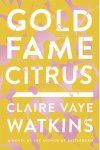 Gold Fame Citrus by Claire Vaye Watkins: Gold, fame, citrus: reasons people once came to California; now, only a desperate remnant remains in the waterless wasteland. As a smart, believable dystopian with a family at its heart, this trumps any of last year’s efforts (like Station Eleven or California).
 Preparation for the Next Life by Atticus Lish: Like West Side Story, this debut novel is an updated Romeo and Juliet narrative – a tragedy-bound love story with a grimy contemporary setting and a sobering message about racism and the failure of the American dream. The matter-of-fact style somehow manages to elevate the everyday and urban into an art form. (Reviewed for Third Way magazine in August.)
- Circling the Sun
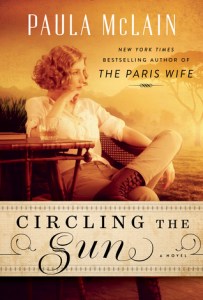 by Paula McLain: Before she ever thought of flying solo across the Atlantic, aviatrix Beryl Markham was just Beryl Clutterbuck: raised in Kenya, one of Africa’s first female horse trainers, its first professional female pilot, and the other side of the love triangle featuring Karen Blixen (Isak Dinesen) and Denys Finch Hatton. McLain describes her African settings beautifully, and focuses as much on the small emotional moments that make a life as she does on its external thrills.
 Kitchens of the Great Midwest by J. Ryan Stradal: One of my favorite debuts of the year: a culinary-themed collection of short stories loosely linked through the character of Eva Thorvald, a young chef with an unfortunate past and a rare palate. Read it for a glimpse of how ordinary, flawed Americans live – no fairytale endings here.
 Hausfrau by Jill Alexander Essbaum: This arresting debut reads like a modern retelling of Madame Bovary, with its main character a desperate American housewife in Zurich. Watch Anna’s trajectory with horror, but you cannot deny there is a little of her in you.
 The Versions of Us by Laura Barnett: In this impressively structured, elegantly written debut, Barnett chronicles the romantic lives of two Cambridge graduates through three-quarters of a century, giving three options for how their connection might play out. There is no one perfect person or story: unsentimental this may be, but it feels true to how life works. (Reviewed for Third Way magazine in July.)
 Fates and Furies by Lauren Groff: An incisive study of a marriage, beautifully written and rich with allusions to Shakespeare and Greek mythology. Groff makes it onto a short list of women I expect to produce the Great American Novel (along with Curtis Sittenfeld, Jennifer Egan, and Hanya Yanagihara).
 Purity by Jonathan Franzen: East Germany, Bolivia and Oakland, California: Franzen doesn’t quite pull all his settings and storylines together, but this is darn close to a 5-star Dickensian read. It’s strong on the level of character and theme, with secrecy, isolation and compassion as recurring topics.
 You Too Can Have a Body Like Mine by Alexandra Kleeman: Kleeman’s first novel is a full-on postmodern satire bursting with biting commentary on consumerism and conformity. Think of her as an heir to Dave Eggers and Douglas Coupland, with a hefty dollop of Margaret Atwood thrown in.
 The Animals by Christian Kiefer: Kiefer’s second novel contrasts wildness and civilization through the story of a man who runs an animal refuge to escape from his criminal past. A tough opening sequence establishes themes that will be essential to the novel: the fine line between instincts and decisions, the moral dilemmas involved in environmentalism, and the seeming inescapability of violence.
 The Tsar of Love and Techno by Anthony Marra: A collection of tightly linked short stories giving an intimate look at Russia and Chechnya in wartime and afterwards – revealing how politics, family, and art intertwine. Just as he did in his first novel, Marra renders unspeakable tragedies bearable through his warm and witty writing.
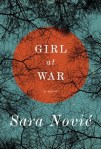 Girl at War by Sara Nović: This pitch-perfect debut novel is an inside look at the Yugoslavian Civil War and its aftermath, from the perspective of a young girl caught up in the fighting. The way Nović recreates a child’s perspective on the horrors of war is masterful: Ana’s viewpoint is realistic and matter-of-fact, without the melodrama an omniscient narrator might inject.
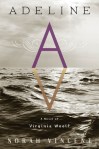 Adeline by Norah Vincent: Set in 1925–1941 and structured like a five-act play, the novel revolves around Virginia Woolf’s philosophical conversations with Leonard Woolf, Lytton Strachey and his lover Carrington, T.S. and Valerie Eliot, W.B. Yeats, and her doctor, Octavia Wilberforce. Vincent has produced a remarkable picture of mental illness from the inside.
- A Little Life
 by Hanya Yanagihara: Jude St. Francis: Dickensian orphan, patron saint of lost causes, Christlike Man of Sorrows, and one of the most memorable characters in recent fiction. This novel is an attempt to tackle the monolithic question of what makes life worth living; among the potential answers: love (though it doesn’t conquer all), friendship, creativity, and the family you create for yourself.
Best Discoveries of the Year: Mary Lawson (Road Ends), Daniel Kehlmann (F: A Novel), Jonathan Evison (This Is Your Life, Harriet Chance!) and Jonathan Coe (Number 11).
Debut Novelists Whose Next Work I’m Most Looking Forward to: Jessamyn Hope (Safekeeping – reviewed here in June) and Carmiel Banasky (The Suicide of Claire Bishop – reviewed for Foreword’s Fall 2015 issue).
 The Year’s Biggest Disappointments: Etta and Otto and Russell and James by Emma Hooper; Where My Heart Used to Beat by Sebastian Faulks and Avenue of Mysteries by John Irving (both rehash the authors’ familiar themes; I couldn’t make it past 15% in the latter).
Novels I Most Wish I’d Gotten to in 2015: Nell Zink’s Mislaid, Sara Baume’s Spill Simmer Falter Wither, and the final two volumes of Jane Smiley’s “Last Hundred Years” trilogy.
What are the best novels you read this year? Any new favorite books or authors? Your comments are always welcome.
I’ll be back tomorrow with my top 15 nonfiction books I read this year (most of them not published in 2015, however – I seem to have been a nonfiction slacker!)
 Bookish Beck = Rebecca Foster. American transplant to England. Freelance proofreader and book reviewer.
 Bookish Beck