#ShortStorySeptember, Meet #RIPXXI: Fremlin, M.R. James & Navarro
I can hardly believe it’s October; I still have a bunch of short stories to finish and review! I’m taking the opportunity to start on Readers Imbibing Peril with these three collections that crank up the suspense with their scenes of the unexplained.

Don’t Go to Sleep in the Dark by Celia Fremlin (1970)
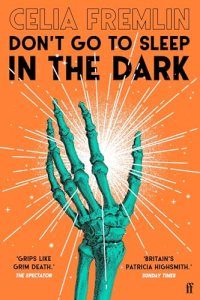
(Faber reprint: 2024)
I wasn’t wild about Fremlin’s Uncle Paul, but these 13 stories were terrific. Nightmares sometimes become reality as children and women of a certain age face up to threats, whether concrete or imaginary. The twist endings can reassure or unsettle, but in either case they call into question the tenor of what’s gone before. Only three tales are in the first person, with the other 10 in an authoritative third person. The need to protect children is a recurring impulse, ageing is a frequent cause of angst, and there are a couple of instances of frightening bird imagery (a nod to du Maurier?). There are also tweaks of horror story tropes – the haunted house in “The Hated House” and “The Locked Room.” Visual and auditory clues ramp up the tension. I’ll highlight a couple of favourites: “The Quiet Game,” in which a mother’s mental illness has dangerous implications for her twins; and “The Baby-Sitter,” about a little girl who’s afraid of The Hen with Great Big Eyes and her child-minder, who’s lived out her own horrors as a European refugee. This one is a fine example of how Fremlin mixes the everyday with suggestions of the supernatural. (Little Free Library) 
Ghost Stories of an Antiquary: A Graphic Collection of Short Stories by M.R. James, Volume I (2016)
(Adapted by Leah Moore and John Reppion)
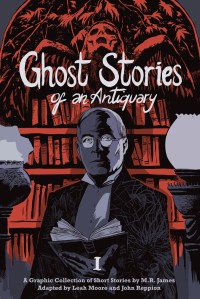 (I reviewed Volume II in 2017.) Though all retold by the same duo, these four stories are each illustrated by a different artist. So although the setup and voice tends to be samey – a dignified man investigating strange happenings at a country house – the art style varies significantly While I didn’t care for the approach in the first two (“Canon Alberic’s Scrap-Book” – Marvel; “Lost Hearts” – Pixar), the others, “The Mezzotint” and “The Ash-tree,” made up for it. I liked the monochrome palette, gentlemen detecting vibe, and Wildean mark of a morphing image of the former. In the latter, a Gothic setting and a history of suppressing witchcraft pave the way for unnatural spectacles. James’s classic ghost stories have been hugely influential on the likes of Susan Hill. (I also wondered if Stephen King borrowed the girl in the bath from “Lost Hearts” for The Shining.) Still, my conclusion about the second volume stands for the whole project: the “problem with using the graphic form for … tales that center around nameless horror is that depicting [what is feared] saps it of its power.”
With thanks to SelfMadeHero for the free copy of The Compendium (Volumes I and II) for review.
Blood Is Dripping onto the Courtyard by Elvira Navarro (2025; 2026)
[Translated from the Spanish by Christina MacSweeney]
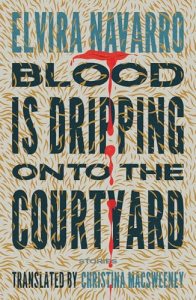 My introduction to Navarro, a Spanish author, reminded me most of Agustina Bazterrica’s 19 Claws and a Black Bird. These nine stories are full of derelict buildings, outsider characters, and traces of the uncanny. Seven are in the third person and two in first. A nice touch: two stories are linked in that they feature Almudena, who is studying in Paris. “The Fear of the City” is, we realize, the story she wrote about femicide, as mentioned, fittingly, in “The City of Fear.” “Idiotic Love” is narrated by a trans woman with an anal fissure and conjures a seedy world of nightclubs and sex shops. This was the longest story and not a pleasant one. There were just three standouts for me. In “The Washing Machine,” which contains the title line, a couple’s appliance keeps filling with blood for no reason. “The Animal Collector” is a tough one for animal lovers because of all the injuries and deaths, but the idea of a highway maintenance man assembling a makeshift zoo for his roadside rescues is alluring. Eventually, he becomes overwhelmed and compassion turns into a burden. In “A Small Bunch of Violets,” Mari chooses a new ornament for her father’s grave during a heat wave, but the flowers keep being displaced. There were too many so-so stories, though.
With thanks to Two Lines Press and publicist Nicolette Praça for the proof copy for review.
A Few Spooky Reads for Halloween
I’m not at all one for scary books; horror and even crime fiction rarely make it onto my reading agenda. But in advance of Halloween I did read a few books that would count as creepy. Maybe you’ll fancy picking one of them up today?
Ghost Stories of an Antiquary, Vol. II by M.R. James
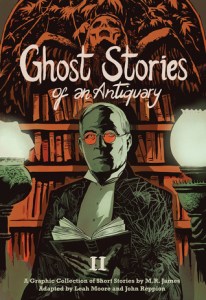 I’ve only ever read one M.R. James piece before, in an anthology of stories about libraries. This was perhaps not an ideal way to encounter his ghost stories for the first time. Though all four (“Number 13,” “Count Magnus,” “Oh, Whistle and I Will Come to You, My Lad” and “The Treasure of Abbot Thomas”) are adapted by the same pair, Leah Moore and John Reppion, each is illustrated by a different artist, so the drawing style ranges from rounded and minimalist to an angular, watercolor Marvel style. The stories have thematic links of research, travel, archaeological discovery and antiquities. Very often there are found documents that must be interpreted. Several narrators are scholars coming across unexplained phenomena: a hotel room that appears and disappears, a sarcophagus lid that opens on its own, a storm summoned by a whistle, and so on.
In a brief introduction, Jason Arnopp applauds the decision to “show readers the ghouls and ghosts,” but I disagree – to me a central problem with using the graphic form for these tales that center around nameless horror is that depicting the source of horror saps it of its power. Still, I appreciated the introduction to James’s ghost stories.
My rating:
With thanks to SelfMadeHero for the free copy for review.
Devil’s Day by Andrew Michael Hurley
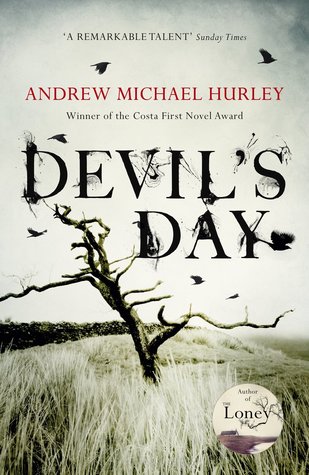 In Hurley’s Lancashire farmland setting, Devil’s Day is a regional Halloween-time ritual when the locals serve up the firstborn lamb of spring as a sacrifice to ward off the Devil’s shape-shifting appearance in the human or animal flock. Is it all a bit of fun, or necessary for surviving supernatural threat? We see the year’s turning through the eyes of John Pentecost, now settled back on his ancestral land with his wife, Kat, and their blind son, Adam. However, he focuses on two points from his past: his bullied childhood and a visit home early on in his marriage that coincided with the funeral of his grandfather, “the Gaffer”. The Endlands is a tight-knit community with a long history of being cut off from everywhere else, which makes it an awfully good place to keep secrets.
The first and last quarters of the book flew by for me, while the middle dragged a bit. The rural atmosphere and the subtle air of menace reminded me of Elmet and Bellman and Black. I’ll certainly seek out Hurley’s acclaimed debut, The Loney. [Read via NetGalley]
Favorite lines:
“Nothing changed in Underclough. Nothing happened. Not really. … elsewhere was always a place where the worst things happened. … The world outside the valley might well collapse but we wouldn’t necessarily feel the ripples here.”
My rating: 
Slade House by David Mitchell
“If I could just see a ghost, just once … Just one ghost, so I know that death’s not game over, but a door.”
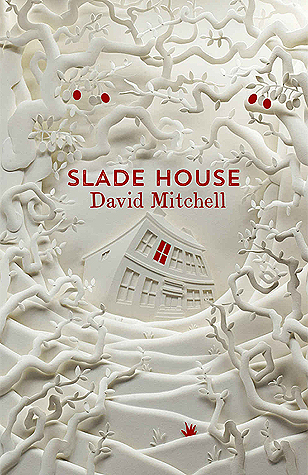 This was so cool! I feel like I’d never experienced a “real” Mitchell book before (having only read The Thousand Autumns of Jacob de Zoet, which is in some ways the odd one out), and I was impressed by how he brings everything together in this short novel. Every nine years between 1979 and 2015, a different visitor gets sucked into the treacherous world-within-a-world of the Grayer twins’ Slade House. This dilapidated mansion located off an unassuming alley morphs to fit each guest’s desires. To reveal more would spoil the fun, so I’ll just say that I love how Mitchell lulls you into a pretty horrific pattern before springing a couple of major surprises in later chapters. Each time period and narrator feels distinct and believable, and I’m told one character is from two other Mitchell novels (and the phrase “bone clock” even makes an appearance). I need to pick up Cloud Atlas soon for sure. [Public library copy]
My rating: 
Recommended spooky listening: The album That Ghost Belongs to Me by The Bookshop Band – all songs inspired by scary books.
 Bookish Beck = Rebecca Foster. American transplant to England. Freelance proofreader and book reviewer.
