20 Books of Summer, 18–20: Ayanna Lloyd Banwo, Sarah Hall, Meghan O’Rourke
Whew, it’s the final day of the challenge and I’ve managed to finish and write up a last batch of two novels and one nonfiction work: a magic realist tableau of love and death in Trinidad, a fateful romance set against the backdrop of the construction of an English dam in 1936, and a personal and cultural record of chronic illness and its treatment in contemporary America.
When We Were Birds by Ayanna Lloyd Banwo (2022)
 I was sent a copy as part of the McKitterick Prize shortlist. The setting of a cemetery, Fidelis in Port Angeles, Trinidad, had vaguely attracted me even before its nomination. Emmanuel Darwin has turned his back on his Rastafarian upbringing to cut off his dreadlocks and work as a gravedigger (any contact with the dead is anathema in the religion). Meanwhile, Yejide, who lives in the hills, is losing her mother, Petronella, and gaining a legacy she’s not sure she wants: the women of her family are caretakers of the souls of the dead, keeping them alive in exchange for protection. Like the corbeaux, dark counterparts of tropical parrots, they tread the border of life and death. As All Saints’ and All Souls’ Days draw closer, Darwin and Yejide together have to decide whether they will be swallowed by the graveyard or escape it. While this was atmospheric and had alluring elements, the speculative angle was not notably well realized and the particular form of patois – eschewing all possessives and most verb conjugations – drove me nuts. I skimmed this one. (Free from the Society of Authors)
Haweswater by Sarah Hall (2002)
I bought this in Cumbria one year and started reading it in Cumbria the next. Once I got home, however, there was little impetus to keep going. Were it not for the temporary local interest, I likely would not have finished this debut novel, which lurches between dry and melodramatic. As it is, I had to skim to the end. Had it been my first taste of Sarah Hall’s work, it might have put me off trying her again.
 The frame is historical: Haweswater was indeed dammed to provide water for the city of Manchester in 1936, flooding the village of Mardale. Hall focuses on the people of Mardale, specifically the Lightburn family, who have persisted with farming despite its particular challenges in this hilly landscape. When Jack Liggett comes out from the City on behalf of the waterworks, he meets with hostility, including from the Lightburns’ daughter, Janet, who negotiates for their tenancy to continue until the dam is actually built. Then, well, you know, Romeo and Juliet and pride and prejudice and all that, and they start an affair. Hall has always written forthrightly about sex, starting here.
There’s a climactic final 60 pages in which three major characters die, two in symbolic acts of suicide, but it was a little too much tragedy, too late, for me after the dull midsection. I was intrigued, however, that a plot point turns on golden eagles being in the valley, as Wild Fell, another of my Haweswater-set reads, opens with the presence of the ghost of England’s last golden eagle, who vanished in 2015. This related snippet shows how over-the-top Hall’s use of dialect is: “Golden eagles wud be mor’less gone, gone or illegal these days, like, notta funni bizniz t’be gittin’ mixed up in, eh? What kinda daft bugger d’yer take mi for?” It’s like Thomas Hardy rustics – hard to take seriously. (Anne-Marie Sanderson’s haunting song “Haweswater” is based on the novel.) (Secondhand – Clutterbooks, Sedbergh, 2022) 
The Invisible Kingdom: Reimagining Chronic Illness by Meghan O’Rourke (2022)
Well before I was a devoted follower of the Barbellion Prize for books on disability and chronic illness, I was interested in these topics. For much of her forties and fifties, my mother struggled with fibromyalgia, one of a suite of illnesses misunderstood or even dismissed by the medical profession (as O’Rourke puts it, with a tongue-in-cheek nod to Jane Austen: “it is a truth universally acknowledged among the chronically ill that a young woman in possession of vague symptoms like fatigue and pain will be in search of a doctor who believes she is actually sick”). I hope this National Book Award nominee goes some way toward convincing skeptics that these are real conditions to be addressed by listening to patients and treating them holistically.
 In 2012 the author became seriously ill and spent much of her thirties in a fog of pain, spending the equivalent of several days per month at doctors’ appointments and agreeing to ever more bizarre treatments in her desperation. Some of her issues were autoimmune and/or genetic: Hashimoto’s (thyroid), Ehlers-Danlos, POTS, endometriosis. She also dealt with infertility at the same time as she was trying to get well enough to contemplate having children. For her, the turning point was when she was diagnosed with Lyme disease and put on antibiotics. (Later she would travel to London to get fecal microbiota transplants to restore her microbiome.) Chronic Lyme is similar to long COVID, the true extent of which we’re only just beginning to understand; reading a list of the symptoms, I was tempted to remotely/retrospectively diagnose a few people I know with one or the other. It can be ever so slightly miserable reading about navigating all of these conditions, though nowhere near as miserable as it must have been for O’Rourke to live through them, of course.
I knew the author for her exquisite memoir of losing her mother to cancer, The Long Goodbye. Here the writing is more functional and journalistic, but I was still impressed by the attention she pays and the connections she draws; she’s also a poet, so she’s open to emotions and keen to capture them in words. In the face of the unexplained, she contends, chronically ill people are searching for meaning and narrative (restitution, chaos or quest, as Arthur Frank named the three options). She probes her own psyche: “had I become trapped in my identity as a sick person, someone afraid of living? If my mission in life had been reduced to being well at all costs, then the illness had won.” There’s a good balance of research, personal experience and general reflection in this one. (Passed along by Laura – thank you!) 
Related reads: Ill Feelings by Alice Hattrick, It’s All in Your Head by Suzanne O’Sullivan, Waiting for Superman by Tracie White
And that’s a wrap! My summer reading was a little scattered and not as thematic as initially planned, but I stuck to my pledge to read only print books that I owned, and then cleared half of them from my shelves through reselling or donating to the Little Free Library. I’ll definitely call that a win.
My favourite from the 20 was a novel, Search by Michelle Huneven, then Making the Beds for the Dead by Gillian Clarke (poetry), followed by two chef’s memoirs, A Cook’s Tour by Anthony Bourdain and Dirt by Bill Buford, and Dorthe Nors’ nature/travel essays. The one DNF and couple of skims are unfortunate, but these things happen.
Next year I fancy a completely open challenge – just, again, getting through books from my shelves. (Maybe all hardbacks?)
Sidle Creek by Jolene McIlwain (Blog Tour)
I’m a sucker for “dirty realism,” a term coined in the 1980s to encompass gritty stories of blue-collar Americana: Ron Rash, David Vann, Daniel Woodrell et al. (I wrote a whole article about it in 2013). It’s less common, certainly, to find women writing in this subgenre, and that feminine touch is part of what makes Sidle Creek unique. In this debut collection of 22 short stories, loosely linked by their location in the Appalachian hills in western Pennsylvania and a couple of recurring minor characters, Jolene McIlwain softens the harsh realities of addiction, poverty and violence with the tender bruises of infertility and lost love.
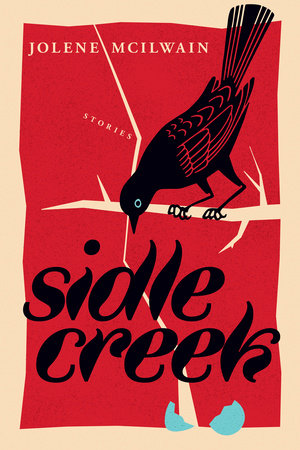
The title story, which opens the book, has a shifting first-person point-of-view, first telling us about and then putting us into the mind of Esme Andersen, who’s 20 in 1975. Various diagnoses have plagued her family, medical words that repeat as chants: hemorrhage, endometriosis. Superstitions around the creek cast it alternately as a potential site of harm or healing as her single father tries to help her deal with her severe periods. The cover image comes from “Shell,” in which Tiller Shanty reads signs in the markings on red-winged blackbird eggs. He learned his skill of divination from his Vietnamese wife, but conceals from her a portent about her future. It turns out there’s more than one way to lose a beloved.
Grief is a resonant theme in so many of the stories. “The Fractal Geometry of Grief” is a shining example. Hubert Ashe, a widowed mathematician, becomes obsessed with a doe and sets up trail cams and a feeding station to watch her. It’s not clear whether he believes the animal is a reincarnation of his wife or not, but it’s unwise to get so attached in a hunting area. In “Seeds,” a man finds a photograph of his dying wife as a girl and revisits the sadness of her life. “Steer,” one of the most affecting stories, has a middle-aged man hit by anxiety, unable to forget the death of one of their cattle back when he was 16. As horrific as the experience was, it made him receptive to both beauty and pain.
Animal suffering is indeed frequent – something that seems important to mention, as I know a lot of readers who avoid scenes of it whenever possible. In “Eminent Domain,” the electricity shed where teenagers used to go drinking is found to be full of slaughtered cats. It’s the prompt the protagonist needs to escape this dead-end town. “Loosed” is a masterpiece in the vein of Demon Copperhead (though much more violent) about a man who makes money on increasingly cruel sport: cock fighting, then dog fighting, then dirty fights between his own four sons. The flash forward that ends this one is devastating. I, too, am sensitive to reading about animal deaths, but the animal suffering only matches the human here. The nastiness of “The Less Said” makes that plain.
Pregnancy or infant loss is a recurring element. In just three pages, “Seed to Full” expresses a world of sorrow as a woodworker crafts a coffin for his infant son. Even where it is not a central subject, infertility is mentioned in a number of stories. In “You Four Are the One,” four adolescent neighbor girls help Cinta Johns out around the house, hoping with her that this fifth pregnancy will be the one that lasts. “The Steep Side,” a memorable closer that shifts between past and future, has a teen coming across a crashed van, a heavily pregnant woman, and an older woman claiming to be a nurse. What he sees haunts him into adulthood.
There’s an air of mystery to that one, and particularly in “Those Red Boots,” about the disappearance of a waitress who worked at a Hooters-style joint where all the comely staff wear the same uniforms and perform titillating dances. My preference was for longer stories like this where you get greater depth of characterization and more scenes and dialogue. I might have considered cutting a handful of the flash-length stories. However, even in these micro-fictions, there are still interesting setups. My favorite among them was “The Fourth,” in which Independence Day fireworks are triggering for shell-shocked Uncle Ron.
At times harrowing, always clear-eyed, these stories are true to life and compassionate about human foibles and animal pain. I would highly recommend them to readers of Kent Haruf and Jayne Anne Phillips. McIlwain has such an established voice that this hardly seems like a first book. I can’t wait to read whatever she writes next.
With thanks to Melville House for the proof copy for review.
Buy Sidle Creek from Bookshop.org [affiliate link]
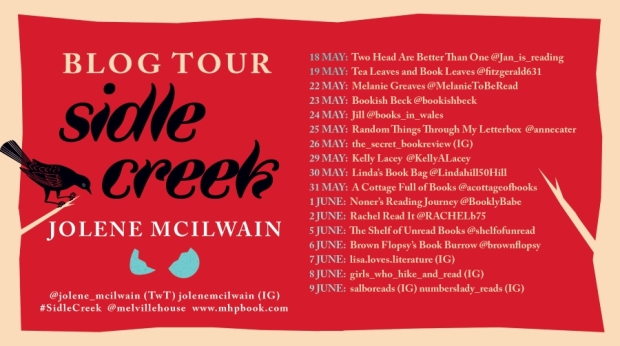
I was delighted to be invited to participate in the blog tour for Sidle Creek. See below for details of where other reviews have appeared or will be appearing soon.
Book Serendipity, Mid-February to Mid-April
I call it “Book Serendipity” when two or more books that I read at the same time or in quick succession have something in common – the more bizarre, the better. This is a regular feature of mine every couple of months. Because I usually have 20–30 books on the go at once, I suppose I’m more prone to such incidents. The following are in roughly chronological order.
Last time, my biggest set of coincidences was around books set in or about Korea or by Korean authors; this time it was Ghana and Ghanaian authors:
- Reading two books set in Ghana at the same time: Fledgling by Hannah Bourne-Taylor and His Only Wife by Peace Adzo Medie. I had also read a third book set in Ghana, What Napoleon Could Not Do by DK Nnuro, early in the year and then found its title phrase (i.e., “you have done what Napoleon could not do,” an expression of praise) quoted in the Medie! It must be a popular saying there.
- Reading two books by young Ghanaian British authors at the same time: Quiet by Victoria Adukwei Bulley and Maame by Jessica George.


And the rest:
- An overweight male character with gout in Where the God of Love Hangs Out by Amy Bloom and The Secret Diaries of Charles Ignatius Sancho by Paterson Joseph.
- I’d never heard of “shoegaze music” before I saw it in Michelle Zauner’s bio at the back of Crying in H Mart, but then I also saw it mentioned in Pulling the Chariot of the Sun by Shane McCrae.
- Sheila Heti’s writing on motherhood is quoted in Without Children by Peggy O’Donnell Heffington and In Vitro by Isabel Zapata. Before long I got back into her novel Pure Colour. A quote from another of her books (How Should a Person Be?) is one of the epigraphs to Lorrie Moore’s I Am Homeless If This Is Not My Home.


- Reading two Mexican books about motherhood at the same time: Still Born by Guadalupe Nettel and In Vitro by Isabel Zapata.
- Two coming-of-age novels set on the cusp of war in 1939: The Inner Circle by T.C. Boyle and Martha Quest by Doris Lessing.
- A scene of looking at peculiar human behaviour and imagining how David Attenborough would narrate it in a documentary in Notes from a Small Island by Bill Bryson and I Have Some Questions for You by Rebecca Makkai.
- The painter Caravaggio is mentioned in a novel (The Things We Do to Our Friends by Heather Darwent) plus two poetry books (The Fourth Sister by Laura Scott and Manorism by Yomi Sode) I was reading at the same time.


- Characters are plagued by mosquitoes in The Last Animal by Ramona Ausubel and Through the Groves by Anne Hull.
- Edinburgh’s history of grave robbing is mentioned in The Things We Do to Our Friends by Heather Darwent and Womb by Leah Hazard.
- I read a chapter about mayflies in Lev Parikian’s book Taking Flight and then a poem about mayflies later the same day in Ephemeron by Fiona Benson.
- Childhood reminiscences about playing the board game Operation and wetting the bed appear in Homesick by Jennifer Croft and Through the Groves by Anne Hull.

- Fiddler on the Roof songs are mentioned in Through the Groves by Anne Hull and We All Want Impossible Things by Catherine Newman.
- There’s a minor character named Frith in Shadow Girls by Carol Birch and Rebecca by Daphne du Maurier.
- Scenes of a female couple snogging in a bar bathroom in Through the Groves by Anne Hull and The Garnett Girls by Georgina Moore.

- The main character regrets not spending more time with her father before his sudden death in Maame by Jessica George and Pure Colour by Sheila Heti.
- The main character is called Mira in Birnam Wood by Eleanor Catton and Pure Colour by Sheila Heti, and a Mira is briefly mentioned in one of the stories in Before You Suffocate Your Own Fool Self by Danielle Evans.
- Macbeth references in Shadow Girls by Carol Birch and Birnam Wood by Eleanor Catton – my second Macbeth-sourced title in recent times, after Tomorrow and Tomorrow and Tomorrow by Gabrielle Zevin last year.


- A ‘Goldilocks scenario’ is referred to in Womb by Leah Hazard (the ideal contraction strength) and Taking Flight by Lev Parikian (the ideal body weight for a bird).
- Caribbean patois and mention of an ackee tree in the short story collection If I Survive You by Jonathan Escoffery and the poetry collection Cane, Corn & Gully by Safiya Kamaria Kinshasa.
- The Japanese folktale “The Boy Who Drew Cats” appeared in Our Missing Hearts by Celeste Ng, which I read last year, and then also in Enchantment by Katherine May.


- Chinese characters are mentioned to have taken part in the Tiananmen Square massacre/June 4th incident in Dear Chrysanthemums by Fiona Sze-Lorrain and Oh My Mother! by Connie Wang.
- Endometriosis comes up in What My Bones Know by Stephanie Foo and Womb by Leah Hazard.

What’s the weirdest reading coincidence you’ve had lately?
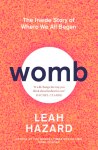
Womb: The Inside Story of Where We All Began by Leah Hazard
Back in 2019, I reviewed Hard Pushed, Leah Hazard’s memoir of being a midwife in a busy Glasgow hospital. Here she widens the view to create a wide-ranging and accessible study of the uterus. As magisterial in its field as Siddhartha Mukherjee’s The Emperor of All Maladies was for cancer, it might have shared that book’s ‘A Biography’ subtitle and casts a feminist eye over history and future alike. Blending medical knowledge and cultural commentary, it cannot fail to have both personal and political significance for readers of any gender.
The thematic structure of the chapters also functions as a roughly chronological tour of how life with a uterus might proceed: menstruation, conception, pregnancy, labour, caesarean section, ongoing health issues, menopause. With much of Hazard’s research taking place at the height of the pandemic, she had to conduct many of her interviews online. She consults mostly female experts and patients, meeting people with surprisingly different opinions. For instance, she encounters opposing views on menstruation from American professors: one who believes it is now optional, a handicap – for teenagers, especially – and that the body was never meant to endure 350–400 periods compared to the historical average of 100 (based on shorter lifespan plus more frequent pregnancy and breastfeeding); versus another who is concerned about the cognitive effects of constant hormonal intervention.
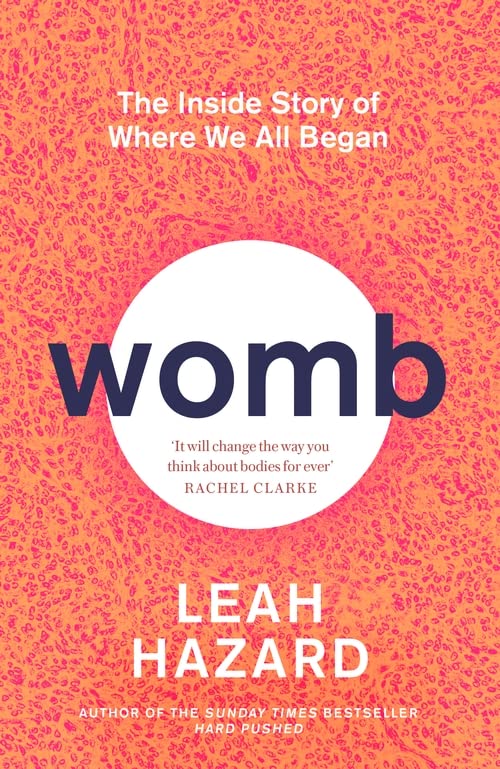
The book forcefully conveys how gynaecological wellness is threatened by a lack of knowledge, sexist stereotypes, and devaluation of certain wombs. Even today, little is known about the placenta, she reports, so research involves creating organoids from stem cells that act like it would. The use of emotionally damaging language like “irritable/hostile uterus,” “incompetent cervix” and “too posh to push” is a major problem. The sobering chapter on “Reprocide” elaborates on enduring threats to reproductive freedom, such as non-consensual sterilization of women in detention centres and the revoking of abortion rights. And even routine problems like endometriosis and fibroids disproportionately affect women of colour.
Hazard has taken pains to adopt an inclusive perspective, referring to “menstruators” or “people with a uterus” as often as to women and mentioning health concerns specific to transgender people. She is also careful to depict the sheer variety of experience: age at first menses, subjective reactions to labour or hysterectomy, severity of menopause symptoms, and so on. Where events have potentially traumatic effects, she presents alternatives, such as a “gentle” or “natural” Caesarean, which is less clinical and more empowering. The prose is pitched at a good level for laypeople: conversational, and never bombarding with information. That I have not had children myself was no obstruction to my enjoyment of the book. It is full of fascinating content that is relevant to all (as in the Harry and Chris solidarity-themed song “Womb with a View,” which has the repeated line “we’ve all been in a womb”). 
Here are just some of the mind-blowing facts I learned:
- Infant girls bleed in what as known as pseudomenses.
- Research is underway to regularly test menstrual effluent for endometriosis, etc. and the uterine microbiome for signs of cancer.
- The cervix can store sperm and release it later for optimal fertilization.
- Caesarean section and induction with oxytocin now occur in one-third of pregnancies, despite the WHO recommendation of no more than 10% for the former and the danger of postpartum haemorrhage with the latter.
- After childbirth, a discharge called lochia continues for 4–6 weeks.
- There have been successful uterine transplants from living donors and cadavers.
- Artificial wombs (“biobags”) have been used for other mammals and are in development; Hazard cautions about possible misogynistic exploitation.
With thanks to Virago Press for the free copy for review.
My (Not the) Booker Prize Reading
A week from today, on the 14th (my birthday, as well as Susan’s – be sure to wish her a happy one!), this year’s Booker Prize will be announced. The Prize’s longlist didn’t contain much that piqued my interest this time around; I read one book from it and didn’t get on with it well at all, and I also DNFed another three.
Read
Frankissstein by Jeanette Winterson
 Winterson does her darndest to write like Ali Smith here (no speech marks, short chapters and sections, random pop culture references). Cross Smith’s Seasons quartet with the vague aims of the Hogarth Shakespeare project and Margaret Atwood’s The Heart Goes Last and you get this odd jumble of a novel that tries to combine the themes and composition of Frankenstein with the modern possibilities of transcending bodily limitations. Her contemporary narrator is Ry Shelley, a transgender doctor sponsored by the Wellcome Trust who supplies researcher Victor Stein with body parts for his experiments in Manchester. In Memphis for a tech expo, Ry meets Ron Lord, a tactless purveyor of sexbots.
Their interactions alternate with chapters narrated by Mary Shelley in the 1810s; I found this strand much more engaging and original, perhaps because I haven’t read that much about Shelley and her milieu, whereas it feels like I’ve read a lot about machine intelligence and transhumanism recently (To Be a Machine, Murmur, Machines Like Me). I think Winterson’s aim was to link the two time periods through notions of hybridness and resistance to death. It never really came together for me. 
DNFed
 Night Boat to Tangier by Kevin Barry – I read the first 76 pages. The other week two grizzled Welsh guys came to deliver my new fridge. Their barely comprehensible banter reminded me of that between Maurice and Charlie, two ageing Irish gangsters. The long first chapter is terrific. At first these fellas seem like harmless drunks, but gradually you come to realize just how dangerous they are. Maurice’s daughter Dilly is missing, and they’ll do whatever is necessary to find her. Threatening to decapitate someone’s dog is just the beginning – and you know they could do it. “I don’t know if you’re getting the sense of this yet, Ben. But you’re dealing with truly dreadful fucken men here,” Charlie warns at one point. I loved the voices; if this was just a short story it would have gotten a top rating, but I found I had no interest in the backstory of how these men got involved in heroin smuggling.
The Wall by John Lanchester – I lost interest in it and wasn’t drawn in by the first pages.
 The Man Who Saw Everything by Deborah Levy – I read the first 35 pages. There’s a lot of repetition; random details seem deliberately placed as clues. I’m sure there’s a clever story in here somewhere, but apart from a few intriguing anachronisms (in 1988 a smartphone is just “A small, flat, rectangular object … lying in the road. … The object was speaking. There was definitely a voice inside it”) there is not much plot or character to latch onto. I suspect there will be many readers who, like me, can’t be bothered to follow Saul Adler from London’s Abbey Road, where he’s hit by a car in the first paragraph, to East Berlin.
 There’s only one title from the Booker shortlist that I’m interested in reading: Girl, Woman, Other by Bernardine Evaristo. I’ll be reviewing it later this month as part of a blog tour celebrating the Aké Book Festival, but as a copy hasn’t yet arrived from either the publisher or the library I won’t have gotten far into it before the Prize announcement.
As for the other five on the shortlist…
- I’m a conscientious objector to Margaret Atwood’s The Testaments. I haven’t appreciated her previous dystopian sequels, and I’ve never really understood all the hype around The Handmaid’s Tale.
- I don’t plan on reading Lucy Ellmann’s Ducks, Newburyport – unless some enterprising soul produces an abridged version of no more than 250 pages.*

Ducks, Newbury
- I didn’t rate The Fishermen highly enough to give Chigozie Obioma’s An Orchestra of Minorities a try.
- I forced myself through Midnight’s Children some years back. What a pointless slog! Lukewarm reviews of his recent work mean I’m now doubly determined to avoid Salman Rushdie’s Quichotte.
- Although the setup appeals to me (a prostitute’s whole life spooling out in front of her in the moments before her death) and I enjoyed her previous novel well enough, I’ve not heard enough good things to pick up Elif Shafak’s 10 Minutes 38 Seconds in this Strange World.
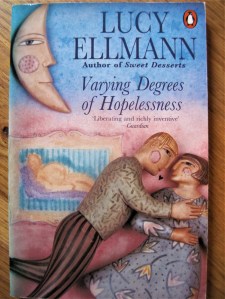 *However, I was delighted to find a copy of her 1991 novel, Varying Degrees of Hopelessness (just 182 pages, with short chapters often no longer than a paragraph and pithy sentences) in a 3-for-£1 sale at our local charity warehouse. Isabel, a 31-year-old virgin whose ideas of love come straight from the romance novels of ‘Babs Cartwheel’, hopes to find Mr. Right while studying art history at the Catafalque Institute in London (a thinly veiled Courtauld, where Ellmann studied). She’s immediately taken with one of her professors, Lionel Syms, whom she dubs “The Splendid Young Man.” Isabel’s desperately unsexy description of him had me snorting into my tea:
He had a masculinity.
His broad shoulders and narrow hips gave him a distinctive physique.
He held seminars and wore red socks.
To hold seminars seemed to indicate a wish to develop a rapport with his students.
The red socks seemed to indicate testosterone.
I swooned in admiration of him.
Unfortunately, the Splendid Young Man is more interested in Isabel’s portly flatmate, Pol. There’s a screwball charm to this campus novel full of love triangles and preposterous minor characters. I laughed at many of Ellmann’s deadpan lines, and would recommend this to fans of David Lodge’s academic comedies. But if you wish to, you could read this as a cautionary tale about the dangers of romantic fantasies. Ellmann even offers two alternate endings, one melodramatic and one more prosaic but believable. I’ll seek out the rest of her back catalogue – so thanks to the Booker for putting her on my radar.
In the meantime, I did a bit better with the “Not the Booker Prize” (administered by the Guardian) shortlist, reading three out of their six:
Flames by Robbie Arnott
 This strange and somewhat entrancing debut novel is set in Arnott’s native Tasmania. The women of the McAllister family are known to return to life – even after a cremation, as happened briefly with Charlotte and Levi’s mother. Levi is determined to stop this from happening again, and decides to have a coffin built to ensure his 23-year-old sister can’t ever come back from the flames once she’s dead. The letters that pass between him and the ill-tempered woodworker he hires to do the job were my favorite part of the book. In other strands, we see Charlotte traveling down to work at a wombat farm in Melaleuca, a female investigator lighting out after her, and Karl forming a close relationship with a seal. This reminded me somewhat of The Bus on Thursday by Shirley Barrett and Orkney by Amy Sackville. At times I had trouble following the POV and setting shifts involved in this work of magic realism, though Arnott’s writing is certainly striking.
A favorite passage:
“The Midlands droned on, denuded hill after denuded hill, until I rolled into sprawling suburbs around noon. Here’s a list of the places I’d choose to visit before the capital: hell, anywhere tropical, the Mariana Trench, a deeper pit of hell, my mother’s house.”
My thanks to Atlantic Books for the free paperback copy for review.
See Susan’s review for a more enthusiastic response.
 The Unauthorised Biography of Ezra Maas by Daniel James: A twisty, clever meta novel about “Daniel James” trying to write a biography of Ezra Maas, an enigmatic artist who grew up a child prodigy in Oxford and attracted a cult following in 1960s New York City, where he was a friend of Warhol et al. (See my full review.)
Supper Club by Lara Williams: A great debut novel with strong themes of female friendship and food. The Supper Club Roberta and Stevie create is performance art, but it’s also about creating personal meaning when family and romance have failed you. (See my full review.)
The other three books on the shortlist are:
- Skin by Liam Brown: A dystopian novel in which people become allergic to human contact. I think I’ll pass on this one.
 Please Read This Leaflet Carefully by Karen Havelin: A debut novel by a Norwegian author that proceeds backwards to examine the life of a woman struggling with endometriosis and raising a young daughter. I’m very keen to read this one.
- Spring by Ali Smith: I’ve basically given up on Ali Smith – and certainly on the Seasons quartet, after DNFing Winter.
(The Not the Booker Prize will be announced on the Guardian website this Friday the 11th.)
Have you read something from the (Not the) Booker shortlist(s)? Any predictions for next week?
Childless Voices by Lorna Gibb
People end up not having children for any number of reasons: medical issues, bereavement, a lack of finances, not having a partner at the right time, or the simple decision not to become a parent. The subtitle of Lorna Gibb’s Childless Voices acknowledges these various routes: “Stories of Longing, Loss, Resistance and Choice.”
 For Gibb, a university lecturer, biographer and novelist, the childless state was involuntary, a result of severe endometriosis that led to infertility and early menopause. Although this has been a source of sadness for her and her husband, she knows that she has it easy compared to women in other parts of the world. Through her research and Skype interviews, she hears horrific stories about infertile women who meet with domestic violence and social ostracism and are sometimes driven to suicide. In Ghana childless women can be branded as witches and exiled. Meanwhile, some are never given the chance to have the children they might long for: Gibb cites China’s one-child policy, female genital mutilation, and enforced sterilization programs like those of the Roma in Yugoslavia and the Quechua in Peru.
Gibb is admirably comprehensive here, considering every possible aspect of childlessness. Particularly interesting are the different cultural adaptations childless women make. Certain countries allow polygamy, giving a second wife a chance to bear children on behalf of an infertile one; Kenya and other parts of sub-Saharan Africa recognize ‘marriages’ between childless women so they can create a family and support system. In Albania being a “sworn virgin” is an old and venerable custom. And, of course, there are any number of support groups and online communities. The situation of those who were once parents but are no longer is especially wrenching. Stillbirth only started to be talked about in the 1980s, Gibb notes, but even today is seen as a lesser loss than that of a child who dies later in life.
The author believes there is societal injustice in terms of who has access to fertility treatment and how the state deals with childless people. In the UK, she characterizes IVF as a “postcode lottery”: where you live often determines how many free cycles you’re entitled to on the NHS. In the USA, meanwhile, fertility treatment is so expensive that only those with a certain level of wealth can consider it. The childless may also feel ‘punished’ by tax breaks that favor parents and workplaces that expect non-parents to work unsociable hours. In a sense, then, the childless contribute more but benefit less.
Chosen childlessness is perhaps given short shrift at just 32 pages out of 239. However, it’s still a very thorough treatment of the reasons why couples decide not to become parents, including cultural norms, career goals, self-knowledge and environmental concerns. No surprise that this was the chapter that resonated with me the most. I also especially enjoyed the personal interludes (all titled “A Short Note on…”) in which Gibb celebrates her feminist, childless heroes like Frida Kahlo and Anaïs Nin and writes about how much becoming a godmother meant to her but also of the sadness of seeing a good friend’s teenage son die of a brain tumor.
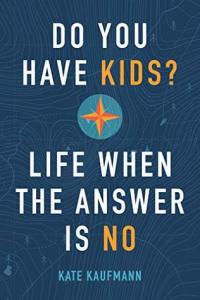 By coincidence, I’ve recently read another book on the same topic: Do You Have Kids? Life when the Answer Is No, by Kate Kaufmann (coming out in America next month). Gibb primarily traces the many different reasons for childlessness; Kaufmann mostly addresses the question of “now what?” – how women without children approach careers, wider family life, housing options, spirituality and the notion of leaving a legacy. Gibb’s approach is international and comparative, while Kaufmann’s is largely specific to the USA. Though the two authors are childless due to endometriosis and infertility, they feel sisterhood with women who never became mothers for whatever reason. I’d say these two books are complementary rather than rivals, and reveal valuable perspectives that can sometimes be overlooked.
My rating:
Childless Voices was published by Granta on February 7th. My thanks to the publisher for the free copy for review.
 Bookish Beck = Rebecca Foster. American transplant to England. Freelance proofreader and book reviewer.
 Bookish Beck