Six Degrees of Separation: What Are You Going Through to No Saints Around Here
I’ve become an occasional Six Degrees of Separation post-er, when the mood strikes me and/or I get a flash of inspiration. This month we began with What Are You Going Through, which I reviewed back in October 2020. (See Kate’s opening post.)
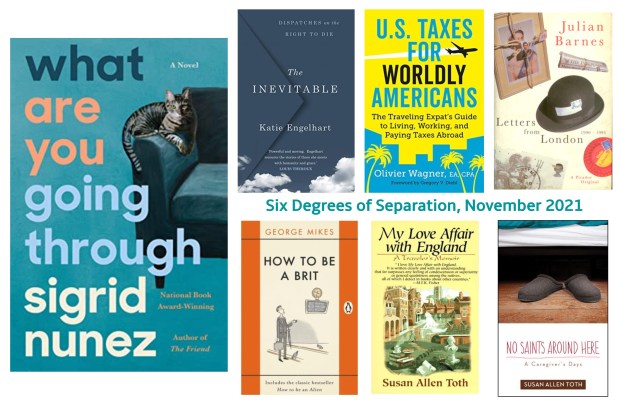
 Between that, The Friend and A Feather on the Breath of God, Sigrid Nunez has quickly become one of my favourite contemporary authors. I have two more of her novels on the shelf to read soon, one from my birthday haul.
In What Are You Going Through, the narrator is called upon to help a terminally ill friend commit suicide. However, I summed up the message as “Curiosity about other lives fuels empathy,” and noted “a sort of slapstick joy early in this morbid adventure.”
 #1 One of the stand-out books from my 2021 reading so far has been The Inevitable, which is about assisted dying. The case studies are wrenching but compassionately told. Katie Engelhart explores the nuances of situations, crafting expert portraits of suffering people and the medical professionals who seek to help them, and adding much in the way of valuable context.
 #2 As the saying goes, if there’s one thing inevitable besides death, it’s taxes. And if you’re a U.S. citizen, you will remain accountable to the IRS until the day you die, no matter where you live. (Eritrea is the only other country that requires expatriates to fill in tax returns.) I’ve now gotten my U.S. tax forms down to a science, keeping a list of pointers and previous years’ forms as scanned files so that I just have to plug in the year’s numbers, put zeroes in all the important boxes (since I’ve already paid income tax in the UK), and send it off. A matter of an hour or two’s work, rewarded by a G&T.
But I distinctly remember the Junes when I would spend days muddling through byzantine IRS forms, so I am very grateful that an offer for this e-book arrived in my inbox via my blog contact form in 2017: U.S. Taxes for Worldly Americans by Olivier Wagner. It goes through each form, often line by line. Three cheers for actually helpful self-help guides!
 #3 Another expat tip that I found extremely useful, small as it might seem, is that “quite” means something different in American vs. British English. To an American it’s a synonym for “very”; to the guarded Brits, it’s more like “rather.” I have the Julian Barnes essay collection Letters from London to thank for this vital scrap of etymological knowledge.
 #4 Unsurprisingly, I have built up a small library of books about understanding the English and their ways. In the How to Be a Brit omnibus, collecting three short volumes from the 1940s–70s, George Mikes (a Hungarian immigrant) makes humorous observations that have, in general, aged well. His mini-essays on tea, weather and queuing struck me as particularly apt. I would draw a straight line from this through Bill Bryson’s Notes from a Small Island to the Very British Problems phenomenon.
 #5 As I was preparing to fly to England for the first time for my study abroad year, one of the authors who most whetted my appetite for British travel was Susan Allen Toth, whose trilogy of UK-themed memoirs-with-recommendations began with My Love Affair with England – included in one of my Landmark Books in My Life posts. I’m rereading one of the other three now.
 #6 Toth is a very underrated author, I feel. I’ve read most of her memoirs and have a short nonfiction work of hers on my pile for #NovNov. Her most recent book is No Saints Around Here: A Caregiver’s Days (2014), in which she chronicled the last 18 months of her husband James’s life, as she and an army of caregivers coped with his decline from Parkinson’s disease. Toth gets the tone just right: although she is honest, she is never melodramatic; although she often feels sorry for herself, she also recognizes how lucky she has been, not just to have done a good job of looking after James, but to have had him in her life at all.
I’ve gone full circle from one story of caregiving to another, via death, taxes and Englishness. The starting and ending books are reminders that you never fully know what another person is going through; all we can do is our best while cutting others some slack.
Where will your chain take you? Join us for #6Degrees of Separation! (Hosted on the first Saturday of each month by Kate W. of Books Are My Favourite and Best.) Next month’s starting point is our buddy read for week 4 of #NovNov, Ethan Frome by Edith Wharton.
Have you read any of my selections? Are you tempted by any you didn’t know before?
Short Stories in September, Part II: Tove Jansson, Brandon Taylor, Eley Williams
Each September I make a special effort to read short stories, which otherwise tend to languish on my shelves and TBR unread. After my first four reviewed last week, I have another three wonderfully different collections, ranging from bittersweet children’s fantasy in translation to offbeat, wordplay-filled love notes via linked stories suffused with desire and desperation.
Tales from Moominvalley by Tove Jansson (1962; 1963)
[Trans. from the Swedish by Thomas Warburton]
 I only discovered the Moomins in my late twenties, but soon fell in love with the quirky charm of Jansson’s characters and their often melancholy musings. Her stories feel like they can be read on multiple levels, with younger readers delighting in the bizarre creations and older ones sensing the pensiveness behind their quests. There are magical events here: Moomintroll discovers a dragon small enough to be kept in a jar; laughter is enough to bring a fearful child back from literal invisibility. But what struck me more was the lessons learned by neurotic creatures. In “The Fillyjonk who believed in Disasters,” the title character fixates on her belongings—
“we are so very small and insignificant, and so are our tea cakes and carpets and all those things, you know, and still they’re important, but always they’re threatened by mercilessness…”
—but when a gale and a tornado come and sweep it all away, she experiences relief and joy:
“the strange thing was that she suddenly felt quite safe. It was a very strange feeling, and she found it indescribably nice. But what was there to worry about? The disaster had come at last.”
My other favourite was “The Hemulen who loved Silence.” After years as a fairground ticket-taker, he can’t wait to retire and get away from the crowds and the noise, but once he’s obtained his precious solitude he realizes he needs others after all. The final story, “The Fir Tree,” is a lovely Christmas one in which the Moomins, awoken midway through their winter hibernation, get caught up in seasonal stress and experience the holiday for the first time. (Public library) 
Filthy Animals by Brandon Taylor (2021)
Real Life was one of my five favourite novels of 2020, and we are in parallel fictional territory here. Lionel, the protagonist in four of the 11 stories, is similar to Wallace insomuch as both are gay African Americans at a Midwestern university who become involved with a (straight?) white guy. The main difference is that Lionel has just been released from hospital after a suicide attempt. A mathematician (rather than a biochemist like Wallace), he finds numbers soothingly precise in comparison to the muddle of his thoughts and emotions.
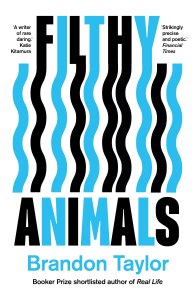 In the opening story, “Potluck,” he meets Charles, a dancer who’s dating Sophie, and the three of them shuffle into a kind of awkward love triangle where, as in Real Life, sex and violence are uncomfortably intertwined. It’s a recurring question in the stories, even those focused around other characters: how does tenderness relate to desire? In the throes of lust, is there room for a gentler love? The troubled teens of the title story are “always in the thick of violence. It moves through them like the Holy Ghost might.” Milton, soon to be sent to boot camp, thinks he’d like to “pry open the world, bone it, remove the ugly hardness of it all.”
Elsewhere, young adults face a cancer diagnosis (“Mass” and “What Made Them Made You”); a babysitter is alarmed by her charge’s feral tendencies (“Little Beast”); and same-sex couples renegotiate their relationships (Simon and Hartjes in “As Though That Were Love” and Sigrid and Marta in “Anne of Cleves,” one of my favourites). While the longer Lionel/Charles/Sophie stories, “Potluck” and “Proctoring,” are probably the best and a few others didn’t make much of an impression, the whole book has an icy angst that resonates. Taylor is a confident orchestrator of scenes and conversations, and the slight detachment of the prose only magnifies his characters’ longing for vulnerability (Marta says to Sigrid before they have sex for the first time: “I’m afraid I’ll mess it up. I’m afraid you’ll see me.” To which Sigrid replies, “I see you. You’re wonderful.”). (New purchase, Forum Books)
 A bonus story: “Oh, Youth” was published in Kink (2021), an anthology edited by Garth Greenwell and R.O. Kwon. I requested this from NetGalley just so I could read the stories by Carmen Maria Machado and Brandon Taylor. All of Taylor’s work feels of a piece, such that his various characters might be rubbing shoulders at a party – which is appropriate because the centrepiece of Real Life is an excruciating dinner party, Filthy Animals opens at a potluck, and “Oh, Youth” is set at a dinner party.
Grisha is here with Enid and Victor, his latest summer couple. He’s been a boytoy for hire since his architecture professor, Nate, surprised him by inviting him into his open marriage with Brigid. “His life at the time was a series of minor discomforts that accumulated like grit in a socket until rotation was no longer possible.” The liaisons are a way to fund a more luxurious lifestyle and keep himself in cigarettes.
While Real Life brought to mind Virginia Woolf, Taylor’s stories recall E.M. Forster or Thomas Mann. In other words, he’s the real deal: a blazing talent, here to stay.
Attrib. and Other Stories by Eley Williams (2017)
 After enjoying her debut novel, The Liar’s Dictionary, this time last year, I was pleased to find Williams’s first book in a charity shop last year. Her stories are brief (generally under 10 pages) and 15 of the 17 are first-person narratives, often voiced by a heartbroken character looking for the words to describe their pain or woo back a departed lover. A love of etymology is patent and, as in Ali Smith’s work, the prose is enlivened by the wordplay.
The settings range from an art gallery to a beach where a whale has washed up, and the speakers tend to have peculiar careers like an ortolan chef or a trainer of landmine-detecting rats. My favourite was probably “Synaesthete, Would Like to Meet,” whose narrator is coached through online dating by a doctor.
 I found a number of the stories too similar and thin, and it’s a shame that the hedgehog featured on the cover of the U.S. edition has to embody human carelessness in “Spines,” which is otherwise one of the standouts. But the enthusiasm and liveliness of the language were enough to win me over. (Secondhand purchase from the British Red Cross shop, Hay-on-Wye – how fun, then, to find the line “Did you know Timbuktu is twinned with Hay-on-Wye?”)
I’ll have one more set of short story reviews coming up before the end of the month, with a few other collections then spilling into October for R.I.P.
Review Book Catch-Up: Fox, Le Riche, Nunez, and Thammavongsa
Today I have a book of poems about Covid lockdown and being autistic, a reprint of a vintage cookbook with a difference, the pinnacle of autofiction that I’ve found thus far, and a prize-winning collection of short stories about immigrants’ everyday challenges.
The Oscillations by Kate Fox (2021)
 The first section, “After,” responds to the events of 2020; six of its poems were part of a “Twelve Days of Lockdown” commission. Fox remembers how sinister a cougher at a public event felt on 13th March and remarks on how quickly social distancing came to feel like the norm, though hikes and wild swimming helped her to retain a sense of possibility. I especially liked “Pharmacopoeia,” which opens the collection and looks back to the Black Death that hit Amsterdam in 1635 – “suddenly the plagues / are the most interesting parts / of a city’s history.” “Returns” plots her next trip to a bookshop (“The plague books won’t be in yet, / but the dystopia section will be well stocked / … I spend fifty pounds I no longer had last time, will spend another fifty next. / Feeling I’m preserving an ecology, a sort of home”), while “The Funerals” wryly sings the glories of a spring the deceased didn’t get to see.
The second section, “Before,” is more wide-ranging, responding to artworks, historical events, family situations, and more. Fox has been vocal about her ASD, which is the subject of “What Could Be Called Communication,” about some habits of the neurodivergent that you might recognize. I also liked “The Fruits,” which narrates the end of a pregnancy, and the closing poem, “Emergency” (“between us, / sometimes despite us / love spreads like a satellite signal, / like sea foam, / like spilt coffee on a counter top, / like home.”). That was one of the few places in the whole book where the language (alliteration and an end-rhyme) struck me; elsewhere, the themes felt more notable than the poetic techniques.
With thanks to Nine Arches Press for the proof copy for review.
Eating Alone by Kathleen Le Riche (1954)
Recently reprinted as a facsimile edition by Faber, this was Le Riche’s third cookbook. It’s like no other cookbook I’ve read, though: It doesn’t list ingredients or, generally, quantities, and its steps are imprecise, more like suggestions. What it reads like is a set of short stories with incidental recipes. Le Riche had noted that people who live alone some or all of the time, for whatever reason, often can’t be bothered to cook for themselves properly. Through these old ladies, bachelors, career girls, and mothers with children off at school, she voices her ideas on shopping, food storage, simple cooking, and making good use of leftovers, but all through the medium of anecdote.
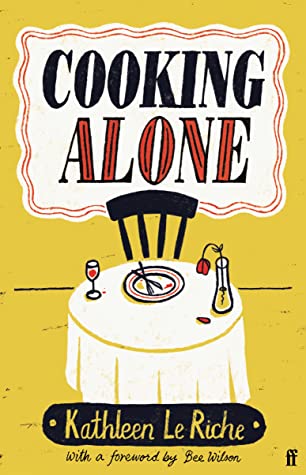 For instance, “The Grass Widower,” while his wife is away visiting her mother, indulges his love of seafood and learns how to wash up effectively. A convalescent plans the uncomplicated meals she’ll fix, including lots of egg dishes and some pleasingly dated fare like “junket” and cherries in brandy. A brother and sister, students left on their own for a day, try out all the different pancakes and quick breads in their repertoire. The bulk of the actual meal ideas come in a chapter called “The Happy Potterer,” whom Le Riche styles as a friend of hers named Flora who wrote out all her recipes on cards collected in an envelope. I enjoyed some of the little notes to self in this section: appended to a recipe for kidney and mushrooms, “Keep a few back for mushrooms-on-toast next day for a mid-morning snack”; “Forgive yourself if you have to use margarine instead of butter for frying.”
I don’t think there are any recipes here that I would actually try to reproduce, though I may one day attempt the Grass Widower’s silver-polishing method (put a strip of aluminium foil and some “washing soda” (soda crystals?) in the sink and pour over some boiling water from the kettle; dip in the silver items, touching them to the foil, and watch the tarnish disappear like magic!). This was interesting as a cultural artefact, to see the meals and ingredients that were mainstays of the 1950s (evaporated milk, anyone?) and how people coped without guaranteed refrigeration. It’s also a good reminder to eat well no matter your circumstances.
With thanks to Faber for the free copy for review.
A Feather on the Breath of God by Sigrid Nunez (1995)
My third from Nunez, after The Friend and What Are You Going Through, and my most loved of her books thus far, cementing her as one of my favourite authors. Like the other two, it’s narrated by an unnamed woman who defines herself by the people she encounters and the experiences she has in an unforgiving but still somehow beautiful and funny old world. From the little I know of Nunez, this seems the closest to autofiction, especially in terms of her parental origins. The father, Chang, born in Panama and raised in China, immigrated to the USA at age 12. In Germany for war service, he met her mother, Christa, just after VE Day.
 Chang and Christa, the subjects of the book’s first two sections – accounting for about half the length – were opposites and had a volatile relationship. Their home in the New York City projects was an argumentative place the narrator was eager to escape. She felt she never knew her father, a humourless man who lost touch with Chinese culture. He worked on the kitchen staff of a hospital and never learned English properly. Christa, by contrast, was fastidious about English grammar but never lost her thick accent. An obstinate and contradictory woman, she resented her lot in life and never truly loved Chang, but was good with her hands and loved baking and sewing for her daughters.
Growing up, the narrator never knew quite what to make of her mixed, “exotic” background. For a time, she escaped into ballet, a tantalizingly female discipline that threw up a lot of issues: class pretensions, the eroticization of young girls and of pain, and eating disorders. When she went without solid food for days at a time, she felt she was approaching the weightlessness Saint Hildegard likened to being “a feather on the breath of God.” The final chapter, “Immigrant Love,” jumps ahead to when the narrator taught English as a foreign language and had an affair with Vadim, a married Russian taxi driver full of charisma but also of flaws. This finale is a brilliant twist on her parents’ situation, and a decision to teach English in China brings things full circle, promising a connection to her late father’s heritage.
The strategy of identifying the self by the key relationships and obsessions of a life struck me as spot on. This short novel punches above its weight, with profound observations on every page. Its specific situations are engaging, yet it speaks to the universals of how we cope with a troublesome past. “One wants a way of looking back without anger or bitterness or shame. One wants to be able to tell everything without blaming or apologizing,” Nunez writes, crystallizing her frank, wry approach. I’m eager to read all the rest of her oeuvre.
First published in the UK in 2021. With thanks to Virago Press for the free copy for review.
How to Pronounce Knife by Souvankham Thammavongsa (2020)
 Thammavongsa pivoted from poetry to short stories and won Canada’s Giller Prize for this debut collection that mostly explores the lives of Laotian immigrants and refugees in a North American city. The 14 stories are split equally between first- and third-person perspectives, many of them narrated by young women remembering how they and their parents adjusted to an utterly foreign culture. The title story and “Chick-A-Chee!” are both built around a misunderstanding of the English language – the latter is a father’s approximation of what his children should say on doorsteps on Halloween. Television soaps and country music on the radio are ways to pick up more of the language. Farm and factory work are de rigueur, but characters nurture dreams of experiences beyond menial labour – at least for their children.
The stories are punchy: perfect snapshots of lives lived on the tightrope between expectation and despair. In “Mani Pedi,” Raymond is a former boxer who starts working at his sister’s nail salon and falls in love with a client. His sister warns him, “Don’t you be dreaming big now, little brother. Keep your dreams small. The size of a grain of rice.” In “Slingshot,” an older woman loses touch with her much younger lover, while in “The Gas Station,” Mary, a prim tax accountant, opens herself to love but ends up disappointed. The great-grandmother in “Ewwrrrkk” warns an eight-year-old that “I love you” pries open one’s legs like nothing else. “Randy Travis” and “Picking Worms” were probably my two overall favourites. Looking back, I have trouble remembering some of the individual stories. It’s not so much that they all blend into one, but that they form a cohesive whole. I’d recommend this even to readers who don’t normally pick up short stories, and will look out for more from this author.
Out in paperback on Thursday the 18th. With thanks to Bloomsbury for the free copy for review.
Would you be interested in reading one or more of these?
Blog Tour: The Cabinet of Calm by Paul Anthony Jones
 I’m delighted to be on the blog tour for The Cabinet of Calm: Soothing Words for Troubled Times by Paul Anthony Jones, which will be published in the UK by Elliott & Thompson on Thursday the 14th. Jones has a Master’s degree in linguistics and writes about etymology and obscure words. This is his seventh book of English-language trivia.
I was also on the blog tour for The Cabinet of Linguistic Curiosities: A Yearbook of Forgotten Words and enjoyed having that as my daily bedside book for a whole year. The short essays in his books are perfect for reading one or two at a time just before bed. (One of my current bedside reads is Jones’s 2016 book The Accidental Dictionary: The remarkable twists and turns of English words. As soon as I finish that, I’ll launch into the new one.)
The book’s publication, and the blog tour, neatly coincide with Mental Health Awareness Week (18–24 May). Here’s a bit more information about the book, from the press release: “For almost a decade, Paul Anthony Jones has written about the oddities and origins of the English language, amassing a vast collection of some of its more unusual words. Last year, doubly bereaved and struggling to regain his spirits, he turned to words – words that could be applied to difficult, challenging times and found solace. The Cabinet of Calm is the result.
“Paul has unearthed fifty-one linguistic remedies to offer reassurance, inspiration and hope in the face of such feelings as grief and despair, homesickness and exhaustion, missing our friends and a loss of hope. Written with a trademark lightness of touch, The Cabinet of Calm shows us that we’re not alone. From MELORISM, when you’re worried about the future of the world[,] and AGATHISM, when you’re feeling disillusionment or struggling to remain positive[,] to … STOUND, for when you’re grieving, someone else has felt like this before, and so there’s a word to help, whatever the challenge.”
I was assigned at random this exclusive extract from The Cabinet of Calm; how delightful to find that it references one of my favourite books!

Growlery
“Like so many of the English language’s best and most inventive words, growlery is a word we owe to one of our best and most inventive writers. In 1853, Charles Dickens used the word growlery in his novel Bleak House. As the kindly benefactor Mr Jarndyce welcomes one of the novel’s key narrators, Esther Summerson, to his eponymous home, he shows her into ‘a small room next to his bed-chamber’, containing ‘a little library of books and papers, and in part quite a little museum of his boots and shoes and hat-boxes’…
Although the word growlery itself had first appeared in the language somewhat earlier (as a term for the sound of grumbling or complaining) Mr Jarndyce’s growlery is essentially the Dickensian equivalent of what we in our less poetic, twenty-first-century language might call a ‘safe space’. It is a calming, comfortable, solitary room, filled with familiar and enlightening things, in which a bad mood can be privately vented, mused on and assuaged.
We might not all have the luxury of a bespoke room in a rambling country retreat in which to give vent to our problems, but there’s no reason why our own particular growleries have to match Mr Jarndyce’s … Wherever – or, for that matter, whatever – your particular growlery is, it’s undoubtedly a word and a place well worth knowing whenever you need to lighten your spirits.”
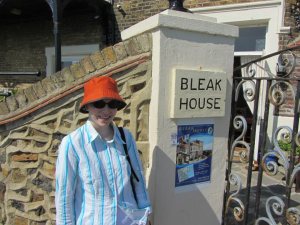
At “Bleak House” in Broadstairs, Kent in August 2012. Dickens occasionally lived here between the 1830s and the 1850s.
If you are in the UK and interested in purchasing a copy, please try to support an independent bookshop nearby. For instance, my local, Hungerford Bookshop, is still delivering. Or have a look for another shop on Twitter using the hashtags #ChooseBookshops and #shopindie.
Final 2019 Review Books: Brodesser-Akner, Cregan & McCulloch
The final three review books of the year (not counting DNFs, which will be briefly dispatched on Sunday): a much-hyped novel set in contemporary New York City, a memoir of suicidal depression and recuperation, and a study of linguistics in the Internet era.
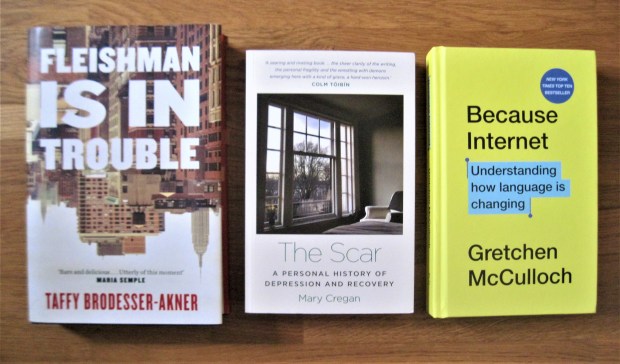
Fleishman Is in Trouble by Taffy Brodesser-Akner
According to the aggregated best-of lists (which Kate has surveyed here), this was one of the top two novels of 2019. I’m going to have to shrug my shoulders and admit, I don’t get it. To me this didn’t stand out at all from the sea of fiction about crumbling marriages and upper-middle-class angst. Toby Fleishman is 41-year-old head of hepatology at a New York City hospital. He recently split from his wife, Rachel, agent to the creator of a Hamilton-style phenomenon. Not content with their comfortable lifestyle, Rachel hankers for true wealth.
 When Rachel goes AWOL at a yoga retreat, Toby is left in charge of their children: Hannah, 11, and Solly, nine. He ferries them to and from summer camp, all the while bombarded with dirty texts and semi-nude selfies from the women he’s flirting with via a dating app. Had this novel been written by a man, people would have been up in arms about the unpleasant sexual content. But this is not just written by a woman; it’s also narrated by a woman: Elizabeth Epstein Slater, a former journalist turned stay-at-home mom. She and Toby became friends on their junior year abroad in Israel and have started hanging out more after his divorce.
So this is a book within a book Elizabeth is writing about one turbulent summer in her friends’ lives, but also her own – she’s dissatisfied with her staid marriage. It’s also Brodesser-Akner’s winking commentary on macho or moralizing fiction: “this was the only way to get someone to listen to a woman—to tell her story through a man” and “none of my characters were likable,” Elizabeth thinks. But attempts to humanize Toby and Rachel fell flat for me. Sadness over the loss of one patient was insufficient to endear me to the randy Toby, and early life with a grim grandmother and severe postpartum trauma couldn’t make me care about whether Rachel was coming back. I also never fully suspended disbelief about Elizabeth’s intimate knowledge of the Fleishmans.
This very New York novel started out promising, with echoes of Where’d You Go, Bernadette? or The Nest. There are some perceptive passages about marriage, and the writing in general is more than capable. But the story didn’t feel nearly fresh enough to justify all that acclaim, or the 373-page length.
With thanks to Wildfire for the free copy for review.
The Scar: A Personal History of Depression and Recovery by Mary Cregan
 Cregan has a scar that reminds her, every time she notices it, of how close she came to taking her own life decades ago. In 1983, at the age of 27, she gave birth to a baby girl, Anna, who died two days later of a heart defect. The loss plunged her into a depression so severe that she made a halfhearted suicide attempt some weeks later and was admitted to a psychiatric hospital, where she was given electroconvulsive therapy. One morning in the hospital, she brought a glass jar of lotion into the shower with her, smashed it, and took a shard to her throat. She only narrowly missed her carotid artery. Cregan wonders if, had she been given appropriate medication, all this heartache could have been avoided.
“I’ve often wished I could undo my own act (if indeed ‘I’ and ‘my’ are accurate words for a self in the condition I was in.)”
“It took a long time to work all of this out, because it’s very hard to see yourself clearly when depressed. The problem is that you think with your mind, but your mind is ill and untrustworthy. Your mind is your enemy.”
Alongside her own winding story, the author surveys the history of mental health treatment in the United States. This felt more familiar and thus engaged me less than the personal material. Nevertheless, I would recommend this forthright memoir to anyone keen to read about the experience of mental illness.
With thanks to the author for arranging my free copy from Lilliput Press, Dublin.
Because Internet: Understanding how language is changing by Gretchen McCulloch
 I’m surprised by how fascinating I found this: I’m a late adopter when it comes to technology (I’m still resisting a smartphone) and I haven’t given linguistics a thought since that one class I took in college, but it turns out that my proofreader’s interest in the English language and my daily use of e-mail and social media were enough to make it extremely relevant. The Montreal linguist’s thesis is that the Internet popularized informal writing and quickly incorporates changes in slang and cultural references. At the same time, it still reflects regional and age-specific differences in the way that people speak (write conversationally).
The book goes deep into topics you may never have considered, like how we convey tone of voice through what we type and how emoji function as the gestures of the written word. You’ll get a breakdown of current generations in terms of when the Internet became the default in their life (I belong to what the author calls “Semi Internet People”: I remember first using the Internet in a classroom in seventh grade, getting dial-up AOL at home not long thereafter, and opening my own Hotmail account in high school), a history of lolcats, and musings on the metaphorical use of periods and capital letters. If you are among the unconvinced, you’ll also be schooled in the appeal of gifs and memes.
Some trivia I picked up:
- In 2015 the tears of joy emoji became the most popular emoji, more used than the smiley-face emoticon.
- For many of us the Internet serves as what sociologists call a “third place” besides home and work where we can socialize.
- Only 5–8% of Internet users are bloggers.
- “Subtweeting” (as in subliminal) and “vaguebooking” are when you post about a situation without giving any specifics.
- Parents often refer to a child by an initial or nickname so the child won’t have a searchable social media presence.
- The Library of Congress now archives memes (The Lolcat Bible, Urban Dictionary, etc.).
McCulloch portrays language as a constantly changing network, such that terms like “standard” and “correct” no longer apply. She writes with such geeky enthusiasm that you’ll happily accompany her down any linguistic alley.
With thanks to Harvill Secker for the free copy for review.
 Bookish Beck = Rebecca Foster. American transplant to England. Freelance proofreader and book reviewer.
 Bookish Beck