The Fruit Cure by Jacqueline Alnes (Blog Tour)
Jacqueline Alnes was a college runner until she experienced a strange set of neurological symptoms: fainting, blurred vision, speech problems and seizures. Initially diagnosed with vestibular neuronitis, she later got on a waiting list for a hospital epilepsy unit. Her symptoms ebbed and flowed over the next few years. Sometimes she was well enough to get back to running – she completed a marathon in Washington, D.C. – but occasionally she was debilitated. Study abroad in Peru exacerbated her problems because of altitude sickness. She also spent time in a wheelchair. Chronic illness left her open to depression and self-harm, including disordered eating. This turned more extreme when she was drawn into the bizarre world of fruitarianism, which offered her structure and black-and-white logic.

Alongside her own story, Alnes tells that of a few eccentrics who were key in popularizing the all-fruit diet. In the 1950s, Essie Honiball (author of I Live on Fruit), an anorexic teacher pregnant by a married man, was preyed on by quack doctor Cornelius Dreyer, who had previously had patients die under his care. Dreyer was based in South Africa, but there were parallel movements in other countries, too. Veganism and the raw food diet came under the same general umbrella, but were not as exclusive. The other main characters in the narrative are “Freelee” (Leanne Ratcliffe) and “Durianrider” (Harley Johnstone), founders of the 30 Bananas a Day website, which swayed Alnes when she was desperate for a cure. They spread their evangelistic message via blogs, vlogs and conferences. Like any cult-like body, theirs hinged on control and fell victim to infighting and changes of direction over the years.
Alnes clearly hopes her own experience will be instructive, exposing the dangers of extreme treatments for vulnerable people:
Scammy cures have been here since the beginning of time and will continue to exist for as long as people do, but the more we can work to make our systems of healing more equitable for people, no matter [their] race, gender, class, sexual orientation, or body size, the less people will get caught up in harmful practices that end up hurting them in the end.
She effectively employs metaphors from the Book of Genesis, likening early-years Durianrider and Freelee to Adam and Eve (them of the forbidden fruit) and pondering her own illness-origin story:
There are endless ways to write an origin story. Over the years, I’ve succumbed to the temptation of rewriting this beginning, as if returning to that first night [she fell ill] will give me answers or allow me to change what happened. Instead, holes in the narrative emerge.
As will be familiar to readers of stories of chronic illness and disability, no clear answers emerge here. Alnes’ condition is up and down and there’s been no definitive cure. Like Essie, she was lured into adhering slavishly to a fruitarian diet for a time, but she now has a healthier, more flexible attitude towards food. I found I wasn’t particularly interested in reading about the central cranks, preferring to skip over the biographical material to follow the thread of Alnes’ own journey instead. The whole book seems a little too niche; a more generalist work about various radical health cures and their proponents may have engaged me more. Still, it was a reasonably interesting case study.
With thanks to Melville House Press for the proof copy for review.
Buy The Fruit Cure from Bookshop UK [affiliate link]
Related reading:
Heal Me by Julia Buckley
I was pleased to be part of the blog tour for The Fruit Cure. See below for details of where other reviews have appeared or will be appearing soon.

Recent BookBrowse & Shiny New Books Reviews, and Book Club Ado
Excerpts from and links to some of my recent online writing for other places:
BookBrowse
Three O’Clock in the Morning by Gianrico Carofiglio
 The quotation that gives Carofiglio’s tender novel its title is from F. Scott Fitzgerald’s The Crack-Up: “In a real dark night of the soul it is always three o’clock in the morning.” It lends an appropriate sense of time suspended, of earnest seeking and extreme circumstances: The main action of the book takes place over just a few days in June of 1983, when Italian teenager Antonio and his father are stranded in Marseilles while there for Antonio to be seen by an epilepsy specialist. The gift of this time outside of time allows them to get to know each other better, such that the memory of the trip will be precious to Antonio even decades later. I appreciated how the limited setting heightened this short novel’s emotions. Carofiglio invites readers to peer between the leisurely progression of events to see the bond that is being formed. (See my full review at BookBrowse. See also my related article on HarperVia, a new publishing imprint for international literature.)
The Dictionary of Lost Words by Pip Williams
 Inspired by the composition of the Oxford English Dictionary, this Australian debut novel explores the lives of the women on its fringes through the words that were omitted. The suffrage movement and World War I loom large as the storyline enters the 1910s. I most appreciated the relationships Esme has with the various women in her life. The main action spans the 40 years of the original composition of the OED. That scope means there is a lot of skipping forward in time. Especially in the first half, I longed for the narrative to slow down so I could spend more time with this character. Despite the first-person narration, I never felt I knew Esme very well. Women’s bonds and women’s words are strong themes in this forthrightly feminist novel that, despite its flaws, would make a great book club selection. (See my full review at BookBrowse. See also my reading list of books about dictionaries and lost words.)
Shiny New Books
Notes from Deep Time: The Hidden Stories of the Earth Beneath Our Feet by Helen Gordon
 To assess the place of humanity, we can look back to prehistory, but also forward to envision the “deep future.” (It was only in a late chapter on nuclear waste disposal sites and warning messages to the future that I found too much direct overlap with Footprints by David Farrier.) This engagingly blends both tactics, surveying the fields of geology and palaeontology and pondering the future traces of the Anthropocene. I most enjoyed the middle chapters, in which science meets wildlife and cultural studies. For instance, a chapter on ammonites leads into a profile of Mary Anning and the history of both fossil hunting and women in STEM careers. The prose is well pitched to the layman’s level. Interviews, travels, and snapshots from her own life generally keep the material from becoming too dry. An invigorating interdisciplinary tour. (See my full review at Shiny New Books.)
My book club has been meeting via Zoom since April 2020. This is a common state of affairs for book clubs around the world. Especially since we have 12 members (if everyone attends, which is rare), we haven’t been able to contemplate meeting in person as of yet. However, a subset of us meet midway between the monthly reads to discuss women’s classics like Marge Piercy’s Woman on the Edge of Time. For next week’s meeting on Mrs. Dalloway, we are going to attempt a six-person get-together in one member’s house.
 Anyway, a neat thing we did last month was a Zoom chat with the author: a BBC correspondent who happens to be the brother of one of our members. If you’re a news junkie in the UK, you may know the name Jon Sopel, though since I don’t have a telly or ever listen to radio, I hadn’t encountered him until this “in-person” meet-up. He has been the BBC’s North America Editor since 2014.
UnPresidented is the third book he wrote over the course of the Trump presidency. It started off as a diary of the 2020 election campaign, beginning in July 2019, but of course soon morphed into something slightly different: a chronicle of life in D.C. and London during Covid-19 and a record of the Trump mishandling of the pandemic. But as well as a farcical election process and a public health crisis, 2020’s perfect storm also included economic collapse and social upheaval – thanks to the murder of George Floyd and the subsequent Black Lives Matter protests worldwide plus isolated rioting.
UnPresidented served as a good reminder for me of the timeline of events and the full catalogue of outrages committed by Trump and his cronies. You just have to shake your head over the litany of ridiculous things he said and did, and got away with – any one of which might have sunk another president or candidate. The style is breezy and off-the-cuff, so the book reads quickly. There’s a good balance between world events and personal ones, with his family split across the UK and Australia. I appreciated the insight into differences from the British system. I thought it would be depressing reading back through the events of 2020, but for the most part the knowledge that everything turned out “right” allowed me to see the humour in it. Still, I found it excruciating reading about the four days following the election.

Sopel kindly gave us an hour of his time one Wednesday evening before he had to go on air and answered our questions about Biden, Harris, journalistic ethics, and more. He was charming and eloquent, as befits his profession.
Would any of these books interest you?
The 2019 Wellcome Book Prize: Shadow Panel and Wish List
On Tuesday the longlist for the 2019 Wellcome Book Prize will be announced. For the third year in a row I’m running a shadow panel, and it’s composed of the same four wonderful book bloggers who joined me last year: Paul Cheney of Halfman, Halfbook, Annabel Gaskell of Annabookbel, Clare Rowland of A Little Blog of Books, and Dr. Laura Tisdall.
This year we’re going to do things slightly differently: we plan to split up the longlist, taking two to three titles each, so that between us we will have read them all and can announce our own preferred shortlist before the official shortlist is announced in March. At that point we’ll catch up by (re)reading the six shortlisted books, each reviewing the ones we haven’t already. Essentially, I’m adding an extra stage of shadow panel judging, simply because I can. I hope it will be fun – and also less onerous, in that we should get a leg-up on the shortlist and not have to read all six books in March‒April, which has proved to be a challenge in the past.
My Wellcome Prize hopefuls are all the fiction or nonfiction titles I’ve read on a medical theme that were published in the UK in calendar year 2018. I have put asterisks beside the 12 books in this post that I predict for the longlist. (The combination of wishful thinking and likelihood means that these are not exclusively my personal favorites.)

Below is a list of the books I’ve already featured on the blog in some way, with links to my coverage and a few-word summary of their relevance.
Nonfiction
Gross Anatomy by Mara Altman: Female body woes
*Beneath the Skin: Great Writers on the Body: Essays on organs
*All that Remains by Sue Black: Forensic anthropology
Everything Happens for a Reason by Kate Bowler: Living with advanced cancer
Heal Me by Julia Buckley: Tackling chronic pain
*The Unmapped Mind by Christian Donlan: Adjusting to life with MS
From Here to Eternity by Caitlin Doughty: Funerary rites around the world
This Really Isn’t About You by Jean Hannah Edelstein: A genetic disease in the family
Natural Causes by Barbara Ehrenreich: Questioning the wellness culture
On Smaller Dogs and Larger Life Questions by Kate Figes: Pondering breast cancer
Shapeshifters by Gavin Francis: Instances of bodily change
The Reading Cure by Laura Freeman: Healing from an eating disorder
Nine Pints by Rose George: The story of blood
Waiting for the Last Bus by Richard Holloway: Ageing and death
*Heart: A History by Sandeep Jauhar: Heart disease and treatments
Sick by Porochista Khakpour: Chronic Lyme disease
Human Errors by Nathan Lents: Flawed bodies; evolutionary adaptations
Skybound by Rebecca Loncraine: Breast cancer; flying lessons
Amateur by Thomas Page McBee: Memoir of F2M transformation
*Face to Face by Jim McCaul: Tales of facial surgery
*Somebody I Used to Know by Wendy Mitchell: A firsthand account of early Alzheimer’s
*That Was When People Started to Worry by Nancy Tucker: Mental illness from the inside
*The Language of Kindness by Christie Watson: Nursing as a vocation
Fiction
Little by Edward Carey: Anatomical models in wax (thanks to Clare for the reminder!)
Orchid & the Wasp by Caoilinn Hughes: Non-epileptic seizures
*The Winter Soldier by Daniel Mason: Neurology, surgery during WWI
The Way of All Flesh by Ambrose Parry: Medicine in 1840s Edinburgh
Other eligible books that I have read but not happened to mention on the blog:
 In Shock by Rana Awdish: The doctor became the patient when Awdish, seven months pregnant, was rushed into emergency surgery with excruciating pain due to severe hemorrhaging into the space around her liver, later explained by a ruptured tumor. Having experienced brusque, cursory treatment, even from colleagues at her Detroit-area hospital, she was convinced that doctors needed to do better. This memoir is a gripping story of her own medical journey and a fervent plea for compassion from medical professionals.
 Doctor by Andrew Bomback: Part of the Bloomsbury Object Lessons series, this is a wide-ranging look at what it’s like to be a doctor. Bomback is a kidney specialist; his wife is also a doctor, and his father, fast approaching retirement, is the kind of old-fashioned, reassuring pediatrician who knows everything. Even the author’s young daughter likes playing with a stethoscope and deciding what’s wrong with her dolls. In a sense, then, Bomback uses fragments of family memoir to compare the past, present and likely future of medicine.
 A Moment of Grace by Patrick Dillon [skimmed]: A touching short memoir of the last year of his wife Nicola Thorold’s life, in which she battled acute myeloid leukemia. Dillon doesn’t shy away from the pain and difficulties, but is also able to summon up some gratitude.
 Get Well Soon: Adventures in Alternative Healthcare by Nick Duerden: British journalist Nick Duerden had severe post-viral fatigue after a run-in with possible avian flu in 2009 and was falsely diagnosed with ME / CFS. He spent a year wholeheartedly investigating alternative therapies, including yoga, massage, mindfulness and meditation, visualization, talk therapy and more. He never comes across as bitter or sorry for himself. Instead, he considered fatigue a fact of his new life and asked what he could do about it. So this ends up being quite a pleasant amble through the options, some of them more bizarre than others.
 *Sight by Jessie Greengrass [skimmed]: I wanted to enjoy this, but ended up frustrated. As a set of themes (losing a parent, choosing motherhood, the ways in which medical science has learned to look into human bodies and minds), it’s appealing; as a novel, it’s off-putting. Had this been presented as a set of autobiographical essays, perhaps I would have loved it. But instead it’s in the coy autofiction mold where you know the author has pulled some observations straight from life, gussied up others, and then, in this case, thrown in a bunch of irrelevant medical material dredged up during research at the Wellcome Library.
 *Brainstorm: Detective Stories From the World of Neurology by Suzanne O’Sullivan: Epilepsy affects 600,000 people in the UK and 50 million worldwide, so it’s an important condition to know about. It is fascinating to see the range of behaviors seizures can be associated with. The guesswork is in determining precisely what is going wrong in the brain, and where, as well as how medicines or surgery could address the fault. “There are still far more unknowns than knowns where the brain is concerned,” O’Sullivan writes; “The brain has a mind of its own,” she wryly adds later on. (O’Sullivan won the Prize in 2016 for It’s All in Your Head.)
 I’m also currently reading and enjoying two witty medical books, The Mystery of the Exploding Teeth and Other Curiosities from the History of Medicine by Thomas Morris, and Chicken Unga Fever by Phil Whitaker, his collected New Statesman columns on being a GP.
Four additional books I have not read but think might have a chance of making the longlist:
Primate Change: How the World We Made Is Remaking Us by Vybarr Cregan-Reid
 The Beautiful Cure: Harnessing Your Body’s Natural Defences by Daniel M. Davis
Because I Come from a Crazy Family: The Making of a Psychiatrist by Edward M. Hallowell
*She Has Her Mother’s Laugh: The Powers, Perversions, and Potential of Heredity by Carl Zimmer
Look out for the announcement of the longlist on Tuesday afternoon! I’ll report back, perhaps on Wednesday, with some reactions and the shadow panel’s reviewing strategy.
Have you read, or are you interested in, any of these books?
Can you think of other 2018 releases that might be eligible for the Wellcome Book Prize?
Incidents of Book Serendipity
Since May I’ve been posting my occasional reading coincidences on Twitter and/or Instagram. This is when two or more books that I’m reading at the same time or in quick succession have something pretty bizarre in common. Because I have so many books on the go at once – usually between 10 and 20 – I guess I’m more prone to such serendipitous incidents. What’s the weirdest one you’ve had lately? (The following are in rough chronological order.)
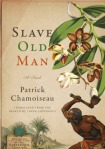
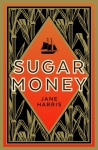
- Two historical novels set (partially) among the slaves of Martinique and featuring snippets of Creole (Patrick Chamoiseau’s Slave Old Man and Jane Harris’s Sugar Money)
- A book about epilepsy and a conductor’s memoir, followed by a novel with a conductor character and another who has seizures (Suzanne O’Sullivan’s Brainstorm and Lev Parikian’s Why Do Birds Suddenly Disappear? to Caoilinn Hughes’s Orchid & the Wasp)
- Two characters mistake pregnancy for cholera (in Alexandra Fuller’s Leaving Before the Rains Come and W. Somerset Maugham’s The Painted Veil)
 Two characters are reading Ursula K. Le Guin’s The Left Hand of Darkness (in Lily Brooks-Dalton’s Good Morning, Midnight and Julie Buntin’s Marlena) … I’ve since tried again with Le Guin’s book myself, but it’s so dry I can only bear to skim it.
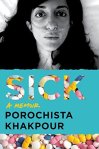
- Two memoirs by Iranian-American novelists with mental health and drug use issues (Porochista Khakpour’s Sick and Afarin Majidi’s Writing and Madness in a Time of Terror)

- References to the blasé response to Martin Luther King’s assassination in North Carolina (in Paulette Bates Alden’s Crossing the Moon and David Sedaris’s Calypso)
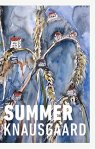
- The Police lyrics (in Less by Andrew Sean Greer and Summer by Karl Ove Knausgaard [a whole essay called “Sting”])

- Salmon croquettes mentioned in Less by Andrew Sean Greer and An American Marriage by Tayari Jones
 I’m reading Beryl Markham’s West with the Night … and then Glynnis MacNicol picks that very book up to read on a plane in No One Tells You This
- Starting two books with the word “Ladder” in the title, one right after the other: Ladders to Heaven by Mike Shanahan and Ladder of Years by Anne Tyler (followed just a couple of weeks later by A Ladder to the Sky by John Boyne!)


 Two books set in Dunedin, New Zealand, one right after the other – I planned it that way, BUT both have a character called Myrtle (To the Is-Land by Janet Frame and Dunedin by Shena Mackay). Then I encountered Harold Gillies, the father of plastic surgery, in Jim McCaul’s Face to Face, and guess what? He was from Dunedin!
- Then I was skimming Louisa Young’s You Left Early and she mentioned that her grandmother was a sculptor who worked with Gillies on prostheses, which was the inspiration for her WWI novel, My Dear I Wanted to Tell You.
- Two novels featuring drug addicts (Pretend I’m Dead by Jen Beagin and Bad News by Edward St. Aubyn)
- The same Wallace Stevens lines that appear as an epigraph to Barbara Kingsolver’s Unsheltered are mentioned in Elaine Pagels’s Why Religion? – “After the final no there comes a yes / And on that yes the future world depends.”

 “Twinkle, Twinkle, Little Star” is mentioned in Little by Edward Carey and Marilla of Green Gables by Sarah McCoy
- Reading Nine Pints, Rose George’s book about blood, at the same time as Deborah Harkness’s Time’s Convert, which is partially about vampires; in this it takes 90 days for a human to become fully vampirized – the same time it takes to be cured of an addiction according to the memoir Ninety Days by Bill Clegg.
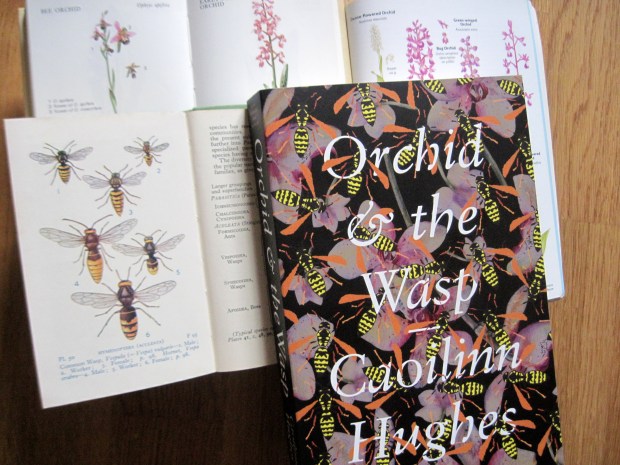
Orchid & the Wasp by Caoilinn Hughes
Gael Foess, the antiheroine of Caoilinn Hughes’ debut novel, is a trickster. When we first meet her in Dublin in 2002, the 11-year-old is promptly kicked out of school for trying to sell other girls “virginity pills.” As the years pass we see her con her way into a London Business School interview, self-assuredly teach a literature class when her professor doesn’t show up, pretend to be a journalist to get an exclusive interview, and use deception to try to boost the careers of both her mother, Sive (a conductor), and her younger brother, Guthrie (a painter and single dad). In the title metaphor, which refers to an orchid species that lures pollinating wasps, Gael is the seductive flower that gets what it wants. We’re also invited to think of her, with that typically Gael-ic name, as an incarnation of mythological Irish hero Cúchulainn.
The novel spans about nine years: a politically turbulent decade that opens with Iraq War protests and closes with the Occupy movement in New York City. The financial crisis temporarily jolts Gael and Guthrie’s father, Jarleth, a high-flying Barclays banker who leaves the family in 2008. The biblical parable of the talents, which he recounted to Gael when she was a little girl, comes back to resonate: It’s a potent reminder that money and skills don’t get distributed fairly in this life. When Gael gets to New York in 2011, she plans to redress the balance in two paradoxical ways: living in the Occupy camp and taking part in protests; and secretly earning her brother a fortune on his modern art. For even while decrying her father’s privilege, she indulges her own love of fine things; even if ironically, she says that she aspires to be in the 1%, too.
With all her contradictions, Gael is an unforgettable character. I also found Guthrie fascinating. It was serendipitous that I read this novel alongside Suzanne O’Sullivan’s new book, Brainstorm. Guthrie was a mystically religious child and suffered from seizures, which doctors determined weren’t due to epilepsy but to somatic delusions – psychological rather than physiological. The seizures, ironically, became a boon because they inspire his art: “they’re hallowed and each aura is an absolution – a benison – and not just a synaptic blip.”

The U.S. cover
Hughes is wonderfully adept at voices, bringing secondary characters to life largely through how they speak. I especially warmed to Art, Sive’s boyfriend, who’s a Yorkshireman; and Harper, Gael’s OCD-plagued flatmate from Las Vegas. Even a brief run-in with American officialdom gets the perfect deadpan rendering: “United States Customs has no interest in surprises. Matter of fact, we hate surprises.” The novel often has a frenetic pace – an energy that’s well matched by the virtuosic use of language, with wordplay, neologisms, and metaphors drawn from art, music and nature. An orchestra is compared to a flock of starlings; a despondent Sive “began to resemble a bass clef.” The Irish are like radishes: “Pink on the outside, white underneath. Speck of mud on their cheeks.” Harper’s entire upbringing is pithily reduced to an “only-childhood of sprinkler weather, window glare and doughnut glazing.” I also loved this tiny poem of a phrase: “sobbing hampers syntax.”
My only real misgiving about the novel is the ending: After Gael comes back from New York, things sort of fizzle out. I even wondered if the story line could have stopped a chapter earlier. But in a way it makes sense to get no tidy closure for our protagonist. Gael is still only 20 years old at the book’s end, so it’s no surprise that she remains a restless wanderer. I certainly wouldn’t object to hearing about her further adventures in a sequel. Hughes is an exciting writer who has rightfully attracted a lot of buzz for her debut, and this is sure to be one of my novels of the year. It’s a perfect follow-on read from Tom Rachman’s The Italian Teacher, and I’d also recommend it highly to fans of Sweetbitter, The Art of Fielding, The Nix, and The Life and Death of Sophie Stark. Watch out for it in two weeks’ time.
My rating: 
Orchid & the Wasp will be published by Oneworld in the UK on June 7th. It’s not out in the USA until July 10th (Hogarth). My thanks to Margot Weale for a proof copy for review.
 Bookish Beck = Rebecca Foster. American transplant to England. Freelance proofreader and book reviewer.
 Bookish Beck