#ReadIndies Catch-up: Ansell, Kinard, McNaught, Ponce, Toews and Vara
At last, my first dedicated selections for Read Indies month, two of which have been languishing on the shelf since 2022! A few more indie titles will appear in my February roundup tomorrow. I’ve got a huge variety here: an extended essay comparing life among the unhoused in London in the 1980s with the freedom of the open road and the island of Jura; gospel-saturated poems of queer African American life; an exposé of spiritual abuse in a Pentecostal church with branches in England and Nigeria; an Ecuadorian novella obsessed with bodies and sex; a funny yet heartbreaking novel about a zany family trying not to fall apart; and short stories about siblings, adolescence, memory, death and much more. I name the publishers and other books I have on the docket from each one.

Deer Island by Neil Ansell (2013)
 My last unread book by Ansell (whose Deep Country, The Last Wilderness, and The Circling Sky I’ve loved) and one that had been out of print for many years, so it was great to hear that Little Toller was reissuing it. Ansell has visited most countries; pressed for a favourite place, he names the Scottish isle of Jura. In memory he returns to a place he hadn’t been in over 20 years. In the early 1980s he lived in London and volunteered with The Simon Community, a homeless charity, for three years. Later that decade, he found himself in the same situation as those he served, squatting in chaotic multi-occupancy London properties. But in between he’d had a magical jaunt to Jura by hitchhiking and motorbike with a girlfriend. And later, when his only sentimental keepsake was stolen from his squat bedroom, he left that lifestyle behind and fled to Jura, haunt of golden eagles and otters; refuge for George Orwell, who experienced his fair share of squalor – Down and Out in Paris and London gets a mention, but Ansell doesn’t belabour a comparison he more than earns. It’s a shame this is so short, but it’s a carefully crafted slice of life, and illustrates a sobering truth: “Security is an illusion.”
With thanks to Little Toller Books for the free copy for review. Deer Island came out in paperback on 27 February.
Little Toller
Also read recently: brother. do. you. love. me. by Manni Coe
Currently reading: The Long Field by Pamela Petro
Orders of Service by Willie Lee Kinard III (2023)
 At a confluence of Southern, Black and gay identities, Kinard writes of matriarchal families, of congregations and choirs, of the descendants of enslavers and enslaved living side by side. The layout mattered more than I knew, reading an e-copy: often it is white text on a black page; words form rings or an infinity symbol; erasure poems gray out much of what has come before. “Boomerang” interludes imagine a chorus of fireflies offering commentary – just one of numerous insect metaphors. Mythology also plays a role. “A Tangle of Gorgons,” a sample poem I’d read before, wends its serpentine way across several pages. “Catalog of My Obsessions or Things I Answer to” presents an alphabetical list. For the most part, the poems were longer, wordier and more involved (four pages of notes on the style and allusions) than I tend to prefer, but I could appreciate the religious frame of reference and the alliteration.
Two favorite passages:
Ma taught me how to change a tire
the fall before it got real cold one October,
on the plot of dirt the pole beans we call Babel
spiral from, where our boozy station wagon
sat after hobbling home & passing out
in the backyard
(from “Work”)
I left before the door was closed.
I built myself of drowning hymns.
I stole every one to fly.
(from “Icarus Confesses”)
With thanks to Alice James Books for the advanced e-copy for review.
Alice James Books
Also read recently: Theophanies by Sarah Ghazal Ali
Immanuel by Matthew McNaught (2022)
 “Immanuel was the centre of the world once. Long after it imploded, its gravitational pull remains.” McNaught grew up in an evangelical church in Winchester, England, but by the time he left for university he’d fallen away. Meanwhile, some peers left for Nigeria to become disciples at charismatic preacher TB Joshua’s Synagogue Church of All Nations in Lagos. It’s obvious to outsiders that this was a cult, but not so to those caught up in it. It took years and repeated allegations for people to wake up to faked healings, sexual abuse, and the ceding of control to a megalomaniac who got rich off of duping and exploiting followers. This book won the inaugural Fitzcarraldo Editions Essay Prize. I admired its blend of journalistic and confessional styles: research, interviews with friends and strangers alike, and reflection on the author’s own loss of faith. He gets to the heart of why people stayed: “A feeling of holding and of being held. A sense of fellowship and interdependence … the rare moments of transcendence … It was nice to be a superorganism.” This gripped me from page one, but its wider appeal strikes me as limited. For me, it was the perfect chance to think about how I might write about traditions I grew up in and spurned.
With thanks to Fitzcarraldo Editions for the proof copy for review.
Fitzcarraldo Editions
Currently reading: Intervals by Marianne Brooker
Up next: Alphabetical Diaries by Sheila Heti
Blood Red by Gabriela Ponce (2020; 2024)
[Translated from the Spanish by Sarah Booker]
 Like other short works I’ve read by Hispanic women authors (Die, My Love, September and the Night, In Vitro), this Ecuadorian novella is intense, fragmentary, and obsessed with the female body and psyche. The unnamed narrator, a woman separated from her husband and freed from inhibitions, gives in to her substance and sex addictions – “For me, anything that isn’t falling in love has never merited much attention. That giddiness from proximity or bodies”. I was reminded of A Spy in the House of Love in that she flits compulsively from one lover to another, but Ponce is much more explicit than Nin. At least at the start, the sex scenes are almost constant and described in graphic detail. The narrator meets her lovers in warehouses and caves. Literal holes/orifices and blood are profuse, but also symbolically weighty, with fear of pregnancy also featuring heavily. I was impressed at how Booker rendered the stream-of-consciousness approach, which involves several-page paragraphs and metaphors of moths and moss. I wouldn’t say this was a pleasant book to spend time with, but the style and vocabulary made it worthy of note.
With thanks to Dead Ink for the free copy for review. Blood Red was first published in English by Restless Books in the USA in 2022.
Dead Ink
Up next: Sinking Bell by Bojan Louis
Fight Night by Miriam Toews (2022)
 I knew from All My Puny Sorrows that Canadian author Miriam Toews has a knack for combining humour and heartbreak. I can’t believe it took me since 2015 to read another of her novels. Once again, there seems to be a strong autobiographical element and suicide in the family is part of the backstory. Although abandonment and failure haunt these three female generations, we see everything through a child’s point-of-view, which turns life into a jolly adventure. Swiv’s mother, an underemployed actress, is heavily pregnant with “Gord”; her father is out of the picture. Swiv has been expelled, which gives her plenty of time with Grandma Elvira, who makes friends with everyone she meets but, alas, is crumbling physically. Luckily, Swiv knows just how to keep her going with nitro spray and compression socks and pills rescued from the floor. Before Gord arrives, Grandma wants one last adventure: a flight from Canada to Fresno, California to see her remaining family. Their trip is a disaster, in hilarious ways. Child narrators are tough to pull off, so kudos to Toews for making eight-year-old Swiv almost completely believable (though a bit too precocious). These characters are all foul-mouthed fighters, with a quick wit and the determination to make their stories matter. You’ll laugh and cry.
With thanks to Faber for the proof copy for review.
Faber
Also read recently: Happiness Falls by Angie Kim
Currently reading: Places I’ve Taken My Body by Molly McCully Brown
This Is Salvaged by Vauhini Vara (2023)
 The epigraph is from the two pages of laughter (“Ha!”) in “Real Estate,” one of the stories of Birds of America by Lorrie Moore. Vara shares Moore’s themes, which are the stuff of literary fiction generally – adolescence, friendship, ageing, memory, romantic relationships – but also her tone of dark comedy. The death of a sibling recurs. In “The Irates,” teenage Swati, whose brother died of cancer, and her friend Lydia get phone sales jobs through the Chinese restaurant where they go for egg rolls. In “I, Buffalo,” Sheila tries to hide her alcoholism when her sister Priya comes for a visit with Sheila’s brother-in-law and niece. “The girl” in “You Are Not Alone” is delighted to spend her eighth birthday in Florida with her estranged father, but less so when she learns there’s a stepmother figure in the picture. The women of “Sibyls” look after an elderly neighbour with dementia. The querulous child in “Unknown Unknowns” reminded me of Good Talk by Mira Jacob. My two favourites were the title story, about building a Noah’s Ark replica, and “What Next,” about a woman accompanying her teenage daughter to meet her father for the first time. A few stories didn’t stand out, and while I liked the writing, this didn’t necessarily feel like a cohesive collection.
With thanks to Grove Press UK for the free copy for review. This Is Salvaged came out in paperback in the UK on 1 February.
Grove Atlantic
Up next: Get the Picture by Bianca Bosker, Home/Land by Rebecca Mead, We Play Ourselves by Jen Silverman
Have you discovered any new-to-you independent publishers recently?
Nonfiction November: Being the ‘Expert’ on Women’s Religious Memoirs
This week of the month-long challenge is hosted by JulzReads. I’m a total memoir junkie and gravitate towards ones written by women: sometimes those whose lives are completely different to mine (medical crises, parenting, etc.) and sometimes those who’ve had experiences similar to mine (moving to a new country, illness and dysfunction in the family, etc.).
In my late teens I fell into a crisis of faith that lasted for many years – or maybe is still ongoing – and planted the seed for my Master’s thesis on women’s faith and doubt narratives in Victorian fiction. I’m always looking out for memoirs that discuss religious conversion, doubt, or loss of faith.
I know we don’t all share the same obsessions. (The bookish world would be boring if we did!) It’s possible this topic doesn’t interest you at all. But if it does, or if you’d like to test the waters, here are 15 or so relevant reads that have stood out for me; I think I’ve only written about a few of them on here in the past.
[Note: I highly recommend any autobiographical writing by Anne Lamott, Madeleine L’Engle, and Kathleen Norris; although all three write/wrote about faith, their engagement with doubt doesn’t quite feel specific enough to get them a spot on this list.]
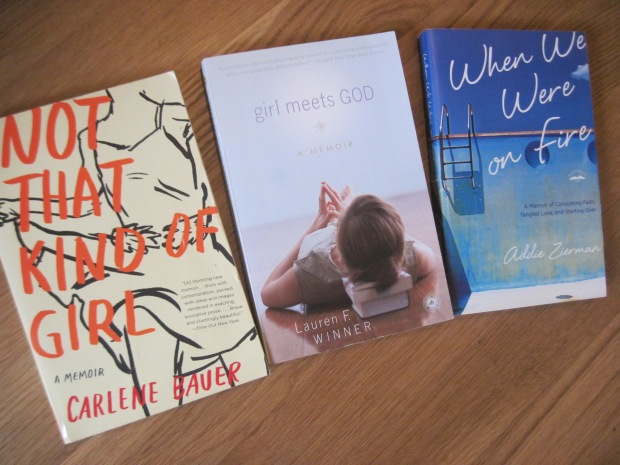
Most of the books below I read from the library or on Kindle/Nook, or have lent to others. These are the ones I happen to own in print.
Recommended from This Year’s Reading
 Everything Happens for a Reason, and Other Lies I’ve Loved by Kate Bowler: An assistant professor at Duke Divinity School, Bowler was fascinated by prosperity theology: the idea that God’s blessings reward righteous living and generous giving to the church. If she’d been tempted to set store by this notion, that certainty was permanently fractured when she was diagnosed with stage IV colon cancer in her mid-thirties. Bowler writes tenderly about suffering and surrender, and about living in the moment with her husband and son while being uncertain of the future, in a style reminiscent of Anne Lamott and Nina Riggs.
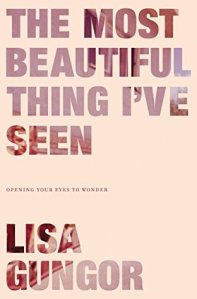 The Most Beautiful Thing I’ve Seen: Opening Your Eyes to Wonder by Lisa Gungor: Like many Gungor listeners, Lisa grew up in, and soon outgrew, a fundamentalist Christian setting. She married Michael Gungor at the absurdly young age of 19 and they struggled with infertility and world events. When their second daughter was born with Down syndrome and required urgent heart surgery, it sparked further soul searching and a return to God, but this time within a much more open spirituality that encircles and values everyone – her gay neighbors, her disabled daughter; the ones society overlooks.
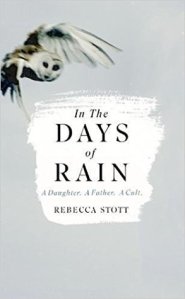 In the Days of Rain: A Daughter, a Father, a Cult by Rebecca Stott: This is several things: a bereavement memoir that opens with Stott’s father succumbing to cancer and eliciting her promise to finish his languishing memoirs; a family memoir tracking generations in England, Scotland and Australia; and a story of faith and doubt, of the absolute certainty experienced inside the Exclusive Brethren (a sect that numbers 45,000 worldwide) and how that cracked until there was no choice but to leave. Stott grew up with an apocalyptic mindset. It wasn’t until she was a teenager that she learned to trust her intellect and admit doubts.
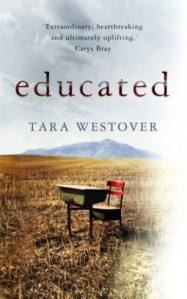 Educated by Tara Westover: You might be tired of hearing about this book, but it really does deserve the hype. Westover’s is an incredible story of testing the limits of perseverance and sanity. After an off-grid, extremist Mormon upbringing in Idaho, hard work took her from almost complete ignorance to a Cambridge PhD. She writes with calm authority, channeling the style of the scriptures and history books that were formative in her upbringing and education. This is one of the most powerful and well-written memoirs I’ve ever read.
Recent Releases (all came out on Nov. 13th)
 A River Could Be a Tree by Angela Himsel: From rural Indiana and an apocalyptic Christian cult to New York City and Orthodox Judaism by way of studies in Jerusalem: Himsel has made quite the religious leap. She was one of 11 children and grew up in the Worldwide Church of God (reminiscent of the Exclusive Brethren from Stott’s book). Although leaving a cult is easy to understand, what happens next feels more like a random sequence of events than a conscious choice; maybe I needed some more climactic scenes.
 Why Religion? A Personal Story by Elaine Pagels: Pagels is a religion scholar known for her work on the Gnostic Gospels. As a teen she joined a friend’s youth group and answered the altar call at a Billy Graham rally. Although she didn’t stick with Evangelicalism, spirituality provided some comfort when her son died of pulmonary hypertension at age six and her physicist husband Heinz fell to his death on a hike in Colorado little more than a year later. She sees religion’s endurance as proof that it plays a necessary role in human life.
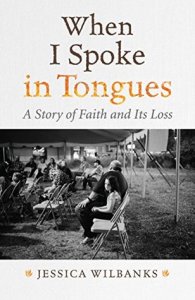 When I Spoke in Tongues: A Story of Faith and Its Loss by Jessica Wilbanks: Like me, Wilbanks grew up attending a Pentecostal-style church in southern Maryland. I recognized the emotional tumult of her trajectory – the lure of power and certainty; the threat of punishment and ostracism – as well as some of the specifics of her experience. Captivated by the story of Enoch Adeboye and his millions-strong Redemption Camps, she traveled to Nigeria to research the possible Yoruba roots of Pentecostalism in the summer of 2010.
Read Some Time Ago
 Not That Kind of Girl by Carlene Bauer: A bookish, introspective adolescent, Bauer was troubled by how fundamentalism denied the validity of secular art. All the same, Christian notions of purity and purpose stuck with her throughout her college days in Baltimore and then when she was trying to make it in publishing in New York City. Along the way she flirted with converting to Catholicism. What Bauer does best is to capture a fleeting mindset and its evolution into a broader way of thinking.
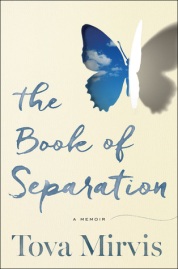 The Book of Separation by Tova Mirvis: In a graceful and painfully honest memoir, Mirvis goes back and forth in time to contrast the simplicity – but discontentment – of her early years of marriage with the disorientation she felt after divorcing her husband and leaving Orthodox Judaism. Anyone who has wrestled with faith or other people’s expectations will appreciate this story of finding the courage to be true to yourself.
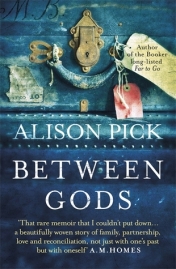 Between Gods by Alison Pick: At a time of transition – preparing for her wedding and finishing her first novel, set during her Holocaust – the author decided to convert to Judaism, the faith of her father’s Czech family. Ritual was her way into Judaism: she fasted for Yom Kippur and took her father to synagogue on the anniversary of her grandfather’s death, but also had the fun of getting ready for a Purim costume party.
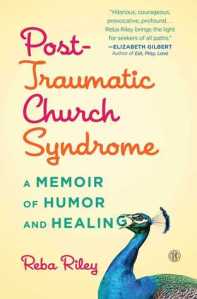 Post-Traumatic Church Syndrome: A Memoir of Humor and Healing by Reba Riley: Riley was a Pentecostal-leaning fundamentalist through high school, but turned her back on it in college. Yet she retained a strong spiritual compass that helped her tap into the energy of the “Godiverse.” She concocted the idea of experiencing 30 different religious traditions before she turned 30, and spent 2011–12 visiting a Hindu temple, a Buddhist meditation center, a mosque, a synagogue, a gathering of witches, and a range of Christian churches.
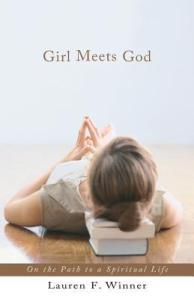 Girl Meets God: A Memoir by Lauren F. Winner: Some people just seem to have the religion gene. That’s definitely true of Winner, who was as enthusiastic an Orthodox Jew as she later was a Christian after the conversion that began in her college years. Like Anne Lamott, Winner draws on anecdotes from everyday life and very much portrays herself as a “bad Christian,” one who struggles with the basics like praying and finding a church community and is endlessly grateful for the grace that covers her shortcomings.
 When We Were on Fire by Addie Zierman: Zierman was a poster girl for Evangelicalism in her high school years. After attending Christian college, she and her husband spent a lonely year teaching English in Pinghu, China. Things got worse before they got better, but eventually she made her way out of depression through therapy, antidepressants and EMDR treatments, marriage counselling, a dog, a home of their own, and – despite the many ways she’d been hurt and let down by “Church People” over the years – a good-enough church.
Read but Not Reviewed
 Fleeing Fundamentalism by Carlene Cross
Leaving Church by Barbara Brown Taylor
On my TBR Stack
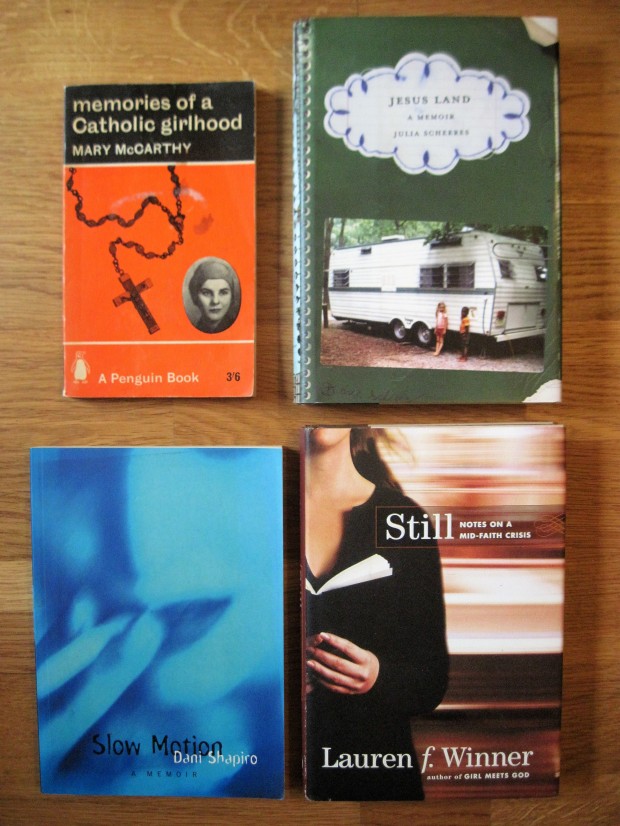
 Not pictured: (on Nook) Girl at the End of the World by Elizabeth Esther; (on Kindle) Shunned by Linda A. Curtis and Cut Me Loose by Leah Vincent. Also, I got a copy of Priestdaddy by Patricia Lockwood for my birthday, but I’m not clear to what extent it’s actually about her religious experiences.
 Bookish Beck = Rebecca Foster. American transplant to England. Freelance proofreader and book reviewer.
 Bookish Beck