The Moomins and the Great Flood (#Moomins80) & Poetry (#ReadIndies)
To mark the 80th anniversary of Tove Jansson’s Moomins books, Kaggsy, Liz et al. are doing a readalong of the whole series, starting with The Moomins and the Great Flood. I received a copy of Sort Of Books’ 2024 reissue edition for Christmas, so I was unknowingly all set to take part. I also give quick responses to a couple of collections I read recently from two favourite indie poetry publishers in the UK, The Emma Press and Carcanet Press. These are reads 9–11 for Kaggsy and Lizzy Siddal’s Reading Independent Publishers Month challenge.
The Moomins and the Great Flood by Tove Jansson (1945; 1991)
[Translated from the Swedish by David McDuff]
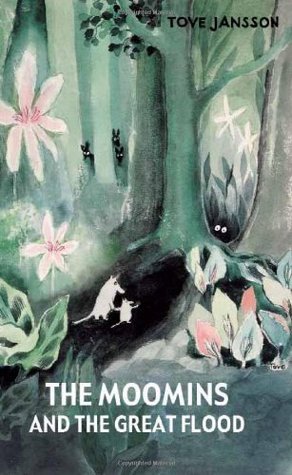 Moomintroll and Moominmamma are the only two Moomins who appear here. They’re nomads, looking for a place to call home and searching for Moominpappa, who has disappeared. With them are “the creature” (later known as Sniff) and Tulippa, a beautiful flower-girl. They encounter a Serpent and a sea-troll and make a stormy journey in a boat piloted by the Hattifatteners. My favourite scene has Moominmamma rescuing a cat and her kittens from rising floodwaters. The book ends with the central pair making their way to the idyllic valley that will be the base for all their future adventures. Sort Of and Frank Cottrell Boyce, who wrote an introduction, emphasize how (climate) refugees link Jansson’s writing in 1939 to today, but it’s a subtle theme. Still, one always worth drawing attention to.
I read my first Moomins tale in 2011 and have been reading them out of order and at random ever since; only one remains unread. Unfortunately, I did not find it rewarding to go right back to the beginning. At barely 50 pages (padded out by the Cottrell-Boyce introduction and an appendix of Jansson’s who’s-who notes), this story feels scant, offering little more than a hint of the delightful recurring characters and themes to come. Jansson had not yet given the Moomins their trademark rounded hippo-like snouts; they’re more alien and less cute here. It’s like seeing early Jim Henson drawings of Garfield before he was a fat cat. That just ain’t right. I don’t know why I’d assumed the Moomins are human-size. When you see one next to a marabou stork you realize how tiny they are; Jansson’s notes specify 20 cm tall. (Gift)
The Emma Press Anthology of Homesickness and Exile, ed. by Rachel Piercey and Emma Wright (2014)
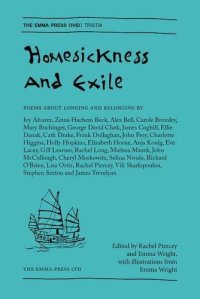 This early anthology chimes with the review above, as well as more generally with the Moomins series’ frequent tone of melancholy and nostalgia. A couple of excerpts from Stephen Sexton’s “Skype” reveal a typical viewpoint: “That it’s strange to miss home / and be in it” and “How strange home / does not stay as it’s left.” (Such wonderfully off-kilter enjambment in the latter!) People are always changing, just as much as places – ‘You can’t go home again’; ‘You never set foot in the same river twice’ and so on. Zeina Hashem Beck captures these ideas in the first stanza of “Ten Years Later in a Different Bar”: “The city has changed like cities do; / the bar where we sang has closed. / We have changed like cities do.”
Departures, arrivals; longing, regret: these are classic themes from Ovid (the inspiration for this volume) onward. Holly Hopkins and Rachel Long were additional familiar names for me to see in the table of contents. My two favourite poems were “The Restaurant at One Thousand Feet” (about the CN Tower in Toronto) by John McCullough, whose collections I’ve enjoyed before; and “The Town” by Alex Bell, which personifies a closed-minded Dorset community – “The town wraps me tight as swaddling … When I came to the town I brought things with me / from outside, and the town took them / for my own good.” Home is complicated – something one might spend an entire life searching for, or trying to escape. (New purchase from publisher)
Gold by Elaine Feinstein (2000)
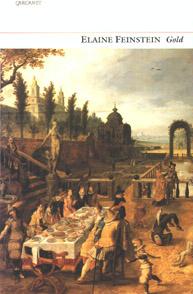 I’d enjoyed Feinstein’s poetry before. The long title poem, which opens the collection, is a monologue by Lorenzo da Ponte, a collaborator of Mozart. Though I was not particularly enraptured with his story, there were some great lines here:
I wanted to live with a bit of flash and brio,
rather than huddle behind ghetto gates.
The last two stanzas are especially memorable:
Poor Mozart was so much less fortunate.
My only sadness is to think of him, a pauper,
lying in his grave, while I became
Professor of Italian literature.
Nobody living can predict their fate.
I moved across the cusp of a new age,
to reach this present hour of privilege.
On this earth, luck is worth more than gold.
Politics, manners, morals all evolve
uncertainly. Best then to be bold.
Best then to be bold!
Of the discrete “Lyrics” that follow, I most liked “Options,” about a former fiancé (“who can tell how long we would have / burned together, before turning to ash?”) and “Snowdonia,” in which she’s surprised when a memory of her father resurfaces through a photograph. Talking to the Dead was more consistently engaging. (Secondhand purchase – Bridport Old Books, 2023)
R.I.P. Reads, Part I: Ahlberg, Gaskell, Hinchcliffe and Watson
I don’t generally read horror or suspense, but the R.I.P. challenge is my annual excuse to pick up some slightly scarier material. For this first installment of super-short responses, I have a children’s book about a seriously problematic cat, a Victorian ghost story, and two recent Scotland-set novels about exiles haunted by the unexplained. (All: Public library)

The Improbable Cat by Allan Ahlberg (2003)
 I picked this up expecting a cute cat tale for children, only realizing afterwards that it’s considered horror. When a grey kitten wanders into their garden, Davy is less enamoured than the rest of the Burrell family. His suspicion mounts as the creature starts holding court in the lounge, expecting lavish meals and attention at all times. His parents and sister seem to be under the cat’s spell in some way, and it’s growing much faster than any young animal should. Davy and his pal George decide to do something about it. Since I’m a cat owner, I’m not big into evil cat stories (e.g., Cat out of Hell by Lynne Truss), and this one was so short as to feel underdeveloped.
 “The Old Nurse’s Story” by Elizabeth Gaskell (1852)
(collected in Gothic Tales (2000), ed. Laura Kranzler)
I had no idea that Gaskell had published short fiction, let alone ghost stories. Based on the Goodreads and blogger reviews, I chose one story to read. The title character tells her young charges about when their mother was a child and the ghost of a little girl tried to lure her out onto the Northumberland Fells one freezing winter. It’s predictable for anyone who reads ghost stories, but had a bit of an untamed Wuthering Heights feel to it. 
Hare House by Sally Hinchcliffe (2022)
 The unnamed narrator is a disgraced teacher who leaves London for a rental cottage on the Hare House estate in Galloway. Her landlord, Grant Henderson, and his rebellious teenage sister, Cass, are still reeling from the untimely death of their brother. The narrator gets caught up in their lives even though her shrewish neighbour warns her not to. There was a lot that I loved about the atmosphere of this one: the southwest Scotland setting; the slow turn of the seasons as the narrator cycles around the narrow lanes and finds it getting dark earlier, and cold; the inclusion of shape-shifting and enchantment myths; the creepy taxidermy up at the manor house; and the peculiar fainting girls/mass hysteria episode that precipitated the narrator’s banishment and complicates her relationship with Cass. The further you get, the more unreliable you realize this narrator is, yet you keep rooting for her. There are a few too many set pieces involving dead animals, and, overall, perhaps more supernatural influences than are fully explored, but I liked Hinchcliffe’s writing enough to look out for what else she will write. (Readalikes: The Haunting of Hill House and Wakenhyrst)
Metronome by Tom Watson (2022)
 Ever since I read Blurb Your Enthusiasm, I’ve been paying more attention to jacket copy. This is an example of a great synopsis that really gives a sense of the plot: mysterious events, suspicion within a marriage, and curiosity about what else might be out there. Aina and Whitney believe they are the only people on their island. They live simply on a croft and hope that, 12 years after their exile, they’ll soon be up for parole. Whitney stubbornly insists they wait for the warden to rescue them, while Aina has given up thinking anyone will ever come. There’s a slight Beckettian air, then, to the first two-thirds of this dystopian novel. When someone does turn up, it’s not who they expect. The eventual focus on parenthood meant this reminded me a lot of The Road; there are also shades of The Water Cure and Doggerland (though, thankfully, the dual protagonists ensure a less overly male atmosphere than in the latter). This was an easy and reasonably intriguing read, but ultimately a bit vague and bleak for me, and not distinguished enough at the level of the prose (e.g., way too many uses of “onside”).
 Bookish Beck = Rebecca Foster. American transplant to England. Freelance proofreader and book reviewer.
 Bookish Beck