Review and Q&A: Unruly Creatures by Jennifer Caloyeras
The 11 stories in Jennifer Caloyeras’ new collection, Unruly Creatures (released on October 3rd by West Virginia University Press), feature characters who find themselves in extreme situations and/or are let down by their bodies. Often, their tentative steps outside their own problematic situations involve making unexpected connections with the animal world: a neglected boy learns from a taxidermist, a trainer at the Institute for Privileged Primates is surprised by the depth of her feelings for one of the gorillas in her care, a woman who has just had a double mastectomy empathizes with a cow stuck in the crater left by a crashed meteor, and two teens realize they can only bond with their father when in animal costumes.
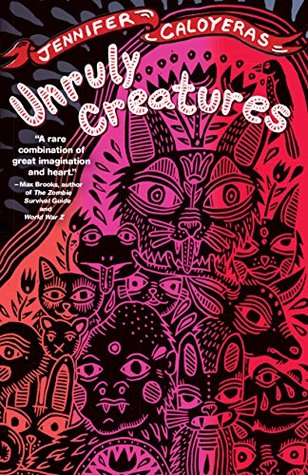 I appreciated the variety of forms and voices here. One story set in a dystopian future has an epistolary element, including letters and memos; two others use second-person or first-person plural narration, respectively. There’s also a lot to think about in terms of gender. For instance, one protagonist frets about out-of-control pubic hair, while another finds it difficult to maintain her trans identity on a male prison ward. “A Real Live Baby” was a stand-out for me. Its title is a tease, though, because Chloe is doing the Egg Baby project in school and ‘babysits’ for her delusional neighbor, who keeps a doll in a stroller. The conflation of dolls and babies is also an element in recent stories by Camilla Grudova and Lesley Nneka Arimah – proof, if we needed it, that modern motherhood is both an enigma and a work in progress.
I’d recommend this story collection to readers of Margaret Atwood and Karen Joy Fowler – and to book clubs. You certainly won’t run out of things to discuss!
My rating:
Jennifer kindly offered to take part in a Q&A over e-mail. We talked about eco-lit, fairy tales gone wild, and how writing and marketing short stories is different from novels.
Animals take on a variety of roles in these stories: research subjects, art projects, friends. Are you an animal lover? Or was that linking theme incidental? And what did you hope to convey about the ways the human and animal worlds intersect?
I am an animal lover. I always have been. When I was younger I really wanted to be a marine biologist. I couldn’t quite get around the math. Then for a while, I thought, animal psychologist. I’ve always been obsessed with animals and animal behavior and the ways in which humans are constantly distancing themselves from animals and their behavior. We have a bit of an unfair superiority complex when it comes to the animal world. I ended up going down an entirely different path (musician and singer) before applying to graduate school for a MA in English and then a MFA in creative writing.

Jennifer with her dogs. Photo by Gene Fama.
But to get back to your question, I didn’t set out to write a collection of linked animal stories; that ended up happening organically. I like to use animals as a mirror or lens through which we see ourselves: sometimes at our worst, most instinctive behavior – sometimes at our best. I think an apt metaphor is that of child staring at an animal at a cage in the zoo, internalizing the thought, “I am nothing like that animal. I am everything like that animal.”
Sometimes the humans are the truly unruly creatures – thinking especially of the obnoxious plane passenger in “Airborne” and Ernest, the persnickety postman in “Big Brother.” How does placing them alongside animal characters point up their flaws?
I am a huge fan of unlikable and unreliable narrators. And I think the short story genre lends itself to utilizing these types of narrators, because you don’t have to sustain this for the duration of an entire novel. In “Big Brother”, the reader aligns with everyone else in the story, not the protagonist. Ernest can’t get over the fact that Les, his co-worker, could have such a bond with a parrot, when Ernest has such a difficult time connecting with anyone, yet in the same story, Ernest’s earnest love for his dog is apparent. He has the key to connecting with people, he just doesn’t have the means to put this knowledge to use.
“H2O” imagines a future extreme drought situation in which only the elite can afford fresh water. Does this feel like a plausible scenario, especially where you live in California?
Oh, the water situation is really scary. I don’t think we’re far off from the scenario presented in this story. It’s always absurd to me when we hear about drought conditions and yet, here I am, driving by a huge verdant golf course. And the access for the wealthy in this particular story resonates in terms of access in general in a capitalistic society. In the story, which is a sort of eco-lit satire (I think I just made up that genre), water is the most coveted commodity, yet it’s marketed differently depending on economic status. Living in Los Angeles, there seems to be a production value to everything here, so I wanted to add that twist in the story – the commercialism of a commodity – how it would be talked about on a production set. How to do the perfect “hard sell” when it comes to water.
I especially love the fairy tale-gone-wild mood of “Unruly”: Caroline loathes the Rapunzel-like abundance of her pubic hair, and instead of a glass slipper we get glass shards in Tom’s arm. How does twisting a fairy tale play with readers’ expectations for a story?
I’ve always been obsessed with fairy tales. My second young adult novel, Strays, has a whole component where a high school English teacher introduces 16-year-old Iris, the protagonist, to Angela Carter’s The Bloody Chamber (if you’re a fairy tale fan, you have to read this one!), which is a feminist reinterpretation of fairy tales. I love how familiar all the fairy tale tropes are. I love the use of magical realism in fairy tales and I love the idea of playing with a familiar and predictable story and undercutting the reader’s expectations. To that end, I recently read (and loved) A. Igoni Barrett’s Blackass – which was a retelling of Kafka’s Metamorphosis. But instead of waking up as a cockroach, in this version – a black man in Lagos wakes up as a white man, afforded all of the benefits of white privilege. As a reader you’re thinking, “I know the story, but I don’t know this story.”
The story “Stuffed” was also inspired loosely by the fairy tale of Hansel and Gretel. The witch in the woods is replaced by a taxidermist (who is not evil) and instead, things with the child go dark pretty quickly.
Occasionally ersatz creatures are on display: doll babies, taxidermied animals, or animal costumes. What are we to make of that gulf between the real thing and the false one on display?
Surrogates are some of my favorite things to explore! I took a deep dive into the world of taxidermy while doing research for “Stuffed”. I really couldn’t get enough. I remember as a child getting lost for hours in the Hall of Mammals at the Natural History Museum in Los Angeles. I think, for me, it’s the idea of creating something to replace something, but the replacement is complete artifice. In terms of taxidermy, essentially, you are replacing death or recreating death to imitate life. A real dead animal is ugly, sunken, decayed. But we have these artists who take death, stuff it with synthetic material, replace eyeballs with beads and you have a recreation of an animal that sometimes looks better off than a live version of that animal. A lot of what is explored in these stories is a stripping down to raw human behavior. People hide behind the masks and costumes and artifice, but placed in certain situations, their animal instincts will always emerge.
[See also my review of the taxidermy-themed English Animals by Laura Kaye.]
Can you remember what the seed was for some of these stories? A particular line, scene, image, or character? Do you start writing a story with a title in mind, or does the title usually suggest itself later on?
Titles always come last for me. Always. I can’t name a thing until I know what that thing is. Writing is such a process and oftentimes I won’t end up where I think I’m going when I’m writing a story. They always surprise me. “Unruly” (the story of the pubic-haired Rapunzel) came directly out of this vivid dream I had when I was pregnant with my first child. I dreamed that I was naked with long flowing hair everywhere and a squirrel came out of a tree, nipped off a chunk of my hair and ran back to her nest and wove the hair into the nest. I remember waking up hysterically laughing. In hindsight it was such an obvious fertility dream; for the sake of the story, I made it a representation of coming-of-age/adolescence – a time where one’s body feels out of control, but I took it to the next level.

Photo by Gene Fama.
“The Sound of an Infinite Gesture” came directly from Koko the signing gorilla. It’s amazing that a gorilla can use sign language and communicate, but there was also something odd about people putting these very human ideas on a gorilla (remember they got her a pet kitten? And now I see they have her signing PSAs to save the environment?), so I started ruminating on what if we took this idea further – the gorilla communicates so well with her trainer that they begin to develop intimate feelings for one another.
Stories will often come out of an article I read (how leeches are being used in modern medicine led to “Bloodletting”) or from a friend, “Hey, did you know that people go to furry parties where they dress up in costumes and hug one another?” which led to “Plush” and I start playing around with what that might look like. It’s a lot of imaginative play involved. That’s my favorite part of writing – that dreamy time before I actually sit down to type – when it’s all just floating around my head and I’m trying to make a movie of it in my mind.
You’ve previously written YA novels. How different was the experience of writing these short stories? Do you see this work finding a dissimilar audience?
Writing a short fiction collection is not for the faint of heart. I was actually shocked at how slim the collection looked when it arrived in the mail. I kept thinking, “but I did all that work!” Each story, in a way, is treated like a novel. And I’m not talking just about the structure from beginning to end. Every word in a short story is precious; you have to economize. And, in order to get momentum for the collection, you want to publish stories from the collection in literary journals, which takes the same amount of energy and query letters that sending out your novel to an agent or publisher takes!
The audience for this book is completely different than the 13–17 demographic of the two other books. I have had a few people say, “Oh I bought your latest book for my child” and I’m quick to say, “it’s not for kids!” But read at your own risk.
Who are some of your favorite writers? Who has inspired your prose style or your story strategies?
I have so many favorite writers! And I read across all genres. It’s hard to say exactly who has influenced my work, but I will share my favorites! I love Lorrie Moore’s Birds of America. I think she is the best at synthesizing humor and pathos in the same space. I strive to do this in my stories. Pastoralia by George Saunders is another favorite collection. He is a master storyteller, satirist, humorist and his stories bring me to my knees from emotion in unexpected ways. I love Aimee Bender’s use of magical realism. I recently read Ottessa Moshfegh’s Homesick for Another World and loved it! There are so many amazing and varied voices when it comes to contemporary short fiction! The faculty member I worked closely with at the University of British Columbia when I was working on my MFA in creative writing was the Giller-nominated writer, Zsuzsi Gartner. In addition to being an incredible writer herself, she opened up the world of endless possibilities in short fiction, which was incredibly liberating.
What are you working on next?
Last year, I was selected as the writer-in-residence at the Annenberg in Santa Monica and I began working on a contemporary novel about expectations and parenthood. I’m still working on it and hope to be finished by the beginning of the new year. (Now that it’s in writing, maybe I will be further motivated!) I was pretty sure that I was done with short fiction for a while, but then ideas started coming to me again, so it’s my job to listen.
I also teach writing at UCLA Extension’s Writers’ Program. I will be teaching a new course, “Writing the Young Adult Novel”, in the winter and my usual “Intro to Short Fiction” in the spring. The classes are online, so if any of your readers are interested, sign up!
I spend a good amount of my time editing and helping to develop manuscripts and stories for clients. So it’s a nice balance between writing, editing and teaching.
My father, screenwriter Ron Clark, and I are toying with starting a podcast. Stay tuned!
Other places to reach Jennifer on social media:
Facebook Author Page: Jennifer Caloyeras
Twitter: @Jencaloyeras
Instagram: JenniferCaloyeras
Review: How Saints Die by Carmen Marcus
“A story is like a net: you have to make your own; you have to throw the loops just right; you have to be careful what gets in and what gets out, what you catch and what you keep.”
Ten-year-old Ellie Fleck isn’t like the other children in her North Yorkshire town. The daughter of Pete, a grizzled fisherman, and Kate, an Irish Catholic woman who’s in a mental hospital after a presumed suicide attempt, Ellie was raised on stories of selkies and martyrdoms. Superstition infuses her daily life, making her afraid of pool trips with her classmates – it’s bad luck for fishermen to learn to swim – and leading her to expect her dead grandmother’s soul to waft in through an open window on Halloween night.
 What with bullies’ beatings and her teacher Mr. Lockwood’s disapproval, it’s no wonder Ellie misses lots of school, going sea-coaling with her father or running off to the coast alone instead. But with Christmas approaching and Kate due home from the hospital, Ellie’s absences warrant an official visit. Social worker May Fletcher, the mother of Ellie’s new friend Fletch, is also concerned about Ellie’s home life. “How Saints Die,” Ellie and Fletch’s gruesome skit performed as an addendum to the school Nativity play, seems like proof that something is seriously wrong.
This is performance poet Carmen Marcus’s debut novel; from what I can tell it seems partially autobiographical. It powerfully conveys the pull of the sea and the isolation of an unconventional 1980s childhood. The dreamy, hypnotic prose alternates passages from Ellie’s perspective with shorter chapters from the points of view of the adults in her life, including her father, busybody neighbor Mrs. Forster, and May Fletcher. Marcus is equally skilled at the almost stream-of-consciousness passages describing Ellie’s trips to the sea and at humorous one-line descriptions:
Sand and salt in the cut, stinging. Her dad would know what to do. She wants him here, now, to show her. Without him the beach takes her up entirely, the shushshush of the sea and the coarse cackle of the waders at the waters-edge, creakcrackcreakcrackyawyaw; the wind tugging at the shell of her ear. All of it pulling, nipping, cutting at her – snipsnipsnip – and now blood, her edges ragged and wet.
Mrs Forster always smells faintly sweet and acidic like old Christmas cake.
– What are sins?
– They’re like germs but in your thoughts.
It’s easy to get lost in Ellie’s supernatural world of spirits and sea wolves, while the occasional outsider views make it clear just how dangerous some of her notions could be. Like Paula Cocozza’s How to Be Human, this sets up an intriguing contrast between magic realism and madness. The language is full of transformations and fairy tale tropes. I was reminded at times of Amy Sackville’s Orkney and Fiona Melrose’s Midwinter. Although there is perhaps one perilous situation too many at the climax and the resolution is a bit drawn out (and there is also less punctuation than I would like), this is still a strong and absorbing first novel and one I fully expect to see on next year’s Women’s Prize for Fiction longlist.
My rating:
How Saints Die is published in the UK today, July 13th, by Harvill Secker. My thanks to Louise Court for sending a free copy for review.
The Doll’s Alphabet: Stories by Camilla Grudova
Camilla Grudova lives in Toronto and has a degree in Art History and Germany from McGill University of Montreal. The Doll’s Alphabet, her debut collection, sets surreal tales of women’s inner lives against ruined cityscapes. These 13 stories are like perverted fairytales or fragmentary nightmares, full of strange recurring imagery and hazily dystopian setups. Flash fiction-length stories alternate with longer ones that move at a dizzying pace, and the book is roughly half third-person and half first-person – a balance I always appreciate.
 “Unstitching,” the two-page opener, introduces the metaphors and gender politics that form the backdrop for Grudova’s odd imagination. One day Greta realizes she can unstitch herself, removing an outer covering to reveal her true identity; “It brought great relief … like undoing one’s brassiere before bedtime or relieving one’s bladder after a long trip.” Her neighbor Maria does the same, but men – including Greta’s husband – find this intimidating, and are jealous because they don’t seem to have a deeper self to uncover. I was tickled by the idea of women having a secret life unshared by men, but had trouble grasping the actual mechanics of the unstitching: “She did not so much resemble a sewing machine as she was the ideal form on which a sewing machine was based. The closest thing she resembled in nature was an ant.” Huh? This is a case where keeping things vague might have been a better strategy.
Sewing machines keep popping up, along with mermaids, dolls, babies, zoos, factories, and old-fashioned or derelict shops. For example, the narrator of “The Mouse Queen” is a clerk in a doll’s house shop, while her husband Peter works in a graveyard. One night he brings home the corpse of an old dwarf woman, which the narrator decides to stow in the abandoned grocery store under their apartment. Um, naturally.
In “Waxy” (full text available on the Granta website) the narrator works at a sewing machine factory and unlawfully acquires a baby by her sub-par Man, Paul. The sexual violence in this one and in “Moth Emporium” is deeply unsettling: even in these off-kilter fictional worlds women’s bodies are considered a threat and pregnancy is never innocuous.
My two favorites were “Agata’s Machine” (full text available at The White Review) and “Notes from a Spider.” The former is perhaps indebted to D.H. Lawrence’s “The Rocking-Horse Winner” in its picture of obsessive and ultimately self-destructive activity. It features two Eastern European eleven-year-olds: the narrator is bullied, while her friend Agata is an aloof genius. In her attic room Agata keeps what looks like a sewing machine, but pushing its treadle creates flickering images of Pierrot (a clown) or an angel. This one has a chilling ending. The last story, “Notes from a Spider,” is told by a half-man, half-spider with eight legs. He keeps a zoo for vermin and opens – what else? – a sewing machine museum.
I’ve discovered that I have limited tolerance for outlandish tales like these. I’d be intrigued to find one of Grudova’s stories in an anthology, and I might be happy to read the best four or five of these. But because the same images and concepts keep repeating, the book feels twice as long as it needs to be. Ultimately this book was not for me, but I would not hesitate to recommend it to you if you have enjoyed the more fantastical of the feminist short stories by Karen Russell, Alexandra Kleeman and Helen Simpson.
The Doll’s Alphabet was published on February 14th by Fitzcarraldo Editions. With thanks to publicist Nicolette Praça for the review copy.
My rating: 
London-based publisher Fitzcarraldo Editions produces elegantly simple volumes of long-form essays and niche contemporary fiction, with much of the latter appearing in English translation for the first time. I’ve enjoyed a number of Fitzcarraldo books – particularly On Immunity by Eula Biss, The Hatred of Poetry by Ben Lerner, and Second-Hand Time by Svetlana Alexievich – and even when the topics don’t hold any particular interest for me (as was the case with Football by Jean-Philippe Toussaint and Pretentiousness by Dan Fox), they are still thought-provoking, out-of-the-ordinary discourses on the topic at hand.

Coming up next from Fitzcarraldo (March 22nd) is French author Mathias Enard’s novel Compass, which won the 2015 Prix Goncourt. On one sleepless night in Vienna Franz Ritter, an ailing musicologist, entertains memories of travels in the Middle East and his unrequited love for Sarah. Here’s part of the first run-on paragraph as a preview of the hypnotic style:
We are two opium smokers each in his own cloud, seeing nothing outside, alone, never understanding each other we smoke, faces agonizing in a mirror, we are a frozen image to which time gives the illusion of movement, a snow crystal gliding over a ball of frost, the complexity of whose intertwinings no one can see, I am that drop of water condensed on the window of my living room, a rolling liquid pearl that knows nothing of the vapour that engendered it, nor of the atoms that still compose it but that, soon, will serve other molecules, other bodies, the clouds weighing heavy over Vienna tonight: over whose nape will this water stream, against what skin, on what pavement, towards what river, and this indistinct face on the glass is mine only for an instant, one of the millions of possible configurations of illusion …
Her Father’s Daughter (Peirene)
Originally issued in 2005, Her Father’s Daughter was French author Marie Sizun’s first of seven novels, published when she was 65. It’s an autobiographical reflection on a painful experience from her childhood: in 1945, when she was four and a half, the father she had never met returned from the war and reentered the family, only to leave again two years later. That is the essential storyline of this spare novella, told from the perspective of a four-year-old girl whose name is France but who is usually just referred to as “the child.”
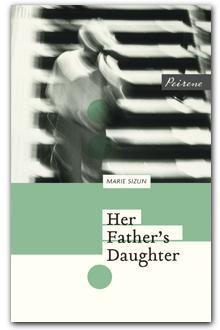 “Of the outside world, the child still knows pretty much nothing.” Her universe is limited to her Paris neighborhood and apartment; her mother, Liliane (Li), is the star around which she orbits. Li gives her daughter free rein, even leaving her alone in the apartment while she goes shopping. When the child learns that her father, a prisoner of war, is soon to return from Germany, she is anxious and resentful. The “secret, intimate world” she has with her mother looks fragile, and she is jealous of anyone who tries to encroach. Meanwhile her father and grandmother both think France has been spoiled and seek to instill a new sense of discipline.
There’s a secret at the heart of the book, something big that the mother and grandmother are covering up. It involves a trip to Normandy, yet whenever the girl tries to speak of the event later on, they deny it and tell her she’s only dreaming. My favorite passages of the book recount her helpless anger as she tries to expose their lies: “Fury from the child, who ploughs on, incredulous. Protests. Persists. In vain.” All she can do in retaliation for this deception and the increasing tension between her parents is pour her mother’s perfumes down the sink.
Sizun’s style is characterized by short, simple phrases. The child is not the narrator, yet the prose imitates the straightforward language that a child might use: “A very strange thing for the child, having a father. A father who’s there. At home. All the time. Morning, noon and night.” The compact chapters chronicle the family’s descent into silence, ignoring each other and walking away – which eventually the father does for good.
Peirene issues books in trios. This one is part of the “Fairy Tale: End of Innocence” series, along with The Man I Became by Peter Verhelst. It’s interesting to think about the book in that context, with the Eden of the mother and daughter being shattered by the entry of the father. “Fathers are found in fairy tales, and they’re always slightly unreal and not very kind,” the child thinks. Unfortunately, I found this novella to be slightly monotonous, with a particularly flat ending. I’ll leave you with a few words from the author about what she was trying to do with the book:
I needed to tell this story. To speak about that wound. … As my writing progressed and the book took shape, I felt this therapy wasn’t only for my personal use but spoke to everyone who, like me, may have been immersed in misunderstandings, in emotional distortions with loved ones, for example being forced to choose between a father and a mother.
It’s not exactly a cheery Father’s Day read, but an intriguing little book all the same.
Translated from the French by Adriana Hunter. With thanks to Peirene Press for the free copy.
My rating: 
Note: I’m traveling until the 24th so won’t be responding to comments right away, but will be sure to catch up soon after I’m back. I always welcome your thoughts!
 Bookish Beck = Rebecca Foster. American transplant to England. Freelance proofreader and book reviewer.
