Assisted Dying: Intervals by Marianne Brooker; Wendy Mitchell; and a Local Panel Discussion
Intervals by Marianne Brooker is on the longlist for the inaugural Women’s Prize for Non-Fiction, which my book club has applied to shadow. I’ve now read three of the nominees, the others being Matrescence and A Flat Place (review coming up tomorrow). Unsurprisingly, I’ve gravitated towards the ones based around a personal narrative – although all three are also political and incorporate research and cultural critique. Brooker’s is an extended essay about her mother’s protracted death with multiple sclerosis and the issues it brought up around disability, poverty, and inequality of access to medical care and services.

Specifically, Brooker decries the injustice of the wealthy having the option of travelling to Dignitas in Switzerland for an assisted death (current cost: £15,000), whereas her single mother, who lived in rented accommodation and had long been disabled and unable to work, apart from crafting and reading tarot, had so such relief in sight. Instead, she resorted to refusing life-sustaining nourishment. VSED, or voluntarily stopping eating and drinking, was a topic much on my mind anyway because of Wendy Mitchell’s death last month.
 Mitchell was diagnosed with early-onset Alzheimer’s in her fifties and was an energetic campaigner for dementia education and research for the last decade of her life. With a co-author, she wrote three books that give a valuable insider’s view of life with dementia: Somebody I Used to Know, What I Wish People Knew About Dementia, and One Last Thing, in which she specifically discusses VSED. She was determined to live independently. For her, a dignified life was being able to meet her own daily physical needs. She did not want to be in a care home, or to exist past the point where she could no longer recognise her daughters. So when, in January, she fell and broke both wrists, giving her a taste of dependency and derailing her plans to travel to Dignitas, she knew that the time had come. VSED was her way out. You can read her farewell message here.
Is wilful starvation a good death? I don’t really know. It’s peaceful, at least; a person simply gets weaker and weaker, spending more and more time asleep until they fade out, at home. But it can take two weeks to die in this way. Should loved ones have to watch this process?
Denied a liveable life and a legal right to die, my mum made a choice within and between the lines of the law. A decade after her diagnosis, when she was forty-nine and I was twenty-six, she decided to stop eating and drinking to end her suffering and her life. Her MS symptoms were barely treatable and certainly incurable: severe pain, incontinence, fatigue, the gradual but intensifying loss of mobility, vision and speech. But these medical symptoms were compounded by social conditions: isolation, stress, debt and fear of a future in which she would not be able to live or die in her chosen home. We were caught in a perfect storm.
Brooker’s description of the vigil of these last days, like her account of her vivacious mother’s life, is both tender and unflinching. It’s almost like a counterpoint to Simone de Beauvoir’s A Very Easy Death, but with the same incisive attention and emotional transfer between mother and daughter. The book also incorporates political commentary and quotations from psychologists and cultural critics. This somewhat distances the reader; it feels less like a bereavement memoir and more like an impassioned, personally inspired treatise. But that’s not to say there isn’t some levity. She remembers good times from their earlier life together, and reckons with her new role as her mother’s memorial and archivist in a way that really rang true for me. I wish the title was more evocative so as to draw the right readers to this book. 
With thanks to Fitzcarraldo Editions for the free copy for review.
Also on this topic, I have read In Love by Amy Bloom, That One Patient by Ellen de Visser, The Inevitable by Katie Engelhart, Darke Matter by Rick Gekoski, and Wild and Precious Life by Deborah Ziegler.
Last night I attended a local panel discussion put on by the Campaign for Dignity in Dying. It wasn’t a debate in that 3.5 of the 4 members on the panel were pro-assisted dying, and I would guess more than four-fifths of the audience as well. In fact, the only anti- voice of the evening was from a young Catholic man during question time. I knew about the event because one panelist attends my church: George Carey, a former archbishop of Canterbury.
The Anglican Church’s line – the religious response in general – is to uphold the sanctity of life and thus to oppose assisted suicide, so for Lord Carey to do otherwise is noteworthy. He changed his mind in 2014, he explained, after the high-profile case of Tony Nicklinson, who was paralysed after a stroke and lost his appeal over the right to die. “There is no theological contradiction between valuing life and wanting a good death,” Carey insisted. Jesus showed mercy to the ill and dying, and so should we. (He also, more facetiously, described King Saul’s mercy killing by an enemy soldier in 2 Samuel as an assisted death.)
The other panelists were a lawyer, a retired doctor, and a Member of Parliament. Lawyer Graham Wood noted that the 1961 Suicide Act, under which anyone who assists a suicide can be prosecuted, would have to be abolished, and that there would also need to be a negotiation regarding Article 2 of the European Convention on Human Rights, which protects the “right to life.” He was the most wary of the speakers, warning of the danger of undue influence being exerted by relatives when money and assets are involved – he said he sees the worst of humanity in his line of work.

Dr Barry Newman pinned his support for assisted dying to compassion and autonomy, two overriding values of a liberal society. He acknowledged the current professional risk for doctors, and noted that the UK’s main medical bodies remain neutral. However, he brought up a loophole, “double effect,” administering a medication that might end life but whose intent is to alleviate suffering, e.g., a high dose of morphine to an end-stage cancer patient.
Kit Malthouse, Conservative MP for northwest Hampshire, co-chairs a group on end-of-life and has campaigned for assisted dying. (American readers may be surprised by a conservative politician having liberal views on an ethical matter. In the UK, morality is not in lockstep with religions and/or political parties as it is in the USA. This was something it took me a while to get used to: I have Christian friends who vote for four different political parties.) He was disappointed that a members’ bill on assisted dying failed in 2015, but has hope that multiple recent cases (e.g., Esther Rantzen) will put it back on the agenda and believes support in the Commons is sufficient to push legislation through in six months.
“It’s coming,” he assured, not least because many of the UK’s European neighbours and other allies have introduced assisted dying. The UK bill does not go as far as the Dutch legislation, about which all the panelists expressed doubt, and can be tailored to this country’s health system. The status quo, Malthouse cautioned, is people suffering. We know from Oregon that the current proposal will work well, he said; there is vanishingly little abuse of the system in any of the places that have instituted assisted dying legislation.
It was all preaching to the choir as far as I was concerned. Indeed, the spontaneous applause and affirming subvocalizations reminded me of a Pentecostal church service. Clearly, many from the audience had witnessed loved ones dying in horrible ways (a few of these stories came out during question time, such as a woman whose husband went to Dignitas and another who had to fight for her terminally ill sister’s wishes when she was mistakenly resuscitated by paramedics after a suicide attempt). Malthouse observed that supporters of assisted dying have often been through horrific experiences with relatives or spouses.
I was already firmly in support so last night didn’t sway me in any way, but I was encouraged that so many people are thinking and talking about these issues. Maybe by the time I face such a crisis myself, or on someone else’s behalf, a compassionate law will be in place.
In the Past Week…
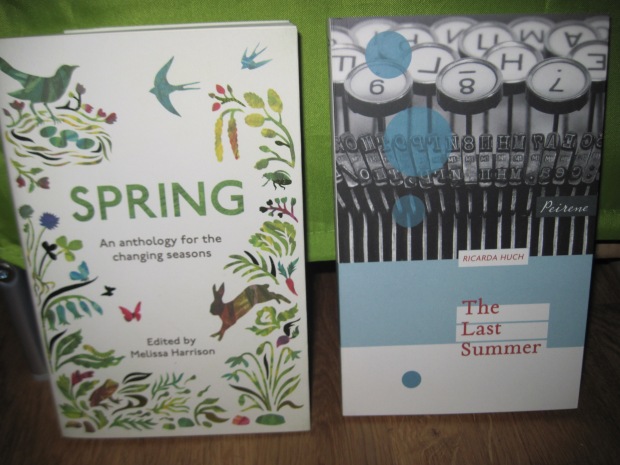
It truly felt like spring was on the way. Temperatures were in the mid-fifties (I’ve never really gotten to grips with Centigrade) and the daffodils in our back garden were trying their best to join the snowdrops decorating the churchyard in town. I started reading this pair of books to look to the seasons ahead instead of dreading that winter might return in earnest:
Some lovely things have happened in the past week.
- I’ve delighted from afar as my sister, a widow for just over two years, precipitously falls in love with a pastor she met through a dating website.
- I had my second yoga class and, after the one other participant had to leave early, got what was essentially a private lesson. Many of the poses feel right at the edge of what my flexibility and balance will allow, which is surely a sign that the exercise is doing me good.
- (This one’s not so much lovely as annoying yet amusing.) The cat, already a connoisseur of cereal milk, discovered the illicit pleasure of melted butter in a dish we unthinkingly left on the counter, and now will not rest in his search for it. This is bad news as he’s already quite the butterball. He’s also ramped up his efforts to access all of the house’s secret spaces, including the airing cupboard, the under-stairs cupboard, and the crawlspace under the bath. [Stay tuned for tomorrow’s mini-reviews of yet more cat books, including one about some very mischievous Siamese cats.]
- On Friday I got an e-mail out of the blue asking me to review a book for the Times Literary Supplement. It was October 2015 when I first wrote for them, but that ended poorly: they ran out space in the magazine for my review and paid me a “kill fee” instead, but it made me doubt myself – was that code for them not thinking my writing was good enough to publish? So hearing back from them five months after I’d last gotten in touch asking for work was a great surprise. And I get to read History of Wolves, which I’ve heard marvelous things about.
- We went to a brilliant gig by folk artists Phillip Henry and Hannah Martin in a hole-in-the-wall venue 10 minutes from our house. It was doubtless the first time I’d seen beatboxing and a classical Indian sitar/guitar used in folk music, and Henry’s harmonica skills were literally unbelievable. You had to have been there. I was impressed anew at how folk, arising as it does from liberal working-class traditions, is unafraid to tackle social issues. They had songs about his cotton mill-working grandfather, the war in Syria, immigration, and a detention center in the Midlands. My favorite, though, was “Landlocked,” about a real woman from the eighteenth century who went to sea with her naval husband but ended up right back where she started: selling fish at Exmouth harbor. I loved Martin’s deep, rich voice and the complex interplay of guitar, banjo, pedal steel and fiddle in many of their songs.
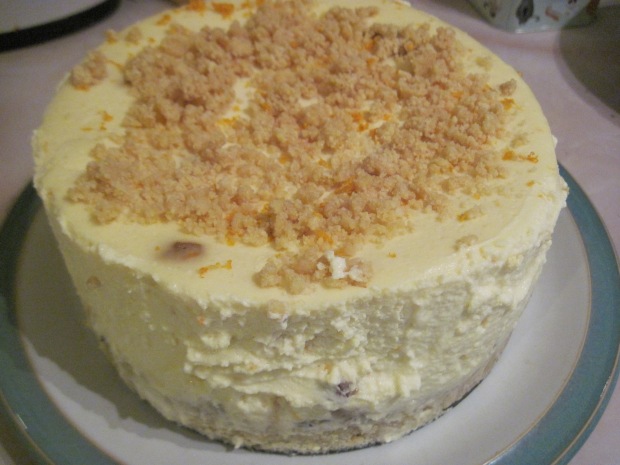
- With one of our leftover jars of homemade mincemeat we made a decadent mincemeat cheesecake from this Nigel Slater recipe. What with the shortbread crust and crumbs and the orange zest in the topping, it was very much like having mince pies – but also cheesecake. Yum.
- This morning we attended a service led by a former archbishop. We knew that George Carey was a parishioner at the Berkshire church we’ve been frequenting since December, but hadn’t seen him at the pulpit yet. He’s one of various retired and lay clergy who have been filling in while the church seeks to appoint a new vicar. Carey gave a damn fine sermon (I guess he’s had plenty of practice) on the enormous topic of why bad things happen to good people, refuting the prosperity gospel and telling the tragically fascinating story behind the hymn “It Is Well with My Soul.”
And, of course, I’ve been reading some brilliant books. This week’s ongoing reading has included three terrific novels: Homegoing by Yaa Gyasi, Spaceman of Bohemia by Jaroslav Kalfař, and Narcissism for Beginners by Martine McDonagh.
 Bookish Beck = Rebecca Foster. American transplant to England. Freelance proofreader and book reviewer.
 Bookish Beck