How People Found My Blog Recently
Back in May I surveyed a few months’ worth of the (often very odd) web searches that led people to my blog. In the past four and a half months the search terms have been more normal in that they generally relate to books or authors I’ve covered. However, I do hope I haven’t disappointed some searchers: after all, I don’t reveal the exact location of the croft in Seal Morning, instruct readers in how to pronounce ‘Athill’, or give any details about Ann Kidd Taylor’s wedding!
In any case, it’s always interesting to see what people were looking up – Oliver Balch’s Under the Tump, Michel Faber’s Undying, Sarah Perry’s The Essex Serpent and various graphic novels were popular topics – and I reckon I count among the “bookish cat people” of the first search. (Spelling and punctuation are unedited throughout this list!)
May 26: bookish cat people, oliver balch under the tump
May 31: a book review of any book about 140-160 words, in my next life i want to be a cat. to sleep 20 hours a day and wait to be fed. to sit around licking my ass., under the tump by oliver balch reviews
June 25: irmina yelin, george watsky bipolar
July 2: michel faber undying goodreads, the first bad man book miranda july plot
July 16: she’s my only father’s daughter, essex serpent, sue gee, hay on wye
July 21: the ghost of nelly burdons beck
August 5: correct pronunciation of athill in diana athill s name
August 11: the essex serpent usa release
August 24: ann kidd taylor wedding
August 25: paintings with a woman reading a book
August 29: michel faber undying review, to the bright edge of the world interview
September 8: agatha christie graphic novel, house of hawthorne
September 13: irmina by barbara yellen
September 19: paulette bates
September 21: bbc miniseris vs book war and peace
September 26: vincent van gogh graphic novel
September 28: reviews on my son my sonby howard spring
September 30: seal morning location of croft
October 3: john pritchard_something more
Vincent van Gogh’s Life as a Graphic Novel
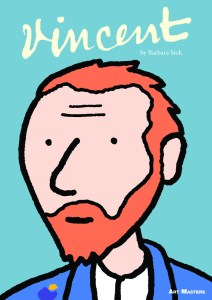 Dutch artist and writer Barbara Stok’s Vincent is the second graphic novel I’ve read from SelfMadeHero’s “Art Masters” series, after reviewing Munch last month. It’s another biographical study of an artist, in this case of Vincent van Gogh. Oddly, though, the drawing style and the subject’s vibrant shock of red hair reminded me most of Agatha.
The book focuses primarily on the time van Gogh spent in the South of France. He settled in Arles, staying first in a hotel and then in a large rental house he hoped to turn into an artists’ colony – he temporarily attracted Paul Gauguin before driving him away with his strict, workaholic ways and his temper.
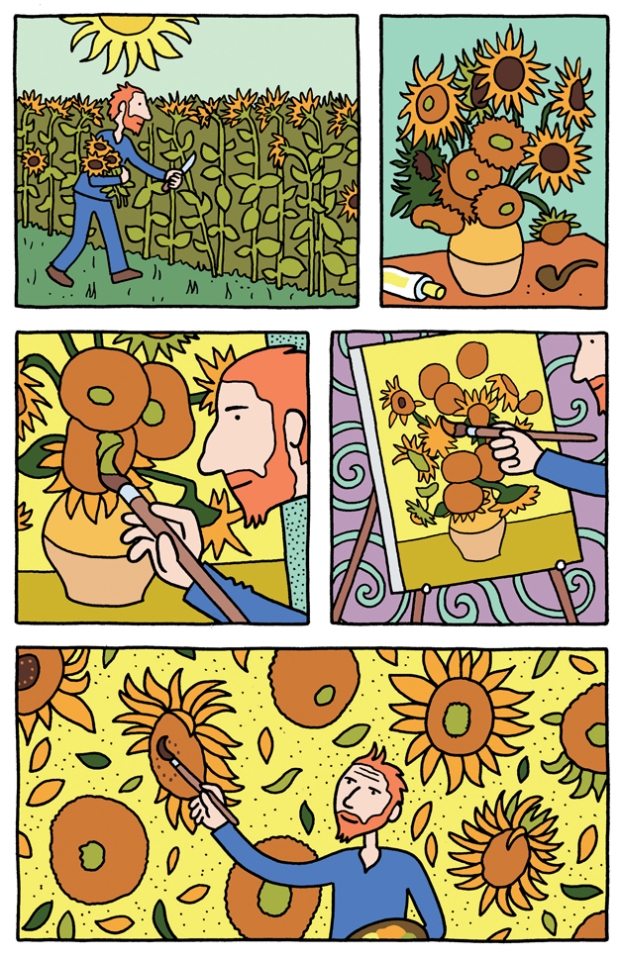
In presumably authentic letters to his younger brother Theo (an art dealer who supported him financially) back in Paris, van Gogh details his progress and tells of his fondness for the Provence scenery. I particularly love the panels where you can spot the direct inspiration for some of van Gogh’s most famous paintings: wheat fields, cypress trees, sunflowers, irises, a starry night sky, and even his cluttered bedroom.
We also get insights into the philosophy behind van Gogh’s work: “An artist has to put character and emotion into his work, not just paint whatever sells,” he insists to an art dealer who expects him to pander to public taste. “I use lots of different techniques, all mixed together. I like to exaggerate the colors in order to capture the soul of the subject,” he explains to a couple of fellow painters who take an interest in him. He used thick, confident brush strokes and painted quickly, making him annoyingly prolific in others’ eyes.
Stok does a wonderful job of depicting van Gogh as a misunderstood genius who drove people away with his lack of social skills, and sensitively introduces the breakdown during which he famously cut off his ear. He admitted himself to a mental hospital, where he could be treated for his epileptic attacks and continued to paint natural scenes under supervision.

Striking colors in the breakdown scene.
The book closes on what seems to be a fairly positive note: van Gogh voluntarily leaves the hospital and moves to Auvers-sur-Oise, near Paris, where he can be closer to Theo and his young family. “I foresee a future full of problems, but I’m not pessimistic,” he declares to his brother. And yet the final page shows a pair of gravestones: Vincent died in 1890 at age 37 and Theo just a year later, at 33.
Turn back one page and you see what might actually be a rather ominous scene: van Gogh has been painting in a wheat field; in one last two-page spread, he has disappeared from view and a flock of crows has taken off and filled the sky. Were they startled by the gunshot of his attempted suicide? While still true to the facts of van Gogh’s life, it’s a refreshingly subtle ending.
Stok perfectly captures van Gogh’s personality amid the warm colors of the French countryside, and whetted my appetite to read his letters for myself. I’d recommend this to anyone with an interest in the lives of artists, whether you think you’re a fan of graphic novels or not.
With thanks to the publisher, SelfMadeHero, for the free copy for review. Translated from the Dutch by Laura Watkinson.
My rating: 
Munch, Steffen Kverneland (graphic novel)
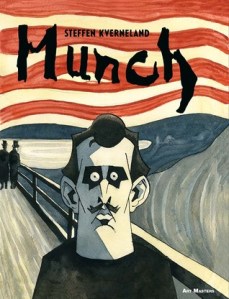 Munch is my second biography in graphic novel form from SelfMadeHero, following on from a life of Agatha Christie that I reviewed last month. Norwegian painter Edvard Munch (1863–1944) is, of course, best known for The Scream, but I learned a lot more about his work through this striking visual tour curated by illustrator Steffen Kverneland. Much of the text accompanying Kverneland’s images is from authentic primary sources: Munch’s diaries and letters, his contemporaries’ responses to his art, and so on.
Munch’s mother died early in his life, and sickroom and deathbed scenes were to permeate his work. “Disease and insanity and death were the black angels that stood by my cradle,” he wrote. “A mother who died early – gave me the seed of consumption – a distraught father – piously religious, verging on madness – gave me the seeds of insanity.” His first solo show opened in Kristiania (now Oslo) in 1889. Three and a half years later scandal erupted when his exhibition in Berlin was closed down. The establishment disapproved of the Impressionist influence in his work and thought he showed a lack of artistic technique. As it turned out, having his show shut down was the best publicity he ever could have asked for.
Kverneland shows different incarnations of Munch’s most famous pieces, such as Madonna, The Girls on the Bridge and The Scream. He also traces the painter’s important relationships, such as his friendship with playwright August Strindberg and his pursuit of the various women who inspired his nudes. In 1895, the writer Sigbjørn Obstfelder gave a lecture on Munch’s art. His appreciation included the following:
As no other Norwegian painter, Munch has focused on essential questions – has caused the deepest subjects to quiver. Before, one painted landscapes and everyday life – Munch paints human beings in all their shapes – even the beastly human. He finds his subjects where the emotions are strongest. Munch is one of the genuine artists who can shift boundaries.
This is a visually remarkable book, with various styles coexisting sometimes on the same page. Sometimes Munch is portrayed like a superhero in a comic (often with a hugely exaggerated chin); other times the images are more like photographs or nineteenth-century portraits. Pen sketches alternate with color spreads in which red, orange, sepia and flesh tones and black dominate. Some of my most admired individual panels have angular faces drawn in almost kaleidoscopic fragments. Strindberg’s is the most frighteningly fractured face, with triangles and trapezoids emphasizing his angry expression.
There’s also a meta aspect to this work: Kverneland depicts his travels with his friend Lars Fiske to sites associated with Munch, again using everything from black-and-white sketches to color photographs. These were, I’m afraid, my least favorite parts of the book: the friends’ raunchy, booze-filled banter has not translated well, and the style of some of their scenes is among the most cartoon-ish.
“Munch had become a monk whose life was devoted to art” is one of the last lines of the graphic novel. It’s a nice summation of what has gone before – with that wordplay especially remarkable given that this is a work in translation. I haven’t come away with a particularly clear sense of the trajectory of Munch’s life, but that’s probably not the point of a deliberately splintered biography like this one.
Kverneland worked on the book for seven years. First published in 2013, it won Norway’s Brage Prize for Literature. This is the fourth installment in SelfMadeHero’s “Art Masters” series, after Pablo, Vincent and Rembrandt. I can highly recommend it to you if you are already a fan of Munch’s work. However, if, like me, you look to graphic novels to also tell you a good story, you might come away slightly disappointed.
With thanks to the publisher, SelfMadeHero, for the free copy. Translated from the Norwegian by Francesca M. Nichols.
My rating:
Note: I’m traveling until the 24th so won’t be responding to comments right away, but will be sure to catch up soon after I’m back. I always welcome your thoughts!
Agatha Christie’s Life as a Graphic Novel
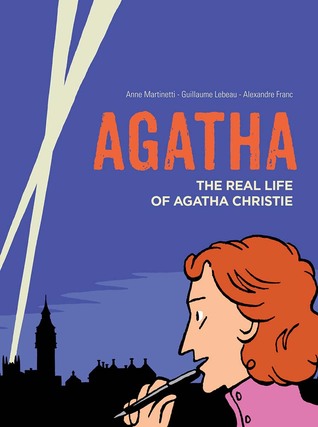 Agatha, a biography in graphic novel form written by Anne Martinetti and Guillaume Lebeau and illustrated by Alexandre Franc, opens – appropriately – with the real-life mystery at the heart of Agatha Christie’s story. In December 1926 the celebrated crime novelist disappeared, prompting a full-scale police investigation. She had abandoned her car by a lake in Surrey and traveled by train to Harrogate, where she checked into a hotel under a false name. Was it all an elaborate act of revenge for her husband’s philandering? Christie strikes up a conversation with Hercule Poirot, her most famous creation, in the hotel room, while back in London a clairvoyant is brought in to confirm she is alive. The medium’s look into Christie’s past sets up the novel’s first half as an extended flashback giving her history up until 1926.
Agatha Miller was raised in a wealthy household in Torquay, Devon. I never knew that she was a flaming redhead or that her father was American. His death when she was 11 was an early pall on an idyllic childhood of outdoor exploration and escape into books – even though her mother opined, “No child ought to be allowed to read until the age of 8. Better for the eyes and the brain.” She first turned her hand to writing while laid up in bed in 1908, completing her first story in two days. She and her mother took an exciting trip to Egypt, and in 1912 she met Lieutenant Archibald Christie at a ball. During the First World War she was a nurse at the town hospital in Torquay, where she came across a Belgian refugee who – at least in the authors’ theory – served as the inspiration for Poirot.
The Christies’ only daughter, Rosalind, was born in 1919. The following year The Mysterious Affair at Styles, the first Poirot mystery, was published. Christie’s career successes are intercut with her round-the-world travels (portrayed as sepia photographs), marriage difficulty and a new romance with archaeologist Max Mallowan, and the occasional intrusion of real-world events like World War II.
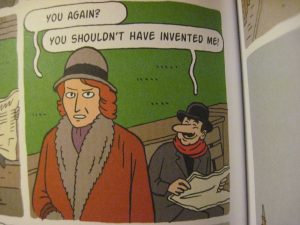 Meanwhile, her invented detectives jockey for her attention: not just Poirot, but Miss Marple and Tommy and Tuppence too. You have to suspend your disbelief during these scenes. I don’t think the authors are literally suggesting that Christie hallucinated conversations with her characters. Rather, it’s a whimsical way of imagining how her detectives took on lives of their own and became ‘real people’ she cared for yet found exasperating – she often threatens to do away with Poirot as Arthur Conan Doyle tried to do with Sherlock Holmes. There were only a couple of pages where I felt that a conversation with Poirot was a false way of conveying information. For the most part, this strategy works well; when coupled with the opening scene in 1926, it keeps the biography from being too much of a chronological slog.
With the exception of the sepia-tinged travel sections, this is a book packed with bright colors, particularly with Christie’s flash of red hair animating the first three quarters. It finishes with a timeline of Christie’s life and a complete bibliography of her works – no doubt invaluable references for diehard fans. I’ve only read one or two Christie books myself (my mother is the real devotee), but I enjoyed this quick peek into a legendary writer’s life. I was reminded of just how broad her reach was: from Hollywood studios to the West End, where The Mousetrap has been showing for a record-breaking 63 years. Her influence cannot be denied.
With thanks to the publisher, SelfMadeHero, for the free copy. Translated from the French by Edward Gauvin. (This one is in paperback!)
My rating: 
Are you an Agatha Christie fan? Does this tempt you to read more by or about her?
Reviews Roundup, March–April
One of my goals with this blog was to have one convenient place where I could gather together all my writing that appears in disparate online locations. To that end, once a month I provide links to all book reviews I’ve published elsewhere, with a rating (below each description) and a taster so you can decide whether to read more. A few exceptions: I don’t point out my Kirkus Indie, BlueInk or Publishers Weekly reviews since I don’t get a byline.
The Bookbag
 The Improbability of Love by Hannah Rothschild: From the Baileys Prize longlist, an enchanting debut novel that blends art and cooking, mystery and romance. Annie McDee, a heartbroken PA and amateur chef, pays £75 for a painting from a junk shop, not realizing it’s a lost Watteau that will spark bidding wars and uncover a sordid chapter of history. In a triumph of playful narration, we mostly learn about the artwork’s history from the painting ‘herself’. She recounts her turbulent 300-year-history and lists her many illustrious owners, including Marie Antoinette, Napoleon and Queen Victoria. These are the novel’s only first-person sections; you can just imagine a voiceover from Helen Mirren or Judi Dench.

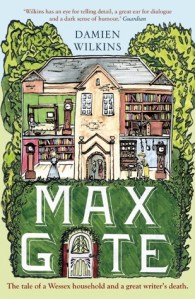 Max Gate by Damien Wilkins: This is a novel of Thomas Hardy’s last days, but we get an unusual glimpse into his household at Max Gate, Dorchester through the point-of-view of his housemaid, twenty-six-year-old Nellie Titterington. Ultimately I suspect a third-person omniscient voice would have worked better. In fact, some passages – recounting scenes Nellie is not witness to – are in the third person, which felt a bit like cheating. Fans familiar with the excellent Claire Tomalin biography might not learn much about Hardy and his household dynamics, but it was fun to spend some imaginary time at a place I once visited. [First published in New Zealand in 2013; releases in the US and UK on June 6th.]
 Dust by Michael Marder: A philosopher carries out an interdisciplinary study of dust: what it’s made of, what it means, and how it informs our metaphors. In itself, he points out, dust is neither positive nor negative, but we give it various cultural meanings. In the Bible, it is the very substance of mortality. Meanwhile “The war on dust, a hallmark of modern hygiene, reverberates with the political hygiene of the war on terror.” The contemporary profusion of allergies may, in fact, be an unintended consequence of our crusade against dust. The discussion is pleasingly wide-ranging, with some unexpected diversions – such as the metaphorical association between ‘stardust’ and celebrity – but also some impenetrable jargon. I’d be interested to try other titles from Bloomsbury’s “Object Lessons” series.
Foreword Reviews
How to Cure Bedwetting by Lane Robson (Oh, the interesting topics my work with self-published books introduces me to!): Explaining the anatomical and behavioral reasons behind bedwetting, the Calgary-based physician gives practical tips for curing the problem within six to twelve months. Throughout, the text generally refers to “pee” and “poop,” which detracts slightly from the professionalism of the work. All the same, this compendium of knowledge, drawing as it does on the author’s forty years of experience, should answer every possible question on the subject. Highly recommended to parents of younger elementary school children, this book will be an invaluable reference in tackling bedwetting.
Nudge
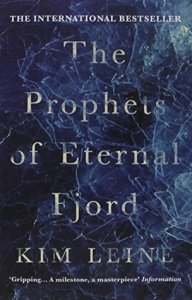 The Prophets of Eternal Fjord by Kim Leine: An epic novel about an unconventional priest, set in late-eighteenth-century Denmark and Greenland. This struck me as a cross between Carsten Jensen’s We, the Drowned, another historical saga from Denmark and one of my favorite novels of all time, and Michel Faber’s The Crimson Petal and the White. Like the former, it features perilous sea voyages and ambivalent father–son relationships; like the latter, it’s edgy and sexualized, full of lechery and bodily fluids. No airbrushing the more unpleasant aspects of history here. The entire story is told in the present tense, with no speech marks. It took me nearly a month and a half to read; by the end I felt I’d been on an odyssey as long and winding as Morten’s.
PANK
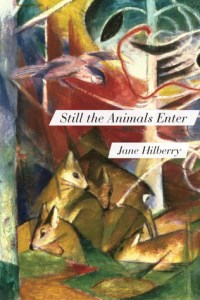 Still the Animals Enter by Jane Hilberry: A rich, strange, and gently erotic collection featuring diverse styles and blurring the lines between child and adult, human and animal, life and death through the language of metamorphosis. Ambivalence about the moments of transition between childhood and adulthood infuses Part One. Early on, “A Hole in the Fence” finishes on a whispered offer: “You could be part of this.” The message in this resonant collection, though, is that we already are a part of it: part of a shared life that moves beyond the individual family or even the human species. We are all connected—to the children we once were, to lovers and family members lost and found, and to the animals we watch in wonder.
Pittsburgh Post-Gazette
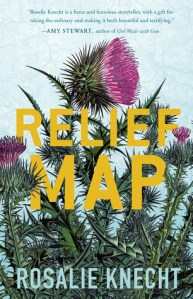 Relief Map by Rosalie Knecht: Lomath, Pennsylvania consists of a half-mile stretch between old textile mills and is home to just 150 people. During one unpredictable summer, blackouts and the arrival of an Eastern European fugitive draw the residents into a welter of paranoia and misguided choices. Our eyewitness to provincial commotion is 16-year-old Livy Marko, who considers herself plain and awkward – her childhood style was supplied by Anne of Green Gables and Goodwill. Knecht’s writing is marked by carefully chosen images and sounds. The novel maintains a languid yet subtly tense ambience. For Livy, coming of age means realizing actions always have consequences. Offbeat and atmospheric, this debut is probably too quiet to make a major splash, but has its gentle rewards.
Shiny New Books
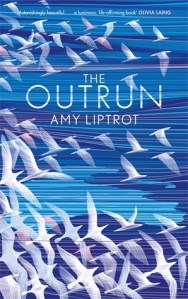 The Outrun by Amy Liptrot: Put simply, this is a memoir about Amy Liptrot’s slide into alcoholism and her subsequent recovery. Liptrot grew up on mainland Orkney, a tight-knit Scottish community she was eager to leave as a teenager but found herself returning to a decade later, washed up after the dissolute living and heartbreak she left behind in London. A simple existence, close to nature and connected to other people, was just what she needed during her first two years of sobriety. Her atmospheric writing about the magical Orkney Islands and their wildlife, rather than the slightly clichéd ruminating on alcoholism, is what sets the book apart. (On the Wellcome Prize shortlist.)
I also post reviews of most of my casual reading and skimming on Goodreads:
 Look We Have Coming to Dover! by Daljit Nagra: The dialect was a bit too heavy for me in some of these poems about the Sikh experience in Britain. By far my favorite was “In a White Town,” which opens: “She never looked like other boys’ mums. / No one ever looked without looking again / at the pink kameez and balloon’d bottoms, // mustard-oiled trail of hair, brocaded pink / sandals and the smell of curry. That’s why / I’d bin the letters about Parents’ Evenings …”
 Work Like Any Other by Virginia Reeves: Between the blurb and the first paragraph, you already know everything that’s going to happen. I admire books that can keep you reading with interest even though you know exactly what’s coming, but this isn’t really one of those. Ultimately I would have preferred for the whole novel, rather than just alternating chapters, to be in Roscoe’s first-person voice, set wholly in prison (where he helps out in the library and with the guard dogs) but with brief flashbacks to his electricity siphoning and the circumstances of his manslaughter conviction. The writing is entirely capable, but the structure made it so I felt the story wasn’t worth my time.
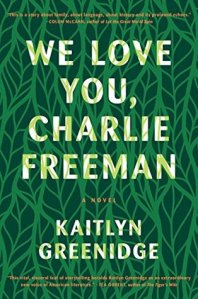 We Love You, Charlie Freeman by Kaitlyn Greenidge: The Freemans are raising Charlie, a chimpanzee, as part of their family for a Toneybee Institute experiment and teaching him to communicate via sign language. Flashbacks to the late 1920s bring an uncomfortable racial subtext to the surface, suggesting that the Toneybee has been involved in dodgy anthropological research over the decades. This is a deep and unsettling story of human–human interactions, even more so than human–animal interactions. I much preferred it to We Are All Completely Beside Ourselves.
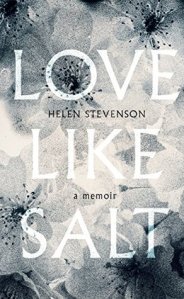 Love Like Salt by Helen Stevenson: Stevenson’s daughter Clara has cystic fibrosis, so I approached and enjoyed this as an illness memoir. However, it’s very scattered, with lots of seemingly irrelevant material included simply because it happened to the author: her mother’s dementia, their life in France, her work as a translator and her hobby of playing the piano, her older husband’s love for Italy and Italian literature, etc. Really the central drama is their seemingly idyllic life in France, Clara being bullied there, and the decision to move back to England (near Bristol), where the girls would attend a Quaker school on scholarships and Clara was enrolled in a widespread clinical trial with modest success. Enjoyable enough if you share some of the author’s interests.
 Springtime: A Ghost Story by Michelle de Kretser: Ghost story? Really? There’s very little in the way of suspense, and not too much plot either, in this Australia-set novella. I would expect tension to linger and questions to remain unanswered. Instead, the author exposes Frances’s ‘ghost’ as harmless. What I think de Kretser is trying to do here is show that ghosts can be people we have known and loved or, alternatively, places we have left behind. There is some nice descriptive writing (e.g. “three staked camellias stood as whitely upright as martyrs”), but not enough story to hold the interest.

 Let the Empire Down by Alexandra Oliver: This debut collection is heavily inspired by history and travel, as well as Serbian poetry and personal anecdote. I enjoyed the earlier poems, especially the ones with ABAB or ABBA rhyme schemes. My favorite was “Plans,” about a twenty-something manicurist who abandoned her talent for science to get ready cash: “A girl’s future should be full and bright, a marble, / but (alas for her) there is a catch: / we take on the immediate. Hope flags: / wishing to be wise and come out shining, / we pop a beaker over our own flame. / We do it cheerfully. We do it coldly.” The last quarter is devoted to poems about films, especially Italian cinema.
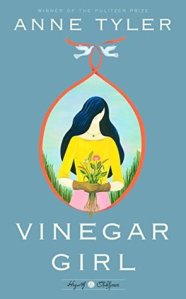 Vinegar Girl by Anne Tyler: This is the most fun I’ve had with the Hogarth Shakespeare series so far, as well as my favorite of the three Anne Tyler novels I’ve read. Yes, it’s set in Baltimore. Kate Battista, the utterly tactless preschool assistant, kept cracking me up. Her father, an autoimmune researcher, schemes for her to marry his lab assistant, Pyotr, so he can stay in the country after his visa expires. The plot twists of the final quarter felt a little predictable, but I was won over by the good-natured storytelling and prickly heroine. (I don’t know The Taming of the Shrew well enough to comment on how this functions as a remake.) Releases in June.
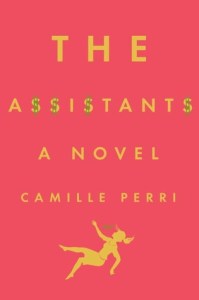 The Assistants by Camille Perri: At age 30, Tina Fontana has been a PA to media mogul Robert Barlow for six years. He’s worth millions; she lives in a tiny Brooklyn apartment. One day a mix-up in refunding expenses lands her with a check for $19,147. If she cashes it she can pay off her debts once and for all and no one at Titan Corporation will be any the wiser, right? This is a fun and undemanding read that will probably primarily appeal to young women. I would particularly recommend it to readers of Friendship by Emily Gould and A Window Opens by Elisabeth Egan. Releases May 3rd.
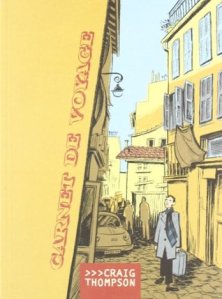 Carnet de Voyage by Craig Thompson: A sketchbook Thompson kept on his combined European book tour for Blankets and research trip for Habibi in March–May 2004. It doesn’t really work as a stand-alone graphic memoir because there isn’t much of a narrative, just a series of book signings, random encounters with friends and strangers, and tourism. My favorite two-page spread is about a camel ride he took into the Moroccan desert. I could also sympathize with his crippling hand pain (from all that drawing) and his “chaos tolerance” overload from the stress of travel.
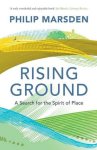 Rising Ground: A Search for the Spirit of Place by Philip Marsden: Some very nice writing indeed, but not much of a storyline. The book is something of a jumble of mythology, geology, prehistory, and more recent biographical information about some famous Cornish residents, overlaid on a gentle travel memoir. I enjoyed learning about the meanings of Cornish place names, in particular, and spotting locations I’ve visited.
And my highest recommendation goes to…
Commonwealth by Ann Patchett: It all starts with an early 1960s christening party Los Angeles policeman Fix Keating is throwing for his younger daughter, Franny. DA Bert Cousins turns up, uninvited, with a bottle of gin the grateful guests quickly polish off in their fresh-squeezed orange juice. He also kisses the hostess, sparking a chain of events that will rearrange the Keating and Cousins families in the decades to come. The novel spends time with all six step-siblings, but Franny is definitely the main character – and likely an autobiographical stand-in for Patchett. As a waitress in Chicago, she meets a famous novelist who’s in a slump; the story of her childhood gives him his next bestseller but forces the siblings to revisit a tragic accident they never fully faced up to. Sophisticated and atmospheric; perfect for literary fiction fans in general and Patchett fans in particular. Releases September 13th.
Irmina by Barbara Yelin (Graphic Novel)
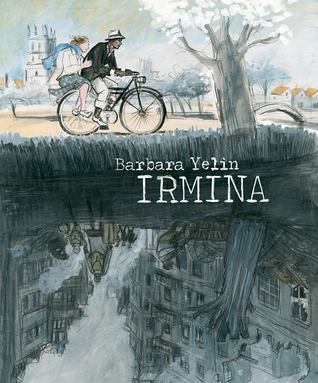 Barbara Yelin’s Irmina is one of the most visually stunning graphic novels I’ve ever come across. Not only that, but it’s based on a fascinating family story: after her grandmother’s death Yelin, a Munich-based artist, found a box of diaries and letters that told the story of a budding love affair that was not to be and charted a young woman’s gradual capitulation to Nazi ideology. How could her grandmother go from being a brave rule-breaker to a cowed regime supporter in just a few short years, she wondered? This fictionalized biography is her attempt to reconcile the ironies and hard facts of her ancestor’s life.
In 1934 Irmina von Behdinger arrives in London for a cultural exchange, attending a commercial school to train as a typist. One night she accompanies a friend to a fancy party and meets Howard, a young Barbados native she initially assumes to be a bartender. It turns out he actually has a scholarship to study law at Oxford. He’s learned, dignified and charming, and soon he and Irmina begin spending a lot of time together. Although she wishes she, too, could study at a proper university, women’s education is not valued in Germany.
Irmina and Howard’s carefree explorations of Oxford and London contrast with the increasingly bleak news coming from Germany about Hitler and his treatment of Jews. As her host family decries Nazism, Irmina tries to protest: “they are not MY Germans … this is politics! It doesn’t affect the average person.” She dreams of being an independent working woman and pursuing a relationship with Howard, but a change in her financial circumstances means she has to go back to Stuttgart instead. Promising to return to England as soon as she can raise some money, Irmina bids farewell to Howard at Portsmouth harbor in April 1935.
Back in Germany, she finds a translation job with the Ministry of War, hoping desperately to be transferred to the German consulate in London once she proves herself. But as the years pass and German relations with the rest of Europe grow strained, her dream seems increasingly unlikely. Having recently lost touch with Howard, she meets Gregor Meinrich, an architect for the SS, and gives up work when they marry and have a son. With the rare exception of a shocking event like Kristallnacht, it’s all too easy to ignore what’s happening to the nation’s Jews and absorb the propaganda that says they have earned their misfortune.
The novel is in three parts: London, Berlin and Barbados – Irmina gets a brief, late chance to see what her life might have been like with Howard. Yelin’s usual palette is muted and melancholy: grays, charcoal, slate blue, browns and flesh tones. However, in each section she chooses one signature color that adds symbolic flashes of life. For London it’s the bright blue of Irmina’s scarf, mirrored in Oxford’s sky and river, as well as in the occasional shopfront and lady’s dress.
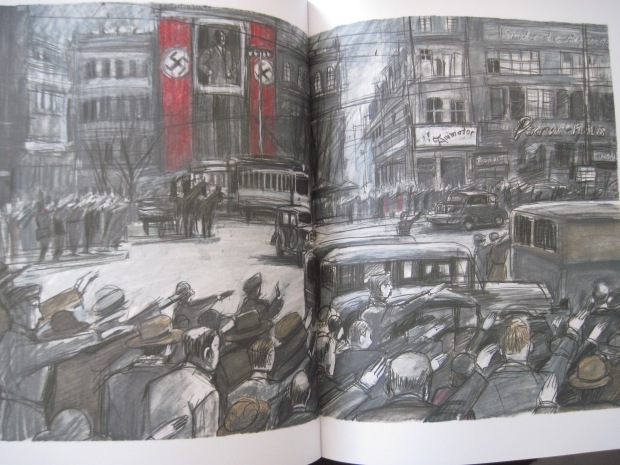
In Berlin the red of the Nazi flag crops up in lipstick, dress patterns, flowers, wine and the décor of a ballroom. In the most poignant scene of all, though, red is equated with the spilling of Jewish blood. As a friend discusses what she doesn’t want to hear – “they’re taking them all to the East now, where they kill them” – Irmina is getting a jar of berry preserves down from a high shelf and drops it, spattering scarlet everywhere. On the other hand, to evoke the calm and natural beauty of 1980s Barbados, the featured hue is a seafoam green.
I was particularly impressed with the two-page spreads showing city scenes. They range from Impressionist fog to Modernist detail, reminding me of everything from Monet to Modigliani. Although the artwork stands out a bit more than the story, this still strikes me as a fresh look at the lives of ordinary Germans who were kept in the dark (by themselves and others) about Hitler’s activities. In an afterword, Dr. Alexander Korb, Director of the University of Leicester’s Stanley Burton Centre for Holocaust and Genocide Studies, reflects on Irmina’s motivation:
Irmina had a full range of possibilities. Yet the fact that she chose the Nazi path from the wide variety in front of her, encompassing feminism, internationality and individuality, makes her story typical of this time. It was just as typical that she failed to find happiness in fascism, like millions of others.
For the out-of-the-ordinary window onto Third Reich history and the excellent illustrations, I highly recommend Irmina to graphic novel lovers and newbies alike.
With thanks to the publisher, SelfMadeHero, for the free copy. Translated from the German by Michael Waaler.
My rating:
Review: Ruins by Peter Kuper
In the past few years I’ve made a conscious effort to get more into graphic novels. In that time I’ve discovered some real gems – highlighted in a previous post entitled “Graphic Novels for Newbies” – and Peter Kuper’s latest book, Ruins, is among my favorites. Kuper is a comics legend: he’s a long-time MAD Magazine illustrator and the author of more than 20 books, as well as a teacher at the School of Visual Arts in Manhattan.
 Ruins appealed to me because of its environmental theme, but I found so much more to love. I previewed it in my last post, “Books as Objects of Beauty,” because it’s a simply gorgeous physical book – what with the embossed title on the cover and spine, the red-edged pages, the built-in ribbon bookmark, and the entomological drawings on the endpapers. Luckily what’s inside is just as special as the packaging.
In essence, this is the bittersweet story of an American couple traveling from Manhattan to Oaxaca, Mexico for a sabbatical year. Samantha hopes to brush up on her Spanish, work on a book about Mexican history and legends, and finally get pregnant. George, recently laid off from his job as an entomologist at the Natural History Museum, is delighted with Oaxaca’s invertebrate life – leafcutter ants, edible grasshoppers, and a pesky scorpion – but not so convinced about having a baby; surely the world is too messed up to bring a new life into?
The novel’s small cast also includes Angelina, their housekeeper; another George, a British bookseller; and Al, a former photojournalist and heavy drinker who joins with our George to document the local teachers’ strike. We learn that Samantha has lived here before and has returned in part to exorcise tragic events from her past. The book’s title thus has many meanings in context: not only the ruined cities Samantha and George visit as tourists and the ruin corrupt Governor Ulises Ruiz Ortiz is currently making of the place, but also the decay of relationships old and new and the decline of the environment.
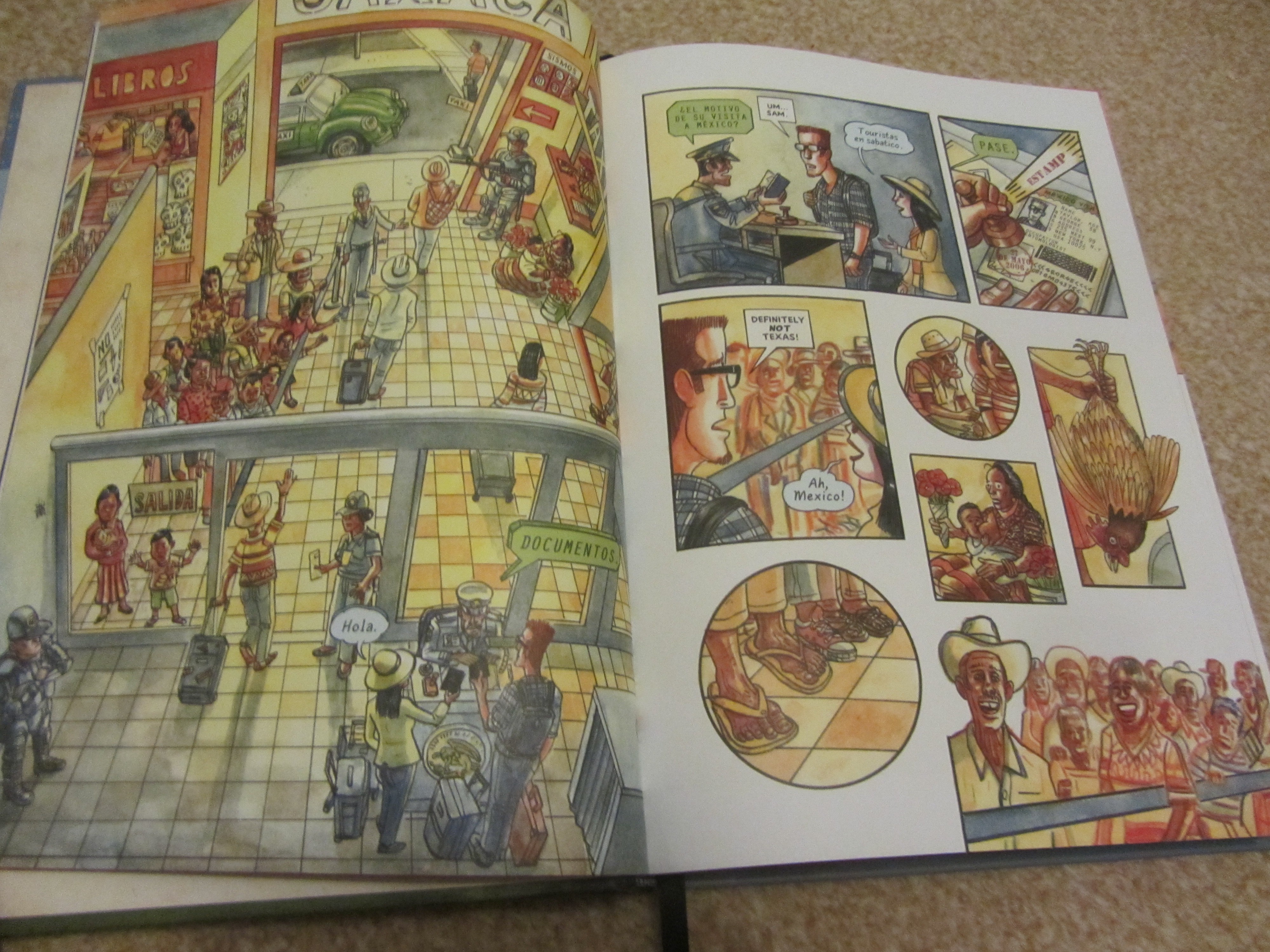
The colorful arrival at Oaxaca Airport.
The environmental agenda comes through in the parallel story of one monarch’s migration. Sections set in Mexico alternate with short interludes showing the butterfly’s journey south from America to Michoacan, Mexico, where monarchs gather en masse in a pine forest. The limited palette of these spreads, in contrast with the vibrant colors of the Oaxaca scenes, is particularly effective: the monarch is generally the only speck of color against a monochrome blue-gray background showing rather dreary American scenes. Tagged in Pennsylvania, the monarch flies over polluted rivers, a nuclear power plant, an abandoned West Virginian mine, the aftermath of Hurricane Katrina, Monsanto tomato pickers, a Texas border arrest, and a Mexican drug deal gone wrong – a symbol of precarious hope in spite of circumstance.
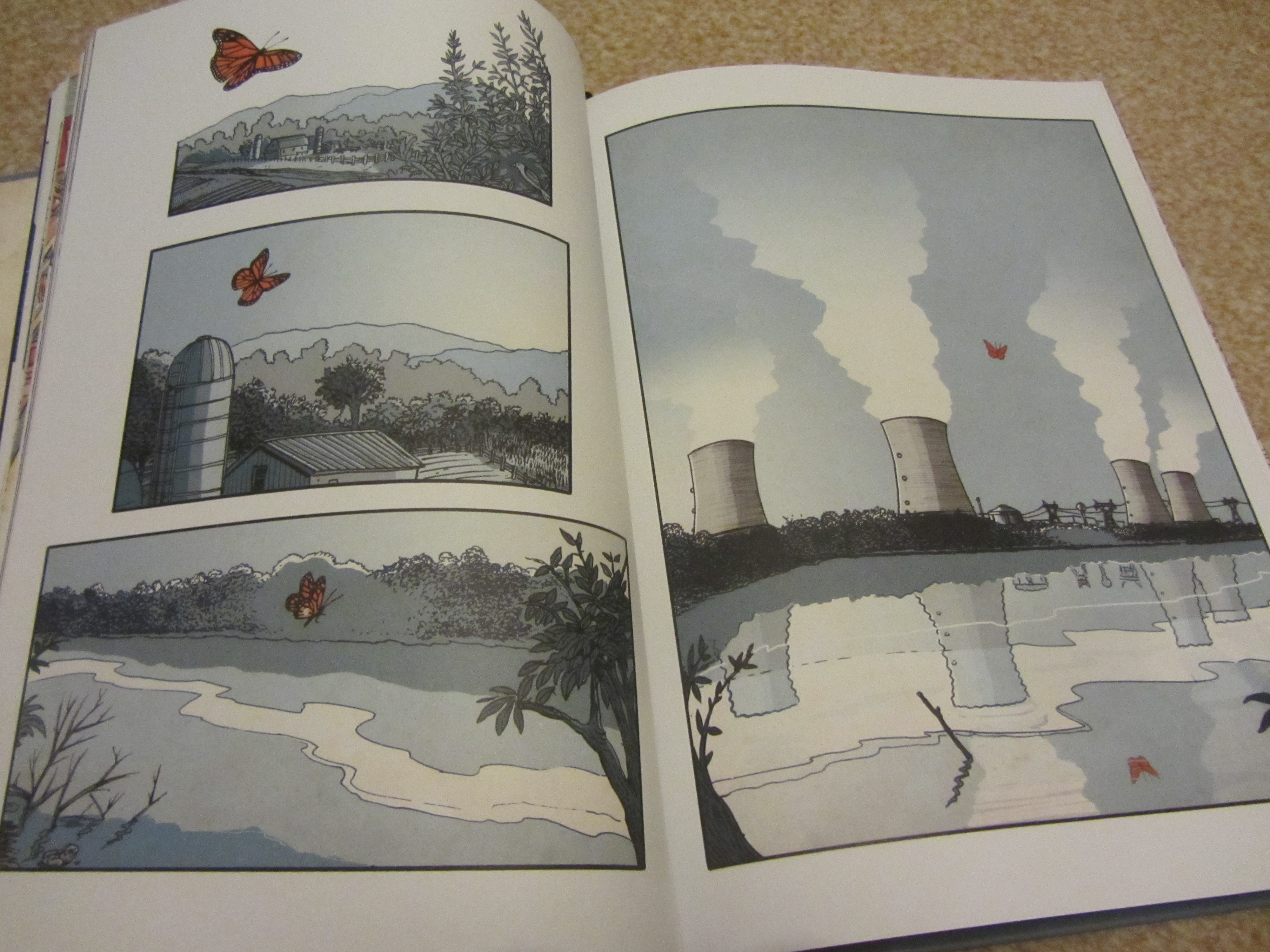
The tagged monarch flying over a polluted scene.
A Mexican folk belief has it that monarchs are the souls of dead children returning. At the end of the book a newly hatched butterfly starts its journey north – but what has become of our human heroes? That’s for readers lucky enough to get their hands on a copy of this wonderful book to find out.
Kuper and his family lived in Oaxaca from 2006 to 2008 and return annually for visits; you can see both familiarity and love in his terrific drawings of the city and its natural surroundings. Just as it tempers monochrome with color, Ruins carefully balances sadness and hope. If you think a graphic novel can’t sustain an involved and satisfying plot, think again. I’d especially recommend this to Barbara Kingsolver fans – the Mexican setting and monarch migration theme tie in with The Lacuna and Flight Behavior, respectively.
With thanks to the publisher, SelfMadeHero, for the free copy.
My rating: 
Books as Objects of Beauty
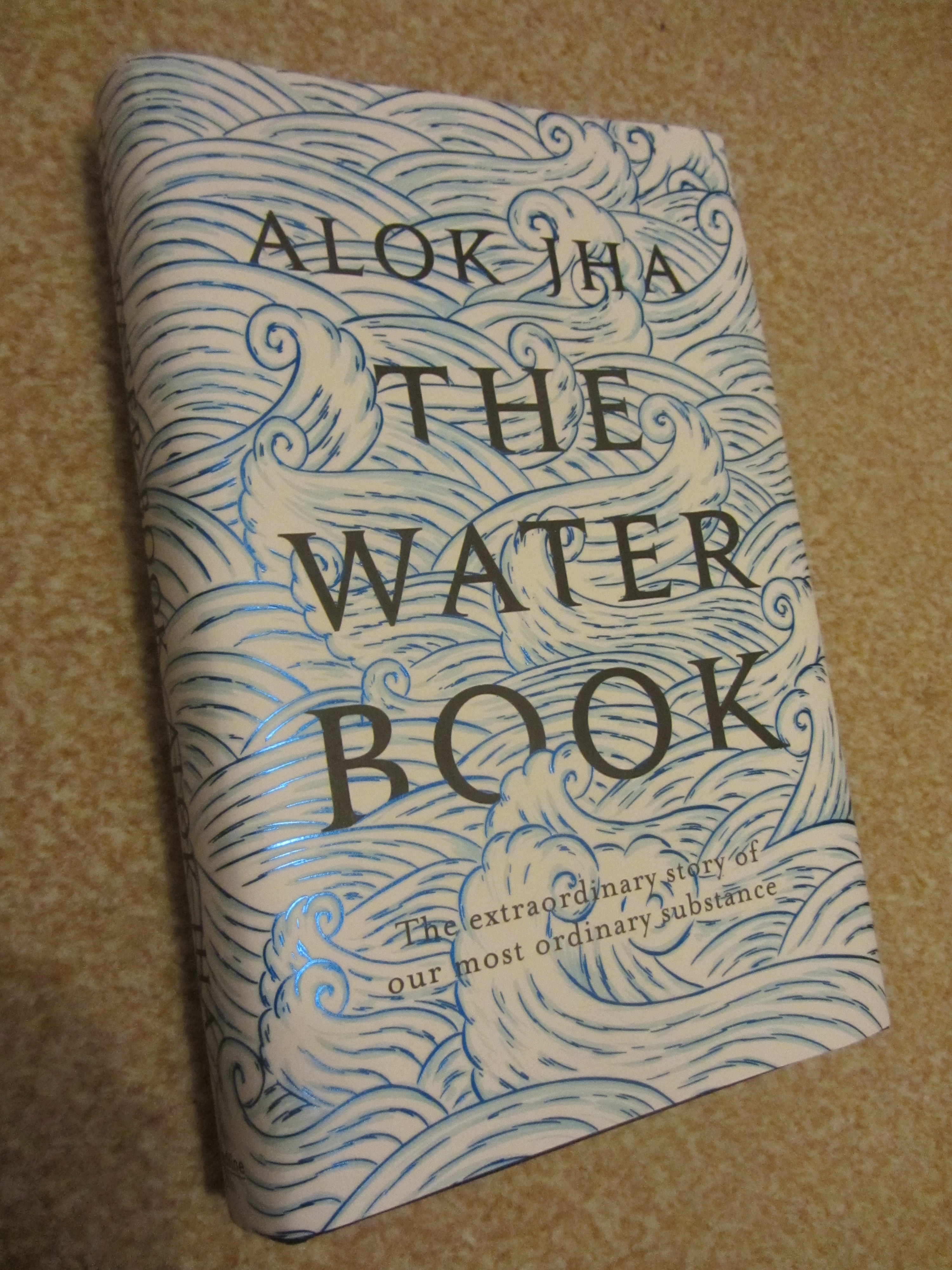
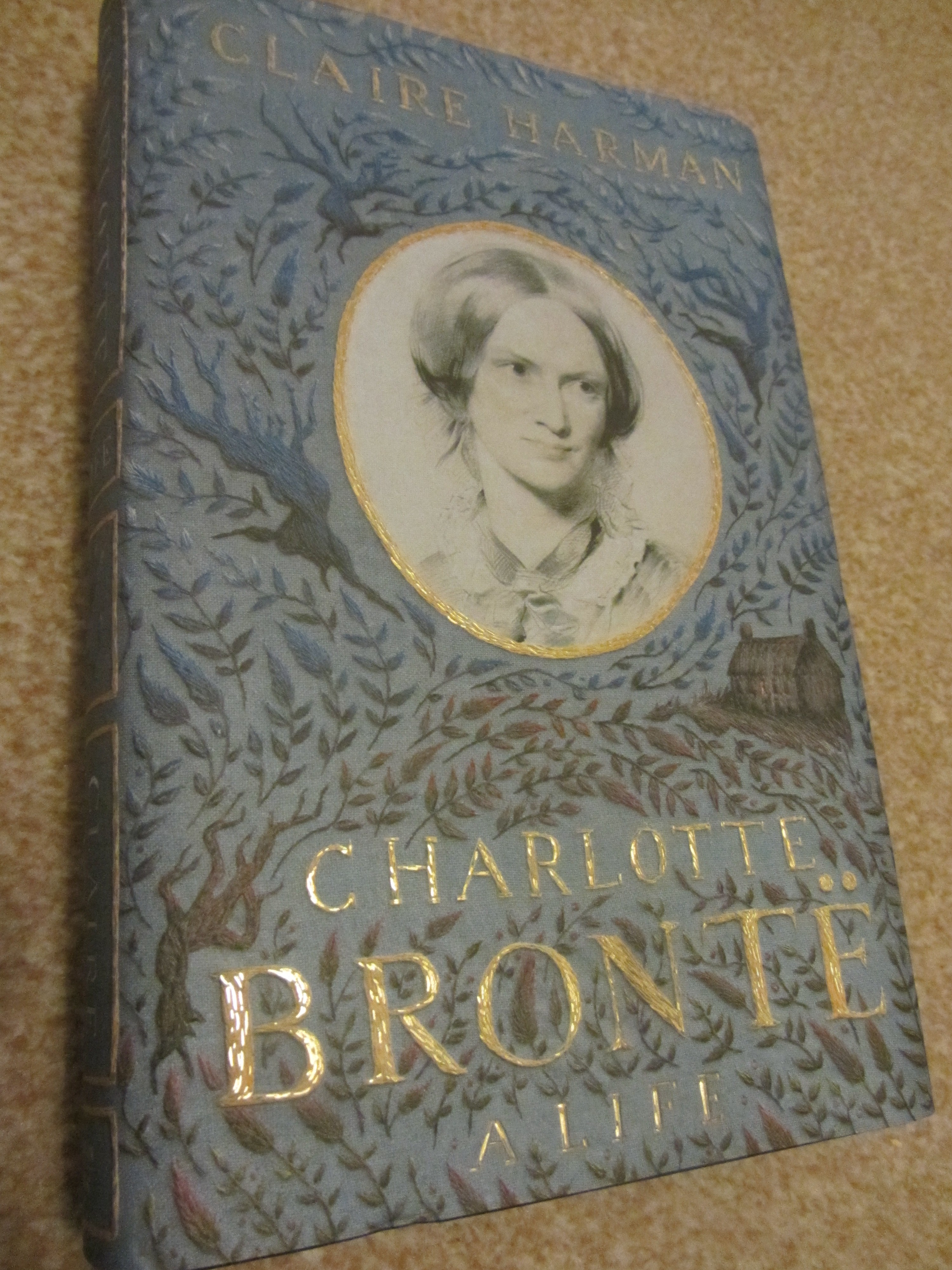
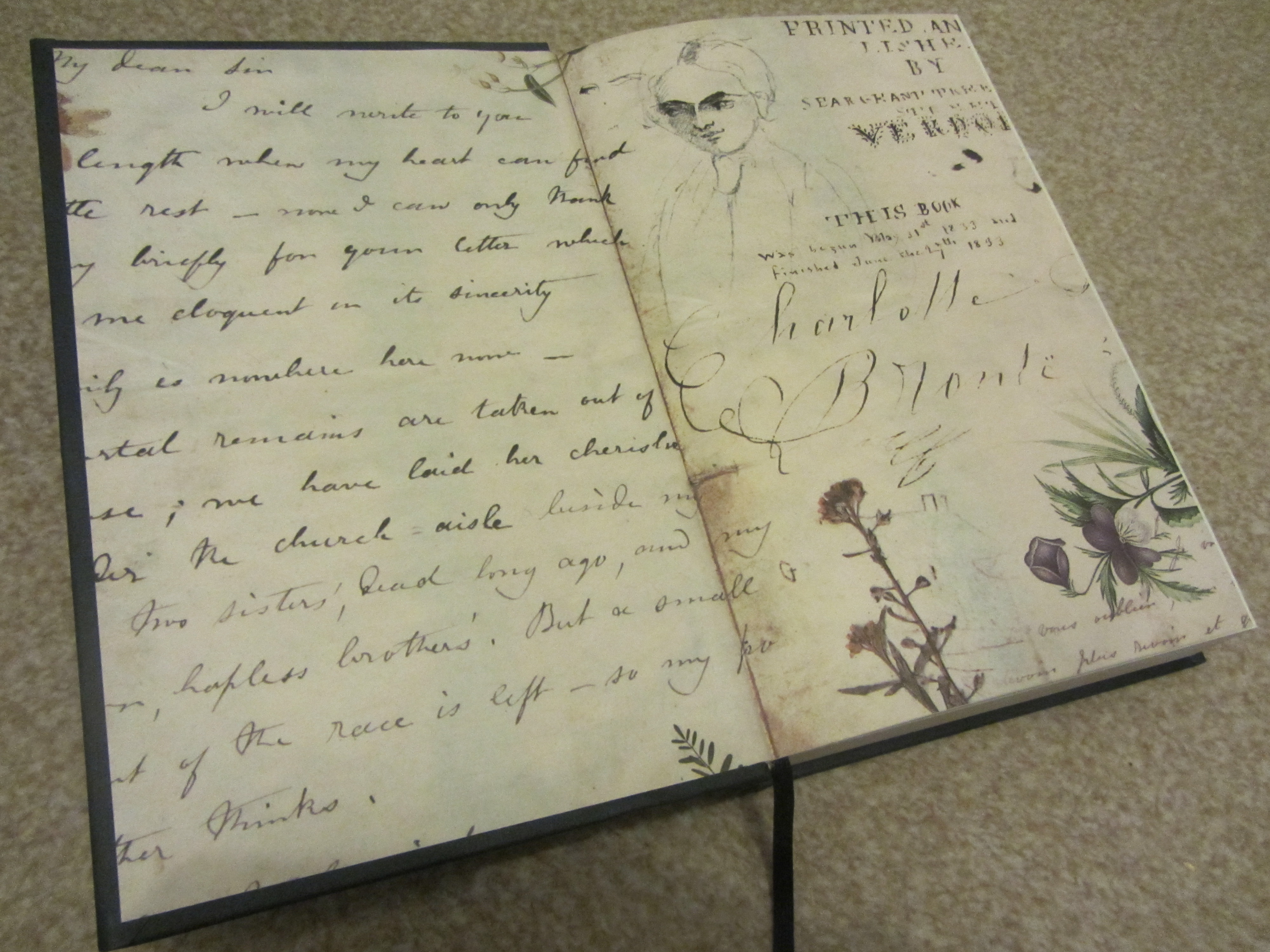
At least half of my reading nowadays is e-books, usually downloaded from NetGalley and Edelweiss and read on my Kindle. All the same, I still love the feel and smell of paper books, and it’s a special treat when the books are things of beauty in their own right. A few books I’ve reviewed recently have been absolutely stunning physical objects. Here are some photographs and a rundown of their key attributes:
The Water Book by Alok Jha – Just look at that gorgeous, shiny cover! I was less taken with the contents of the book itself, but never mind. (My review is forthcoming at Nudge.)
Charlotte Brontë: A Life by Claire Harman – Embossed embroidery effect on the cover, handwriting and sketches (including the only known C. Brontë self-portrait, only recently identified) on the endpapers, and built-in ribbon bookmark. (My review will go up at For Books’ Sake on Wednesday.)
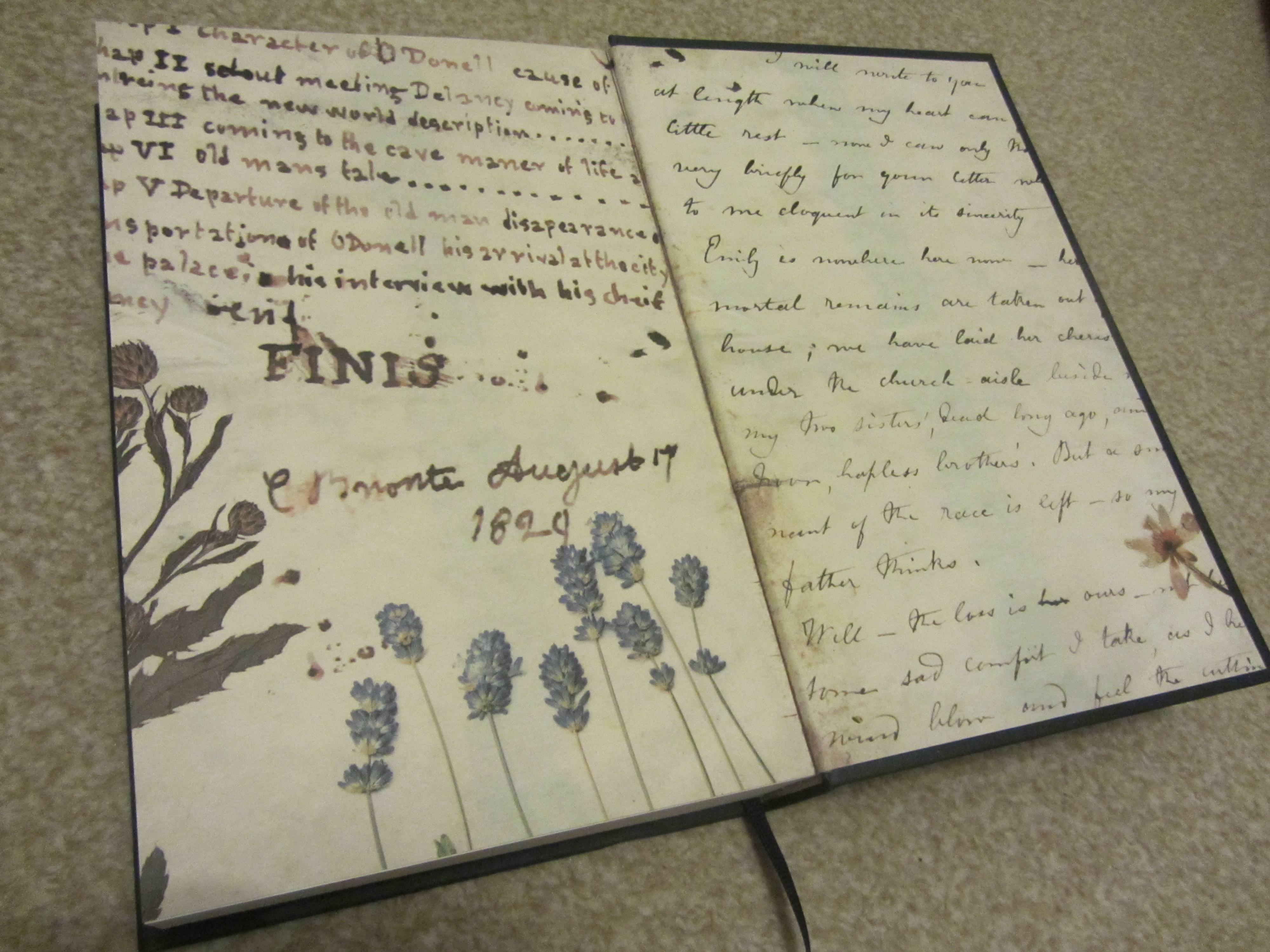
A Brief History of Seven Killings by Marlon James – The dustjacket of this Booker Prize winner is lovely enough, but take it off and you still hold a striking object, in appropriately Rastafarian colors. (Full review in December issue of Third Way magazine.)


Ruins by Peter Kuper – Embossed title on the cover, with the monarch in matte; entomological drawings on the endpapers; alternating monochrome and full-color sequences; plus a built-in ribbon bookmark. (To be reviewed here in the near future.)


To survive in this modern age, physical books have to be more than just words on a page, because e-books do that much more efficiently. They simply have to be beautiful.
What are some of the most eye-catching books you’ve encountered recently?
Graphic Novels for Newbies
Following on from last week’s article on quick reads…
I sometimes wonder if counting graphic novels on my year lists is a bit like cheating, since some are little more than comic books. However, the majority of graphic novels I read have a definite storyline and more words on a page than your average comic. When I worked in London I took advantage of the extensive public library holdings there and tried out a lot of graphic novelists’ work that was new to me. Some of my favorites are Alison Bechdel, Posy Simmonds, Audrey Niffenegger and Joe Sacco. As it happens, I’ve never officially reviewed graphic novels (nor do I own any), but here’s a handful I’ve enjoyed, along with my reading notes:
 Fun Home: A Family Tragicomic by Alison Bechdel
This memoir in graphic novel form is super. Bechdel puts the ‘fun’ in both dysfunctional family and funeral home – the family business her father inherited in small-town Pennsylvania. All through her 1970s upbringing, as Alison grew up coveting men’s shirts and feeling strange quivers of suspicion when she encountered the word “lesbian” in the dictionary, her father was leading a double life, sleeping with the younger men who babysat his kids or helped out with his twin passions of gardening and home renovation.
In an ironic sequence of events, the coming-out letter Alison sent home from college was followed just weeks later by her mother’s revelation of her father’s homosexual indiscretions and their upcoming divorce, and then no more than a few months later by her father’s sudden death. Bruce Bechdel was run down by a Sunbeam Bread truck as he was crossing the road with an armload of cleared brush from a property he was renovating. Was it suicide, or just a horribly arbitrary accident? (The Sunbeam Bread detail sure makes one cringe.) In any case, it was a “mort imbécile,” just as Camus characterized any death by automobile.
Bechdel traces the hints of queerness in her family, the moments when she and her father saw into each other and recognized something familiar. She also muses on the family as a group of frustrated and isolated artists each striving, unfulfilled, towards perfection. This is a thoughtful, powerful memoir, and no less so for being told through a comic strip.
(Bechdel’s Are You My Mother? was also on my BookTrib list of mother–daughter memoirs to read for Mother’s Day.)
 Blankets by Craig Thompson
This sweet, autobiographical coming-of-age story in graphic novel form is not quite as likable and quick-witted as Fun Home, but it has similar themes such as sexual awakening and the difficulty of understanding one’s parents. Blankets are a linking metaphor: the quilt Craig’s first love, Raina, makes for him; huddling in the same bed with his little brother Phil for warmth during freezing Wisconsin winters; and playing ‘storm at sea’ with the covers.
There’s also an interesting loss-of-faith element to the narrative. Craig is brought up in your average Midwestern fundamentalist Evangelical church and attends youth group, camp, etc. (where he meets Raina); the pastor even wants him to consider going into the ministry, but he doesn’t fit in here – even in the Christian subculture he’s forced into a fringe group of outsiders. Writing and drawing are acts of self-creation and self-preservation. He wants to find a way to use his drawing for good but no one seems to see a value in it. Thus everything, or nothing in particular, leads him to reject his faith when he gets to college.
How satisfying it is to leave a mark on a blank surface. To make a map of my movement – no matter how temporary.
The drawings are lush and bold (though even more so in Thompson’s Habibi). [SPOILERS ahead!] I appreciated how Thompson denies the satisfaction of a happy ending to Craig and Raina’s love story; it’s more realistic this way, recognizing that high school sweethearts rarely stay together. As Raina says, “everything ENDS…everything DEGENERATES, CRUMBLES – so why bother getting started in the first place?” And yet the beauty and power in memory of young love remains, thus Thompson’s rhapsodizing here.
 Mrs Weber’s Omnibus by Posy Simmonds
[a collection of her comics for the Guardian]
As with the Garfield cartoons, you get to see the development of Simmonds’s style and the characters, as well as the march of fashion over the period 1977–1993. Very clever skewering of middle class liberal values and political correctness gone mad: the characters (especially polytechnic sociology lecturer George, in the Department of Liberal Studies, and children’s book author Wendy Weber) espouse these values, but their actions don’t always live up to the tolerance they preach. Here are some of the themes:
- 1980s politics: reactionary against Thatcherism; youth unemployment and purposelessness; income inequality; economic and social injustice
- Hypocrisy, avoiding unpleasant truths, compromising youthful ideals
- Middle vs. upper-middle / upper class: second homes, private education
- Place of women: the irony that stay-at-home motherhood is idealized and the difficulties of working motherhood denied (women – liberated to do what?)
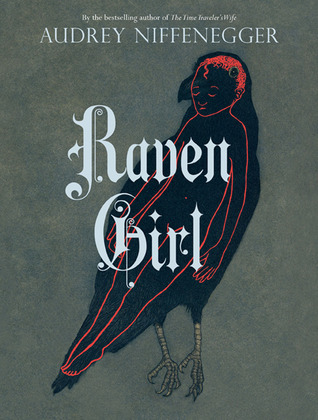 Raven Girl by Audrey Niffenegger
A lovely and simple fairy tale, with classical plot elements like transformation and true love transcending all boundaries. In a quaint English setting, a country postman is tasked with delivering a letter to an address he’s never seen before:
Dripping Rock
Raven’s Nest
2 Flat Drab Manor
East Underwhelm, Otherworld
EE1 LH9 [postcode = East of East, Lower Heights]
Here the postman meets a young raven fallen out of her nest, takes her home to mend her and they fall in love. Even when her wing heals and she can fly, she chooses to stay with him. Their daughter is a mixed creature; she can only croak, but she has no wings and so is raised as a human child. At university she meets a plastic surgeon who can create human-animal chimeras; she begs him to make her wings – a mixture of science and magic. It involves bloody surgery and painful recovery, but in the end she has the wings she’s always felt were hers. Her identity is described in terms very much like Jan Morris’s in Conundrum, when describing her sex change and her knowledge that she was really a girl: “My mother is a raven and my father is a postman, but I feel that truly I should have been a raven.”
Like Niffenegger’s other work, there’s an ever so slightly uncomfortable blend of sinister/grotesque elements with charming, innocuous magic.
 Jimmy Corrigan, the Smartest Kid on Earth by Chris Ware
This is probably the most peculiar graphic novel I’ve ever read. It’s the story of Jimmy Corrigan, a sad-sack workaholic who, at 36, has no friends apart from his mother, who constantly telephones him. One day he gets a letter from the father he’s never met, asking him to come meet him. And so Jimmy gets on a plane from Chicago out to suburban Michigan. Corrigan is one of those unfortunate-looking fellows who has a potato for a head and a wispy comb-over, and could be anywhere between 30 and 60; he looked little different as a child in the flashback scenes – somewhat like Charlie Brown, also in his depression, diffidence and inability to speak to women.
I much preferred the historical interludes looking at his grandfather (another Jimmy) and his years growing up in Chicago with the World’s Fair under construction. I also liked the more random additions such as patterns for cutting and folding your own model village or business cards with ‘scenic views’ of today’s Waukosha, MI on them.
Parental (verbal) abuse and neglect is a recurring theme, as are bullying from peers, car accidents, and Superman. There’s also an uncomfortable amount of imagined violence – either homicide or suicide.
Also recommended:
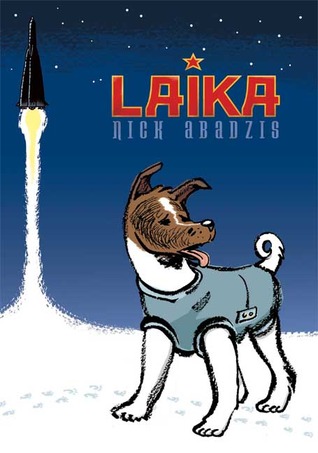 Laika by Nick Abadzis
Palestine by Joe Sacco
Couch Fiction by Philippa Perry
Days of the Bagnold Summer by Joff Winterhart
Do you read graphic novels? What are some of your favorites?
 Bookish Beck = Rebecca Foster. American transplant to England. Freelance proofreader and book reviewer.
 Bookish Beck