Classic of the Month: Down and Out in Paris and London by George Orwell (1933)
I’d of course read Animal Farm and Nineteen Eighty-Four, but this was my first taste of George Orwell’s nonfiction. It was his first book, published when he was 30, and is an excellent first-hand account of the working and living conditions of the poor in two world cities. I started it on the Eurostar between London and Paris and have enjoyed dipping into it over the past couple of weeks. I most appreciated the first two-thirds, in which Orwell is working as a dishwasher and waiter in Paris hotel restaurants for up to 80 hours a week and has to pawn his clothes to scrape together enough money to ward off starvation. Chapter 3 is a masterful piece of writing that, with its second-person address, puts the reader right into this desperate situation with him. The matter-of-fact words about poverty and hunger are incisive:
Hunger reduces one to an utterly spineless, brainless condition, more like the after-effects of influenza than anything else. It is as though one had turned into a jellyfish, or as though all one’s blood had been pumped out and luke-warm water substituted. Complete inertia is my chief memory of hunger
Two bad days followed. We had only sixty centimes left, and we spent it on half a pound of bread, with a piece of garlic to rub it with. The point of rubbing garlic on bread is that the taste lingers and gives one the illusion of having fed recently.
It is disagreeable to eat out of a newspaper on a public seat, especially in the Tuileries, which are generally full of pretty girls, but I was too hungry to care.
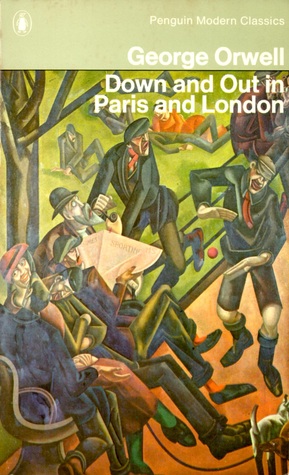 Even as he’s conveying the harsh reality of exhaustion and indignity, Orwell takes a Dickensian delight in people and their eccentricities. His pen portraits of those he associates with – Boris, a former captain in the Russian Army who is always coming up with new money-making schemes in Paris; Paddy, a tramp he falls in with in London; and Bozo, a “screever” (street painter) who “managed to keep his brain intact and alert, and so nothing could make him succumb to poverty” – are glistening passages enhanced by recreated dialogue. There are a few asides, such as a chapter about London slang and swearing, that break up the flow, and I might have liked more context about Orwell’s earlier and later life – how he slipped into poverty and how he worked his way out of it again – but he more than succeeds in his aim of exposing the truth of what it was like to be poor at that time.
Depressingly, though, this is not merely a period piece: well over 80 years later, the poor are still in danger of homelessness and enslavement to low wages and zero-hours contracts. No doubt it is still what Orwell refers to as a “dismal, demoralizing way of life,” and the poor “are ordinary human beings … if they are worse than other people it is the result and not the cause of [that] way of life.”
Our town has its fair share of the down-and-out, as was brought home to me just yesterday. My husband had an unpleasant encounter with a group of them when he tried remonstrating with a man who was cutting flowers in the community garden we’ve volunteered our time to create – the very day before the Britain in Bloom competition! When I dropped by later to help get the garden tidy for judging, they were still hanging about on the other side of the canal, smoking and drinking. Then I spotted with them an older woman who goes to our church. I’ve broken bread with her on a regular basis. She borrowed a couple of books from the theological library last week. And she must be a hair’s breadth away from homelessness, if not actually homeless. It felt like a wake-up call, a reminder that these people whose lives seem so hopelessly foreign are not as distant or as different as we might like to think.

George Orwell’s 1943 press photo. Branch of the National Union of Journalists (BNUJ). [Public domain]
My rating: 
Next month: The Go-Between by L.P. Hartley
Three Novellas in Translation
The Institute by Vincent Bijlo
[London’s Holland Park Press specializes in making classic and contemporary Dutch literature available in English translation.]
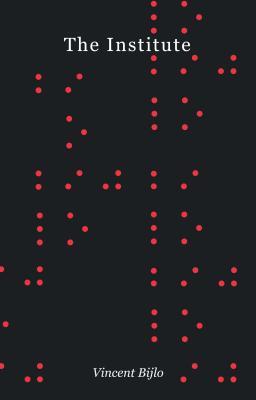 Otto Iking is a resident at the Institute, a boarding school for the blind. He characterizes his fellow students firstly according to their smell – “foul soap,” “piss” or “grated Swiss cheese” – only later adding in details about their speech and habits. It’s a zany sort of place, powered by pranks and strange decisions. Some stand-out scenes include hiding Harry’s glass eyes and a visit from the president of Surinam, a former Dutch colony. The slapstick humor works well (“When I walked into a lamppost, I said sorry. When I struck my head against a traffic sign, I said sorry. No one has ever apologised to street furniture as often as I did”), but some humor translates less well, seeming cruel or even offensive (“Tony was fat and deaf and black-skinned”).
Alongside the silliness is the matter of Otto’s coming of age. He has the first inklings of what sex is about and falls for Sonja, and also undergoes training to prepare him for the real world, things like reading and writing Braille, preparing and eating tricky meals (soup’s a killer). One day he hopes to go to a mainstream school and broadcast radio programs. The institutional setting and quirky cast reminded me of The Secret Diary of Hendrik Groen, 83¼ Years Old and Linda Grant’s The Dark Circle.
The Institute, originally from 1998, was published on April 27th. Translated from the Dutch by Susan Ridder. My thanks to Bernadette Jansen op de Haar for sending a free copy for review.
This is the first of three Otto Iking novels. Vincent Bijlo, a Dutch stand-up comedian, was born blind.
My rating: 
Dance by the Canal by Kerstin Hensel
[Peirene Press issues its translated European novellas in trios. This is the final installment in the “East and West: Looking Both Ways” series; I’ve also reviewed the first two, The Last Summer by Ricarda Huch and The Orange Grove by Larry Tremblay.]
 I don’t think I’ve ever read a novel narrated by a homeless person before. Gabriela von Haßlau has a noble name and a solid upper-middle-class background – her father was a surgeon and chief medical officer specializing in varicose veins; her mother was trained as a radiographer before becoming a housewife and society hostess – but her life took a turn for the worse at some point and she now lives in an encampment under a canal bridge in the town of Leibnitz (a fictional stand-in for Leipzig).
It’s July 1994 and she decides to write her life story on whatever scraps of paper she can get her hands on. She remembers being forced to play the violin as a child even though she was largely unmusical, enduring mockery at school for being one of the intelligentsia, playing hooky with her best friend Katka, and failing at a mechanical engineering apprenticeship. The narrative toggles between Gabriela’s memories and her present situation: getting blankets and food from a shelter and trying to avoid being sent to the mental hospital.
My unfamiliarity with German history, especially that relating to East Germany and reunification, means I probably missed some nuances of the plot; I found the ending quite sudden. What was most worthwhile about the book for me was experiencing homelessness with Gabriela and tracing some of the unfortunate events that led her to this situation. It’s also interesting to see how she shapes her life story in scenes and streams of consciousness.
Dance by the Canal, originally from 1994, was published on July 3rd. Translated from the German by Jen Calleja. With thanks to Peirene Press for the free copy for review.
My rating: 
Hair Everywhere by Tea Tulić
[London’s Istros Books specializes in Balkans and South-Eastern European literature in translation.]
 How could I resist such a terrific title and cover image? This was Croatian novelist Tea Tulić’s first book. In brief, titled vignettes almost like flash fiction stories, she dramatizes how a cancer diagnosis affects three generations of women. The book is strong on place, sensual detail and scene-setting. The narrator’s mother is in the hospital, and all the specialists and medicinal plant extracts in the world don’t seem to be helping. In such a restrictive narrative format, a line or two of dialogue can reveal a lot about a character’s attitude. The grandmother is a weary pessimist – “I just need to help your mother get through this and then I can die” – while the narrator is quite the hypochondriac.
The tone ranges from poignant to cynical, as in the absurd two-page sequence in which the family cannot locate an on-duty doctor who can read the latest X-ray results for them. The deadpan language and mixture of black humor and pathos reminded me of Adios, Cowboy by Olja Savičevi, which coincidentally is the only other Croatian novel I’ve encountered, and was originally published in the same year, 2011.
A few favorite lines:
“One little cloud was urinating.”
“While I watch her lying in bed, I can feel the umbilical cord between us. Something I have tried to cut a thousand times already. And now I hold onto that invisible cord as though I were hanging from a bridge.”
“Patrick Swayze” in its entirety: “My brother is angry because the doctors say they cannot help Mum. I tell him Patrick Swayze had lots of money but he still died of cancer.”
Hair Everywhere was published on May 22nd. Translated from the Croatian by Coral Petkovich. My thanks to Susan Curtis for sending a free copy for review – and to TJ at My Book Strings for making me aware of this title during Women in Translation Month.
My rating: 
 Bookish Beck = Rebecca Foster. American transplant to England. Freelance proofreader and book reviewer.
 Bookish Beck