Three on a Theme: Armchair Travels at the Italian Coast (Rachel Joyce, Sarah Moss and Jess Walter – #18 of 20 Books)
I’ve done a lot of journeying through Italy’s lakes and islands this summer. Not in real life, thank goodness – it would be far too hot! – but via books. I started with the Moss, then read the Joyce, and rounded off with the Walter, a book that had been on my TBR for 12 years and that many had heartily recommended, so I was delighted to finally experience it for myself.
The Homemade God by Rachel Joyce (2025)
Joyce has really upped her game. I’ve somehow read all of her books though I often found them, from Harold Fry onward, disappointingly sentimental and twee. But with this she’s entering the big leagues, moving into the more expansive, elegant and empathetic territory of novels by Anne Enright (The Green Road), Patrick Gale (Notes from an Exhibition), Maggie O’Farrell (Instructions for a Heatwave) and Tom Rachman (The Italian Teacher). It’s the story of four siblings, initially drawn together and then dramatically blown apart by their father’s death. Despite weighty themes of alcoholism, depression and marital struggles, there is an overall lightness of tone and style that made this a pleasure to read.
Vic Kemp, the title figure, was a larger-than-life, womanizing painter whose work divided critics. After his first wife’s early death from cancer, he raised three daughters and a son with the help of a rotating cast of nannies (whom he inevitably slept with). At 76 he delivered the shocking news that he was marrying again: Bella-Mae, an artist in her twenties – much younger than any of his children. They moved from London to his second home in Italy just weeks before he drowned in Lake Orta. Netta, the eldest daughter, is sure there’s something fishy; he knew the lake so well and would never have gone out for a swim with a mist rolling in. Did Bella-Mae kill him for his money? And where is his last painting? Funny how waiting for an autopsy report and searching for a new will and carping with siblings over the division of belongings can ruin what should be paradise.
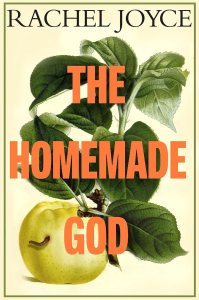
The interactions between Netta, Susan, Goose (Gustav) and Iris, plus Bella-Mae and her cousin Laszlo, are all flawlessly done, and through flashbacks and surges forward we learn so much about these flawed and flailing characters. The derelict villa and surrounding small town are appealing settings, and there are a lot of intriguing references to food, fashion and modern art.
My only small points of criticism are that Iris is less fleshed out than the others (and her bombshell secret felt distasteful), and that Joyce occasionally resorts to delivering some of her old obvious (though true) messages through an omniscient narrator, whereas they could be more palatable if they came out organically in dialogue or indirectly through a character’s thought process. Here’s an example: “When someone dies or disappears, we can only tell stories about what might have been the case or what might have happened next.” (One I liked better: “There were some things you never got over. No amount of thinking or talking would make them right: the best you could do was find a way to live alongside them.”) I also don’t think Goose would have been able to view his father’s body more than two months after his death; even with embalming, it would have started to decay within weeks.
You can tell that Joyce got her start in theatre because she’s so good at scenes and dialogue, and at moving people into different groups to see what they’ll do. She’s taken the best of her work in other media and brought it to bear here. It’s fascinating how Goose starts off seeming minor and eventually becomes the main POV character. And ending with a wedding (good enough for a Shakespearean comedy) offers a lovely occasion for a potential reconciliation after a (tragi)comic plot. More of this calibre, please! (Public library) 
Ripeness by Sarah Moss (2025)
One sneaky little line, “Ripeness, not readiness, is all,” a Shakespeare mash-up (“Ripeness is all” is from King Lear vs. “the readiness is all” is from Hamlet), gives a clue to how to understand this novel: As a work of maturity from Sarah Moss, presenting life with all its contradictions and disappointments, not attempting to counterbalance that realism with any false optimism. What do we do, who will we be, when faced with situations for which we aren’t prepared?
Now that she’s based in Ireland, Moss seems almost to be channelling Irish authors such as Claire Keegan and Maggie O’Farrell. The line-up of themes – ballet + sisters + ambivalent motherhood + the question of immigration and belonging – should have added up to something incredible and right up my street. While Ripeness is good, even very good, it feels slightly forced. As has been true with some of Moss’s recent fiction (especially Summerwater), there is the air of a creative writing experiment. Here the trial is to determine which feels closer, a first-person rendering of a time nearly 60 years ago, or a present-tense, close-third-person account of the now. [I had in mind advice from one of Emma Darwin’s Substack posts: “What you’ll see is that ‘deep third’ is really much the same as first, in the logic of it, just with different pronouns: you are locking the narrative into a certain character’s point-of-view, but you don’t have a sense of that character as the narrator, the way you do in first person.” Except, increasingly as the novel goes on, we are compelled to think about Edith as a narrator, of her own life and others’.
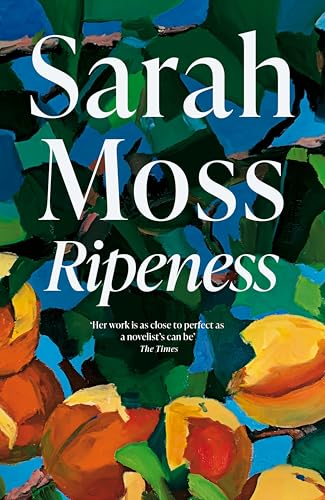
In the current story line, everyone in rural West Ireland seems to have come from somewhere else (e.g. Edith’s lover Gunter is German). “She’s going to have to find a way to rise above it, this tribalism,” Edith thinks. She’s aghast at her town playing host to a small protest against immigration. Fair enough, but including this incident just seems like an excuse for some liberal handwringing (“since it’s obvious that there is enough for all, that the problem is distribution not supply, why cannot all have enough? Partly because people like Edith have too much.”). The facts of Maman being French-Israeli and having lost family in the Holocaust felt particularly shoehorned in; referencing Jewishness adds nothing. I also wondered why she set the 1960s narrative in Italy, apart from novelty and personal familiarity. (Teenage Edith’s high school Italian is improbably advanced, allowing her to translate throughout her sister’s childbirth.)
Though much of what I’ve written seems negative, I was left with an overall favourable impression. Mostly it’s that the delivery scene and the chapters that follow it are so very moving. Plus there are astute lines everywhere you look, whether on dance, motherhood, or migration. It may simply be that Moss was taking on too much at once, such that this lacks the focus of her novellas. Ultimately, I would have been happy to have just the historical story line; the repeat of the surrendering for adoption element isn’t necessary to make any point. (I was relieved, anyway, that Moss didn’t resort to the cheap trick of having the baby turn out to be a character we’ve already been introduced to.) I admire the ambition but feel Moss has yet to return to the sweet spot of her first five novels. Still, I’m a fan for life. (Public library) 
#18 of my 20 Books of Summer
(Completing the second row on the Bingo card: Book set in a vacation destination)


Beautiful Ruins by Jess Walter (2012)
 I loved how Emma Straub described the ideal summer read in one of her Substack posts: “My plan for the summer is to read as many books as possible that make me feel that drugged-up feeling, where you just want to get back to the page.” I wish I’d been able to read this faster – that I hadn’t had so much on my plate all summer so I could have been fully immersed. Nonetheless, every time I returned to it I felt welcomed in. So many trusted bibliophiles love this book – blogger friends Laila and Laura T.; Emma Milne-White, owner of Hungerford Bookshop, who plugged it at their 2023 summer reading celebration; and Maris Kreizman, who in a recent newsletter described this as “One of my favorite summer reading novels ever … escapist magic, a lush historical novel.”
I’m relieved to report that Beautiful Ruins lived up to everyone’s acclaim – and my own high expectations after enjoying Walter’s So Far Gone, which I reviewed for BookBrowse earlier in the summer. I was immediately captivated by the shabby glamour of Pasquale’s hotel in Porto Vergogna on the coast of northern Italy. With refreshing honesty, he’s dubbed the place “Hotel Adequate View.” In April 1962, he’s attempting to build a cliff-edge tennis court when a boat delivers beautiful, dying American actress Dee Moray. It soon becomes clear that her condition is nothing nine months won’t fix and she’s been dumped here to keep her from meddling in the romance between the leads in Cleopatra, filming in Rome. In the present day, an elderly Pasquale goes to Hollywood to find out whatever happened to Dee.
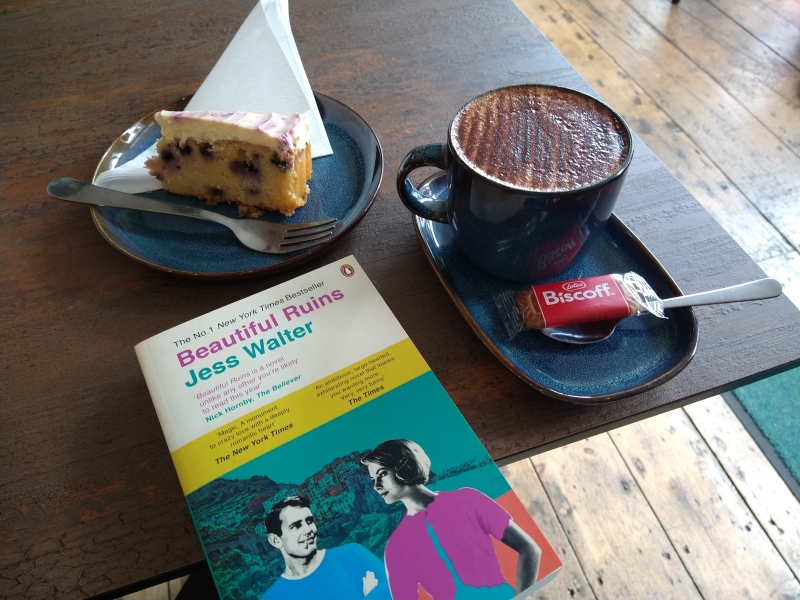
A myriad of threads and formats – a movie pitch, a would-be Hemingway’s first chapter of a never-finished wartime masterpiece, an excerpt from a producer’s autobiography and a play transcript – coalesce to flesh out what happened in that summer of 1962 and how the last half-century has treated all the supporting players. True to the tone of a novel about regret, failure and shattered illusions, Walter doesn’t tie everything up neatly, but he does offer a number of the characters a chance at redemption. This felt to me like a warmer and more timeless version of A Visit from the Goon Squad. There are so many great scenes, none better than Richard Burton’s drunken visit to Porto Vergogna, which had me in stitches. Fantastic. (Hungerford Bookshop – 40th birthday gift from my husband from my wish list) 
20 Books of Summer, 1–3: Chimamanda Ngozi Adichie, Daisy Johnson & Ruth Padel
It’s been a slow start to #20BooksofSummer2025 for me, but I’ll hope to do some catching up during our Scotland holiday and then once we’re home in July. So far, I’m sticking to the list I chose last month. These first few were slightly disappointing, to be honest, but I have no doubt I’ll find some gems among my original selections.
Dream Count by Chimamanda Ngozi Adichie (2025)
This was one of my Most Anticipated books of the year and had a lot to live up to as Adichie’s first novel since the amazing Americanah. When I first attempted to read it, I was dismayed by how much it felt like a rehashing of Americanah, with Chia (a travel writer in Maryland) and her cousin Omelogor (a feminist blogger) together reminiscent of Ifemelu. It did get more readable and somewhat more interesting as it went on. But instead of finding the narration and structure natural, I ended up full of questions about what Adichie intended.
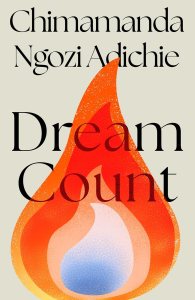 Why four main characters? Why is it the one non-Nigerian who’s poor, victimized, and less proficient in English? (That Kadiatou is based on a real person doesn’t explain enough. Her plight does at least provide what plot there is.) Why are the other three, to varying extents, rich and pretentious? Why are two narratives in the first person and two in the third person? Why in such long chunks instead of switching the POV more often? Why so many men, all of them more or less useless? (All these heterosexual relationships – so boring!) Why bring Covid into it apart from for verisimilitude? But why is the point in time important? What point is she trying to convey about pornography, the subject of Omelogor’s research?
It’s Adichie, so of course she writes solid prose with engaging characters, convincing dialogue, and provocative ideas. There’s a focus here on women’s experiences of attempted or actual motherhood (e.g., PMDD, fibroids, single parenthood or pressure to adopt), and, as per usual, a bit about race (specifically colorism, ethnic prejudice, and code-switching). But the characters’ connections seem weak, their coverage of the range of women’s experiences narrow. The title is, I suppose, the best clue to what Adichie wanted to do with the novel. Everyone dreams of finding, or preserving, love and family. Chia yearns for someone who will truly know her, and because she’s convinced this will be a romantic bond she devotes lockdown to a mental inventory of past relationships. Kadiatou dreams of peace more than of justice, and only in that she gets what she wants is there a happy ending of sorts. I wish I could be more positive, but this was a slog for me. (New purchase – Hungerford Bookshop) 
The Hotel by Daisy Johnson (2024)
I’d really enjoyed Johnson’s two novels, Everything Under and Sisters, and have a copy of her previous short story collection, Fen, on the shelf. This completely passed my notice last year. I liked the idea of eerie linked short stories, but I wish I’d known this was originally written for radio as I think it accounts for how simplistic and insubstantial the 15 tales are.
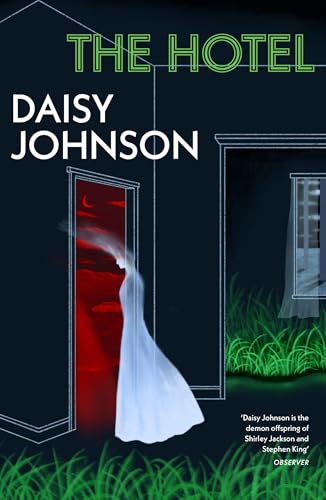 The Hotel is a fenland folly, built on the site of a pond where a suspected witch was drowned. Ever after, it is a cursed place. Those who build the hotel and stay in it are subject to violence, fear, and eruptions of the unexplained – especially if they go in Room 63. Anyone who visits once seems doomed to return. Most of the stories are in the first person, which makes sense for dramatic monologues. The speakers are guests, employees, and monsters. Some are BIPOC or queer, as if to tick off demographic boxes. Just before the Hotel burns down in 2019, it becomes the subject of an amateur student film like The Blair Witch Project.
Scary books don’t tend to work for me because I am often too aware of how they are constructed and so fail to give myself over to the reading experience and take them seriously. I can’t summon much enthusiasm for these stories, though I suppose the setting is rather atmospheric. My favourite was “Infestation,” about two girls – the one (not randomly) named Shirley – who think they discover something down in the laundry room in 1968. Only one of them makes it out alive. Okay, this one was creepy, but the rest left me unmoved. (Gift – purchased with Hungerford Bookshop with Christmas token) 
Girl by Ruth Padel (2024)
Padel is one of my favourite poets and a repeat appearance on my summer reading list; I reviewed her Emerald in 2021. I’ve read 12 of her books now. This collection is about girlhood, by way of personal history and myth.
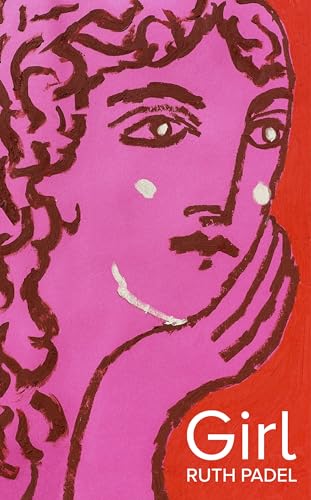 The first section, “When the Angel Comes for You,” is about the Virgin Mary, its 15 poems corresponding to the 15 Mysteries of the Rosary (as Padel explains in a note at the end; had she not, that would have gone over my head). The opening poem about the Annunciation is the most memorable its contemporary imagery emphasizing Mary’s youth and naivete: “a flood of real fear / and your heart / in the cowl-neck T-shirt from Primark / suddenly convulsed. But your old life // now seems dry as a stubbed / cigarette.” The third section, “Lady of the Labyrinth,” is about Ariadne, inspired by the snake goddess figurines in a museum on Crete. The message here is the same: “there is always the question of power / and girl is a trajectory / of learning how to deal with it”.
But the only poems that truly stood out to me are in the central autobiographical section arising from Padel’s own girlhood as well as her observations of her daughter and grandchild (setting up a Maiden–Mother–Crone triad). “Girl in a Forest” and “Tomboy and Panther” draw on the lure of the jungle to depict a wild child who chooses trousers over skirts. I loved “Fair Verona” for its traveler’s nostalgia but also for the hint of menace: so many tourists fondled the breast on a statue of Juliet that it had to be replaced. “How much touching // does it take for a bronze breast to crack?” the poet asks.
There’s some good alliteration throughout, and I warmed to the vision of girlhood as a time of promise and possibility: “the wonder / the where shall I go what new thing / will this day bring of being a girl.” Overall, though, I didn’t think the book had a lot of substance to convey about its theme. (Gift – purchased with Hungerford Bookshop with Christmas token) 
Off to Scotland today. I’ve packed Ice Cream by Helen Dunmore and Pet Sematary by Stephen King from my 20 Books list, plus other books I may substitute in. I’m scheduling a few posts for while we’re away; forgive me if I don’t reply to comments until July.
Hungerford Bookshop’s Summer Reading Celebration
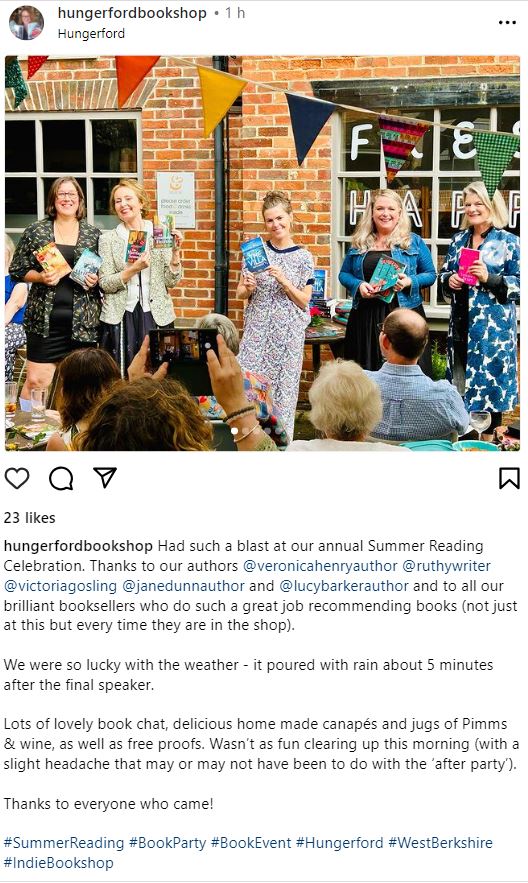
On Saturday evening my nearest indie, Hungerford Bookshop, hosted a Summer Reading celebration with five authors, some of them local, introducing their novels. It was such a delight to be invited! The rain just about held off for the duration of the outdoor event, and it was fun to learn more about new-to-me books over Pimm’s and canapes and pick up some proof copies.
Veronica Henry usually writes English countryside and coastal stories, but this time it’s Thirty Days in Paris, about Juliet, a woman of a certain age who takes a one-month rental in the city to write a novel, having amicably separated from her husband. Henry based the flat on one she stayed in in Paris, and called this novel a wish fulfilment for her.

Ruth Kelly, a ghostwriter (The Prison Doctor, etc.) based in Kintbury, has written her first novel, The Villa, a thriller about a reality TV franchise. The main character is a journalist and the other two POVs are the producer and viewers collectively. She said the book starts with the body and moves backwards.

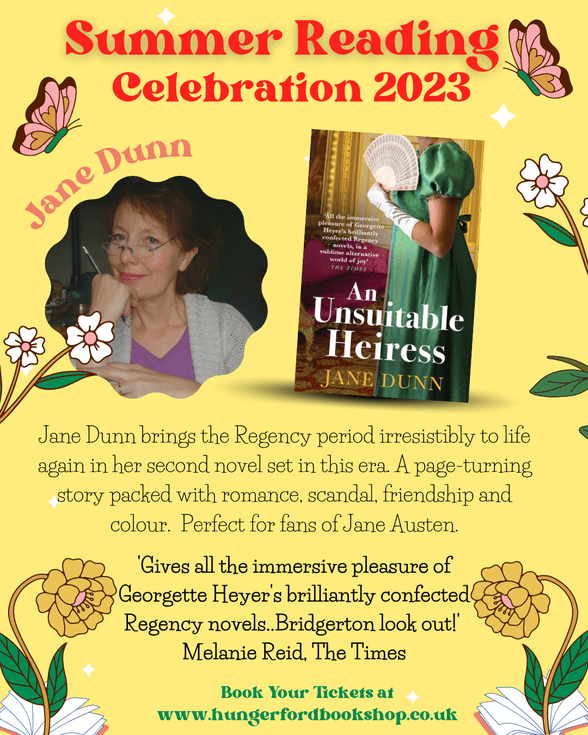
Jane Dunn is a biographer (of Daphne du Maurier, Antonia White et al.) who pivoted to writing Regency romances, having been inspired by a newfound love of Georgette Heyer. Her books, including An Unsuitable Heiress, feature women who are slightly on the periphery: a widow, illegitimate children, a male impersonator, and so on.
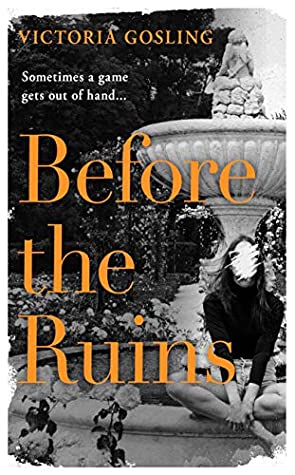
Victoria Gosling was a last-minute fill-in for an author who couldn’t make it. She moved back to Marlborough from Berlin, where she was living when she wrote her book set in Marlborough, Before the Ruins. She called it a slow-burn (Secret History-type) thriller about four people who spent the summer they were 17 squatting in a derelict manor house and have been dealing with the fallout ever since. I’ll get this one out from the library soon.
Lucy Barker’s debut novel, The Other Side of Mrs Wood, is about two warring mediums in 1873. Since I love most things set in the Victorian period, this was the one I’d already heard about and placed an order on through the library. It’s based on real-life mediums Agnes Guppy and Florence Cook and sounds like great fun! The summer reading choices are usually paperbacks, but an exception was made for this one still in hardback.

Which of these take your fancy?
There was also bookshop news and bookseller recommendations. The big announcement was the opening of a new branch in Wantage, taking over a closing-down shop.
Bookseller recommendations:
 Hilary: Briefly, A Delicious Life by Nell Stevens (I’d second that one; here’s my review)
Tessa: The Redemption of Isobel Farrar by Alan Robert Clark
Alison: Shrines of Gaiety by Kate Atkinson
Emma: Beautiful Ruins by Jess Walter (I’ve long been interested in this one)
Alex: The Sanctuary by Andrew Hunter Murray (& Lessons by Ian McEwan in paperback)
Imogen: Little Wing by Freya North (my ears pricked up to hear it’s set on the Isle of Harris)
In Memoriam by Alice Winn: Review & Author Event
I read In Memoriam by Alice Winn last month, then had the chance to see the author in conversation at Hungerford Town Hall, an event hosted by Hungerford Bookshop, on Friday evening. Here’s what I thought of the novel, which is on my Best of 2023 list.
Review
Heartstopper on the Western Front; swoon! It’s literary fiction set in the trenches of WWI, yes, but also a will-they-won’t they romance that opens at an English boarding school. Oh they will (have sex, that is), before the one-third point, but the lingering questions are: will Sidney Ellwood and Henry Gaunt both acknowledge this is love and not just sex, as it is for many teenage boys at their school (either consensually, as buddies; or forced by bullies); and will one or both survive the war? “It was ridiculous, incongruous for Ellwood to be bandying about words like ‘love’ when they were preparing to venture out into No Man’s Land.”
Winn is barely past 30 (and looks like a Victorian waif in her daguerreotype-like author photo), yet keeps a tight control of her tone and plot in this debut novel. She depicts the full horror of war, with detailed accounts of battles at Loos, Ypres and the Somme, and the mental health effects on soldiers, but in between there is light-heartedness: banter, friendship, poetry. Some moments are downright jolly. I couldn’t help but laugh at the fact that Adam Bede is the only novel available and most of them have read it four times. Gaunt is always the more pessimistic of the two, while Ellwood’s initially flippant sunniness darkens through what he sees and suffers.

I only learned from the Acknowledgements and Historical Note that Preshute is based on Marlborough College, a posh school local to me that Winn attended, and that certain particulars are drawn from Siegfried Sassoon, as well as other war literature. It’s clear the book has been thoroughly, even obsessively, researched. But Winn has a light touch with it, and characters who bring social issues into the narrative aren’t just 2D representatives of them but well rounded and essential: Gaunt (xenophobia), Ellwood (antisemitism), Hayes (classism), Devi (racism); not to mention disability and mental health for several.
I also loved how Ellwood is devoted to Tennyson and often quotes from his work, including the book-length elegy In Memoriam itself. This plus the “In Memoriam” columns of the school newspaper give the title extra resonance. I thought I was done with war fiction, but really what I was done with was worthy, redundant Faulks-ian war fiction. This was engaging, thrilling (a prison escape!), and, yes, romantic. (Public library) 
Readalike: The New Life by Tom Crewe, another of my early favourites of 2023, is set in a similar time period and also considers homosexual relationships. It, too, has epistolary elements and feels completely true to the historical record.
Some favourite lines:
“If Ellwood were a girl, he might have held his hand, kissed his temple. He might have bought a ring and tied their lives together. But Ellwood was Ellwood, and Gaunt had to be satisfied with the weight of his head on his shoulder.”
“Gaunt wished the War had been what Ellwood wanted it to be. He wished they could have ridden across a battlefield on horseback, brandishing a sword alongside their gallant king. He put on his gas mask. His men followed.”
Buy In Memoriam from Bookshop.org [affiliate link]
Event
Winn is in the UK on a short book tour; although she is English, she now lives in Brooklyn and recently had a baby. She was in conversation with AJ West, the author of The Spirit Engineer, also set on the cusp of WWI. Unrecognizable from her author photo – now blonde with glasses – she is petite rather than willowy. As I was leaving, two ladies remarked to each other how articulate she was. Indeed, she was well spoken and witty and, I expect, has always been precocious and a high achiever. I think she’s 32. Before this she wrote three novels that remain unpublished. She amazed us all by admitting she wrote the bulk of In Memoriam in just two weeks, pausing only to research trench warfare, then edited it for a year and a half.
West asked her about the genesis of the novel and she explained her obsession with the wartime newspapers of Sassoon’s school and then the letters sent home by soldiers, tracking the shift in tenor from early starry-eyed gallantry to feeling surrounded by death. She noted that it was a struggle for her to find a balance between the horrors of the Front and the fact that these young men come across in their written traces as so funny. She got that balance just right.
Was she being consciously anti-zeitgeist in focusing on privileged white men rather than writing women and minorities back into the narrative, as is so popular with publishers today, West asked? She demurred, but added that she wanted to achieve something midway between being of that time and a 2023 point-of-view in terms of the sexuality. Reading between the lines and from secondary sources, she posited that it was perhaps easier to get away with homosexuality than one might think, in that it wasn’t expected and so long as it was secret, temporary (before marrying a woman), or an experiment, it was tolerated. However, she took poetic licence in giving Gaunt and Ellwood supportive friends.

Speaking of … West (a gay man) jokingly asked Winn if she is actually a gay man, because she got their experiences and feelings spot on. She said that she has some generous friends who helped her with the authenticity of the sex scenes. In the novel she has Ellwood interpret Tennyson’s In Memoriam as crypto-homosexual, but scholars do not believe that it is; Gaunt’s twin sister Maud also, unconsciously in that case, has a Tennysonian name. This was in response to an audience question; this plus another one asking if Winn had read The New Life reassured me that my reaction was well founded! (Yes, she has, and will in fact be in conversation with Crewe in London on the 23rd. She’s also appearing at Hay Festival.)
If you’ve read the book and/or are curious, Winn revealed the inspirations for her three main characters, the real people who are “in their DNA,” as she put it: Gaunt = Robert Graves (half-German, interest in the Greek classics); Ellwood = Sassoon; Maud = Vera Brittain. She read a 5-minute passage incorporating a school scene between Gaunt and Sandys and a letter from the Front. She spoke a little too quickly and softly, such that I was glad I was within the first few rows. However, I’m sure this is a new-author thing and, should you be so lucky as to see her speak in future, you will be as impressed as I was.
Local Resistance: On Gallows Down by Nicola Chester
It’s mostly by accident that we came to live in Newbury: five years ago, when a previous landlord served us notice, we viewed a couple of rental houses in the area to compare with what was available in Reading and discovered that our money got us more that little bit further out from London. We’ve come to love this part of West Berkshire and the community we’ve found. It may not be flashy or particularly famous, but it has natural wonders worth celebrating and a rich history of rebellion that Nicola Chester plumbs in On Gallows Down. A hymn-like memoir of place as much as of one person’s life, her book posits that the quiet moments of connection with nature and the rights of ordinary people are worth fighting for.
So many layers of history mingle here: from the English Civil War onward, Newbury has been a locus of resistance for centuries. Nicola* has personal memories of the long-running women’s peace camps at Greenham Common, once a U.S. military base and cruise missile storage site – to go with the Atomic Weapons Establishment down the road at Aldermaston. As a teenager and young woman, she took part in symbolic protests against the Twyford Down and Newbury Bypass road-building projects, which went ahead and destroyed much sensitive habitat and many thousands of trees. Today, through local and national newspaper and magazine columns on wildlife, and through her winsome nagging of the managers of the Estate she lives on, she bears witness to damaging countryside management and points to a better way.

While there is a loose chronological through line, the book is principally arranged by theme, with experiences linked back to historical or literary precedents. An account of John Clare and the history of enclosure undergirds her feeling of the precarity of rural working-class life: as an Estate tenant, she knows she doesn’t own anything, has no real say in how things are done, and couldn’t afford to move elsewhere. Nicola is a school librarian and has always turned to books and writing to understand the world. I particularly loved Chapter 6, about how she grounds herself via the literature of this area: Kenneth Grahame’s The Wind in the Willows, Adam Thorpe’s Ulverton, and especially Richard Adams’s Watership Down.
Whatever life throws at her – her husband being called up to fight in Iraq, struggling to make ends meet with small children, a miscarriage, her father’s unexpected death – nature is her solace. She describes places and creatures with a rare intimacy borne out of deep knowledge. To research a book on otters for the RSPB, she seeks out every bridge over every stream. She goes out “lamping” with the local gamekeeper after dark and garners priceless nighttime sightings. Passing on her passion to her children, she gets them excited about badger watching, fossil collecting, and curating shelves of natural history treasures like skulls and feathers. She also serves as a voluntary wildlife advocate on her Estate. For every victory, like the re-establishment of the red kite population in Berkshire and regained public access to Greenham Common, there are multiple setbacks, but she continues to be a hopeful activist, her lyrical writing a means of defiance.
We are writing for our very lives and for those wild lives we share this one, lonely planet with. Writing was also a way to channel the wildness; to investigate and interpret it, to give it a voice and defend it. But it was also a connection between home and action; a plank bridge between a domestic and wild sense. A way both to home and resist.
You know that moment when you’re reading a book and spot a place you’ve been or a landmark you know well, and give a little cheer? Well, every site in this book was familiar to me from our daily lives and countryside wanderings – what a treat! As I was reading, I kept thinking how lucky we are to have such an accomplished nature writer to commemorate the uniqueness of this area. Even though I was born thousands of miles away and have moved more than a dozen times since I settled in England in 2007, I feel the same sense of belonging that Nicola attests to. She explicitly addresses this question of where we ‘come from’ versus where we fit in, and concludes that nature is always the key. There is no exclusion here. “Anyone could make a place their home by engaging with its nature.”
*I normally refer to the author by surname in a book review, but I’m friendly with Nicola from Twitter and have met her several times (and she’s one of the loveliest people you’ll ever meet), so somehow can’t bring myself to be that detached!
On Gallows Down was released by Chelsea Green Publishing on October 7th. My thanks to the author and publisher for arranging a proof copy for review.
My husband and I attended the book launch event for On Gallows Down in Hungerford on Saturday evening. Nicola was introduced by Hungerford Bookshop owner Emma Milne-White and interviewed by Claire Fuller, whose Women’s Prize-shortlisted novel Unsettled Ground is set in a fictional version of the village where Nicola lives.
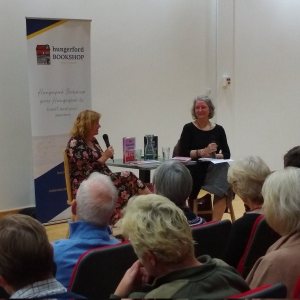
Nicola Chester and Claire Fuller. Photo by Chris Foster.
Nicola dated the book’s genesis to the moment when, 25 years ago, she queued up to talk to a TV news reporter about Newbury Bypass and froze. She went home and cried, and realized she’d have to write her feelings down instead. Words generally come to her at the time of a sighting, as she thinks about how she would tell someone how amazing it was.
Her memories are tied up with seasons and language, especially poetry, she said, and she has recently tried her hand at poetry herself. Asked about her favourite season, she chose two, the in-between seasons – spring for its abundance and autumn for its nostalgia and distinctive smells like tar spot fungus on sycamore leaves and ivy flowers.


A bonus related read:
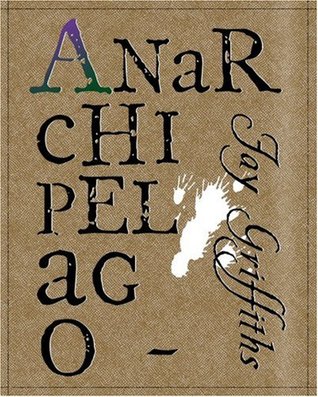
Anarchipelago by Jay Griffiths (2007)
This limited edition 57-page pamphlet from Glastonbury-based Wooden Books caught my eye from the library’s backroom rolling stacks. Griffiths wrote her impish story of Newbury Bypass resistance in response to her time among the protesters’ encampments and treehouses. Young Roddy finds a purpose for his rebellious attitude wider than his “McTypical McSuburb” by joining other oddballs in solidarity against aggressive policemen and detectives.
There are echoes of Ali Smith in the wordplay and rendering of accents.
“When I think of the road, I think of more and more monoculture of more and more suburbia. What I do, I do in defiance of the Louis Queasy Chintzy, the sickly stale air of suburban car culture. I want the fresh air of nature, the lifefull wind of the French revolution.”
In a nice spot of Book Serendipity, both this and On Gallows Down recount the moment when nature ‘fought back’ as a tree fell on a police cherry-picker. Plus Roddy is kin to the tree-sitting protesters in The Overstory by Richard Powers as well as another big novel I’m reading now, Damnation Spring by Ash Davidson.
New Reading Projects! (Join Me?)
It’s only one week since we announced the Not the Wellcome Prize winner, the culmination of a month-long project that was months more in the planning. I don’t think I’ll be coordinating another blog tour anytime soon, as it was a lot of work finding participants, working out a schedule and keeping on top of the publicizing via social media. Still, it was a lot of fun, and already I’m missing the buzz and ready to get stuck into more projects.
I’d love it if you joined me for one or more of these. Some could be combined with your 20 Books of Summer or other challenges, too.
Ongoing buddy reads
 It would have been Richard Adams’s 100th birthday on the 9th. That night I started rereading his classic tale of rabbits in peril, Watership Down, which was my favorite book from childhood even though I only read it the once at age nine. I’m 80 pages in and enjoying all the local place names. Who would ever have predicted that that mousy tomboy from Silver Spring, Maryland would one day live just 6.5 miles from the real Watership Down?!
 My husband is joining me for the Watership Down read (he’s not sure he ever read it before), and we’re also doing a buddy read of Arctic Dreams by Barry Lopez. In that case, we ended up with two free copies, one from the bookshop where I volunteer and the other from The Book Thing of Baltimore, so we each have a copy on the go. Lopez’s style, like Peter Matthiessen’s, lends itself to slower, reflective reading, so I’m only two chapters in. It’s novel to journey to the Arctic, especially as we approach the summer.
I plan to take my time over these two, so tell me if you have a copy of either and feel like picking it up at any point over the next few months.
Bibliotherapy self-prescriptions
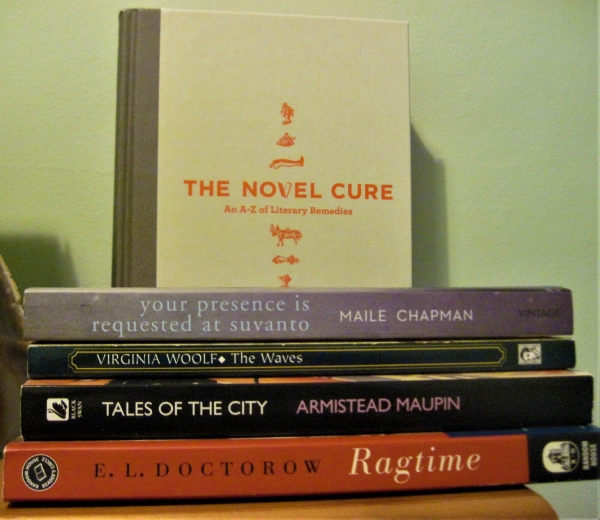
The other day I got out my copy of The Novel Cure by School of Life bibliotherapists Ella Berthoud and Susan Elderkin and browsed through the categories for some prescriptions that might feel relevant to the current situation. I found four books I own that fit the bill:
From the list of “The Ten Best Novels to Lower Your Blood Pressure”: Your Presence Is Requested at Suvanto by Maile Chapman & The Waves by Virginia Woolf (and I’ve read another three of them, including, recently, Crossing to Safety).
One of several prescriptions for Loneliness: Tales of the City by Armistead Maupin.
The cure for Zestlessness: Ragtime by E. L. Doctorow.
If you have access to one of these, or have a copy of The Novel Cure and are keen on following up on another of the prescriptions, let me know.
And now for two memes that I (think I) have created. Although I’m sure something similar has been done in the past, I couldn’t find any specific blogs about them. I don’t know about you, but I always need encouragement to pick up books from my own shelves – even though libraries are currently closed, I’m still working my way through a library stack, and I’m tempted to make another order of new books from Hungerford Bookshop. It’s great to support libraries and independent bookstores, of course, but there could be no better time to mine your own bookshelves for treasures you bought ages ago but still have never read.
Journey through the Day with Books
I enjoyed picking out 18 books from my shelves that refer to particular times of day or meals or activities associated therewith. Four of these are books I’ve already read and four are ones I’m currently reading. You can piggyback on my selections if you wish, or find your own set.
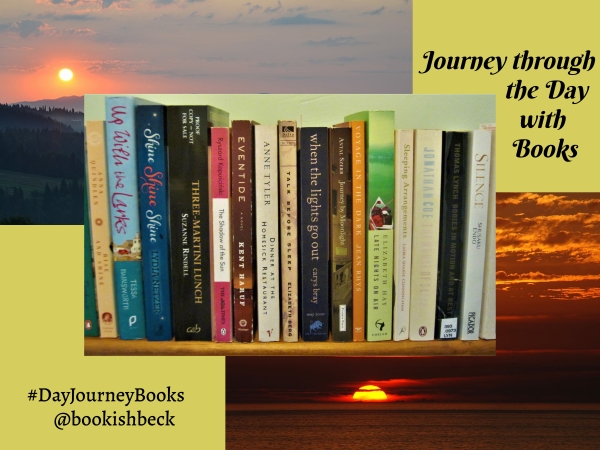
Here’s my full list:
Zennor in Darkness by Helen Dunmore
Rise and Shine by Anna Quindlen
Up with the Larks by Tessa Hainsworth
Shine Shine Shine by Lydia Netzer
Three-Martini Lunch by Suzanne Rindell
The Shadow of the Sun by Ryszard Kapuściński
Eventide by Kent Haruf
Dinner at the Homesick Restaurant by Anne Tyler
Talk before Sleep by Elizabeth Berg
When the Lights Go Out by Carys Bray
Journey by Moonlight by Antal Szerb
Voyage in the Dark by Jean Rhys
Late Nights on Air by Elizabeth Hay
Sleeping Arrangements by Laura Shaine Cunningham
The House of Sleep by Jonathan Coe
Bodies in Motion and at Rest by Thomas Lynch
Silence by Shūsaku Endō
Arctic Dreams by Barry Lopez
The Four in a Row Challenge
I’ve been contemplating this one for quite a while. It’s inspired by Phyllis Rose’s The Shelf –from LEQ to LES: Adventures in Extreme Reading (one of Simon’s favourite books – see his review), for which she picked a shelf of the New York Society Library, eliminated duplicates and repeat entries from the same author, and read the remainder – whether she’d heard of them or not; whether they were awful or not. (“Hands down the worst book on the shelf is Le Queux’s Three Knots, a mystery that reads as if it were written by an eight-year-old on Percocet.”)

This is a variation in that you’re looking at your own TBR shelves and picking a set of four books in a row. For many, that will be four novels whose authors’ surnames all start with the same letter. But if you organize your books differently (especially within nonfiction), you may find that the set of four is more arbitrary. You never know what they might have in common, though (book serendipity!).
I’m no strict challenge host, so if you want to engineer your shelf order, or if you decide to swap a book in later on, that is no problem at all. My one firm rule is only one book per author.
I’ve picked out a few appealing sets, all from my fiction shelves. F, G, L and M had particularly rich pickings. I’ll report back as I finish each set, while the “Journey through a Day” may well take me the whole rest of the year.
Still ongoing (more here): Projects to read as many Bellwether Prize, Wellcome Book Prize and Women’s Prize winners as possible, as well as Wellcome long- and shortlistees.
Can I tempt you to take part in any of these reading projects?
[Journey through the Day: Sunrise in Pieniny, Poland (Pudelek / CC BY-SA (https://creativecommons.org/licenses/by-sa/4.0)) / Sunset (Alvesgaspar / CC BY-SA (https://creativecommons.org/licenses/by-sa/3.0))
Four in a Row: Four pelicans in a row (Sheba_Also 43,000 photos / CC BY-SA (https://creativecommons.org/licenses/by-sa/2.0)) / Phone boxes, Market Place, Ripon (Tim Green from Bradford / CC BY (https://creativecommons.org/licenses/by/2.0))]
Pandemic Reading Strategies & Recommendations, Serious or Tongue-in-Cheek
If you’ve been spending time blog-hopping or on Twitter over the last few weeks, you will have seen countless riffs on this topic. Everyone’s pondering what’s best to read in these times. All we can get our hands on about plagues (Boccaccio, Camus, Defoe)? Allegories of similarly challenging worldwide disasters (WWII, 9/11)? Childhood favorites? Comfort reads? Funny books? Light, undemanding stuff? Rereads?
My general answer would be: as always, read whatever you want or can – anything that captures your attention is worthwhile. We’re under so much stress that our reading should be entirely unpressured. But to be a little more specific, I’ve gathered reading recommendations on a variety of topics, drawing on lists that others have made and linking to my own blog reviews where applicable.
(Some of these ideas are less serious than others.)
If you are brave enough to learn about zoonotic diseases:
 Spillover: Animal Infections and the Next Human Pandemic by David Quammen: This is top-notch scientific journalism: pacey, well-structured, and gripping. The best chapters are on Ebola and SARS; the SARS chapter, in particular, reads like a film screenplay, if this were a far superior version of Contagion. It’s a sobering subject, with some quite alarming anecdotes and statistics, but this is not scare-mongering for the sake of it; Quammen is frank about the fact that we’re still all more likely to get heart disease or be in a fatal car crash.
If you can’t look away from pandemic stories, historical or imagined:


I already had Philip Roth’s Nemesis (set in 1940s New Jersey amid a polio epidemic) out from the library because it was on the Wellcome Book Prize shortlist in 2011. I was also inspired to take Year of Wonders by Geraldine Brooks (set in the 1660s and featuring an English village that quarantined itself during the Plague) off the shelf. I’m nearing the end of these two and should have my reviews up next week.
You will see no one book referenced more than Station Eleven by Emily St. John Mandel. It’s a wholly believable dystopian novel in which 99% of the population has been wiped out by a pandemic. The remnant bands together not just to survive but to create and preserve art. “What was lost in the collapse: almost everything, almost everyone, but there is still such beauty.” (My full BookBrowse review from December 2014.)
See also this Publishers Weekly list of “13 Essential Pandemic Novels.”
If you’re feeling cooped up…
 Infinite Home by Kathleen Alcott: “Edith is a widowed landlady who rents apartments in her Brooklyn brownstone to an unlikely collection of humans, all deeply in need of shelter.” (I haven’t read it, but I do have a copy; now would seem like the time to read it!)
…yet want to appreciate the home you’re stuck in:


Years ago I read and loved At Home: A Short History of Private Life by Bill Bryson and Happier at Home by Gretchen Rubin. I can’t tell you anything more than that because it was before the days when I reviewed everything I read, but these are both reliable authors.
 I love the sound of A Journey Around My Room by Xavier de Maistre: “Finding himself locked in his room for six weeks, a young officer journeys around his room in his imagination, using the various objects it contains as inspiration for a delightful parody of contemporary travel writing and an exercise in Sternean picaresque.”
I’m also drawn to Home: The Story of Everyone Who Ever Lived in Our House by Julie Myerson, who combed archives for traces of all the former residents of her 1870s terraced house in Clapham.
If you’re struggling with being on your own:


The Lonely City by Olivia Laing: This remarkable book on outsider artists interweaves biography, art criticism and memoir. Laing is a tour guide into the peculiar, lonely crowdedness you find in a world city.
How to Be Alone by Sara Maitland: Maitland argues that although being alone is easy to achieve, there is an art to doing it properly, and solitude and loneliness are by no means the same thing. Profiling everyone from the Desert Fathers of early Christianity to the Romantic poets, she enumerates all the benefits that solitude confers.
Journal of a Solitude by May Sarton: A one-year account of her writing life in New Hampshire, this is Sarton’s best. The book dwells on the seasonal patterns of the natural world (shovelling snow, gardening, caring for animals) but also the rhythms of the soul – rising in hope but also falling into occasional, inevitable despair.
See also this Penguin UK list of books to read in self-isolation.
If you’ve been passing the time by baking…
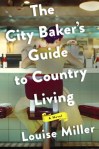 The City Baker’s Guide to Country Living by Louise Miller: As chief baker at the Sugar Maple Inn in Guthrie, Vermon, Olivia Rawlings settles into a daily routine of baking muffins, bread and cakes. This is a warm, cozy debut novel full of well-drawn secondary characters and romantic possibilities. There’s nothing clichéd about it, though. Livvy is a sassy narrator, and I loved how Miller documents the rhythms of the small-town country year, including tapping the maple trees in the early spring and a pie baking contest at the summer county fair.
 Sourdough by Robin Sloan: Lois Clary, a Bay Area robot programmer, becomes obsessed with baking. “I needed a more interesting life. I could start by learning something. I could start with the starter.” She attempts to link her job and her hobby by teaching a robot arm to knead the bread she makes for a farmer’s market. Madcap adventures ensue. It’s a funny and original novel and it makes you think, too – particularly about the extent to which we should allow technology to take over our food production.
…but can’t find yeast or eggs in the shop:
Yeast: A Problem by Charles Kingsley (1851). Nope, I haven’t read it, but our friend has a copy in his Everyman’s Library collection and the title makes us laugh every time we see it.
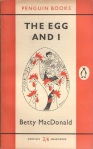 The Egg & I by Betty Macdonald: MacDonald and her husband started a rural Washington State chicken farm in the 1940s. Her account of her failure to become the perfect farm wife is hilarious. The voice reminded me of Doreen Tovey’s: mild exasperation at the drama caused by household animals, neighbors, and inanimate objects. “I really tried to like chickens. But I couldn’t get close to the hen either physically or spiritually, and by the end of the second spring I hated everything about the chicken but the egg.” Perfect pre-Easter reading.
And here are a few lists I put together for Hungerford Bookshop:
If you need a laugh:
Fiction:
Lucky Jim by Kingsley Amis
The Darling Buds of May (and sequels) by H.E. Bates
Ella Minnow Pea by Mark Dunn
Heartburn by Nora Ephron
 Cold Comfort Farm by Stella Gibbons
Anything by Nick Hornby
Three Men in a Boat by Jerome K. Jerome
Anything by David Lodge
Dear Committee Members by Julie Schumacher
The Rosie Project (and sequels) by Graeme Simsion
To Say Nothing of the Dog by Connie Willis
Nonfiction:
 Anything by Bill Bryson
21st-Century Yokel by Tom Cox
Anything by Gerald Durrell
Anything by Nora Ephron (essays)
This Is Going to Hurt by Adam Kay
Priestdaddy by Patricia Lockwood
Dear Lupin by Roger Mortimer
Anything by David Sedaris
Little Failure by Gary Shteyngart
If you want to disappear into a long book:


The Heart’s Invisible Furies by John Boyne
Jonathan Strange & Mr Norrell by Susanna Clarke
David Copperfield by Charles Dickens
Middlesex by Jeffrey Eugenides
The Crimson Petal and the White by Michel Faber
The Signature of All Things by Elizabeth Gilbert
The Nix by Nathan Hill
We, the Drowned by Carsten Jensen
Mary Ann Sate, Imbecile by Alice Jolly
The Poisonwood Bible by Barbara Kingsolver
The Wind-Up Bird Chronicle by Haruki Murakami
The Sparrow by Mary Doria Russell
American Wife by Curtis Sittenfeld
East of Eden by John Steinbeck
The Goldfinch by Donna Tartt
Cutting for Stone by Abraham Verghese
The Paying Guests by Sarah Waters
If you’re looking for some hope:
 Almost Everything: Notes on Hope by Anne Lamott
Hope in the Dark by Rebecca Solnit
Hope Dies Last: Making a Difference in an Indifferent World by Studs Terkel
I’ve been doing a combination of the above strategies, reading about historical plagues in fiction and nonfiction but also doing some rereading and consuming lighter genre stuff like mysteries. I continue to dip into new releases, and I enjoy the ongoing challenge of my reading projects. Right now, I’m working through a few current Women’s Prize longlistees, as well as some past Wellcome Book Prize nominees and Women’s Prize winners, and I’m about to start a third #1920Club title. Plus I’m already thinking about my 20 Books of Summer (I’m considering an all-foodie theme).
Further reading:
- Book Riot pinpoints seven categories of books to read during a pandemic.
- Clare surveys the post-pandemic literary landscape.
- Elle logs her pandemic reading and viewing.
- Laura discusses pandemic reading strategies and distraction reading.
- Literary Hub looks at parallel situations, including post-9/11 reads, to make predictions, and asks what your “go-to quarantine read” says about you. (I’ve read Kindred most recently, but I wouldn’t say that describes me.)
- Simon thinks about what we can and should read.
- Susan highlights some comfort reads.
What are your current reading strategies?
Book Spine Poetry Returns
The literary world continues to revolve, rapidly replacing all in-person events with online ones. On Thursday night I was meant to be in London seeing Anne Tyler. Instead, I spent the evening on Twitter, watching a literary prize announcement, attending two virtual book launches, and (pre)ordering three March releases from my nearest independent bookstore, Hungerford Bookshop. Today I sent the shop owner a long list of book recommendations for the website. I offered remote bibliotherapy for customers and she asked me to add to her curated lists of Long books, Books that are part of a big series, Books to make you laugh, and Books about hope (that last one was really hard). I’m also going to be taking part in two blog tours in early April for novels whose book tours were cancelled. A hint is below.
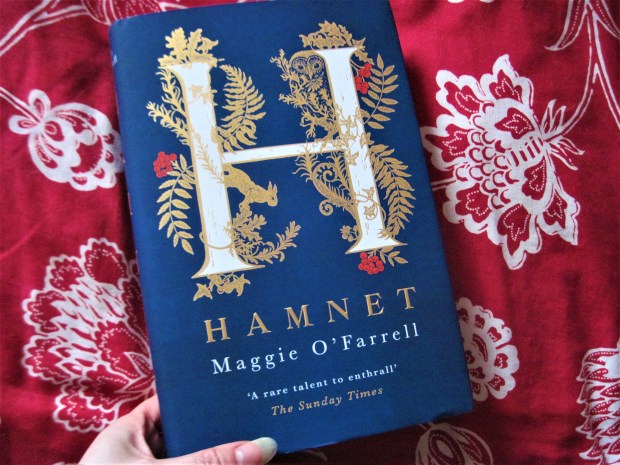
I’m continuing to read and write to the blog plan I had set up for March into April. What else is there to do? In the meantime, I assembled some titles, mostly from books on my bedside table, into a few impromptu poems. Remember what fun book spine poetry was back in 2016? (My efforts from that short-lived craze are here and here.)
A partial haiku for our times:
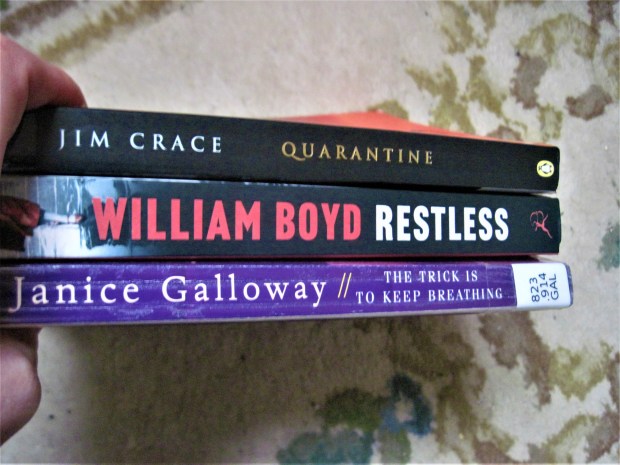
Plus two more wee poems of hope and lament.
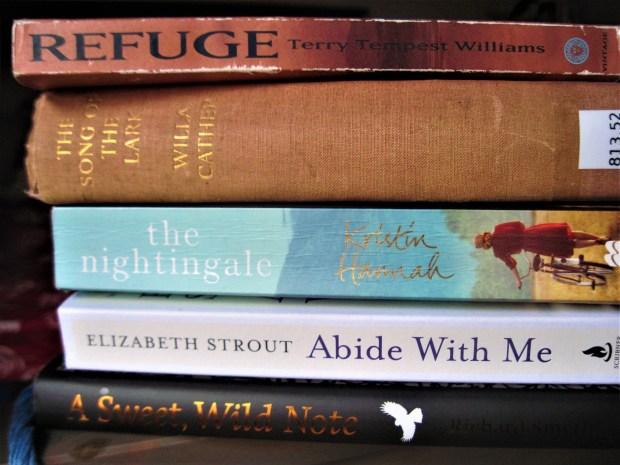
Refuge
The song of the lark,
The nightingale
Abide with me
A sweet, wild note.
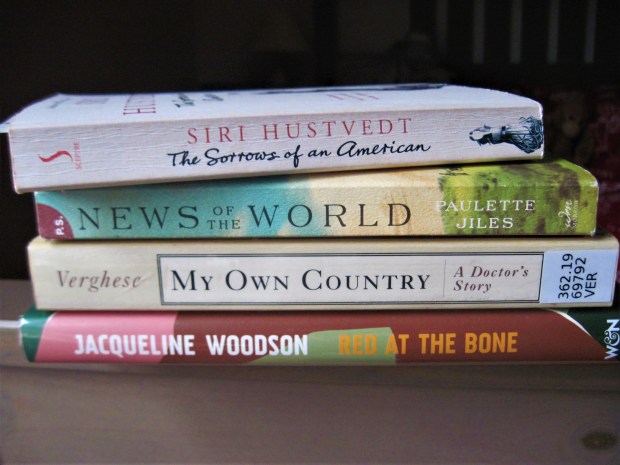
The Sorrows of an American
News of the world:
My own country,
Red at the bone.
I hope you are all staying safe and keeping your spirits up.
What have you been reading that has felt particularly appropriate or comforting?
Birthday Happenings
One of the best things about being a home-based freelancer is that I can arrange my work schedule to suit my life. Having my birthday fall on a Friday this year was especially good because it meant I got until Monday to submit my daily editing load. My husband was working as usual, so I spent much of the day reading under the cat and charity shopping. I bought seven books, a nice mixture of England-themed nonfiction and juicy novels, plus new-to-me comfy black flats. (Total spend: £10.25.) Being short on time that evening, we lazily ordered delivery pizza for probably the first time in eight years, followed by cocktails and cake.
 I didn’t end up using my literary cakes and cocktails books this year, but that gives me a chance to proffer my own pun names for what we did make. We tried two gin cocktails we’d found recipes for in the Guardian. The one they called “Elderflower Collins” was absolutely delicious: lemon juice, elderflower cordial and gin, topped up with San Pellegrino Limonata (lemon soda) and garnished with a lemon slice and a mint sprig. I dub it “A Visit from Mr. Collins,” as in the Bennet girls will have to down quite a few of these before…
Unfortunately, the second cocktail was not a hit. The “Miss Polly Hawkins” combines chamomile-flavored gin (I steeped two chamomile teabags in 60 mL of gin for a week), rose syrup (we didn’t have it or want to buy it so substituted our homemade rosehip syrup), plain gin and egg white. Egg white is a fairly frequent ingredient in cocktails – it adds gloss and body – but we found that it made the drink gloopy. That plus the overall floral and medicinal notes meant this was fairly hard to swallow; we had to drown it in sparkling water and ice cubes to get it down. Alas, I modify Iris Murdoch to call this “An Unappealing Rose.”
 However, my cake was an unqualified success. I usually go for chocolate or chocolate/peanut butter desserts, but decided to be different this year and requested the Italian Pear and Ginger Cheesecake from Genevieve Taylor’s cookbook A Good Egg. It was sophisticated and delicious. Running with the Italy thing, I’ll pick out a Forster title and call it “Where Angels Pear to Tread.” (It doesn’t make a whole lot of sense; then again, neither do a lot of the names in Tequila Mockingbird and Scone with the Wind!)
On Sunday the birthday fun continued with a trip to Hungerford Bookshop (our nearest independent bookshop) and a gentle country walk. I bought two secondhand books but came away with a total of four – in the basement they have a table covered in free proof copies, so my husband and I grabbed one each (how I wish I could have taken the lot!). It’s a great idea for rewarding customer loyalty and dealing with unwanted proofs; perhaps I’ll donate a stack of mine to them next time I’m there.


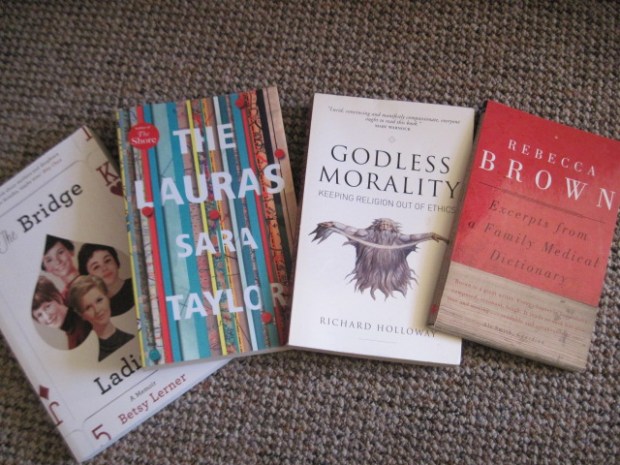
Two proofs (left) and two nonfiction purchases.
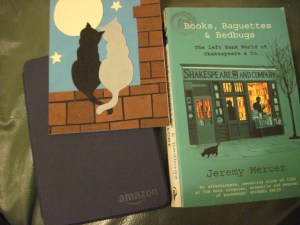
This year I got a Kindle case and two bookshop-themed memoirs as presents: The Little Bookstore of Big Stone Gap by Wendy Welch and Books, Baguettes and Bedbugs by Jeremy Mercer. I started reading the former – the story of a married couple opening a bookshop in recession-era Virginia – right away. I also got a poster frame so I can finally hang my literary map of the British Isles on the wall above my desk, and a “Shhhh, reading in progress” mug.


Consuming tasty food and drink + acquiring a baker’s dozen of books + getting out into the countryside = a great birthday weekend!
 Bookish Beck = Rebecca Foster. American transplant to England. Freelance proofreader and book reviewer.
 Bookish Beck


.jpg)
.jpg)