Novellas in November, Part 1
This is my second year of joining Laura (Reading in Bed) and others in reading mostly novellas in November. I’ve trawled my shelves and my current library pile for short books, limiting myself to ones of around 150 pages or fewer. First up: four short works of fiction. (I’m at work on various ‘nonfiction novellas’, too.) For the first two I give longer reviews as I got the books from the publishers; the other two are true minis.

Swallowing Mercury by Wioletta Greg
(translated from the Polish by Eliza Marciniak)
[146 pages]
I heard about this one via the Man Booker International Prize longlist. Quirkiness is particularly common in indie and translated books, I find, and while it’s often off-putting for me, I loved it here. Greg achieves an impressive balance between grim subject matter and simple enjoyment of remembered childhood activities. Her novella is, after all, set in Poland in the 1980s, the last decade of it being a Communist state in the Soviet Union.
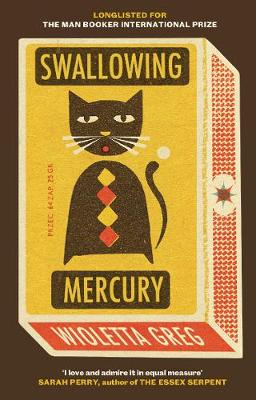 The narrator (and autobiographical stand-in?) is Wiolka Rogalówna, who lives with her parents in a moldering house in the fictional town of Hektary. Her father, one of the most striking characters, was arrested for deserting from the army two weeks before she was born, and now works for a paper mill and zealously pursues his hobbies of hunting, fishing, and taxidermy. The signs of their deprivation – really the whole country’s poverty – are subtle: Wiolka has to go selling hand-picked sour cherries with her grandmother at the market even though she’s embarrassed to run into her classmates; she goes out collecting scrap metal with a gang of boys; and she ties up her hair with a rubber band she cut from an inner tube.
Catholicism plays a major role in these characters’ lives: Wiolka wins a blessed figure in a church raffle, the Pope is rumored to be on his way, and a picture of the Black Madonna visits the town. A striking contrast is set up between the threat of molestation – Wiolka is always fending off unwanted advances, it seems – and lighthearted antics like school competitions and going to great lengths to get rare matchbox labels for her collection. This almost madcap element balances out some of the difficulty of her upbringing.
What I most appreciated was the way Greg depicts some universalities of childhood and adolescence, such as catching bugs, having eerie experiences in the dark, and getting one’s first period. This is a book of titled vignettes of just five to 10 pages, but it feels much more expansive than that, capturing the whole of early life. The Polish title translates as “Unripe,” which better reflects the coming-of-age theme; the English translator has gone for that quirk instead. 
A favorite passage:
“Then I sat at the table, which was set with plates full of pasta, laid my head down on the surface and felt the pulsating of the wood. In its cracks and knots, christenings, wakes and name-day celebrations were in full swing, and woodworms were playing dodgeball using poppy seeds that had fallen from the crusts of freshly baked bread.”
Thanks to Portobello Books for the free copy for review.
A Field Guide to the North American Family by Garth Risk Hallberg
[126 pages]
 Written somewhat in the style of a bird field guide, this is essentially a set of flash fiction stories you have to put together in your mind to figure out what happens to two seemingly conventional middle-class families: the Harrisons and the Hungates, neighbors on Long Island. Frank Harrison dies suddenly in 2008, and the Hungates divorce soon after. Their son Gabe devotes much of his high school years to drug-taking before an accident lands him in a burn unit. Here he’s visited by his girlfriend, Lacey Harrison. Her little brother, Tommy, is a compulsive liar but knows a big secret his late father was keeping from his wife.
The chapters, each just a paragraph or two, are given alphabetical, cross-referenced headings and an apparently thematic photograph. For example, “Entertainment,” one of my favorite stand-alone pieces, opens “In the beginning was the Television. And the Television was large and paneled in plastic made to look like wood. It dwelled in a dim corner of the living room and came on for national news, Cosby, Saturday cartoons, and football.”
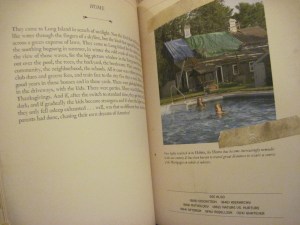 This is a Franzen-esque take on family dysfunction and, like City on Fire, is best devoured in large chunks at a time so you don’t lose momentum: as short as this is, I found it easy to forget who the characters were and had to keep referring to the (handy) family tree at the start. Ultimately I found the mixed-media format just a little silly, and the photos often seem to bear little relation to the text. It’s interesting to see how this idea evolved into the mixed-media sections of City on Fire, which is as epic as this is minimalist, though the story line of this novella is so thin as to be almost incidental.
Favorite lines:
“Depending on parent genotype, the crossbreeding of a Bad Habit and Boredom will result in either Chemistry or Entertainment.”
“Though hardly the most visible member of its kingdom, Love has never been as endangered as conservationists would have us believe, for without it, the Family would cease to function.”
Thanks to Vintage Books for the free copy for review.
The Comfort of Strangers by Ian McEwan
[100 pages]
 This is the earliest McEwan work I’ve read (1981). I could see the seeds of some of his classic themes: obsession, sexual and otherwise; the slow building of suspense and awareness until an inevitable short burst of violence. Mary and Colin are a vacationing couple in Venice. One evening they’ve spent so long in bed that by the time they get out all the local restaurants have shut, but a bar-owner takes pity and gives them sustenance, then a place to rest and wash when they get lost and fail to locate their hotel. Soon neighborly solicitude turns into a creepy level of attention. McEwan has a knack for presenting situations that are just odd enough to stand out but not odd enough to provoke an instant recoil, so along with the characters we keep thinking all will turn out benignly. This reminded me of Death in Venice and The Talented Mr. Ripley.
First Love by Gwendoline Riley
[167 pages – on the long side, but I had a library copy to read anyway]
 Neve tells us about her testy marriage with Edwyn, a Jekyll & Hyde type who sometimes earns our sympathy for his health problems and other times seems like a verbally abusive misogynist. But she also tells us about her past: her excess drinking, her unpleasant father, her moves between various cities in the north of England and Scotland, a previous relationship that broke down, her mother’s failed marriages, and so on. There’s a lot of very good dialogue in this book – I was reminded of Conversations with Friends – and Neve’s needy mum is a great character, but I wasn’t sure what this all amounts to. As best I can make out, we are meant to question Neve’s self-destructive habits, with Edwyn being just the latest example of a poor, masochistic decision. Every once in a while you get Riley waxing lyrical in a way that suggests she’s a really great author who got stuck with a somber, limited subject: “Outside the sunset abetted one last queer revival of light, so the outlook was torched; wet bus stop, wet shutters, all deep-dyed.”
Other favorite lines:
“An illusion of freedom: snap-twist getaways with no plans: nothing real. I’d given my freedom away. Time and again. As if I had contempt for it. Or was it hopelessness I felt, that I was so negligent? Or did it hardly matter, in fact? … Could I trust myself? Not to make my life a lair.”
Have you read any of these novellas? Which one takes your fancy?
Two Mother–Daughter Author Pairs for Mother’s Day
This coming Sunday is Mother’s Day in the USA. (Mothering Sunday generally falls in March here in the UK, so every year I have to buy a card early to send to my mother back in the States, but I still associate Mother’s Day with May.) Earlier in the year I got over halfway through a Goodreads giveaway book, Beyond the Pale by Emily Urquhart, before I realized its author was the daughter of a Canadian novelist I’d read before, Jane Urquhart. That got me thinking about other mother–daughter pairs that might be on my shelves. I found one in the form of Sue Monk Kidd’s The Secret Life of Bees plus an advance e-copy of her daughter Ann Kidd Taylor’s upcoming debut novel, The Shark Club. (I’ve previously reviewed their joint memoir, Traveling with Pomegranates.) And, as a bonus, I have a mini-review of Graham Swift’s novella Mothering Sunday: A Romance.
The Whirlpool, Jane Urquhart
 From 1986, this was Urquhart’s first novel. Overall it reminded me of A. S. Byatt (especially The Virgin in the Garden) and John Fowles’s The French Lieutenant’s Woman. Set in 1889 on the Canadian side of Niagara Falls, it features characters who, each in their separate ways, are stuck in the past and obsessed with death and its symbolic stand-in, the whirlpool. Maud Grady, the local undertaker’s widow, takes possession of the corpses of those who’ve tried to swim the Falls. Her creepy young son starts off mute and becomes an expert mimic. Major David McDougal is fixated on the War of 1812, while his wife Fleda camps out in a tent reading Victorian poetry, especially Robert Browning, and awaiting a house that may never be built. Local poet Patrick sees Fleda from afar and develops romanticized ideas about her.
Each of these narratives is entertaining, but I was less convinced by their intersections – except for the brilliant scenes when Patrick and Maud’s son engage in wordplay. In particular, I was unsure what the prologue and epilogue (in which Robert Browning, dying in Venice, is visited by images of Shelley’s death by drowning) were meant to add. This is the second Urquhart novel I’ve read, after Sanctuary Line. I admire her writing but her plots don’t always come together. However, I’m sure to try more of her work: I have a copy of Away on the shelf, and Changing Heaven (1990) sounds unmissable – it features the ghost of Emily Brontë! [Bought from a Lambeth charity shop for 20p.]
My rating:
Beyond the Pale: Folklore, Family and the Mystery of Our Hidden Genes, Emily Urquhart
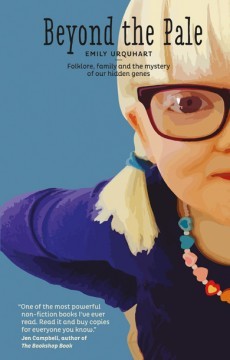 In December 2010, the author’s first child, Sadie, was born with white hair. It took weeks to confirm that Sadie had albinism, a genetic condition associated with extreme light sensitivity and poor eyesight. A Canadian folklorist, Urquhart is well placed to trace the legends that have arisen about albinos through time and across the world, ranging from the Dead Sea Scroll story of Noah being born with blinding white skin and hair to the enduring superstition that accounts for African albinos being maimed or killed to use their body parts in folk medicine.
She attends a NOAH (America’s National Organization for Albinism and Hypopigmentation) conference, discovers potential evidence of a family history of albinism, and even makes a pilgrimage to Tanzania to meet some victims. It’s all written up in as engaging present-tense narrative of coming to terms with disability: to start with Urquhart is annoyed at people reassuring her “it could be worse,” but by the end she’s ever so slightly disappointed to learn that her second child, a boy, will not be an albino like his sister. [Goodreads giveaway copy]
My rating:
The Secret Life of Bees, Sue Monk Kidd
 It’s hard to believe it was 15 years ago that this debut novel was an It book, and harder to believe that I’d never managed to get around to it until now. However, in some ways it felt familiar because I’d read a fair bit of background via Kidd’s chapter in Why We Write about Ourselves and Traveling with Pomegranates, in which she and her daughter explored the Black Madonna tradition in Europe.
It joins unusual elements you wouldn’t expect to find in fiction – beekeeping and the divine feminine – with more well-trodden territory: the Civil Rights movement in the South in the 1960s, unhappy family relationships, secrets, and a teenage girl’s coming of age. Fourteen-year-old Lily is an appealing narrator who runs away from her memories of her mother’s death and her angry father, peach farmer T. Ray. You can’t help but fall in love with the rest of her new African-American, matriarchal clan, including their housekeeper, Rosaleen, who scandalizes the town by registering to vote, and the bee-keeping Boatwright sisters, August, June, and May, who give Lily and Rosaleen refuge when they skip town.
Although this crams in a lot of happenings and emotional ups and downs, it’s a charming story that draws you into the brutal heat of a South Carolina summer and keeps you hoping Lily will forgive herself and slip into the rhythms of a purposeful life of sisterhood. [Secondhand purchase in America]
A favorite line: “The way people lived their lives, settling for grits and cow shit, made me sick.”
My rating:
The Shark Club, Ann Kidd Taylor
 Dr. Maeve Donnelly loves sharks even though she was bitten by one as a child. She’s now a leading researcher with a Florida conservancy and travels around the world to gather data. Her professional life goes from strength to strength, but her personal life is another matter. Aged 30, she’s smarting from a broken engagement to her childhood sweetheart, Daniel, and isn’t ready to open her heart to Nicholas, a British colleague going through a divorce.
Things get complicated when Daniel returns to their southwest Florida island to work as the chef at her grandmother’s hotel – with his six-year-old daughter in tow. Maeve is soon taken with precocious Hazel, who founds the title club (pledge: “With this fin, I do swear. To love sharks even when they bite. When they lose their teeth, I will find them. When I catch one, I will let it go”), but isn’t sure she can pick up where she left off with Daniel. Meanwhile, evidence has surfaced of a local shark finning operation, and she’s determined to get to the bottom of it.
This is a little bit romance and a little bit mystery, and Taylor brings the Florida Keys setting to vibrant life. It took a while to suspend disbelief about Maeve’s background – an orphan and a twin and a shark bite survivor and a kid brought up in a hotel? – but I enjoyed the sweet yet unpredictable story line. Nothing earth-shattering, but great light reading for a summer day at the beach. Releases June 6th from Viking. [Edelweiss download]
My rating: 
Mothering Sunday: A Romance, Graham Swift
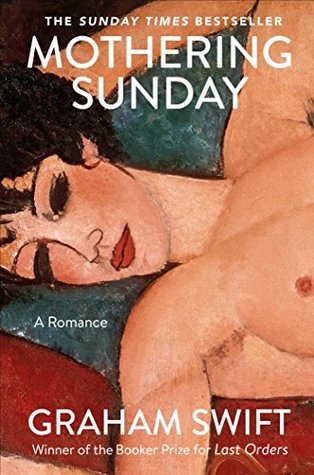 If you’re expecting a cozy tale of maternal love, let the Modigliani nude on the U.K. cover wipe that notion out of your mind. Part of me was impressed by Swift’s compact picture of one sexy, fateful day in 1924 and the reverberations it had for a budding writer even decades later. Interesting class connotations, too. But another part of me thought, isn’t this what you would get if Ian McEwan directed a middling episode of Downton Abbey? It has undeniable similarities to Atonement and On Chesil Beach, after all, and unlike those novels it’s repetitive; it keeps cycling round to restate its main events and points. There’s some good lines, but overall this felt like a strong short story stretched out to try to achieve book length. [Library read]
My rating: 
Six “Love” Books for Valentine’s Day
Starting in mid-January I began surveying my shelves, library stack and Kindle for books with “love” in the title. Here are the six I had time to try; I didn’t get to Alain de Botton’s The Course of Love on my Kindle, nor my paperback copies of Iris Murdoch’s The Sacred and Profane Love Machine and Nancy Horan’s Loving Frank.
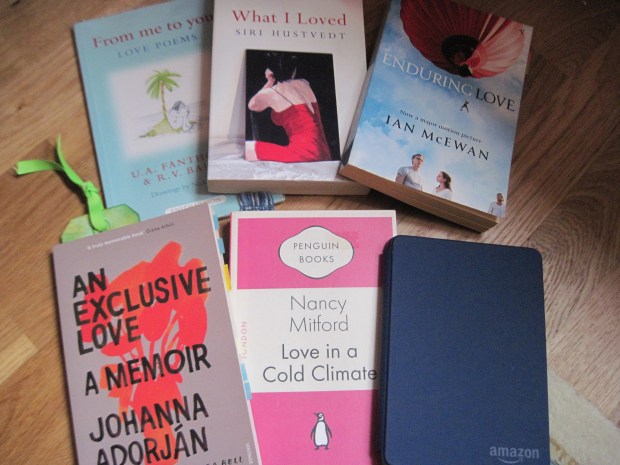
You’ll notice that a number of the books I’ve read aren’t that optimistic about love; in several cases the use of the word in the title even seems to be ironic. As Lady Montdore exclaims in Love in a Cold Climate, “Love indeed – whoever invented love ought to be shot.” So I can’t offer them as particularly romantic choices. But let’s start positively, with some pleasantly out-of-the-ordinary love poems.
From Me to You: Love Poems, U.A. Fanthorpe and R.V. Bailey
 Ursula Fanthorpe and Rosie Bailey met as English teachers at the same Cheltenham school in their late twenties and were partners for nearly 40 years. None of the poems in this short volume are attributed, though I recognized a few from Fanthorpe’s Collected Poems. They’re not particularly distinguished as poetry, but I appreciated the simple, unsentimental examples of what makes up everyday life with a partner: “There is a kind of love called maintenance, / Which stores the WD40 and knows when to use it; // Which checks the insurance, and doesn’t forget / The milkman” (“Atlas”) and “I’m working on a meal you haven’t had to imagine, / A house cleaned to the rafters” (“Dear Valentine”). [Public library]
What I Loved, Siri Hustvedt
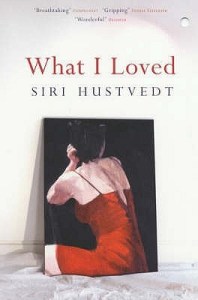 This 2003 novel could just as well have been titled “What I Lost,” which might be truer to its elegiac tone. Narrated by Professor Leo Hertzberg and set between the 1970s and 1990s, it’s about two New York City couples – academics and artists – and the losses they suffer over the years. With themes of modern art, perspective, memory, separation and varieties of mental illness, it asks to what extent we can ever know other people or use replacements to fill the gaps left by who and what is missing. Read it if you’ve enjoyed The Suicide of Claire Bishop by Carmiel Banasky, other books by Siri Hustvedt, or anything by Howard Norman. My favorite lines about love were “I often thought of our marriage as one long conversation” and “love thrives on a certain kind of distance … it requires an awed separateness to continue.” [Charity shop]
Love in a Cold Climate, Nancy Mitford
 I didn’t realize this 1949 novel is a sequel to The Pursuit of Love, so it took a while to figure out who all the characters were. Fanny Logan is a cousin orbiting around Lord and Lady Montdore and their daughter Polly Hampton, all recently returned from some years in India. Fanny marries an Oxford don, while Polly shocks everyone by eloping with her uncle by marriage, “Boy” Dougdale, a recent widower once known as the “Lecherous Lecturer” for interfering with little girls. (This hint of pedophilia is carelessly tossed off in a way no writer would get away with today.) Meanwhile, the heir to the Hampton estate, an effeminate chap named Cedric, comes over from Canada for a visit and wins Lady Montdore over. This amusing picture of aristocratic life in the 1930s marvels at who we love and why. [Bookbarn International]
Enduring Love, Ian McEwan
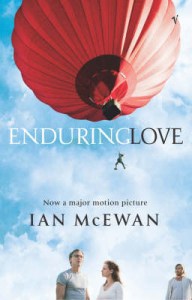 Interesting to consider this as a precursor to Saturday: both have a scientist as the protagonist and get progressively darker through a slightly contrived stalker plot. Enduring Love opens, famously, with a ballooning accident that leaves its witnesses questioning whether they couldn’t have done more to prevent it. Freelance science journalist Joe Rose – on a picnic with his partner, Keats scholar Clarissa, at the time – was one of those who rushed to help, as was Jed Parry, a young Christian zealot who fixates on Joe. He seems to think that by loving Joe, a committed atheist, he can bring him to God. In turn, Joe’s obsession with Jed’s harassment campaign drives Clarissa away. It’s a deliciously creepy read that contrasts rationality with religion and inquires into what types of love are built to last. [Charity shop]
An Exclusive Love: A Memoir, Johanna Adorján
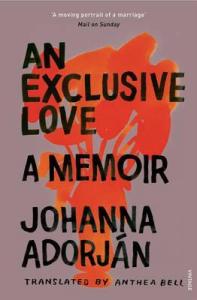 The author’s grandparents, Hungarian Holocaust survivors who moved to Denmark as refugees, committed suicide together on October 13, 1991. Her grandfather, an orthopedic surgeon who had been in an Austrian concentration camp, was terminally ill and his wife was determined not to live a day without him. This short, elegant memoir alternates Adorján’s imagined reconstruction of her grandparents’ last day with an account of their life together, drawn from family memories and interviews with those who knew them. She wonders whether, like Primo Levi and Arthur Koestler, theirs was a typically Jewish failure to fit in wherever they went, and/or a particularly Hungarian melancholy. “The answer is their great love,” the newspaper report of their death insisted. [Waterstones clearance]
Note: That striking cover is by Leanne Shapton.
And another nonfiction selection that I didn’t make it all the way through:
A Book about Love, Jonah Lehrer
 (Abandoned at 31%.) Although I can see why he starts where he does, Lehrer’s early focus on attachment and attunement – two psychological theories of how babies learn to relate affectionately to others – means the book gets bogged down in studies performed on mice and/or children and feels more like a parenting book than anything else. (If that’s what you’re after, read All Joy and No Fun.) A glance at the table of contents suggests the rest of the book will go into marriage, divorce and how love changes over time, but I couldn’t be bothered to stick around. That said, Lehrer’s popular science writing is clear and engaging, and with the heartfelt mea culpa at the start of this book I couldn’t hold a grudge about his earlier plagiarism scandal. [Kindle book from NetGalley.]
No overtly heartwarming love stories in that selection, then, but are there any you fancy reading anyway? Have you read any “love” titles recently?
See also: The Guardian’s list of Top 10 Authentic Romances.
Review & Giveaway: Hame by Annalena McAfee
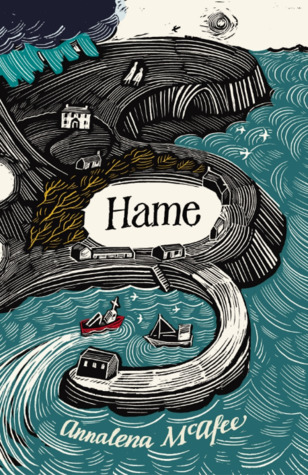 As I mentioned on Tuesday, I previously knew of Annalena McAfee only as Mrs. Ian McEwan, though she has a distinguished literary background: she founded the Guardian Review and edited it for six years, was Arts and Literary Editor of the Financial Times, and is the author of multiple children’s books and one previous novel for adults, The Spoiler (2011).
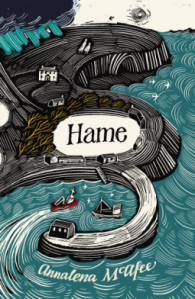
Well, anyone who reads Hame will be saying “Ian who?” as this is on such a grand scale compared to anything McEwan has ever attempted. The subtitle, “The Fascaray Archives,” gives an idea of how thorough McAfee means to be: the life of fictional poet Grigor McWatt is her way into everything that forms the Scottish identity. Her invented island of Fascaray is a carefully constructed microcosm of Scotland from ancient times to today. I loved the little glimpses of recent history, like the referendum on independence and a Donald Trump figure, billionaire “Archie Tupper,” bulldozing an environmentally sensitive area to build his new golf course (this really happened, in Aberdeenshire in 2012).
Narrator Mhairi McPhail arrives on Fascaray in August 2014, her nine-year-old daughter Agnes in tow. She’s here to oversee the opening of a new museum, edit a seven-volume edition of McWatt’s magnum opus, The Fascaray Compendium (a 70-year journal detailing the island’s history, language, flora, fauna and customs), and complete a critical biography of the poet. Over the next four months she often questions the feasibility of her multi-strand project. She also frets about her split from Marco, whom she left back in New York City after their separate infidelities. And her rootlessness – she’s Canadian via Scotland but has spent a lot of time in the States, giving her a mixed-up heritage and accent – is a constant niggle.
Mhairi’s narrative sections share space with excerpts from her biography of McWatt and extracts from McWatt’s own writing: The Fascaray Compendium, newspaper columns, letters to on-again, off-again lover Lilias Hogg, and Scots translations of famous poets from Blake to Yeats. We learn of key events from the island’s history through Mhairi’s biography and McWatt’s prose, including ongoing tension between lairds and crofters, Finnverinnity House being used as a Special Ops training school during World War II, a lifeboat lost in a gale in the 1970s, and the way the fishing industry is now ceding to hydroelectric power.
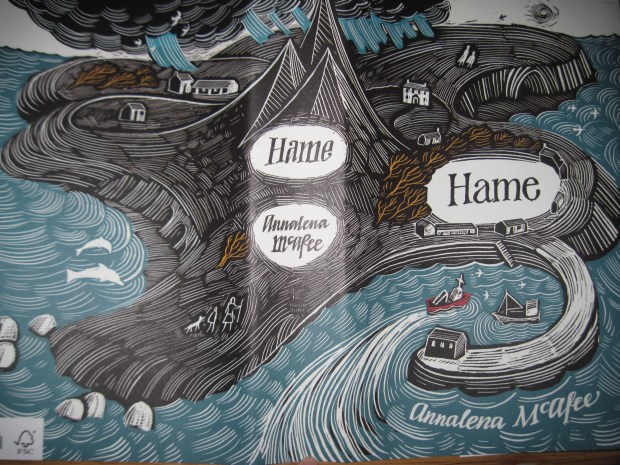
The balance between the alternating elements isn’t quite right – sections from Mhairi’s contemporary diary seem to get shorter as the novel goes along, such that it feels like there’s not enough narrative to anchor the book. Faced with yet more Scots poetry and vocabulary lists, or passages from Mhairi’s dry biography, it’s mighty tempting to skim.
That’s a shame, as the novel contains some truly lovely writing, particularly in McWatt’s nature observations:
In July and August, on rare days of startling and sustained heat, dragonflies as blue as the cloudless skies shimmer over cushions of moss by the burn while the midges, who abhor direct sunlight, are nowhere to be seen. Out to sea, somnolent groups of whales pass like cortèges of cruise ships and around them dolphins and porpoises joyously arc and dip as if stitching the ocean’s silken canopy of turquoise, gentian and cobalt.
For centuries male Fascaradians have sailed in the autumn, at the time of the ripe barley and the fruiting buckthorn, to hunt the plump young solan geese or gannets – the guga – near their nesting sites on the uninhabited rock pinnacles of Plodda and Grodda. No true Fascaradian can suffer vertigo since the scaling of these granite towers is done without the aid of mountaineers’ crampons or picks.
“Hame” means home in Scots – like in McWatt’s claim to fame, the folk-pop song “Hame tae Fascaray” – and themes of home and identity are strong here. The novel asks to what extent identity is bound up with a particular country and language, and whether we can craft our own selves. Must the place you come from always be the same as the home you choose? I could relate to Mhairi’s feeling that there’s nowhere she belongs, whether she’s in the bustle of New York or “marooned on a patch of damp peat floating in the North Sea.”
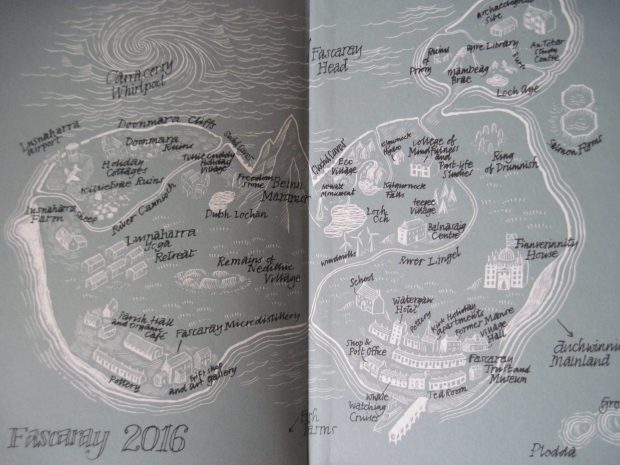
A map of the island from the inside of the back cover.
Although the blend of elements initially made me think that this would resemble A.S. Byatt’s Possession, it’s actually more like Rachel Cantor’s Good on Paper, which similarly stars a scholar who’s a single parent to a precocious daughter. In places I was also reminded of the work of Scarlett Thomas, Sara Maitland and Sarah Moss, and there’s even an echo of Robert Macfarlane’s Landmarks in the inventories of dialect words.
If you’ve done much traveling in Scotland, an added pleasure of the novel is trying to spot places you’ve been. (I thought I could see traces of Stromness, Orkney; indeed, McWatt reminded me most of Orcadian poet George Mackay Brown.) The comprehensive, archival approach didn’t completely win me over, but I was impressed by the book’s scope and its affectionate portrait of a beloved country. McAfee is of Scots-Irish parentage herself, and you can tell this is a true labor of love, and a cogent tribute.
Hame was published by Harvill Secker on February 9th. With thanks to Anna Redman for sending a free copy for review.
My rating:
Giveaway Announcement!
I was accidentally sent two copies of Hame, so I am giving one away to a reader. Alas, this giveaway will have to be UK-only – the book is a hardback of nearly 600 pages, so would be prohibitively expensive to send abroad.
If you’re interested in winning a copy, simply leave a comment to that effect below. The competition will be open through the end of Friday the 17th and I will choose a winner at random on Saturday the 18th, to be announced via the comments and a personal e-mail.
Good luck!
Literary Power Couples: An Inventory
With Valentine’s Day on the way, I’ve been reading a bunch of books with “Love” in the title to round up in a mini-reviews post next week. One of them was What I Loved by Siri Hustvedt – my second taste of her brilliant fiction after The Blazing World. Yet I’ve not tried a one of her husband Paul Auster’s books. There’s no particular reason for that; I’ve even had his New York Trilogy out from the library in the past, but never got around to reading it.
How about some other literary power couples? Here’s some that came to mind, along with an inventory of what I’ve read from each half. It’s pretty even for the first two couples, but in most of the other cases there’s a clear winner.
Zadie Smith: 5
Nick Laird: 5 (= ALL)
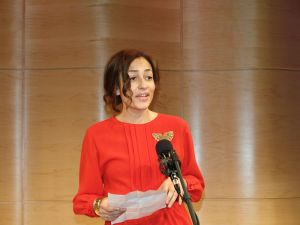
Zadie Smith in 2011. By David Shankbone (CC BY 3.0 (http://creativecommons.org/licenses/by/3.0) via Wikimedia Commons.
I’ve read all of Zadie Smith’s work apart from NW; I only got a few pages into it when it first came out, but I’m determined to try again someday. To my surprise, I’ve read everything her husband Nick Laird has ever published, which includes three poetry collections and two fairly undistinguished ‘lad lit’ novels. I’m pleased to see that his new novel Modern Gods, coming out on June 27th, is about two sisters and looks like a stab at proper literary fiction.
Jonathan Safran Foer: 4 (= ALL)
Nicole Krauss: 3 (= ALL)
Alas, they’re now an ex-couple. In any case, they’re both on the fairly short list of authors I’d read anything by. Foer has published three novels and the nonfiction polemic Eating Animals. Krauss, too, has three novels to her name, but a new one is long overdue after the slight disappointment of 2010’s Great House.
Margaret Drabble: 5
Michael Holroyd: 0
Michael Holroyd is a biographer and general nonfiction dabbler. I have a few of his books on my TBR but don’t feel much compulsion to seek them out. By contrast, I’ve read four novels and a memoir by Margaret Drabble and am likely to devour more of her fiction in the future.

Margaret Drabble in 2011. By summonedbyfells [CC BY 2.0 (http://creativecommons.org/licenses/by/2.0)%5D via Wikimedia Commons.
Claire Tomalin: 2
Michael Frayn: 1
Claire Tomalin’s masterful biographies of Charles Dickens and Thomas Hardy are pillars of my nonfiction collection, and I have her books on Nelly Ternan and Samuel Pepys on the shelf to read as well. From her husband, celebrated playwright Michael Frayn, however, I’ve only read the comic novel Skios. It is very funny indeed, though, about a case of mistaken identity at an academic conference on a Greek island.
Plus a few I only recently found out about:
Ian McEwan: 7 (+ an 8th in progress)
Annalena McAfee: 1 (I’ll be reviewing her novel Hame here on Thursday)
Katie Kitamura: 1 (I just finished A Separation yesterday)
Hari Kunzru: 0
Madeleine Thien: 1 (Do Not Say We Have Nothing)
Rawi Hage: 0
Afterwards I consulted the lists of literary power couples on Flavorwire and The Huffington Post and came up with a few more that had slipped my mind:
Michael Chabon: 1
Ayelet Waldman: 0
I loved Moonglow and am keen to try Michael Chabon’s other novels, but I also have a couple of his wife Ayelet Waldman’s books on my TBR.
Dave Eggers: 5
Vendela Vida: 0
I’ve read a decent proportion of Dave Eggers’s books, fiction and nonfiction, but don’t know anything by his wife and The Believer co-founder Vendela Vida.
David Foster Wallace: 2
Mary Karr: 1
I didn’t even know they were briefly a couple. From Wallace I’ve read the essay collection Consider the Lobster and the commencement address This Is Water. I’ve definitely got to get hold of Karr’s memoirs, having so far only read her book about memoir (The Art of Memoir).
And some classics:
Ted Hughes: 1 (Crow)
Sylvia Plath: 0
F. Scott Fitzgerald: 2 (The Great Gatsby and Tender Is the Night)
Zelda Fitzgerald: 0
![F. Scott and Zelda Fitzgerald in 1921. By Kenneth Melvin Wright (Minnesota Historical Society) [Public domain], via Wikimedia Commons.](https://bookishbeck.com/wp-content/uploads/2017/02/f_scott_fitzgerald_and_wife_zelda_september_1921.jpg?w=208&h=300)
F. Scott and Zelda Fitzgerald in 1921. By Kenneth Melvin Wright (Minnesota Historical Society) [Public domain], via Wikimedia Commons.
How have you fared with these or other literary power couples? Do you generally gravitate towards one or the other from a pair?
The Best Fiction of 2016: My Top 15
You might be surprised to hear that I received ‘only’ eight books for Christmas. (And a very fetching owl bookmark.) Here they are:

As I did last year, I’ve come up with my top 15 fiction books of the year (the three translated works first appeared in English in 2016) and even attempted to rank them. Many of these books have already featured on the blog in some way over the course of the year. To keep it simple for myself as well as for all of you who are figuring out whether you’re interested in these books or not, I’m limiting myself to two sentences per title: the first is a potted summary; the second tells you why you should read it. I also link to any full reviews.
Without further ado, let the countdown begin!
 Your Heart Is a Muscle the Size of a Fist by Sunil Yapa: A hard-hitting novel with an unforgettably resonant title, this is set at the 1999 Seattle WTO protest: Yapa explores the motivations and backstories of activists, police officers, and delegates as the day deteriorates into violence. This fine debut is about cultivating the natural compassion in your heart even while under the threat of the fist.
 The Crime Writer by Jill Dawson: Beyond the barest biographical facts, Dawson has imagined the plot based on Patricia Highsmith’s own preoccupations: fear of a stalker, irksome poison-pen letters, imagining what it would be like to commit murder … and snails. You’re never quite sure as you’re reading what is actually happening in the world of the novel and what only occurs in Highsmith’s imagination, making this one of the most gripping, compulsive books I encountered this year.
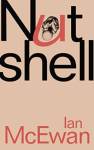 Nutshell by Ian McEwan: Within the first few pages, I was captivated and convinced by the voice of this contemporary, in utero Hamlet. His captive state pairs perfectly with Hamlet’s existential despair, but also makes him (and us as readers) part of the conspiracy: even as he wants justice for his father, he has to hope his mother and uncle will get away with their crime; his whole future depends on it.
 The Longest Night by Andria Williams: This absorbing work of historical fiction combines a remote setting, the threat of nuclear fallout, and a marriage strained to the breaking point in a convincing early 1960s atmosphere. A great debut and an author I’d like to hear more from.
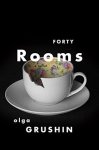 Forty Rooms by Olga Grushin: Each of us is said to occupy 40 rooms in our lives; this novel in 40 vignettes, one per room, tells the life story of a Russian immigrant to America who dreams of becoming a poet but ends up a suburban housewife and mother of six. I feel this book will resonate with women of every age, prompting them to question the path they’ve taken, the passions they’ve left unexplored, and whether it’s too late to change.
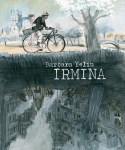 Irmina by Barbara Yelin: After her grandmother’s death Yelin, a Munich-based artist, found a box of diaries and letters that told the story of a budding love affair that was not to be and charted a young woman’s gradual capitulation to Nazi ideology. For the out-of-the-ordinary window onto Third Reich history and the excellent illustrations, I highly recommend this to graphic novel lovers and newbies alike.
 The Wonder by Emma Donoghue: In the 1850s a nurse investigates the case of an Irish girl surviving without food for months: miracle or hoax? Donoghue writes convincing and vivid historical fiction, peppering the text with small details about everything from literature to technology and setting up a particularly effective contrast between medicine and superstition.
 The Summer Guest by Alison Anderson: The kernel of the novel is a true story: for two summers in the late 1880s, Chekhov (known here as Anton Pavlovich) stayed at the Lintvaryovs’ guest house in Luka, Ukraine; one strand of the narration is a journal kept during those years by the family’s eldest daughter, who’s dying of a brain tumor. An elegantly plotted story about writing, translation, illness, and making the most of life.
 Quiet Flows the Una by Faruk Šehić: This autobiographical novel by a Bosnian poet and former soldier is full of poetic language and nature imagery. The lyrical writing about his beloved river provides a perfect counterpoint to the horror and absurdity of war.
 Three-Martini Lunch by Suzanne Rindell: Rindell brings the late 1950s, specifically the bustling, cutthroat New York City publishing world, to life through the connections between three young people who collide over a debated manuscript. It’s an expert evocation of Beat culture and post-war paranoia over communism and homosexuality.
 Golden Hill by Francis Spufford: The novel opens suddenly as twenty-four-year-old Richard Smith arrives from London with a promissory note for £1000; before he can finally get his money, he’ll fall in and out of love, fight a duel, and be arrested twice – all within the space of two months. Bawdy, witty, vivid historical fiction; simply brilliant.
 Why We Came to the City by Kristopher Jansma: Five university friends strive to make their lives count against the indifferent backdrop of recession-era New York City. You’ll see yourself in one or more of the characters, and the rest you’ll greet as if they were your own friends and makeshift family.
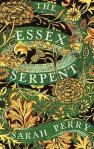 The Essex Serpent by Sarah Perry: The Essex Serpent was a real-life legend from the latter half of the seventeenth century, but Perry’s second novel has fear of the sea creature re-infecting Aldwinter, her invented Essex village, in the 1890s. This exquisite work of historical fiction explores the gaps – narrower than one might think – between science and superstition and between friendship and romantic love.
 The Tobacconist by Robert Seethaler: Seventeen-year-old Franz Huchel’s life changes for good when in 1937 his mother sends him away from his quiet lakeside village to work for her old friend Otto Trsnyek, a Vienna tobacconist. This novel is so many things: a coming-of-age story, a bittersweet romance, an out-of-the-ordinary World War II/Holocaust precursor, and a perennially relevant reminder of the importance of finding the inner courage to stand up to oppressive systems.
 Sweetbitter by Stephanie Danler: The restaurant where twenty-two-year-old Tess works is a claustrophobic world unto itself, like a theatre set where the food is high art and the staff interactions are pure drama. Everything about this novel is utterly assured: the narration, the characterization, the prose style, the plot, the timing; it captures the intensity and idealism of youth yet injects a hint of nostalgia.
& A poetry selection:
 Still the Animals Enter by Jane Hilberry: A rich, strange, gently erotic collection featuring diverse styles and blurring the lines between child and adult, human and animal, life and death through the language of metamorphosis. The message is that we are part of a shared life beyond the individual family or even the human species; we are all connected.
What are the best novels you read this year? Any new favorite books or authors?
I’ll be back tomorrow with the best nonfiction books I read this year.
The 2017 Releases I’m Most Excited About
2017 hasn’t even begun and already I’m overwhelmed by the quantity and quality of new books to be released. This is by no means a full picture of what’s coming out next year; it’s only 30 titles that I happen to have heard about and/or know I want to seek out. The descriptions are taken from the publisher blurbs on Goodreads, NetGalley or Edelweiss. Some of these I already have access to in galley form; others I’ll be doing my darndest to get hold of! (Within categories, titles are in alphabetical order by author rather than by publication date.)
ASSIGNED
English Animals by Laura Kaye (for the blog tour) [Jan. 12, Little, Brown UK]: “When Mirka [from Slovakia] gets a job in a country house in rural England, she has no idea of the struggle she faces to make sense of a very English couple, and a way of life that is entirely alien to her.”
 Pachinko by Min Jin Lee (for BookBrowse) [Feb. 7, Grand Central]: “Pachinko follows one Korean family through the generations, beginning in [the] early 1900s. … [A] sweeping saga of an exceptional family in exile from its homeland and caught in the indifferent arc of history.”
No One Is Coming to Save Us by Stephanie Watts Powell (for the Pittsburgh Post-Gazette) [Apr. 4, Ecco]: “The Great Gatsby brilliantly recast in the contemporary South: a powerful first novel about an extended African-American family and their colliding visions of the American Dream.”
The Twelve Lives of Samuel Hawley by Hannah Tinti (for The Bookbag) [Mar. 28, Tinder Press]: “A father protects his daughter from the legacy of his past and the truth about her mother’s death in this thrilling new novel … Both a coming-of-age novel and a literary thriller, The Twelve Lives of Samuel Hawley explores what it means to be a hero, and the cost we pay to protect the people we love most.”
NOVELS (all by authors I’ve enjoyed in the past)
Greatest Hits by Laura Barnett [June 15, W&N]: “Cass Wheeler [is] a British singer-songwriter, hugely successful since the early 70s … Her task is to choose 16 songs from among the hundreds she has written … for a uniquely personal Greatest Hits record”
The Idiot by Elif Batuman [Mar. 14, Penguin]: “1995: Selin, the daughter of Turkish immigrants, arrives for her freshman year at Harvard. … With superlative emotional and intellectual sensitivity, mordant wit, and pitch-perfect style, Batuman dramatizes the uncertainty of life on the cusp of adulthood.”
The Hearts of Men by Nickolas Butler [Mar. 7, Ecco]: “Nelson, irrevocably scarred from the Vietnam War, becomes Scoutmaster of Camp Chippewa, while Jonathan marries, divorces, and turns his father’s business into a highly profitable company. … [A] sweeping, panoramic novel about the slippery definitions of good and evil, family and fidelity”
New Boy by Tracy Chevalier [May 16, Hogarth]: “The tragedy of Othello is transposed to a 1970s suburban Washington schoolyard, where kids fall in and out of love with each other before lunchtime, and practice a casual racism picked up from their parents and teachers.”
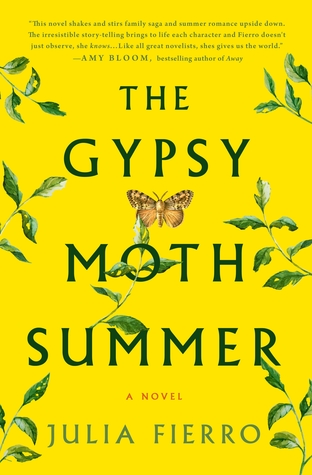 Gypsy Moth Summer by Julia Fierro [June 6, St. Martin’s]: “It is the summer of 1992 and a gypsy moth invasion blankets Avalon Island. … The Gypsy Moth Summer is about love, gaps in understanding, and the struggle to connect: within families; among friends; between neighbors and entire generations.” – Plus, get a load of that gorgeous cover!
Grief Cottage by Gail Godwin [June 6, Bloomsbury USA]: “Grief Cottage is the best sort of ghost story, but it is far more than that—an investigation of grief, remorse, and the memories that haunt us. The power and beauty of this artful novel wash over the reader like the waves on a South Carolina beach.”
The Evening Road by Laird Hunt [Feb. 7, Little, Brown & Co.]: “Reminiscent of the works of Louise Erdrich, Edward P. Jones and Marilynne Robinson, The Evening Road is the story of two remarkable women on the move through an America riven by fear and hatred, and eager to flee the secrets they have left behind.”
 The Awkward Age by Francesca Segal [May 4, Chatto & Windus]: “In a Victorian terraced house, in north-west London, two families have united in imperfect harmony. … This is a moving and powerful novel about the modern family: about starting over; about love, guilt, and generosity; about building something beautiful amid the mess and complexity of what came before.” – Sounds like Ann Patchett’s Commonwealth…
The Best of Adam Sharp by Graeme Simsion [Feb. 9, Penguin]: “The Best of Adam Sharp is about growing old and feeling young, about happy times and sad memories, about staying together and drifting apart, but most of all, it’s about how the music we make together creates the soundtrack that shapes our lives.” – Sounds a lot like the Barnett!
SHORT STORIES (also by authors I’ve enjoyed in the past)
The Dinner Party by Joshua Ferris: [May 2, Little, Brown & Co.]: “Full of the keenly observed, mordant wit that characterizes his beloved, award-winning novels, the stories in The Dinner Party are about people searching for answers in the aftermath of life’s emotional fissures”
Bad Dreams and Other Stories by Tessa Hadley [May 16, Harper]: “Hadley has proven herself to be the champion of revealing the hidden depths in the deceptively simple. In these short stories it’s the ordinary things that turn out to be most extraordinary: the history of a length of fabric or a forgotten jacket.”
NOVELS BY AUTHORS NEW TO ME
 A Separation by Katie Kitamura [Feb. 7, Riverhead Books]: “A mesmerizing, psychologically taut novel about a marriage’s end and the secrets we all carry.”
Hame by Annalena McAfee (Mrs. Ian McEwan) [Feb. 9, Harvill Secker]: “Mhairi McPhail dismantles her life in New York and moves with her 9-year-old daughter, Agnes, to the remote Scottish island of Fascaray. Mhairi has been commissioned to write a biography of the late Bard of Fascaray, Grigor McWatt, a cantankerous poet with an international reputation.”
NONFICTION: memoirs
 Poetry Can Save Your Life: A Memoir by Jill Bialosky [June 13, Atria]: “[A]n unconventional coming-of-age memoir organized around the 43 remarkable poems that gave her insight, courage, compassion, and a sense of connection at pivotal moments in her life.”
Between Them: Remembering My Parents by Richard Ford [May 2, Harper Collins]: “Ford brings his trademark candor, wit, and empathetic storytelling to the most intimate of landscapes: that of his love for two people who remain a mystery. Mining poignant details of his life in the American South during some iconic periods of the 20th century, Between Them illuminates the writer’s past as well as his beliefs on memory, relationships, and self-knowledge.”
The Mighty Franks: A Family Memoir by Michael Frank [May 16, Farrar, Straus and Giroux]: “A psychologically acute memoir about an unusual and eccentric Hollywood family.”
Sick: A Life of Lyme, Love, Illness, and Addiction by Porochista Khakpour [Aug. 8, Harper Perennial]: “In the tradition of Brain on Fire and The Empathy Exams, an honest, beautifully rendered memoir of chronic illness, misdiagnosis, addiction, and the myth of full recovery that details author Porochista Khakpour’s struggles with late-stage Lyme disease.”
A Stitch of Time: The Year a Brain Injury Changed My Language and Life by Lauren Marks [May 2, Simon & Schuster]: “Lauren Marks was twenty-seven, touring a show in Scotland with her friends, when an aneurysm ruptured in her brain and left her fighting for her life. … [A]n Oliver Sacks-like case study of a brain slowly piecing itself back together”
Homing Instincts: Early Motherhood on a Midwestern Farm by Sarah Menkedick [May 2, Pantheon]: “Fresh, intimate, and radiantly meditative, Homing Instincts is the story of one woman’s ‘coming of age’ as a first-time parent on her family’s rural Ohio farm.”
My Jewish Year: 18 Holidays, One Wondering Jew by Abigail Pogrebin [Mar. 14, Fig Tree Books]: “Although she grew up following some holiday rituals, Pogrebin realized how little she knew about their foundational purpose and contemporary relevance; she wanted to understand what had kept these holidays alive and vibrant, some for thousands of years. Her curiosity led her to embark on an entire year of intensive research, observation, and writing about the milestones on the religious calendar.”
 Theft by Finding: Diaries (1977–2002) by David Sedaris [May 30, Little, Brown & Co.]: “[F]or the first time in print: selections from the diaries that are the source of his remarkable autobiographical essays.”
How to Make a French Family: A Memoir of Love, Food, and Faux Pas by Samantha Vérant [Apr. 4, Sourcebooks]: “When Samantha is given a second chance at love at the age of forty, she moves to southwestern France, thinking she’s prepared for her new role in life as an instant American wife and stepmom. It turns out, though, that making a French family takes more than just good intentions and a quick lesson in croissant-baking.”
NONFICTION: poetry, biography, essays, travel
Eat This Poem: A Literary Feast of Recipes Inspired by Poetry by Nicole Gulotta [Mar. 21, Roost Books]: “The twenty-five inspiring poems in this book—from such poets as Marge Piercy, Louise Glück, Mark Strand, Mary Oliver, Billy Collins, Jane Hirshfield—are accompanied by seventy-five recipes that bring the richness of words to life in our kitchen, on our plate, and through our palate.”
Mozart’s Starling by Lyanda Lynn Haupt [May 16, Little, Brown & Co.]: “A charming story of Mozart and his pet starling, along with a natural history of the bird.”
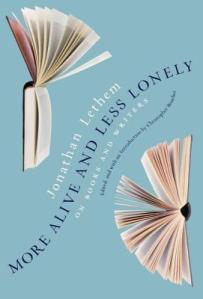 More Alive and Less Lonely: On Books and Writers by Jonathan Lethem [Mar. 14, Melville House]: “[C]ollects more than a decade of Lethem’s finest writing on writing, with new and previously unpublished material, including: impassioned appeals for forgotten writers and overlooked books, razor-sharp essays, and personal accounts of his most extraordinary literary encounters and discoveries.”
The Not-Quite States of America by Doug Mack [Feb. 14, W.W. Norton]: “American Samoa, Guam, Puerto Rico, the Northern Mariana Islands, and the U.S. Virgin Islands—and their 4 million people—are often forgotten, even by most Americans. … When Doug Mack realized just how little he knew about the territories, he set off on a globe-hopping quest covering more than 30,000 miles to see them all.”
What 2017 books are you most looking forward to?
Which of these interest you?
Books in Brief: Five I Loved Recently
Novels narrated by an octogenarian and an unborn child; memoirs about connection with nature and escaping an abusive relationship; and a strong poetry collection that includes some everyday epics: these five wildly different books are all 4-star reads I can highly recommend.
The Secret Diary of Hendrik Groen, 83¼ Years Old
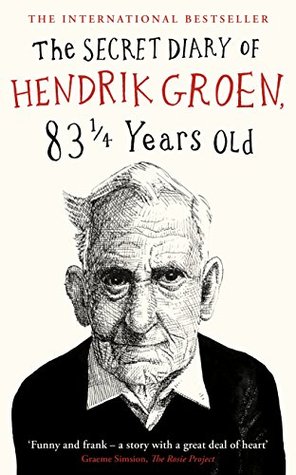 In this anonymous Dutch novel in diary form, Hendrik Groen provides a full reckoning of how 2013 went down in his Amsterdam old folks’ care home. He and five friends form the “Old But Not Dead” club and take turns planning exciting weekly outings. Much comic relief is provided by his incorrigibly tippling friend, Evert, and the arrival of Eefje makes late-life romance seem like a possibility for Hendrik. However, there’s no getting around physical decay: between them these friends suffer from incontinence, dementia, diabetic amputations and a stroke. By the time 2014 rolls around, their number will be reduced by one. Yet this is a tremendously witty and warm-hearted book, despite Hendrik’s sad family history. It’s definitely one for fans of A Man Called Ove – but I liked this more. A sequel from 85-year-old Hendrik came out this year in Dutch; I’ll be looking forward to the English translation.
The Moth Snowstorm: Nature and Joy
By Michael McCarthy
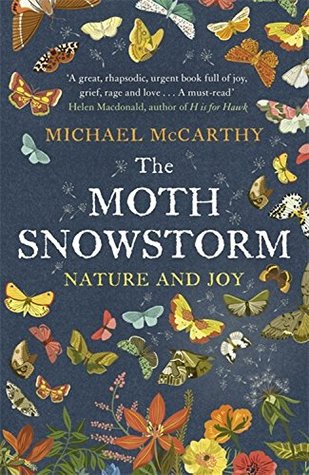 An environmental journalist for the UK’s Independent, McCarthy offers a personal view of how the erstwhile abundance of the natural world has experienced a dramatic thinning, even just in England in his lifetime. He gives both statistical and anecdotal evidence for that decline; as a case study he discusses the construction of a sea wall at Saemangeum in South Korea, responsible for decimating a precious estuary habitat for shorebirds. As if to balance his pessimism about the state of the world, McCarthy remembers singular natural encounters that filled him with joy and wonder – first discovering birdwatching as a lad near Liverpool, seeing a morpho butterfly in South America – but also annual displays that rekindle his love of life: the winter solstice, the arrival of cuckoos, and bluebells. This memoir is more sentimental than I expected from an English author, but I admire his passion and openness.
Nutshell
By Ian McEwan
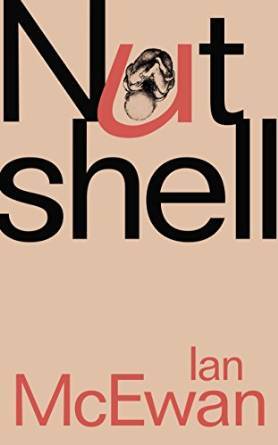 My seventh McEwan novel and one of his strongest. Within the first few pages, I was utterly captivated and convinced by the voice of this contemporary, in utero Hamlet. Provided you suspend disbelief a bit to accept he can see/hear/surmise everything that happens – the most tedious passages are those where McEwan tries to give more precise justification for his narrator’s observations – the plot really works. Not even born and already a snob with an advanced vocabulary and a taste for fine wine, this fetus is a delight to spend time with. His captive state pairs perfectly with Hamlet’s existential despair, but also makes him (and us as readers) part of the conspiracy: even as he wants justice for his father, he has to hope his mother and uncle will get away with their crime; his whole future depends on it.
Favorite line: “I have lungs but not air to shout a warning or weep with shame at my impotence.”
How Snow Falls
By Craig Raine
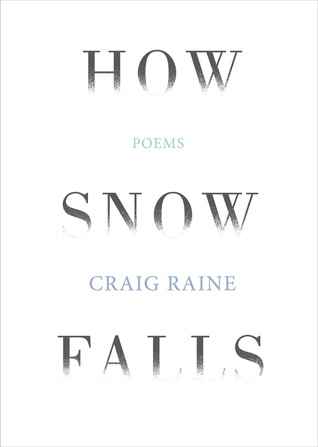 One of the few best poetry collections I’ve read this year. It contains nary a dud and is a good one to sink your teeth into – it’s composed of just 20 poems, but several are in-depth epics drawn from everyday life and death. Two elegies, to a dead mother and a former lover, are particularly strong. I loved the mixture of clinical and whimsical vocabulary in “I Remember My Mother” as the poet charts the transformation from person to corpse. “Rashomon” is another stand-out, commissioned as an opera and inspired by the short story “In a Grove” by Ryūnosuke Akutagawa. In couplets with a flexible rhyme scheme, the poem alternates the perspectives of a bandit, a captive husband, his raped wife, and the woodcutter who becomes an unwilling observer. Alliteration is noteworthy throughout the collection, but here produces one of my favorite lines: “Sweet cedar chips were spurting in the gloom like sparks.”
Land of Enchantment
By Leigh Stein
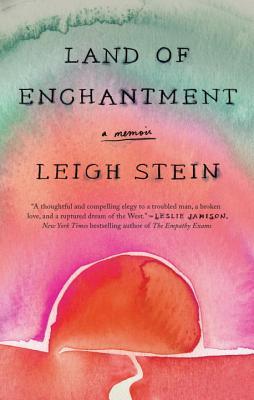 Stein tells of her abusive relationship with Jason, a reckless younger man with whom she moved to New Mexico. The memoir mostly toggles between their shaky attempt at a functional relationship in 2007 and learning about his death in a motorcycle accident in 2011. Even though they’d drifted apart, Jason’s memory still had power over her. Breaking free from him meant growing up at last and taking responsibility for her future. You might call this a feminist coming-of-age narrative, though that makes it sound more strident and formulaic than it actually is. I admired the skipping around in time, and especially a late chapter in the second person. I also enjoyed how New Mexico provides a metaphorical as well as a literal setting; Stein weaves in references to Georgia O’Keeffe’s art and letters to put into context her own search to become a self-sufficient artist.
Have you read any of these? Which one takes your fancy?
Surveying the Almighty TBR List
Coming to the end of one year and looking ahead to another: it’s a good opportunity to take stock of my virtual and physical to-read piles once more. Thanks to fellow book bloggers Naomi at The Writes of Woman and Eleanor at Elle Thinks for giving me this meme idea and tagging me in it, respectively.
How do you keep track of your TBR pile?
I have a ridiculously large to-read shelf on Goodreads, but that’s more like a vague lifelong wish list – some of them I own, some I’ve only heard of and want to investigate further, some I’m desperate to get hold of, and so on. I recently culled my online TBR and cut it by about 10%, but it’s still overwhelming. In real life, I take occasional inventories of the unread books in our flat (192 at last count). However, this doesn’t account for the fact that at least half of my book collection is still in my parents’ house in the States. While I’m back there for some time over the holidays, I enjoy gazing at my books and choosing a select few to bring back in my suitcase. On this trip I’ll be boxing them all up to go into storage. When shall I ever be reunited with them?!
Is your TBR mostly print or e-book?
If I only consider the books I already have access to, there are more unread print ones on my shelves than there are e-book approvals through NetGalley and Edelweiss. There’s not all that much in it, though; I might estimate the print TBR at 400–500, while I have about 300 books at my disposal through those online sources and new titles come up for request all the time.
How do you determine which books from your TBR to read next?
This generally depends on review deadlines, library due dates, and e-book expirations. In some sense, then, my reading list is completely imposed on me from outside. However, I always make sure I let whimsy guide some of my choices. Next year I hope to be even better about just picking up a book off my shelves and starting it for no reason other than instantaneous interest.
A book that has been on my TBR the longest
On the virtual TBR: probably Fast Food Nation and some of Margaret Atwood’s back catalogue. On the vague list in my head: all the more obscure Dickens and Hardy titles.
 A book I recently added to my TBR
Rochester Knockings: A Novel of the Fox Sisters by Hubert Haddad.
 A book on my TBR strictly because of its beautiful cover
I love the beard-house on the cover of Know Your Beholder by Adam Rapp.
A book on my TBR that I never plan on reading
Will I really pick up Martin Amis’s novels, or Ian McEwan’s early work? How about those obscure Thomas Hardy novels like A Laodicean and A Pair of Blue Eyes?
 An unpublished book on my TBR that I’m excited for
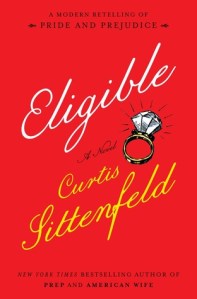
I recently started Eligible by Curtis Sittenfeld (to be published on April 19, 2016). Her novel American Wife is one of my absolute favorites, so I was excited about her Pride and Prejudice retelling and lucky enough to be sent an advanced copy. I’m not that into it yet – the third-person omniscient voice is taking a while to get used to because first-person female narrators are Sittenfeld’s forte – but I hope it will pick up soon.
 A book on my TBR that everyone recommends
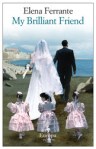
I’ve encountered almost universal praise for Elena Ferrante’s four autobiographical novels, the first of which is My Brilliant Friend. They’re on my priority list for 2016.
A book on my TBR that everyone has read but me
1984 by George Orwell.
 A book on my TBR that I’m dying to read
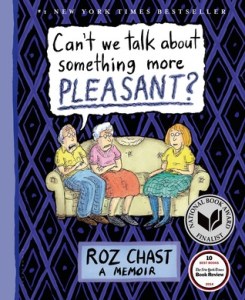
Some of my priority books to get hold of are Nell Zink’s novels, the final two books in Jane Smiley’s The Last Hundred Years trilogy, Can’t We Talk about Something More Pleasant? by Roz Chast, and Reasons to Stay Alive by Matt Haig. I’ve also been meaning to read The Signature of All Things by Elizabeth Gilbert for ages, and I’m intrigued to try The Guest Cat by Takashi Hiraide.
How many books are on your TBR shelf?
5,664 on the Goodreads shelf; maybe 500 in the print queue.
People I’m tagging:
Shannon at River City Reading
Lucy at Literary Relish
In Praise of Literary Prizes
I like a spot of competition. Whether watching Olympic figure skating, playing board games like Scrabble and Boggle, entering a low-key Oscars pool, or rooting for my favorites in American Idol seasons and Miss America pageants, I’ve always loved trying to pick the best. This means that literary prizes are hugely exciting for me, and I follow the races closely.
I’m particularly devoted to the Man Booker Prize. I was delighted to see Hanya Yanagihara’s A Little Life on the recent longlist (catch up on it here), a truly interesting set of books, diverse in terms of their genres and authors’ nationalities and nicely balanced between male and female writers (6:7). I’ve read four of the longlisted titles so far:
 The Fishermen, Chigozie Obioma (full review in May 2015 issue of Third Way): From a young Nigerian debut novelist comes a haunting tale of sibling rivalry and revenge. With sectarian riots afoot, the four oldest Agwu boys decide to make money by skipping school and fishing in the Omi-Ala River. Things get more complicated when Abulu, the local madman, issues a prophecy that seems bound to divide the brothers. The first quarter of the novel, especially, is drenched in foreshadowing (not always subtle, nor do the plot turns often rise above the predictable). Rich with prophecy and allusions, this owes much to biblical narratives and tragedies from Shakespeare to Chinua Achebe.
- Lila, Marilynne Robinson – reviewed at For Books’ Sake
- A Spool of Blue Thread, Anne Tyler – also reviewed at For Books’ Sake
- A Little Life, Hanya Yanagihara – reviewed at Shiny New Books

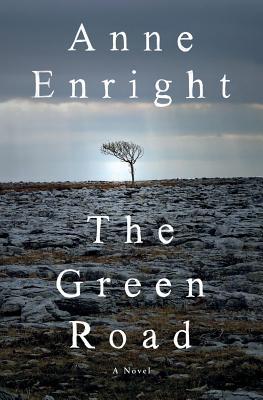 Next up: I’m reviewing The Green Road by Anne Enright for the November 2015 issue of Third Way. The Booker Prize shortlist will be announced on September 15th and the winner on October 13th.
Beyond the Booker, here are some of the other prizes I follow throughout the year, listed in vague chronological order:
 The Not the Booker Prize run by the Guardian. On this year’s shortlist is Shame by Melanie Finn, a book I loved when I reviewed it for Third Way’s April 2015 issue. It’s a powerful story of regret and the search for redemption. Though it has elements of a straightforward psychological thriller, the daring structure and moral complexities are more akin to Graham Greene. In alternating chapters, Pilgrim Jones contrasts flashbacks to her car accident and the subsequent investigation back in Switzerland with her present-tense African odyssey. This is Conrad’s Africa, a continent characterized by darkness and suffering. The question of culpability remains murky, yet the possibility of salvation shines through. [Voting will take place in October.]

- The Guardian First Book Award (open to both fiction and nonfiction): the shortlist will be announced this Friday, August 14th. One entry, Spill Simmer Falter Wither by Sara Baume, has already been chosen by readers, and the other nine are selected from publishers’ submissions. [Winner announced in late November.]
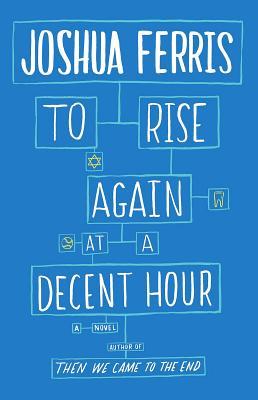
 The Dylan Thomas Prize for young writers (under 39) went to Joshua Ferris for To Rise Again at a Decent Hour last year. [Longlist in September, shortlist in October and winner announced in November.]
- The Costa Book Awards give separate prizes for fiction, debut fiction, biography, poetry, and children’s books, and also choose one overall winner. [Category shortlists in late November, category winners in early January and overall winner on January 26, 2016.]
- The Folio Prize, only two years old, considers any work of fiction published in English; before the Booker expanded to include American entries last year, it was the most Catholic of the fiction prizes. Now it risks being considered redundant; especially since it lost its Folio Society sponsorship, it’s unclear whether it will continue. [Shortlist in February and winner announced in March.]
 The Wellcome Book Prize is for medical-themed literature, fiction or nonfiction. Last year’s winner, The Iceberg by Marion Coutts, meant a lot to me for personal reasons but was also one of the most unusual and impressive memoirs I’ve ever read. I reviewed it for The Bookbag here. [Shortlist in March and winner announced in April.]

- The Pulitzer Prize is America’s premier literary award. I confess I often feel a little out of touch with the winners and don’t necessarily make a conscious effort to seek out the nominated books. I’d like to be more familiar with Pulitzer winners. Next year marks the prize’s centennial, so there’s no better time! [Winners announced in April.]
- The Independent Foreign Fiction Prize is for any book that has been translated into English and published in the UK in the previous year. I’ve found some great offbeat reads by browsing through previous longlists. As of next year, the prize is merging with the Man Booker International award, which previously recognized the life work of a foreign author every other year. [Longlist in March, shortlist in April and winner announced in May.]
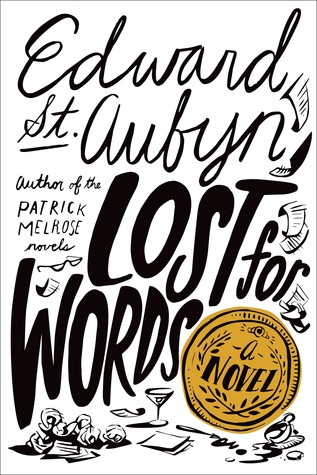
 The Bollinger Everyman Wodehouse Prize, the UK’s prize for comic literature, has run since 2000. Among the past winners are Paul Torday, Howard Jacobson, Terry Pratchett, Geoff Dyer, Gary Shteyngart, and (surprise!) Ian McEwan. I’ve read five of the winners, including Lost for Words by Edward St. Aubyn. [Shortlist in March and winner announced in May.]
- The Baileys Women’s Prize for Fiction (formerly known as the Orange Prize). Ali Smith won the 2015 award for How to Be Both. [Longlist in March; shortlist and winner announced in June.]
Do you follow literary prize races? Do you make a point of reading the winner and/or the shortlisted books? All comments welcome!
 Bookish Beck = Rebecca Foster. American transplant to England. Freelance proofreader and book reviewer.
 Bookish Beck