Seven Final Novellas: Crumley, Morris, Rapp Black; Hunter, Johnson, Josipovici, Otsuka (#NovNov)
We’ll be wrapping up Novellas in November and giving final statistics on Tuesday. Today, I have mini reviews of another seven novellas I’ve been working on, some of them for the whole month. I’ll start with some short nonfiction and then move on to the fiction.
Nonfiction:
Barn Owl by Jim Crumley (2014)
[63 pages]
 I reviewed Kingfisher and Otter, two other titles from Crumley’s “Encounters in the Wild” series for the publisher Saraband, earlier in the month. Barn Owl follows the same pattern, traveling the Scottish islands in search of close encounters (with badgers and ospreys, too) but also stretching back to a childhood memory from 1950s Dundee, when there was an owl-occupied derelict farmstead a quarter-mile from his home. This is a lovely little full-circle narrative in that the book closes with “the barn owl, unlike all other night-flying owls, is the one that we can see in the dark … its inarguable beauty is layered with mystery, and …all of us have a place in our hearts and minds for mysterious beauty. I have known that to be an essential truth since I was about eight years old.” (Public library)
Conundrum by Jan Morris (1974)
[148 pages]
 A reread of a book that transformed my understanding of gender back in 2006. Morris (d. 2020) was a trans pioneer. Her concise memoir opens “I was three or perhaps four years old when I realized that I had been born into the wrong body, and should really be a girl.” Sitting under the family piano, little James knew it, but it took many years – a journalist’s career, including the scoop of the first summiting of Mount Everest in 1953; marriage and five children; and nearly two decades of hormone therapy – before a sex reassignment surgery in Morocco in 1972 physically confirmed it. I was struck this time by Morris’s feeling of having been a spy in all-male circles and taking advantage of that privilege while she could. She speculates that her travel books arose from “incessant wandering as an outer expression of my inner journey.” The focus is more on her unchanging soul than on her body, so this is not a sexual tell-all. She paints hers as a spiritual quest toward true identity and there is only joy at new life rather than regret at time wasted in the ‘wrong’ one. (Public library)
Frida Kahlo and My Left Leg by Emily Rapp Black (2021)
[145 pages]
 This was my third memoir by the author; I reviewed The Still Point of the Turning World and Sanctuary earlier in the year. Like Sinéad Gleeson does in Constellations, Rapp Black turns to Frida Kahlo as a role model for “translating … pain into art.” Polio, a streetcar accident, 32 operations, failed pregnancies and an amputated leg – Kahlo endured much suffering. It was this last particular that especially drew Rapp Black (who has had a prosthetic leg since early childhood) to her. On a visit to Kahlo’s Mexico City home, she can hardly bear the intimacy of seeing Kahlo’s prostheses and corsets. They plunge her back into her own memories: of passing as normal despite a disability, having an eating disorder, losing her son Ronan to Tay-Sachs disease, and starting over with a new marriage and baby. Rapp Black weaves this all together artfully as well as effectively, but for someone like me who is already conversant with her story, there wasn’t quite enough in the way of new material.
With thanks to Notting Hill Editions for the free e-copy for review.
Fiction:
These first two ended up having a major arc in common: desperate preservation of key family relationships against the backdrop of a believably falling-apart near-future world.
The End We Start From by Megan Hunter (2017)
[127 pages]
 A woman, her partner (R), and their baby son flee a flooded London in search of a place of safety, traveling by car and boat and camping with friends and fellow refugees. “How easily we have got used to it all, as though we knew what was coming all along,” she says. Her baby, Z, tethers her to the corporeal world. What actually happens? Well, on the one hand it’s very familiar if you’ve read any dystopian fiction; on the other hand it is vague because characters only designated by initials are hard to keep straight and the text is in one- or two-sentence or -paragraph chunks punctuated by asterisks (and dull observations): “Often, I am unsure whether something is a bird or a leaf. *** Z likes to eat butter in chunks. *** We are overrun by mice.” etc. It’s touching how Z’s early milestones structure the book, but for the most part the style meant this wasn’t my cup of tea. (Secondhand purchase)
My Monticello by Jocelyn Nicole Johnson (2021)
[For novella only: 182 pages?]
 Pick this up right away if you loved Danielle Evans’s The Office of Historical Corrections. After “the unraveling,” Da’Naisha and fellow escapees from racial violence in Charlottesville – including her former and current boyfriends, the one Black and the other white; and her ailing grandmother, MaViolet – shelter at Thomas Jefferson’s famous Virginia estate. At first they stay by the visitor’s center, but as weeks pass and they fear a siege, they retreat to the mansion itself. Da’Naisha, our narrator, becomes the de facto leader of the motley crew, spearheading a trip out for supplies. She harbors two major secrets, one about her heritage and one about her future. Although this is a bit too similar to Parable of the Sower, against which I judge just about any dystopian fiction, the setting and timeliness can’t be beat. I read the U.S. ebook edition, which includes five short stories that also explore race issues and employ the first person plural and second person to good effect; “Buying a House Ahead of the Apocalypse” encapsulated my whole autumn mood. (Read via Edelweiss)
The Cemetery in Barnes by Gabriel Josipovici (2018)
[101 pages]
 After reviewing Josipovici’s 100 Days earlier in the month, I wanted to get a taste of his fiction. The protagonist is a translator who has lived in London, Paris and now rural Wales. He’s been married twice but, whatever his living situation, he’s always prized the solitude and routine he needs for his work. Passages from Monteverdi’s opera L’Orfeo and Joachim du Bellay’s poetry – in the original language, sometimes but not always translated for us – drift through the novella, which also prioritizes the sort of repeated phrases that constitute a long-cohabitating couple’s domestic vocabulary. References to cemeteries and to du Bellay’s Regrets are hints of something hasn’t isn’t being revealed to us up front. I think I worked out what it was. Clever and interesting, but I’d like a bit more grounding detail. A favorite line: “for one’s life not living up to expectation there is no excuse, except for the paltry one that this is true of everybody’s life.” (University library)
When the Emperor Was Divine by Julie Otsuka (2002)
[145 pages]
 Otsuka’s The Buddha in the Attic, about Japanese mail order brides in early 1900s San Francisco, was one of my first encounters with the first person plural, which I’ve come to love. It also serves as a prequel to this, her debut novel. In Berkeley, California in 1942, a Japanese man is arrested as a potential enemy combatant. His wife, son and daughter are given just a matter of days to pack their things and evacuate to an internment camp in the desert. Otsuka takes us along on the train journey and to the camp, where small moments rather than climactic ones reveal the children’s sadness and the injustice of what they’re missing out on. I most enjoyed the last section, when they all return to their home after over three years away and start to piece life back together. I’d already read a few novels featuring Japanese internment (e.g. The Japanese Lover and Snow Falling on Cedars) but, more than that, Otsuka’s writing is a tad too subtle for me. (Secondhand purchase)
In total, I read 29 novellas this November – a new record for me! I didn’t set out to read the equivalent of nearly one per day, but it happened to pan out like that. Some of my selections were very short indeed, at under 100 pages; multiple volumes of Garfield comics also helped. Three were 5-star reads: The Cost of Living by Deborah Levy plus two rereads, Conundrum by Jan Morris (above) and our classics buddy read, Ethan Frome by Edith Wharton.
I also had a couple of DNFs:
Gone by Michael Blencowe: (45 pages) I made a second attempt on this essay collection about extinct species this month. Maybe I’ve just read too much around the topic recently. (Review copy)
Inside the Bone Box by Anthony Ferner: (50 pages) I loved the idea of a novella about a neurosurgeon, but mostly this concerns Nick’s fatness and his family members’ various dysfunctions. (New purchase)
Six Degrees of Separation: From Hamnet to Paula
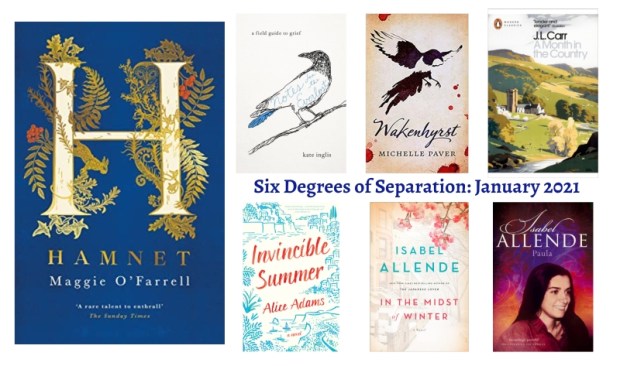
 I was slow off the mark this month, but here we go with everyone’s favorite book blogging meme! This time we start with Hamnet, Maggie O’Farrell’s Women’s Prize-winning novel about the death of William Shakespeare’s son. (See Kate’s opening post.) Although I didn’t love this as much as others have (my review is here), I was delighted for O’Farrell to get the well-deserved attention – Hamnet was also named the Waterstones Book of the Year 2020.
 #1 I’ve read many nonfiction accounts of bereavement. One that stands out is Notes from the Everlost by Kate Inglis, which is also about the death of a child. The author’s twin sons were born premature; one survived while the other died. Her book is about what happened next, and how bereaved parents help each other to cope. An excerpt from my TLS review is here.
 #2 Also featuring a magpie on the cover, at least in its original hardback form, is Wakenhyrst by Michelle Paver (reviewed for R.I.P. this past October). I loved that Maud has a pet magpie named Chatterpie, and the fen setting was appealing, but I’ve been pretty underwhelmed by all three of Paver’s historical suspense novels for adults.
 #3 One of the strands in Wakenhyrst is Maud’s father’s research into a painting of the Judgment Day discovered at the local church. In A Month in the Country by J. L. Carr (reviewed last summer), a WWI veteran is commissioned to uncover a wall painting of the Judgment Day, assumed to be the work of a medieval monk and long ago whitewashed over.
 #4 A Month in the Country spans one summer month. Invincible Summer by Alice Adams, about four Bristol University friends who navigate the highs and lows of life in the 20 years following their graduation, checks in on the characters nearly every summer. I found it clichéd; not one of the better group-of-friends novels. (My review for The Bookbag is here.)
 #5 The title of Invincible Summer comes from an Albert Camus quote: “In the midst of winter, I found there was, within me, an invincible summer. And that makes me happy.” Inspired by the same quotation, then, is In the Midst of Winter by Isabel Allende, a recent novel of hers that I was drawn to for the seasonal link but couldn’t get through.
 #6 However, I’ve enjoyed a number of Allende books over the last 12 years or so, both fiction and non-. One of these was Paula, a memoir sparked by her twentysomething daughter’s untimely death in the early 1990s from complications due to the genetic condition porphyria. Allende told her life story in the form of a letter composed at Paula’s bedside while she was in a coma.
So, I’ve come full circle with another story of the death of a child, but there’s a welcome glimpse of the summer somewhere there in the middle. May you find your own inner summer to get you through this lockdown winter.
Join us for #6Degrees of Separation! (Hosted on the first Saturday of each month by Kate W. of Books Are My Favourite and Best.) Next month’s starting point is Redhead at the Side of the Road by Anne Tyler.
Have you read any of my selections? Are you tempted by any you didn’t know before?
Snow-y Reads
It’s been a frigid start to March here in Europe. Even though it only amounted to a few inches in total, this is still the most snow we’ve seen in years. We were without heating for 46 hours during the coldest couple of days due to an inaccessible frozen pipe, so I’m grateful that things have now thawed and spring is looking more likely. During winter’s last gasp, though, I’ve been dipping into a few appropriately snow-themed books. I had more success with some than with others. I’ll start with the one that stood out.


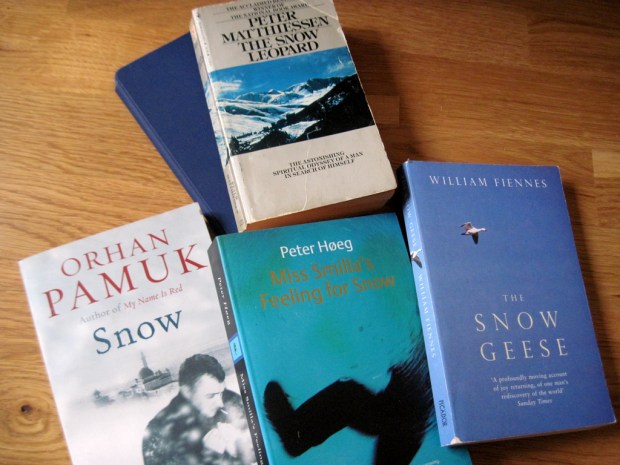
Miss Smilla’s Feeling for Snow by Peter Høeg (1992)
[trans. from the Danish by Felicity David]
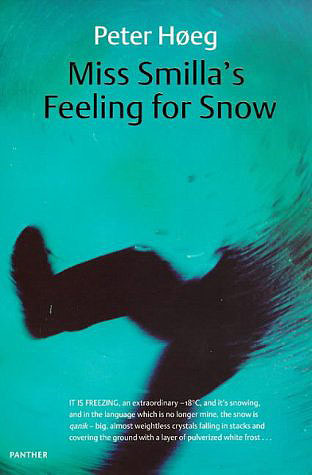 Nordic noir avant la lettre? I bought this rather by accident; had I realized it was a murder mystery, I never would have taken a chance on this international bestseller. That would have been too bad, as it’s much more interesting than your average crime thriller. The narrator/detective is Smilla Jaspersen: a 37-year-old mathematician and former Arctic navigator with a Danish father and Greenlander mother, she’s a stylish dresser and a shrewd, bold questioner who makes herself unpopular by nosing about where she doesn’t belong.
Isaiah, a little Greenlander boy, has fallen to his death from the roof of the Copenhagen apartment complex where Smilla also lives, and she’s convinced foul play was involved. In Part I she enlists the help of a mechanic neighbor (and love interest), a translator, an Arctic medicine specialist, and a mining corporation secretary to investigate Isaiah’s father’s death on a 1991 Arctic expedition and how it might be connected to Isaiah’s murder. In Part II she tests her theories by setting sail on the Greenland-bound Kronos as a stewardess. At every turn her snooping puts her in danger – there are some pretty violent scenes.
I read this fairly slowly, over the course of a month (alongside lots of other books); it’s absorbing but in a literary style, so not as pacey or full of cliffhangers as you’d expect from a suspense novel. I got myself confused over all the minor characters and the revelations about the expeditions, so made pencil notes inside the front cover to keep things straight. Setting aside the plot, which gets a bit silly towards the end, I valued this most for Smilla’s self-knowledge and insights into what it’s like to be a Greenlander in Denmark. I read this straight after Gretel Ehrlich’s travel book about Greenland, This Cold Heaven – an excellent pairing I’d recommend to anyone who wants to spend time vicariously traveling in the far north.
Favorite wintry passage:
“I’m not perfect. I think more highly of snow and ice than of love. It’s easier for me to be interested in mathematics than to have affection for my fellow human beings.”
My rating:
One that I left unfinished:
Snow by Orhan Pamuk (2002)
[trans. from the Turkish by Maureen Freely]
 This novel seems to be based around an elaborate play on words: it’s set in Kars, a Turkish town where the protagonist, a poet known by the initials Ka, becomes stranded by the snow (Kar in Turkish). After 12 years in political exile in Germany, Ka is back in Turkey for his mother’s funeral. While he’s here, he decides to investigate a recent spate of female suicides, keep tabs on the upcoming election, and see if he can win the love of divorcée Ipek, daughter of the owner of the Snow Palace Hotel, where he’s staying. There’s a hint of magic realism to the novel: the newspaper covers Ka’s reading of a poem called “Snow” before he’s even written it. He and Ipek witness the shooting of the director of the Institute of Education. The attempted assassination is revenge for him banning girls who wear headscarves from schools.
As in Elif Shafak’s Three Daughters of Eve, the emphasis is on Turkey’s split personality: a choice between fundamentalism (= East, poverty) and secularism (= West, wealth). Pamuk is pretty heavy-handed with these rival ideologies and with the symbolism of the snow. By the time I reached page 165, having skimmed maybe two chapters’ worth along the way, I couldn’t bear to keep going. However, if I get a recommendation of a shorter and subtler Pamuk novel I would give him another try. I did enjoy the various nice quotes about snow (reminiscent of Joyce’s “The Dead”) – it really was atmospheric for this time of year.
Favorite wintry passage:
“That’s why snow drew people together. It was as if snow cast a veil over hatreds, greed and wrath and made everyone feel close to one another.”
My rating:
One that I only skimmed:
The Snow Geese by William Fiennes (2002)
 Having recovered from an illness that hit at age 25 while he was studying for a doctorate, Fiennes set off to track the migration route of the snow goose, which starts in the Gulf of Mexico and goes to the Arctic territories of Canada. He was inspired by his father’s love of birdwatching and Paul Gallico’s The Snow Goose (which I haven’t read). I thought this couldn’t fail to be great, what with its themes of travel, birds, illness and identity. However, Fiennes gets bogged down in details. When he stays with friendly Americans in Texas he gives you every detail of their home décor, meals and way of speaking; when he takes a Greyhound bus ride he recounts every conversation he had with his random seatmates. This is too much about the grind of travel and not enough about the natural spectacles he was searching for. And then when he gets up to the far north he eats snow goose. So I ended up just skimming this one for the birdwatching bits. I did like Fiennes’s writing, just not what he chose to focus on, so I’ll read his other memoir, The Music Room.
My rating:
 Considered but quickly abandoned: In the Midst of Winter by Isabel Allende
Would like to read soon: The Snow Leopard by Peter Matthiessen – my husband recently rated this 5 stars and calls it a spiritual quest memoir, with elements of nature and travel writing.
What’s been your snowbound reading this year?
December Reading Plans & Year-End Goals
Somehow the end of the year is less than four weeks away, so it’s time to start getting realistic about what I can read before 2018 begins. I wish I was the sort of person who was always reading books 4+ months before the release date and setting trends, but I’ve only read three 2018 releases so far, and it’s doubtful I’ll get to more than another handful before the end of the year. Any that I do read and can recommend I will round up briefly in a couple weeks or so.
I’m at least feeling pleased with myself for resuming and/or finishing all but two of the 14 books I had on hold as of last month; one I finally DNFed (The Unseen by Roy Jacobsen) and another I’m happy to put off until the new year (Paradise Road: Jack Kerouac’s Lost Highway and My Search for America by Jay Atkinson – since he’s recreating the journey taken for On the Road, I should look over a copy of that first). Ideally, the plan is to finish all the books I’m currently reading to clear the decks for a new year.
Some other vague reading plans for the month:
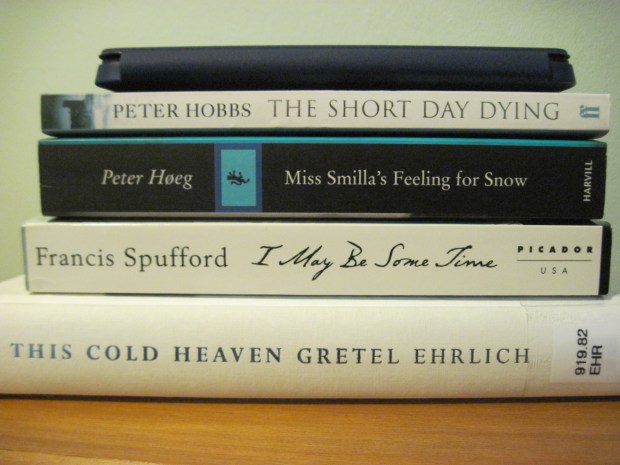
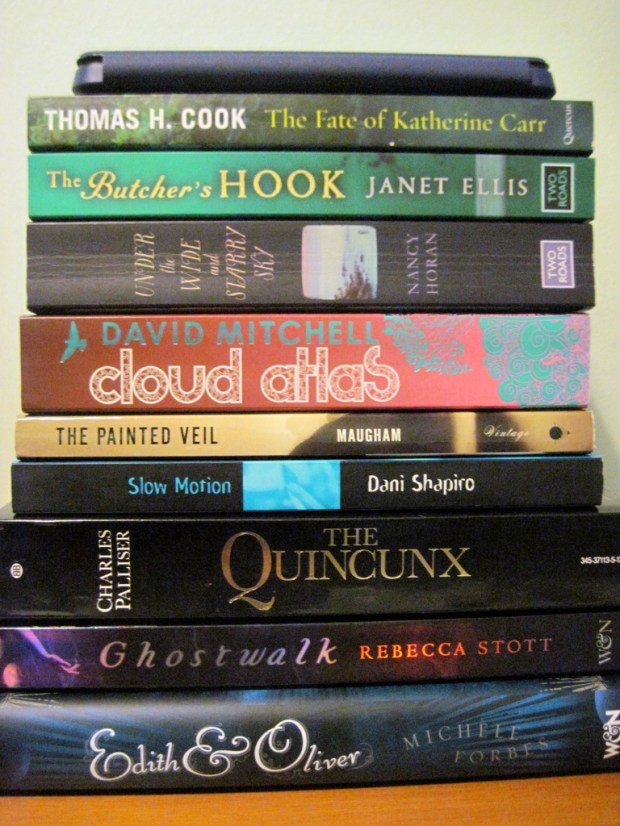
I might do a Classic of the Month (I’m currently reading The Awakening by Kate Chopin) … but a Doorstopper isn’t looking likely unless I pick up Hillary Clinton’s Living History. However, there are a few books of doorstopper length pictured in the piles below.
Christmas-themed books. The title-less book with the ribbon is Seven Days of Us by Francesca Hornak, a Goodreads giveaway win. I think I’ll start that plus the Amory today since I’m going to a carol service this evening. On Kindle: A Very Russian Christmas, a story anthology I read about half of last year and might finish this year.
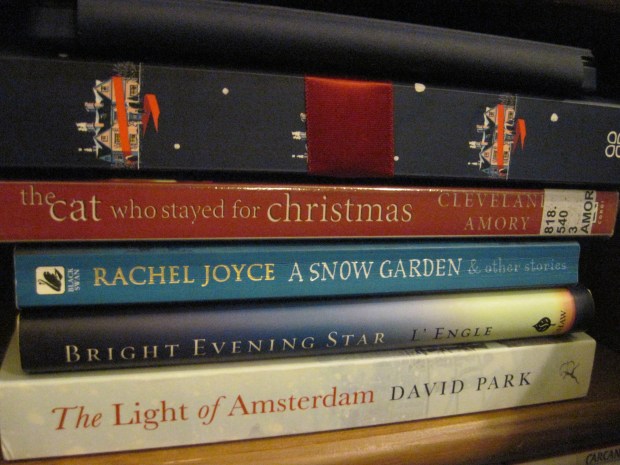
Winter-themed books. On Kindle: currently reading When the Professor Got Stuck in the Snow by Dan Rhodes; Winter by Karl Ove Knausgaard is to be read. (The subtitle of Spufford’s book is “Ice and the English Imagination”.)
As the holidays approach, I start to daydream about what books I might indulge in during the time off. (I’m giving myself 11 whole days off of editing, though I may still have a few paid reviews to squeeze in.) The kinds of books I would like to prioritize are:
Absorbing reads. Books that promise to be thrilling (says the person who doesn’t generally read crime thrillers); books I can get lost in (often long ones). On Kindle: The Bear and the Nightingale by Katherine Arden.
Cozy reads. Animal books, especially cat books, generally fall into this category, as do funny books and children’s books. My mother and I love Braun’s cat mysteries; I read them all starting when I was about 11. I’ve never reread any, so I’d like to see how they stand up years later. Goodreads has been trying to recommend me Duncton Wood for ages, which is funny as I’ve had my eye on it anyway. My husband read the series when he was a kid and we still own some well-worn copies. Given how much I loved Watership Down and Brian Jacques’ novels as a child, I’m hoping it’s a pretty safe bet.

Books I’ve been meaning to read for ages. ’Nuff said. On Kindle: far too many.

And, as always, I’m in the position of wishing I’d gotten to many more of this year’s releases. In fact, there are at least 22 books from 2017 on my e-readers that I still intend to read:
- A Precautionary Tale: How One Small Town Banned Pesticides, Preserved Its Food Heritage, and Inspired a Movement by Philip Ackerman-Leist
- In the Midst of Winter by Isabel Allende
 The Floating World by C. Morgan Babst
- The Day that Went Missing by Richard Beard
- The Best American Series taster volume (skim only?)
- The Heart’s Invisible Furies by John Boyne*
- Guesswork: A Memoir in Essays by Martha Cooley
- The Night Brother by Rosie Garland
- Difficult Women by Roxane Gay
- The Twelve-Mile Straight by Eleanor Henderson
- Eco-Dementia by Janet Kauffman [poetry]
- The Rules Do Not Apply by Ariel Levy
- A Stitch of Time: The Year a Brain Injury Changed My Language and Life by Lauren Marks
- Hug Everyone You Know: A Year of Community, Courage, and Cancer by Antoinette Truglio Martin
 Homing Instinct: Early Motherhood on a Midwestern Farm by Sarah Menkedick
- One Station Away by Olaf Olafsson
- Ghosts of the Tsunami: Death and Life in Japan’s Disaster Zone by Richard Lloyd Parry
- Memory’s Last Breath: Field Notes on My Dementia by Gerda Saunders
- See What I Have Done by Sarah Schmidt
- What She Ate: Six Remarkable Women and the Food That Tells Their Stories by Laura Shapiro
- Midnight at the Bright Ideas Bookstore by Matthew J. Sullivan
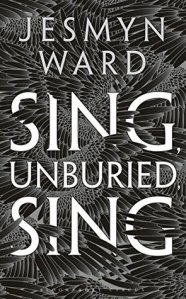
- Sing, Unburied, Sing by Jesmyn Ward*
* = The two I most want to read, and thus will try hardest to get to before the end of the year. But the Boyne sure is long.
[The 2017 book I most wanted to read but never got hold of in any form was The Resurrection of Joan Ashby by Cherise Wolas.]
Are there any books from my stacks or lists that you want to put in a good word for?
How does December’s reading look for you?
Reviews Roundup, October–November
One of my goals with this blog is to have one convenient place where I can gather together all my writing that has appeared in disparate online locations. To that end, once a month I provide links to all book reviews I’ve published elsewhere, with a rating (below each description) and a taster so you can decide whether to read more. A few exceptions: I won’t point out my Kirkus Indie, BlueInk or Publishers Weekly reviews since I don’t get a byline.
This month you may recognize a few books I already previewed in my posts on books as beautiful objects and library books read in October.
The Bookbag
Charlotte Brontë’s Secret Love by Jolien Janzing: Charlotte and Emily Brontë’s time in Belgium – specifically, Charlotte’s passion for her teacher, Constantin Heger – is the basis for this historical novel. The authoritative yet inviting narration is a highlight, but some readers may be uncomfortable with the erotic portrayal; it doesn’t seem to fit the historical record, which suggests an unrequited love affair. My other issue with the book is a couple of subplots that only seem to have minor significance.

In Fidelity by Jack Wilson: In this 1970s-set novel, the central couple’s relationship is tested by illness and extramarital sexual experiences. Moving from New England to Nigeria and back, the story asks what loyalty really requires when a once-strong connection has faded over time. Strongly reminiscent of John Updike in Part One, this is the male view of adultery. Something about the self-justifying tone stuck in my craw. A more balanced book would give the wife’s perspective, too, as Carol Shields did in Happenstance, or like Lauren Groff recently did to great success in Fates and Furies.

BookBrowse
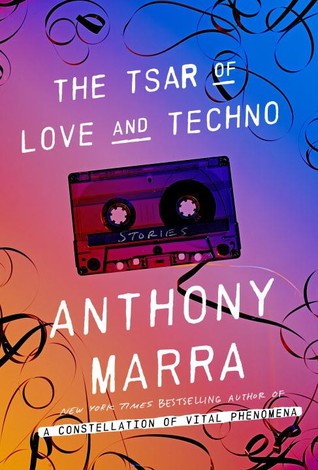 The Tsar of Love and Techno by Anthony Marra [subscription service]: This collection of tightly linked short stories, an intimate look at Russia and Chechnya in wartime and afterwards, reveals how politics, family, and art intertwine. Ranging from 1937 to 2013, the pieces show how fear and propaganda linger in the post-Stalinist era. In art as much as in politics, it can be difficult to distinguish airbrushed history from bitter reality. Just as he did in his excellent debut novel, A Constellation of Vital Phenomena, Marra renders unspeakable tragedies bearable because of his warm and witty writing. All his characters’ voices are well-realized and inviting, and he comes up with terrific one-liners.

BookTrib
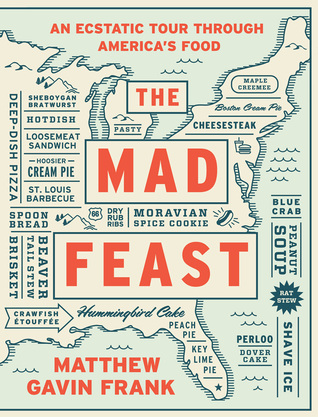 Mad Feast by Matthew Gavin Frank: This is the cookbook David Foster Wallace might have written. In an off-the-wall blend of memoir, travel, history and fiction, Frank proceeds region by region, choosing for each American state one beloved dish and interrogating its origins as well as its metaphors and associations. It’s a mixed bag of familiar foods and ones that only locals are likely to know about. Each chapter ends with a recipe for the signature plate, whether from a Lutheran church or a posh restaurant. Frank’s digressive, anecdotal approach takes some getting used to. If you appreciate the style of writers like Geoff Dyer, Maggie Nelson and Will Self, this should be your next food-themed read.
For Books’ Sake
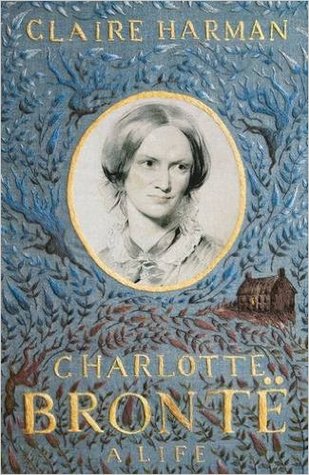 Charlotte Brontë: A Life by Claire Harman: With her bicentennial approaching in April 2016, it’s the perfect time to revisit Charlotte Brontë’s timeless stories. One of the things Harman’s biography does best is trace how the Brontës’ childhood experiences found later expression in fiction. A chapter on the publication of Jane Eyre is a highlight. Diehard fans might not encounter lots of new material, but Harman does make a revelation concerning Charlotte’s cause of death – not TB, as previously believed, but hyperemesis gravidarum (extreme morning sickness). This will help you appreciate afresh a “poet of suffering” whose novels were “all the more subversive because of [their] surface conventionality.”

Cockfosters by Helen Simpson: Simpson’s sixth story collection is full of wry, incisive reflections on aging, loss, regrets, gender roles, and a changing relationship to sex. Most of Simpson’s characters are in their late forties, a liminal time when they’re caught between older parents and still-needy children. Many pieces are dialogue-driven, like scenes in plays. In “Kentish Town,” book club members meet to discuss Dickens’s The Chimes. Simpson weaves in discussion of the plot with commentary on the state of the nation as the ladies set the world to rights and make New Year’s resolutions. It’s a perfect story to read in the run-up to Christmas. The overall stand-out is “Erewhon,” named for Samuel Butler’s 1872 satirical utopian novel. It quickly becomes clear that gender roles are reversed in its fictional world.
Foreword Reviews
 Addiction Is Addiction by Raju Hajela, Paige Abbott and Sue Newton: This comprehensive, well-organized guide discusses the features of addictive thinking and feeling, suggests holistic recovery methods, and offers useful definitions, diagrams, and case studies. The authors are affiliated with Health Upwardly Mobile Inc., Calgary, Alberta. Tracing the history of addiction back to the eighteenth century, when it was first known as “alcoholic disease syndrome,” they present an expert view of the disease’s symptoms and outlook. Strongly recommended to those who have participated in groups like Alcoholics Anonymous or Narcotics Anonymous.
Kirkus
Indie Spotlight: Books about Religion: Self-publishing allows writers to tell their full stories. An article based on interviews with four indie religion authors and mini-reviews of their books.
Nudge
Notes on Suicide by Simon Critchley: Critchley is a philosophy professor at New York’s New School for Social Research. Although he reassures readers with his first line that “This book is not a suicide note,” he also hints that its writing was inspired by personal trouble: “my life has dissolved over the past year or so, like sugar in hot tea.” Not suicidal himself, then, but sympathetic to those who are driven to self-murder. This concise essay illuminates arguments surrounding suicide, with points of reference ranging from Greek philosophers to Robin Williams. Overall, though, it feels cursory and inconclusive.
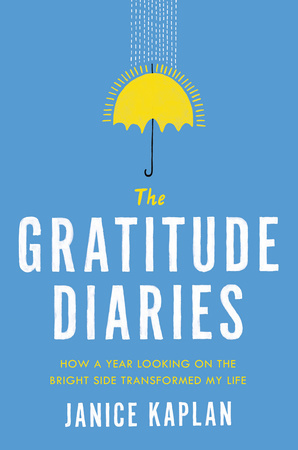 The Gratitude Diaries by Janice Kaplan: We can all do with a little encouragement to appreciate what we already have. In so many areas of life – finances, career, relationship, even the weather – we’re all too often hoping for more or better than what we are currently experiencing. Here Kaplan undertakes a year-long experiment to see if gratitude can improve every aspect of her life. She draws her information from interviews with researchers and celebrities, quotes from philosophers, and anecdotes from her own and friends’ lives. It’s easy, pleasant reading I’d recommend to fans of Gretchen Rubin.
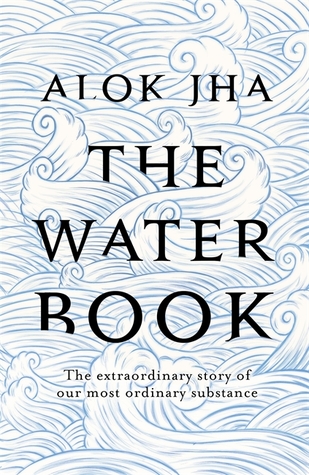 The Water Book by Alok Jha: An interdisciplinary look at water’s remarkable properties and necessity for life on earth. For the most part, Jha pitches his work at an appropriate level. However, if it’s been a while since you studied chemistry at school, you may struggle. Part IV, on the search for water in space, is too in-depth for popular science and tediously long. In December 2013 Jha was part of a month-long Antarctic expedition. He uses the trip as an effective framing device, but I would have liked more memoiristic passages. All in all, I was hoping for less hard science and more reflection on water’s importance to human culture.
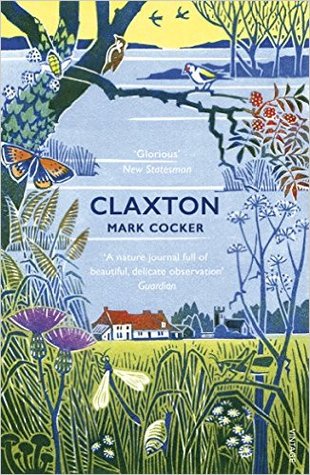 Claxton: Field Notes from a Small Planet by Mark Cocker: Mark Cocker is the Guardian’s country diarist for Norfolk. The short pieces in this book are reprints of his columns, some expanded or revised. I would advise keeping this as a bedside or coffee table book from which you read no more than one or two entries a week, so that you always stay in chronological sync. You’ll appreciate the book most if you experience nature along with Cocker, rather than reading from front cover to back in a few sittings. The problem with the latter approach is that there is inevitable repetition of topics across years. All told, after spending a vicarious year in Claxton, you’ll agree: “How miraculous that we are all here, now, in this one small place.”
 A Mile Down by David Vann: Vann, better known for fiction, tells the real-life story of his ill-fated journeys at sea. He hired a Turkish crew to build him a boat of his own, and before long shoddy workmanship, language difficulties, bureaucracy, and debts started to make it all seem like a very bad idea. Was he cursed? Would he follow his father into suicide? The day-to-day details of boat-building and sailing can be tedious, and there’s an angry tone that’s unpleasant; Vann seems to think everybody else was incompetent or a crook. However, he does an incredible job of narrating two climactic storms he sailed through.
Wasafiri
The Triumph of the Snake Goddess by Kaiser Haq: Beginning with the creation of the world and telling climactic tales of the snake goddess Manasa’s interactions with humans, Haq crafts a uniquely playful set of sacred stories that bear striking similarities to those from other religious traditions. Like Greek myths, the Manasa stories are full of shape-shifting and mistaken identity; rape and incest; jealousy and revenge; and over-the-top exploits of warring gods. She even wears snakes in her hair, like Medusa. Many parallels can also be drawn with the Hebrew and Christian scriptures. Haq’s rendering of the creation account, in particular, resembles the language of Genesis. This book will appeal to students of comparative religion, but can be read with equal enjoyment by laymen in search of engaging storytelling.
I also post reviews of most of my casual reading and skimming on Goodreads.
Mrs. Stevens Hears the Mermaids Singing by May Sarton: Although I’m a huge fan of Sarton’s memoirs, this was my first taste of her fiction. I was underwhelmed: it’s slight and strangely unfeminist. Part of the problem may be that I know so much about Sarton that I couldn’t help but see all the autobiographical detail here. Most of the novel’s action takes place in one day, as Mrs. Stevens awaits the arrival of two interviewers and reflects on past love affairs (some with women) and the meaning of the Muse. For me, Sarton’s journals are a better source of deep thoughts on the writer’s vocation, the value of solitude and the memory of love. This was seen as Sarton’s coming-out book, although it’s not at all sexually explicit.
 Running on the March Wind by Lenore Keeshig: Keeshig is a First Nations Canadian; these poems are full of images of Nanabush the Trickster, language from legal Indian acts, and sly subversion of stereotypes – cowboys and Indians, the only good Indian is a dead Indian (in “Making New”), the white man’s burden, and so on. In places I found these more repetitive and polemical than musical, though I did especially like the series of poems on trees.
The Cartographer Tries to Map a Way to Zion by Kei Miller: Kei Miller is a Jamaican writer who uses island patois and slang, and Rastafarian images and language, alongside standard English. Here he sets up (especially with the long, multi-part title poem) a playful contrast between the cartographer, emblem of civilization and unbiased science, and the rastaman, who takes an altogether more laidback approach to mapping his homeland. This was the perfect poetry collection to be reading in tandem with A Brief History of Seven Killings (see below).
 Very British Problems Abroad by Rob Temple: This is possibly ever so slightly funnier than the original (Very British Problems). A lot of it rings true. Once again the fact that the book originated as tweets means you can’t read too much of it at a time or the one-liners grow tiresome. A couple of my favorites were: “The feeling of dread as you approach the campsite and only then remembering that last year you said you’d never, ever do this again” and “Noticing an avalanche heading your way and hoping your umbrella’s up to the job.”
 Purity by Jonathan Franzen: By starting and ending with Purity ‘Pip’ Tyler, Franzen emphasizes his debt to Dickens: shades of both Bleak House and Great Expectations are there in the discovery of true parentage and unexpected riches. This is strong on the level of character and theme. Secrecy, isolation and compassion are recurring topics. East Germany, Bolivia and Oakland, California: Franzen doesn’t quite pull all his settings and storylines together, but this is close. With a more dynamic opening section, it might have been 5 stars.
 A Brief History of Seven Killings by Marlon James: This is an edgy, worthwhile Booker pick, but not for the faint-hearted. For the most part, James alternates patois and standard speech, but nearly every section is packed with local slang and expletives. Whether in monologue or dialogue, the many voices form a captivating chorus. The novel is in five parts, each named after a popular song or album of the time. James’s scope, especially as he follows Josey Wales to the Bronx, is too wide. All the narrative switches, once so dynamic, grow tiresome. At 350 pages this would have been a 5-star read. Nevertheless, I’ll be watching the HBO miniseries. (Full review to appear in December 2015 issue of Third Way magazine.)
 Kitchens of the Great Midwest by J. Ryan Stradal: One of my favorite debuts of 2015. Stradal has revealed that his grandmother’s Lutheran church cookbook was the inspiration for this culinary-themed novel that takes place over the course of 30 years. His unique structure takes what are essentially short stories from different perspectives and time periods and links them loosely through Eva Thorvald. Eva’s pop-up supper club gains fame thanks to her innovative adaptations of traditional Midwestern foods like venison or Scandinavian lutefisk; it charges $5,000 a head. I loved almost all of Stradal’s ordinary, flawed characters. If you want a peek at how average Americans live (apart from the $5,000 meals), you’ll find it here.
 The Japanese Lover by Isabel Allende: Allende is a wonderful storyteller. This isn’t up to the level of her South American novels (e.g. The House of the Spirits), and in elaborating both Alma’s and Irina’s stories there’s a bit too much telling rather than showing, but I thoroughly enjoyed the book all the same – I devoured it in just a few days. Allende is sensitive to both the process of aging and the various strategies for dealing with traumatic events from the past.
 Accidental Saints: Finding God in All the Wrong People by Nadia Bolz-Weber: I knew of Nadia Bolz-Weber through Greenbelt Festival. She’s a foul-mouthed, tattooed, fairly orthodox Lutheran pastor. This brief, enjoyable memoir is about how she keeps believing despite her own past issues and the many messed-up and outwardly unlovable people who show up at her church, House for All Sinners and Saints in Denver. In my favorite section, she zeroes in on one Holy Week and shows the whole range of emotions and trauma that religion can address. The Ash Wednesday chapter is the overall highlight.
 The Road to Little Dribbling: Adventures of an American in Britain by Bill Bryson: Bryson’s funniest book for many years. It meant a lot to me since I am also an American expat in England. Two points of criticism, though: although he moves roughly from southeast to northwest in the country, the stops he makes are pretty arbitrary, and his subjects of mockery are often what you’d call easy targets. Do we really need Bryson’s lead to scorn litterbugs and reality television celebrities? Still, I released many an audible snort of laughter while reading.
 Shaler’s Fish by Helen Macdonald: I was a huge fan of Macdonald’s memoir, H is for Hawk, so was excited to read her poetry collection, originally published in 2001 but to be reissued by Atlantic Monthly Press. Unfortunately, despite the occasional bird and nature imagery (e.g. in “Monhegan”), I found these poems largely inaccessible. Perhaps it was the sprinkling of archaic vocabulary and spellings, or the general lack of punctuation apart from annoying slashes and ampersands.

Portrait of an Addict as a Young Man: A Memoir by Bill Clegg: One of the finest memoirs I’ve come across (and I read a heck of a lot of them). Through this book I followed literary agent Bill Clegg on dozens of taxi rides between generic hotel rooms and bar toilets and New York City offices and apartments; together we smoked innumerable crack pipes and guzzled dozens of bottles of vodka while letting partners and family members down and spiraling further down into paranoia and squalor. Every structural and stylistic decision works: the present tense, short paragraphs, speech set out in italics, occasional flashback chapters distanced through third-person narration. Clegg achieves a perfect balance between his feelings at the time – being out of control and utterly enslaved to his next hit – and the hindsight that allows him to see what a pathetic figure he was becoming.
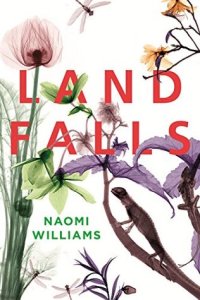 Landfalls by Naomi J. Williams: An enjoyable novel of eighteenth-century maritime adventure, based on a true story and reminiscent of Matthew Kneale’s English Passengers and Peter Carey’s Parrot and Olivier in America. Williams moves between the perspectives of various crew members and outsiders, sometimes employing first person and sometimes third. Key chapters are set in South America, California, Alaska, Macao, and the Solomon Islands. I especially enjoyed a chapter from the point-of-view of a native Alaskan girl – one of the few times the novel focuses on female experience.
 Dept. of Speculation by Jenny Offill: Not as innovative or profound as I was expecting given the rapturous reviews from so many quarters. It’s an attempt to tell an old, old story in a new way: wife finds out her husband is cheating. Offill’s style is fragmentary and aphoristic. Some of the facts and sayings are interesting, but most just sit there on the page and don’t add to the story. What I did find worthwhile was tracing the several tense and pronoun changes: from first-person, past tense into present tense, then to third-person and back to first-person for the final page.
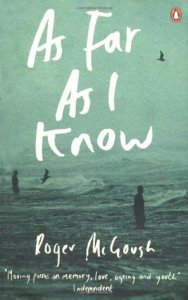 As Far As I Know by Roger McGough: A bit silly for my tastes; lots of puns and other plays on words. In style they feel like children’s poems, but with vocabulary and themes more suited to adults. I did like “Indefinite Definitions,” especially BRUPT: “A brupt is a person, curt and impolite / Brusque and impatient / Who thinks he’s always right.” The whole series is like that: words with the indefinite article cut off and an explanation playing on the original word’s connotations. From the “And So to Bed” concluding cycle, I loved Camp bed: “A la Recherche du Temps Perdu / on the bedside table / Gardenia on the pillow / Silk pyjamas neatly folded.”
 The Penguin Lessons: What I Learned from a Remarkable Bird by Tom Michell: Marley & Me with a penguin. Well, sort of. A sweet if slight story about the author keeping a Magellanic penguin as a pet while teaching in an Argentina boarding school in the 1970s. On a vacation to Uruguay the twentysomething rescued a penguin from an oil spill and named him Juan Salvado. The uproarious process of cleaning the oil-sodden bird, achieved with a bidet, string bag, and plenty of dish soap, was my favorite passage. However, I’m hesitant about anthropomorphizing, and the language can be stiff – I would have dated this to the 1950s by the speech. Also, there’s precious little evidence of Argentina’s political upheaval.
 Bookish Beck = Rebecca Foster. American transplant to England. Freelance proofreader and book reviewer.
 Bookish Beck