20 Books of Summer, 17–18: Suzanne Berne and Melissa Febos
Nearly there! I’ll have two more books to review for this challenge as part of roundups tomorrow and Saturday. Today I have a lesser-known novel by a Women’s Prize winner and a set of personal essays about body image and growing up female.
A Perfect Arrangement by Suzanne Berne (2001)
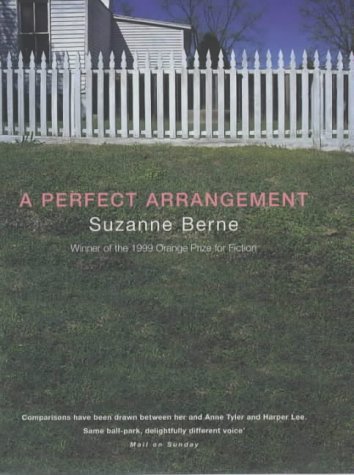 Berne won the Orange (Women’s) Prize for A Crime in the Neighbourhood in 1999. This is another slice of mild suburban suspense. The Boston-area Cook-Goldman household faces increasingly disruptive problems. Architect dad Howard is vilified for a new housing estate he’s planning, plus an affair that he had with a colleague a few years ago comes back to haunt him. Hotshot lawyer Mirella can’t get the work–life balance right, especially when she finds out she’s unexpectedly pregnant with twins at age 41. They hire a new nanny to wrangle their two under-fives, headstrong Pearl and developmentally delayed Jacob. If Randi Gill seems too good to be true, that’s because she’s a pathological liar. But hey, she’s great with kids.
It’s clear some Bad Stuff is going to happen to this family; the only questions are how bad and precisely what. Now, this is pretty much exactly what I want from my “summer reading”: super-readable plot- and character-driven fiction whose stakes are low (e.g., midlife malaise instead of war or genocide or whatever) and that veers more popular than literary and so can be devoured in large chunks. I really should have built more of that into my 20 Books plan! I read this much faster than I normally get through a book, but that meant the foreshadowing felt too prominent and I noticed some repetition, e.g., four or five references to purple loosestrife, which is a bit much even for those of us who like our wildflowers. It seemed a bit odd that the action was set back in the Clinton presidency; the references to the Lewinsky affair and Hillary’s “baking cookies” remark seemed to come out of nowhere. And seriously, why does the dog always have to suffer the consequences of humans’ stupid mistakes?!
This reminded me most of Friends and Strangers by J. Courtney Sullivan and a bit of Breathing Lessons by Anne Tyler, while one late plot turn took me right back to The Senator’s Wife by Sue Miller. While the Goodreads average rating of 2.93 seems pretty harsh, I can also see why fans of A Crime would have been disappointed. I probably won’t seek out any more of Berne’s fiction. (Secondhand – Community Furniture Project, Newbury) 
Girlhood by Melissa Febos (2021)
I was deeply impressed by Febos’s Body Work (2022), a practical guide to crafting autobiographical narratives as a way of reckoning with the effects of trauma. Ironically, I engaged rather less with her own personal essays. One issue for me was that her highly sexualized experiences are a world away from mine. I don’t have her sense of always having had to perform for the male gaze, though maybe I’m fooling myself. Another was that it’s over 300 pages and only contains seven essays, so there were several pieces that felt endless. This was especially true of “The Mirror Test” (62 pp.) which is about double standards for girls as they played out in her simultaneous lack of confidence and slutty reputation, but randomly references The House of Mirth quite a lot; and “Thank You for Taking Care of Yourself” (74 pp.), which ponders why Febos has such trouble relaxing at a cuddle party and whether she killed off her ability to give physical consent through her years as a dominatrix.
 “Wild America,” about her first lesbian experience and the way she came to love a perceived defect (freakishly large hands; they look perfectly normal to me in her author photo), and “Intrusions,” about her and other women’s experience with stalkers, worked a bit better. But my two favourites incorporated travel, a specific relationship, and a past versus present structure. “Thesmophoria” opens with her arriving in Rome for a mother–daughter vacation only to realize she told her mother the wrong month. Feeling guilty over the error, she remembers other instances when she valued her mother’s forgiveness, including when she would leave family celebrations to buy drugs. The allusions to Greek myth were neither here nor there for me, but the words about her mother’s unconditional love made me cry.
I also really liked “Les Calanques,” which again draws on her history of heroin addiction, comparing a strung-out college trip to Paris when she scored with a sweet gay boy named Ahmed with the self-disciplined routines and care for her body she’d learned by the time she returns to France for a writing retreat. This felt like a good model for how to write about one’s past self. “I spend so much time with that younger self, her savage despair and fleeting reliefs, that I start to feel as though she is here with me.” The prologue, “Scarification,” is a numbered list of how she got her scars, something Paul Auster also gives in Winter Journal. As if to insist that we can only ever experience life through our bodies.
Although I’d hoped to connect to this more, and ultimately felt it wasn’t really meant for me (and maybe I’m a deficient feminist), I did admire the range of strategies and themes so will keep it on the shelf as a model for approaching the art of the personal essay. I think I would probably prefer a memoir from Febos, but don’t need to read more about her sex work (Whip Smart), so might look into Abandon Me. If bisexuality and questions of consent are of interest, you might also like Another Word for Love by Carvell Wallace, which I reviewed for BookBrowse. (Gift (secondhand) from my Christmas wish list last year) 
20 Books of Summer, 15–17: Bill Buford, Kristin Newman, J. Courtney Sullivan
One last foodie selection for the summer: a chef’s memoir set mostly in Lyon, France. Plus a bawdy travel memoir I DNFed halfway through, and an engaging but probably overlong contemporary novel about finances, generational conflict and women’s relationships.
Dirt: Adventures in French Cooking by Bill Buford (2020)
 Buford’s Heat was one of the highlights of my foodie summer reading in 2020. This is a sequel insomuch as it tells you what he did next, after his Italian-themed apprenticeships. The short answer is that he went to Lyon to learn French cooking in similarly obsessive fashion. Without knowing a word of French. And this time he had a wife and twin toddlers in tow. He met several celebrated French chefs – Michel Richard, Paul Bocuse, Daniel Boulud – and talked his way into training at a famous cookery school and in Michelin-starred kitchens.
These experiences are discussed in separate essays, so I rather lost track of the timeline. It’s odd that it took the author so many years to get around to publishing about it all. You’d think his sons were still young, but in fact they’re now approaching adulthood. The other slightly unusual thing is the amount of space Buford devotes to his pet theory that French cuisine (up to ragout, at least) evolved from Italian. Unsurprisingly, the French don’t favour this idea; I didn’t particularly care one way or the other.
Nonetheless, I enjoyed reading about his encounters with French bureaucracy; the stress of working in busy (and macho) restaurants, where he’s eventually entrusted with cooking the staff lunch; and his discovery of what makes for good bread: small wheat-growing operations rather than industrially produced flour – his ideal was the 90-cent baguette from his local boulangerie. This could have been a bit more focused, and I’m still more likely to recommend Heat, but I am intrigued to go to Lyon one day. (Secondhand gift, Christmas 2022) 
What I Was Doing While You Were Breeding by Kristin Newman (2014)
 (DNF, 156/291 pages) As featured in my Six Degrees post earlier in the month. Newman is a comedy writer for film and television (That ’70s Show, How I Met Your Mother, etc.). I liked how the title unabashedly centres things other than couplehood and procreation. When she’s travelling, she can be spontaneous, open-to-experience “Kristin-adjacent,” who loves doing whatever it is that locals do. And be a party girl, of course (“If there is one thing that is my favorite thing in the world, it’s making out on a dance floor”). However, this chronological record of her sexual conquests in Amsterdam, Paris, Russia, Argentina, etc. gets repetitive and raunchy. I also felt let down when I learned that she married and had a child right after she published it. So this was just her “Pietra Pan” stage before she copied everyone else. Which is fine, but were her drunken shenanigans really worth commemorating? (Secondhand, Bas Books & Home)
Friends and Strangers by J. Courtney Sullivan (2020)
I got Emma Straub vibes from this big, juicy novel focusing on two women in upstate New York: Elisabeth, a married journalist who moved out of Brooklyn when she finally conceived via IVF; and Sam, a college art student who becomes her son Gil’s babysitter. Elisabeth misses her old crowd and doesn’t fit in with the middle-aged book club ladies in her suburban neighbourhood; Sam is almost her only friend, a confidante who’s also like a little sister (better, anyway, than Elisabeth’s real sister, who lives on tropical islands and models swimwear for inspirational Instagram posts). And Sam admires Elisabeth for simultaneously managing a career and motherhood with seeming aplomb.
 But fundamental differences between the two emerge, mostly to do with economics. Elisabeth comes from money and takes luxury products for granted, while Sam is solidly working-class and develops a surprising affinity with Elisabeth’s father-in-law, George, who is near bankruptcy after Uber killed off his car service business. His pet theory, “The Hollow Tree,” explains that ordinary Americans have been sold the lie that they are responsible for their own success, when really they are in thrall to corporations and the government doesn’t support them as it should. This message hits home for Sam, who is distressed about the precarious situation of the Latina dining hall employees she has met via her work study job. Both Elisabeth and Sam try to turn their privilege to the good, with varied results.
Although I remained engrossed in the main characters’ stories, which unfold in alternating chapters, I thought this could easily have been 300 pages instead of nearly 400. In particular, Sullivan belabours Sam’s uncertainty over her thirtysomething English fiancé, Clive, whom Elisabeth refers to as “sleazy-hot.” The red flags are more than obvious to others in Sam’s life, and to us as readers, yet we get scene after scene meant to cast shade on him. I also kept wondering if first person would have been the better delivery mode for one or both strands. Still, this was perfect literary cross-over summer reading. (Little Free Library) 
 Bookish Beck = Rebecca Foster. American transplant to England. Freelance proofreader and book reviewer.
 Bookish Beck