Three Hours by Rosamund Lupton (Blog Tour Review)
It can’t happen here. Or can it? That’s a question Rosamund Lupton asks with her novel about a siege at a progressive school in rural England. When out in public with my copy of the book, I was asked a few times what I was reading. I would explain that it was about a school shooting in Somerset, and the reply was always “In the UK?!” Guns are difficult to come by in this country thanks to firearms legislation that was passed following a couple of high-profile massacres in the 1980s and 90s. So, to an extent, you’ll have to suspend your disbelief about the perpetrators getting access to automatic weapons and bombs. And you should, because the story that unfolds is suspenseful and timely.
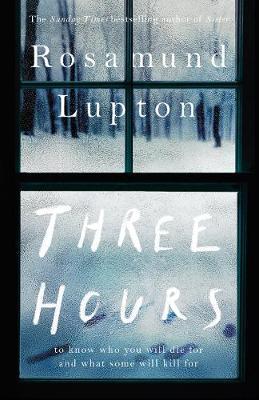 Cliff Heights School is in the midst of a surprise November blizzard. It’s also under attack. At 9:16 the headmaster, Matthew Marr, is shot twice. Students bundle him into the library, barricade the doors and tend to his head and foot injuries as best they can. He recognized the shooter, but the damage to his brain means he’s incapable of telling anyone who it was.
At 8:15 Rafi Bukhari, a Syrian refugee pupil, had seen an IED explode on the school grounds and alerted Marr, who promptly evacuated the junior school. But the institution is based across several buildings, with some students in the theatre for a dress rehearsal, more in the pottery hut for art class – and now a few trapped in the library.
Lupton toggles between these different locations, focusing on a handful of staff and students and the relationships between them. Hannah, who’s doing her best to help Mr. Marr, is Rafi’s girlfriend. Rafi is concerned for his little brother, Basi, who’s still traumatized after their escape from Syria. Mr. Marr sponsored the boys’ move to England. Could it be that anti-Muslim sentiment has made the Bukhari boys – and thus the school they attend – a target?
We also spend time behind the scenes with police investigators as they pursue leads and worried parents as they await news of their children. I found the book most gripping when the situation was still a complete unknown; as the options narrow down and it becomes clear who’s responsible, things feel a bit more predictable. However, there are still unexpected turns to come.
A few elements that stood out for me were the use of technology (FaceTime, WhatsApp and drones weren’t available at the time of Columbine), the Syrian boys’ history, and the student production of Macbeth, whose violence ironically comments on the school’s crisis. While not my usual fare, I found this well worth reading and will look into Lupton’s back catalogue, too.
Readalikes: Bloomland by John Englehardt and A Mother’s Reckoning by Sue Klebold
My rating: 
Three Hours will be published by Penguin Viking on the 9th. My thanks to the publisher for the free copy for review.
My pal Annabel has also reviewed the book today.
Other 2019 Superlatives and Some Statistics
My best discoveries of the year: The poetry of Tishani Doshi; Penelope Lively and Elizabeth Strout (whom I’d read before but not fully appreciated until this year); also, the classic nature writing of Edwin Way Teale.


The authors I read the most by this year: Margaret Atwood and Janet Frame (each: 2 whole books plus parts of 2 more), followed by Doris Lessing (2 whole books plus part of 1 more), followed by Miriam Darlington, Paul Gallico, Penelope Lively, Rachel Mann and Ben Smith (each: 2 books).
Debut authors whose next work I’m most looking forward to: John Englehardt, Elizabeth Macneal, Stephen Rutt, Gail Simmons and Lara Williams.
My proudest reading achievement: A 613-page novel in verse (Mary Ann Sate, Imbecile by Alice Jolly) + 2 more books of over 600 pages (East of Eden by John Steinbeck and Cutting for Stone by Abraham Verghese).


Best book club selection: Red Dust Road by Jackie Kay was our first nonfiction book and received our highest score ever.
Some best first lines encountered this year:
 “What can you say about a twenty-five-year old girl who died?” (Love Story by Erich Segal)
- “The women of this family leaned towards extremes” (Away by Jane Urquhart)
- “The day I returned to Templeton steeped in disgrace, the fifty-foot corpse of a monster surfaced in Lake Glimmerglass.” (from The Monsters of Templeton by Lauren Groff)
The downright strangest book I read this year: Lanny by Max Porter
The 2019 books everybody else loved (or so it seems), but I didn’t: Fleishman Is in Trouble by Taffy Brodesser-Akner, The Topeka School by Ben Lerner, Underland by Robert Macfarlane, The Boy, The Mole, The Fox and The Horse by Charlie Mackesy, Three Women by Lisa Taddeo and The Nickel Boys by Colson Whitehead
 The year’s major disappointments: Cape May by Chip Cheek, We Are the Weather: Saving the Planet Begins at Breakfast by Jonathan Safran Foer, Letters to the Earth: Writing to a Planet in Crisis, ed. Anna Hope et al., Bowlaway by Elizabeth McCracken, Rough Magic: Riding the World’s Loneliest Horse Race by Lara Prior-Palmer, The Lager Queen of Minnesota by J. Ryan Stradal, The Knife’s Edge by Stephen Westaby and Frankissstein by Jeanette Winterson
The worst book I read this year: Jonathan Livingston Seagull by Richard Bach
Some statistics on my 2019 reading:
Fiction: 45.4%
Nonfiction: 43.4%
Poetry: 11.2%
(As usual, fiction and nonfiction are neck and neck. I read a bit more poetry this year than last.)
Male author: 39.4%
Female author: 58.9%
Nonbinary author (the first time this category has been applicable for me): 0.85%
Multiple genders (anthologies): 0.85%
(I’ve said this the past three years: I find it interesting that female authors significantly outweigh male authors in my reading; I have never consciously set out to read more books by women.)
E-books: 10.3%
Print books: 89.7%
(My e-book reading has been declining year on year, partially because I’ve cut back on the reviewing gigs that involve only reading e-books and partially because I’ve done less traveling; also, increasingly, I find that I just prefer to sit down with a big stack of print books.)
Work in translation: 7.2%
(Lower than I’d like, but better than last year’s 4.8%.)
Where my books came from for the whole year:
- Free print or e-copy from publisher: 36.8%
- Public library: 21.3%
- Secondhand purchase: 13.8%
- Free (giveaways, The Book Thing of Baltimore, the free mall bookshop, etc.): 9.2%
- Downloaded from NetGalley, Edelweiss or Project Gutenberg: 7.8%
- Gifts: 4.3%
- University library: 2.9%
- New purchase (usually at a bargain price): 2.9%
- Church theological library: 0.8%
- Borrowed: 0.2%
(Review copies accounted for over a third of my reading; I’m going to scale way back on this next year. My library reading was similar to last year’s; my e-book reading decreased in general; I read more books that I either bought new or got for free.)
Number of unread print books in the house: 440
(Last thing I knew the figure was more like 300, so this is rather alarming. I blame the free mall bookshop, where I volunteer every Friday. Most weeks I end up bringing home at least a few books, but it’s often a whole stack. Surely you understand. Free books! No strings attached!)
Best of 2019: Fiction and Poetry
I’ve managed to whittle my favorite releases of 2019 down to 20 in total: 12 nonfiction (that’s for tomorrow), 5 fiction and 3 poetry. It felt like a particular achievement to limit myself to five top novels, though plenty more turn up on my runners-up list, due Saturday.
Let the countdown begin!
Fiction
-
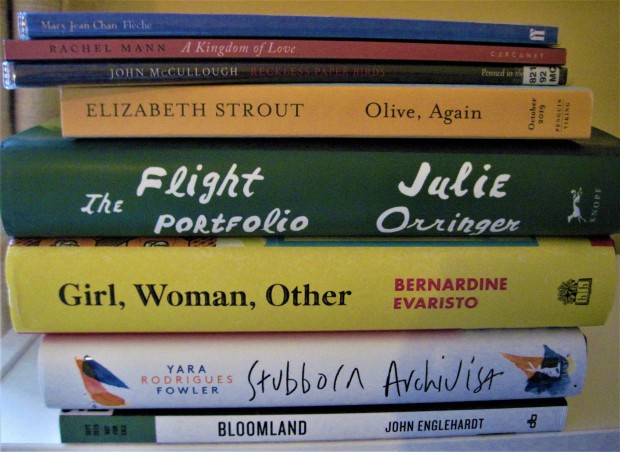
 Bloomland by John Englehardt: Subtle and finely crafted literary fiction about a mass shooting at a fictional Arkansas university. The second-person narration draws the reader into the action, inviting ‘you’ to extend sympathy to three very different characters: Rose, a student who becomes romantically involved with one of the injured; Eddie, a professor whose wife dies in the massacre; and Eli, the shooter. Englehardt writes a gorgeous sentence, too.
-
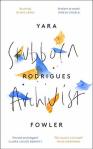 Stubborn Archivist by Yara Rodrigues Fowler: Autofiction in fragments, like a pure stream of memory and experience. Navigating between two cultures and languages, being young and adrift, and sometimes seeing her mother in herself: there’s a lot to sympathize with in the Brazilian–English main character. What a hip, fresh approach to fiction. I’d hoped to see Fowler on the Women’s Prize longlist and winning the Young Writer of the Year Award.
-
 Girl, Woman, Other by Bernardine Evaristo: A terrific linked short story collection about 12 black women in twentieth-century and contemporary Britain balancing external and internal expectations and different interpretations of feminism to build lives of their own. It’s a warm, funny book, never strident in its aims yet unabashedly obvious about them. It’s timely and elegantly constructed – and, it goes without saying, a worthy Booker Prize winner.
-
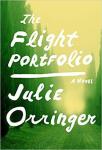 The Flight Portfolio by Julie Orringer: Every day the Emergency Rescue Committee in Marseille interviews 60 refugees and chooses 10 to recommend to the command center in New York City. Varian Fry and his staff arrange bribes, fake passports, and exit visas to get celebrated Jewish artists and writers out of the country via the Pyrenees or various sea routes. The story of an accidental hero torn between impossible choices is utterly compelling. This is richly detailed historical fiction at its best.
-
 Olive, Again by Elizabeth Strout: Crosby, Maine feels like a microcosm of modern society, with Olive as our Everywoman guide. She hasn’t lost her faculties or her spirit, but the approach of death lends added poignancy to her story. Strout is a master of psychological acuity and mixing hope with the darkness. Those who are wary of sequels need not fear: Olive, Again is even better than Olive Kitteridge. (I revisited the book for BookBrowse, whose subscribers likewise voted it the 2019 Best Fiction Award Winner.)
Poetry
-
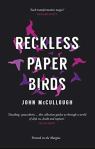 Reckless Paper Birds by John McCullough: From the Costa Awards shortlist. I was struck by the hard-hitting, never-obvious verbs, and the repeating imagery. Flashes of nature burst into a footloose life in Brighton. The poems are by turns randy, neurotic, playful and nostalgic. In “Flock of Paper Birds,” one of my favorites, the poet tries to reconcile the faith he grew up in with his unabashed sexuality.
-
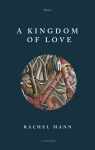 A Kingdom of Love by Rachel Mann: The Anglican priest’s poetry is full of snippets of scripture and liturgy (both English and Latin), and the cadence is often psalm-like. This is beautiful, incantatory free verse that sparkles with alliteration and allusions that those of a religious background will be sure to recognize. It’s sensual as well as headily intellectual. Doubt, prayer and love fuel many of my favorite lines.
-
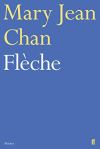 Flèche by Mary Jean Chan: Exquisite poems of love and longing, with the speaker’s loyalties always split between head and heart, flesh and spirit. Over it all presides the figure of a mother – not just Chan’s mother, who had difficulty accepting that her daughter was a lesbian, but also the relationship to the mother tongue (Chinese) and the mother country (Hong Kong). Fencing terms are used for structure. I was impressed by how clearly Chan sees how others perceive her, and by how generously she imagines herself into her mother’s experience. I’ve read 3.5 of the 4 nominees now and this is my pick to win the Costa Award.
What were some of your top fiction (or poetry) reads of the year?
Tomorrow I’ll be naming my favorite nonfiction of 2019.
My Most Anticipated Releases of the Second Half of 2019
Although over 90 books from the second half of the year are already on my radar, I’ve managed to narrow it down to the 15 July to November releases that I’m most excited about. I have access to a few of these already, and most of the rest I will try requesting as soon as I’m back from Milan. (These are given in release date order within thematic sections; the quoted descriptions are from the publisher blurbs on Goodreads.)
[By the way, here’s how I did with my most anticipated releases of the first half of the year:
- 16 out of 30 read; of those 9 were somewhat disappointing (i.e., 3 stars or below) – This is such a poor showing! Is it a matter of my expectations being too high?
- 10 I still haven’t managed to find
- 1 print review copy arrived recently
- 1 I have on my Kindle to read
- 1 I skimmed
- 1 I lost interest in]
Fiction
 The Lager Queen of Minnesota by J. Ryan Stradal [July 23, Pamela Dorman Books] Stradal’s Kitchens of the Great Midwest (2015) is one of my recent favorites. This one has a foodie theme again, and sounds a lot like Louise Miller’s latest – two sisters: a baker of pies and a founder of a small brewery. “Here we meet a cast of lovable, funny, quintessentially American characters eager to make their mark in a world that’s often stacked against them.”
 Hollow Kingdom by Kira Jane Buxton [August 6, Grand Central Publishing / Headline Review] As soon as I heard that this was narrated by a crow, I knew I was going to have to read it. (And the Seattle setting also ties in with Lyanda Lynn Haupt’s book.) “Humanity’s extinction has seemingly arrived, and the only one determined to save it is a foul-mouthed crow whose knowledge of the world around him comes from his TV-watching education.”
 Inland by Téa Obreht [August 13, Random House / Weidenfeld & Nicolson] However has it been eight years since her terrific debut novel?! “In the lawless, drought-ridden lands of the Arizona Territory in 1893, two extraordinary lives collide. … [L]yrical, and sweeping in scope, Inland subverts and reimagines the myths of the American West.” The synopsis reminds me of Eowyn Ivey’s latest.
 A Door in the Earth by Amy Waldman [August 27, Little, Brown and Company] I loved The Submission, Waldman’s 2011 novel about a controversial (imagined) 9/11 memorial. “Parveen Shamsa, a college senior in search of a calling, feels pulled between her charismatic and mercurial anthropology professor and the comfortable but predictable Afghan-American community in her Northern California hometown [and] travels to a remote village in the land of her birth to join the work of his charitable foundation.” (NetGalley download)
Bloomland by John Englehardt [September 10, Dzanc Books] “Bloomland opens during finals week at a fictional southern university, when a student walks into the library with his roommate’s semi-automatic rifle and opens fire. In this richly textured debut, Englehardt explores how the origin and aftermath of the shooting impacts the lives of three characters.” (print review copy from publisher)
 The Dutch House by Ann Patchett [September 25, Harper / Bloomsbury UK] I’m more a fan of Patchett’s nonfiction, but will keep reading her novels thanks to Commonwealth. “At the end of the Second World War, Cyril Conroy combines luck and a single canny investment to begin an enormous [Philadelphia] real estate empire … Set over … five decades, The Dutch House is a dark fairy tale about two smart people who cannot overcome their past.”
Medical themes
 Will My Cat Eat My Eyeballs?: Big Questions from Tiny Mortals about Death by Caitlin Doughty [September 10, W.W. Norton / September 19, Weidenfeld & Nicolson] I’ve read Doughty’s previous books about our modern attitude towards mortality and death customs around the world. She’s wonderfully funny and iconoclastic. Plus, how can you resist this title?! Although it sounds like it’s geared towards children, I’ll still read the book. “Doughty blends her mortician’s knowledge of the body and the intriguing history behind common misconceptions … to offer factual, hilarious, and candid answers to thirty-five … questions.”
 The Undying: Pain, Vulnerability, Mortality, Medicine, Art, Time, Dreams, Data, Exhaustion, Cancer, and Care by Anne Boyer [September 17, Farrar, Straus and Giroux] “A week after her forty-first birthday, the acclaimed poet Anne Boyer was diagnosed with highly aggressive triple-negative breast cancer. … A genre-bending memoir in the tradition of The Argonauts, The Undying will … show you contemporary America as a thing both desperately ill and occasionally, perversely glorious.” (print review copy from publisher)

From the author’s Twitter page.
Breaking and Mending: A doctor’s story of burnout and recovery by Joanna Cannon [September 26, Wellcome Collection] I haven’t gotten on with Cannon’s fiction, but a memoir should hit the spot. “A frank account of mental health from both sides of the doctor-patient divide, from the bestselling author of The Trouble with Goats and Sheep and Three Things About Elsie, based on her own experience as a doctor working on a psychiatric ward.”
 The Body: A Guide for Occupants by Bill Bryson [October 3, Doubleday / Transworld] His last few books have been somewhat underwhelming, but I’d read Bryson on any topic. He’s earned a reputation for making history, science and medicine understandable to laymen. “Full of extraordinary facts and astonishing stories, The Body: A Guide for Occupants is a brilliant, often very funny attempt to understand the miracle of our physical and neurological makeup.”
 The Depositions: New and Selected Essays on Being and Ceasing to Be by Thomas Lynch [November 26, W.W. Norton] Lynch is such an underrated writer. A Michigan undertaker, he crafts essays and short stories about small-town life, the Irish-American experience and working with the dead. I discovered him through Greenbelt Festival some years back and have read three of his books. Some of what I’ve already read will likely be repeated here, but will be worth a second look anyway.
Other Nonfiction
 Confessions of a Bookseller by Shaun Bythell [August 29, Profile Books] The Diary of a Bookseller was a treat in 2017. I’ve read the first two-thirds of this already while in Milan, and I wish I was in Wigtown instead! This sequel picks up in 2015 and is very much more of the same – the daily routines of buying and selling books and being out and about in a small town – so it’s up to you whether that sounds boring or comforting. I’m finding it strangely addictive. (NetGalley download)
We Are the Weather: Saving the Planet Begins at Breakfast by Jonathan Safran Foer [September 17, Farrar, Straus and Giroux / October 10, Hamish Hamilton] Foer’s Eating Animals (2009) was a hard-hitting argument against eating meat. In this follow-up he posits that meat-eating is the single greatest contributor to climate change. “With his distinctive wit, insight and humanity, Jonathan Safran Foer presents this essential debate as no one else could, bringing it to vivid and urgent life, and offering us all a much-needed way out.”
 Surfacing by Kathleen Jamie [September 19, Sort of Books] Jamie is a Scottish poet who writes exquisite essays about the natural world. I’ve read her two previous essay collections, Findings and Sightlines, as well as a couple of volumes of her poetry. “From the thawing tundra linking a Yup’ik village in Alaska to its hunter-gatherer past to the shifting sand dunes revealing the impressively preserved homes of neolithic farmers in Scotland, Jamie explores how the changing natural world can alter our sense of time.”
 Unfollow by Megan Phelps-Roper [October 8, Farrar, Straus and Giroux / riverrun] Ties in with my special interest in women’s religious memoirs. “In November 2012, at the age of twenty-six, [Phelps-Roper] left [Westboro Baptist Church], her family, and her life behind. Unfollow is a story about the rarest thing of all: a person changing their mind. It is a fascinating insight into a closed world of extreme belief, a biography of a complex family, and a hope-inspiring memoir of a young woman finding the courage to find compassion.”
 Bookish Beck = Rebecca Foster. American transplant to England. Freelance proofreader and book reviewer.
 Bookish Beck