Assisted Dying: Intervals by Marianne Brooker; Wendy Mitchell; and a Local Panel Discussion
Intervals by Marianne Brooker is on the longlist for the inaugural Women’s Prize for Non-Fiction, which my book club has applied to shadow. I’ve now read three of the nominees, the others being Matrescence and A Flat Place (review coming up tomorrow). Unsurprisingly, I’ve gravitated towards the ones based around a personal narrative – although all three are also political and incorporate research and cultural critique. Brooker’s is an extended essay about her mother’s protracted death with multiple sclerosis and the issues it brought up around disability, poverty, and inequality of access to medical care and services.

Specifically, Brooker decries the injustice of the wealthy having the option of travelling to Dignitas in Switzerland for an assisted death (current cost: £15,000), whereas her single mother, who lived in rented accommodation and had long been disabled and unable to work, apart from crafting and reading tarot, had so such relief in sight. Instead, she resorted to refusing life-sustaining nourishment. VSED, or voluntarily stopping eating and drinking, was a topic much on my mind anyway because of Wendy Mitchell’s death last month.
 Mitchell was diagnosed with early-onset Alzheimer’s in her fifties and was an energetic campaigner for dementia education and research for the last decade of her life. With a co-author, she wrote three books that give a valuable insider’s view of life with dementia: Somebody I Used to Know, What I Wish People Knew About Dementia, and One Last Thing, in which she specifically discusses VSED. She was determined to live independently. For her, a dignified life was being able to meet her own daily physical needs. She did not want to be in a care home, or to exist past the point where she could no longer recognise her daughters. So when, in January, she fell and broke both wrists, giving her a taste of dependency and derailing her plans to travel to Dignitas, she knew that the time had come. VSED was her way out. You can read her farewell message here.
Is wilful starvation a good death? I don’t really know. It’s peaceful, at least; a person simply gets weaker and weaker, spending more and more time asleep until they fade out, at home. But it can take two weeks to die in this way. Should loved ones have to watch this process?
Denied a liveable life and a legal right to die, my mum made a choice within and between the lines of the law. A decade after her diagnosis, when she was forty-nine and I was twenty-six, she decided to stop eating and drinking to end her suffering and her life. Her MS symptoms were barely treatable and certainly incurable: severe pain, incontinence, fatigue, the gradual but intensifying loss of mobility, vision and speech. But these medical symptoms were compounded by social conditions: isolation, stress, debt and fear of a future in which she would not be able to live or die in her chosen home. We were caught in a perfect storm.
Brooker’s description of the vigil of these last days, like her account of her vivacious mother’s life, is both tender and unflinching. It’s almost like a counterpoint to Simone de Beauvoir’s A Very Easy Death, but with the same incisive attention and emotional transfer between mother and daughter. The book also incorporates political commentary and quotations from psychologists and cultural critics. This somewhat distances the reader; it feels less like a bereavement memoir and more like an impassioned, personally inspired treatise. But that’s not to say there isn’t some levity. She remembers good times from their earlier life together, and reckons with her new role as her mother’s memorial and archivist in a way that really rang true for me. I wish the title was more evocative so as to draw the right readers to this book. 
With thanks to Fitzcarraldo Editions for the free copy for review.
Also on this topic, I have read In Love by Amy Bloom, That One Patient by Ellen de Visser, The Inevitable by Katie Engelhart, Darke Matter by Rick Gekoski, and Wild and Precious Life by Deborah Ziegler.
Last night I attended a local panel discussion put on by the Campaign for Dignity in Dying. It wasn’t a debate in that 3.5 of the 4 members on the panel were pro-assisted dying, and I would guess more than four-fifths of the audience as well. In fact, the only anti- voice of the evening was from a young Catholic man during question time. I knew about the event because one panelist attends my church: George Carey, a former archbishop of Canterbury.
The Anglican Church’s line – the religious response in general – is to uphold the sanctity of life and thus to oppose assisted suicide, so for Lord Carey to do otherwise is noteworthy. He changed his mind in 2014, he explained, after the high-profile case of Tony Nicklinson, who was paralysed after a stroke and lost his appeal over the right to die. “There is no theological contradiction between valuing life and wanting a good death,” Carey insisted. Jesus showed mercy to the ill and dying, and so should we. (He also, more facetiously, described King Saul’s mercy killing by an enemy soldier in 2 Samuel as an assisted death.)
The other panelists were a lawyer, a retired doctor, and a Member of Parliament. Lawyer Graham Wood noted that the 1961 Suicide Act, under which anyone who assists a suicide can be prosecuted, would have to be abolished, and that there would also need to be a negotiation regarding Article 2 of the European Convention on Human Rights, which protects the “right to life.” He was the most wary of the speakers, warning of the danger of undue influence being exerted by relatives when money and assets are involved – he said he sees the worst of humanity in his line of work.

Dr Barry Newman pinned his support for assisted dying to compassion and autonomy, two overriding values of a liberal society. He acknowledged the current professional risk for doctors, and noted that the UK’s main medical bodies remain neutral. However, he brought up a loophole, “double effect,” administering a medication that might end life but whose intent is to alleviate suffering, e.g., a high dose of morphine to an end-stage cancer patient.
Kit Malthouse, Conservative MP for northwest Hampshire, co-chairs a group on end-of-life and has campaigned for assisted dying. (American readers may be surprised by a conservative politician having liberal views on an ethical matter. In the UK, morality is not in lockstep with religions and/or political parties as it is in the USA. This was something it took me a while to get used to: I have Christian friends who vote for four different political parties.) He was disappointed that a members’ bill on assisted dying failed in 2015, but has hope that multiple recent cases (e.g., Esther Rantzen) will put it back on the agenda and believes support in the Commons is sufficient to push legislation through in six months.
“It’s coming,” he assured, not least because many of the UK’s European neighbours and other allies have introduced assisted dying. The UK bill does not go as far as the Dutch legislation, about which all the panelists expressed doubt, and can be tailored to this country’s health system. The status quo, Malthouse cautioned, is people suffering. We know from Oregon that the current proposal will work well, he said; there is vanishingly little abuse of the system in any of the places that have instituted assisted dying legislation.
It was all preaching to the choir as far as I was concerned. Indeed, the spontaneous applause and affirming subvocalizations reminded me of a Pentecostal church service. Clearly, many from the audience had witnessed loved ones dying in horrible ways (a few of these stories came out during question time, such as a woman whose husband went to Dignitas and another who had to fight for her terminally ill sister’s wishes when she was mistakenly resuscitated by paramedics after a suicide attempt). Malthouse observed that supporters of assisted dying have often been through horrific experiences with relatives or spouses.
I was already firmly in support so last night didn’t sway me in any way, but I was encouraged that so many people are thinking and talking about these issues. Maybe by the time I face such a crisis myself, or on someone else’s behalf, a compassionate law will be in place.
Asking What If? with Rodham by Curtis Sittenfeld
Early on in Curtis Sittenfeld’s sixth novel, a work of alternative history narrated entirely by Hillary Rodham and covering the years between 1970 and the recent past, the character describes the method of decision-making she’s used since the third grade:
I thought of it as the Rule of Two: If I was unsure of a course of action but could think of two reasons for it, I’d do it. If I could think of two reasons against it, I wouldn’t.
Here’s the Rule of Two as applied to Rodham:
- You are likely to enjoy this novel if:
- You (if American) voted for Hillary Clinton or (if not) admire her and think she should have won the 2016 presidential race.
- You are a devoted fan of Curtis Sittenfeld’s writing and, in particular, loved American Wife (her 2008 masterpiece from the perspective of a fictionalized Laura Bush) and/or “The Nominee,” a short story voiced by HRC that appeared in the UK edition of You Think It, I’ll Say It.
- You will probably want to avoid this novel if:
- The idea of spending hours in Hillary’s head – hearing about everything from how Bill Clinton makes her feel in bed to her pre-debate nervous diarrhea – causes you to recoil.
- You’re not particularly interested in “What if?” questions, or would prefer that they were answered in one sentence rather than 400 pages.
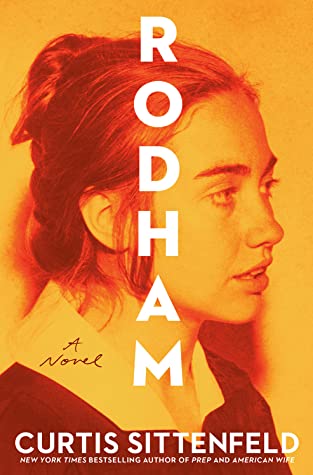 Sittenfeld is one of my favorite authors and I’ve read everything she’s published, so I was predisposed to like Rodham and jumped at the chance to read it early. She has a preternatural ability to get inside other minds and experiences, channeling a first-person voice with intense detail and intimacy. It’s almost like she’s a medium instead of a novelist. As in “The Nominee,” the narration here is perfectly authentic based on what I’d read from HRC’s memoirs. However, a problem I had was that the first third of the novel sticks very closely to the plodding account of her early years in Living History, which I’d read in 2018. I liked coming across instances when she was told she was too strong-willed and outspoken for a girl, but felt the need for a layer of fiction as in American Wife.
So I was looking forward to the speculative material, which begins in 1974 when evidence of Bill Clinton’s chronic infidelity and sex addiction comes to light. He warns Hillary that he’ll never get over his issues and will only hold her back in the future, so she’s better off without him. She takes him at his word and leaves Arkansas a single woman. I’m going to leave it there for plot summary. IF you want the juicy specifics and don’t mind spoilers, or you don’t think you’ll read the novel itself but are still curious to learn what Sittenfeld does with her what-if future scenario, you can continue reading in the marked section below. There’s a lot to think about, so I would welcome comments from others who have read the book.
 As to my own general reaction, though: I was fully engaged in the blend of historical and fictional material and read the novel in big chunks of 50+ pages at a time. The made-up characters are as convincing as the real-life ones, and there are a few relationships I found particularly touching. To my relief, there’s a satisfying ending and a couple of central figures get a pleasing comeuppance. But the chronology has an abrupt start and stop pattern, going deep into one time period or scene and then rushing forward, and I was left wondering what happened next, even if it would require another 400 pages. This would almost be better suited to some kind of serial format – it’s like the best kind of summer binge reading/watching.
My rating: 
Rodham will be published in the UK on July 9th by Doubleday. I read an advanced e-copy via NetGalley. My thanks to the publisher and publicists for arranging my early access.
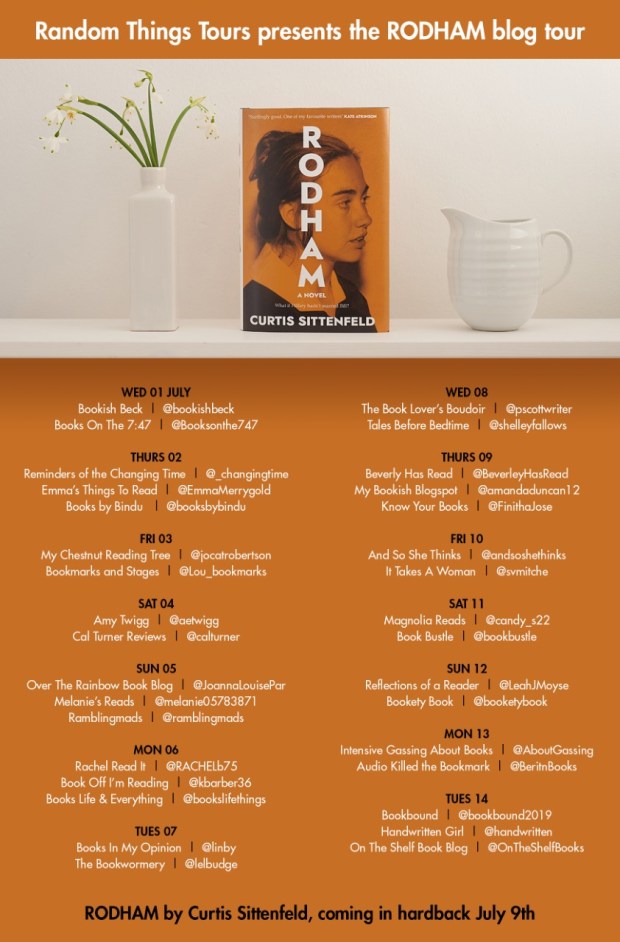
I was delighted to be invited to help kick off the blog tour for Rodham. See below for details of where other reviews will be appearing soon.
SPOILERS ENSUE; YOU HAVE BEEN WARNED.
The alternative history section of the novel picks up in 1991, when Hillary Rodham is on the law faculty at Northwestern University in Illinois, not far from where she grew up. She and James, a married colleague with whom she flirts harmlessly, are glued to the TV as news of Thurgood Marshall’s retirement from the Supreme Court and replacement by conservative African-American judge Clarence Thomas is complicated by a sexual harassment claim brought by Anita Hill. (It’s impossible not to see history repeating itself with Christine Blasey Ford’s testimony at Brett Kavanaugh’s confirmation hearing.) In the wake of this scandal, Rodham’s gay friend Greg Rheinfrank, a Democratic strategist and all-round great character, suggests that she run for the U.S. Senate – Washington, D.C. could clearly use more of a progressive female presence. Even though it eventually involves running against a (real-life) Black female, she agrees and wins in 1992, becoming a multi-term senator and running for president three times, starting with the 2004 race and culminating with 2016.
Meanwhile, Bill Clinton has married and divorced twice and is now a tech billionaire living in California and rumored to attend sex parties. A sex scandal quickly derailed his first presidential campaign in 1992, but in 2015 he decides to run again, thereby competing with his own ex-girlfriend for the Democratic nomination (at his rallies, “Shut her up!” becomes a popular chant that he tolerates from the crowd). Rodham makes it clear to her staff that he should not become president because he is a sexual predator.

Hillary Rodham Clinton speaking in Iowa, January 2016. Gage Skidmore / CC BY-SA (https://creativecommons.org/licenses/by-sa/3.0).
But here a curious compromise comes into play: Donald Trump has a bone to pick with Clinton, so after some rigorous courting from Rodham and her staffers, he agrees to endorse her. In the novel, then, Clinton and Trump are like villainous twins: wealthy narcissists who devalue women. Trump is only differentiated by his lack of class and intelligence. He still tweets, spouts odious opinions and comes across as a buffoon, but – crucially – doesn’t run on the Republican ticket. Instead, it’s Jeb Bush, and Rodham beats him by 2.9 million votes.
So, whew! – a satisfying ending. At points I feared that Sittenfeld would conclude that, despite all that was different after Rodham rejecting Clinton, she still would have lost to Donald Trump. Instead, the novel envisions defeat for Clinton and comeuppance for Trump when he’s indicted for tax fraud in New York. It’s, of course, a vision of “what should have happened” (versus Hillary’s own account in What Happened). But in the back of my mind was the thought that, really, you could have just printed one sentence, “What if the USA didn’t still use that stupid electoral college system?” and you would have gotten the same outcome, because in 2016 HRC won the popular vote by that same 2.9 million.
Specific scenes and elements that I loved:
- Through her (fictional) childhood best friend, Maureen Gurski, we get an alternative vision of what life could have been like had Rodham married and had children; Maureen’s daughter Meredith becomes like a surrogate daughter for her.
- In 2015 Rodham becomes close to Misty, a supporter who’s battling breast cancer, and has her speak to open a rally for her.
- She goes on a stoned bonehead’s radio show and storms out in protest at his sexism – I totally got vibes of Leslie Knope on Crazy Ira and The Douche’s radio show (that’s a Parks and Recreation reference, in case you’re not familiar with it).
- Rodham gets a late chance at romance: there’s a “First Boyfriend” who seems just right for her.
- This isn’t a hagiography: Sittenfeld includes instances when Rodham is tone-deaf about race and chooses pragmatism over the moral high road (e.g. campaign funding).
- Sittenfeld found ways to incorporate real speech from press conferences, campaign announcements, etc. I also recognized two verbatim lines from the infamous “baking cookies” remarks HRC gave to reporters in 1992 (in the novel this happens in 2004).
 Ultimately, I think Rodham doesn’t work as well as American Wife because we already know too much about Hillary, from her three published (ghostwritten) memoirs and from her being so much in the public eye since 1992. Whereas Laura Bush was something of a mystery, and American Wife introduced a comfortable cushion of fiction, Rodham is a little too in-your-face with its contemporary history and its message. But it’s a lot of fun nonetheless.
If you have made it all the way to the end of this extended review, give yourself a pat on the back!
 Bookish Beck = Rebecca Foster. American transplant to England. Freelance proofreader and book reviewer.
 Bookish Beck