Booker Prize Shortlist Reads by Kennard and Perry & A Prediction
I’ve now read all but one of the novels on the Booker Prize shortlist (is it any surprise that it’s the longest one, The Disappearers by Marlon James, that I’ve been too daunted to attempt?). Luke Kennard and Rebecca Perry are both poets, which tends to indicate that particular care will be taken over the prose. Apart from that and having unnamed first-person narrators, I see no similarities between the two books, which are wildly different in tone. I have a preference, and I bet it’s not what you expect. Both: Public library
Black Bag by Luke Kennard
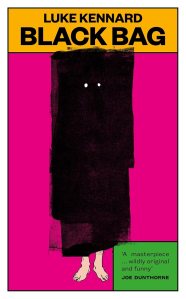 This was uproarious entertainment from the meta first line onward: “If you met anyone as whiny, as disobliging and egocentric as the average narrator of a novel in real life you’d find them unbearable.” An out-of-work actor in his late thirties who survives from one murder mystery dinner theatre gig to the next sees an ad for an unusual job. All he has to do is sit silently at the back of a university lecture hall each week, wearing a black leather bag with eyeholes. The professor is repeating a famous psychology experiment about attitudes changing through repeated exposure. For the narrator, being black bag is about freedom from his identity and inhibitions; maybe, also, finding solidarity. For his friend Claudio, who streams footage of himself gaming for a living, it’s a potential investment opportunity. For Justine, a married academic the narrator meets on campus, it’s a chance for kinky anonymous sex. I laughed out loud at the narrator’s habits of imagining his life in a 19th-century Swedish village and voicing his parents’ dog’s thoughts, and at so many random lines:
Is it not the case that for most of my life I have felt like I have just put a large crisp in my mouth during what turns out to be a quiet and pivotal scene in a play?
In the kingdom of dumb f*cks the guy with the English major is king.
Think of the moment, following the 2008 subprime crisis, when cupcakes proliferated like a cancer.
Ridiculous the plot may be, but it’s as hilarious as the novel is at the sentence level. For all that, it is still a cogent critique of modern masculinity, hypercapitalism and artificial intelligence (the scene where he and Justine go to see an AI-produced film, The Orb of Homuncules, is side-splitting). My criticism would be, as I’ve heard from various others, that the novel is overlong and slightly aimless in the second half; it could easily lose the 80 pages covering Claudio’s temporary absence. Still, when’s the last time a Booker nominee was this much pure fun? 
May We Feed the King by Rebecca Perry
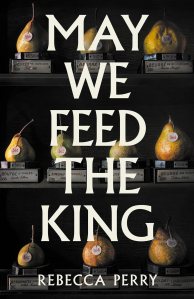 An unnamed curator arrives at a historic palace to stage its rooms with scenes of historical accuracy, tenderly rendered in the sort of detail only the most attentive visitors will register. Among other things, she’s an aficionado of high-quality, lifelike (expensive) fake food. She throws herself into the work as a way of distracting herself from the emptiness of her personal life since her partner left. We figure this out by reading between the lines, because she’s quite cagey: “At this point, certain things had happened in my life. I was ready to immerse myself.” She also finds herself unexpectedly drawn to the archivist, referred to by they/them pronouns. Her sections are in one- to two-page fragments, titled in a way that can obfuscate or signal an interpretation, such as “Peeking through a Crack in the Curtain and Seeing Another Curtain.” My favourite passage came from “All Work Is Holy”:
The rule is this: it must appear as if the person or people have just left the room. The viewer must feel as if the air is alive with their energy, that they only just missed them, that they will be back in any moment. If this isn’t the case, the scene is no more than an arrangement of objects. The scene is dead.
Indeed, the French phrase for “still life” is nature morte or dead nature. To try to bring history back to life, Perry devotes all but the first 55 and last 26 pages to a recreation of an unwilling medieval king’s court. He’s only on the throne because his two brothers died. There are rumours of infidelity concerning both him and his wife, and talk of removing him for incompetence. Soon they will all pass from life into legend.
I loved the late scene when the curator is introducing the exhibit to visitors and hears their ideas about how we know what happened in history – this is like a transcript of absolutely the best uni lecture or event Q&A ever. What gets preserved and passed down, and why? To what extent is there meaning in physical artefacts? These questions are compelling, yet I only really engaged with the contemporary storyline, while the historical pastiche felt like sub-Hilary Mantel, occasionally evocative but often edging towards pretension. 
I’d already read:
The End of Everything by M. John Harrison: A “dull, watery postapocalyptic slog [that] sheds no real light on the past, present, or future”. 
The Things We Never Say by Elizabeth Strout: About “a likeable Everyman with the same …secrets and struggles we all have.” It’s “the most engaged Strout has been with the present day, and the most specific she’s gotten about political outrages.” 
John of John by Douglas Stuart: One of my books of the year. “Cal seeks to reconcile his sexuality and artistic goals with his family’s expectations and his devout upbringing. The characters’ power plays and acts of desperation are heartrending, but mischief and love of colour and crafts lend lightness.” 
Here’s my thinking…
Masculinity is a/the theme in four of this year’s shortlisted novels (from the Kennard: “men are mostly frightened and crazy and very easily misled”) – and in last year’s winner, Flesh by David Szalay, too.
I’ve felt sure that The Disappearers or John of John would win: previous winners whose works normalize homosexuality. I would want the latter to win for its beauty and emotional power, but I think the former more likely as the judges (including Raymond Antrobus, who is British Jamaican) may have an eye on the whiteness of recent winners.
Elizabeth Strout may be doomed to be a Booker bridesmaid. I don’t think this is her best book, but I wouldn’t mind if it won.
I would actually be delighted if the Prize went to the wildcard, Black Bag. But I can’t see that happening. The same goes for the Harrison (please oh please).
Let’s say, though, that the judges want something completely different. Then perhaps May We Feed the King is it. Mary Beard (chair) and Patricia Lockwood, in particular, came across as huge fans during the shortlist announcement event.
I’m torn, so I’ll just go with the novel I loved the most: John of John by Douglas Stuart.
What’s your prediction for the winner?
 Bookish Beck = Rebecca Foster. American transplant to England. Freelance proofreader and book reviewer.

